
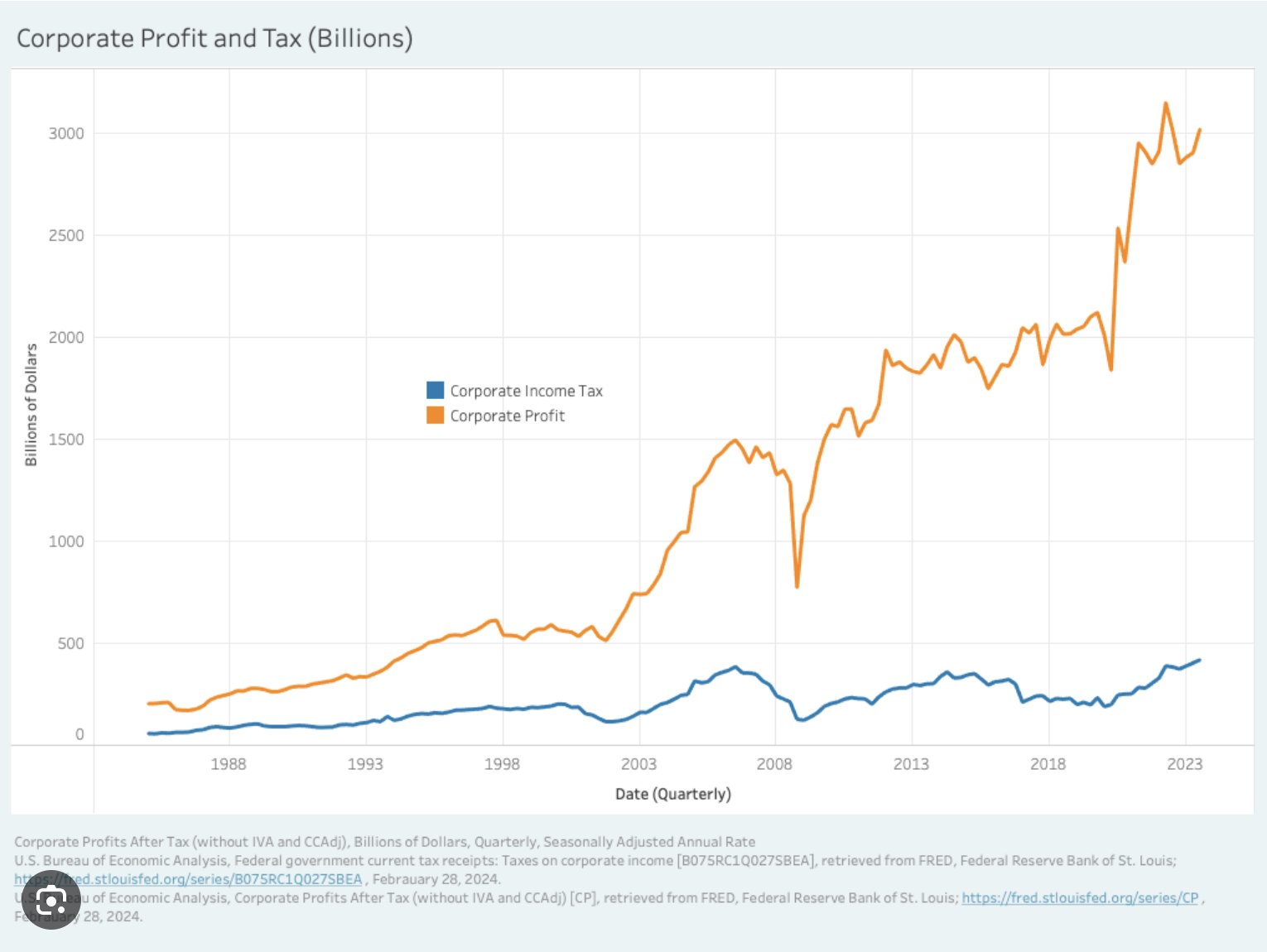
Stumbled upon this chart of US corporate profits vs. corporate taxes. The important part isn’t the taxes, it’s the profits. (Note that this is nominal and doesn’t include inflation adjustment, not that American inflation numbers mean anything anyway.)
Now let’s look at another chart. This one of his how much profit companies that produce actual products (aka. not finance, insurance and so on) make per dollar of GDP added.
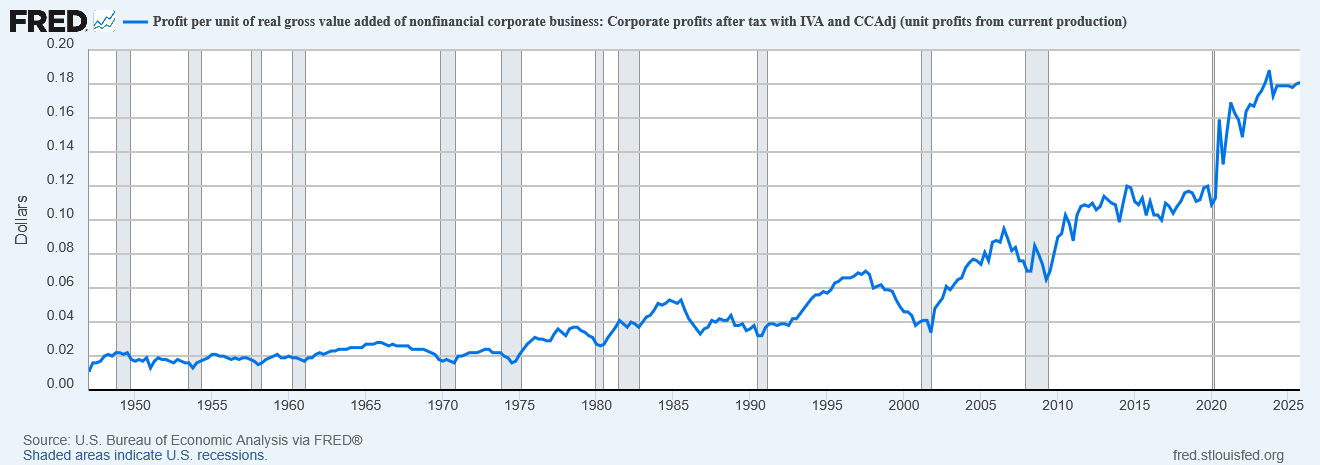
Notice that the long term rate through the “good” period of American prosperity (where there was a huge middle class and wages rose at the same rate as productivity) is pretty steady, and never goes above about 13cents to a dollar. It starts rising around 76 (Carter, who was very neoliberal)and continues a sustained rise, with a huge spike after Covid.
What you see in America are constant fears of inflation. Every single BLS adjustment to inflation rate measures that I am aware of since 1980 has had the net effect of reducing stated inflation. The real inflation rate in America is massive.
Meanwhile, in China, the constant fear is deflation.
Why? Because China has competitive markets and America does not. Barriers to entry are high, and everyone is looking for high profits thru barriers to competition. American firms took economic studies that showed that in competitive markets profits were low and spent all their time trying to make markets un-competative so they could have high profits. This mostly meant capturing government, because it is government regulation and enforcement which keeps markets competitive.
China wants competitive markets in most sectors, except those which provide public goods. They are aggressive about it. Chinese firms compete on quality and price and often engage in price wars, so much so that sometimes the government steps in to stop them from driving themselves bankrupt. Last time I checked the the EV manufacturing market I found over a hundred companies. The competition is savage.
So Chinese companies have low prices, “over production” and constantly introduce new models and products to try and either increase quality or price. Tesla goes years between new models, Chinese companies sometimes introduce multiple new models a year.
Everyone wants to get a share of high US profits, that’s one reason why money floods into the US. But US companies have become uncompetitive. They keep effectively shrinking: more profits, sure, but only by slowly, then quickly, destroying the companies. This is why the US has 100% tariffs on Chinese EVs, if they let them in at all. And now they’re losing their foreign markets, as Europeans and Canada start letting in Chinese EVs.
The story is similar in most industries. America and Europe can’t compete. Period. Because instead of trying to be competitive, they’ve tried to create non-competitive markets and then soaked their customers as hard as possible. This works, till there isn’t any competition, or until you destroy your customers, who are also your employees, because US companies have also been keeping wage increases for everyone except executives and a few key employees (used to be programmers, but they’re about to get it in the neck) below price increases.
And this is how you wind up with 50% of all spending being done by 10% of the population, making most of America’s population economic cripples. It’s why you can’t afford tickets to a rock concert or a sports game, even though those were once solidly middle class pursuits and affordable to the poor.
This is a specific example of a general rule that you can always extract more profit if you’re willing to drive your company or your country into the ground.
About 20 years ago I wrote an article titled “there was a class war. The rich won.”
They’re still winning, but by doing so they have destroyed America’s place in the world, and indeed, the entire West’s. Hundreds of years of Western dominance are coming to an end because these greedy bastards wanted high profits for fifty years, and didn’t care what they did their country or most of their fellow citizens.
Everyone reads these article for free, but the site and Ian take money to run. If you value the writing here and can, please subscribe or donate.
Jan Wiklund
The description doesn’t add up to me. In my world big business would be more competitive than small, because big business have economies of scale. And as long as there are more corporation in any one business than one, there should be competition between them.
Or, taken in consideration the probable collusion when there are less than, say, six corporations, there would be competition if they are more than six. Particularly if any of the six is Chinese.
Ian Welsh
https://www.promarket.org/2019/09/16/the-cost-of-america-oligopoly-problem/
among many other data points.
Your world is a lovely one, though, and I wish we lived in it.
StewartM
Jan Wikilund
And as long as there are more corporation in any one business than one, there should be competition between them.
In my state, there are three medical insurers. You are free to buy policies from any of them.
The thing is, however, you really can’t. Because they have divided up the state between themselves so that in any given area, there’s really only one option that would be ‘in network’ for the policies sold. You either buy that one, or you spend a ton of $$$ for “out of network” costs.
Ian
Summarized well, though the “cannibalization for profit” or as you said “burning down the house in order to heat it” is what I’ve observed. American companies aren’t capable of doing the tricks that they once did. In my last days at my old company, I would talk to vendors who would be ‘wow’ed’ by my knowledge of their products–and I told them “It was your predecessors at your same company who taught me all this!”
Apparently everywhere, CEOs with no or little technical expertise (I’m looking at you, Elon Musk and DOGE) go about chopping heads willy-nilly and think that they are engaged in “creative destruction” when it’s just destruction, pure and simple. They have no clue what they’re doing to a firm’s institutional knowledge. US companies every year are conducting lobotomies on themselves.
A change in our culture and ideology happened in the 1970s/80s; driven by the likes of the Ayn Rands and similar ideologues. Rich guys became “geniuses”, far-seeing visionaries. But if you recall the TV shows of the 1960s, by contrast, on the sitcom “Gilligan’s Island” nobody, but nobody, considered Thurston Howell III, the millionaire “rich guy” on the island (played by Jim Bacchus) to be the smart guy among the castaways on the island. The smart guy was the “professor” figure, played by Russell Johnson. The millionaire guy was pompous, status-obsessed, money-obsessed, vain, and pretentious, but not smart.
So in the 1960s we knew that “science guys” and technicrats were smart, and that rich guys might be a variety of things, but generally not smart. So how did it come to be that you see all these guys quoting Jack Welsh or Musk or Steve Jobs or others as some fountains of wisdom?
Carborundum
From what I’m seeing there, an important part of the story absolutely is the taxes. If aggregate corporate taxes collected are holding more or less steady while aggregate profits are increasing sharply, then the effective tax rate is commensurately dropping.
Unless unit productivity is increasing as dramatically as profit (spoiler: we know it isn’t), this pre-determines an increase in profit per unit of gross value add. I would bet that these graphs say more about the long, still ongoing story of shifting the tax burden than price-gouging due to reduced competition. Reduced competition *will* definitely be playing a part, as you state, but I’d be surprised if it’s a majority of the effect.
spud
Jan Wiklund:
all one needs to do is look at who sits on the boards of these companies, the collusion becomes so obvious, even the blind can’t miss it.
i watched as G.M.(as well as the other three), which should have been howling to the rafters for universal health care, had board members that also sat, or were advisors to health insurance companies. same with oil companies, G.M.(as well as the other three at that time)should have embraced off the shelf technology for increased gas millage, but government had to force them to compete with the japanese high millage cars, when they had board members who were ether on oil company boards, or ties to oil companies.
today almost all companies have either been cooped by hedge funds/finance, or affected by their policies.
just look at whats left of made in the U.S.A., and it says with global components. hedge funds are today even, driving whats left of production off shore.
Ian:
as long as capitalism has the buy in option for the rich, stock markets and all sorts of markets that popped up around stock ownership, capitalism will fail always, and quite quickly to boot.
then get bailed out, and the collapse starts up immediately till it becomes unsustainable.
get rid of stock ownership, markets etc. go to employee owned co-ops. if a employee dies or quits, who ever take their place gets part ownership. no passing along any benefits.
its never easy keeping the rich at bay.
StewartM:
i always felt rand was a mole planted by the soviets. although she was to stupid to understand here role. the soviets would look at her idiotic idiotology, and say the stupid capitalists will embrace it, just as Lenin predicted, and bring the system down.
i am sure when Deng sat across the table from bill clinton, he imagined the same thing, Lenin was right.
KT Chong
The Great Divergence: Why China’s Deflation is a Strategic Choice
While the West struggles with sticky inflation and protected profit margins, China has taken a different path. In Western economic theory, deflation is viewed as a “death spiral.” In 2026, however, it’s clear that China’s deflation isn’t a failure — it’s a byproduct of a hyper-competitive, technologically advanced “Social Contract.”
The pursuit of profits via “rent-seeking” has driven American decline. Conversely, China’s embrace of “savage” competition has created a deflationary engine that is currently dismantling the Western industrial model.
—
1. Social Stability Over Profits
The primary driver of China’s deflation is a deliberate policy shift toward social stability. Unlike the U.S., where the state protects asset values to favor corporations, China sees deflation as a tool for the common people.
• The Philosophy: Inflation favors “renter” interests and big capital; deflation increases the purchasing power of the common people and worker. Xi Jinping has famously challenged Western narratives by rhetorically asking: “What’s so bad about deflation?”
• The Case Study: Beijing intentionally popped its own real estate bubble. They viewed high prices not as “wealth,” but as a social barrier to marriage and family formation. By enforcing the “Three Red Lines,” the Chinese government popped the real-estate bubble on purpose. They prioritized demographics and stability — in a society in which women demands the “Five Cs” (College, Career, Cash, Car, and Condo) from prospective suitors — over the balance sheets of banks and corporations. In the Chinese economic model, falling prices are a feature, not a bug.
—
2. The “Involution” Arena: Darwinian Capitalism
The U.S. model often protects monopolies through “regulatory capture.” The Chinese model does the opposite through a **Provincial Tournament** that functions like an economic “Hunger Game.”
• Provincial Darwinism: Local governments fund competitions to produce a handful of “regional champions” to meet national mandates. Businesses and ventures enter a state of “Involution” — a brutal cycle of price wars that eliminates the weak and ensures the survival of only the fittest.
• National Champions: The “regional champions” then compete in another round of intense competition to produce the ultimate survivors. These national champions are “trialed-by-fire” entities. By the time they emerge onto the global stage, they are the leanest, most brutal and efficient “killers” of competitions, ready to crush American, European, Japanese and Korean companies that have been long been protected by their respective governments.
• The Verdict: This is capitalism in its most extreme form. Western firms, coddled by lobbying and high margins, simply cannot survive a direct collision with these “the fittest of the fittest” survivors and serial killers.
—
3. The Robotic Dividend
China is solving its demographic crisis by replacing labor with silicon. While the West treats AI as a digital novelty (LLMs/chatbots), China treats it as industrial and national infrastructure.
• Embodied AI: Focusing on “Physical Intelligence” to automate the factory floor.
• Dark Factories: 24/7 autonomous facilities with zero human overhead.
• Price Compression: This “Robotic Dividend” keeps manufacturing costs falling even as the population ages, putting constant downward pressure on the price of global goods.
—
4. The Energy Moat: Arbitrage and Renewables
China has built a “double-pronged” energy advantage that the West cannot match:
• Strategic Arbitrage: While the West pays “war premiums” for energy, China buys discounted fossil fuels from the Western-sanctioned Russia, Iran, and Venezuela. Even with the Hormuz crisis, China’s “Special Treatment” from Iran and Russia ensures a stable, cheap supply. (Note: Russia no longer offers “friendship discount” on oil and gas to India — but still does to China — after India betrayed Russia by capitulating to Trump in February, only to crawl back to Russia after Iran closed the Strait of Hormuz.)
• The Green Loop: China paid the high initial cost ($CAPEX$) for green energy years ago. Today, they benefit from nearly zero operating costs ($OPEX$).
• Optimization: Because China’s “Involution” has also driven down the cost of solar panels and batteries, their startup costs for new energy projects are now a fraction of what they are in the West.
—
5. Conclusion: The Export of Efficiency
The convergence of these factors has turned China into a Deflation Exporter. While the West protects ‘rent-seeking’ corporations with 100% tariffs, China has made its industries so efficient they are effectively immune to traditional market barriers.
As of 2026, the world is split. The West is an “Economic Island” of high-profit, high-cost stagnation. China is an engine of efficiency driving the marginal cost of production toward zero. The question isn’t whether China is stalling — it’s whether the West can survive a world where everything is becoming cheaper except for their own protected goods.
cc
Great post Ian. This is probably best exemplified by Peter Thiel of Palantir (along with Alex Karp, the rest of the Paypal Mafia.)
“Competition is for losers.”
– prominent oligarch in the US plutocracy, Peter Thiel, in 2014
Thiel and co. are key backers of Trump – and also of J.D. Vance who used to work for Thiel. Thiel groomed Vance into political power, positioning him to assume the Presidency after Trump. Another member of the Paypal Mafia, David Sacks has a key position in the Trump administration, and another, Musk, of course, has huge influence in the Trump administration, as well.
Thiel believes in striving for monopoly and in 2014, published a WSJ piece title “Competition is for Losers”.
“Competition Is for Losers”
“If you want to create and capture lasting value, look to build a monopoly, writes Peter Thiel”
Sept. 12, 2014
https://www.wsj.com/articles/peter-thiel-competition-is-for-losers-1410535536
Shortly after that he also gave a talk at Stanford, also titled “Competition is for Losers”, where he was introduced by one Sam Altman, now the CEO of OpenAI, who has openly called for the US to ban his AI competitors from China.
You can see Thiel at this talk at the very start of this Ben Norton video, and Altman a bit later (around 10:45 in the video):
Tech CEOs admit they want AI monopoly: US plans to block China’s competition & ‘steal’ engineers
https://www.youtube.com/watch?v=4jniPAD2uoo
cc
As Pepe Escobar wrote:
“Silicon Valley stalwart Peter Thiel has always stressed the target of the digital entrepreneur is exactly to bypass competition. As quoted in Crashed: How a Decade of Financial Crises Changed the World, Thiel declared, “Capitalism and competition are antagonistic. Competition is for losers.””
Paypal Mafia (Thiel, Musk, Hoffman, Sacks, etc.)
https://en.wikipedia.org/wiki/PayPal_Mafia
Two-part article from Oliver Hua Bin:
“Peter Thiele and Vladimir Ilyich Lenin – Apostles of Two Economic Orders”
https://huabinoliver.substack.com/p/peter-thiele-and-vladimir-ilyich
https://huabinoliver.substack.com/p/peter-thiel-and-vladimir-ilyich-lenin
Removing competition is of course also the name of the game for the US on the world stage. Thus, Iran, Russia, and China are targeted. Europe has already been taken out of competition by the US, knee-capped in Tonya Harding style by blowing up Europe’s Nordstream gas pipelines that had provided cheap, reliable energy from Russia. The submissive and cowed Europeans now pay up for US LNG at 4x the price.
Also from Ben Norton:
Palantir CEO predicted US war on Iran, Russia, and China
https://www.youtube.com/watch?v=DcZJ0eKfWFM
KT Chong
The Jack Ma Saga: How China Put Its Richest Man and No. 1 Tech Bro in His Place
Alibaba (now the “Ant Group”) is the national champion. Jack Ma was a “final boss” of China’s early Hunger Games for capitalists. Yet his fall serves as the proof that in China’s version of capitalism, the State maintains a monopoly on power and holds the leash over those champions and bosses; whereas in the American version, the Capital has achieved total control over the State.
Here is the breakdown of why the Jack Ma saga — and his status now in 2026 — perfectly illustrates “rent-seeking” vs. “state discipline.”
—
1. The Ant Group IPO: A Move Toward Rent-Seeking
In 2020, Jack Ma was preparing for the largest IPO in history ($37 billion) for Ant Group.
• Ma’s American Dream: Ma wanted Ant Group to function like a tech company (high valuation, low regulation) while performing the work of a bank (lending).
• The Rent-Seeking Angle: Ant Group was using its massive consumer data to facilitate loans while offloading 98% of the risk onto traditional state banks. He was essentially trying to “disrupt” the system by privatizing the profits and socializing the risk — the classic hallmark of American financial “innovation.”
• The Data Concern: As the Ant Group used its vast amount of consumer data to boost its IPO valuation, Beijing realized that if a private entity controlled and monetized the personal data of 1 billion Chinese, Jack Ma could essentially hold the state hostage. China would not allow any corporate interest to compromise the country’s Data Sovereignty.
—
2. The “Speech” and the Fall
Jack Ma’s infamous speech in Shanghai (October 2020) where he called Chinese banks “pawnshops” and criticized Chinese regulators was his “Icarus moment.”
• China’s Reaction: Within days, the IPO was pulled.
• The Humbling of “The” Tech Bro: For a long time, the West thought Ma had been “disappeared.” In reality, as we see from the vantage point of 2026, he was being forcibly retired and relinquish control of the Ant Group, and the company was fined $1 billion and forced to restructure to be regulated like a bank (holding its own capital, reserve and risk, barred from rent-seeking and selling personal data to foreign interests.)
—
3. Where in the World is Jack Ma in 2026?
The current status of Jack Ma is a fascinating study in “rehabilitation” under the CCP:
• The Tech Mogul is Dead, Long Live the Teacher: Ma has largely re-emerged not as a billionaire playboy or political influencer, but as a researcher and educator. He holds professorships in Tokyo and Hong Kong, focusing on agriculture and education technology.
• The Message: By allowing him to return to public life in 2025 and 2026 as a “humble educator,” Xi Jinping sent a clear message: You can be rich, and you can be successful, but you will never be more powerful than the State, and you will never be allowed to build a “rent-seeking” fortress that threatens the social contract.
—
4. Conclusion: The “Oligarchy” Check
In the U.S., a billionaire “winning” is often seen as a sign of a healthy economy. In China, a billionaire becoming too successful, gaining too much power, is seen as a systemic risk that needs to be “trimmed” to keep the market competitive and the society stable. China’s current 15th Five-Year Plan (2026-2030) explicitly reaffirm its goal for “Common Prosperity” — prioritizes “human well-being” over the “maximization of capital returns.”
Purple Library Guy
On the billionaires such as Thiel explicitly wanting to avoid competition and create monopolies so as to extract lots of rent . . . this is an inherent “collective action” problem we see in capitalism. For each capitalist, the objective is to grow their capital. The fastest way to do that is through monopoly rent or outright fraud, so each individual capitalist is motivated to do that stuff (and influence the state to make it easier to do). But, if all the capitalists take those roads, it will be bad for the overall economy and the national projects of whatever nation they are in.
When most members of the elites of a society privilege their individual short term gains over national projects that will benefit their whole class in the longer term, and refuse to acknowledge the distinction, I have come to call that “decadence”, an old word that’s not often used these days but I think captures the situation in much of the West very precisely. It fits even better because this individual self-indulgence at the financial level seems to inevitably go hand in hand with a lot of the other classic markers of decadence, the whole Epstein schtick.
On the corporate profits and taxation, I think there’s a strong relationship. It’s not just that corporate profits go up because less of their profits are taken away in taxes. Low taxation depresses investment and increases profit-taking. This may sound weird, but I’ve said it before and I’ve never seen a counter-argument. Consider: Say I’m running a corporation, with the shareholders’ interests in mind, and corporate taxes are high, as are marginal tax rates for rich individuals. And, I’m looking at revenues that significantly exceed spending. I can call the excess “profit”, and then issue some of it as a dividend or something for the shareholders. But if I do that, I will pay a high tax on that profit, and the shareholders will pay a high tax on their capital gain. So instead, the shareholders will probably be better off if I plough that money back into the corporation, doing things that will grow revenue in the longer term. That way, the money is not “profit”, does not get taxed, and the shareholders simply own something that is more inherently valuable by the full amount of the money I spent on it. So we reinvest most of that money instead of declaring big profits. (Back when there were such tax rates, stock buybacks were also illegal)
Now imagine the same scenario, except both corporate taxes and taxes on individual rich people are low. Now, if I distribute the company’s excess straight to the shareholders, they get nearly all of it! So why not? To hell with reinvesting in the company, just give the shareholders all the money. Maybe even more than all the money, I can BORROW money to hand over to the shareholders! For a while, anyway. And by the time the chickens come home to roost I, too, have exercised my stock options and moved on.
So. Low corporate (and rich people) taxes –> High profits, low, or even negative, investment into firms.
mago
I remember when the Supreme Court issued the decree that corporations are people.
Citizens United?
Living in Costa Rica then I raged against the machine.
Corporations are people just like you and me they poop and pee, and shave their pubes and check their blemishes in the mirror.
Gimme a fucking break. Whatever drugs you’re doing I don’t want to know or partake of.
That the Epstein Class is high ain’t no lie. We all are on something or another. Legal street drugs include sugar, caffeine and whatever over the counter substances light your fire.
Whew! Having said all that, I’d like to add that having trained in working for the benefit of others I find the predominant predilection of greed and self absorbed behavior incomprehensible and understandable at the same time.
People will be people and whatcha gonna do?
Get down on your knees pray and don’t let the bastards get you down, or is it the baddies?
Difficult to keep up in a world of pain.
Carborundum
PLG – what you are saying isn’t weird and the general scenario is reasonably well known; it’s actually an element of what I was thinking of when referring to the shifting of the tax burden. As an extra kicker, take a look at the US concept of the qualified dividend…
KT Chong
I forgot to explicitly connect the dots on energy:
• 1st prong: Discounted, sanctioned oil and gas from Russia and Iran have provided China with cheap fossil energy (relative to what Europe, Japan, South Korea, and even the U.S. pay for oil and gas).
• 2nd prong: Green and renewable energy come with massive front-loaded R&D, infrastructure, setup, and transition costs, but very low operating costs compared to fossil fuels. China paid those upfront costs long ago. Now it is reaping the rewards, enjoying cheap energy with low operating costs.
• The U.S. and most of its allies never fully paid those upfront setup costs for green and renewable energy. Their short-term mindset made them unwilling to absorb the massive front-loaded expense of transitioning. Now they are increasingly less able to afford those costs.
• Brutal competition and involution have pushed Chinese producers to improve, optimize, and perfect their manufacturing logistics and processes, driving down the cost of installing green and renewable infrastructure and producing energy technologies like solar panels and wind turbines. As a result, even maintenance, upkeep, and upgrade costs are becoming cheaper in China.
• China now has the advantage of cheap and abundant energy from both prongs, which lowers manufacturing input costs and, in turn, reduces the final prices of consumer goods and finished products.
• By contrast, the U.S. and its allies have imposed trade barriers and restrictions on cheaper Chinese green and renewable products, making it even more costly to transition to energy systems that would be cheaper in the long run (and supportive of manufacturing and pricing).
• This is a key factor behind deflation in China that is rarely discussed in the West (in part because it challenges prevailing American energy narratives, policies, and strategy), and also a reason the U.S. struggles to compete as long as its businesses face higher energy costs — especially now.
Jan Wiklund
As I said, I know there is collusion. And with Trump’s tariffs one can always cut out those who don’t take part in them.
But intil they were set, I suppose there was competition from abroad, from Japan, from EU, and yes, even from China. Or wasn’t it? Or do you refer exclusively to business like insurance, housing and the like where no global competition exists?
spud
Jan Wiklund:
But intil they were set, I suppose there was competition from abroad, from Japan, from EU, and yes, even from China. Or wasn’t it? Or do you refer exclusively to business like insurance, housing and the like where no global competition exists?
global competition causes inflation and deflation. inflation of prices once they capture a market, which means massive amounts of money flows offshore, only to end up back here as inflation. just look at the real estate market, and stock markets.
plus its a massive deflationary storm to wage earners.
the founders understood this well with tariffs listed as the duty of government in the constitution, as well as FDR and the smoot-hawley tariff regime.
its why so many foreign companies opened branches and factories inside america. it was cheaper than importing.
from 1993 on wards, the capitalist leeches and parasites found importing was a way of by passing and destroying competition, and wage earners, and export countries found it cheaper to export their unemployment, poverty and deflation onto the backs of working americans.
in most cases, they never had to open a factory here.