
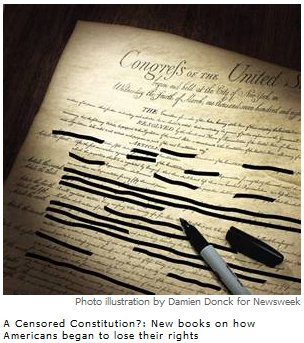
 If you’ve read Machiavelli, especially “Discourses on Livy”, which is actually his major work (“The Prince” is not) you know his emphasis on Virtu of the people and elites as what holds Republics together. Machiavelli thought that Republics were the best form of government and that the greatest feat was to create or maintain a Republic: he was not a fan of autocratic government.
To summarize an important part of the Discourses: good men can make bad systems work, but good systems cannot save bad men. This is the opposite of what most “leadership” and “management” thinkers say today, but they’re wrong and Machiavelli was right.
I mention this because we’re seeing it in the US today. I won’t pretend the Constitution or the Bill of Rights were perfect, or didn’t include substantial evil (aka. slavery), but the Bill of Rights in particular is genuinely good. It’s failing completely right now, the government is just ignoring rulings it doesn’t like. The first thru fifth amendments are essentially dead letters, including habeas corpus.
Likewise the Constitution did include substantial checks and balances and they aren’t working.
It’s ironic that the worshippers of the US constitution have always touted its system of “checks and balances” as part of its distinctive genius and that at present every one of those supposed checks and balances is failing.
But I think this is unfair. The checks and balances exist, the system was designed fairly well, BUT it requires virtuous people to use them. When the Supreme Court, Congress and Presidency are all filled with corrupt men and women with no virtues (virtu), of course they don’t work. The best system in the world won’t work if the people running it don’t want to follow it.
American elites don’t believe in civil liberties. (Remember how the Patriot Act passed with only Senator opposing.) They don’t believe in liberty, freedom or equality. It is asinine to pretend that they do. They believe in nothing but enriching themselves and their donors, and they seem themselves as an elite and feel no duty towards the masses well-being. This is so obvious that arguing against it is absurd.
Since they don’t want to enforce the Bill of Rights, they don’t. Since they fundamentally are OK with ICE running rampant, genocide, war and impoverishing the American people, they make it happen and certainly don’t push back against it. Why would they want people to have rights? In what way does that benefit them, as long as they have rights (which, mostly, they do. Elite impunity to law is the real Constitution right now.)
Without virtue: without wanting to do the “right” thing, no system intended to produce good results can work. America doesn’t work to produce good outcomes for most people because American elites only want it to produce good outcomes for them. It’s that simple, and no laws or constitution or rights can fix that. The only fix is to replace the entire elite, wholesale, by whatever means necessary.
But that requires a population willing to replace them at whatever price is necessary, and that means the people have to be virtuous (brave, just and desiring the welfare of their fellow citizens) and enough of them aren’t, especially since at least a plurality of regular Americans are cowardly, unjust and want to hurt their fellow citizens.
In such a situation no laws, no constitution, can work and the issue is thrown back on power, as it was during the Civil War but since, this time there is no anti-evil party (Lincoln and the Republicans) there is no clear basis for organizing or fighting. This means a long descent is far more likely than a revival of the good parts of the Constitution and the Bill of Rights.
Good people can make bad systems work. Bad people cannot make good systems work.
China works because the Communist Party, whatever its flaws, genuinely wants its people to be prosperous, genuinely tries to reduce inequality and genuinely wants China to be strong. America doesn’t work because American elites, including both major parties genuinely wants only a small minority to be wealthy, genuinely wants to impoverish most Americans and genuinely just wants money without the work required to keep or make America strong. And they sure as hell don’t believe in civil liberties.
This site is only viable due to reader donations. If you value it and can, please subscribe or donate.
Like & Subscribe
Excellent. Spot on. I agree with pretty much everything except to say we’re not losing the Bill of Rights but instead we are seeing it for the paper tiger it always was. Relying on virtue as the glue and grease is tenuous at best. It always was. Don’t get me wrong, virtue is certainly an admirable and positive goal and all of us should aspire to it, but it’s an ideal and, well, we know ideals are seldom achieved and it’s the direction that ultimately prevails and matters. Virtue is quite similar to Adam Smith’s invisible hand, no? It works in the abstract as a presumption but not so much in practice if at all.
Your post is perfectly timed with my latest video where I give you a hat tip.
https://www.youtube.com/watch?v=YeDaNTcEPLU
Feral Finster
“The checks and balances exist, the system was designed fairly well, BUT it requires virtuous people to use them.”
The checks and balances work, when the sociopaths haven’t corrupted both sides, the check-ed and the check-er.
Once that happens, it’s harder to remove sociopaths, as they now are entrenched.
david lamy
“The only fix is to replace the entire elite, wholesale, by whatever means necessary.”
Regression to the mean would seen to protect these elites. For example, state governors have not mobilized their state police and national guard forces to arrest, and eject federal thugs.
I’m afraid that violence will be a necessary component to ridding our landscape of these elites. One problem is that those that cheer this savagery against immigrants and supporting citizens is that their distribution is uniformly distributed across non-urban locales.
Everyday new software and hardware deploys with the capability to limit any attempt to ply back our rights granted in amendments 1 through 5.
Jan Wiklund
The most essential “virtù” is the ability of collective action in the lower classes. “‘Asabiyya”, as it was called by Ibn Khaldoun (https://en.wikipedia.org/wiki/Asabiyyah).
It was the ability of collective action in trade unions that made both American New Deal and Scandinavian Social Democracy possible. But it was the systems, that more and more were considered as automatic, that lead to the loss of the ability. If everything will go well automatically there is no need for abilities.
Collective action requires permanent, or quasi-permanent, organization. According to Asef Bayat, the defeat of the Arab spring was caused by lack of permanent organization, https://www.sup.org/books/middle-east-studies/revolution-without-revolutionaries. It’s possible to topple a government with spontaneous risings, but this government will be followed by an equally bad one if there is no organization to back up something different. See also the European 1848.
Upper classes are always bad, however. Only the ‘asabiyya of the lower clases will keep them in check.
Ian Welsh
Virtue is quite real, and nothing works well without it. Even “bad” systems don’t work without morally neutral virtues like bravery, fortitude and and energy. The invisible hand is an observation that some good things happen from self interest (but not all. Most people haven’t actually read the Wealth of Nations, Smith was very clear on the limits of the good which could be produced by self interest, something the disciples of incentives forget.)
We all know that virtue is real, even Machiavelli, a genuine cynic who thought the worst of people as a rule, knew that virtue was real and that some people had it and that a certain level of it in the population and elites was required for Republics to operate.
Feral Finster
@Jan:
Resistance types will not like what I have to say here, but there is a reason that that those who rule over us are able to exert power well beyond their numbers:
Group solidarity and a willingness to do *whatever* *it* *takes* to advance group goals. This often is violence but not necessarily.
It’s the same reason that a few Hells Angels were able to run riot at Altamont while many times their number of concertgoers milled around, got beat up, or ran for their lives. Every Hells Angel knew that his fellow outlaws would support him, whatever the cost, and they were not afraid to hurt or kill anyone who got in their way, nor did they fear any consequences.
The hippies, by contrast, were dithering and indecisive, when if they had the Angels’ determination and ethos, could have easily disarmed them or worse.
spud
the system of immunity and limited liability has built up a entitled elite, drunk with power and contempt for citizens. they are the true sovereign citizens.
this system of sovereignty starts at the very bottom of our government, from local governments all the way to the federal government.
the powers that be could care less about the lawsuit system that is supposed to hold the sovereign accountable.
its all paid for by the tax payers. cops and D.A.’s call it a paid vacation.
https://www.youtube.com/watch?v=94mJrkJXaio
Woman arrested for speaking at a city council meeting
when the probable cause hearing was held, that fascist mayor never showed. he could care less.
even a lowly clerk can do this to you.
this is going on daily everywhere. its why this type of government, always fails in the end.
none of these creatures ever face jail. they should have all of their wealth taken, and face jail time.
we can’t storm the bastile anymore.
but a functioning economy and a loyal military may not survive what the sovereigns wrought onto themselves.
Ian Welsh
All types of governments, even the most stable (Egyptian Pharoanic and Chinese Imperial) fail in the end. Nothing humans make is eternal. The questions are “how long” and “how good?”
Dan Lynch
A nation’s ideology & values matter, certainly. But what is America’s ideology? Capitalism. Settler-colonialism. Imperialism. Greed is good. Ayn Rand. Horatio Alger. Rugged individualism. John Wayne winning WWII (while he actually avoided the draft so he could stay home and cheat on his wife). American exceptionalism. Sprinkled with feel-good words like “freedom, liberty, and democracy” that don’t actually mean much.
The recent ICE protests are a case in point. Masked cops executing people on the street is bad and should be opposed, but on the other hand, do we really want open borders? There is no realistic plan because there is no coherent ideology. A realistic plan might include jailing wealthy farmers and CEOs who hire illegal immigrants, but that’s not compatible with our greed-is-good capitalist ideology. A realistic plan might include stopping the foreign wars and foreign meddling that drives much immigration, but that’s not compatible with our imperialist ideology.
So we muddle along with meaningless slogans like “Abolish ICE.” Suppose we do abolish ICE but cops continue to execute people in the street? Are we supposed to abolish all law enforcement? Maybe we should “Abolish Executing People In The Street,” instead? But there is no coherent ideology and no coherent value system, so not surprisingly, we don’t have coherent goals or policies.
Like & Subscribe
Thanks for the clarification, Ian. I understand your point more fully now.
My guess is Ben was even more pessimistic than Machiavelli.
“A republic, if you can keep it” is a famous, cautionary quote attributed to Benjamin Franklin at the close of the 1787 Constitutional Convention. When asked by Elizabeth Willing Powel whether the newly formed U.S. government was a republic or a monarchy, Franklin emphasized that maintaining a representative democracy depends on the active, virtuous, and informed participation of its citizens.
Donald Trump has plenty of virtù. Consider his estate versus the state. He’s deployed a preponderance of virtù to secure his estate and it is prospering beyond even his wildest imaginations. Virtù can be beneficial in many ways and not just for and by the state. This is poignant considering nation-states will be, any are, going the way of the dodo bird.
spud
Ian Welsh:
things can go on forever, then all of a sudden in a week or two, it all changes.
todays’ fast moving world means that empires that lasted for centuries, crumble fast now.
no one has replicated the imperial era Austrian, or ottoman empires that lasted for centuries, that made it into the modern era.
the nazi’s finally won in 1993, only to see today that their empire is quickly slipping away in the west.
so it all has to do with how long can they hang on.
and it looks today in the modern world, they cannot hang on for long. so feudalism is their answer, and technology from the east driven by high standards of living will over come them very easily.
i agree with you.
Mel
Robert Pirsig ran into this problem in _Zen and the Art of Motorcycle Maintenance_. Peoplecriticized thhe book because Pirsig discussed Quality without defining what Quality is. Trouble is, a definition of Quality has to be read and undestood in a high-quaality way. Otherwise people can get it totally wrong.
A definition of something as pervasive as virtu (or Quality) has to be very general; being general it can seem vague; being vague it can seem meaningless.
The early Soviet apparathiks who expropriated all the food from the kulaks were engaged in collective action, but without virtiu the result was horrific mass starvation.
Jan Wiklund
Feral Finster: That was what I said. Without ‘asabiyya you can’t do much.
However, it’s not a very interesting conclusion that a few people can wreak havoc during short time. The interesting part is that asabiyya also can make systems stop wreaking havoc, if it’s great enough.
Like & Subscribe
Is this virtù? Maybe. Maybe not. Is that determination subjective or objective or a combination of subjectivity and objectivity?
Xi’s Recent Purges of Top Military Brass
https://www.youtube.com/watch?v=EaVXg7SjKcU
elkern
But, “virtue” isn’t a yes-no thing, is it? “Good” people have “bad” traits and sometimes do “bad” things, and vice versa…
My [limited] understanding of old polytheistic religions leads me to imagine that this was once common knowledge. Various “Gods” had distinct character, each including “good” and “bad” components.
Monotheistic religions tend to equate their unitary God with “Goodness”; they then have to invent some opposing “Bad” supernatural being (a Satan, godlike but can’t be a god because only one is allowed?). That reinforces humans’ natural (?) simplistic tendency to judge other humans as either “good” or “bad” (which typically means “with me/us” or “against me/us”).
Am I a “bad” person because I refuse to view my MAGA sister as “bad”? Where does one draw the line between compassion and weakness?
Like & Subscribe
What we really need is to develop an impressive, prodigious Egregore and yes Jan, this can be accomplished via ‘asabiyya. An Egregore to battle the monstrous Egregore that currently has ensnared much of the world and has made it captive to it.
An egregore (pronounced egg-ree-gore) is a concept from occultism and esotericism, describing a non-physical entity or thoughtform that arises from the shared thoughts, beliefs, and emotions of a group, gaining a life of its own and influencing its creators, like a collective consciousness for a nation, religion, or organization. Sustained by group energy, it can become a powerful, autonomous force for good or ill, manifesting as deities, national identities, or even brand loyalties, feeding on collective focus and intention.
David on an Island
Ian, you left out two important amendments, the Sixth which anchors the Bill of Rights by guaranteeing every accused person a speedy and public trial before a local jury with compulsory process, confrontation of witnesses, and counsel, and the Fourteenth, which reminded everyone that the due process of law guaranteed by the Bill of Rights is applicable to every “person” in the United States regardless of birth or citizenship.
It was Ronald Reagan who amnestied 3 million extra-legal migrants in order to crush organized labor and destroy the ability of an American Asabiyya as described by Ibn Khaldoun to resist the greed and impunity of the elites Reagan aspired to represent. The precarity that extra-legal migration and globalization inflicted on the average American also crushed virtù among the people, many of whom have come to reflect the cowardice, injustice, and cruelty of the regime.
When our laws protect elites but do not bind them, but bind the masses but do not protect them, we are all in serious trouble. Bad people cannot make a good system work.
StewartM
Hmm, I would say that relying on “good” or “virtuous” men makes a bad system. Yes, bad systems can function with good leadership, but you shouldn’t count on that.
The problem with the US system is that it always had gaping holes. Examples: letting ONE person, a the president, appoint judges; not making violations of the Constitution statutory crimes with penalties (starting with immediate removal from office!), no independent enforcement of court decisions, having control over the president’s bodyguard under the executive branch instead of either Congress or the courts (or both; that way, a President who defies a court order or is held to have violated the Constitution WILL BE REMOVED as his bodyguard doesn’t answer to him), no indictment for a President for *even crimes committed while holding office*, relying instead on the politicized and unreliable impeachment process, and more. There are ways to plug all these holes.
Even now, if the courts had the power to enforce their decisions and even remove Trump for for defying court decisions, we wouldn’t be in this sad situation. He’s defying 34 % of all court rulings by one count, he’d be out of office immediately. (Of course, getting good judges and not political hacks is another problem to fix, but that’s the result of ONE PERSON picking judges).
In short, group decisions, even by “bad” men, are on the whole better and less risky than individual decisions. For most of US history, Congress and not the presidency was the primary power. It’s safer for it to reside there, it’s hard to have a system of 435 dictators.
This is not an exclusive list of things to fix. We need to end “first past the post” elections, multi-representative larger districts (encompassing both rural and urban areas), and/or proportional representation, some sort of ranked choice or instant run-off system should be in at least some of our elections (especially the President; the original intent of the President was to be someone, like George Washington, who most people could back or accept, not a polarizing figure). Sometimes I think that we had better elections away from TV and the internet, where people had to READ what candidates and parties proposed instead of going on sound byte crap. Rhetoric and the cute comeback one-liners may be good for stand-up comics, but it does not indicate governinng ability.
spud
i coined a saying a while back. most people who are fascists, don’t even know that they are fascists.
new poll in minnesota today, about 35% of the people,are fine with whats going on with ice.
that tallies with about one third of the population of chile voted for Pinochet, after his reign of terror.
and in argentina recently, about 40% voted for fascism.
mago
The dualistic good/bad divide gives lie to nuance and ever changing reality. Having said that, yeah, the so called elites are vacuous self absorbed and self serving scum. (I have issues with the way the word ‘elite’ is employed, because there’s nothing elite or enlightened about these bottom feeders who’ve risen to the top.)
I question whether a plurality of Americans are actually cowardly (probably) and want to hurt their fellow citizens. There’s a strong tradition in place of volunteering and helping the downtrodden, but maybe that’s just an opinion formed from living in alternative locales and cultures. I do read news outside the mainstream, so am not naive about rampant cruelty here and there, yet I still believe in basic human kindness, however obscured it may be in these degenerate times. So as a skeptic and a realist, I’m still a dreamer and a believer.
And, no, I’m not a Gemini, but a Virgo.
mago
Sent a comment. Received a message saying comment already sent, although it wasn’t. Obedient and ignorant I trusted the message and didn’t resubmit. No doubt the comment didn’t deserve the light of day.
StewartM
Dan Lynch
but on the other hand, do we really want open borders?
You mean, like the ones we had for the vast majority of our history?
Like the ones currently in-place in the EU? (You can drive or take a train between EU countries without batting an eyelash, it’s like crossing state lines in the US).
This sounds like the gay marriage debate, where the opposition threw up the awful spectacle of polygamy and polyandry to contend why it should never be so, to which most liberal types contorted themselves into knots trying to explain why gay marriage was ok while polygamy and polyandry weren’t. But the simplest reply would been:
“Sure, why not? Those have been shown to work too!” Don’t let your opponents define the limits of debate.
And, my former college landlady, being enough Cherokee to look it, and a physical anthropologist to boot, shrugged and said “Ah, let ’em all in. After you guys came here the place went to hell anyways”
Bob
China looks OK right now because it’s on its uppers and can afford to be nice. Like the West after WW2. But until recently it was pretty nasty. My Tibetan friends told me all about it.
And without a doubt, it will turn nasty again once all their resources start dwindling. At present it just looks like it might just be a less odious sort of authoritarianism where you get cheap housing and healthcare in return for keeping your gob shut that the type we have in olde England.
Anyway, I am down with L&Ss egregore idea.
Like & Subscribe
And, my former college landlady, being enough Cherokee to look it, and a physical anthropologist to boot, shrugged and said “Ah, let ’em all in. After you guys came here the place went to hell anyways”
Fair enough, but let’s face it, the indigenous were also complicit in their own right. Sure, they were not as organized about it as the Europeans, but they were having an increasingly devastating ecological impact and that was early as 11,000 BC!!!
https://www.pnas.org/doi/10.1073/pnas.95.24.14576
From ≈11,200 to 8,000 years ago, the Great Plains of North America were populated by small Paleoindian hunting groups with well developed weaponry and the expertise to successfully hunt large mammals, especially mammoths and bison. Mammoths became extinct on the Plains by 11,000 years ago, and, although paleoecological conditions were worsening, their demise may have been hastened by human predation. After this, the main target of the Plains Paleoindian hunters consisted of subspecies of bison, Bison antiquus and Bison occidentalis. As bison populations gradually diminished, apparently because of worsening ecological conditions, by ≈8,000 years ago, human subsistence was forced into a greater dependence on small animal and plant foods. Human paleoecology studies of the Paleoindian time period rely heavily on multidisciplinary efforts. Geomorphologists, botanists, soil scientists, palynologists, biologists, and other specialists aid archaeologists in data recovery and analysis, although, with few exceptions, their contributions are derived from the fringes rather than the mainstream of their disciplines.
I’m sure if we could interview a mammoth it would say, “ah, let ’em all in. After humans came here the place went to hell anyways. I mean, look what happened to us.”
That is not meant to excuse the ecological atrocities perpetrated by the Europeans and now us Americans and the Chinese too who are now taking their place as the preeminent destroyers of the planet.
StewartM
Like&Subscribe
Sure, they were not as organized about it as the Europeans, but they were having an increasingly devastating ecological impact and that was early as 11,000 BC!!
That’s actually a disputed claim, the mass extinctions in the Americans also coincided with significant climate change, which by itself often spells doom for species.
https://en.wikipedia.org/wiki/Late_Pleistocene_extinctions
For one thing, these extinctions were less severe in places like Africa and Eurasia where humans already were, and if you look at the list of die-offs you’ll see bird and rodents and other animals not generally thought of as desirable prey animals for humans (when the caloric expenditure needed to catch and get a meal from something exceeds the caloric intake one gets from it, it’s not a cost-effective food source).
The large predators disappearing is expected; when large prey disappears the predators that fed on it go too, as they can’t satisfy their caloric needs by catching small game either.
But fair enough. The reason I chuckled over the “Jurassic Park” movies was the idea that dinosaurs would be a threat to humans. We do great at killing off megafauna, so they’d have had no chance either. Though with any DNA-reconstructed dinosaurs (as Robert Bakker pointed out) they would, like H. G. Well’s Martians, have problems with Earth’s bacteria and viral populations, as their immune systems would be designed to fight off infections of those 65 million years or more ago, not those of today. They’d be very sick animals that would need a lot of medical attention to be kept alive.
And really, hunter-gatherers are really too low-density to kill off that much. A lot of extinctions were caused by post-Neolithic populations; the Roman games themselves caused many animals to disappear entirely within the Empire, and here’s a list of what disappeared in England alone in post-Neolithic times:
https://www.countryfile.com/wildlife/britains-extinct-beasts
Tony Wikrent
Mike Brock has posted on his substack Notes From The Circus a series “The Crisis” exploring the issues of ideology and citizenship. I may email Ian and ask if they can be reposted in full, or at least linked to. Here is No. 2.
https://www.notesfromthecircus.com/p/the-crisis-no-
The Crisis, No. 2 — On the cynical and the craven
Mike Brock, Jan 26, 2026 [Notes From The Circus]
[The ideology of Trump and his plutocrat friends who believe they have the “right to exit” from obligations to society and democratic constraints.]
I want to tell you about the people who built this….
I want to tell you about the architects. The theorists. The men who decided, decades ago, that democracy was an obstacle to be overcome, and who have spent the intervening years building the infrastructure to overcome it.
This is a story about ideology. About money. About the deliberate construction of a parallel power structure designed to compete with—and ultimately replace—constitutional government. It is a story about people you may have heard of, and others you have not, and what they have been doing while the rest of us were distracted….
In 1997, William Rees-Mogg and James Dale Davidson published The Sovereign Individual: Mastering the Transition to the Information Age. The thesis was simple: the internet would dissolve the power of nation-states. Digital technology would allow the wealthy to escape the constraints of geography, taxation, and democratic accountability. A new era was dawning—an era in which capital would be sovereign, and those who possessed it would owe nothing to the societies that had made their wealth possible….
The logic of technology would produce a world of “cognitive elites” who operated beyond the reach of governments, while the masses—whom the authors regarded with undisguised contempt—would be left to fight over the scraps of the old order.
This was not presented as a dystopia. It was presented as liberation. Liberation for the strong. For the smart. For those who understood where history was going and positioned themselves accordingly.
The Sovereign Individual became a founding text of what would later call itself the “technology elite.” Peter Thiel has cited it as one of the most important books he has ever read. It circulates in Silicon Valley like scripture. It told a generation of wealthy men that their wealth entitled them to exit—to leave behind the obligations of citizenship and build something new. Something better. Something for themselves….
Exit. That is the key word. That is what they want.
Not exit as in emigration. Not exit as in leaving one country for another. Exit as in departure from the very concept of democratic constraint. Exit from the principle that the people have any right to govern themselves. Exit from the idea that wealth carries obligations. Exit from the social contract itself.
They have built an entire ideology around this word. They call it “the right of exit.” They mean the right of capital to escape accountability. The right of the powerful to refuse the claims of their fellow citizens. The right to take the wealth that was generated within a society and remove it from that society’s reach….
Because here is where it ends: with Alex Pretti dying in the street.
You may think these things are unconnected. The network state ideology, the bootcamps in Singapore, the arcane theories of Rothbard and Hoppe and Schmitt—what do any of these have to do with a VA nurse being shot ten times in the back in Minneapolis?
Everything. They have everything to do with it.
The men who shot Alex Pretti were instruments of a federal government that has been captured by this ideology. The administration they serve was funded by these people, staffed by these people, advised by these people. The cruelty is not incidental. The cruelty is the point. The cruelty is what happens when you build a movement around the idea that democratic constraints are illegitimate and the strong should dominate the weak.
Tony Wikrent
Here is The Crisis No. 3 from Mike Brock
https://www.notesfromthecircus.com/p/the-crisis-no-3
The Crisis, No. 3 — On the institution of the Citizen
Mike Brock, Jan 26, 2026 [Notes From The Circus]
When we take power—and we will take power—we are going to have to do some uncomfortable things.
I say this plainly because I am tired of pretending otherwise. The republic is in crisis. The people who brought us to this crisis must be held accountable. And the conditions that allowed this crisis to occur must be changed, fundamentally and permanently, so that it never happens again.
This will not be comfortable. It will not be polite. It will not satisfy those who believe that politics is a matter of splitting differences and finding common ground with people who have demonstrated, beyond any reasonable doubt, that they do not share our commitment to constitutional democracy….
The institution of the Citizen is the largest institution in the Republic.
I want you to sit with that sentence. I want you to understand what it means.
We speak of institutions constantly. The presidency. The Congress. The courts. The military. The press. We analyze their health, their dysfunction, their capture by hostile forces. We write articles about institutional decay and institutional reform. We understand, at least in the abstract, that a republic is only as strong as its institutions.
But we have forgotten the largest institution of all. The one that encompasses all the others. The one without which none of the others can function.
The Citizen.
Citizenship is not a status. It is not a passport. It is not a set of rights you passively enjoy while going about your private business. Citizenship is an institution—the foundational institution of republican government—and like all institutions, it must be built, maintained, renewed, and defended.
An institution has structure. It has norms. It has practices. It has privileges, and it has responsibilities. The institution of the Citizen is no different. To be a citizen is to occupy a role in the political order, a role that carries obligations as well as rights, duties as well as freedoms.
We have forgotten this. We have allowed citizenship to decay into a consumer identity, a tribal marker, a thing you perform on social media rather than practice in your community. We have produced generations of Americans who do not understand what the Constitution requires, what self-governance demands, what they owe to each other and to the republic that protects them all.
And now we are paying the price….
We let civic education decay into an afterthought. We let citizenship become a brand. We convinced ourselves that democracy was self-sustaining, that the institutions would hold on their own, that we did not need to do the hard work of forming each generation in the practices and responsibilities of self-governance.
The enemies of democracy did not make the same mistake. They built their own educational infrastructure—their think tanks, their media networks, their podcasts and YouTube channels and bootcamps. They taught their children that government was the enemy, that taxation was theft, that the collective good was a fiction, that the only loyalty was to oneself and one’s capital.
And now their children are in power, and our children do not know how to stop them….
We tried neutrality. We tried stepping back, letting the marketplace of ideas sort it out, trusting that democracy would defend itself. The result is a generation that cannot distinguish between news and propaganda, that thinks freedom means the absence of all obligation, that has been taught by algorithm to hate their neighbors and worship their exploiters.
The marketplace of ideas has been cornered by people with more money than conscience. The neutral approach has produced a citizenry that does not know what citizenship means.
We are done with neutrality. We are going to teach our children what democracy requires….
Alper Mat
This is essentially what Nassim Taleb captures with his wine-and-sewage asymmetry: add a drop of sewage to a glass of wine and you get sewage; add a drop of wine to a glass of sewage and you still get sewage. The Constitution is the glass of wine. Virtù-less elites are the sewage. No ratio of good institutional design to bad actors produces a functioning republic.
There’s a Turkish proverb that gets at the same structure from a different angle: a fool threw a stone into a well, and a hundred wise men couldn’t get it out (“Deli kuyuya bir taş atmış, yüz akıllı çıkartamamış”). What it adds to the discussion is the labor asymmetry: destruction is a single act, repair is a collective project that may be impossible regardless of the wisdom or resources brought to bear.
This connects to Jan Wiklund’s point about asabiyyah above. The hundred wise men don’t fail because they’re not wise enough; they fail because retrieving a stone from a well requires coordinated collective effort, and that capacity has been systematically dismantled. The fool doesn’t need solidarity; the wise men do.
StewartM’s counterpoint about better institutional design is well taken, but I think Welsh and Machiavelli have the deeper insight. You can build enforcement mechanisms, automatic removal clauses, independent courts. But who enforces the enforcers? At some point you always bottom out at people who choose to act, and if the virtù isn’t there, the cleverness of the design is irrelevant. The stone is in the well.
Mark Andrew Oglesby
From the article: “When the Supreme Court, Congress and Presidency are all filled with corrupt men and women with no virtues (virtu), of course they don’t work. ” Excellent article Ian Welsh, and you are correct, this system must be eliminated, and it can be. And why must it (they, our so-called leaders?) be eliminated? Because they are parasites who are killing the host and they really do not understand this principle that when the host dies, the parasites die with it. Therefore, they need to be taught this very simple lesson: Stop killing the host, which is We The People! The real Nation! Wherein they are vastly outnumbered and will lose in the end. Unite to save our world or we are all going to be destroyed. It’s up to We The People to save these parasites from themselves. As to We The People? The need for virtue, living by principle must begin in our own lives and hearts or again, we’re all finished!
Alan Rosner
Machiavelli, in the Discourses, says that a republic loses it’s virtue over three or more generations. With us the decay was fixed into place when Nixon merged the conservative elites of the South into the northern corporate elite structures. It’s only got worse with each generation.
Some Guy
“good men can make bad systems work, but good systems cannot save bad men. This is the opposite of what most “leadership” and “management” thinkers say today, but they’re wrong and Machiavelli was right.”
Exactly, 100% correct, nothing to add.
Like & Susbcribe
Alper puts the cherry on top. Why bother at all? When it’s just that easy to throw a boot in the loom and gum up the works, what’s the point of even trying? It’s a better idea to retreat into the cover of the jungle and live the rest of your life in peace and blissful ignorance because as I’ve come to find out, the more I know, the more you and we know, the less we know. Knowing is a trap.
This excellent clip from this excellent movie, one of my favorites, captures the sentiment perfectly.
F*ck It!
https://www.youtube.com/watch?v=jyqr-hGGpQg
Whatever will be, will be. We’re all talking past each other. The words of the prophets are written on the Subway walls. The sound of silence.
Like & Subscribe
There’s a Turkish proverb that gets at the same structure from a different angle: a fool threw a stone into a well, and a hundred wise men couldn’t get it out (“Deli kuyuya bir taş atmış, yüz akıllı çıkartamamış”). What it adds to the discussion is the labor asymmetry: destruction is a single act, repair is a collective project that may be impossible regardless of the wisdom or resources brought to bear.
I’m not sure I understand the proverb. Who cares if there’s a stone in the well? It would be far worse if the fool threw a Jew down the well, I’m sure everyone would agree.
https://www.youtube.com/watch?v=Vb3IMTJjzfo
Seriously though, and that was satire for the pedants in the crowd who lack a sense of humor, Machiavelli is certainly food for thought but is he purely and comprehensively relevant considering his context was 16th century Florence and Republics at that time had been scarce or non-existent since Rome and Greece?
Yes, of course, perhaps he informed minds that ultimately resulted in the resurgence of Republics as a form of governance, but as I’ve noted and you should know, this resurgence of Republics is coming to a close and the American Constitution for example, a document crafted 200 years subsequent to the publishing of Machiavelli’s political philosophy and no doubt influenced by said philosophy in part either directly or indirectly, is outdated and a new and improved Constitution is long past due.
Machiavelli for sure was intelligent and insightful but he wasn’t right about everything no matter how persuasive his argumentation. The following for example argues he was not accurate about mercenaries keeping in mind mercenaries during that time were very different than contemporary notions of mercenaries.
https://en.rattibha.com/thread/1500185345274564618
Machiavelli is definitely an interesting character, but his opinions are accepted too uncritically in the modern age and he is in this regard somewhat overrated.
Machiavelli was definitely completely wrong with his negative opinions about the mercenaries and I’ll explain why.
Dan Kelly
good men can make bad systems work, but good systems cannot save bad men
Does ‘good men’ making ‘bad systems’ work mean that a huge part of that ‘making it work’ is actually tranforming it into a ‘good system’ or does it just mean that the good guys are a bit more resourceful and so can make the bad work for a time?
Otherwise, it will ultimately exhaust even the best woman, no?
https://www.youtube.com/watch?v=fibDNwF8bjs
Ian Welsh
Let’s say there’s a bad law on the books. Good prosecutors wlll tend not to charge people, good judges will give them a shorter sentence, good juries will find them not guilty.
Let’s say that it’s feudalism and the strict terms of the deal mean there won’t be enough men to defeat the Viking raids. Good nobles will send more men than they strictly have to by the law.
Etc…