
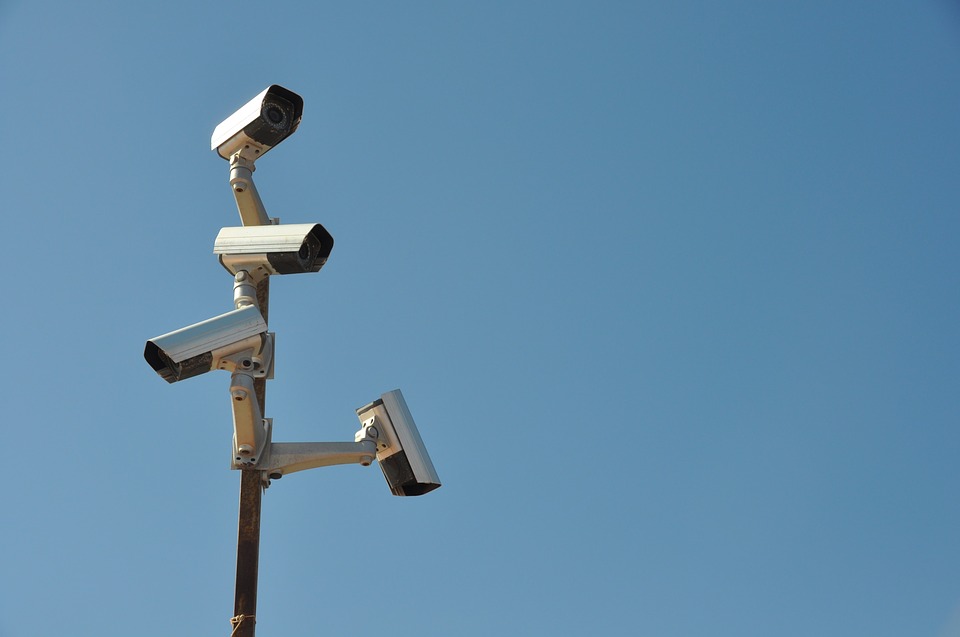
Back in the late 2010s I covered the onrushing surveillance state heavily. Having said most of what I wanted to say, I let it lie for the time being. But now it’s almost here. The NYTimes has a decent article on what Uganda is doing (and if a third world nation can do it…) Of course the article blames it mostly on China.
Ugandans have discovered that, increasingly, there is nowhere to hide. Civic life here is defined by thickening webs of state surveillance built with foreign help. Chinese cameras and facial-recognition software monitor the streets; Russian radio frequency chips implanted in license plates have been tracking cars in real time; Israeli software plunders the private contents of phones. Technology has created an intrusive eye that never blinks — a stealthy weapon for dictators keen to stifle speech and thought.
Leaked internal documents revealed Toka’s technology can reportedly locate cameras, remotely access them, watch live feeds and even alter live or previously recorded footage while concealing evidence the system was compromised.
YES, THEY CAN ALTER LIVE OR PREVIOUSLY RECORDED FOOTAGE WHILE CONCEALING EVIDENCE THE SYSTEM WAS COMPROMISED.
Hmm I wonder where that ability could come in handy? The stated purpose for altering footage? “Masking of on-site activities” during “covert operations.”
Yeah, right. I mean, I’m sure it’ll be used for that, but more sinisterly it will be used to alter footage to frame people. Given how often police lie on the stand and fake evidence you know this will happen. Imagery is going to have to be discounted in trials, and we’ll have to go back to witnesses, but you know that won’t happen soon, this is just too convenient for any cops or intelligence organizations. You don’t even have to use a honey trap, you can just change the footage.
Many surveillance devices now don’t just watch, they listen. They often have thermal imaging, face and gait recognition. It’s harder and harder to avoid them identifying you. Even without chips, America’s flock cameras monitor all car travel by scanning license plates.
Then there’s the phones most people carry everywhere. They’re mobile listening and tracking devices and it’s trivial to take over the camera as well. I tend not to carry a phone with me most of the time, but it’s becoming more and more difficult to navigate life without a phone these days. Indeed, in China, it’s essentially impossible and I expect it won’t be more than a few years before it’s true in most of the West.
So governments and any big corp that cares enough will know exactly where you go, and where you’ve been. They can alter footage to embarrass you or frame you for a crime. They can fairly easily listen in to what you say, even when you’re not using the phone.
Then we have autonomous armed robots. The armed robot dogs are already here, same with armed flying drones. The great problem for elites is always the issue of enforcer reliability. This is why Saudi Arabia is getting its ass kicked on the ground, because they deliberately crippled their troops to reduce the possibility of a coup.
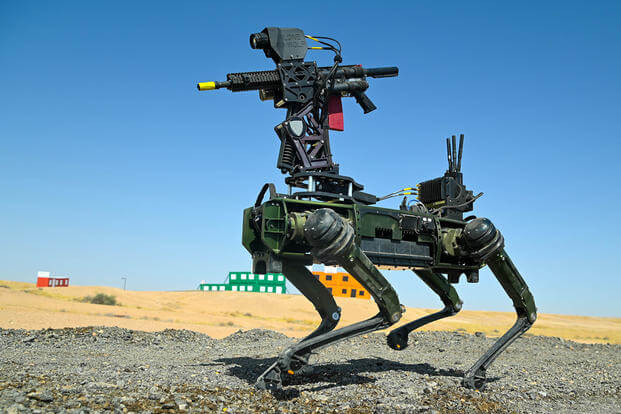
Now, add in AI, which elites hope will allow them to replace technical workers: the problem with using all this tech is that you still have the enforcer issue: but if the autonomous robots can be maintained and built by AI, well, that problem is lessened. (Some people will still be necessary, but far less.)
This enables a full panopticon on daily life, especially for people who use “smart” home devices, which are notorious for the data they send home. They’ll know who you are, what you’re doing, who you associate with, how much money you have, what you spend it on, etc, etc… Then they’ve got their robots to take you out, or they can frame you by altering the video that they have of you to show you committing a crime.
It’s silly to think they won’t take advantage of this to lock societies down and attempt a full authoritarian state where rebellion is impossible.
This has always been the endgame of the new communications, AI, and robotics techs, as I wrote well over ten years ago and it’s far worse than 1984, because in that novel they couldn’t store the information, someone had to be watching the camera feed. Likewise as age verification (to protect the kiddies, honest) becomes ubiquitous, getting information the state or oligarchs don’t want you to have will become harder and harder. Ban the sites they don’t like, forbid workarounds, keep track of everything you do and overcome the information problem. In the old days a group like the Stasi might know a great deal, but they couldn’t analyze every individual: AI makes that possible and firms are already working on pre-crime tech to predict who’s a radical or otherwise a danger to the state or those who profit from it. The first step, of course, will be de-banking, which doesn’t even need a court to find you guilty of anything.
Know everything, predict what people will do, make sure that they get only the information you want and if necessary, deal with dissidents with autonomous robots who are (they hope) utterly reliable.
It’s what authoritarians have always wanted, and it’s almost here.
What I write here is for the benefit of everyone, but alas, I live in capitalism and I, and the site, take money to keep running. If you value the writing here and can, please subscribe or donate.
Bob
Yes. And the public are pretty indifferent to it. If a person tries the avoid engaging with AI, which is increasingly difficult, they are called Luddites or cuckoo. Of a person tries to limit phone use, likewise.
Apparently the real Luddites weren’t anti all technology, just the tech that took their livelihoods.
Now a Luddite would have to be anti all tech. I am for sure. Yet here I type. The irony is not lost on me.
Full authrotarianism has always been an aspiration of the ruling class. All of this unfolding has always been obvious to some of us. Ho hum. Told ya so.
Fortunately for the rest of the humans, they have some clever mechanisms for pretending everything is always normal and fine. At least in modern societies.
mago
Given all this one would assume that you and your readership will be targeted, not that I’m paranoid or anything.
Soredemos
How about the fact that the ‘AI’ sucks, and is actually getting worse with time?
Feral Finster
People of influence and authority have 1984 within their grasp and they will not let anything get in their way.
Ben
I think this analysis, although accurate, doesn’t focus enough on interstate (inter-authoritarian) competition. When the threat from the populace is eliminated, the only thing left to scare the elite will be other elites.
Historically this was primarily the case – successful peasant rebellions are very rare. Most elites groups were ended by other elite groups.
Hypothetically, all the elites could negotiate and divide the spoils among themselves, but do you really think the current crop of elites could do that (especially in the west)? I don’t. They are not deal capable.
The more the western elite surveil and controls the western populace, the more they will fear the entities they can’t observe and control (Chinese and Russian elites specifically), the more they will move against them, the more the non-western elites will flight back. Slowly but surely escalating on all sides. Look around you, it’s been going like this for some time now.
My point is that this sort of mass surveillance isn’t a stable situation in a multi-state world, even in the absence of the possibility of popular revolt. In many ways it will be less stable, because the average person in the west doesn’t want war as much as the elites do, and the elites will consider themselves untouchable (right up until they aren’t, at which point they will panic and lash out).
This is why I think this cycle will end in a massive thermonuclear war, probably in the next half century. Elite escalation gets out of control, there are no significant counterweights and when once side eventually gets crushed (probably the west) the elites will absolutely choose total annihilation over humiliating defeat and subservience.
An army of cameras, robots and drones might be able to suppress a populace, but it doesn’t survive 100 megatons. Maybe some of the elites make it to their bunkers, but those that aren’t killed by starvation or their own guard labor will find themselves entombed, surrounded by ruins populated entirely by those who despise them until they eventually succumb to some aliment that whatever medical equipment they were able to stash away can’t handle.
Not a particularly positive vision of the future I’ll admit, but maybe those who rise from the ruins of this world will be able to make a better one. At very least, it will be centuries before the world recovers enough for this kind of technological mass surveillance becomes possible again.
cc
“Toka is an Israeli cyber-intelligence company backed by Andreessen Horowitz that sells its technology exclusively to governments, militaries, intelligence agencies and law enforcement.”
This rapidly rising fascist control seems in no small part to be driven and accelerated by Zionist interests.
For context, for those that haven’t seen it yet, this clip is now at 24.2 million views:
“Harrison H. Smith – I might get killed for posting this, the least you could do is watch it.” – 24.2M views
https://x.com/HarrisonHSmith/status/2018753453544124833
At the 5:33 mark of the video:
“Citizens will be on their best behavior, because we’re constantly recording and reporting everything that is going on.”
– Oracle CEO Zionist billionaire oligarch Larry Ellison, September 2024
Another Silicon Valley oligarch said:
“A trillion sensor in space, in the air and on the ground will allow us to know anything, anywhere, at any time. There will be no hiding.. A good thing… Humans behave better when they’re being watched.”
(from https://youtu.be/5BLnM-gxj-o?t=1423, a Ben Norton video related to this, 34m)
Caitlin Johnstone happens to have a short piece today that goes quite well as a follow-up to this post. Has a video reading (just under 4 minutes) that can be played for effect.
https://caitlinjohnstone.com.au/2026/10/13/when-the-gates-of-tech-dystopia-snap-shut/
spud
Ben:
much agreement. and i will also add, humans are curious and clever. so far they end up getting around just about everything the rich and powerful throw at us.
sometimes it takes a long time, other times it falls apart quickly for the rich and powerful.
the good governance from 1933-1993, has ran its course, and the people are waking up to the fact, that if you try to defend yourself as you get murdered by cops, you get charged and thrown into the slammer for decades, or more. so just stand there and get murdered, is wearing thin these days.
speak out at city hall, gets you beaten and jailed. give a opinion, you go to jail.
technology is a two way street. and if you ever read up on the nazi party, or any of those central and eastern europeon fascists parties, almost from day one, they tried to assassinate their leaders. its just nature of the beast.
add to it, you can see the oligarchs are already lusting for what other oligarchs have, and we might get to view constant blood baths for control .
albrt
Things are bad, but they can get worse. As Malcolm Kyeyune wrote today, “If society can’t afford people, it can’t afford extremely bespoke, precision-manufactured synthetic ‘people’.” So we’ve got that going for us, which is nice.
Bob
@Margo
If you’re not crippled by paranoia, you’re not paying attention.
Ooh, what was that?
StewartM
This has always been the endgame of the new communications, AI, and robotics techs, as I wrote well over ten years ago and it’s far worse than 1984, because in that novel they couldn’t store the information, someone had to be watching the camera feed.
THIS is what the Unabomber’s rant *should* have been about. The technology itself actually is neutral, it can be used for good or bad, but as long as the society’s organization is set up to be well-nigh guaranteed to be run by sociopaths (as our capitalist society is) then even a technology that holds the promise of liberation and prosperity (and the early internet did offer that) will be turned into an instrument of suppression, control, and impoverishment.
In short, tech won’t save you unless you change your social order. All this social control was sold to the public via emotional appeals like “protecting the kids” or “stopping the terrorists” which were always diversions.
Bullweather
Between this article and the prior day’s, I’m wondering if drug cartels are going to start the next American Revolution.
StewartM
Then there’s the phones most people carry everywhere. They’re mobile listening and tracking devices and it’s trivial to take over the camera as well. I tend not to carry a phone with me most of the time, but it’s becoming more and more difficult to navigate life without a phone these days. Indeed, in China, it’s essentially impossible and I expect it won’t be more than a few years before it’s true in most of the West.
I see this again by design. It does two things:
a) a quality computer can last for a decade or more, if say running an OS not designed to be obsoleted (I run Linux). I have owned Linux computers and kept them running for 15 years and 18 years. Sure, they slow down by the end of their tenure but they’re still servicable. Phones, by contrast, are expected to fail or be obsoleted in a few years, so it’s a never-ending money drain on average Jane and Joe and a constant revenue stream for our betters.
b) If you run Linux, you largely control the software (hardware is another question, but that’s unavoidable). Even if you run Windows or a Mac, you have more control over the device than you have over your phone. With a phone, you’re just a dumb user who can only customize things to the degree that your social betters want. That is the IDEAL SITUATION, and which is why phones are so relentlessly “pushed” on people. Now there is phone-only software (you might be able to run it on a computer, but that requires setting up a phone simulation in a ‘sandbox’, so to speak) and moreover a lot of 2FA now requires phones (either for texts or for passkeys). The latter is touted for superior security, but really, I think strong passphrases are sufficient. I’ve only had one passphrase broken and that was a weak one in a publicized security breach; it was changed to a harder one immediately. Now it’s quite easy to generate ‘gobbletygook-looking’ passphrases generated from randomized characters in your browser and in software password safes, and these can even be security shared (via encryption) across all your devices. These passphrases are in theory on par with the encryption algorithms themselves in difficulty to break.
I will also add that hardware is become more privacy-unfriendly. A lot of newer filesystems prevent users from permanently delete any file by overwriting it. SSDs also have this feature. Again, the claim is that these filesystems/hardware protects one from drive failure, but having used conventional SATA drives and older filesystems I have only had two drives fail in my life, despite heavy use; plus you should always keep backups. The counter to not being able to destroy files is that “you have encryption” but encryption is putting all one’s eggs into one security basket and while the encryption itself can’t be broken, it can be bypassed by keyloggers.
When I mention things like this, I am first told that “this is just bad programming or design” but it’s been so relentlessly driven since Windows95, to make it ever harder to prevent your device from secretly recording all your usage, that it’s clear THAT WAS THE DESIGN. And it makes sense, particularly given the use that Windows has in corporate markets (the bosses want to be able what see from your device what you’ve been doing with it). Such corporate surveillance one might justify, but there’s none at all from extending the same to the entire population. But to our social betters, we’re all just peasants with no rights worth honoring.
mago
Hey Bob. That was an attempt at being sardonic and ironic.
I’ve been looking over my shoulder for a few decades, justifiably so.
Brian M
A couple of thoughts…
First, a computer/robot/connected world is an inherently hackable world. These systems WILL be hackable and WILL be hacked. Such systems can be turned on their owners. The more the elite power structure relies on non-human enforcers and tools, the less secure they are likely to be. Yes, people can be bought or coerced, but technology can be hacked and the thing about computers is that they can do a lot of damage in a very short amount of time.
Second, one wonders who the West will attack for lack of privacy, lack of rights, authoritarian oversight, etc. when they have adopted those very technologies and processes. Even worse, the West is highly likely to put much of this power into the hands of essentially unregulated corporations that care little about human values and everything about profits. In such an environment, it seems inevitable that the outcomes will be much, much more draconian and invasive than anything that exists in places where the governments do worry about keeping the population satisfied in order to avoid civil unrest, countries we have spent years criticizing.
Dan Kelly
They crapified the internet in the interest of wholesale surveillance.
I remember Giorgio Maone of NoScript fame wondering at first if he should even continue NoScript because given the emerging underlying structural realities that were being pushed true anonymity on the internet would be impossible anyway.
Basically, Web 2.0 both killed anonymity-privacy and led to hyper-centralization and aggregration and tracking…and this was all predicted to happen by the ‘open source community’ and beyond because it was all by design.
[I know Berners-Lee among others have challenged the idea of any distinction between web 1 and 2 and the like because his vision was always supposed to be about collaboration in any form I suppose…but the security and surveillance aspects as well as the expanded commercial applications with ‘web 2.0’ or whatever one wants to call it are rather obvious to me]
The problem with ‘cell phones’ is cell phones.
It is their ubiquitous always-on always-with-you nature.
It used to be that you left the house and if you weren’t in a group you were alone.
I mean really alone.
No one could contact you.
And if you wanted to contact someone you had to go to where someone was or to where a public pay phone was or to a friend’s or even a stranger’s house to use their phone.
This has all changed in the last thirty years.
And this really almost unfathomable change was required in order to get to the surveillance endgame which is the normalized zeitgeist of not just cameras and listening devices everywhere but also of never really being able to ‘get away’ for lack of a better way of putting it…and further of being thoroughly frightened when one is ‘away’ – in this case away from an electronic doodad.
A recent study showed conclusively that a cell device turned off and sitting on a desk across the room from a student nevertheless caused great distraction in the student.
There is simply nothing historically that remotely compares to that level of distraction.
An old phone on the wall?
Because that distraction isn’t just from the anticipation of a call – whether desired or undesired.
It is the distraction of basically missing out on the entire world which the phone has become the conduit for.
‘They’ll be on their best behavior because we’ll be watching and listening and tracking all the time’ is much easier accomplished if the target population willingly and even execitedly carry around a transponder on their person at all times.