
So, economists like to say that comparative advantage is the one economic law that is indisputable. Everyone should make what they’re comparatively best at, and everyone is better off as a result.
The guy who came up with comparative advantage was Ricardo, and I think we should quote him directly:
In one and the same country, profits are, generally speaking, always on the same level; or differ only as the employment of capital may be more or less secure and agreeable. It is not so between different countries. If the profits of capital employed in Yorkshire, should exceed those of capital employed in London, capital would speedily move from London to Yorkshire, and an equality of profits would be effected; but if in consequence of the diminished rate of production in the lands of England, from the increase of capital and population, wages should rise, and profits fall, it would not follow that capital and population would necessarily move from England to Holland, or Spain, or Russia, where profits might be higher.
Read that carefully. Ricardo makes an assumption which is not true in the modern world: that capital cannot move between countries. If something isn’t profitable, companies will invest in something that is, in the same country.
Bu unlike in the early 19th century we live in a world where capital is mobile (and profits are not on the same level either, finance and various oligopolies make far more than competitive companies.)
So if profits aren’t high enough, companies shut down production in their home country and invest outside it or in financial/rentier projects which have high returns, but don’t actually produce many jobs or real products.
This chart tells a story about Europe:
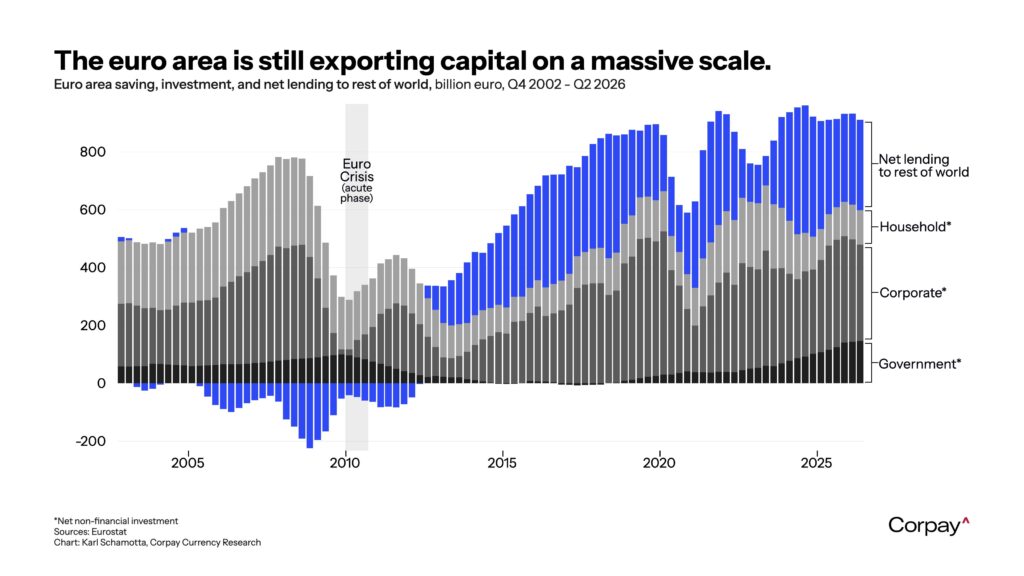
Europe is sending almost as much money to overseas investments as it is spending on investments in Europe.
Of course it can’t compete.
This is perfectly rational behaviour, mind you, our current thinking around corporations is that their only responsibility is to make money: not to do social good, hire people or keep their own countries technologically and industrially viable.
If Europe wants to turn things around, they should make it much harder to move capital abroad and engage in other policies which make it so that corporations don’t spend a lot of money on buybacks, dividends or executive salaries and bonuses. Force them to invest in Europe.
That’s not going to happen any time soon, of course, since European politicians are neoliberal to the core and bought by the rich.
And so, in this as in many other ways, Europe will continue its decline.
We’re about 3 weeks into our annual fundraiser. We’ve raised about $10,905 out of a $14,500 goal from 87 people. This blog is free for everyone to read, and we’ve got about ten thousand visitors a month. Of those about 6K are regulars.
The simplest truth of capitalism is that you get more of what you pay for. Money sends the message and resources required to do things. In most cases your power is tiny, one of millions, but this isn’t like that because the numbers and the need (to keep the blog and Ian running) are relatively small.
So if you value this blog, if it’s worth having around to you, please consider Subscribing or Donating.
Leave a Reply