Ian Welsh

The horizon is not so far as we can see, but as far as we can imagine

Week-end Wrap April 14, 2019

Strategic Political Economy

“Research is vital to the moral integrity of social movements” 
Rev. Dr. William J. Barber II [Economic Policy Institute, via Naked Capitalism 4-8-19]
A must-read.

One of the quickest ways for a movement to lose its integrity is to be loud and wrong. We’ve seen too many movements that have bumper sticker sayings but no stats and no depth. Researchers help to protect the moral integrity of a movement by providing sound analysis of the facts and issues at hand. Armed with this information, we’re able to pull back the cover and force society to see the hurt and the harm of the decisions that people are making….

…the prophet Isaiah said to those who were rich, powerful and presumed themselves to be morally superior. “Woe unto those who legislate evil and rob the poor of their rights and make women and children their prey.” Isaiah even went as far as saying that religious activity—worship and prayer—was not a cover for their failure to “loose the band of wickedness.” Wickedness in that text is specific to the issue of not paying people what they deserve and trying to cover it over with a lot of religiosity. He goes on to say that the nation will never be able to repair itself until it ends the wickedness of not paying people what they deserve. Because society’s policies had actually insulated destruction, injustice and inequality could never be resolved without a change of policy.

These statements reflect more than just a difference of opinion concerning the legislation. Rather, such bold and specific statements suggest an analysis of the society which concluded that the legislation was evil in that it was robbing those who were most vulnerable. In other words, Isaiah’s moral authority to criticize policy could be confirmed and validated by research….

The 13 former Confederate states, which only have about 36 percent of this country’s population, decide 178 electoral votes, 26 United States Senate seats and 35 percent of the seats in the United States House of Representatives. That means all it takes to win control of both houses of Congress is 25 Senate seats and 16 percent of U.S. House of Representatives seats available from the other 37 states.

100 million is the number of people that didn’t vote in the 2016 election. 40 million is the number of poor and low-wealth people in this country. The majority of them are in the South and are the key to the transformation of our politics.

All of the close elections we witnessed in the 2018 midterms are a sign that we are right at the tipping point. If there’s ever been a time that we ought to go south and shift the political calculus in this nation for the next 20 to 40 years and beyond, it is in fact right now.
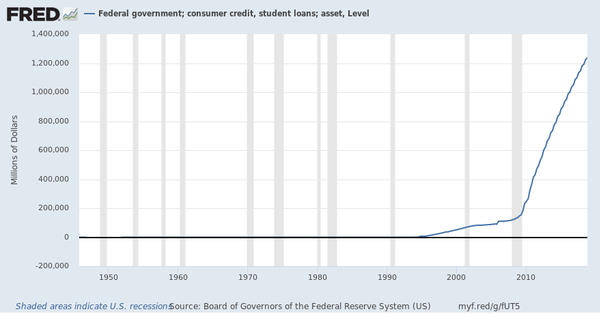

Eat the Young: Student Loan Version

So, does this look predation to you?

It looks like predation to me.

Here’s the thing, in the bankruptcy bill, Joe Biden, among others, made it impossible to default on student loans.

This is bad. It is bad capitalism. In capitalism, people who lend money are supposed to bear the risk of lending money. If someone can’t pay them back, they should lose the money they loaned. The function of lenders, in capitalism, is to allocate money to those who will make enough to pay it back. That is the justification for letting people have lots of money–that they are good at allocating it.

When you remove the risk, by having the government both back the loans AND make it so they can’t be discharged in bankruptcy, you make it so the virtues of capitalism (such as they are) don’t work.

In truth, education should be mostly free and paid for by the government. There’s an ethical argument for that, but it’s not the one I’m making.

If education actually increases earnings or welfare (someone who is healthier will cost the government less, someone who is happier is better for other people), then that’s good. The problem with it is that it’s hard to capture. Not everyone gets a lot of benefit from education, but some people do.

Government, if it has high enough progressive taxation, doesn’t need quantify who will win from educating their citizens. They only need to know that enough people will and that whoever wins, they’ll get their share of it. This isn’t just about income or happiness or health: A lot of the greatest inventors, for example, didn’t make much money. Someone else did.

No problem. Government still taxes whoever that is.

This is government’s great advantage, and why there are a lot of things government should do.

But because the recapture rate is basically the progressive taxation rate + the rate of taxation of corporate profits, if you have low taxation it doesn’t work.

Note, also, that what private investors have done, by making default impossible, and having the government guarantee loans, is to make the government give them something close to government returns. “Now we don’t need to know who wins, because we always win.”

But since they bear only the upside and not the downside, unlike a good government, they don’t have an incentive to actually make education good.

Education costs are out of control. So are education loans. This is the rich and, generally speaking, the older, taking returns from the young and poor.

It’s evil. It’s economically stupid. It’s not capitalism.

Let’s hope it ends soon, and for a bonus, let’s hope that government makes default possible again and refuses to make “investors” whole.


The results of the work I do, like this article, are free, but food isn’t, so if you value my work, please DONATE or SUBSCRIBE.

Julian Assange Arrested for Violating Bail

Update 2: So, we have a US extradition charge. This is a direct assault on the freedom of the press and those who say it isn’t are fools. The DOJ claim is that Assange didn’t just accept Manning’s documents, he encouraged Manning to go get more. Journalists do this all the time. Likewise, Assange is not American and Wikileaks is not an American institution, so the US is claiming extraordinary extradition rights.

So, it begins. The US put a ton of pressure on Ecuador to make this happen:

Julian Assange

In itself, this isn’t a big deal, though Ecuador’s caving is pathetic (if rather expected). The question is: What comes next? If Assange is extradited to the US, it will be a huge blow for freedom of the press. Since the Swedish sexual assault charges have been rescinded, if that doesn’t happen this all seems rather overblown.

This has nothing to do with Assange being something of a piece of work. It has to do with the fact that the information Wikileaks released with collateral murder, and even with the DNC leak, was legitimate journalistic information. The idea that journalists don’t accept info from state actors or don’t have political biases and preferences is hilariously wrong and stupid.

It’s also absurd to pretend that Assange has been treated as any other suspect. He hasn’t. His entire case has been politicized from the start, with pressure exerted that is not routine for the sort of sexual assault of which he was accused.

This is a political situation, from its start to its conclusion, whatever that might be.

Remember that Manning was just recently sent to prison on contempt charges because she refused to cooperate with a US grand jury on Wikileaks.

Assange isn’t a nice guy and that isn’t relevant to either his rights, or the bad precedent which will be set if he is prosecuted for releasing information, no matter what the source or reason.

Discuss below, and we’ll see how this plays out.

Update: video of the removal. Pathetic.


The results of the work I do, like this article, are free, but food isn’t, so if you value my work, please DONATE or SUBSCRIBE.

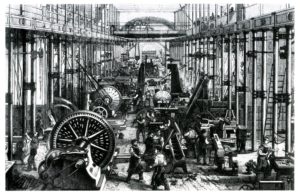
Don’t Confuse Capitalism with Industrialization

There is a very bad habit among modern triumphalists, the types who go on and on about how great the current world is, to confuse capitalism and industrialization.
Capitalism is part of how many nations industrialized, but industrialization is where the majority of the gains come from. When you replace human labor with machines run by coal and hydrocarbons and some other sources of power, you get most of the gains of capitalism.

This is why for much of its history the USSR, in fact, did just fine, and actually outgrew most capitalist nations.

Nor is the victory of “capitalism” as clean and clear as people make out. With a very few exceptions, mostly city states, countries industrialized under protectionism, not under “free trade” or “free markets.” This is beyond question, it is not open to debate: It is true of America, Japan, China and Britain, among others.

These were very heavily state-managed economies in many cases. Germany’s electrical revolution was a result of the German High Command making sure it happened, “Siemens, my good man, go start an electrical company!” (Hall’s “Cities in Civilization” tells this story well.)

Likewise, Japan had massive government involvement. And this is when we pretend that, say, Britain forbidding the export of raw wool, wasn’t a government action (and without which there is no textile revolution and thus, likely, no Industrial Revolution at all.)

Nonetheless, to be sure, the majority of the world did industrialize under some form of capitalism. Capitalism is how a lot of the decisions of what to do were made. Capitalism is how the right to command resources was allocated. But it doesn’t happen without massive government intervention: Commons don’t enclose themselves, government has to be onside. Chinese villages don’t give up and say, “Make me into housing!” by themselves either, government force is involved. There is little natural capital accumulation: It comes from taking away other people’s stuff and rights.

Unless we run across extra-terrestrials, or we lose our modern technological civilization, we will never know if it would have been possible to industrialize other than through central government mobilization (so-called communism), protectionist capitalism, or free trade capitalism (for city states).

However, capitalism was, and is, a way to distribute resources to do things. It is not the things themselves. It is not, itself, industrialization, and confusing the two is a dangerous intellectual error.

It is at least conceivable that we could have industrialized in very different ways than we did. History is contingent, what happened happened, but it was a result of specific historical conditions interacting with principles.

Better power sources, funneled through better machines, is the Industrial Revolution. That is not what capitalism is.

And because either we made bad decisions due to our adherence to capitalism, which have lead to the current onrushing climate and ecological crises, OR it is intrinsic to industrialisms, we’d better hope it was capitalism (and state communism) which was the primary problem. We had better hope that there are ways to use machines and energy that won’t cause environmental catastrophe; that there are other ways to decide who gets resources and for what purpose they use them.

If there aren’t, well, we’re likely to lose our civilization or even go extinct.

We need to stop being nodes in a shitty resource allocation algorithm, and we need to start actually making sane decisions based on group autonomy and welfare.

And capitalism, capitalism doesn’t do that.


The results of the work I do, like this article, are free, but food isn’t, so if you value my work, please DONATE or SUBSCRIBE.


The Ongoing Libyan Catastrophe

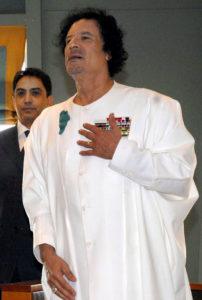
It’s worth remembering that before Hillary Clinton convinced Barack Obama to support bombing the hell out of Libya, Libya had the highest standard of living in Africa.
Today, it has open air slave markets and is fought over by various Jihadist groups. The so-called central government is a punching bag.

Even if you thought Libya was a bad place, run by a bad man (and he was no saint), the truth is that you never, ever, want the US to intervene in any country unless you want it to become a failed state wasteland. This isn’t your great-grandfather’s US; it isn’t the US which rebuilt Germany and Japan. This is late-Imperial-decline-America, incapable of nation building even at home, let alone in other countries.

Libya was the primary reason Clinton was unqualified to be President. After being for the Iraq war, Libya proved she had learned nothing; that she would make the same mistake again.

Libya has also contributed to destabilizing the EU, as it has contributed to the refugee crisis. Whatever problems the US has with the EU, and vice-versa, straight realpolitik suggest that you don’t undermine you second most important ally in the world (right after Japan) when a new hegemonic power (China) is rising to challenge your dominance.

But ultimately it’s about the people. About the harm. About the slavery, death, disease, rapes, and torture that the “intervention” led to. The attack was, ultimately, monstrous, judged solely on its results. Results which, after Iraq and Afghanistan, were easily predictable.

American liberals have this weird idea that they’re still the good guys, and that the US is a force for good in the world. It isn’t. The best thing for the world, and the US (and Americans), right now, would be for the US to remove its troops from around the world, stop attacking other nations (including drone bombing them) and mind its own business. There’s plenty of problems at home the US should fix first, before it ever goes abroad looking for monsters.


The results of the work I do, like this article, are free, but food isn’t, so if you value my work, please DONATE or SUBSCRIBE.

America: A Failing State

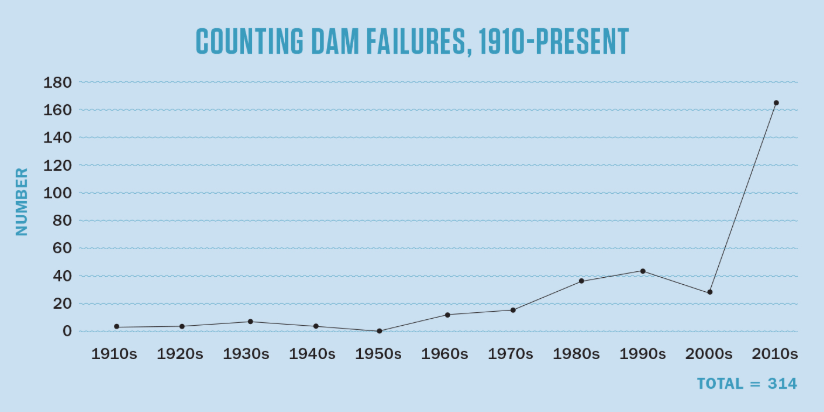
When stuff that should work just gets worse and worse, you know your state is failing.

Then we have the overdose rates…(pdf)

People who are happy and have hope for the future rarely become drug addicts.

Adam Smith wrote that “…there is a great deal of ruin in a nation.”

That amount is not infinite.

The US is not keeping up its infrastructure. It is not building important new infrastructure, as anyone who has seen high-speed trains overseas (or good airline terminals) knows.

The US is losing wars. It is losing in Afghanistan. When it left Iraq it had to pay local militias not to attack as it left. It arguably won in Libya, if you call contributing to a refugee crisis destabilizing its main strategic partner, the EU, winning, which anyone sane wouldn’t.

The US has turned, in large part, against the World Trade Organization, which it created. Even before turning against it, the WTO failed in its latest round of trade negotiation.

The prices of basic medicines in the US are soaring (the price of insulin has tripled) and there is an actual decline in life expectancy–the first since the Spanish Flu.

The US is alienating its most important allies, like the EU. Increasingly, it uses financial sanctions to punish nations, which has led to talk of creating a financial network without the US at its center.

Core manufacturing (for example, of computer chips) has moved offshore, and the US is no longer the key manufacturer of electronic goods, nor are any of its allies (Japan controlling this wouldn’t matter much, China doing so, does). The most advanced 5G technology was created by China. The most important technological city in the world is in China.

China now manufactures more than the US, and in purchasing power parity terms, has a larger economy.

Core nations like Italy (a member of the G7) are beginning to look to Beijing. Italy has signed up for China’s Belt and Road Initiative, which is, among other things, a rival to the WTO and the US-led trade order. Non-core nations are increasingly turning to China for loans and development, for which China is willing to lend them the money, often at better rates than the IMF and WTO with less demands for internal controls.

The US military is showing signs of being unable to create effective, advanced military equipment: Take for example, the F-35, which basically can’t fly. It is showing signs of intense incompetence, as when it let multiple planes be destroyed on the ground by a hurricane rather than, uh, fly them out or get them under effective cover.

The US is led by Donald Trump, a reality TV star, who was made to look like an effective billionaire mogul by clever editing. While Trump is not without his competencies (he did spend his life shitting into a gold toilet and screwing models), he’s clearly a few screws loose and a flaming narcissist.

Meanwhile the opposition party, faced with an extremely unpopular president, mutters about “working together” and how they would never impeach a weak President.

The US is a gold-flecked garbage heap slowly rolling towards the ocean. On fire.

There is a lot of ruin in a nation, but for almost 40 years now, US elites have treated the US as something to loot, and assumed that the good times would keep rolling. They were uninterested in actually governing. They were happy to move much of the US’s core manufacturing overseas, to the most likely nation to replace America as a hegemon, because the Chinese were smart enough to make American elites rich.

And so, today, large parts of the US are shitholes, which the residents hate so much they are consuming record amounts of drugs and committing suicide, because who the fuck wants to live in a nation with no hope, shitty bosses, and no hope.

Oh, of course, there are people doing well. There were people doing well in 400AD as the Roman Empire collapsed. There are always some people doing well.

But the number of people doing well keeps getting less and less, and the decline keeps getting worse and worse.

But the top is doing fine, so they see no reason to do anything.

Heck, Trump just gave them another tax cut. Everyone they know is doing great.

And so the decline goes on, because until the elites are made to feel the pain of the majority, they will not change.

And so far, no one is willing or able to make the elites pay.


The results of the work I do, like this article, are free, but food isn’t, so if you value my work, please DONATE or SUBSCRIBE.


Week-end Wrap – Political Economy – April 7, 2019

***Post is By Tony Wikrent***


Draining The Swamp In North Carolina Yields The Head Of The State Republican Party, The Party’s Top Donor And 3 Others, Including A Far Right Member Of Congress

About a decade ago, mostly back in 2006 and 2008, we used to write a lot about a North Carolina multimillionaire congressman named Robin Hayes. The district he represented, NC-08, is now mostly NC-09, the one where a Trumpist candidate was caught rigging the ballots last year, causing the election to be voided…. Hayes was a freak. One of the reasons he lost so badly to Kissel in 2008 was because he accused then candidate Barack Obama of “inciting class warfare” and claiming that “liberals hate real Americans that work and accomplish and achieve and believe in God.” That brought him a lot of attention and he not only denied that he ever said it, he also accused the media reporting his remarks “irresponsible journalism.” Unfortunately for Rep. Hayes, someone made a tape. When that was released Hayes simple denied that he denied the statement. Kissel beat him by ten points.

Instead of just letting him quietly slip away into obscurity, the North Carolina elected him chairman of the state party, a two year term. They elected him again in 2016. Today Hayes was in court, having been indicted by a federal grand jury on a variety of charges for funneling bribe money to the re-election campaign of North Carolina Insurance commissioner Mike Causey.

It was actually wealthy entrepreneur and Republican Party mega-donor Greg Lindberg who was being investigated when the FBI stumbled upon Hayes. Lindberg would write $40 checks to the DCCC on the same day he wrote $500,000 checks to the Republican Party of North Carolina. He’s contributed million of dollars to the GOP in recent years and was the state party’s biggest single donor and is the money-bags behind the state’s crooked Lt. Govenor, Dan Forest, who is running for governor next year.

Strategic Political Economy

Taibbi: On Russiagate and Our Refusal to Face Why Trump Won

Matt Taibbi [Rolling Stone, via Naked Capitalism 3-31-19]
This is long, for Taibbi, but an absolute must-read.

The 2016 campaign season brought to the surface awesome levels of political discontent. After the election, instead of wondering where that anger came from, most of the press quickly pivoted to a new tale about a Russian plot to attack our Democracy. This conveyed the impression that the election season we’d just lived through had been an aberration, thrown off the rails by an extraordinary espionage conspiracy between Trump and a cabal of evil foreigners.

This narrative contradicted everything I’d seen traveling across America in my two years of covering the campaign. The overwhelming theme of that race, long before anyone even thought about Russia, was voter rage at the entire political system.

The anger wasn’t just on the Republican side, where Trump humiliated the Republicans’ chosen $150 million contender, Jeb Bush (who got three delegates, or $50 million per delegate). It was also evident on the Democratic side, where a self-proclaimed “Democratic Socialist” with little money and close to no institutional support became a surprise contender.

[Jacobin, via Naked Capitalism 4-2-19]

The media doesn’t talk much about working-class America. But when it does, it mainly has one thing to say about it: that it’s entirely white, male, and very right-wing. All those things are lies….

Central to this story is the decline of labor reporting, once a mainstay of major dailies. Today, by contrast, as Martin puts it: “A conference gathering of labor/workforce beat reporters from the country’s leading newspapers could fit into a single booth at an Applebee’s.” Of the country’s top twenty-five newspapers, he notes, a majority no longer covers the workplace/labor beat on a full-time basis, and the landscape for such reporting appears to be even bleaker on television (one 2013 survey cited by Martin, for example, reveals that only 0.3 percent of network TV news in the years 2008, 2009, and 2011 covered labor issues).

Abigail Disney: What It’s Like to Grow Up With More Money Than You’ll Ever Spend
[The Cut, via The Big Picture 4-1-19]

In what ways did your dad change, other than having a jet?Actually, having a jet is a really big deal. If I were queen of the world, I would pass a law against private jets, because they enable you to get around a certain reality. You don’t have to go through an airport terminal, you don’t have to interact, you don’t have to be patient, you don’t have to be uncomfortable. These are the things that remind us we’re human….

How did the jet change your dad? It wasn’t just the plane, but it’s not a small thing when you don’t have to be patient or be around other people. It creates this notion that you’re a little bit better than they are. And for the past 40 years, everything in American culture has been reinforcing that belief. We say, “Job creators, entrepreneurs, these are the people who make America great.” So there are people walking around with substantial wealth who think that they have it because they’re better. It’s fundamental to remember that you’re just a member of the human race, like everybody else, and there’s nothing about your money that makes you better than anyone else. If you don’t know that and you have money, it’s the road to hell, no matter how much stuff you have around you….

They did a study at the Chronicle of Philanthropy years ago where they asked people who inherited money, “What amount of money would you need to feel totally secure?” And every single one of them, no matter what they had, named a number that was roughly twice what they inherited. So that’s what you need to know about money, right? If that is your primary measure of success or value in life, then good luck with that, because it will never feel good.

Thinking Beyond Monetary Policy and Banking Regulation to Manage the Next Economic Downturn [Roosevelt Institute, via Naked Capitalism 4-4-19]

Our corporate sector is broken. Corporations aren’t making productive investments or putting the more than $1 trillion of firm-level debt toward growth-inducing uses, such as research and development (R&D), capital investments, or better compensation for our workforce. Instead, they’re putting more and more funds, largely financed by debt, toward rewarding shareholders, which is reaching upwards of $2.9 trillion since 2012 through a combination of stock buybacks and takeovers of non-financial corporations….

… Irene Tung, from the National Employment Law Project (NELP), and I found that the restaurant industry spent more on payouts to shareholders, in the form of buybacks, than it made in profits—ultimately funding buybacks through debt and/or cash reserves. Buybacks actually totaled nearly 140 percent of net profits in the restaurant industry alone. “Leveraged buybacks”—the issuance of new corporate debt in order to fund stock buybacks—is more pervasive and contributes to the highly skewed economy we have today. McDonald’s, for example, could have paid each of its 1.9 million workers almost $4,000 more a year if the company redirected the money it spends on buybacks to workers’ paychecks instead….

Unless we fix our broken corporate sector—which means rectifying today’s high-profit, low-wage economy—banking regulation, securities laws, and monetary policy can only go so far. We need to think outside banking regulatory levers and instead implement solutions that encourage the kind of corporate behavior that prioritizes productive activities that grow the real economy—corporate behavior that supports higher wages, better jobs, and new business development, for example. To redirect our corporate sector to the productive, growth inducing activities we seek, we need to rein in corporate power by raising taxes on corporations, the financial sector, and capital; revamping our antitrust laws to break up concentrated and anticompetitive market power; and reforming the laws that govern corporate decision-making.

We also need policies to rebuild worker power. Workers are a key stakeholder within firms and across our economy at large, who play a critical role in generating corporate value. Bold policy solutions are necessary to rebalance economic power and ensure that workers—who are investing in companies with their own labor on a daily basis—have a voice in the firm and agency over their lives. This includes policies that give workers a say over how corporate boards are structured, including who sits on them. This also must include building countervailing power for workers by promoting workplace unionization, encouraging bargaining across industries, and protecting workers’ rights to engage in collective action—most notably, the right to strike.

The Stupid Idiot’s Guide to the Future of Uber and Lyft
[Splinter News 4-2-19]

….from a “business” perspective, it is fair to say that Lyft and Uber’s main function is to take money from the world’s savviest investors and use that money to offer everyone subsidized rides. Lyft lost nearly a billion dollars just last year, and Uber’s losses are even more staggering. And this is with the benefit of being able to exploit drivers by treating them as contractors rather than employees—something that could very well change one day, and which would raises costs considerably….

You do not need to be a financial genius to see that the only real path to profitability for Lyft and Uber is to raise prices so that rides actually bring in more money than they cost…. there are basically three possibilities, which we will list forthwith:

1) The Bad (For Uber and Lyft, Not Necessarily For Society) ScenarioAfter burning through literally tens of billions of dollars from venture capitalists and sovereign wealth funds and institutional investors and all the world’s smartest people, it finally becomes clear that these companies cannot reach profitability, because once they finally raise their prices high enough to allow them to make $$$, people are much less enthusiastic about calling a car….

2) The Medium ScenarioAfter putting the taxi industry out of business through clever and semi-dirty regulatory arbitrage, Lyft and Uber become, essentially, the taxi business all over again, as regulations and organized labor catch up to technology. This business is moderately profitable and stable but not really anything that would necessarily inspire all this, you know, hype. Congratulations, tech geniuses—you spent decades tearing down and then rebuilding the taxi business, arriving back where you began.

3) The Good For Uber and Lyft and Definitively Bad For Society ScenarioThe long-term plan of these companies succeeds: they destroy public transportation in America. Lured by cheap, subsidized rides, bus and subway ridership falls for years, leading governments to reduce and then more or less cease investment in new public transportation, which makes existing public transportation worse, creating a feedback loop that further incentivizes choosing Uber over the train. Once it becomes clear that public transportation has been crippled in major cities, ride-sharing companies can start raising their prices in peace, safe from competition. The companies will then at last become wildly profitable—by, in essence, extorting the public for transportation services that our dysfunctional government is not providing.

Tony Wikrent [Real Economics 4-5-19]

An excerpt from Joseph Dorfman’s The Economic Mind in American Civilization

….a wide and deep-ranging distinction between “business” and “industry” and a broad view of the nature of “institutions.”

Veblen discerned that the high command of the “institution” of modern capitalism was vested in the most powerful of financiers, who by controlling the flow of credit to important industries were able to manipulate them for their own ends… more directly concerned with the material contribution of society. In this high command was reflected most clearly and extremely the spirit of pure gain (monetary) or pecuniary profit, entirely abstracted from material efficiency or service.

On the other hand, the all-important “institution” making material progress was “technology,” the state of the industrial arts.

The industrial arts, in Veblen’s sense, were not only the arts proper but the habits, skills, transmission of skills, and the opportunity to develop and advance them. It was not physical capital or labor, let alone funds, which were to Veblen the great productive factor, but the cumulative growth of the technological habits of thought that comprised the machine process; without this intangible element physical instruments and labor would be of little use. Productivity was therefore an indivisible social phenomenon, not an individual one, a function of the given technology.

Economics in the real world

Veblen’s Idea of Business Versus Industry

THIS POST IS BY TONY WIKRENT
I had wanted to reply to comments in the thread of Economics as Cultural Warfare: The Case of Adam Smith, where Bruce Wilder makes an important correction to my view of Smith: “Smith’s central argument rather famously is that the division of labor is the primary source of wealth!” Which of course is perfectly true, given that one of Smith’s most famous passages is that describing the impressive productivity of the machines Smith found in a pin making factory.

But my design is to utterly annihilate any respect for Adam Smith by showing that he is little more than an apologist for the imperial looting, immiseration, and devastation the British empire exacted on its colonial subject populations. In my world view, there is nothing about any apologist for the British empire that is worth salvaging. Was it possible that here was an anomaly for which I would have to bend my rules?

As I pondered this over the past week, I realized that tossing Smith’s division of labor argument into the trash bin of history is more easily accomplished by referencing the arguments made by Thorstein Veblen regarding the differences between business and industry. I was not very surprised to find that I could find nothing on the internet about Veblen’s argument worth linking to. Veblen has always been  persona non grata in the mainstream economics profession — which means he probably has gored one or more of the profession’s sacred cows. Which of course makes Veblen all the more attractive in our day, when the stench of the intellectual rot among economic academicians has reached an overpowering level. Modern Monetary Theory may have some weaknesses and faults, but I would rather have it blowing through the academy to dispel as much of the bad air as it can, than leaving the brain dead body to continue rotting and fouling the air.

Researching my attack on Smith, I had taken off my bookshelf Joseph Dorfman’s The Economic Mind in American Civilization. I now opened Dorfman’s book again to see what he had written about Veblen. I was surprised but delighted to find the best summary I had yet read of Veblen’s separating business from industry. In case readers don’t know it, Dorfman wrote a book in 1935 entitled Thorstein Veblen and His America. And what readers certainly do not know is that the descendants of Veblen loathed the book, and spent years trying to persuade, then force, Dorfman to change the book, mostly the parts in which he described Veblen’s personal traits and peccadilloes, including the controversies Veblen stirred up at every university that ever hired him. Veblen’s descendants were unsuccessful. The source for this is Jon Larson, who worked with Veblen’s descendants in the restoration of the Veblen farm.

Despite this sad history, Dorfman’s explanation of Veblen’s ideas on the differences between business and industry are extremely useful today. I hope to see in the comments someone expressing their “eureka” moment — yes, let us bury Adam Smith once and for all, and never hear of him again.

Below excerpted from Chapter XIX, “The Disturbing Voice of Thorstein Veblen,” The Economic Mind in American Civilization, Joseph Dorfman (Viking Press, 1949). 

Page 311 of 532

Powered by WordPress & Theme by Anders Norén