Ian Welsh

The horizon is not so far as we can see, but as far as we can imagine

Canada Day, Canada’s Shame

It’s a muted Canada day this year because of the discovery of dead children at residential schools for natives.

The residential schools were boarding schools for native children. The children were taken from their parents by force (some parents were killed for resisting). Once there, they were treated badly, not allowed to speak their native language, and inculcated in Christianity, which is why they were run by the Catholic Church.

The reasoning was that the only way to “civilize” the natives was to make them Christians, and to remove them from their culture.

So far, over a thousand children have been found in unmarked graves this year. More will be found. The BBC estimates 2,000 dead, but I’m betting it is more.

The children at these schools were abused, they were not treated with love, and when they returned to the reservations, many of them acted as adults who were abused children not treated with love; reservations have huge amounts of alcoholism, drug use, and abuse. This trauma, combined with the other generational trauma natives endured, plus the systematic mistreatment of natives on reservations, has lead to reservations being third-world enclaves in a first-world nation, and anti-native racism is rampant in Canada — especially in rural areas.

This has lead to a lot of canceling, some of it unquestionably justified, some of it less so.

The Atlantic Magazine wrote a good defense of John A. MacDonald (even if it was written by Frum), Canada’s first Prime Minister, for example: He supported residential schools, but in his time they were voluntary and his policies, for the time, were relatively enlightened towards the natives — including some attempts to feed them during the famine caused by the US genocide of the bison herds.

The key paragraph is:

This is not a “reckoning with history.” It’s a refusal to reckon with the actual possibilities open to the people of the past. This is not “moral responsibility.” It’s a flight from responsibility into rituals of self-purification through denunciation and destruction. It is easier to perform outrage than to improve outcomes in education, addiction, and economic development.

The real problem here is that modern day natives live in slums and are treated terribly. The simple fact of the matter is that a real attempt was made to genocide their cultures (that’s what compulsory residential schools were part of) and that putting them in reservations and treating even the adults like children (that was pretty much their legal status), then failing to care for them, makes Canada culpable for the state they are in.

There is no getting around this easily. What was done cannot be undone, but Canada could do what it can to make it right, and the simplest way to start would be with money. There are a million “status” Indians in Canada, and just giving them a boatload of cash is something Canada can afford to do, and should do. (We spend about $200 billion on various business subsidies, including for oil and gas; we can find the money.)

On their side, the natives need to understand that countries rarely self-dismember, and that turnaround (taking away the rights of non-natives) is a no-go, and would be stupid and self-defeating. Canada would have to give natives a fair bit of land, but that land would not be fully sovereign; they would not be separate countries. Something like provincial powers or even provincial status would be appropriate, but it must be done in a way that respects democratic and civil rights. If Indians want settlers off their returned land (settlers who have sometimes been there for over a 100 years), those people will need to be compensated, and it’s reasonable for the Canadian government to bear those costs.

The price tag for all of this will be in the hundreds of billions. Canada can afford it, and it is the right thing to do, but it must also come with genuine reconciliation over time.

In the meantime, Canada is right to be ashamed, and the Pope needs to get off his ass and apologize as well — because the Catholic Church are who perpetrated the actual administration and the actual, day-to-day abuse. (This reminds me of the dead bodies found buried secretly near Irish Catholic-run orphanages.)

Like every other state in the Americas, Canada is a settler state. We were built on conquest and genocide. I have little patience for constant self-whipping over the fact; it is what is, and most people still alive today had nothing to do with it.

But we are responsible for our behaviour today, which is still very bad, and we are responsible for making right what can be made right — things that were done by those who came before us, those who created and maintained this country on land stolen from the natives, while they continued to hurt those natives, pretending instead that they were caring for them.


(My writing helps pay my rent and buys me food. So please consider subscribing or donating if you like my writing.)
 

Talking ‘Bout Cancel Culture

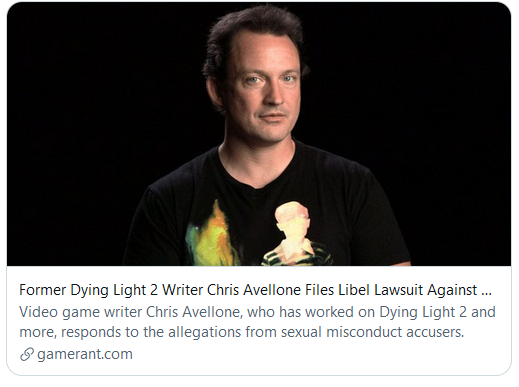
So, Chris Avellone, for those who don’t know, is (or was) a famous game writer. He wrote much of Planescape:Torment, considered one of the best role-playing games of all time. It often sits at on “best of” lists.

Last Year, Avellone was accused of inappropriate behaviour with a number of women. Game companies he’d been working with dropped him like he was greased shit; he became unemployable.

Now, I don’t know what Avellone did, or didn’t do, but what I do know is that if being cancelled means you’ll never have a good job ever again, you’ve got two choices: You can grovel (which rarely seems to work), or you can fight.

Well, or you can slink away, I guess. If you never need to work again, that’s an okay option, I suppose. Otherwise, your future is minimum wage McJobs.

Avellone has chosen to fight. I’m not sure it’s the smartest way (libel lawsuits are hell), but it’s the way he’s chosen.

Big names like C.K. Louis, the comedian, often bounce back fairly easily.

But the effects on mid- and low-level people are often catastrophic. Every time their name is entered into a search engine for the rest of their lives, what’ll come up is their alleged offense. Anyone who hires them knows that they are opening themselves up to a PR hit, so they don’t.

I’m not super-opposed to cancelling. For a long time, too many mid- and high-level celebrities lived in bubbles. The grapevine for insiders always knew about their issues, but outsiders were kept ignorant, and in the worst cases, young women were fed to them. This is certainly the case for Bill Cosby.

Cosby went to jail, eventually, and without the pile-on, that might never have happened.

But inappropriate behaviour and criminal behaviour are two different things, and the penalty of “will never have a decent job ever again” seems a bit high. Even when it doesn’t hit quite that level, as in the case of Alexis Kennedy, the hit can be harsh; his company went from expanding and illustrious to a small shop that will do one artisan game at a time. His little company had sponsored and helped multiple even smaller companies; all of them, save one, felt they had to give up the sponsorship, thus losing important help and money.

I feel a bit bad about Kennedy, because for about the first week and a half I shrugged and assumed it was true enough.

I looked into after a bit, because I admired Kennedy’s writing. The initial accusation was of being a sexual predator, but nothing that came out over the next couple weeks supported that. He had given his girlfriend a job at his firm (she begged him to), then when they broke up, he stopped praising her work and started criticizing it harshly. By all accounts, he was something of an asshole boss, though, and it’s equally possible that his praise was fake as it is that his criticism was motivated by the breakup.

He met his next girlfriend at work and, apparently, they flirted outrageously at a work event (she’s happy, they’re still together). He also apparently sat too close to some women for their comfort. There were some other offenses, mostly amounting to “an asshole boss who doesn’t follow his own procedures,” but nowhere was there any indication he was a sexual predator. No accusations of rape; not even an accusation of pressuring women for sex. He certainly seems to have weaseled on some things, but a lot of it came down to “he says/someone else says” about accusations that were almost all, at worst, “harsh language” and “two inappropriate relationships with juniors that they admit were consensual, and the unhappy one begged him for the job.”

But he still got cancelled.

I suppose this post would end better if I had a rousing finale about how I hate cancel culture or how it’s overall good, but really it’s just mob behaviour, little different from the social dynamics that used to be far more common in villages and institutions and rare outside of them. Sometimes the target “deserves” it, sometimes they don’t, and rather often, the person is disagreeable in some way. But the punishment is either disproportionate or they are accused of something they didn’t do because what they did do is shitty, but not something people feel they can hurt them for.

So I guess my non-rousing finale is, “Don’t believe it until you’ve done your own research.” Don’t become part of the mob, letting your emotions get away with you or shrug and assume something is probably true. It may be, it may not be, but you don’t actually know.

(Avellone’s Personal Post on the accusations.)


(My writing helps pay my rent and buys me food. So please consider subscribing or donating if you like my writing.)
Reminder: Prepare for the Forest Fire/Smoke Season

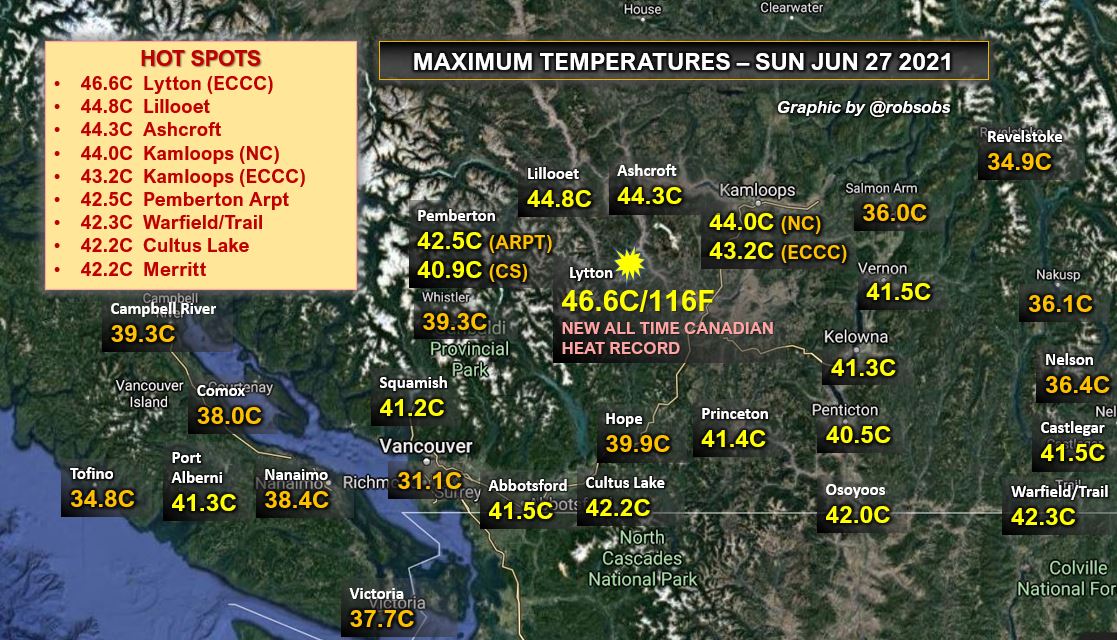
These temperatures from the West coast of Canada last weekend were absolutely insane.

I grew up in Western BC, Vancouver, and Victoria, in the ’70s and ’80s. These temperatures are crazy. Victoria, in particular (bottom right) is (or was) noted for mild temperatures. Hardly anyone has air conditioners. My parents retired there, and I visited regularly right up to about 2010. It was retirement paradise.

Anyway, if you live in the west of Canada or the US (and the West now extends far past the coast, almost to the mid line, in many cases), please be sure to buy a respirator mask (with extra filters) and an indoor air purifier, and do it NOW. The fire season is likely to hit early and hard this year, and after the rush you won’t be able to find any anywhere.

Make other preparations, including getting ready to leave, as necessary. If you are asthmatic, see about stocking up on meds, and so on. Don’t leave this, please. I know I’ve written this before, recently, and it’s a bit boring to write it again, but I want to be sure people hear this.

As for the West, I am in mourning. I love the coast; the rain forests dripping with water, the ferns looking like jewels in the dew, the deep, dark forests where decaying leaves soften each step and old trees shelter you as you walk. Much of that is going to go away. Future generations along most of the West coast will never know the beauty and ease of the temperate rain forest.

For this and many other crimes, those who chose to do nothing about climate change are guilty. We are losing so much, and will lose so much more, that should never have been placed at risk.

Some of what will go is no loss, mostly human things. But the animals and plants did nothing to deserve this, and my sorrow is even more for them than the humans who will suffer.

Only fools ask for what they deserve, but ask or not, we are going to get it. It’s just a pity that so many of the most responsible won the death bet, and so many of those who will suffer did nothing to warrant it.

Meanwhile… get prepared for fire season, so your suffering is reduced and less is added to the toll, at least these years.

Update: Barely ahead of it, wildfires have started in BC. Get the gear you need tomorrow, Wednesday. Don’t wait.


(My writing helps pay my rent and buys me food. So please consider subscribing or donating if you like my writing.)
Week-end Wrap – Political Economy – June 27, 2021

Week-end Wrap – Political Economy – June 27, 2021

by Tony Wikrent

Strategic Political Economy

THE 50-100 PAY GAP: These 20 Harsh Facts About Income and Wealth Inequality Will Shock You

[Capital & Main, via Naked Capitalism 6-22-2021]

Fourteen shocking facts on inequality and working Americans
● Worker hourly compensation increased just 17% from 1979 to 2019, while worker productivity increased more than 72% over the same time period.
● Had the income of the bottom 90% of Americans kept up with GDP growth, they’d have collectively taken home $2.5 trillion more in 2018. Over the 43 years since 1975 combined, the figure is $47 trillion.
● The wealth of the bottom half of families — roughly 64 million families — adds up to only 1% of total U.S. household wealth.
● The median white family has 41 times more wealth than the median Black family and 22 times more wealth than the median Latino family.
● In 2016, 72% of white families owned their home, compared to just 44% of Black families and 45% of Latino families.
● For the average American consumer, the share of their expenditures spent on health doubled from 1980 to 2018.
● Half of U.S. adults with lower incomes skipped necessary medical care such as doctor visits, recommended tests, treatments, follow-up care or prescription medications in the past year because of the high cost.
● Between 2008 and 2018, the number of states in which health insurance premiums and deductibles consumed at least 10% of median income increased from seven to 42.
● The price of education increased 600% more than incomes from 1980 to 2018.
● One in four Americans have no retirement savings — and those who do aren’t saving enough. The median retirement savings account of $120,000 for those approaching retirement (ages 55 to 64) will likely provide less than $1,000 per month over a 15-year retirement span.
● Social Security benefits have lost 30% of their buying power since 2000.
● Nearly 83 million adults — 34 percent of all adults in the country — reported that their household found it somewhat or very difficult to cover usual expenses such as food, rent or mortgage, car payments, medical expenses or student loans in the last seven days, according to survey research in November 2020.
● Nearly half of Black adults reported it was somewhat or very difficult to pay usual household expenses, nearly twice the rate among white adults and Asian adults (28%). A similar share (47%) of Latino adults reported such difficulties.

[Twitter, via Naked Capitalism 6-23-2021]

Open Thread

Use comments to discuss topics unrelated to recent posts.

Yes, Virginia, Permafrost IS Going to Release Carbon and Methane

So, for years I’ve been saying that a great point of concern was methane/carbon release from permafrost. Every time I brought this up, I was told by someone that studies said it was unlikely.

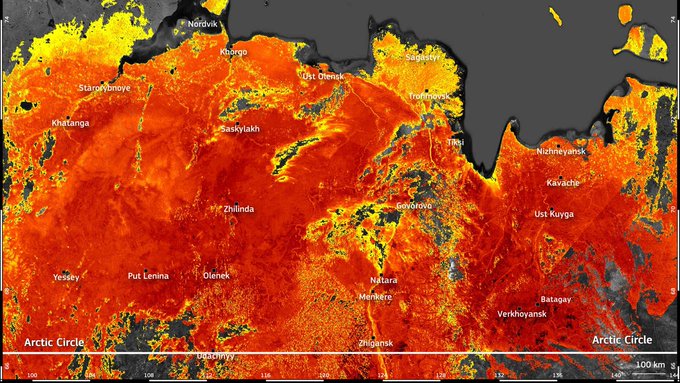
This summer in the Russian arctic:

Arctic Temperature 2nd last weekend June 2021.

Feel free to take a break from reading to bend over and kiss your ass goodbye.

There is more carbon stored in permafrost that there is carbon in the atmosphere. When permafrost thaws, it comes out as a combination of carbon and methane.

The greatest concern for climate change has always been, “When do we hit the self-reinforcing spirals?” Put another way, “When does it stop mattering if humans reduce emissions?”

The problem is that we really don’t understand the climate very well; our models are crude. Almost everything is actually coming in faster than we anticipated — Arctic ice is clearing faster than expected, Antarctic ice is calving sooner than we thought it would, glaciers are retreating faster than expected, etc, etc.

This, again, was easily predictable, in the sense that, for decades now, consensus forecasts have always come in “under” the actual results. So the smart bet was always on the over, and that’s the bet I’ve made and shared with my readers for many years now.

CLIMATE CHANGE IS NOT GOING TO BE STOPPED.

Even if it is still possible to do, we are not going to do it — our political masters aren’t doing anything significant enough to even nudge the curves. Our populations are not voting primarily on climate change, or Sanders would be President of the US and Corbyn Prime Minister of the UK.

You must plan for climate changed based on the assumption that government will be of little help — it’s you and your friends and any other people you can find who want to prepare with you.

This means assuming breakdowns in the supply chain. It means assuming hotter weather in general, BUT more variable weather also — cold waves and so on will also become more frequent. Hurricanes and other extreme weather events will continue their trends of being more common and more powerful.

Assume a marine inundation event sooner than expected; if you aren’t at least a couple feet above sea level, don’t assume you have forever do something about that — a couple decades, maybe, and extreme weather could easily cause a flood before that.

Remember that water is going to be harder and harder to get; as the glaciers go away and as there is less snow pack, rivers will be fed far less. A vast amount of groundwater has been polluted by farm runoff, fracking, and other stupidity.

I also expect that oxygen concentration in the air will decline, and air quality will be worse.

This is an accelerating trend. It has moved very slowly, but it is speeding up and will continue to speed up. Think about how Covid curves have gone in incompetent countries: slow, slow, slow — VERTICAL. We’re a ways from vertical yet, but the lines for effects are no longer in “looks flat” territory.

It may be that your circumstances allow you to do little, but do what you can. And turn your efforts towards triage: Saving, or helping, yourself and those you want to save. The political battle is lost, was lost, and until absolute catastrophe hits, nothing of significance will be done.

That’s the future. Plan for it, please.


(My writing helps pay my rent and buys me food. So please consider subscribing or donating if you like my writing.)

Why Non-surveillance States Will Out-compete Surveillance States

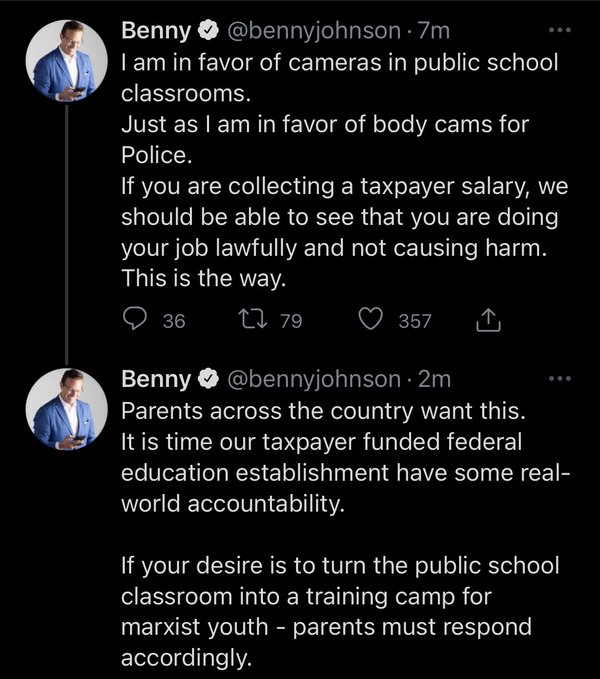
So, we have this proposal for cameras and mics in classrooms:

Johnson’s not a particularly important person and one can pick apart his logic (teachers don’t have guns), but the logic of unchecked surveillance — of cameras and microphones everywhere — leads to this place and far worse.

Right now, governments and corporations track your every move through your phone. They can force your microphone on and listen to you, and we know that they have. Infrared, gait recognition, and facial recognition, combined with drones, satellites, and ubiquitous cameras mean that it will soon be possible to track citizens’ movements 24/7 and listen in much of the time. Add in the cameras and microphones most people voluntarily put into their houses, which are in no way secure and which EULAs often allow access to anyway, and there is little to none of your life that will be unknown.

We are heading to this place. It is not in question — there is a VAST appetite for information in corporations so they can train their AIs and model and manipulate you, and from governments driven by the idea that “well, if we don’t surveil everyone and anything bad happens, we can be blamed,” from police and intelligence agencies.

There is an argument, put first, so far as I know, by David Brin, that mass surveilance is inevitable. The technology will exist (he wrote in 1998) and it will be used, and the only question is whether it ends up that everyone is surveilled and everyone can watch it, or if only criminals, government, and big corps get to watch and listen, and the rest of us are just passive victims.

I will suggest that there is a third path.

We live in a time when we have repeatedly refused to actually control technology if a profit can be made from it. Obviously, evil technologies have been allowed to run rampant to the point where we may render our entire planet unliveable.

So we assume we can’t control technology: “If it exists, it will be used.”

There is a counter-example. The Japanese Tokugawa Shogunate didn’t like firearms. They limited them and, over time, got rid of most of them except for a few old ones.

That ended badly for them: The American White Ships came, forced Japan open, and the Shogunate fell to a an internal rebellion, whose motto might as well have been “More guns! Lots more Guns! And Gunships! And EMPIRE!”

But only the first part applies to rejecting most surveillance technology because surveillance tech is not a competitive advantage between states (one can argue it makes training modern “AIs” easier, but that is minor).

Surveillance states, where people know that everything they do or say is recorded, create stultifying conformity. Almost everyone acts the same way and the easiest way to act the same way is to think and feel the same way.

Since the age of helicopter parenting and insecurity (which requires kids to go to school and get good grades and do everything right), measures of American creativity have crashed.

But this is a general rule: States where you can’t be different without being punished, where you can’t say or think what others disagree with, are obviously less creative.

Less creative states are less competitive states in eras where technology and culture matter.

If any state is brave enough to outlaw surveillance tech (except in limited circumstances), and do the work to make it stick (ie. re-engineer modern telecom tech, which is designed to be insecure from the ground up, plus be pro-active and criminally punitive to those who violate the law) they will have a massive advantage over surveillance states, technologically and culturally. I’m willing to predict, with near 100 percent certainty, that if most countries go to full-surveillance state mode, whichever ones don’t are the places which will have technological and artistic golden ages — especially if they are also smart enough to welcome refugees from surveillance states.

Freedom; real freedom, is a competitive advantage in eras where technology or culture (really, the two are intertwined) determine who wins. States which embrace surveillance technology will be ones where elites are more concerned with maintaining their internal position, i.e., staying in charge of their society and keeping the peons down, rather than those who look outwards to competition against other societies and who want the most vibrant and interesting culture internally.

The choice to embrace surveillance states is the choice to stagnate.

Many think it is otherwise, “we must embrace all technologies without choosing how they are used or we will fall behind.”

This is an immature stance; a foolish one. The mature, intelligent stance is to look at technologies and see what their results are likely to be, and then use them intelligently, to control technology and not be controlled by it.

Certainly there are technologies that are so bad overall that, as long as we have individual states, we will have to use them or fall behind in a world where those who fall behind are treated abominably; but surveillance isn’t one of those technologies. Rather, embracing it will make societies less competitive and reduce their inhabitants’ quality of life. Its only advantage is for those seeking a steady-state police state or cyberpunk dystopia.

All others should steer well clear, and all individuals who aren’t themselves very powerful should understand that surveillance is intended to dis-empower them — to get the most out of them possible, while giving the least in return, and turning them into automata for the benefit of the overlords (think Amazon warehouses and delivery drivers).

You cannot be more free than if you are unknown to your masters. The more they know, the more they will control. If you let the powerful turn you into a surveillance object, they will wring you dry, and you will have to hope that some society, somewhere, is still free and defeats your dystopia.


(My writing helps pay my rent and buys me food. So please consider subscribing or donating if you like my writing.)

How Techies Can Help Us Avoid the Rise of the Warbots

The sad truth of technological progress is that it often leads to worse outcomes, often for long periods of time. The classic example is agriculture, which led to most people living shorter, more unhealthy lives with more dental problems (pain!) and harder births for women. Most of these people also were oppressed by harsh kings, nobles, or big men.

Communications technologies are often heralded, and they have their good sides, but every significant advance in communications from oral memory techniques and writing to the modern internet has been used to increase centralized control and enable closeer control of more and more people. Modern surveillance and immediate communications allow micro-control of individuals which used to require a slave driver right there on the spot. (Hi, Amazon warehouses and delivery drivers!)

Other results have been mixed. For example, gunpowder led to mass conscription armies, and conscription armies have tended to correlate strongly with more democratic and equal societies. (It is VERY robust that those who actually are necessary for fighting get treated well — from Athens and Rome to medieval knights to Swiss Pikemen.)

We’ve moved out of the mass conscription era into a “professional” military period, and this has corresponded with a loss of equality, but we are now moving into an extremely dangerous period: The rise of autonomous fighting machines. Turkey used them in the recent Azerbijan/Armenian war, and almost everyone is working on them.

Warbots mean you only need to keep a small techie class happy, and even they don’t really have a veto on how elites use the warbots. If they want to massacre protestors, there is almost no possibility of refusal.

The narrowing of the base of people necessary, and their removal from the actual fighting puts us in a dangerous place, where .1 percent + a small, well-treated technical group can dominate a society and win wars; they don’t need everyone else beyond the Warbot supply chain.

So what we need is an easy counter. Something like IEDs – a technology any decent techie can create without needing a ton of resources.

Most modern techies spend their entire lives working on questionable techs–how to serve more ads to convince people to buy shit they don’t need — tech that does no good in the world.

If you’re an inventor type, and you want to do good, here’s your chance: Figure out a counter to warbots that ordinary people can use.


(My writing helps pay my rent and buys me food. So please consider subscribing or donating if you like my writing.)

Page 221 of 532

Powered by WordPress & Theme by Anders Norén