
Use to discuss topics unrelated to recent posts.
China from Deng (82) on, had two main plays.
The first play was a standard mercantalist export driven developing state. Low costs were used to create low cost goods primarily for overseas consumption. Foreign currency was plowed back into capital machinery acquisition. Foreign partners were given good deals and the decision makers become rich, but to play one had to give up intellectual property.
This is the standard industrialization sequences, followed by almost everyone, including Britain, Germany, the United States, Japan and South Korea.
It generally requires an already industrialized sponsor (Britain was an obvious exception to this, but the Dutch provided a similar service pre-industrialization.) For China that sponsor, from Deng on, was the United States: the US took the goods, sold the capital machinery, made profits and was generally pretty happy about the deal (just as Britain was while it sold its patrimony to the US for temporary profits.)
The second play was the housing driven internal capitalization market to make people at home feel good and fund local governments. Local governments (who control about 70% of the Chinese budget, far higher than any other major nation) oversaw massive development deals. Housing values rose, the governments made lots of money as they kept rising for decades. Similar to how for a long time now betting on rising real-estate prices in the US or Canada or the UK was a sure thing.
This synergized with moving peasants off the land and into factory and service jobs, which allowed for large commercial farms, seen as far more effective than small farms, let alone collectivized farms. (No one has been able to make collectivized farms work so far.)
This is standard, again, to industrialize you need a labor pool, and peasants tied to the land and ancestral villages aren’t free labor.
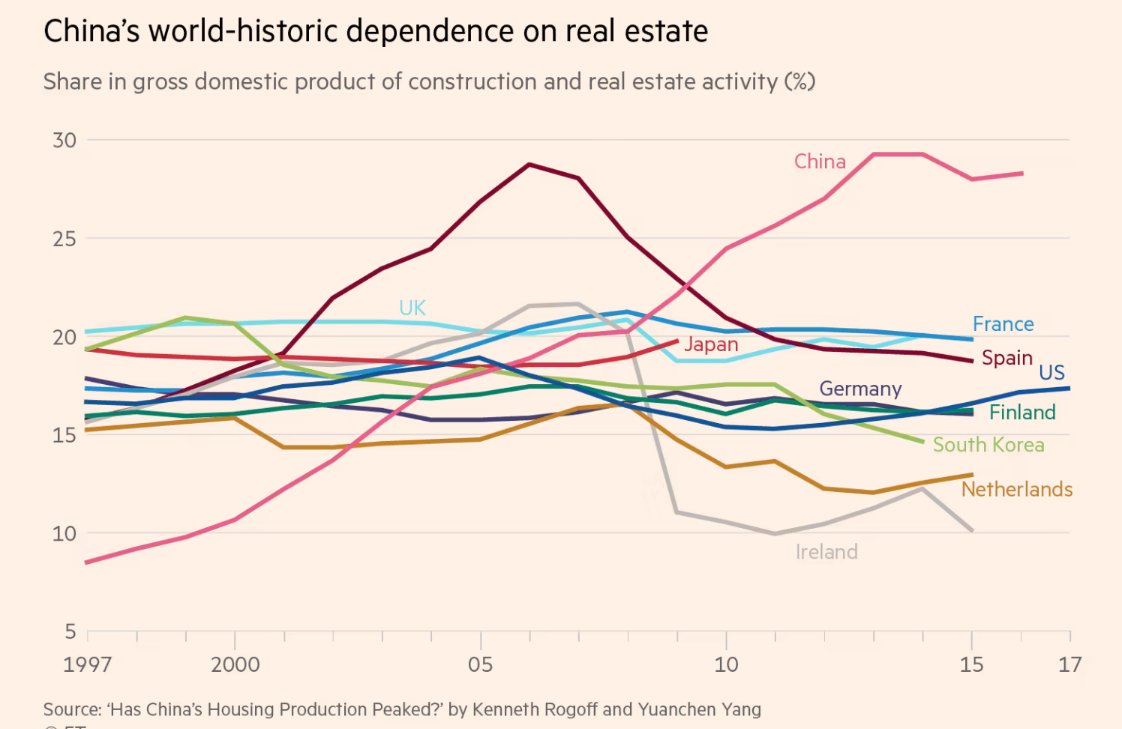
One problem with this play is that it is a “virtuous” or self-reinforcing cycle and it can get completely out of control (see above.) The second is that it makes local governments very dependent: they don’t want it to end, even though it leads to massive inequality and mal-distribution of resources.
But that chart shouldn’t be seen as entirely a bad thing: note that US housing prices are ludicrously high by restriction of supply. The Chinese ARE and did supply a lot of new housing. The problem is it now isn’t getting to people who need it.
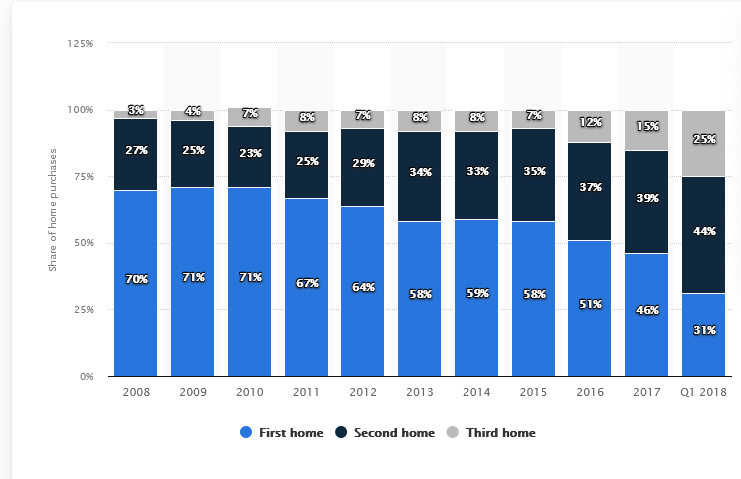
The above chart is pathological, and notice that it only goes to 2018. Anecdotally, young people in China, like in the US or Canada or the UK just can’t afford to buy a home unless their parents pay.
The second play, by the way, is often used independently. Turkey, for example, got about a decade and a half of prosperity out of it, but without the underlying “real” economy to support it, all it lead to in the end was inflation and economic weakness, because gains are always very unevenly distributed.
The problem with these two plays is that they are time bounded and lead to the middle income trap. They don’t develop a consumer economy, and income stagnates: far above undeveloped, but much lower than high income nations like the US, Japan and so on.
Likewise, these plays lead to extreme levels of inequality, as they did in the US during the gilded Age.
So, China had/has problems: high inequality; a gilded Age; housing which isn’t getting to those who need it. The social contract of “if you work and get a degree and so on, you’ll do well, is on the edge of breaking.”
But they’re working on it. Some parts they’ve already somewhat solved.
Solutions
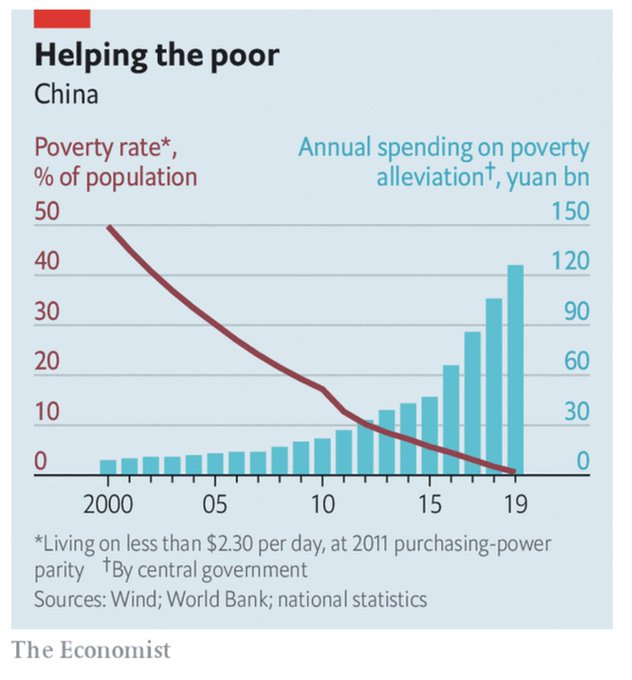
The first is poverty. The extreme poverty metric is garbage, but the chart still indicates that there’s a hell of a lot less poverty than there was even twenty years ago.
The second is what is called “moving up the value chain.” Countries which industrialize tend to recapitulate history, starting with textiles (the first industrialized goods.) But if you want to become a high income nation, you need to produce the highest value-add goods. China now does, and has even deliberately been moving out low value industry to other countries.
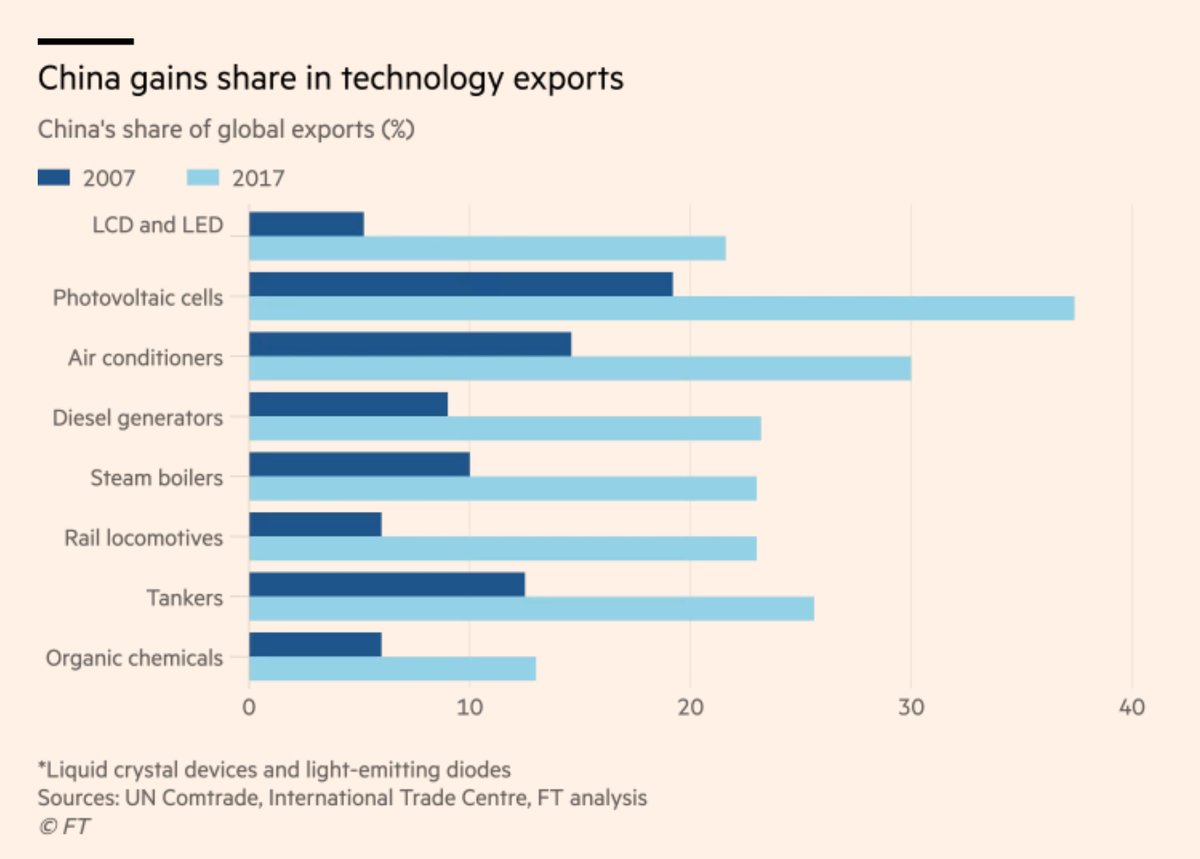
For a long time, if you wanted to buy advanced goods you had to go to the West, Japan, South Korea and Taiwan. That was it, and all of those are firm members of the “rules based order” or, really, of the US. Now you don’t, and China is absolutely eating the West’s lunch. France’s exports to its ex-African colonies, to name just one, have absolutely collapsed. China offers better deals with less political and military interference, and now that those nations don’t “need” France, they’re kicking France out.
But if the rest of the world doesn’t need to buy from the West, in the medium to long term, they aren’t going to sell to us, because we have so little they want. This where we move into Western collapse mode and is a large part of why, ex-climate change and environmental collapse, China would have already one, except perhaps for some shooting along the way. (Much like America’s ascendence was already baked in by 1900.)
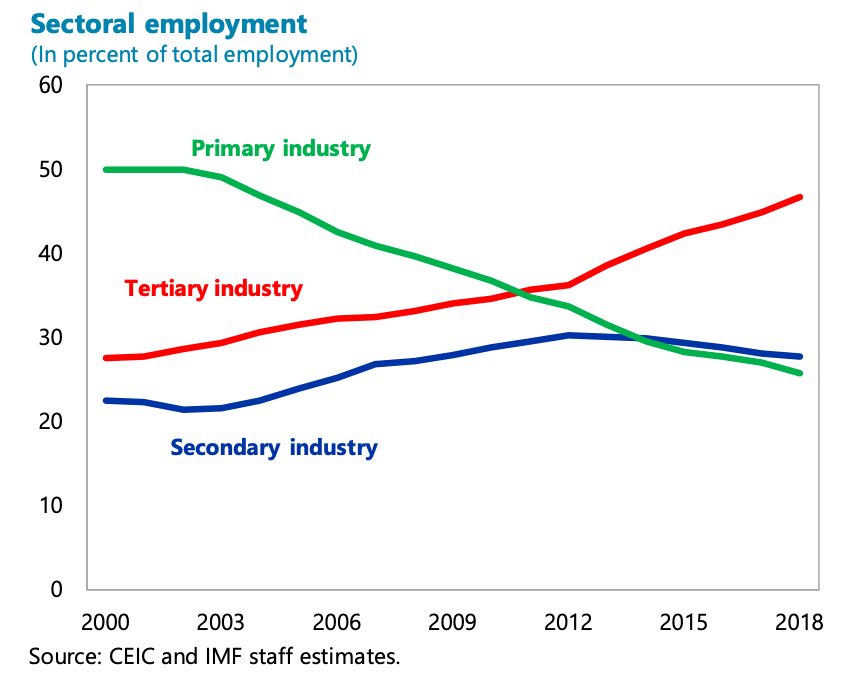
Moving to a high income, goes in two phases: first you increase manufacturing, then you increase services. (Manufacturing is secondary industry, services are tertiary, and primary is resource extraction in the chart below.) Again, you can see China is making this transition, and blazingly fast, too.
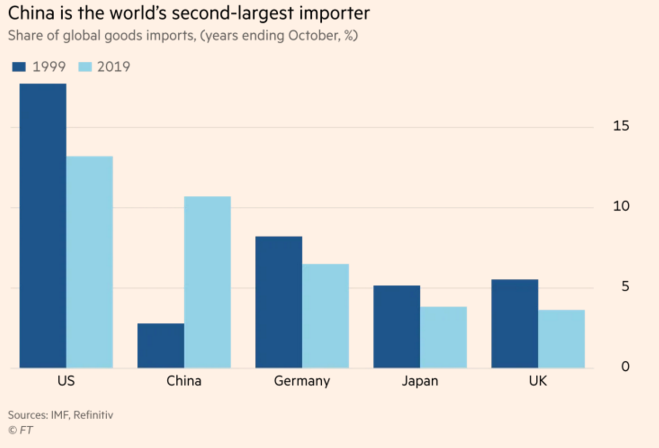
Key to being a high income nation is a consumer economy. While you want to create as much of the goods and services as you can domestically, there is always a transition from “living with what you have” and “spending almost all your foreign money on capital goods” to “we can now import stuff.” China is well on its way.
But China’s main issue now is the real-estate market. Prices are too high; it’s an investment and speculation vehicle; the people who need housing aren’t able to afford it, and since China has enough housing now, further investment is a mis-allocation of resources.
Which leads us to—
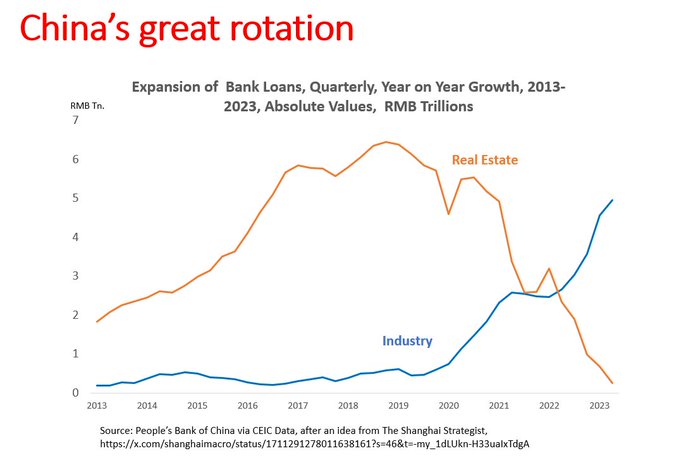
Boom. China is crashing the real-estate market. In the western press this is viewed as bad, an economic crisis, but it is necessary. Housing needs to become a commodity good, so that everyone can afford it and so that resources go to more needed areas.
And while making it to high income includes a lot of consumption, China has challenges which can only be met thru manufacturing, engineer and science. It needs to leap past the final western barriers in industries like semiconductors, biotech and aircraft. It has to transition to a clean electrified economy and prepare for climate change. (Really, to avoid a collapse, they have to build a massive sea wall along the northern coast, otherwise the northern breadbasket will wind up under water.)
From where I sit, China is doing most of its major economic policy correctly. Transitions are painful, and it is possible they’ll botch their transition, but these changes are necessary. Indeed, if the West is serious about re-industrializing, we need to do the same thing, with certain differences. We need to build more housing and collapse pricing, where they need to build less housing and collapse prices.
There’s more to write on China, in particular about climate change, demographics, Covid, Chinese dependencies and so on, and we’ll return. But for now, this is the big picture.
About two-thirds of these charts are from Albert Pinto’s twitter account. Worth following.
https://twitter.com/70sBachchan
Donors and subscribers make it possible for me to write, so if you value my writing, please DONATE or SUBSCRIBE
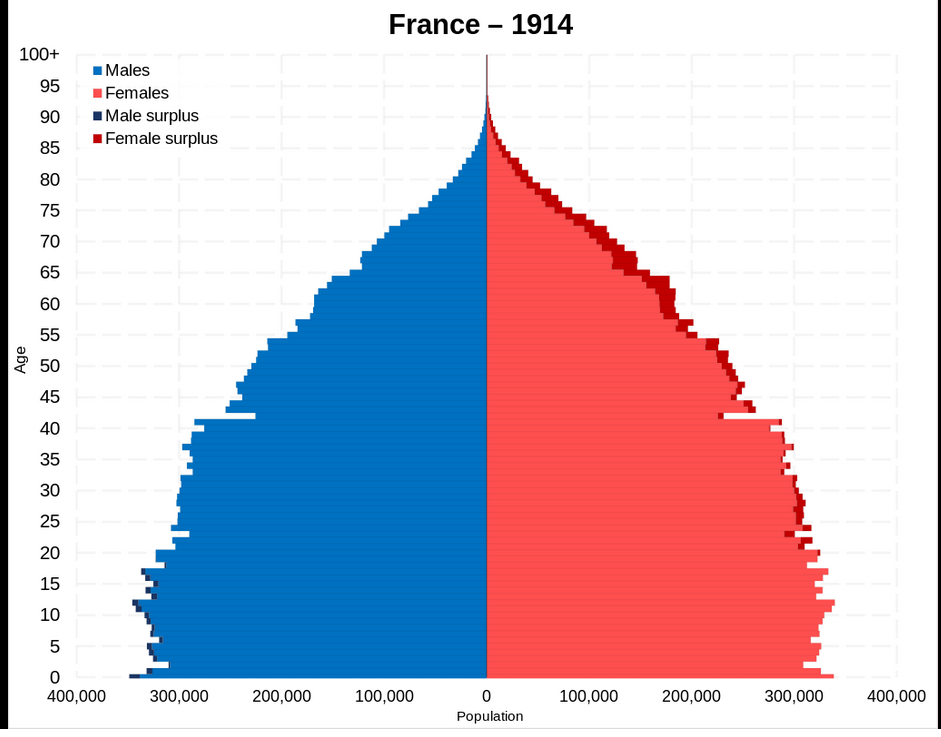
The great devastation of World War I for the combatants was a lost generation. A massive chunk of the fighting age men died. The established figure for France is somewhere around 1.5 million (the official figure is 1.3 million, but it is generally agreed that’s too low.)
Let’s take a look at what that meant. First the population pyramid in 1914.
Next, the population pyramid in 1920 (Both from Wikipedia.)
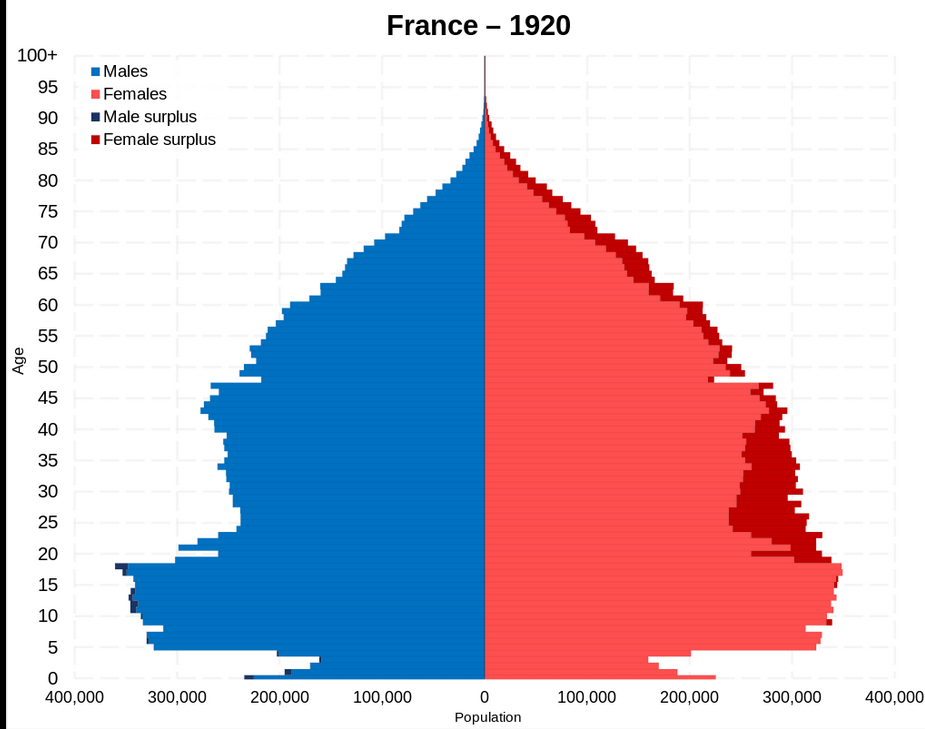
Ouch.
Similar charts for France before and after the Napoleonic wars would be even worse. Or Russia before and after WWII.
Anyway, at the beginning of the war and even before, I called for peace on the Austrian model. Well, it turns out that almost happened.
Gerhard Shroeder, the former chancellor of Germany, confirms.
At the peace negotiations in Istanbul in March 2022 with Rustem Umerov, the Ukrainians did not agree on peace because they were not allowed to. For everything they discussed, they first had to ask the Americans. I had two talks with Umerov, then a one-on-one meeting with Putin, and then with Putin’s envoy. Umerov opened the conversation with greetings from Zelensky. As a compromise for Ukraine’s security guarantees, the Austrian model or the 5+1 model was proposed. Umerow thought that was a good thing. He also showed willingness on the other points. He also said that Ukraine does not want NATO membership. He also said that Ukraine wants to reintroduce Russian in the Donbass. But in the end, nothing happened. My impression was that nothing could happen, because everything else was decided in Washington. That was fatal. Because the result will now be that Russia will be tied more closely to China, which the West should not want.
And the Europeans? They have failed. There would have been a window in March 2022. The Ukrainians were ready to talk about Crimea. This was even confirmed by the Bild newspaper at the time.
No NATO, Austrian style peace, they give up their claims on Crimea.
Instead what has happened is the loss of a generation of Ukrainian men. I suspect the overall population will turn out to be even worse than the French in WWI, especially since 6.2 million fled Ukraine out of a population of 43.79 million before the war. That’s about 14%. I’m guessing most of them won’t want to return, though some will be forced to by their host countries.
Ukraine will take generations to recover from this war. Eighty years from now it and climate change will be the major factors.
Ukraine is going to wind up without Crimea, Donbass, Luhansk, the Crimean land bridge and possibly a chunk more. It could even lose its entire coast.
The war is being determined on the battlefield. Russia is now, as best I can tell, actually taking ground faster than before. In the battle for Avdiivka the Russians have taken the local hill with the commanding view over the entire region, allowing them to interdict reinforcements and hit anything they want.
They did this quickly.
Ukraine is losing, the speed of its loss will increase, and they will wind up with less population and land than if they had just made peace two months into the war.
Donors and subscribers make it possible for me to write, so if you value my writing, please DONATE or SUBSCRIBE
Russian offensive military campaigns in eastern Ukraine have been partly behind a 90% increase in Russian casualties recorded by Ukraine, according to an intelligence update from the UK Ministry of Defence.
Russia has been carrying out offensive operations in the area of Avdiivka, a small city just to the north of Donetsk.
We’ll note first that UK intelligence has been just a wee bit biased. So if they say 90%, well, take it with a tablespoon of salt.
But let’s assume this is true. What that means is that on shifting to offense from defense, while attacking one of the most heavily fortified areas in Ukraine, Russian casualties have slightly less than doubled.
Which is dog bites man. It’s what you’d expect.
The question is advancement. Maps are quite different from different sources and so are casualty lists but it’s clear that this is slow work.
The bottom line is that Avdiivka is more heavily fortified than Bakhmut. Russia isn’t going to take it easily or quickly unless there is a Ukrainian collapse. Understand clearly that the US and NATO are running out of arms to send to Ukraine, and that artillery shells and missiles intended for Ukraine are now being sent to Israel.
The Palestinian/Israeli war is turning out to be a big plus for Russia and if the war expands, especially if the US becomes more directly involved, Ukraine may find itself out of equipment and ammunition. America is particularly like to go to war if Iran declares.
Without equipment, even the best fortifications won’t stand.
Meanwhile, in Palestine, the 17 trucks of relief were not, in the end, let in. Most Palestinians are down to about a liter of water a day, and not clean water either. Food is running out. The Israeli army has still not invaded Gaza. I would guess they are waiting for deprivation to do its work, and reluctant to allow any aid in because some of it would be used by Hamas fighters.
Israeli morale appears to be shaky, and they are very wary of invading a built up urban area with 40K entrenched fighters. Since they don’t feel they can win that battle as it stands (at least without shattering casualties) they are engaging in siege warfare. Unfortunately, there are 2 million civilians.
All hospitals in Gaza have been told they must evacuate, and are refusing. Anaesthetics are almost entirely out, so operations are being carried out without anaesthesia. Vinegar is being used as a disinfectant in some cases.
To call this a humanitarian disaster is to understate the case, but at least the Israelis have managed to make Russia look civilized.
I would expect massive breakouts of disease given the water and sanitation issues, especially if this goes on for weeks to months, as seems likely.
The Israeli end game appears to be genocide or full ethnic cleansing. We’ll see if they stick it out and if other forces allow it. Even US friendly states like Qatar and Jordan are becoming restive: Jordan’s King straight up refused to meet with Biden, which is amazing.
At least one Iraqi militia is moving to the border with Israel, and I expect many are. Hezbollah is being held back, I suspect, by a reluctance to have Lebanon subject to full bombing again, but have forced Israel to create a five mile DMZ on their border and to evacuate settlers.
I still think an OPEC embargo would be the simplest way to force an end to this, but if a military solution is desired, I’m sure Hezbollah and other potential antagonists want a simultaneous declaration of war.
The joker remains Israel’s nuclear weapons, with threats to glass Iran, and so on. The simplest solution would be to get a nuclear umbrella from Pakistan or Russia, but even that might not work if Israel thinks it is about to lose. To avoid that, a reciprocal threat would have to be made: a promise to not kill Israeli civilians unless nukes are used. Ugly, but Israel is, at least, acting like a mad dog.
This seems likely to drag out for quite some time, which is very bad for the civilians in Gaza.
If you ever wondered what you would do if a genocide was likely or occurring, you now know.
Donors and subscribers make it possible for me to write, so if you value my writing, please DONATE or SUBSCRIBE
by Tony Wikrent
Strategic Political Economy
Deb Chachra’s ‘How Infrastructure Works’
Cory Doctorow [Pluralistic, via Naked Capitalism Water Cooler 10-18-2023]
“Infrastructure isn’t merely a way to deliver life’s necessities – mobility, energy, sanitation, water, and so on – it’s a shared way of delivering those necessities. It’s not just that economies of scale and network effects don’t merely make it more efficient and cheaper to provide these necessities to whole populations. It’s also that the lack of these network and scale effects make it unimaginable that these necessities could be provided to all of us without being part of a collective, public project. The dream of declaring independence from society, of going ‘off-grid,’ of rejecting any system of mutual obligation and reliance isn’t merely an infantile fantasy – it also doesn’t scale, which is ironic, given how scale-obsessed its foremost proponents are in their other passions. Replicating sanitation, water, rubbish disposal, etc to create individual systems is wildly inefficient. Creating per-person communications systems makes no sense – by definition, communications involves at least two people. So infrastructure, Chachra reminds us, is a form of mutual aid. It’s a gift we give to ourselves, to each other, and to the people who come after us. Any rugged individualism is but a thin raft, floating on an ocean of mutual obligation, mutual aid, care and maintenance. Infrastructure is vital and difficult. Its amortization schedule is so long that in most cases, it won’t pay for itself until long after the politicians who shepherded it into being are out of office (or dead). Its duty cycle is so long that it can be easy to forget it even exists – especially since the only time most of us notice infrastructure is when it stops working.”
In the Nineteenth Century, Scientists Set Out to Solve the “Problem of American Storms”
[Humanities, via The Big Picture 10-21-2023]
[In the 1830s, telegraph] operators had discovered something both interesting and paradoxical, the writer Andrew Blum observes in his book The Weather Machine. The telegraph had collapsed time but, in doing so, it had somehow simultaneously created more of it. Now people could see what the future held before it happened; they could know that a storm was on its way hours before the rain started falling or the clouds appeared in the sky. This new, real-time information also did something else, Blum points out. It allowed weather to be visualized as a system, transforming static, localized pieces of data into one large and ever-shifting whole….
Morse’s invention promised to finally help shed light on what Joseph Henry, the first secretary of the newly founded Smithsonian Institution, called in the 1847 annual report the “problem of American Storms.” Henry was referring to an ongoing scientific spat known as the “storm controversy,” which had been raging in the pages of journals for nearly two decades….
The Smithsonian’s weather “crusade” would become the institution’s first major scientific undertaking, and it consisted of two parts. The first involved recruiting the telegraph companies to provide daily, nationwide weather updates. Starting in 1849, instruments were sent out to several offices around the country with a request that operators pause traffic on the lines in the morning to submit brief descriptions of local conditions. A few years later, Henry installed a map in the lobby of the Smithsonian Castle, where the collected information was displayed using a series of color-coded cards and arrows. Any time after 10:00 a.m., members of the public could stroll in and see for the first time “one view of the meteorological condition of the atmosphere over the whole country.” ….The Smithsonian’s volunteer weather project would not officially end until 1874, but after the war, Henry continued to face significant funding constraints, as well as larger questions about who should be tracking weather in the United States and how they should be doing it. Science was shifting toward professionalization in the post–Civil War era, and an era of amateur meteorologists—of statesmen tinkering with hygrometers in the fields of their plantations, of businessmen arguing about the atmosphere in scientific journals—was coming to an end.The country did need weathermen, however. That much was now apparent. And those weathermen had to come from someplace. Congressman Halbert E. Paine, a Republican from Wisconsin’s first district, thought that place should be the War Department. In 1869, he introduced a piece of legislation to that effect. “Military discipline,” he wrote, “would probably help secure the greatest promptness, regularity, and accuracy in the required observations.” ….As the Signal Corps grew, the focus on tracking storms expanded to incorporate forecasts (which were referred to as “probabilities.”) Daily weather maps and bulletins produced by the Signal Office were displayed in post offices and observer-sergeants submitted their information to local newspapers. The work of the Division of Telegrams and Reports for the Benefit of Commerce was no longer benefiting just commercial interests—ranchers and sailors and farmers—but the public at large. At least one-third of households in the United States, Myer estimated at one point, were receiving weather information from the Signal Corps in one form or another.
By 1880, the Army’s weather service was “flourishing,” writes Raines. The state of the country’s military communications systems, however, was another story. The man-hours and money being siphoned away from the Army’s signaling work and into its storm intelligence efforts only continued following Myer’s death from nephritis in August of that year. The new chief signal officer, Colonel William B. Hazen, would go on to pour more of his office’s resources into weather-related research, rolling out new scientific projects—the development of a meteorology textbook, “aerial investigations” conducted in hot-air balloons, studies of atmospheric electricity—taking the Signal Corps’s meteorological work to new heights, literally, while the Division of Military Signaling tried and failed to catch up with the technological advances being made by its European counterparts.
In 1887, writes Raines, “the question of the status of the Signal Corps . . . finally came to a head” when Secretary of War William C. Endicott “stated in his annual report that because of its concentration on weather duties the Signal Corps could no longer be relied upon for military signaling.”….
Young Morality and Old Morality
Hamilton Nolan [How Things Work, via Naked Capitalism Water Cooler 10-18-2023]
“Who is being childish here? Is it the young college students, appalled at genocide looming in front of their eyes, possessed with the overwhelming urge to do something, who—despite not possessing a PhD in global affairs—flood into the streets and rage against the atrocity? Or is it the well educated and highly placed and influential adults, granted positions of great importance, who, as a crisis unfolds, as civilians are murdered, as neighborhoods are bombed, as oppression and religion collide in war, use their time griping about the hotheadedness of the young people protesting in the streets? Which of these groups has more accurately identified what should be our current topic of attention—the young people whose focus is on the governments that possess militaries and missiles and are poised to cause thousands of deaths, or the adults whose focus is on how some college kid said something annoying at a DSA rally? Wake the f*ck up. The adults in the room are everywhere proving the kids’ critique to be true.”
Samuel Huntington’s Great Idea Was Totally Wrong
Jordan Michael Smith, October 19, 2023 [The New Republic]
His “Clash of Civilizations” essay in Foreign Affairs turned 30 this year. It was provocative, influential, manna for the modern right—and completely and utterly not true….
…Huntington’s argument is so antiquated that it has already gone through several afterlives and been resurrected, like a horror movie villain. As the twentieth century ended and liberal capitalist democracy seemed unrivaled, it appeared as though The Clash of Civilizations was unduly pessimistic and perhaps irrelevant to the international arena. But after the terrorist attacks of September 11, 2001, Huntington’s book became a bestseller for a second time, as conservatives across the United States and Europe cited its arguments for why Islam was fundamentally incompatible with Western society. When refugees from Syria and elsewhere in the Middle East attempted to find stability in white-majority countries, Huntington’s ideas were invoked as a reason for opposing such ventures. Right-wingers like Steve Bannon have utilized the Clash of Civilizations thesis to reject immigration to the United States. Perhaps most surprisingly, thinkers around Russian leader Vladimir Putin have argued that their country is the leading defender of a Christian civilization that the rest of Europe has largely abandoned, providing yet another lifeline to a 30-year-old essay….
How a Maneuver in Puerto Rico Led to a $29 Billion Tax Bill for Microsoft
[ProPublica, via The Big Picture 10-16-2023]
In the largest audit in U.S. history, the IRS rejected Microsoft’s attempts to channel profits to a small factory in Puerto Rico that burned Windows software onto CDs
I’ve mentioned before the possibility of military defeat, but there’s a better way.
Simply have OPEC do another oil embargo to the West and its enablers until the situation is resolved, with a two-state or one state solution and significant restitution. Yeah, the US and Canada produce a surplus, but it’s not enough of a surplus to support all their allies.
And if all OPEC members don’t agree, it really doesn’t matter. Russia, Saudi Arabia, Iran, Iraq and the Gulf States are enough. Since Russia’s already already under various sanctions…
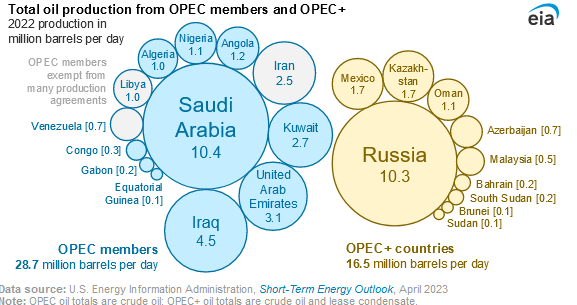
That would, of course, require Saudi Arabia and the Gulf States to do more than cry crocodile tears about the Palestinians, and actually do something, which is unlikely. But it’s worth remembering that it is possible and putting it on the table.
Besides, the lion should show its teeth occasionally anyway.
Donors and subscribers make it possible for me to write, so if you value my writing, please DONATE or SUBSCRIBE
Use to discuss topics unrelated to recent posts. (aka. no Palestine.)
Let’s spell this out in the simplest terms possible.
Israelis came to a land with its own native population. They wanted to live in the land and the land was not very large. (Israel is a small country.)
That required that the people who were already there be removed.
This was done in stages. Some of the early parts were done by buying the land, generally from landlords who didn’t live in Palestine, then evicting the natives. Most of it was done with violence, starting with the Nakba.
The project of Israel is to create a Jewish religious-ethnic state where there hasn’t been one in nearly two thousand years.
The locals people also breed faster than Israelis.
This means they must, again, be removed. There are two ways to do this. You can get them to move away from the land you want, which is known as ethnic cleansing, or you can kill them, which if done in large enough numbers against a specific group is known as genocide.
Israel’s project is intrinsically one of ethnic cleansing, with the possibility of genocide.
That’s how it was designed.
This is why I support a one state solution, in which Israel becomes a secular state with everyone having citizenship. As long as it is a “Jewish” state, ethnic cleansing will always be the goal, at least until it is completed.
Israel cannot be redeemed until the basis for its existence is changed.
This doesn’t make Israel unique, many if not most states were settler states at some point, with more or less ethnic cleansing (sometimes they just made the conquered people the lower castes, as with Normans in England or Aryans in India).
We now believe that ethnic cleansing and genocide is bad and that it shouldn’t be done any more. (Or we say we believe that.)
When Israelis say “you oppose what you yourself did” they aren’t wrong. But that’s like saying “well, you murdered a bunch of people in the past, why can’t I murder people now?”
At the end of the day, however, this will be determined not by what is moral, but by balance of force. For a long time the Israelis had the most force, the question is if they still do.
If they do (with America and Europe’s help) then they will keep moving towards their project.
If they don’t, then the best they can hope for is a single state solution. All other end states for them are worse.
Donors and subscribers make it possible for me to write, so if you value my writing, please DONATE or SUBSCRIBE