Oh?
My goodness. Never seen anything quite like this just now on French news @le20hfrancetele
A quarter of a million people forced to leave their homes. Firemen exhausted in the unequal fight. Huge area around Bordeaux engulfed in flames
Please give it a watch
My Eng subtitles pic.twitter.com/HujNlMzUrl— Alex Taylor (@AlexTaylorNews) July 26, 2026
Almost everything is on track.
- Covid?
- The financial crisis?
- This war? China officially leading the US in tech and industry?
- Global warming coming on faster than expected?
- Massive wildfires every summer?
- Trump being President?
- The Ukraine war?
- That little genocide in Palestine?
- The US being unable to build enough weapons?
- The complete breakdown of international law and (more seriously) the WTO trade order?
- A revolution in war making technology which has allowed middle powers to fight great powers?
- Multiple payment systems challenging dollar privilege.
- Serious collapses in animal and insect populations, so much so that bug splat doesn’t exist in much of the world any more and that I rarely see songbirds.
- Constant, inexorable rises in food prices, even before the war.
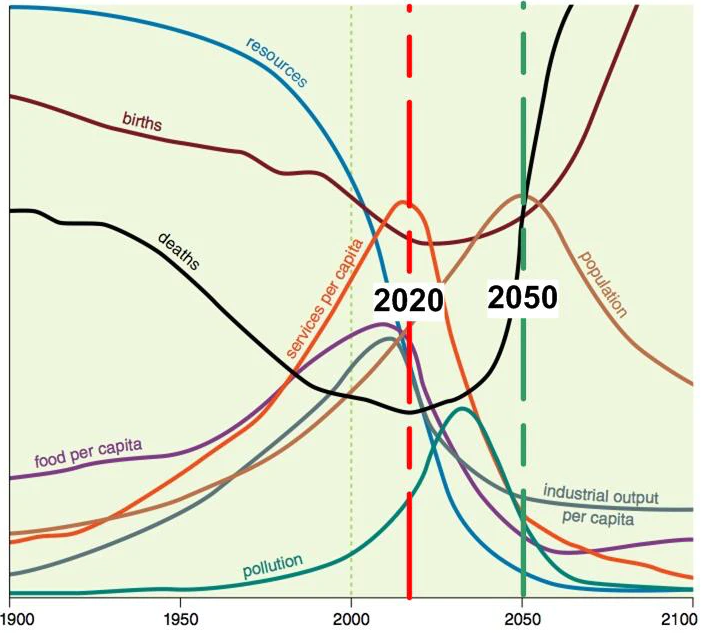 Notice that food per capita line. Remember all the screaming about fertility rates and look at the births line (though I think the collapse is more severe than modeled.) Industrial output is still increasing, as the chart suggests, but China’s about to go over a demographic ledge and I expect it will peak within ten years of the chart’s prediction. Resources are very definitely being depleted, though less fast than predicted. Still, it’s happening. Just read in detail about oil production.
Collapse happens slowly, then all at once. The post-USSR order has collapsed. It’s gone. The trade order has collapsed. Military supremacy is gone. Every summer we get wildfires and smoke in major cities, which did not happen before about 2019. This is a textbook example of climate change re-ordering the environment. What will grow up afterwards will be a different mix of plants and animals.
Things are happening. Big things. If you want the official “big collapse” well, it’s not here yet for the first world, but the death by a thousand self-inflicted wounds continues. As much as I admire what China has done, and as impressed as I am by solar and so on, they are still an industrial society based on planned obsolescence and over-production and are about to hit a demographic cliff (good in the long run, but it will cause issues.) The only escape from much of the resource trap would be large scale off world mining. Musk isn’t going to manage it. The Chinese are taking a shot, we’ll see. That wouldn’t, by itself, fix ecological collapse, however and won’t supply all necessary resources. It’s also unlikely to come on line in time, if at all.
You’re living thru an epochal period, similar to the WWI thru WWII period: everything is changing, but this time including serious environmental issues. There’s also all the social issues related to AI, phones, the collapse of reading and reasoning ability in some societies, mass surveillance and the rise of authoritarianism, even as civil liberties are contracting in almost every country in the world.
The post-war and post-cold war orders are dying or dead. The negative consequences of the industrial revolution are hitting home after we got the goodies for a couple centuries.
Things are happening. More things will happen over the next couple decades. If you can’t see that, you’re blind.
What I write here is for the benefit of everyone, but alas, I live in capitalism and I, and the site, take money to keep running. If you value the writing here and can, please subscribe or donate.
Dermot o connor
I save a special contempt for the people who try to normalise the catastrophic. Twice my life has been in danger from these events, and several friends have lost homes and almost lives from them. I can only wonder if the professional shruggers went through the same if it would cop them on. I doubt it.
Like & Subscribe
I save a special contempt for the people who try to normalise the catastrophic.
I have even more contempt for people who exploit catastrophes in order to manipulate perceptions and perspectives.
If you are soooo concerned about the uptick and rash of wildfires and believe them to be the result of manmade climate change, then you have a duty and a moral obligation to not laud China’s ascendance to the premier world’s superpower and instead see it as grotesque and the imminent tragic catastrophe it is and the worse catastrophe it is about to become.
To Ian, i can’t speak for rw95 but I can speak for myself or, better yet, I will let Soredemos speak for me since Sor articulated my point perfectly. Here is his comment below lifted from another thread and it appears it has been largely overlooked.
“‘Nothing ever happens” is a particular meme that has always had a certain degree of sarcasm to it. Lot’s of things happen all the time in all kinds of places, most of them bad things. But the point is that from the heart of the Imperial system the system as a whole basically keeps grinding on. It degrades, it gets worse, things get more expensive or harder to do. But it has yet to catastrophically break. Even with something like 2008 or covid society didn’t actually collapse, or even get very close to it in any real sense.
Tell, for example, an Iraqi in 2003 that ‘nothing ever happens’ and it would be an absurd statement. But if you live in the United States the last few decades many things have happened, but the world hasn’t fundamentally broken. Houses got foreclosed on, maybe your cousin died of a fentanyl overdose, lots of people died of covid (though you may or may not have known any of them), maybe your kids are still living with you and will probably have to inherit your house, food has gotten more expensive. But the lumbering giant that is American civilization continues to operate through massive inertia. Very few people alive today remember the Great Depression, which is the last time things completely, visibly broke.
spud
and the super acceleration of the damage being done was when a group of capitalists came to power in 1993, and opened up the world to complete plunder.
one of the few good things that is happening is the demise of the W.T.O., as bill black calls rube goldberg schemes like that, kangaroo courts.
https://neweconomicperspectives.org/2015/04/obama-tpp-every-one-that-doeth-evil-hateth-the-light.html
“Give away U.S. and other nations’ sovereignty to a kangaroo (non) court dominated by lawyers for CEOs
Allow these kangaroo non-courts to destroy vital regulations and bankrupt nations at the behest of the worst corporate CEO plunderers – exposing the world to even more frequent and severe financial crises. I have explained these last two points in more detail in the past.
These provisions of TPP are so bad that they are depraved – and we have abundant, terrible, and global experience under past, more limited Faux Trade deals with the same provisions to know that the word “depraved” is the appropriate description.”
———-
free trade has caused massive increases in pollution just from shipping alone. i pointed this out in 1993, and was laughed at. yet during covid, the pileup of ships in los angles, caused massive pollution, caused the ships to have to anchor hundreds of miles away.
the dead tree’s in california tell the story.
Shipping contributes to air, water, noise, and oil pollution through greenhouse gases, sulfur oxides, plastic waste, underwater noise, and oil spills. Ships emit about 3% of global CO₂ and 18% of nitrogen oxides, and plastic debris from shipping makes up a significant share of marine litter.
Wikipedia aida-americas.org
———-
dead tree’s, the results of emissions from free trade
https://flipboard.com/@flipboard/-californias-trees-are-dying-at-a-catast/f-a7616993ac%2Fbuzzfeed.com
“It’s overwhelming and hard to explain what endless views over mountains look like with a sea of brown and yellowing trees. The area is so affected by dead trees; you smell fires and hear chainsaws all day long. Everywhere you look there are dead trees.”
https://www.localfutures.org/globalizations-blowback/
” Globalization’s Blowback
By Alex Jensen | August 9, 2017 | 4
A recent study of air pollution in the western United States made a startling finding: despite a 50 percent drop over the past 25 years in US emissions of smog-producing chemicals like nitrogen oxides (NOx), smog actually increased during that period in the rural US West – even in such ‘pristine’ environments as Yellowstone National Park.
Most of this increase was traced to “the influx of pollution from Asian countries, including China, North and South Korea, Japan, India, and other South Asian countries.”[1] That’s because over the same period that NOx emissions declined in the US, they tripled in Asia as a whole.[2] In media reports of the study, China and India are described as the “worst offenders” of this fugitive “Asian pollution”.[3]
Left only with these findings, a reasonable conclusion would be that the US has become more environmentally enlightened in recent decades, while Asia – particularly ‘developing’ Asia – is a veritable eco-reprobate, sacrificing not only its own but global airsheds to choking pollution. The new, anti-environmental EPA director, Scott Pruitt, recently expressed this view in explaining why the US should exit the Paris Climate Accord: “[China and India] are polluting far more than we are.”[4]
What’s missing?
A similar study of global air pollution drift in 2014, focusing on China and the US, made comparable findings, but included an important factor missing from the more recent study: production for export.
Among other things, the scholars of the older study asked how much of the Chinese air pollution drifting to the Western US was occasioned specifically in the production of exports for world markets (including the top destination for Chinese manufactures, the US.)
The answer? In 2006, up to 24% of sulfate concentrations over the western United States were generated in the Chinese production of goods for export to the US.[5] Applying these findings to the more recent study, it’s likely that a significant percentage of the Asian nitrogen oxides now choking the US West were also emitted in the production of goods destined for the US.
In other words, it’s meaningless to speak of “Asian pollution” in this context. Though the pollution was emitted in Asia, it properly belongs to the country/ies on whose behalf and at whose behest it was produced.
Even more accurately, the pollution finally belongs to the transnational corporations (TNCs) who are the real drivers and beneficiaries not only of offshoring, but also of insatiable consumerism through marketing and obsolescence.
Economic globalization has enabled the manic scouring of the world by TNCs for the most ‘liberal’ (read: unregulated) environments in which to locate production facilities – the places where expenses can be minimized and profits maximized.
Since the biggest drags on corporate profiteering come from taxes, environmental regulations, and decent labor protections and wages, the global relocations of TNCs have largely been towards countries where those costs are lowest, or absent altogether.
By increasing their economic power, globalization has also given TNCs the ability to capture governments, which then collude in further reshaping of the world through ‘free’ trade treaties, supra-national institutions like the IMF, WTO and World Bank, and subsidies and hand-outs to attract and retain big businesses.
This entire system of globalization, production and pollution off-shoring is driven by the profit-maximization logic governing transnational corporations, greased along by an ever-growing number of bilateral and global free trade treaties. As economist Martin Hart-Landsberg writes:
“Beginning in the late 1980s large multinational corporations, including those headquartered in the US, began a concerted effort to reverse declining profits by establishing cross border production networks (or global value chains).
This process knitted together highly segmented economic processes across national borders in ways that allowed these corporations to lower their labor costs as well as reduce their tax and regulatory obligations. Their globalization strategy succeeded; corporate profits soared. It is also no longer helpful to think about international trade in simple nation-state terms.”[6]
China – having colluded with global capital in turning itself into the ‘factory of the world’[7] – is bearing the lion’s share of globalization’s brunt. But at least China is getting rich as a result, right? Certainly there is an emerging wealthy (and superwealthy) class within China that is profiting from globalization, but it represents a minuscule fraction of the overall population.[8] The mass of the workers who make up China’s labor and ‘bad-labor’[9] workforce are not benefiting from the country’s conversion into a TNC workshop: labor’s share of China’s GDP has been steadily falling since the late 1990s.[10] For a high-end electronic product like the iPhone, less than 2% (about US$10) of the sales price goes to Chinese workers involved in its production.[11]
So who is driving China’s export-oriented boom? Quoting Hart-Landsberg again, “it is not Chinese state enterprises, or even Chinese private enterprises, that are driving China’s exports to the US. Rather it is foreign multinationals, many of which are headquartered in the US, including Apple, Dell, and Walmart”.[12] By 2013, foreign-owned TNCs were responsible for 47% of all Chinese exports (and over 80% of high-tech exports) compared to a mere 11% by Chinese state-owned enterprises.[13] US-based TNCs dominate this control and ownership of exports made in China.
The division of profits from Chinese manufactures is also heavily skewed in favor of foreign corporations. For telecommunications equipment, China produced 38% of world exports in 2013, but their share of the profits generated by the sale of those products was just 6%, while US firms captured 59%. Similar imbalances obtain in the case of textiles, where US firms commandeered 46% of the profit share.[14]
From the production, sale and transport of globally-traded commodities, to the shipping of the resulting waste back to China,[15] and now to the profitable ‘adaptation’ to the ghastly air pollution,[16] TNCs are the main drivers and beneficiaries of this system. In other words, Chinese production and exports are dominated by US and other foreign corporations, and – like the pollution drifting across the globe – are not really ‘Chinese’ at all.[17]
This ‘Asian pollution’ may have an even deeper connection to the American west over which it is now drifting.
The world’s largest surface mines are the Black Thunder mines, in the Powder River Basin straddling the Wyoming/Montana border. The mine’s owner and operator, Arch Coal, exports sizable amounts of this government-owned coal to places like China, where it is burned to power the factories that produce American consumer goods.[18]
==
so who cares if its dying, it could never be reformed any ways, by the time calls for reform come, its to late, the massive damage to the world caused two world wars in the past, we have another one on its way.
GOOD RIDDANCE!
Egoculexegonos
Totally agree but I personally don’t think off world mining is going to happen at all. No resources to kick-start it, just enough to sample here and there a bit. Not even with autonomous probes, robots or nanobots (the most realistic approach). I read a lot of science-fiction when young and wondered in awe about Dyson-spheres and similar stuff. Around the end of the last century I had concluded it was a pipe dream. We were just projecting our accelerated tech development thanks to our cheap-energy and resources blindness. When Fermi asked “Where are they” in his famous paradox he was in the middle of that intoxicating time: we only can imagine thru what we know and we took the whole lot for granted (life, intelligence, civilization…) even tho we knew better (civilizations and empires have collapsed). Besides, outer space is not only immense is size, it is also immense in time; it might be full of civilizational corpses or their festering consequences.
I just hope that, if high tech aliens are out there actually exploring the cosmos, they aren’t just a few sparse (and consequently virtually silent), transhuman-like individuals who have sucked up their civilizations resources and know-how for their personal glory and survival in the endless desert. Imagine a cosmos inhabited by a tiny bunch of retarded alien Melon Musks who just were great at parasitising?
Egoculexegonos
Same as what is happening in Bourdeaux is happening in a huge area between Madrid, Ávila and Toledo in Spain where three fires have converged. Last year’s fires were especially horrible on the Iberian Peninsula (first time in my city we smelt the smoke coming from more than 400 km away) and all records were broken few days ago. Lots of shit in the media about it but people are incredibly gullible and replicate it like parrots. I predicted last year that many would soon be using all this to push their biomass-as-fuel agenda and the signs are becoming clearer now.
Dan Kelly
Thank you Ian.
‘Serious collapses in animal and insect populations, so much so that bug splat doesn’t exist in much of the world any more and that I rarely see songbirds.’
I actually see a sprinkling of ‘lightning bugs – fireflies’ from time to time where I am in southeastern NJ but nothing like the old days.
We used to douse ourselves with Cutter spray and the mosquitoes would still bite.
Now there are no mosquitoes.
There are less greenhead flies, less no see-ums…
I know that many hate suburbia and perhaps with good reason but I wish I could impart how much worse even the suburbs have gotten.
The ‘fine-trimmed’ lawns of lush green grass have gotten progressively more ‘neat and clean’ and the plants and flowers the landscapers put in look bright and showy but if you get up close to them you see that they don’t attract any bugs.
It’s an exceeingly over-engineered and ultimately ‘living dead’ environment.
Nobody explores anything anymore. The kids are completely uncurious about nature and I don’t think the colleges are a help because they spend inordinate amounts of time studying and classifying and documenting and virtually no time simply being.
I don’t know where I’m going with this.
Everything is deeply interrelated.
I have said so poorly what I have seen so clearly.
mago
Great piece. Thanks. You nailed it across most categories.
Glad to see spud calling out pollution from shipping among other things. I’ve been commenting on it for years along with the stupidity of moving worthless goods across the oceans and around the world. Might as well talk to myself judging from reactions.
Yeah, bug splat is not a thing anymore. In the 90’s at this time of year when I would drive a mile down country roads grasshopper and insect carcasses would cover the windshield.
And even within the last five years there were still flocks of swifts and bluebirds swooping around snatching insects. Neither insects nor those birds come around anymore.
However , I’m happy to report that I still see pollinators, but in reduced numbers. They used to swarm around the Russian sage in my neighborhood with their buzzing filling the air. Not so much anymore. I still hear the occasional meadow lark, but rarely. It wasn’t that long ago that they were stereophonic around here.
On a final note, everyone in this region, human and animal alike, has been breathing wildfire smoke all season.
I’d say the karma of the world is quickening.
Bob
We don’t need to live in industrial civilisation. We can’t have that and a living planet.
No one had industrial civilisation until a couple of centuries ago.
Why can’t anyone just let go of it? OK, there is no chance the human egregore will let go. But can some of the more thoughtful people dig in to the idea?
I know I would die like a dog without it. But I can see it has no future.
Egoculexegonos
The insectageddon Dan Kelly and mago mention is an issue I have also noticed here and makes me indescribably miserable. Bottleflies and a kind of tiny beetle we children christened “escudos indios” (Indian shields), just to mention some out of many, were common in my childhood and now you seldom see one. My only joy is that aeroplancton guzzlers like swifts visiting us every late spring from Africa and local bats still seem doing well. There must still be enough tiny chums up there. Actually lately I’ve become very fond of taking “bat baths” during the more and more torrid nights happening lately. I just stand under a near high catwalk crossing over the river at night and watch dozens of flittermice hecticly feeding themselves over the water and among the trees. They often move towards me from all directions and dash past me, sometimes a few centimeters from my head: not a single sound heard despite they are continously screeching; I don’t even feel a slight breeze from their wings despite the closeness. It’s like being inside an extraordinary world you can never really touch. Probably weird but it sort of keeps me somehow connected to reality.
>> “Nobody explores anything anymore. The kids are completely uncurious about nature”
I also have that same sad feeling and perception.
>> “… everyone in this region, human and animal alike, has been breathing wildfire smoke all season”
🙁
>> “OK, there is no chance the human egregore will let go.”
Thanks for the term “egregore”, Bob! I didn’t have a word for the concept. Always happy to learn terms.
Probably no chance for us to let go *willingly* but we will have to let go sooner or later anyway. Physics, chemistry and biology have their own set rulaws and they don’t adapt to us if we don’t adapt to them.
different clue
@Bob,
Could there be a glide path to a soft landing in ex-industrial civilization?
Some people think about this.
Transition Towns movement. https://transitionnetwork.org/
Richard Heinberg has written a book and started a site called Powerdown.
https://richardheinberg.com/bookshelf/powerdown
Archie Druid coined a word for a concept . . . Eco-technic, as in Eco-technic civilization
And other people have adopted the concept and are writing about it ( and doing about it?)
Nathan Lewis: The Eco-Technic Civilization
https://blog.p2pfoundation.net/nathan-lewis-the-eco-technic-civilization/
And I have tried coining my own word which so far has not entered the language the least little bit. And here it is: Artisandustrial. Lets start an Artisandustrial Revolution.
And Permaculture concepts and knowledge could be woven into and around those other things.
Clonal Antibody
Something you should consider when you bring up “Limits to Growth” – that is Prof. Al Bartlett’s very popular lecture that he gave over a 1000 times, never grows old, and policy maker falls into the trap he outlined –
To illustrate the ultimate psychological trap faced by global leadership, Bartlett used his famous “bacteria in a bottle” thought experiment:
Imagine bacteria in a bottle that double their population every minute.
They start with one bacterium at 11:00 AM, and the bottle is completely full (capacity limit) at 12:00 PM.
The Question: At what time is the bottle only half full?
The Answer: 11:59 AM.
This is the psychological dead-end.
At 11:55 AM, the bottle is only 3% full; 97% of it is empty space. If you were a political leader at 11:55 AM, you would look around and see an absolute abundance of resources. You would mock the “doomers” warning about limits, because 97% of the planet remains unexploited.
You would pay lip service to limits, but keep the pedal down. Yet, in reality, you are only five minutes (five doublings) away from absolute, systemic exhaustion.
The Limits to Growth team [1972] and Dr. Albert Bartlett: they weren’t trying to discover new scientific facts; they were trying to invent cognitive crowbars to force the linear human mind to see the exponential reality before it was too late.
They used different tools to solve the exact same psychological bug.
1. The Club of Rome’s Solution: System Dynamics Visualizations
The researchers at MIT realized that a line of text or an equation wasn’t enough to break through the psychological defense mechanisms of policymakers. So, they used the world’s most advanced computer models (World3) to generate visual graphs of interacting curves.
They plotted resource depletion, food production, population, and industrial output on a timeline stretching to 2100.
By making the lines visible, they tried to show the exact moment—somewhere in the mid-21st century—where the exponential curves abruptly flatten, cross over, and plunge into an uncontrolled overshoot and collapse.
They wanted leaders to see that if you keep pushing growth, the crash doesn’t happen slowly; it happens with terrifying velocity.
2. Dr. Al Bartlett’s Solution: Experiential Metaphors
While MIT used hyper-complex computers, Dr. Bartlett used basic, undeniable arithmetic. He understood that policymakers wouldn’t trust a computer model they didn’t understand, so he used the bacteria in the bottle at 11:59 AM and the Rule of 70 as direct, undeniable thought experiments.
He didn’t ask people to project 100 years into the future.
He forced his audience to do the mental arithmetic for just the next few minutes of the thought experiment, showing how a quadrupling of resources only buys a growing system a measly two extra minutes of survival.
The Tragic Diagnosis: Why the Crowbars Failed
Despite their clarity, both attempts failed to shift the global trajectory. The reason they failed is exactly what we identified: the mind’s capacity for denial is stronger than its capacity for arithmetic.
When confronted with these cognitive crowbars, the global leadership deployed a multi-decade gaslighting campaign to protect the status quo:
The “Doomsday Prophecy” Smear: Economists and media outlets aggressively mocked The Limits to Growth, falsely claiming the computer model had predicted total collapse by 1980 or 1990. Because the world didn’t end in 1990 (since the model explicitly pointed to the mid-21st century for the crash), the linear mind comfortably assumed the warning was a hoax and went back to sleep.
The Ecomodernist Pivot: To avoid dealing with Bartlett’s math, the system invented the very comeback that can be labeled as “intellectual masturbation”—the idea that we can decouple growth from material reality. They weaponized this abstract philosophy to soothe the public’s anxiety,
https://www.albartlett.org/presentations/arithmetic_population_energy.html
Jemand
Is there anywhere that we see the birth line turning around? That is the part of the chart I’ve always been least sure about, at least in the near term, while dense population and some level of industrialization is around at all. I think the population collapse may be far deeper.
Though that might mitigate some of the worst of the per capita food line and the deaths line.
I just figure before you see a big trend shift, you start to see it in substantial smaller locations first. But birth collapse is much deeper than has been projected and doesn’t seem to be coming back up fast or far, even where it isn’t still falling. There are some ideologies and religious subgroups trying to raise birth rates, but except for a tiny handful of established and long existing sects, the new ones can’t seem to hold onto their progeny with respect to belief and immediately revert back to ultra low fertility within a generation or two.
Now, I think that’s an excellent thing– we can either reduce our numbers voluntarily, or nature will do it for us. And she will do it without any sentiment or care. But if I’m missing any trend that may be a harbinger of mass birthrate increase, I’d love to read about it!
KT Chong
“The US being unable to build enough weapons?”
“A revolution in war making technology which has allowed middle powers to fight great powers?”
“Multiple payment systems challenging dollar privilege.”
These three are actually good things. Why did you mix them with rest?
Ian Welsh
Good or bad, they are important and thus repudiate “nothing ever happens.”.
Egoculexegonos
One big issue with artisandustriality (thanks for the useful concept different clue! You can see I use it, by deriving it, tho!), permaculture and many other similar techs is that they are quite limited for a world with 8 billions. That is no reason to not using and testing them, tho. Everything minimally useful should be on the table.
The real problem I see about ecosystemic debacle is we are 40 or 45 years behind to do something effective and, besides, we aren’t doing anything beyond a bunch of perfunctory token actions, often co-opted by the few and more harmful than beneficial. Homo sapiens’ masters chose the hard knocks path for us and we, hypnotised as we are, followed suit.
Slavery nominally “disappeared” from the West when cheap energy and technology got married. There’s a divorce looming on the horizon. If we weren’t stupefied by cultural hegemony and really were an intelligent species and not the bunch of navel-gazing, bird-brained apes we are, we would be able to co-operate properly and do something real. Honest holistic biophilia and radical redistribution coupled with knowledge would probably be a good start. I know, I know… Just dreaming.
Dan Kelly
‘Despite their clarity, both attempts failed to shift the global trajectory. The reason they failed is exactly what we identified: the mind’s capacity for denial is stronger than its capacity for arithmetic.’
‘ the mind’s capacity for denial is stronger than its capacity for arithmetic’
If only it were this simple.
You can present these facts as you just outlined them to any number of very intelligent mathematicians, scientists, engineers etc and they will understand the concept very well because they have a capacity for these maths.
But the vast majority won’t then ‘act’ to any serious degree based on these facts.
So the denial overrides the intelligence even among the very highly intelligent.