
The horizon is not so far as we can see, but as far as we can imagine

Category: Space Colonization and Exploration

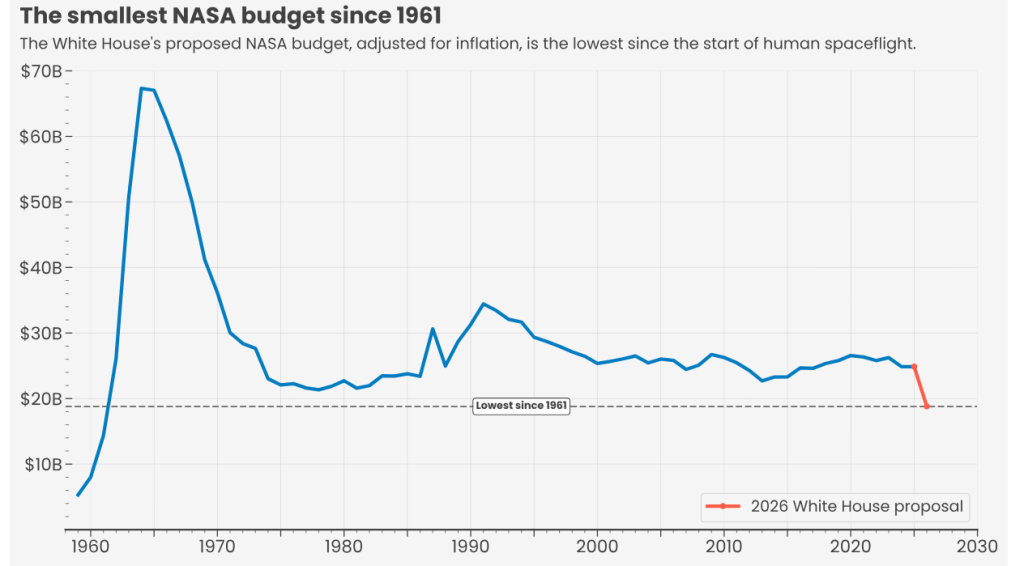
Massive Cuts Incoming At NASA As America Just Gives Up

So…

NASA’s civil servant workforce has varied in size over the years, peaking during the Apollo program. During the 1990s, the Clinton administration reduced the workforce by 25% over five years, a process that some claim laid the groundwork for the shuttle Columbia disaster. This budget proposes to slash NASA’s workforce by nearly 1/3 in a single year via involuntary layoffs, resulting in the agency’s smallest workforce since fiscal year 1960, before NASA’s Marshall Space Flight Center, Johnson Space Center, and Stennis Space Center even existed.

In pretty pictures:

No. SpaceX doesn’t make up for this. China does both, massive public spending and multiple space launch companies.

What else is China doing? 

Space-Based Solar Power (SBSP or SSP), the concept of gathering solar power in space using solar power satellites (SPS) to send it back to Earth, may sound like science fiction, but it is getting closer to reality.

China plans to build a 1km-wide solar array in the geostationary orbit about 36,000km above Earth.

At this distance from atmospheric interferences such as day-night cycles and changing weather, the array will constantly gather solar energy, anticipated to surpass terrestrial photovoltaic systems by more than tenfold in efficiency.

Once collected, this energy will be transformed into microwaves and transmitted to a ground-based collector station.

Colloquially known as a powersat, this was suggested by O’Neill back in the 70s. It could have been done with tech that within reach in about a decade, but, of course, America did no such thing. The space shuttle cost way too much to launch, funding had dried up to do things better and cheaper and space was no longer a priority.

China’s following O’Neill’s playbook, weirdly enough. They’re doing what the US decided not to do. To put it bluntly, if humanity has a future in space, it will be Chinese, not American. This isn’t primarily about colonization, though some people will live in space for a time, it is about putting manufacturing, refining and mining into space so we can re-wild the Earth, and avoid the resource trap.

It’s not a sure thing, by any means, but given that Earth is limited and space is much less limited, it’s the only way out of the limited resource trap. China either succeeds (and it’s them or no one, because there is a ticking clock) or we face inevitable civilization collapse. Once that occurs, having already mined all the easily accessible resources, there is unlikely to be a second chance at a future in space, or even a particularly high tech society.

Anyway, as usual, the future happens in China, and America has given up. AI is bullshit, even if it works, American capitalists want it so they can put a third of the workforce out of work. Meanwhile China builds civilian robots, automates entire factories and ports, has flying cars and drones galore and is actually working towards a real future in space.

We’re about 3 weeks into our annual fundraiser. Our goal is $12,500 (same as last year). So far we’ve raised $9,235 from 82 people out of a readership of about 10,000. 

If you read this blog, you’re usually ahead of everyone else. You know, years in advance, much of what’s going to happen. The intelligence from this blog is better than what people pay $10,000/year for. Without donations and subscriptions, this blog isn’t viable. If you want to keep it, and you can afford to, please give. If you’re considering a large donation, consider making it matching. (ianatfdl-at-gmail-dot-com).

Doomed Tesla (RoboTaxi Edition)

I’ll keep this one short and sweet.

Tesla was contacted by the National Highway Traffic Safety Administration on Monday after videos posted on social media showed the company’s robotaxis driving in a chaotic manner on public roads in Austin, Texas.

Elon Musk’s electric vehicle maker debuted autonomous trips in Austin on Sunday, opening the service to a limited number of riders by invitation only.

In the videos shared widely online, one Tesla robotaxi was spotted traveling the wrong way down a road, and another was shown braking hard in the middle of traffic, responding to “stationary police vehicles outside its driving path,” among several other examples.

Elon Musk is not that smart. He chose to use cameras only, and not Lidar, against the advice of his own engineers.

China has robotaxis already. They work fine. They have Lidar.

Tesla is doomed. Their cars are worse than those of their competitors and more expensive. Robotaxis aren’t going to work. The only thing saving Tesla right now is 100% tariffs on Chinese autos, but even non Chinese electric cars are better and often cheaper.

Meanwhile Musk is in a feud with Trump, Trump has threatened to remove subsidies for Musk enterprises and Musk (again, an idiot) has said Trump should go ahead. And yes, he does need those subsidies.

The majority of Musk’s wealth is tied up in Tesla, and it’s days are numbered. Meanwhile Starship keeps exploding, the last time during fueling, not even after launch. There are a lot of competitors to SpaceX, and w/o NASA contracts SpaceX doesn’t look so hot either. Right now NASA is stuck with Musk, but that’s not going to last.

Musk isn’t going to be the world’s richest man much longer.

If you’ve read this far, and you read a lot of my articles, you might wish to Subscribe or donate. I’ve written over 3,500 posts, and the site, and Ian, take money to run.

Musk’s Empire Is Looking Even More Shaky

So, we’ve talked before about problems with Tesla. Musk’s competitors are, to put it simply, producing better cars which cost less, especially but not only, the Chinese like BYD. Meanwhile, Musk’s politics, like denying climate change and throwing a Nazi salute, while tying himself to Trump just as Trump is pissing off almost every country whose consumers buy Tesla vehicles, has made customers a lot less interested in buying Tesla. He’s trashing his own brand with the people who supported it most.

Musk’s riches are based primarily on Tesla, but he also has SpaceX, which currently has the lowest cost space lift and pretty much guaranteed business from the US government. But a large part of Musk’s SpaceX income comes from Starlink. It looks like SpaceX made about 13 billion in 2024, and of that Starlink provided 8.2 billion. However, in terms of profit, Starlink seems to have provided only about a third of SpaceX’s three billion profits.

That said, Starlink is still in the fairly early stages, with high capital costs, and the revenue numbers indicate it’s a big deal for SpaceX and Musk.

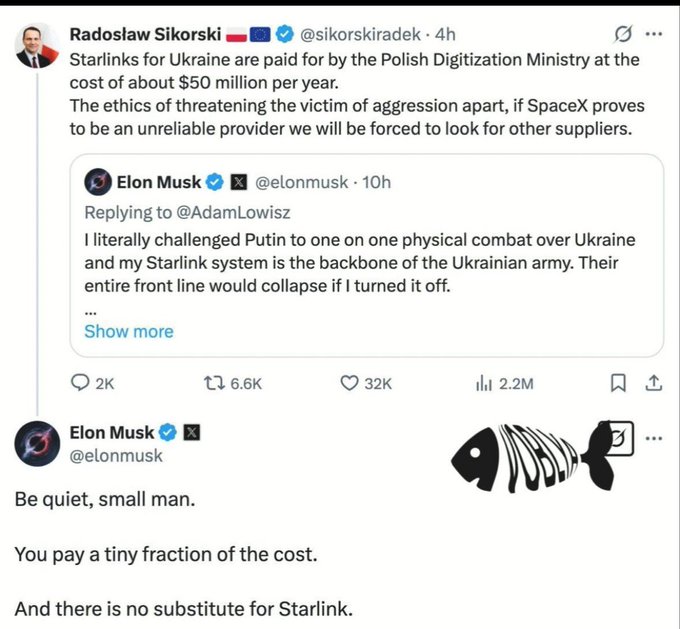
Then we see this:

But here’s the thing: There is an onrushing competitor to Starlink — a Chinese one, Qianfan. They’re far behind Starlink right now, but as they scale, they seem likely to wind up larger than Starlink, and the price for access may be $50 versus $120 for Starlink, though it’s unclear what the terminals themselves will cost.

Musk seems determined to lose Starlink customers, too. He accused oligarch and billionaire Carlos Slim of being tied to Mexican cartels, for example, and Slim immediately cancelled his deal with Starlink, and indicated he’d be pursuing the Chinese alternative.

So, in two to three years, it seems likely that Starlink will not be the only game in town, and the other game will be cheaper. At which point, all Elon Musk has is his political moat; some countries may make it illegal to choose Qianfan.

But… that political moat is looking very leaky outside of the United States since Musk has tied himself to Trump, and Trump has pissed off almost all of Europe, including serious American allies like Poland (see above), Canada, Mexico, and even Japan. China may look like the lesser evil — after all, they rarely tariff anyone unless the tariffs are retaliatory, and they aren’t threatening to annex any countries.

That means the only remaining moat Musk has is his space launch, which is genuinely cheaper. But a cursory search showed me eight Chinese private space-lift companies. They’re all behind SpaceX right now, but then, a few years ago, so were China’s EV manufacturers, and Chinese smarphone producers were behind Apple and Samsung.

Anyway, a company with 13 billion annual revenue isn’t why Musk is so rich. It’s mostly Tesla. Canada, for example, put a 100 percent tariff on Chinese electric vehicles. China has now counter-tariffed, hitting Canadian agriculture hard. It might not seem worth keeping those tariffs going. Europe is similar. No one likes Musk right now other than MAGA, and they prefer gas-guzzlers.

I can’t remember ever seeing someone as rich self-destruct the way Musk is. He’s mishandled Tesla for years, he’s lost his first-mover advantage, he’s destroying his brand value, and pissing off both consumers and governments in almost every country he sells cars or internet in.

So if you don’t like Musk, well, get ready to enjoy a rich harvest of schadenfreude.

This blog runs on donations and subscriptions from readers. It’s free, but not free to produce. If you value it, please give.


How The Great Space Failure of the Seventies Doomed Industrial Society

The simplest fact about the Earth is that it has finite resources.
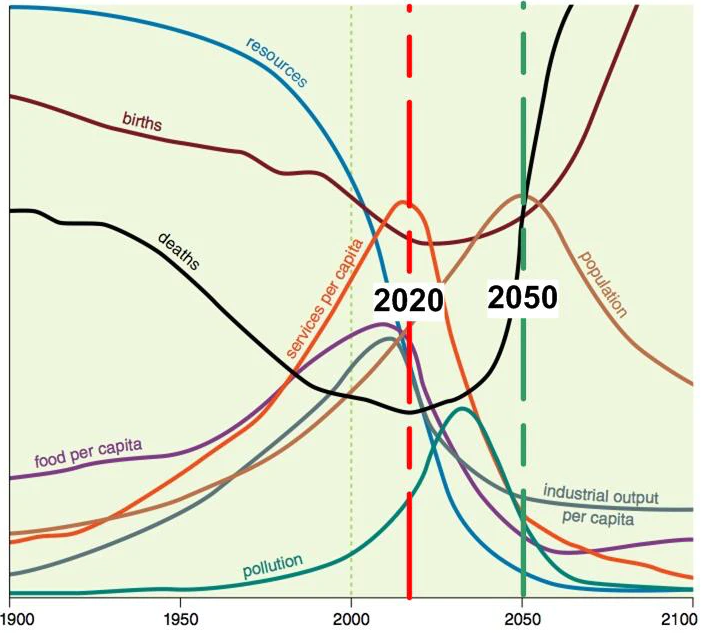
The simplest truth about this era is that we are burning through those resources faster than we can replace them: both renewable and non-renewable. This is deliberate: we chose planned obsolescence, for example, to juice profits without a corresponding increase in standard of living. We chose to subsidize suburbs and exurbs, which sped the destruction of the ecosphere. We destroyed the old transit networks of streetcars so GM and Ford could sell more cars, etc, etc…

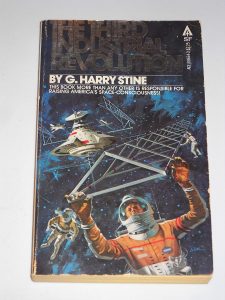
Back in the 70s a series of books came out, starting with the Third Industrial Revolution. They explained how to move industry and energy generation off Earth.

I read it at the time, and was impressed and I’m given to understand it’s very influential in China, today: part of the blueprint of their plans for space.

We knew by the 70s that we were in trouble, the famous “Limits to Growth” had come out, there were widespread concerns about overpopulation and study of issues like energy ratios (how much energy it takes to produce a unit of energy. The lower that number, the more prosperous a society can be.)

But after the moon landing, the space budget was gutted and later so was research and development of technologies like solar power. The powers that be, and the population of the US at the time wanted the world to be as it had been, to hang on to the petrochemical economy, the cars, the suburbs with white picket fences and so on. They opposed change and wanted unearned wealth from asset price increases rather than earned money from real growth.

But the only way to save the old technological world was to change it, and the only way to overcome limited resources and to reduce pollution was to get the resources from space, and move the pollution off Earth. (Note that we’re not talking colonization of space: no huge habitats full of people. We’re talking using space for resources.)

If you wanted to “save” the old world, you had to go into space, big. Public investment on a massive scale was needed, while we still had the resources and while serious consequences of climate change and ecological collapse were still decades in the future.

But, well, most of the people voting and making decisions in the 70s and 80s knew they’d be dead before those consequences hit. It was easier, and, in the short run of a few decades, more profitable to do nothing. So instead of going big, they went small and thus didn’t do the one thing that could save their civilization from the limits of growth.

You get what you support. If you like my writing, please SUBSCRIBE OR DONATE

Extinction is Guaranteed if We Do Not Colonize Space

The Earth is a dangerous place, and humans make it more so.  There are many scenarios, from nuclear war, to designer diseases, to nanotech goo, too environmental catastrophe where we can wipe ourselves out.  Further, there are events almost entirely beyond our control, like meteor impacts, which could wipe us out.  The Earth is a mass-graveyard: most species which have ever existed are extinct.

The Earth is a single point of failure.  If all self-sustainable human breeding populations are on Earth, we are much more likely to go extinct, and far sooner.

Getting of the rock is about human survivability in the longer run.  Getting out into the solar system, learning how to create habitats and breeding populations, increases our viability. Spreading to other solar systems, whenever we can, will increase it even further.

On the other hand, if we stay on Earth, especially given how incapable we are of acting in basic racial self-interest (as proved by climate change) our odds of an extinction event, and soon, go way, way up.


If you enjoyed this article, and want me to write more, please DONATE or SUBSCRIBE.

Powered by WordPress & Theme by Anders Norén