The horizon is not so far as we can see, but as far as we can imagine

Category: Leadership Page 4 of 5

The Terrible Impulse to Rally Around Bad Leaders in a Crisis

So, Andrew Cuomo, the Governor of New York, had his approval ratings soar 30 percent during the Covid-19 pandemic. There is talk of him becoming the US President (presumably this means making him Biden’s VP candidate, then having Biden step aside).

He sounds good on TV.

Cuomo is attempting to cut funding for Medicaid because he refused to tax the rich, as the crisis continues. A panel Cuomo appointed has recommended 400 billion in cuts to hospitals. He repeatedly said New York City has too many hospital beds. He has let prisoners in New York jails stay in them even as he was warned they would be breeding grounds for the disease. He left going to isolation at least two weeks too long.

In other words, he’s a neoliberal who wants to cut key resources even during a crisis, and incompetent to boot.

Back after 9/11, we saw the same thing happen with Bush, Jr. Bush not only ignored warnings about Al-Qaeda’s intention to strike in the US, the actual government response on 9/11 was terrible–the US could not get armed jets into the air, only unarmed ones. It would have been a hilarious display of incompetence if it weren’t for the consequences. Canada had armedjets up before the US: I joked that, if we invaded the US, we could have destroyed the entire US Air Force on the ground (then given you universal health care).

Bush was an incompetent, stupid, and mentally challenged (listen to his speeches–he was impaired). He used the blank check given to him by the rally-round effect to take the country to war with Iraq, a disaster which has spawned disaster after disaster. The money and resources used in Iraq should have been spent on other things–on almost anything else–and the death, maiming, rape, and torture are his legacy, as well as the legacy of Americans who ran to an incompetent leader.

Something similar is happening in Britain. Boris Johnson, the PM, has had his party’s ratings soar. Boris is the fellow who originally didn’t want to do any social distancing at all, based on a herd immunity theory which amounted to “let the maximum number of people die and the hospital capacity be overwhelmed.” Personally, Boris bragged about shaking hands with infected Covid-19 patients, then going on and shaking hands with everybody else he met. Personally, a typhoid Mary. The Conservative party has spent ten years defunding the NHS, to the point where it has one of the lowest numbers of hospital beds per capita in the developed world.

Yet Johnson and the Conservative party’s ratings have gone up.

Trump’s ratings, while they have not soared, have gone up, and Trump’s Covid-19 reponse has been beyond incompetent, sliding into delusional, Emperor-has-no-clothes territory.

This tendency to rally around even incompetent leaders makes one despair for humanity. The correct response in all cases is contempt and an attempt, if possible, at removal of the corrupt and venal people in charge. Certainly, no one should be approving of the terrible jobs they have done.

All three of these leaders have, or will, use their increased power to do horrible things. The Coronavirus bailout bill, passed by Congress and approved by Trump, is a huge bailout of the rich, with crumbs for the poor and middle class. So little, in fact, that there may be widespread hunger soon. Cuomo is pushing forward with his cuts, and I’m sure Johnson will live down to expectations.

Incompetence and ideological blindness to the good of the people are, then, encouraged by the behaviour of the masses. This, it seems, is what they want.

We either break this cycle, or over the crises and catastrophes to come (and the 21st century will be a century of tragedy), we will lose billions of people we needn’t have.


The results of the work I do, like this article, are free, but food isn’t, so if you value my work, please DONATE or SUBSCRIBE.

 

Why US Leadership Stinks and Drone Assassination Doesn’t Matter (Leadership in Organizations People Believe In)

The assassination strategy the US pursues is interesting, not in what it says about the US’s foes, but what it says about the American leaders. Al-Qaeda’s “No. 2 Man” has been “killed” so often that it’s a running joke, and Taliban leadership is regularly killed by assassination. Bush did this, Obama really, really did this. Probably a lot of these stories are BS, but it’s also probably safe to assume that a lot of leadership has been killed.

The Taliban is still kicking the coalition’s ass.

Leadership isn’t as big a deal as people make it out to be–IF you have a vibrant organization in which people believe. New people step up, and they’re competent enough. Genius leadership is very rare, and a good organization doesn’t need it, though it’s welcome when it exists. As long as the organization knows what it’s supposed to do (kick Americans out of Afghanistan), and everyone’s motivated to do that, leadership doesn’t need to be especially great, but it will be generally competent, because the people in the organization will make it so.

American leaders are obsessed with leadership because they lead organizations in whose goals no one believes. Or rather, they lead organizations for whom everyone knows the leadership doesn’t believe in its ostensible goals. Schools are led by people who hate teachers and want to privatize schools to make profit. The US is led by men who don’t believe in the Constitution or the Bill of Rights. Police are led by men who think their jobs are to protect the few and beat down the many, not to protect and serve. Corporations make fancy mission statements and talk about valuing employees and customers, but they just want to make a buck and will fuck anyone, employee or customer, below the C-suite. They don’t have a “mission” (making money is not a mission, it’s a hunger if it’s all you want to do); they are parasites and they know it.

Making organizations work if they’re filled with people who don’t believe in the organization, or who believe that the “leadership” is only out for themselves and has no mission beyond helping themselves, not even enriching the employees or shareholders, is actually hard. People don’t get inspired by making the C-suite rich. Bureaucrats, knowing they are despised and distrusted by their political counterparts, and knowing that they aren’t allowed to do their ostensible jobs, as with the EPA generally not being allowed to protect the environment, the DOJ not being allowed to prosecute powerful monied crooks, and the FDA being the slave of drug companies and the whims of politically-connected appointees, are hard to move, hard to motivate, making it hard to get to anyone to do anything but the minimum.

So American leaders, and indeed the leaders of most developed nations, think they’re something special. in fact, getting people to do anything is difficult, and convincing people to do the wrong thing, when they joined to actually teach, protect the environment, make citizens healthier, or actually prosecute crooks, even more so. Being a leader in the West, even though it comes with virtually complete immunity for committing crimes against humanity, violating civil rights, or stealing billions from ordinary citizens, is, in many respects, a drag. A very, very well-paying drag, but a drag. Very few people have the necessary flexible morals and ability to motivate employees through the coercion required.

So American leaders, in specific, and Westerners, in general, think that organizations will fall apart if the very small number of people who can actually lead, stop leading. But that’s because they think that leading the Taliban, say, is like leading an American company or the American government. They think it requires a soulless prevaricator who takes advantage of and abuses virtually everyone and is still able to get people to, reluctantly, do their jobs.

Functioning organizations aren’t like that. They suck leadership upwards. Virtually everyone is being groomed for leadership and is ready for leadership. They believe in the cause, they know what to do, they’re involved. And they aren’t scared of dying, if they really believe. Oh sure, they’d rather not, but it won’t stop them from stepping up.

So Obama kills and kills and kills, and somehow the Taliban is still kicking his ass. Al-Qaeda, in whatever country you care to name, has its killed every few weeks, and somehow there’s always another one. Because these people believe. There’s always another believer, if it’s a functioning organization, so on it goes.

The declaration of the Haqqani network as terrorists made me laugh. You read about them, and this is what you discover–the founder was a minister in the Taliban government. So, let’s get this straight. His country, in which he was a minister, was invaded, and ten years later he’s still fighting–and he refuses to negotiate with the US, because hey, he figures he’s winning.

Imagine if the US was invaded, occupied, and a puppet government was set up. A cabinet minister escaped, went underground, and set up a resistance network. What would you call him? A terrorist? Sure, if you’re the occupying power. If you’re a citizen? Well, maybe not, eh? Sure he fights nasty, but the nation which kills so many civilians with drones can’t really cast the first stone, can it?

And one day, they’ll probably kill him.

And it won’t make any damn difference.

Originally published Sept 11, 2012. Back to the top August 13,2018.

Back to the top again, January 4th, 2020 because of Qasem’s assassination.


The results of the work I do, like this article, are free, but food isn’t, so if you value my work, please DONATE or SUBSCRIBE.

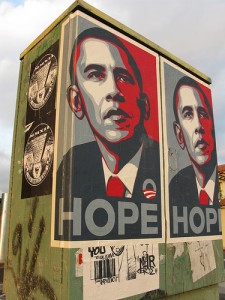
Hope Is Bullshit

by Shepard Fairey

I am unintersted in “hope.”

Or as we called it in the Obama bullshit years, Hopium.

Hope is not a plan. Hope is bullshit.

Luck is real, but you don’t count on luck other than in the sense that the harder you work, and the more things you do, the more likely you are to “get lucky.” But luck is usually the odds coming in, and bad luck is as real as good.

In term of climate change, there is no reason for hope. It’s going to be bad and, in almost all cases, signature events are happening sooner than expected: We’re losing Greenlandian, Arctic, and Antarctic ice sooner than expected. We’re getting artic methane releases 70 years ahead of schedule. Every time an event comes in, it’s sooner or worse than the models predicted.

This is because of how systems work when they leave bounds–because they tend to accelerate, we can expect this sort of thing to continue. It’s going to get worse, sooner.

That’s the “luck” we’ve made. We’ve put half the greenhouse gases in human history into the atmosphere in the past 30 years, which is to say, after the time when we knew for a fact we were cutting our own throats.

Obama ran on hope in another sense, and created an economy which did nothing (and worse than nothing) for African Americans and which was shit for somewhere between 80 percent to 95 percent of the population. His signature health care plan was garbage, and in his period the price of various drugs rose to historical heights. He tripled the rate of drone murders over Bush (Trump has ramped them up even further), and so on.

He was human garbage, a man who bailed out bankers and then helped them steal people’s houses with fraudulent paperwork, then had his attorney-general immunize them with fines worth less than what they stole.

But this man is worshiped by many Democrats, because, hey, he was only human garbage, and Trump is a shambling mound of garbage (but has yet, note, to start any new wars, though he’s been happy to keep Obama and Bush’s wars going).

Oh, and because he was black, and that mattered more, to many people, than the fact he was human garbage.

Obama’s done very well since he left office, making lots of speeches and millions of dollars. Bankers have been very grateful and have shown their gratitude–just as they did for Bill Clinton (another mound of garbage, who cut welfare to hurt the weakest in the US, killed Iraqis with his sanctions that included medicines, and instituted judicial “reforms” which swelled America’s prison population while ending financial regulations intended to avoid financial collapses).

None of these people ever intended to do the right thing, and if you listened carefully you knew that. The best you could hope is that they were the lesser evil: a smaller mound of garbage than their opponents.

In the Democratic primaries, there was always a better option and that option was never chosen, because most Democrats are bad people who want Reaganism with a side of “but we don’t really mean it.”

Nothing is going to get better until we, whichever we we belong to, start choosing better leaders, whether presidential, or more local. Those leaders must want to actually do “good.” Yes, good. You know, taking care of the hungry and the sick, and not burying single payer and the public option like Obama did. (Yes, yes he did, and he wound up passing the OCA without Republicans anyways. He made a choice, and his choice was evil.)

Or perhaps taking care of poor people, including blacks. Or not allowing pirates in suits to gouge people on drug prices, or perhaps *gasp* not vastly expanding fracking, which is what Obama did and bragged about, even as he signed the Paris Accords, knowing he had no intention of honoring them.

Nor did virtually anyone else who signed them, of course, and anyone who thought otherwise is either a fool or on the payroll.

Mounds of garbage. Merkel, Blair, Cameron, Trudeau, Harper, your country’s leader, odds are. People who have always wanted to do as much evil as they could, and as little good as they could get away with. (Remember nothing happened to Greece Angela Merkel was not okay with–and all so German banks could be bailed out indirectly. It would have been embarrassing to just blatantly bail them out. So a lot of Greeks died and suffered.)

There is no “hope” as long as our leaders are people like this. None.

Don’t get hooked on hopium.

We need to elect leaders who want to do as much good as they can, and as little evil as possible. Sanders in the US, Corbyn in Britain.

But we don’t want those leaders, not as a whole, do we?

We’ve been offered them, we have a chance to elect them.

But will we?

Because they have plans, and those plans are to do good.

That’s the only hope you’ve got.


The results of the work I do, like this article, are free, but food isn’t, so if you value my work, please DONATE or SUBSCRIBE.

Our Leaders Kill for Their Own Benefit

Big Brother Award

Most people are terribly confused when it comes to understanding our leaders, whether corporate or political.

They think that the sort of ethical or moral constraints which hold them back, hold back leaders.

But being a leader in our society is about “extracting value” from ordinary people.

Raising the price of insulin to $300, for example. Or launching a war against a country which is no threat to you. Or throwing people in jail for 20 years for minor drug offenses.

Our leaders don’t think the same way we do. Their function isn’t to make our lives better, their function is to make their lives better–along with the lives of those people who can help them or the few people they care about. Biden, for example, goes on and on about how much he loves his family. Boo hoo. Then he supports policies like the bankruptcy bill or three strikes laws which destroy other families.

Obama and Geithner quite deliberately created a relief program for homeowners which relieved almost no one and instead made sure that they went bankrupt, so the banks would get their homes. The policy was intended, and this has been admitted, to help the banks, not ordinary people. (See David Dayen’s Chain of Title if you need the tedious proof.)

To elites, we are tools at best, useless eaters at worse. They are trained to look at us and figure out how much value they can extract: as consumers, workers, voters, and soldiers.

Then they extract the value, and if some of us wind up dead, homeless, sick, or crippled, well, they don’t lose one second of sleep over it.

Because to them, we aren’t people.

The great problem of being a member of an elite is keeping the Praetorian guard happy; this doesn’t just mean the core soldiers and cops, but the key retainers who execute policy at the highest level.

The next great problem is the mob: The tools and useless eaters sometimes get uppity, and revolt and you need to be sure you can put them down–hence the Praetorian guard.

But they’re working on this problem. Modern surveillance makes it so much easier to keep us down. Modern education trains us to be obedient (if you don’t think that’s what school, which is “Sit down, shut up, speak only when spoken to, and give me the answer I want, the way I want it,” does, you are either stupid or haven’t thought about it. Or it’s really, really worked on you.)

Meanwhile, we’re not so far out from the military bots. Get bots that can make bots and they won’t need us.

And that’s good, for them, because, man, having so many of us around is causing them huge problems. Once they don’t need us any more, once they have bots who will do what they want, don’t talk back, and don’t mind being scrapped or mistreated, well, the easiest way to deal with climate change is to get rid of six billion people or so, isn’t it?

I mean, they won’t need us. We’ll be a problem. They’ll have a solution: Climate change will kill some, the bots will deal with the rest, and they have the perfect servant class.

Dystopian fiction? Lunacy?

Well, maybe. But tell me, given that they are accelerating climate change, even though they’ve known about it since the 70s (we have the papers, we know they knew), and given their proven willingness to do anything nasty to us they want if they think it’s in their interest and they can get away with it, what would they be doing differently if this wasn’t true?

More reasonably, of course, some of them are planning this and the rest are just willing to go along when push comes to shove.

Remember, $300 insulin. You do that, you know people will die. You’re OK with it.

And your fellow elites haven’t stopped you. (And yes, yes, they could.)

Killing us for money or other benefits is one of the things our leaders do.

And that isn’t going to change until they’re more scared of us than we are of them.


The results of the work I do, like this article, are free, but food isn’t, so if you value my work, please DONATE or SUBSCRIBE.

Six Lessons From Genghis Khan’s Victories

Genghis Khan, Photo by Francois Phillipe

Genghis Khan, Photo by Francois Phillipe

Some years ago I wrote about the genius of Temujin—Genghis Khan.

I want to return to this, but take a different approach. Why was Temujin so successful?

“Hired A’s”

Yeah, I hate startup culture too. But, the bottom line is that Temujin’s main lieutenants were all brilliant too. Subodei is in the running for one of the world’s greatest generals. His main administrator was brilliant. And Temujin took people who were his enemies and made them his leaders, and they stayed loyal. That’s genius, and it’s the number one thing that made him great, especially because he let them do their jobs without getting in the way: He trusted them and didn’t second guess them.

Effectively Used Spies and Intelligence

Temujin cultivated merchants. He talked to them, he treated them well, he offered them real protection. Before he ever went to war with anyone, he knew their military, he knew any internal problems they had, from disloyal satraps to recently conquered and still restive people. He knew the geography, and so on.

He Prioritized Local Superiority of Force

Westerners have this weird idea that the Mongols were a horde. To the contrary, in all major campaigns of Temujin’s life, they were outnumbered. In many cases, this is true even after his death. Subodei’s invasion of Europe was against much larger numbers.

Temujin and Subodei used feints and threats and encircling movements to deceive their enemies. During the invasion of Afghanistan, for example, an initial attack burned down a large area, making it uninhabitable. The troops then withdrew. The enemy thought that, all the farms having been burned, no invasion could come through that area. Of course, then an invasion did.

This sort of attacking from directions that are assumed impossible was used all the time, and is routine for great generals. (Scipio Africanus and Hannibal, the two greatest generals of ancient times, used it to great effect.)

He also used detached columns to threaten areas that his enemies needed to defend. A small force, moving fast, would force enemies to run back to defend, even if the enemy was much larger.

He used multiple columns all the time, threatening multiple targets that had to be defended, forcing dispersion of enemy forces. Then he would bring his forces together and achieve numerical superiority against armies, that, in toto, were much larger than his.

It doesn’t matter if your enemy outnumbers you overall, if you outnumber them every time you fight them.

He Didn’t Attack Strong Positions or Waste His Own Troops

For example, he left the Chinese capital alone multiple times when he knew the Chinese army was still too strong to defeat. He didn’t order frontal assaults and waste his own troops. He would happily waste unreliable troops: Often, he would levy all men from defeated cities and towns and use them as the first wave attack against enemy walls, for example.

He Didn’t Trust Traitors

Temujin turned enemies into his chief leaders, but he did so after defeating them honestly. Anyone who betrayed their previous masters before defeat he did not trust.

None of this…

…is to deny his obvious advantages–like horse archers, among others. But contrary to what people think, horse archers were defeated often. Yes, they had the ability to break out and conquer far larger civilized nations, but most of the time, large, civilized nations kept them in their place.

Many of Temujin’s victories were over other horse archers: He unified tribes beyond just the Mongols and did so fighting troops which had the same horses and bows and so on that he did.

It was genius on three fronts that made Temujin into Genghis Khan. He was a genius general, who did not interfere with other generals (reading WWII history, and how hard Guderian, Manstein, and Rommel had to fight to get German high command to properly use blitzkrieg is instructive).

He was a genius leader, who could recognize other genius leaders and was able to earn their loyalty and not get in their way.

He made brilliant use of intelligence and planning. Temujin did not fight a war until he knew his enemies’ strengths and weaknesses better than they did.

Finally, he fought his enemies minds. He defeated the enemy leaders by out-thinking them, by making them react to illusions he presented, moving them and their troops around almost as much as he moved his own troops around.

The Mongols, absent a leader like Temujin, might well have broken out. But they would never have created the greatest land empire ever known to man.

More on what this means, for us, later.


The results of the work I do, like this article, are free, but food isn’t, so if you value my work, please DONATE or SUBSCRIBE.

Assassination Works Only Under Two Circumstances

For years, decades even, the US has had a policy of assassination. Americans believe that if you kill the leaders, you kill an organization.

This is delusional. It only works when it almost isn’t necessary. How many times has the US killed the man of the Taliban? Did killing Osama stop Al-Qaeda? Assassinating Yamamoto in WWII was not just meaningless, it was a bad idea (he wasn’t a great admiral, but he did oppose war with both the US and China.)

Assassination ONLY works when the organization is unhealthy OR when much of it doesn’t agree with the current leader but is following them anyway.

In a healthy organization, someone else just steps up and leads, and they’re about as good as whoever was there before. It’s not that leadership doesn’t matter, it’s that healthy organizations create lots of people who are capable of leading. Very few leaders are actually genius leaders; most of what looks like genius is leading a good organization, and know-how. Sometimes, someone is the first person to really figure out how to lead an organization, but if they’re good, they train successors, or people learn from watching them.

The second time it works is if there is a genuine disagreement in organization. Perhaps some are willing to make peace, and some aren’t, and if you kill a few of the key leaders who don’t want to make peace, you can get peace.

The problem with all this, however, is that it’s often hard to tell who is actually a genius leader and which people actually believe in the organization. A lower ranking leader, gunning for the first spot, is often not public about disagreeing with , and if he is, may be lying to get followers. It’s just hard to tell. As for genius: It’s rare, and people are good at faking it–until crunch time. Who was America’s last genius general put in real command? I am not aware of one from the last 20 years (Petraeus certainly wasn’t.)

Hannibals, Caesars, and Subotais are truly, genuinely, rare. Genius political leaders are truly rare as well. And genius politicians often are terrible leaders (not the same thing). You may want them in charge.

But the bottom line is simple: A good organization produces a surfeit of good leaders who agree with the organization’s mission. Decapitation only works on unhealthy organizations.

Managers in the US (the US doesn’t have many leaders) lead unhealthy organizations rife with disillusionment, designed to promote time serving managers who don’t take risks, who actively work to harm the rank and file of the organization, and who believe in nothing but themselves.

Such managers find it difficult to get anything done. They have to use fear, coercion, and lies to get the rank and file to follow orders, because their orders are usually both evil and against the rank and file’s self interest.

They know that managing organizations is difficult from their own experience, and they think that all organizations are like that.

But organizations like the Taliban or Hezbollah (not to conflate, I don’t regard Hezbollah as equivalent in many ways) actually believe in what they are doing. People join because they believe in the mission. Even large drug cartels have a belief in a mission and a winnowing of fools and poltroons that often (though not as often as belief organizations) allows them to replace leadership.

When real leadership meets real mission, people fall over themselves to join. They want to belong. They believe. They will work for virtually nothing. They will beg to be part of something bigger than them.

Most Americans have NEVER experienced this. They cannot understand it at a gut level. It is alien to them.

Assassination works only when organizations are unhealthy, and run by managers, not leaders, or during the early stages of a charismatic cult. (A healthy charismatic cult, like the early disciples of Jesus, will quickly create enough leaders to survive a decapitation strike.)


The results of the work I do, like this article, are free, but food isn’t, so if you value my work, please DONATE or SUBSCRIBE.


The World Is Going to Hell Because

Globe on FireYou get the behaviour you reward.

Politicians in the US, with the Iraq war and the vote to have it, committed the exact same war crime most Nazis were hung for: aggressive war.

They, including the most responsible politician, George W. Bush, were not punished for it. Indeed, Bush was re-elected and so were most of the others.

In 2008, there was a vast financial crisis, caused by bankers and Wall Street brokers and so on–financial executives. It included a widespread amount of fraud, aided and abetted by ratings agencies, financial regulators, and central banks.

No one was held responsible and sent to jail. Instead, they were bailed out and allowed to keep their illicit profits, and the same games that caused the crisis were reinstituted alongside aggressive money printing targeted at the class of people who caused the crisis.

In other words, the people who caused the financial crisis, as a class, were rewarded for that their behavior.

We have an ongoing problem, due to turn into a worldwide catastrophe causing over a billion human deaths and so many non-human deaths it will show up clearly in the geological record. It is called climate change.

Oil companies knew that climate change was real, based on their own research, back in the 80s. Not only did they not make that research public, they spent large amounts of money to fund propaganda saying that what they knew was true wasn’t.

Put more simply, for their own personal and financial gain, major corporate executives did their best to make sure that information known to be true, which might have helped stop a billion or more deaths, was not acted upon.

They have not been punished for that, but they have, indeed, retired wealthy and happy.

If people who knowingly do very very bad things (like causing the death and suffering of millions of people in wars, economic downturns, and forseeable environmental catastrophes) are not only not punished but rewarded, then more of the same behaviour will occur.

During his term in office, Obama increased drone murders significantly and destroyed Libya, in a war of aggression (the same war crime that for which Nazis were hung, and Obama also should be in a war crimes dock along with every other Western leader involved in Libya). He was then re-elected.

None of this stuff should be hard to understand. If leaders who do monstrous things are rewarded, as opposed to punished, for doing those things, more leaders will do even more monstrous things. They have been shown that is what is rewarded.

Welcome to a world tottering towards hell, because that is what too many people want–as measured by what they reward.


The results of the work I do, like this article, are free, but food isn’t, so if you value my work, please DONATE or SUBSCRIBE.

Being Effective and Liked in the Workplace

A couple weeks ago, I wrote an article about how to be liked by service employees and blue collar workers. I wasn’t writing about “in the workplace” or “as a manager,” but most commenters read it as both.

Today, let’s actually talk about being effective (and yes, liked) in the workplace. I’ve been out of a corporate environment for years now, but my last corporate gig was at a large insurance company. It wasn’t managerial, though I led the occasional team and was responsible for one large departmental reorganization. Instead, I was a senior line employee: responsible for getting stuff done that required the help of many other people, but without the authority to just make them do things. By my count, at one point, up to 16 other specialties, spread across almost a dozen different departments, could be required.

I had no authority, but I needed other people to get my job done.

Until I went off the rails in my last year or so, I was very good at this job. And I’ve held line authority positions elsewhere, including being a dispatcher and a managing editor.

So, here are Ian’s guidelines for getting folks to do what you want, at work, and having them like it. To be clear, these never worked on everyone, but they have always worked on enough people.

First, find something to admire. A couple years into that corporate gig, I was talking to a friend who was complaining about our co-workers and how she could never get them to do anything for her.

I said, “Most of the people you’re complaining about are happy to help me. It might be that I like them.” The co-worker she found a persnickity snob, I found precise, knowledgeable, and willing to share his knowledge. The boss she disliked (our mutual boss) was one of the best bosses I ever had, understanding and kind, who never failed to give me the material support I needed. And so on.

Most people go through life with very little admiration. Their families take them for granted at best, nag them at worst. Their bosses pay them attention only when something goes wrong. Their coworkers are concerned only with themselves. All of this is natural– people’s first and second concern tends to be themselves, and they are interested in others only as those people reflect them.

But it’s not hard to find something to admire or like in most people. Maybe they work hard, maybe they’re reliable, maybe they’re really precise, maybe they’re insightful. Find something and genuinely admire it. Don’t be a flatterer, your admiration and appreciation must be real. Faking it is endless work, and unless you’re really great at being fake, you’ll screw it up.

Remember, you don’t need everyone, you just need enough people.

People can tell when you actually like and admire them. And they want to keep that admiration, so they’ll be generous with their time, advice, and help. This isn’t enough by itself, but it is the essential foundation.

Next, treat them right.

I had a few rules I followed at work.

1) If I ask someone to stay late to do something for me, I don’t leave until the job is done, either. It’s my job to be there to help them if they need it. In seven years at that job, I only left work once before someone who was doing me a favor. I apologized and she forgave me, but if I had made a habit of it, she wouldn’t have stayed late for me.

2) If someone helped me, I cleared the way for them. If I asked them to do something, I ran all the interference I could; I got their bosses permission if necessary, if anyone else was needed to help, I was the one who ran them down. If they needed anything else to get it done, I got it.

3) If they were doing me a favor and something went wrong, I took the blame, even if I could have shifted it onto them, even if they made a mistake. They would never lose from helping me if I could make it so they didn’t.

4) If something went right, I made sure they got the credit, and that meant to their boss, to their face, and publicly to others. They got praise, and that praise went where it would make their lives better. Including in writing when appropriate (usually) and in terms of my nominating them for workplace prizes and whatnot.

5) In general, I acted like they were great people, and I meant it. My gratitude was not fake or bombastic, it was real. I was glad to see them, I smiled at them. I thought they were great people. (Note, I did not socialize with my co-workers, with very few exceptions.  This is not based on being their out-of-work friends.)

Did everyone like me? Hell no, some people hated my guts. But enough people liked me. I was able to get many people to do favors for me they would not do for actual management. I was able to get people to stay late, for example, who would simply not stay late for their actual bosses. (It was the sort of workplace at which the boss could not just order someone to work extra hours.)

I was also always on very good terms with my immediate boss, which has been the case in almost all my jobs, simply because I delivered.

Unfortunately, I can’t give any advice on managing up beyond the immediate boss level. As a rule, I’ve always been terrible at dealing with upper-upper-management. Perhaps because they’re used to people saying what they want to hear, and I don’t do that.  Remember, my admiration was real. But I don’t blow smoke up people’s asses: If something can’t be done, I say so. If something is illegal (I handled the compliance for the area), I say so. If there will be negative effects from a decision, I say what they are. And if more resources are needed to get something done properly and in time, I let them know.

Or, perhaps, I was just kind of a jerk.

But the jerkiness was, in most cases, predicated on protecting my people. I can’t override management, especially senior management, but I can put my body in the way, and I can say, “If you do that, it’s going to go wrong in the following ways.”

A few senior management types appreciated that, my direct managers almost always did (a couple exceptions aside), but the more senior the management was, the less I found they were interested in the real world consequences of their decisions, and the more they wanted to be told “we can do that,” even if their ideas were terrible.

So, that’s the Ian Prescription for getting shit done at work, and being liked by enough people, but pissing off the wrong people. Will you be loved? I can’t say I was. Not really my personality at the time. But when I asked for help or favors, I got them.

The same general strategy worked when I was in leadership positions, if combined with strict fairness. When I was a dispatcher, for example, I did not play favorites. The person who could do the delivery fastest got the delivery, even if it was an easy, well-paying one; I didn’t give it to my “favorites.” You only got sidelined for important deliveries if you’d proved, again and again, that you were unreliable. Most dispatchers I dealt with had favorites. I, being human, did too. But I didn’t let that affect my dispatching.

In leadership: fairness. People are treated in accordance with their demonstrated abilities and are given chances to show what they can do. Their successes are celebrated, publicly, their failures discussed in private unless an example needs to be made (which, on occasion they did; justice must be seen to be done).

All of this, in my opinion, is just an extended example of the Golden Rule: Do unto others as you would have them do unto you; combined with some common sense (no, I’m not going to let you do shoddy work).

Treat people right, and they’ll treat you right. There are some people with whom “right” treatment doesn’t work. If I’m a manager, I get rid of those people. If I’m in a position, as I was in my corporate gig where I didn’t have the power to do so, I’d sideline them to the extent that I could; nothing “mission critical” or “Ian critical” went through them if I could avoid it.

Treat people right. It isn’t hard.


If you enjoyed this article, and want me to write more, please DONATE or SUBSCRIBE.

Page 4 of 5

Powered by WordPress & Theme by Anders Norén