The horizon is not so far as we can see, but as far as we can imagine

Category: Economics Page 43 of 97

The “Missing” Inflation Shows Up as Hyper-inflation

In things that rich people buy.

Ever since the financial crisis, there has been a lot of screaming about inflation. Screaming that it should show up, with all the money being created by central banks and, privately, and isn’t.

But it is.

A painting of Christ by the Renaissance master Leonardo da Vinci sold for a record $450 million at auction on Wednesday, smashing previous records for artworks sold at auction or privately.

New York, London, and Vancouver real estate, along with a number of other cities (China’s printing more money than anyone else), is also where it showing up.

And it’s showing up for ordinary people, not as hyper-inflation, but as high inflation of some things. Whatever the figures show, anyone who buys food knows that food prices have been going up faster than normal wages for quite some time.

But mostly it is showing up at the top end, in things that rich people bid up. $450 million is damn near half a billion, the ability to blow that amount of money on a single painting is absolutely crazy, no matter who the painting is by. It could not have happened even 20 years ago, and did not happen even ten years ago.

The rich are floating on an ocean of money, and they have nothing to spend it on that really matters, so it’s going to third homes, real estate, speculation and conspicuous luxury consumption (which is what that painting is).

As an aside, one of the ways to deal with off-shore tax haven money is for the major economies to not allow it back into their countries without high taxation. It’s great that you have a few billion in an offshore haven, but you can’t spend it there. If you want to bring it back or use it as collateral then just make them pay taxes on it. 90 percent is a good rate.

What, they won’t bring it home at that tax level? Then fuck’em. You can’t buy anything that matters in most tax havens, and no one wants to live there. Let it rot, uselessly, there.


The results of the work I do, like this article, are free, but food isn’t, so if you value my work, please DONATE or SUBSCRIBE.
Bitcoin Is a Bad Way to Do Something Necessary

I don’t write about crypto-currency often because its proponents are fanatical. (You’d be fanatical too if you combined rabid self interest that might make you a multi-millionaire with a social engineering project you thought was utopian.)

But more and more, I am inclined to agree with a judgement my friend made years ago: While Bitcoin does something important (creates a peer-to-peer payment network) it does it in a terrible way.

This averages out to a shocking 215 kilowatt-hours (KWh) of juice used by miners for each Bitcoin transaction (there are currently about 300,000 transactions per day). As the average American household consumes 901 KWh per month, each Bitcoin transfer represents enough energy to run a comfortable house, and everything in it, for nearly a week. On a larger scale, De Vries’ index shows that bitcoin miners worldwide could be using enough electricity to at any given time to power about 2.26 million American homes.

This is crazy. Looked at from this point of view, Bitcoin is terrible: Its actual transaction costs are far higher than those for any other form of money of which I am aware.

Bitcoin was also a libertarian project. Libertarians hate inflationary money, so Bitcoin was made deliberately deflationary. There are a limited amount of bitcoins which can be created. There is a strong first mover advantage even without the fact that bitcoin is acting more like stock in a company than money.

Deflationary money is reactionary. It rewards people for being first, not for being productive. It encourages people not to spend and not to invest in something other than money, which is bad for economies. Moderate inflation, contra-gold bugs and Austrians, is a good thing, as it devalues effort from the past. It’s great that you did something wonderful 40 years ago, but what you do today should matter more.

It shouldn’t matter completely more, I’m not saying that retired people shouldn’t be able to eat and pay rent, but it should discount and discount more and more over time.

People who won the past shouldn’t control the future for all that long. People who are winning the present should, if anyone should.

This piece will likely have people screaming in the comments, but just because Bitcoin is not government money does not mean it gets a pass from general economic principles.

And none of this is to say that blockchains are not an important innovation, or that Bitcoin isn’t important, won’t make its early movers lots of money, and so on. Just that its embedded economic assumptions and power requirements won’t produce maximum welfare.


The results of the work I do, like this article, are free, but food isn’t, so if you value my work, please DONATE or SUBSCRIBE.

Yellen’s Legacy Is Doing Nothing that Mattered

So, Janet Yellen has been replaced as Fed chair.

Her reign was meaningless, she just kept the trends moving as they were, and was essentially no help to ordinary Americans. Yes, she kept interest rates low, but that meant little; all that money flooded into corporate bank accounts.

I don’t want to slam Yellen particularly hard. The person who was in place at the time when a real change could have easily been made was Bernanke, and he decided to bail out rich people and let ordinary people sink. He is responsible, with Bush, Obama, and Geithner, for the continued decline and stagnation of the US economy, and for the damage to much of the world’s economy.

If Bernanke had done nothing but allow banks to go bankrupt and the government to take them over, with appropriate support, we would be in far better shape now, though the couple years after the financial crisis would have been worse.

Yellen? Yellen is a drone. She had no idea what to do, so she froze for years in the headlights.


The results of the work I do, like this article, are free, but food isn’t, so if you value my work, please DONATE or SUBSCRIBE.

The Right Stuff: What Prosperity Is and Isn’t

Is a society prosperous when everyone has an abundance of goods, the usual definition of prosperity? Are you prosperous if you have an abundance of goods, but no time to enjoy them? Are you prosperous if you have an abundance of goods, but you’re sick? Are you prosperous if you have an abundance of goods, but you live in an oppressive society? Are you prosperous if you have an abundance of goods but are desperately unhappy and feel you’ve wasted your life?

This falls flat: more goods don’t necessarily make us better off, nor more services. More foods that make us sick aren’t better. More health care doesn’t mean we’re healthier, it often means we’re sicker. More prisons mean our society is producing more criminals and more crime.

Just increasing economic activity doesn’t make people better off. It doesn’t increase prosperity.

Perhaps the best example is the change from hunting and gathering to agriculture. It would seem self-evident that learning how to grow more food would make us better off. In fact, however, moving from hunting and gathering to agriculture lead to worse lives for most people. People were shorter in most agricultural societies, which indicates worse nutrition. They suffered more from disease and had far more chronic health conditions. Most people also had less free time and didn’t live as long as the hunter-gatherers who preceded them.

Nor was this a short term decline, it lasted for thousands of years. Height is a good measure of nutrition, and we are still not as tall as our hunter-gatherer ancestors. Pelvic depth, which measures how easily women give birth has never recovered. Median lifespan was not higher for around 6,000 years. And even after it recovered, it declined again in large parts of the world. Members of the Hellenic world, from 300 BC to 120 AD, had longer lives than westerners before the 20th century.(1)

Our lives can get worse, and stay worse, for hundreds or thousands of years, despite having more goods.

If prosperity means having more stuff, but being sicker and dying sooner, do we want it?


(I am fundraising to determine how much I’ll write this year. If you value my writing and want more of it, please consider donating.)


A better definition of prosperity is about having, not more goods and services, but the right goods and services in the right quantity.

We should want goods and services that make us healthier, happier, smarter, more able to do great works and to live well. Instead of more work, we should want right work, enough work to make the right stuff, but not so much work we have no time for our loved ones, friends and doing the activities we love, whatever those might be. And, as much as possible we should want health instead of medicine and low crime rather than prisons.

All other things being equal more productive capacity is better. The more stuff we can make, in theory, the better off we’ll be. But in practice, it doesn’t always work that way.

Part of the problem is due to hierarchies and inequality. Inequality is undeniably bad for us. The more unequal your society is, the lower the median lifespan. The more unequal the society, the sicker, in general. More heart attacks, much more stress. The more unequal, the more crime. These links are robust.

The links run two ways. On the one hand, humans find inequality stressful. The human body, if subject to long term stress, becomes unhealthy and far more likely to be sick. People who feel unequal act less capable than those who feel equal. This is true for the rich and powerful in unequal societies and the poor. Everyone suffers. Though the poor and weak do suffer more, even the rich and powerful would be healthier and live longer in equal societies, most likely simply due to the stress effect.(2)

The second part is distribution, or rather, the question of who gets to decide the distribution. The more unequal a society, the less stuff the poor and middle class have, comparatively. Some technologies tend to lead to more inequality, some tend to lead to more equality. In most hunter-gatherer societies there isn’t enough surplus to support a class of rich powerful people and their servitors, in particular their servitors who enforce the status quo through ideology or violence. With little surplus, there is equality. This doesn’t mean hunter-gatherers live badly, most of them seem to have spent a lot less time producing what they needed than we do, they certainly didn’t work 40 hour weeks, or 60 hour weeks, closer to 20. (3) The rest of the time they could dance, create art, make love, socialize, make music or whatever else they enjoyed.

Agriculture didn’t lead immediately to inequality, the original agricultural societies appear to have been quite equal, probably even more so than the late hunter-gatherer societies that preceded them. But increasing surpluses and the need for coordination which arose, especially in hydraulic civilizations (civilizations based around irrigation which is labor intensive and require specialists) led to the rise of inequality. The pharoahs created great monuments, but their subjects did not live nearly as well as hunter-gatherers.

The organization of violence, and the technology behind it is also a factor. It is not an accident that classical Greece had democracy in many cities, nor that it extended only to males who could fight and not women or non-fighting males. It is not an accident that Rome had citizenship classes based on what equipment soldiers could afford: the Equestrian class was named that because they could take a horse to war. It is not an accident that the Swiss Cantons, where men fought in pike formation, were democratic for their time. Nor is it an accident that universal suffrage arose in the age of mass conscription.

When Rome moved away from citizen conscription to a professional army it soon lost its liberty. As we move away from mass armies it is notable that while we haven’t lost the vote, formally, the vote seems to matter less and less as politicians more and more do what they want no matter what the electorate might want.

Power matters for prosperity, the more evenly power is spread, the more likely a society is to be prosperous, for no small factions can engage in policies which are helpful to them, but broadly harmful to everyone else. Likewise widespread demand, absent supply bottlenecks, leads to widespread prosperity as well.

In the current era we have seen a massive increase in CEO and executive pay, this is due to the fact that they have taken power over the primary productive organizations in our society: corporations. The owners of most corporations, if they are not also the managers, are largely powerless against the management. It is not that management is more competent than it was 40 years ago, at least at their ostensible job of enriching shareholders, it is that they are more powerful than they were 40 years ago, compared to shareholders and compared to government.

Because increases in the amount we can create do not automatically translate into either creating what is good for us, or into relatively even distribution of what we create, increases in the amount we can create do not always lead to prosperity, and certainly they do not have to lead to widespread affluence. Productivity in America rose 80.4% from 1973 to 2011, but median real wages rose only 10.2% and median male wages rose 0.1%.(4) This was not the case from 1948 to 1973, when wages rose as fast as productivity.

Increases in productivity, in our ability to make more stuff, only lead to prosperity and affluence if we are both making the right stuff, and we are actually distributing that stuff widely. If a small group of individuals are able to skim off most of the surplus then prosperity does not result and if a society which is prosperous allows an oligarchy, nobility or aristocracy to form, even if such an aristocracy (like our own) pretends it does not exist, society will find its prosperity fading.

Creating goods that hurt people is not prosperity either. At the current time about 40% of all deaths are caused by pollution or malnutrition.(5) If someone you love has died, there is a good chance they died because we make stuff in ways that pollute the environment, or because the stuff we make, like much food, is very bad for us. Being fat is not healthy, and we have an epidemic of obesity. Even when we do not, immediately, die, we suffer from chronic diseases at a rate that would astonish our ancestors. As of the year 2000, for example, approximately 45% of the US population suffered from a chronic disease. 21% had multiple conditions.(6) Some of this is just due to living longer, but much of it is due to the food we eat, the stress our jobs inflict on us, and the pollution we spew into the air, land and water.

We should always remember this. Increases in productive capacity and technological advancement do not always lead to welfare and when they do, they do not have to do so immediately. The industrial revolution certainly did lead to increased human welfare, but if you were of the generations thrown off the land and made to work in the early factories, often 6 1/2 days a week, in horrible conditions, you would not have thought so. You were in virtually every way worse off than before being thrown off the land, and so were your children. A few industrialists and the people around them certainly did very well, but that is not prosperity, nor is it affluence.

Prosperity, in the end, is as much about power and politics as it is about technology and productive ability. The ability to make more does not ensure we are making the right things, or that the people who need them, get them. Productive capacity which is not shared is not prosperity.

Originally Published Jan 31, 2014.


The results of the work I do, like this article, are free, but food isn’t, so if you value my work, please DONATE or SUBSCRIBE.

Could Obama Have Fixed the Economy?

I want to revisit this. Obama was the last person who had a real chance to change and fix things. A crisis is an opportunity. FDR used the Great Depression to change the US. Reagan used stagflation to change the US. Bush used 9/11 to change the US.

Obama could have used the financial crisis to change the US. He did not. That was a choice.

His failure leads straight to Trump and various other pathologies. It is a straight line. Failure has consequences. Belief in the status quo (which describes Obama to the T) has consequences.

So, here’s what I wrote about this November 6, 2014 and many other times…

I’m hearing “Obama couldn’t have fixed the economy.  Wage stagnation is not his fault, it’s been going on for decades!” (For the record it’s been going on for at least 34 years, probably 39, and for some parts of the population, for 46 (that’s when wages for working class white males peaked. Which is why they’re pissy.))

This argument is, to give it more courtesy than it deserves, bullshit. I wrote about this back in 2010, and you can read that article, but let’s run through this one more time, because you will never get good leadership if you keep excusing your leaders for betraying you.

Part of the argument is that Obama couldn’t do almost anything because Obama only controlled the House, the Presidency, and didn’t quite have 60 votes in the Senate in his first two years. Because this is the case, I’ll deal with this argument in two parts.  In part one, we will discuss something that needed Congressional approval.

The Stimulus: Negotiating 101, people, is that you always ask for more than you want. Obama asked for too little, and a huge part of his stimulus was tax cuts. Worse than this, his stimulus was structured terribly. What you do with a stimulus package in a recession and financial collapse is you use it to restructure the economy. That means things like moving the entire federal package of buildings over to solar, and buying from American companies. (Don’t even try to natter on about trade deals, the US is more than happy to ignore trade rulings it does not like.) That means putting aside a huge amount of money to refit every American house to run on renewable energy, which are jobs which cannot be off-shored or outsourced; they must be done in-country.

That also means building high-speed rail, and using eminent domain to get it done. It further means moving money off the sidelines which would otherwise sit there by providing a clear direction for the economy so that private actors invest hire and invest.


(I am fundraising to determine how much I’ll write this year. If you value my writing and want more of it, please consider donating.)


Note that, while Obama did not negotiate properly, he did include a huge amount of tax cuts (right-wing ideology), and he produced a stimulus which did not restructure the economy or get private money off the sidelines. I wrote extensively about this at the time. None of this is post-facto judgement:

January 5, 2009: The day the news leaked that 40 percent of the stimulus was tax cuts, I wrote it wouldn’t work.

January 17, 2009: The full details are out. I write: “For ordinary people however, there will be both wage deflation and real asset deflation…

Now, all the things Obama could have done which DID NOT require Congressional approval:

Prosecute the Bankers: This is an executive decision–entirely an executive decision. There was widespread fraud, and no senior executive on Wall Street could credibly claim to not know about it. Seize their emails, indict them under RICO statutes (i.e., take away all their money and force them to use public defenders), and throw them in jail. Do not let them get off with fines that are less than the profits made, effectively immunizing them. This means they will keep doing fraudulent and destructive things, because doing so made them personally rich.

Oh, also, there are now fewer, bigger banks.

Take Over and Break Up the Banks: The Federal Reserve had trillions of dollars of toxic sewage on its books which it borrowed at par, which could not sell on the market at par. But Ian, you cavil, “the Federal Reserve is independent of the President.” No. The President can fire any member of the Board of the Federal Reserve except the Chairman for cause and replace them. Letting the financial collapse happen might qualify as cause. Even if Bernanke refused to leave, he could have been outvoted on every issue by Obama’s people. Once you control them, you return all the toxic sludge to the banks. They go bankrupt. Which leads to:

Make Stockholders and Bondholders Take Their Losses: Yes. This will wipe them out. That’s the point.  The problem with the rich isn’t primarily that they are rich, it is that wealth allows them to largely control the government (I trust this is non-controversial. If it isn’t, I hope you’re on a payroll and required to believe such sewage.) Making them take their losses breaks their power. Once their power is broken, it’s a lot easier to get everything else done. This is also a popular move. (There are ways to fix the pensions which go bankrupt, another time on that.)

Using the Banks You Took Over and Broke Up, Lend! These banks are now under Federal control. They do what the President wants, when the President wants it done. They start lending to create small business, rebuild the nation’s infrastructure, move to renewable energy, and so on and so forth. (Read THIS, for what the US needed to do at the time. Again, it was written at the time.)

This article is not exhaustive

There are many other things Obama could have done, that he chose not to do. It is entirely fair to judge Obama on the economy because not only did he never do what was needed to fix it, he did not even try. Everything he did that was supposedly to fix the economy was insufficient, and he was told so at the time by people who had been right about the oncoming financial crisis, in advance.

Even in small things, like aid for homeowners, the Obama administration chose to do as little as it could–even when it had both the authority and the money for it (which it did).

Obama is a Right-Wing President. That is all. He is a Reaganite, and to the right of Reagan, but somewhat to the left of the Tea Party, which puts him in spitting distance of Atilla the Hun (his record on civil liberties is, according to the ACLU, substantially worse than George W. Bush’s. He deported more Hispanics than George Bush ever did, etc.) Obama had plenty of power to make more of a difference than he did, and he chose not to. In the small things, in the big things, when it came to economic policies and to non-identity-based civil liberties, he virtually always did the right-wing thing.

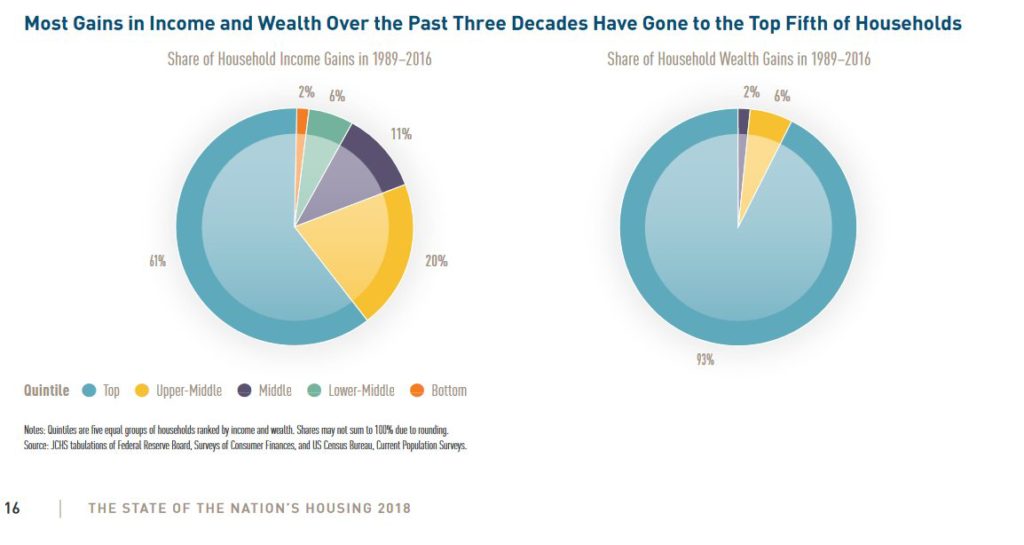
Obama is the first President in post-war history (and maybe all of history) whose economy gave more money to the top 10 percent than the entire value of all productivity gains in his Presidency. Even George W. Bush didn’t manage that.

Yes, stagnation of wages and wealth, and even the drop of both in many sectors while money concentrated in the hands of the rich is something which has been going on for decades. It is hard to stop.

But, because of the financial crisis, Barack Obama had the opportunity. Calls against TARP were running, according to my sources, 200:1 to 1200:1 against. It failed to pass the first time. Nancy Pelosi said she would not pass it if an equal proportion of Republican House members would not vote for it also. They refused to do so.  It would have died except for one thing: Obama twisted arms to make it happen. As the Presidential candidate (and likely future President), he had the ability to do that, and he did.

Again, Obama did not fix the economy because he did not want to. Or rather, keeping rich people rich was more important to him. You can argue, if you wish, that he was not willing to break up the banks because it would have been catastrophic. That argument cannot be dealt with fully here, without doubling the length of an already long essay, but I will be gauche and quote myself, once more, from 2008:

Now, it’s the US. They can try and sweep this crisis under the carpet and pretend there isn’t a huge overhang of bad loans and worthless securities. If it does so, the best case scenario is that the next twenty years or so will be America’s Bright Depression (Stagnating economy). Best case.

I will tell you now that the best case has not happened. As the charts in this post show, the economy stagnated for ordinary people through the recovery and boom of this business cycle. During the recession, there will be job losses again. Most of them will not come back in the next recovery and boom, and neither will wages.

This is Barack Obama’s legacy. Those like Paul Krugman (what happened to Paul?), who pretend that Obama is a great president are laughable. History does not grade on a curve; “Well, we aren’t all chewing on our boots.” Obama had a historic opportunity to be the next Franklin Delano Roosevelt. Instead, he chose to save the rich, and let them eat everyone else. This was a choice. He could have done other things.

Nor is this a noble failure; he did not even try. He did not use the real tools he had at his disposal.

I note, finally, again, because I know most readers will have heard over and over again that Obama saved you from Armaggedon, that the US economy cannot be fixed until the wealth, and therefore power, of the very rich is broken. It cannot be done. However bad you think it would have been if that had been allowed to happen, this economy will continue to get worse because it was not done.

The Federal Reserve has printed trillions of dollars, and given them to the rich. Imagine another world, where it had printed that money and used it to restructure the economy for prosperity and growth.

That, my American friends, is the future Obama stole from you. Indeed, because the rest of the developed world would have followed his lead, he also stole the same future from all of us.


If you enjoyed this article, and want me to write more, please DONATE or SUBSCRIBE.

Corbyn Wants to Destroy the Current Economic System

Take it right to them:

Responding to Hammond’s warning in his speech at this month’s Conservative conference, Corbyn will say the chancellor is “absolutely right” to say that Labour is threatening to destroy the current economic model, adding that the current system “allows homelessness to double, 4 million children to live in poverty and over a million older people not getting the care they need”.

Picture of Jeremy Corbyn

Jeremy Corbyn

The reason the establishment hates him is that he threatens them. He will re-nationalize power and railways, institute rent controls and ownership limits on multiple homes and overseas owners, and build new council housing.

And there’s this:

Corbyn will say Labour is not opposed to technological advancement, but digital giants such as Uber and Deliveroo have built their success not on their technological advantage, but by “establishing a monopoly in their marketplaces and using that to drive wages and conditions down.”

“Imagine an Uber run co-operatively by their drivers, collectively controlling their futures, agreeing their own pay and conditions, with profits shared or re-invested,” he will say.

“The biggest obstacle to this is not technological, but a rigged economic system that favours wealth extractors, not wealth creators.”

This, by the way, is basic economic theory. Markets work for the benefit of most when they are competitive, and bounded by safety nets and regulations. They do not work for the benefit of all when they form monopolies or oligopolies. The latter have to be regulated to the max, broken up, or turned into public utilities.


(I am fundraising to determine how much I’ll write this year. If you value my writing and want more of it, please consider donating.)


Or, perhaps, to change who owns them.

The current economic system is not good capitalism: It is not competitive or regulated or bounded by proper safety nets and guaranteed minimums, let alone proper high-end taxation.

To make capitalism, or rather, markets, work, requires strong government intervention and always has. Thatcher and Reagan were just wrong, and it shows up in virtually all the numbers.

Corbyn is the actual realist here, not those who celebrate the current mode of “capitalism.”

And this is going to be fun to watch.


If you enjoyed this article, and want me to write more, please DONATE or SUBSCRIBE.

Four Laws for Protecting Capitalism from Itself

Right. So, boosters of free trade like to use Singapore as an example.

It’s a bad exemplar of the policies such people actually want for a pile of reasons, but Singapore does contain lessons for how to do trade and capitalism right (other than “be a city state,” which isn’t usually an option).

About 90 percent of the land in Singapore is state owned, and 85 percent of the housing is.

The point here is that trade is important to Singapore BUT the population is largely insulated from the effects of free money flows. Their living costs are stable because the state ensures that stability.

Likewise, Hong Kong, renowned for free trade back in the day, had a huge amount of the real estate owned by its government.


(I am fundraising to determine how much I’ll write this year. If you value my writing and want more of it, please consider donating.)


Free trade is not free financial flow, and real-estate markets should not be subject to foreign money flows or the vagaries of an economy run through trade. You make trade work by sharply limiting what it affects, not by letting it affect everything.

This means stable costs for the native population and workforce and stable costs for people doing business in the country, which means that trade can do its work without destroying its own foundation.

This is true of capitalism in general. Capitalism, due to its inherent flaws, destroys itself in a number of ways. For capitalism to work, policies need to be in place for it to actively avoid these pitfalls:

  1. It must not be allowed to form unregulated monopolies and oligopolies.
  2. It must not be allowed to run bubbles; it must not be allowed to engage in mass fraud.
  3. The money gained from it must not be allowed to turn into power which controls government.
  4. Money must not, generally speaking, be allowed to buy anything that matters; from health care to a good education.

Capitalism, as the standard saying runs, is a good servant, and a terrible master. Only fools let capitalists actually control anything in their society that truly matters.


If you enjoyed this article, and want me to write more, please DONATE or SUBSCRIBE.

Gas Companies Manipulated Pipeline Capacity to Rook New England Customers 3.6 Billion

Shades of Enron:

The systematic withholding of pipeline capacity, particularly on the coldest days, has cost New England electricity consumers $3.6 billion…

On the worst days, including during the Polar Vortex of 2013-2014, up to seven percent of Algonquin’s capacity could be artificially constrained.

“When you relate that back to gas-fired generators, that’s about 28 percent of the gas that would be demanded,” Zaragoza-Watkins said.

This “capacity withholding,” researchers wrote, “increased average gas and electricity prices by 38 percent and 20 percent, respectively, over the three year period we study.”

These sorts of manipulations are always ongoing in any sphere where they can be done with a reasonable chance of success. This is similar to Enron’s price manipulation in the California market, yes, but it is typical of any industry where a few people can finangle prices. The LIBOR (London Interbank Rates) scandal was similiar: A few people could manipulate the rate and cost ordinary people billions of dollars.


(I am fundraising to determine how much I’ll write this year. If you value my writing and want more of it, please consider donating.)


There are always key points in the economy where a few people have disproportionate power. Anything that people must have, that someone else controls, is a leverage point which can be used to extract disproportionate profits.

People must have heating during the polar vortex. People must have loans and credit (and money). People must have houses (during the housing bubble and, indeed, various housing bubbles happening right now.)

If people must, and there is a resource bottleneck, that bottleneck can be squeezed. A pipeline is an obvious bottleneck, but that only some people can create money out of thin air is also a bottleneck. That some people set effective interest rates and profit from them is a bottleneck, and so on.

Careful construction of an economic system limits resource bottlenecks, and assures that those who control the remaining resources can’t profit from squeezing them, if possible, and regulates and inspects the hell out of those bottlenecks that remain profitable to squeeze.

We do not live in such an economy. Rather, our economy has mostly been constructed to encourage such squeezing. Cases where it is genuinely punished are rare (as with virtually all the financial executives getting off in the financial crisis).

This pipeline squeeze looks like it might be the rare exception. But only maybe. Remember, if the executives come out clean, and richer than they would have been otherwise, any fines or punishments will not stop it happening again.


If you enjoyed this article, and want me to write more, please DONATE or SUBSCRIBE.

Page 43 of 97

Powered by WordPress & Theme by Anders Norén