The horizon is not so far as we can see, but as far as we can imagine

Category: The Twilight of Neoliberalism Page 11 of 17

Russia Turns Up the Pressure (and Turns Off the Gas) on Germany and the EU

Well, well…

Russia’s Gazprom has told customers in Europe it cannot guarantee gas supplies because of “extraordinary” circumstances, according to a letter seen by Reuters, upping the ante in an economic tit-for-tat with the west over Moscow’s invasion of Ukraine.

Dated 14 July, the letter from the Russian state gas monopoly said it was declaring force majeure on supplies, starting from 14 June.

Known as an “act of God” clause, a force majeure clause is standard in business contracts and spells out extreme circumstances that excuse a party from their legal obligations.

So, Europe and Germany get gas in exchange for rubles. But Russia can’t spend those rubles for most of what it needs from the West.

The question is, does Europe, especially Germany, need gas more than Russia needs rubles and an increased exchange rate (not always a good thing)?

Everyone has been concentrating on the winter and assuming Germany didn’t need much gas until then, but a great deal of Germany’s electrical grid is supplied by natural gas plants, and as you may have heard, there’s a heat wave in Europe and most of the rest of the world.

So much for air-conditioning. And if much of Germany’s industry will have to shut down as well.

Germany can lose a huge chunk of its industrial base if this continues. The whole “keep buying gas from Russia until we can transition off of it” idea was always dubious, because other gas is much more expensive, but it also rested on the idea that Russia was desperate to keep selling; that there was a symmetry of needs.

But Russia will suffer a lot less without sales than Europe will without gas, and in any case, a shutoff will likely increase the price of gas they are selling elsewhere, making up some of the losses.

The fact is that Germany, an industrial state without a lot of resources, and Russia, a resource state, are natural economic allies, but Germany needs Russia more than Russia needs Germany.

The companies who have been given notice that of force majeure are saying they don’t accept it, but what are they going to do?

The grace period for payments on two of Gazprom’s international bonds expires on 19 July, and if foreign creditors are not paid by then the company will technically be in default.

This is a non-threat threat, because Russia has already defaulted on loans, as it is largely shut out from the Western banking system and thus can’t even transfer the money. (As happened to Argentina.) More defaults theoretically mean that Russia will be unable to access Western loans and so on, but they already can’t, and they have access to the Chinese banking system, which is larger than any Western country’s and perfectly capable of keeping Russia and Russian companies afloat.

Understand clearly that most Germans and Europeans support the anti-Russia sanctions. This is a popularly backed policy: Europeans are paralyzed by fear of Russia and were long before Ukraine. I had a friend in Austria tell me how he scared he was of Putin back in 2016.

We will, however, see what the result of this is. I would guess that in the short-term, it will stiffen opposition to Russia, but I’m less sure about the medium- and long-term. German elites, especially, will feel a need to end the Ukraine war and get back to a steady Russian supply.

No matter what, however, it highlights the price Europe is paying for its anti-Russia stance.
DONATE OR SUBSCRIBE

One Chart To Predict The Future of Civilization Collapse

I first read Limits To Growth sometime around 1982. Limits used computer models to predict possible futures of resource use, pollution and population over-shoot.

At the time I thought it was right, and everything since then has come in about as it said.

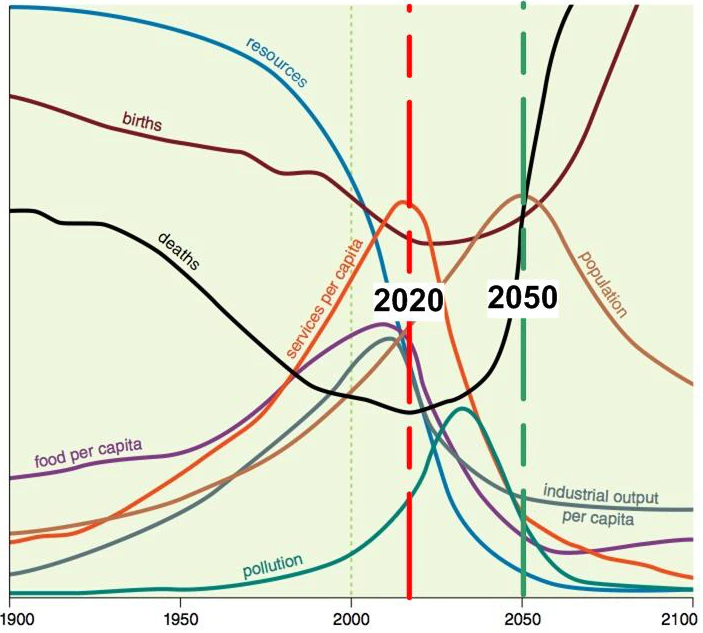
I found this chart from it, with a couple of added date lines in an excellent post on the retrospective book “Limits and Beyond.”

The chart’s a couple years off, but notice that we’re hitting the food per capita just a few years after it expected. You can say “this is because of the Ukraine war” but we were at the stretching point, which is why one war (and a bunch of stupid sanctions) were able to do this.

Note that services and industrial output are expected to peak around the same time. Population starts dropping in about 20 years and the death rate goes vertical about the same time.

Notice how extreme the declines and rises are once they get going. This should be familiar to people from the Covid pandemic, but these trends will last for decades; indeed for generations.

I’m not sure I entirely buy the population model. It’s based on the fact that poor people have more kids, with some delay, but I think the one things the Club of Rome didn’t entirely take into account is how bad climate change and ecological collapse will be.

The point, now, is that we’re about at the peak or slightly past it. The collapse has started. Covid and Ukraine pushed us into it, but it was going to happen anyway, and there’s always an inciting event. What has changed is that there was no slack in the system (and no competence, with the single major exception of China) to deal with it.

The second point is, again, how sharp these declines become, often almost immediately after they start.

Food isn’t going to get cheaper almost anywhere for a while. Then what will happen is that multiple countries which have surpluses will disconnect from the world supply network so they can feed their own people. This won’t be done for humanitarian reasons at home, our elites don’t have such feelings, it will be done because food shortages are the fastest route to revolution, and that includes food shortages caused by too high inflation. If the food’s out there any can’t afford it, it amounts to it not being out there.

This chart doesn’t break out water specifically, but in a lot of places water is going to be in serious shortage. We’re going to lose a lot of river flow and a lot of rivers and lakes outright, because they are fed by glaciers and snow pack which are already in precipitous decline. In some cases there will be an increase before the decrease: floods and so on caused by more water flow as glaciers melt faster, but then there will be almost none.

In many regions there’ll be more rain and there’ll be more rain overall, but it’s not going to make up for the lost river flow and lakes, or for the aquifers we have drained or poisoned.

This is the map, it may be off in a few places, but it’s going to be essentially correct. It didn’t have to be, the book was published as a warning so we could change our ways, but we didn’t and so it’s turned from possible prediction into prophecy.

Come back to this chart over and over again as you think about and plan for the future, but remember that it is a global chart: local areas will have different profiles and charts especially as we de-globalize, and in response to this collapse we are going to de-globalize with a vengeance.

There are certain places you just don’t want to be, which will get hit earlier and harder. In the US, much of the Southwest and south (Texas, for example.) In Asia: Bangladesh in the first wave, then India soon thereafter. I don’t know Africa well enough, but the same regional effects will occur there.

On the human scale there will be mass migrations, refugee waves of tens to hundreds of millions and war over water and arable land. Multiple societies will collapse into warlordism.

This is the future.

Our future.

DONATE OR SUBSCRIBE

Is Capitalism Near Its End?

In the book Does Capitalism Have a Future?, Emmanuel Wallerstein argues that capitalism cannot be saved because capitalism requires the endless pursuit of profits, and the world system is at a stage where there is no room for another wave of exploiting people who are largely outside the system, which capitalism, in its modern form (from about the late 15th century), requires.

The ur-rule of capitalist behaviour, per Wallerstein, is that one must pursue ever-higher profits. If one doesn’t, they’re out of the game. (You and I, dear reader, are not in the game and never were, unless some billionaire or CEO is reading this.)

If you don’t pursue endless profit, you fall behind those who do, and they buy you out, or you go bankrupt, or even you become a small or medium business and have no real power. To have power in capitalism, one must be ever striving for the apex. It’s a red-queen’s race, as in “Alice in Wonderland.”

“Well, in our country,” said Alice, still panting a little, “you’d generally get to somewhere else — if you run very fast for a long time, as we’ve been doing.”

“A slow sort of country!” said the Queen. “Now, here, you see, it takes all the running you can do, to keep in the same place. If you want to get somewhere else, you must run at least twice as fast as that!”

Now, the next thing is that capitalists actually don’t like workers who fully depend on them for survival: they want workers who have other supports; generally some sort of subsistence or government support. Traditionally this would be workers in hinterland regions (in Europe or Britain to start) who still had some land or animals and took the work only to get some extra money.

Other arrangements did exist: You could pay them less than they really needed to survive (the early British proletariat, as can be seen from accounts at the time), or, in the modern world, you can be Walmart and instruct your workers how to get food stamps, welfare, and medicaid, as you pay them less than they need to survive.

Various other companies, including Amazon, who rely on similar supports and school, which is a form of babysitting, can be seen this way as well; workers who have to care for their own children 24/7 can’t work. Extended families, in countries which still have them, do the same thing — grandparents or other relatives care for the children while the parents work.

Each wave of capitalism has gone out to places where there were still people with extended families and means of subsistence, and brought them into capitalism. At first it was cheap, then wages rose as workers became proletariatized and wanted their wages to cover their actual expenses.

Getting government to step in and subsidize workers is a poor substitute, which can’t work in the longer run, because the workers still have to be supported. Even if a specific company is dodging all its taxes, someone is paying, and if that someone is the workers, well, that strategy is only viable while there is wealth to steal from the poor and middle class, because – obviously — taking wealth from the rich defeats the point.

The last wave, to Wallerstein, was this last wave: There are no countries of significance not in the capitalist system, and there is no significant group of people with extra-subsistence to bring into the system to support cheap labor.

Without this, the current form of capitalism is doomed. Profits can only be increased by impoverishing societies as a whole, which destroys the wealth customers need to buy goods.

Though Wallerstein doesn’t emphasize it, there’s also the issue of simple depletion of minerals and of climate change. There are plenty of hydrocarbons in the world, but using them is destroying subsistence, food production in general, and drawing down water, and so on. We are running out of other materials, almost exactly as “The Limits To Growth” report predicted five decades ago.

The reason people like Bezos and Musk are obsessed with space and automation if that if space mining, colonization, and automation are the only viable solutions can the resource constraints and the expansion constraint be broken. It’s the only way that this style of capitalism continue, possibly nearly forever, by expansion to new worlds, the asteroid belt and so on.

Unfortunately, with our current technology, space colonization is a no-go. We can’t even create a biosphere (a closed environment) capable of supporting anything more complex than mold slimes. We can’t deal with the radiation in space. Mars colonization without terraforming will be very limited; it’s a more hostile environment than Antarctica, which we haven’t been able to colonize either.

So, assuming you agree with Wallerstein’s model of modern capitalism, at least in its broad strokes, there’s no way for capitalism to survive.

If it is near the end, what you’ll see is a structural crisis with wide fluctuation. Change to a new equilibrium generally happens with snaps to the new equilibrium, then snaps back. At first, the snaps to the new equilibrium are brief — over time, they become longer and eventually there are no snaps back.

This is also likely to be the case for climate change, the question is where the new equilibrium will be, which is not as easy a question as some people think, because while earth has had high carbon in the past, conditions then were quite different. One example is that atmospheric pressure 2.7 billion years ago was half what it is today.

In any case, whatever the new equilibrium will be is unclear, both socially and environmentally, and how the social equilibrium sets will work is also dependent on where the climate stabilizes.

So at this point, we can say, if we find Wallerstein persuasive, that the modern form of capitalism, which has run progressively larger parts of the world for about five centuries, is on its last legs. What we can’t say is what will replace it.

The goal of those of us who see what is happening is to create ideas; ideologies, which will be available when change becomes so imperative that people are desperate, and reaching for new options. If we don’t, the worst people will dominate with their worst ideologies, and the new system could be even worse in many ways.

DONATE OR SUBSCRIBE

Civilization Ending Long Covid Pt. 2 — 320K Long Term Sick In UK Labor Force

Starting in 2020, an increase of 320K long term sick people. We tend to do percentages off the population, but the UK Labor Force is 34.7 million people. That means, in 2 years, what is probably most Long Covid, caused about a .92% decrease in the labor force just due to long Covid. Another .38% of the population left the UK Labor force for other reasons.

Where’d I get this from? The Bank of England!

Since end of 2019- we’ve seen a fall of 450,000 (1.3% of labour force- a very large decrease in labour force … The persistence & scale in this drop has been a surprise to us. We’ve seen an increase in long-term sickness in that number – around 320,000 people…

…Falling participation in the labour market is not a lack of job opportunities, but a rise in long term sickness linked to the pandemic. The issue of Long Covid is very serious.

Last week I wrote that a big part of rising labor costs was a tight labor market and…

much of why the labor market is tight is because they let a million people die and probably millions be disabled by not handling Covid

I’ve been emphasizing for a long time that Long Covid was going to be the real problem. .92% may not seem like much, but remember:

  • You can get Covid over and over again;
  • There is no long lasting or complete immunity from Covid either from vaccines or natural immunity;
  • New variants are being born all the time and the ones which survive and thirve are generally optimized against whatever is the biggest barrier to current spread;
  • Each time you get Covid you can get long term damage. It may not be sympomatic, but it’s there.
  • So the next time you get Covid, you’re more likely to get symptomatic Long Covid.

Let us assume, for the sake of argument, that UK and US reductions in the labor force are about the same, in percentage terms. (Death rates in the UK are slightly lower than the US, but I don’t trust either country’s stats all that much.)

The US Labor force in 2021 was about 161.2 million. Multiply that by .0092 and we have a reduction of approximately 1 million, four hundred and eight-three thousand people (1.483 million). Now, imagine the US loses that number of people from the workforce every two years?

Doesn’t take long from those numbers to be catastrophic, does it?

Understand that marginal rates control the capitalist market.

The good side of this is that taking so many people out of the workforce absolutely will increase wages without wage controls. And it will keep doing so for as long as we refuse to control Long Covid and have no effective AND widely deployed cure. Problem is, while we do way too much bullshit labor and could get by with less workers, I doubt it’s going to be Wall Street parasites whose jobs we don’t fill, it’ll be people who actually make, grow, mine or distribute goods that matter, and people like nurses and orderlies and teachers and so on who are actually productive, rather than parasites at best.

Meanwhile, China, who supposedly wrecked their economy with Zero-Covid, will not be suffering under this reduction. (The Shanghai outbreak is now almost completely under control, much to the dismay of pro-death and disabling neoliberals.)

And this is before the fact that we will need to take care of all those sick people, though I suppose the American solution will be to let them use up all their savings, get thrown off any private healthcare, perhaps manage to get on Medicaid and eventually wind up on the street and die.

Blah, blah, blah.

The point is that our civilization CANNOT survive this sort of disabling if it just keeps going on and on. Multiply by all the problems we’re going to have with climate change, and stir in a mix of nuclear-armed Great Power competition and the results are catastrophic.

It’s Long Covid or a real cure or a miracle where Covid dies out by itself (not seeing how that happens when natural immunity is limited), or we are in for a world of hurt.

Take precautions. It’s not death you should worry about, it’s disabling. I don’t know what happens after death, but I do know that a lot of very bad things can happen to you while you’re still alive.

DONATE OR SUBSCRIBE

How Big Is The Chinese Economy Compared to The West?

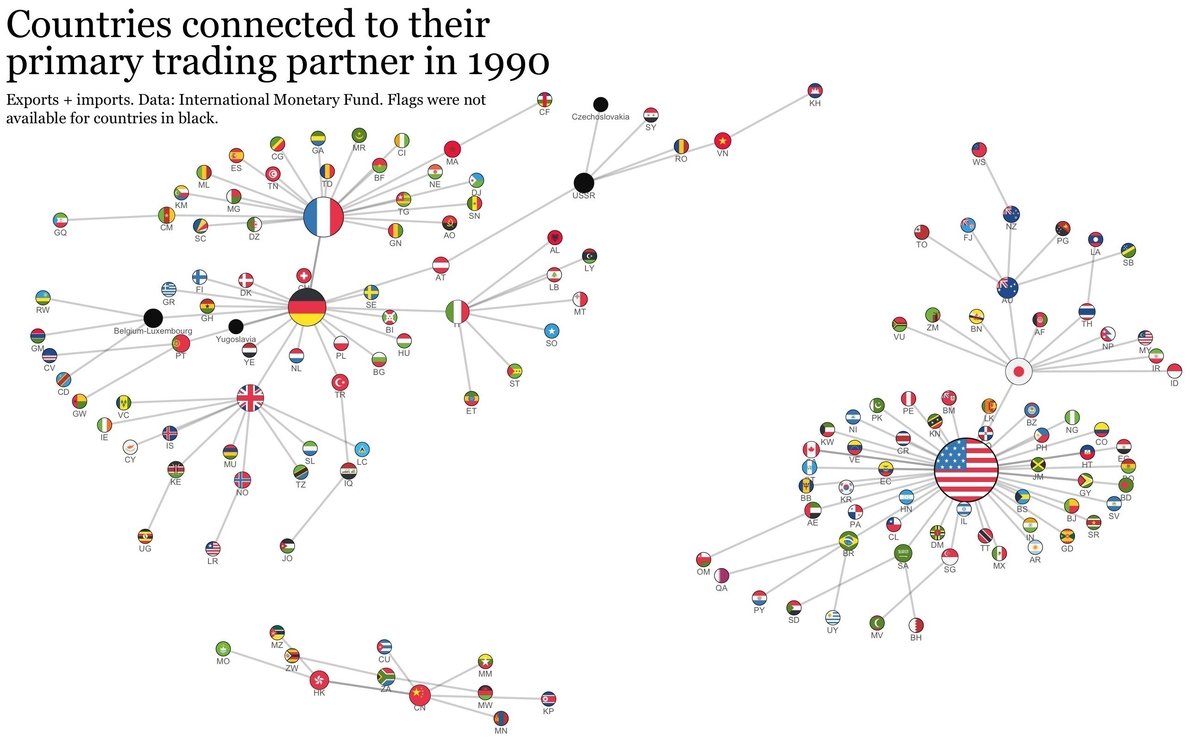
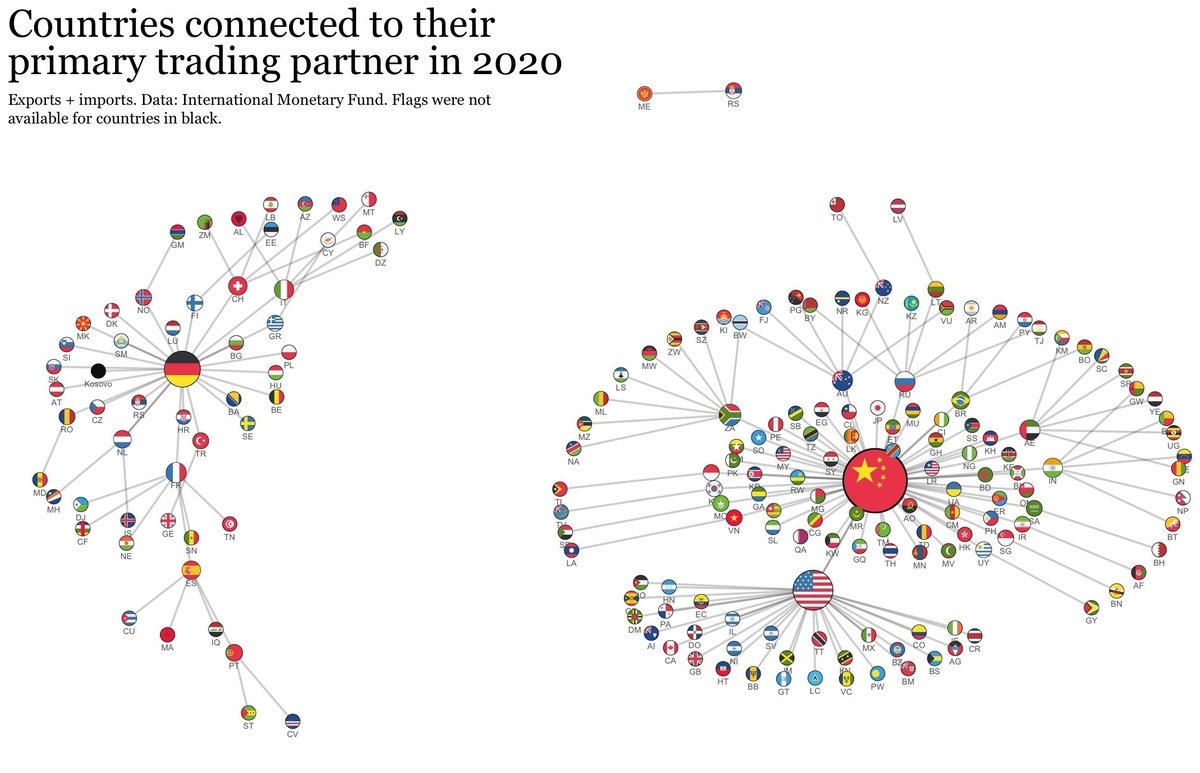
I recently came across these charts, of the biggest trade partner of each country, from 1990 and 2020.

To simplify: China is now more dominant in trade than the US at the height of its recent power. (Also of interest is the change in the UK and Japan’s position, though the collapse of Japan is overstated: it’s not , but it’s still a big trade power.

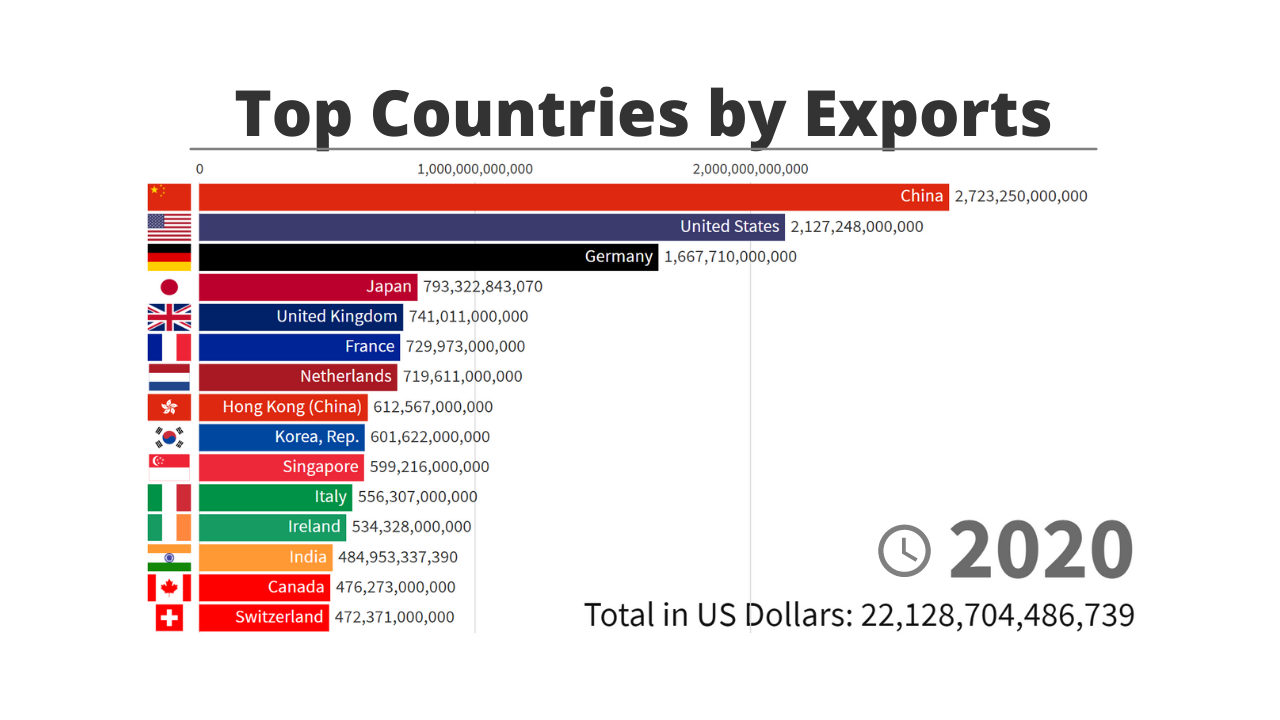
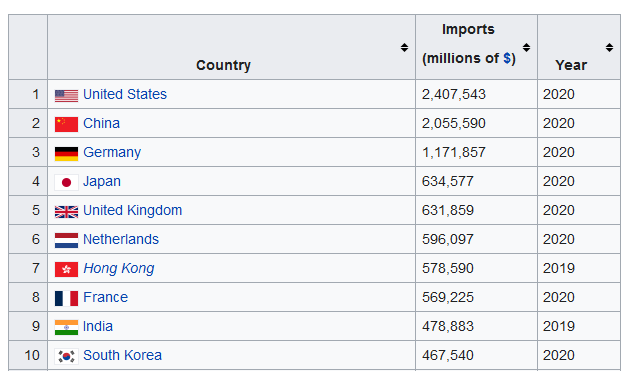
Let’s put the 2020 chart in numbers, bearing in mind that doing it in US dollars will overstate the relative size of the US.

For imports (from Wikipedia):

So, China is the primary trade partner of far more countries than the US. It exports more than the US, and imports less. These numbers understate the situation, though, since they are “goods and services.”

French Economist Jacques Sapir recently did an economic comparison by adjusting GDP numbers (not trade) as follows. First, change them for purchasing power parity (PPP), which is to say you can buy more with the same amount of money in China or Russia than in the US or Germany. Then adjust for the service sector being overvalued, so you’re left with manufacturing and the primary sector (digging things up and refining them) as the primary drivers.

Do this and Russia’s economy is 5% to 6% of the world economy, and much larger than Germany’s. China is about 30%, and the EU + US are about 30%.

Now I don’t entirely endorse this, there are some useful things in “services” like parts of the tech industry (much is worthless though, serving ads better does not increase a country’s actual economic strength. It might sap it.)

But it puts the situation in better perspective than using raw GDP.

Really there are three primary drivers of actual economic power: manufacuturing, resources and technology. Everything else either exists to service those 3 areas, or is nice and maybe even important to social stability (law, entertainment) but not primary.

China is the world’s primary manufacturing power. Russia is a powerhouse for resource exctraction. Russia is a leader in some types of military technology and not far behind in many others, and China is rapidly closing on the West in terms of tech and is even ahead in many areas (5G, for example, or hi speed trains, civilian use of drones, and so on.)

China also has something the US doesn’t have: a belief in technology. Robots and drones are common, technology is viewed as good, not bad and a threat. The Chinese believe in the future in a way that the west hasn’t since the 50s.

On top of all of this China is the world’s largest developer of nations: if you want ports, roads, train stations, hospitals, schools, smart cities or anything else, China will build them for you. They’ll finance them, and some exceptions aside they offer good loan rates because usually they’re more interested in good trade relations and getting your food/oil/minerals than they are about making a profit off building the infrastructure. In addition, Chinese construction companies building overseas infrastructure means those industries don’t have to downsize: they build China, now there isn’t enough work, so they’re off in Africa and South America.

To summarize then: China is:

  1. the number 1 trade partner of more nations than anyone else, and more than the US had in 1990.
  2. the world’s largest manufacturing nation
  3. Technologically near even with the West, and in some places ahead.
  4. The nation that helps the most other nations develop.
  5. When you adjust for PPP and service sector crap, a larger economy than the US. With Russia, a larger economy than the US and the EU combined.

And this is the nation we want to enter into a Cold War with? We shipped them so much of our industry that they now have more than we do, and after doing that we decide it’s time to pick a fight?

One thing is true of post-industrialization great politics: industry, access to resources and tech are what determine power. Since there is no longer a situation where the West has technology that is vastly ahead of everyone else’s, it really comes down to industry + resources.

And with Russia locked in and South America and Africa tending to prefer it, China is ahead or secure in both of those those categories.

If we wanted to keep our supremacy, we had to not ship China our industry and our tech so we could make some of our elites even richer. The Chinese accurately sized up our elite’s weaknesses and exploited them to the hilt. They thought they were “international” elites and it didn’t matter where the manufacturing was done, or who had the technology. The Chinese, however, were a national elite, and they knew it did.

I’m not sure this was exactly a bad thing. The West, in the unipolar moment (and heck, before) vastly misused its power, over and over again. Maybe a two-polar world will be better, if it isn’t, at least all power won’t be centralized in America with a few satrapies getting a voice and maybe that will be better for many countries and billions of people.

DONATE OR SUBSCRIBE


The Petrochemical Age In Context

If you want to do super big picture macrohistory, humans have really had three eras:

1) Hunting/gathering

2) Agriculture

3) Industrial.

To over-summarize, hunter-gatherers, with some exceptions in nutritionally dense areas were generally egalitarian. They had high childhood mortality and a fair bit of violence, but they lived longer lives than any time period before the Industrial era, and were health. In some cases we still haven’t caught up (for example, the width of hips of their women was wider than ours, and that correlates to health and easier childbith.)

Agriculture started out OK-ish for about 2,000 years, but the nature of agriculture creates private surpluses and allows for large elites. It’s easy to appropriate food and service from farmers, because they can’t move away and they can’t hide their take well (crops are harvested at known times, and about how much land produces is also known.) For the vast majority of the population, living in an agricultural civilization sucked. Yes, there were more of us, but we were sicker, died younger and more likely to have a nasty overlord. Violence decreased (though these figures are controversial), but that’s because the lords and masters don’t want other people killing.

Humans in this period were essentially domesticated, and there’s some reason to believe the process weeded out most people who naturally rebel against control. This is little different from how wolves became dogs, and just as degrading.

We know the industrial era, because we live in it, but I want to invite you take the long view: imagine it’s a 1,000 years from now. Or 5,000.

What the industrial age looks like when you zoom out is “the petrochemical age”. We figured out how to harness coal, gas and oil, added in a few other sources of energy, and became clever at hooking machines up to our power sources.

The problem is that in a period of less than 300 years we’ve burned up so many petrochems that we’re overheating the planet thru the mechanism of climate changes gases, and our population is well over the planet’s carrying capacity, leading to a crush in ecosystem diversity and the absolute number of animals, plants and insects.

Since ecosystems + climate are what make the planet habitable for humans, from the long point of view, all the industrial/petrochem era looks like is a massive orgy: a predator species which has overshot the world’s carrying capacity.

If we can’t transition to a technological way of supporting ourselves which doesn’t destroy the world’s carrying capacity, then all this period will be looked back on as is a blip: a brief period of species-wide stupidity, where we exploited technologies and powers we were too foolish and stupid to control the consequences of.

Progress isn’t automatic, and it isn’t one way. When you look at charts of health characteristics in the western world from the stone age, on, one culture stands out: Greek City States. They live longer than anyone else, they are healthier on multiple metrics, and their civilization is destroyed by the Romans, who don’t have nearly as good lives.

The same thing can happen to us. We are not sustainably transitioning to a new way of living. Even when we do some right things like electrification, we don’t build items to endure. We’re dumping valuable minerals into phones and cars and consumer goods we’ll throw out in 5 years or so, and we don’t have the resources to waste. We’ve done nothing to stop climate change. We’re over-fishing. Over 90% of the insects in multiple areas (perhaps world wide) are gone, as anyone over 50 or so can tell you. The birds are gone, too. The big animals. The wild areas. The coral reefs are dying. The Amazon is dying and now a net-emitter of carbon, not a sink.

In theory we could probably still fix this. The technology either exists or is with in sprint to do so, but it’s about more than technology: we’d have to change how we live. Give up our consumption based society; get rid of planned obsolesence and use the same items for decades. Ditch exurbs and suburbs almost entirely, and re-wild or make it so that people who want land have to live by the rule that their presence must increase biodiversity.

The changes are radical, and there is no sign of anyone in power taking them seriously. Instead we build more and more crap, pollute more and more, spew more and more gases into the atmosphere, and salivate over drilling for gas and oil in the arctic, even as we run down or pollute our aquifers.

Our technology was a test: we were given (or gave ourselves) great power, and our task was to use it to benefit ourselves in a way which was beneficial, or at least not catastrophic, for the rest of life on Earth (our ecosystem) and to not destroy a climate which is the only one human civilization has ever known.

We failed in this task, and so the Petrochemical Age is likely to just look like a blip. Perhaps a new technological civilization will arise from our ashes: but if it is to survive and prosper it will  have to do what we didn’t and give at least as much back to nature as it takes out (and rather more, to fix the damage.)

As for us, it seems unlikely most of our civilization will make it. Doubtless hi-tech enclaves will continue to exist, but ecosystem collapse, water shortages and climate change make it unlikely our civilization as a whole will survive another century. It may not even make it 50 years.

And looked at from afar, it’ll be a 4 century mistake, in which some people lived very well, but the near permanent ability of Earth to support life was damaged, making every future human poorer in a very real sense.

DONATE OR SUBSCRIBE


March of De-Dollarization: Russia Selling In Rubles

So, as many readers will have heard, Russia has said it will only accept rubles in exchange for its exports to “hostile nations” — which is to say, those nations who have sanctioned it over Ukraine.

The main thing to understand is that the West froze hundreds of billions of dollars of Russian reserves on account in the West. They sold us stuff for Euros and dollars and we will now not let them use those dollars or Euros. Sanctions mean that even the dollars and euros they have cannot buy many, perhaps most things, in most Western countries and Japan.

So selling us anything in dollars and euros doesn’t make much sense: they can’t use them without exchanging them for other currencies, and our sanctions make that difficult, since they’re closed out from our banking system.

Thus, rubles. An additional advantage of this is that it increases the value of the ruble, which had collapsed under sanctions.

In order to buy Russian oil and gas, Europeans will have to get rubles. Russians are unlikely to want a lot of euros or dollars because they’re almost impossible to spend, so Europe will probably have to buy Yuan and Rupees, then trade those currencies for Rubles. Paying with gold isn’t really practical, because it would have to be physically shipped to Russia or on account with a country they trust (China, India, a few others). Obviously gold in Western banks is not safe.

Russia’s main exports are oil, gas, wheat and minerals. There are usually other sources, but without Russia there aren’t enough to satisfy world demand. Sanctions on Russia, because they are such a big wheat exporter, may wind up killing a few million people in the global South, more than will be killed in the war.

From the point of view of the West, this is a continuation of de-dollarization. If Saudi Arabia also sells oil to China in Yuan, it will be a big deal. Prices are still set in dollars, but I expect that may end fairly soon.

Payment systems are being set up, and the world will split into two different trade areas. China wants another five to ten years before the big (inevitable) split with the West, they may or may not get it, but if they have any sense they won’t allow Russia to be choked out. They certainly aren’t going to cooperate with US sanctions, and that means they need to cleanly separate their financial system from ours, so that funds can’t be seized in transit, executives can’t be locked up and so on.

The Russians didn’t expect this, they were taken by surprise. Probably because, in fact, it’s a weapon that can only be used against a country like Russia (as opposed to Venezuela or Iran or Afghanistan), once. No one outside the West can now trust the West’s system, and everyone with sense will want their reserves kept elsewhere.

This is mostly a good thing, the West has terribly abused its currency primary to hurt other nations, even before the abuse of sanctions which largely accelerated under Clinton. Control of dollars was part of the arsenal used to keep the South poor and the US in control. China was able to get around this because of American greed and stupidity, and now that it has, it has a veto. Since Russia being taken out will lead it to be surrounded by enemies, it is going to use that veto. Again, Russia cannot be choked out by financial and economic sanctions if China does not permit.

I have been writing about this for almost 20 years now, it was clear it would happen eventually but exactly when and how were unclear. For a few years I’ve been saying we were moving to a Cold War world, and we are.

The difference is that unlike in 1950 or 2000, the West is not clearly stronger than the coalition against it. The USSR was always weaker economically, and though for much of the 50s and 60s they had higher growth (something forgotten today), in retrospect and for some of the smarter people at the time, the outcome was never in doubt, it just needed to be managed so it didn’t turn into World War 3.

This time the outcome is in doubt, and I think the smart money would bet slightly against the West, maybe 3/2. The wild card is climate change, which will hit China very hard, but could also do great damage to Europe and America.

Putin was foolish to get into this situation, reserves should have been withdrawn, but this is a smart move. It’s also going to hurt Europe a lot and damage German industry, whose costs will skyrocket (I have little sympathy, given that Germany has used the Euro to basically de-industrialize most of the rest of the EU.)

The post-American hegemony world isn’t quite here, but it’s being born. Welcome to the Age of War and Revolution and the Twilight of the Neoliberalism.

DONATE OR SUBSCRIBE

Three Lessons from the Melian Dialogue Which Apply Today

In the Melian dialogue, the Athenians have sent a military force to the city of Melos. The Athenians urge the Melians to submit. If they don’t, the men will be killed, the children and women taken for slaves. The Athenians say, “The strong do as they will, and the weak suffer what they must.”

In other words, “Take the deal, or you’ll get even worse.”

This is, in essence, what Putin said to Ukraine, and Ukraine, like the Melians, refused. It is at the heart of most of US interactions with “enemy” nations since WWII, and especially since the end of the Cold War. Even if they didn’t promise destruction, enemies were told, “Resist, and we’ll destroy your economy with sanctions, and millions will suffer or die.”

There are two corollaries to this, however. The first is pointed out by the Melians:

But do you not recognise another danger? For, once more, since you drive us from the plea of justice and press upon us your doctrine of expediency, we must show you what is for our interest, and, if it be for yours also, may hope to convince you: Will you not be making enemies of all who are now neutrals? When they see how you are treating us they will expect you some day to turn against them; and if so, are you not strengthening the enemies whom you already have, and bringing upon you others who, if they could help, would never dream of being your enemies at all?

This is what the US did to many countries — these countries may not have declared their enmity, but they do not consider the US a friend. They view the US as a threat, and when the day comes that they can get their revenge, they will do so.

It is at the heart of what is happening in Europe: Rearmament. By using his military, Putin has convinced other nations, especially Germany, to rearm.

But there is a third side, mentioned by neither the Melians nor the Athenians.

“If the powerful can do this, if I do not do it, I am not powerful.”

A great deal of why Russia is doing what it is, and why it created all the little semi-states around itself, was in reaction to the US. “If the US can violate international law, create Kosovo, and go to war with other nations who are weaker than it, if we don’t, we admit we are not powerful.”

Powerful nations can violate international law. If Russia does not violate international law in the same ways as the US and its favored vassal states does, then Russia is admitting it is weak.

The massive sanctions response is a test. Is the West still strong enough to largely limit massive violations of international law to itself and its vassals, or is Russia capable of withstanding those sanctions, and therefore one of the strong?

This question has yet to be answered. It will take time. In large part, as I have pointed out repeatedly, it depends on China. Probably Russia isn’t strong enough; but China + Russia are.

And notice the key allies who are sitting this out: Israel, three of the four Gulf states, the Saudis, and to a large extent, Turkey.

“There is no difference to us between Ukraine and Iraq or various other violations of international law. We aren’t your allies because we are your friends.”

Meanwhile, the US is asking China, their declared enemy for the past twelve years or so, to undercut Russia, because the real question isn’t about Russia, it is about China.

“The strong do as they will, and the weak suffer what they must.” Who are the strong in our world?

DONATE OR SUBSCRIBE

Page 11 of 17

Powered by WordPress & Theme by Anders Norén