Use to discuss topics unrelated to recent posts.
Author: Ian Welsh Page 98 of 437
Water. As I’ve said for many years.
The world is facing an imminent water crisis, with demand expected to outstrip the supply of fresh water by 40 percent by the end of this decade, experts have said on the eve of a crucial UN water summit.
I’ll use the US as an example, though this going to effect almost all countries, some much worse than others, and it will cause a number of wars. Candidates include all nations along the Nile River, and all nations around the Himalayan plateau, among many others. The US may threaten war with Canada to get Canada’s water resources and may invade if Canada is recalcitrant. The Great Lakes will be a great problem.
But let’s take a look at the (more or less) current situation. These are the 2015 numbers for fresh water withdrawals (numbers are done every 5 years, but I, at least, can’t find the 2020 numbers. There won’t be a dramatic change, however.)
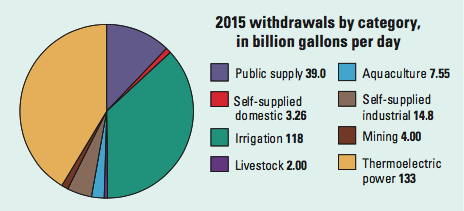
The first thing we notice is that electricity generation and agriculture, for crops, no animals, are the big users. Public supply is a distant third with industrial an even more distant fourth.
How is this historically? The news is mostly good, except in irrigation:
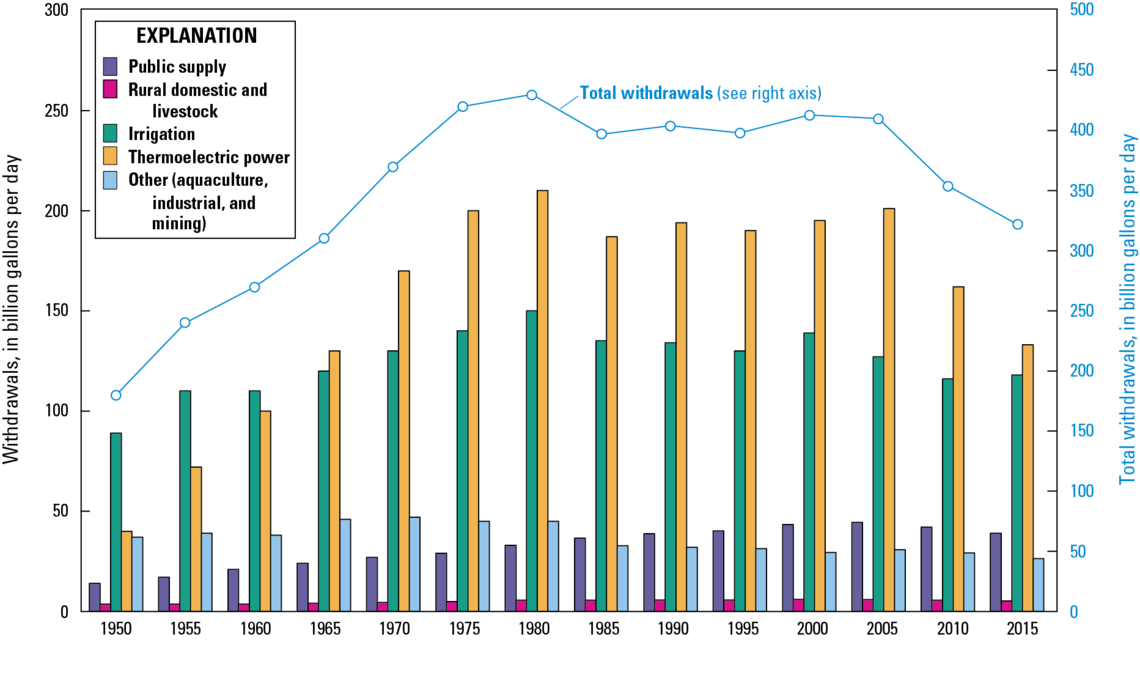
But the irrigation news is bad. It’s only a 2% increase, but…
Not every sector posted declines, though. Fresh groundwater withdrawals increased by 8 percent compared to 2010. And irrigation increased by 2 percent.
Again, the California drought effect is to blame. Irrigation accounts for 70 percent of fresh groundwater withdrawals. Rivers and reservoirs were so depleted during the drought that California farmers pumped and pumped from aquifers. Fresh groundwater withdrawals in California for irrigation increased by 60 percent, while surface water withdrawals for irrigation in the state decreased by 64 percent.
Withdrawing from groundwater means that there’s not enough rain. The long California drought, finally broken this year, but very likely to return, leads to taking more water from aquifers than can be recharged and damages aquifers so that their maximum capacity is permanently reduced.
Let’s flip back to energy generation. Thermoelectric means coal and gas and oil turbines, mostly. There is a general move away, but not quickly enough.
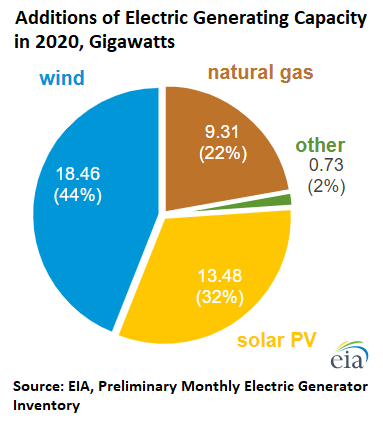
That’s the new generation added, here’s the retired.
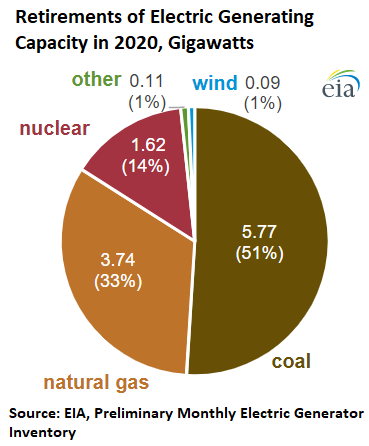
Notice that the natural gas added (9.31) is almost equal to the natural gas and coal removed (9.51). Natural gas uses less water than coal, but still plenty.
The pace of reduction of use of water needs to increase significantly. Solar, while it doesn’t use water for generation does use a lot of water in construction, so wind is preferable from this point of view, with the standard issue of difficulty in supplying baseline energy, since the wind is rarely completely reliable.
There are solutions in many places. California is a huge water problem in the US, but desalinization could provide much of the solution since California is on the coast. I’ll do a full article on that later, but despite high costs, large scale desalinization is possible especially if it done using tidal power and not thermoelectric.
And tidal power is one of the most promising new powers. Wind and solar are unsuited for steady baseline generation, but in places close to the ocean, the waves are constant. For example:
As a newer technology this is still expensive, but moving to scale would reduce costs significantly. It’s 24 hour, though there’s variation in energy generation due to tidal cycles, it’s obviously renewable and it doesn’t use up water during generation, while it doesn’t have nuclear’s downides.
The great problem with desalinization is simply getting it from the shore inland. Depending on geography that may be doable, or not, but great waterworks programs were done in the 18th and 19th century, and much is possible.
Still, as with everything else, we needed to moving on solutions 20 years, or more, ago, and that means solutions aren’tgoing to be ready at the necessary scale in time.
One thing to take from all this, however, is that your person water use isn’t all that important. This doesn’t mean some ridiculous usages shouldn’t end: lawns should be illegal anywhere that doesn’t have enough yearlong rainfall to support them without watering, for example, but taking a shower isn’t going to kill the budget. And as for agriculture, while we can increase water thru desalinization, California growing mass crops of almonds, notoriously water-thirsty, is and always has been ridiculous. Switching to crops that need less water is a no-brainer, though it may require price supports and agricultural market restructuring.
But let’s take it as a given that there’s going to be a worldwide freshwater crisis. Even with use reductions and desalinization, rivers that are fed by glaciers and snowpacks are going to experience a decline and some will stop existing entirely. This will effect all the countries around the Himalayas, all the glacier fed rivers of North and South America, water outflow from the Corderillas, etc, etc…
At first, in most cases, there will be an increase in water, because of faster glacier melt and old snowpacks which have been essentially permanent melting. Then there will be a long term decrease, which will not be reversed without some form of global cooling, which will probably require geo-engineering.
On the bright side, increased warming will, globally, likely increase rainfall, but that doesn’t mean it will increase rainfall where you are or where crops are, and the general prospect for growing crops under global warming scenarios is dismal, except in certain farther north and south areas. Overall, however, the gains will be vastly outstripped by the losses and if we see, for example, problems with any of the great monsoons, the effects will be catrastrophic.
This will be exacerbated by the fact that aquifers worldwide have been massively depleted and the depletion continues. This is as true in India and China as it is in the US. Entire regions which rely on groundwater will collapse.
A water crisis thus feeds directly into a food cris.
As an individual there are solutions. Rainwater collection, condensers, creating your own storage spaces (common in the 20th century but illegal in most municipalities today) and so on. These will be made more difficult because of widespread pollution. It’s no longer safe, for the first time in human history, to just drink rain-water, for example and figuring out how to make the water you collect safe will be a major issue.
But you should consider doing some research on this (and I will likely revisit it with more details). You can survive 30 to 40 days or even more without food. Without water you die quick.
And, politically speaking, any country or region where the water is privately owned needs to move to public ownership.
If you think food riots are bad, water-riots will be worse and quite justifiably so.
The future is getting very close to being today.
The results of the work I do, like this article, are free, but food isn’t, so if you value my work, please DONATE or SUBSCRIBE.
This is an article I’ve been avoiding writing for a few years now because there’s no upside to it, much like a man weighing in on feminism or a white person writing about first nations or anyone who isn’t a racist piece of garbage writing about Israel. But because trans-rights have become a political wedge issue, I feel it has become necessary to discuss them.
I’m fifty-five years old. When I was growing up two things were true about transvestites (which we universally thought of as male to female). People didn’t like them, and people mostly didn’t think it was any of their business unless they were tricked into a romantic or sexual encounter with one.
I don’t want to underplay how much they were disliked. Watch the end of the first Ace Ventura movie to get a feel for it.
But I don’t remember many people saying transvestites (or drag queens) didn’t have a right to exist. Now, admittedly, this is the late 70s and 80s and 90s, not the 50s and 60s.
The current panic needs a dissection. It’s obviously something which conservatives have vastly amplified in an attempt to use it as a wedge issue, so they can roll back advances on GLBTQ rights. I say obviously because they’re the ones pushing it hardest, alongside one group of essentialist feminists, the TERFs. Conservatives always love to find an otherwise leftish group to work with: in the past they often worked with anti-porn feminists (whom I have some sympathy for.)
A wedge issue is meant to split. Split a coalition, split the public. Carve the T and Q off GLBTQ as gays, lesbians and bi-sexuals scramble to protect themselves and get mommy and daddy to associate cross-dressing with their kids and feel queasy about it, rather than with those two nice gays or lesbians who want to marry, or the bisexual whose bed-partners have nothing to do with them.
There are three main avenues of attack. Sports, safety in female only spaces like bathrooms, and “save the kiddies.”
Let’s start with sports. There’s a lot of back and forth on this and disagreeing studies, but my take on this is simple enough. If you’ve gone thru puberty as a man you’re going to have an advantage in certain sports due to skeletal structure. I used to run. Look at men running and women running: women’s mechanics are different and less efficient due to wider hips. It’s just that simple. In some gender divided sports I’m not sure that trans-women should be allowed to compete, as a matter of fairness. I don’t see an issue with trans-men competing in most sports, but it may turn out that there are some sports in which female puberty is an advantage. There are certainly sports where the best women are worlds better than the best men (real long distance swimming, as one example, though it seems like most of the advantage would go away with hormone treatment.)
Sports is fairly niche, however. The second issue is female only spaces, mostly public bathrooms. The bottom line here is that there doesn’t seem to be much trans-on-normie violence, but a ton of normie-on-trans violence and that trans-women are at great risk if forced to use men’s bathrooms. Trans-women get raped and beaten a lot and men’s bathrooms are a bad place for them. The “other” stigma combined with the fact that any post-hormone treatment transwoman is unlikely to be able to hide what she is makes them big obvious targets that a significant minority of men thinks it’s OK to rape or beat. A transwoman, while she has some skeletal advantages in sports where small advantages add up to victory, is not a big physical threat to other women, and there is no evidence of a wave of trans-women violence, though there have been some individual cases. The bathroom stuff is a panic, and largely irrational.
Now, the kids thing. This is the real problem, and this is what has people most worked up over and outraged. The first step is to admit that there’s some reason for it.
Understand clearly, the evidence is that people who go thru puberty as their preferred gender, having never gone thru puberty as their non-preferred gender have better outcomes, both psychologically and medically/physically. This is pretty settled.
But we have a culture where an ten to thirteen year old isn’t supposed to make any important decisions for themselves. Our children, including out teenagers below the age of 18, are chattel. Their parents and other authorities make all the important decisions, with the state having the right to override the parents.
This is a time and social bounded case and has not been the situation in all societies. It’s good we don’t have child labor, but the lack of it means that we have come to believe that children and teens (really two different things) are incapable of making their own decisions well or of knowing what is good for them. Further, because of the amount of hormones in our food and water the age of typical puberty has dropped significantly. Many children used to hit puberty as late as 14, that’s rare now.
The problem is that outcomes ARE better if the decision is made at (or rather just before) puberty onset. Again, this isn’t in doubt.
But, yes, it’s a big decision and you’re given hormones to go thru puberty in your non-biological gender, that’s going to lead to worse outcomes if you change your mind.
To the best of my knowledge, however, fewer people change their mind than stick with it and who believe they made the right choice, at least with the time-limited data we have so far.
The other issue related to this is the use of hormone blockers. (Oddly I’m on hormone blockers right now, as they’re standard in one treatment protocol for cancer.)
Understand clearly: the vast majority of evidence and this evidence was accumulated before kid-trans became an issue, is that early puberty is bad for kids: they’re unhappy, they do less well in school, etc. Late puberty is associated with happier and better adjusted kids. Add that to the fact that puberty now comes earlier than it did before we polluted our food and water and a couple years on puberty blockers is close to a non-issue. Hormone blockers do sometimes cause medical issues, so they aren’t risk free, but the risks of growing up as the non-prefferred gender are significant.
But the bottom line here is simple. Should children be able to make their own decisions? Can they? There’s lots of conservative claims that children are unduly influenced by parents or teachers or whatever to become trans, but a cold eye that notices that being a transvestite is still looked on negatively by most of the population leads to the calculation that it’s more likely they’ll be persuaded away becoming trans than towards becoming trans.
Influence or no, though, the problem is that the decision to be trans is best made just before puberty, because not undergoing the other gender’s puberty leads to the best outcomes. This is a decision which should be made by young teens, and our society thinks that young teens shouldn’t make important decisions.
The body in question, however, and the future, is theirs. They are the ones who have to live with it. I am aware of no vast social interest in whether or not transvestites exist. As for the surgery, just leave that decision till they’re legal adults. But the hormone therapy decision should be made young and perhaps, for once, we should allow children to make a decision that matters to them, with the input of their family and doctors, when they need to make it to get the best results.
As for the politics, fuck the right. If people don’t own their own bodies and have the right to make decisions about them, they own nothing. The only reason this is an issue at all is because it involves children and we treat children like property. The rest of it is politically driven moral-panic bullshit. The existence of transvestites, male or female, does not harm you in the vast majority of circumstances (elite athletics is a tiny issue and bathrooms are largely bullshit) and is none of your goddamn business. Mind your own business and let them mind theirs.
(A summary from Scientific American of the evidence.)
Edit: Corrected to indicate improved psychological outcomes (very robust) and some issues from hormone blockers.
The results of the work I do, like this article, are free, but food isn’t, so if you value my work, please DONATE or SUBSCRIBE.
Something which has slipped past most people’s radar is that China recently acted as the intermediary for peace talks between Iran and Saudi Arabia. The two countries have been at each other’s throats for decades, funding and running operations and proxies against each other. Elijah Manjier has a decent summary (part is behind a subscriber wall) from a pro-Iranian point of view.
It’s also interesting that in this conference no English was used!
Now it’s obvious why the US couldn’t be involved: it hates Iran and doesn’t intend to change that any time soon. But that China was reached out to indicates that it has good relationships with Iran and Saudi Arabia and that it’s considered powerful and prestigious enough to be involved a region far from its core.
On the Saudi side this shows the continued movement away from being a US ally. It suggests continued movement towards China, and that the petro-dollar really is under significant threat.
For Iran, it suggests that the days of the US being able to coordinate sanctions over it are likely numbered. If the Sauds break out of the US bloc, one can expect the Gulf States to follow if Iran is also in the Chinese bloc: these are the regional and cultural great powers. As Chinese/Russian payments expand and with petrochemicals priced in Yuan or Rubles, and with the most important Middle Eastern powers friendly to China, the US is reduced to its core allies. These are important countries, no doubt—Europe, Japan, South Korean, Taiwan and so on, but it is a minority of the world and is filled with countries terrified of US sanctions, looking for a way out under the potential hammerlock.
I don’t want to over-state how important this mediation by China was, but it was important and it’s one of those milestone moments. It wasn’t the US or Europe who the Sauds and Iranians went to, and just as importantly, they didn’t feel they needed US approval. Saudi Arabia using China, whom the US has declared an enemy, to move towards peace with a country the US has been hostile to for about 45 years is an earthquake.
Whether the peace will really happen is more dubious, but if movement, even hesitant 2 steps forward, one step backwards movement continues, it will be worthwhile. I am most interested to see if this will mean some sort of peace can be worked out in Yemen, or if it means the Iranians will abandon the Houthis, which would be sad.
The results of the work I do, like this article, are free, but food isn’t, so if you value my work, please DONATE or SUBSCRIBE.
Niemoller:
First they came for the socialists, and I did not speak out—because I was not a socialist.
Then they came for the trade unionists, and I did not speak out—because I was not a trade unionist.
Then they came for the Jews, and I did not speak out—because I was not a Jew.
Then they came for me—and there was no one left to speak for me.
So, the list isn’t exhaustive, there’s no mention of gays and Gypsies/Roma, for example. No one ever seems to talk about the Roma but as a percentage of their population they got it worse than the Jews did.
But forget that. It seems all we talk about is the tragedy of the Jews, but notice they weren’t killed first. First it was the socialists, then it was trade unionists.
This is because the Nazis first killed those who were an actual threat, then went on to kill those they hated (and who money they could steal without upsetting the majority of the population.)
Liberals always make deals with fascists or reactionaries who take over their countries. They generally do quite well out of them, corporate officers saw their incomes soar under Hitler. The argument between liberal and fascist is an argument over brothers about who should rule their father’s house: fascists treat capitalists and business well, they just need to know their place.
The left can’t make deals, because they are in fundamental opposition. This is true of fascists, who kill left-wingers, but it is also true of making deals with liberals. As Corbyn and Lula recently proved, even the mildest of leftists can’t cut a deal with liberals, because liberals don’t see the left as legitimate.
It should be pointed out that this was true of FDR, as well. The rich and the right never forgave him, always hated him, and spent generations undoing what he had done. Every time you see an attack on so-called entitlements, understand that is part of the right’s long war to destroy FDR’s legacy.
I would put FDR on the left, though some wouldn’t and I understand why. FDR saved capitalism from the capitalists, who had no idea how to fix it and wouldn’t listen to those who did, like Keynes. If your left-wing beliefs mean the absolute destruction of capitalism, and quite possibly they should, then FDR was an enemy, though I see him a different way.
FDR created a system under which capitalism could work and could raise all boats. It did that until the 70s and then failed. FDR was the “can this system work?” attempt.
The answer, for a number of reasons, many of which I’ve written about other places (see “The Decline and Fall of Post War Liberalism and the Rise of Neoliberalism” to start) is NO, capitalism can’t actually work to raise all boats over the long term. What looks like capitalism raising all boats isn’t, it’s industrialization. Under FDR’s policies and those that continued to the late 60s or so, though diluted, inequality fell and fell and fell. Those policies had issues, but as we’ll discuss in my series on the great ideologies, the solution was to fix those problems, as with the 60s civil liberties movement, not to get rid of the system wholesale.
But we did because capitalism, even carefully controlled, always allows a few people to control too much money and thus power and those people always want more and are able to work to get more since they can hire and sponsor large numbers of people to work to destroy any egalitarian system. This is what the rich did with, among other things, their sponsorship of business schools and economics departments. Though forgotten by most today, few men did more to destroy equality and an economy which distributed wealth and income more than the economist Milton Friedman.
The rich—remember. They remember 90% tax rates. They remember estate taxes which broke up their wealth. They remember the period in which they had to give up their estates and their servants. They remember. And they hate.
And so even a mild left winger like Corbyn or Sanders, who’s want 60s economic policies with a side of social justice and think that maybe you shouldn’t run Apartheid states are seen as a mortal threat and that’s because, well, they are. Ninety percent top marginal rates, estate taxes and re-nationalization plus re-regulation of industry and breaking up the huge conglomerates would be absolutely disastrous for those who run our economy and control our politicians.
Remember that when Corbyn looked like he might win the UK Prime Ministership, there were actual threats of a military coup.
Understanding this relationship is important for anyone on the left, even those who are on the very moderate FDR fringe. Liberals will never accept you in power and will do everything they can to stop you. Notice the assassinations of the 60s: two Kennedy brothers, MLK and Malcom X. The liberals won’t mass murder, but if they must they will kill leaders and they will mass deport as they did after World War I. The fascists, well, they’ll just liquidate as much of the left as they can find and anyone who thinks this can’t happen in their country is whistling past their grave.
Finally, let’s point out that markets and capitalism are not the same thing. Markets are useful and have existed for thousands of years. One solution set for destroying capitalism involves finding a way to get the good out of markets without the evil, turning them into servants, rather than the mechanism by which we choose our masters.
Another is to find a way to make economic decisions and distribute goods which doesn’t require markets. That one attempt to do so failed does not mean it is impossible, simply that we have not yet done it at scale in a way which works.
The results of the work I do, like this article, are free, but food isn’t, so if you value my work, please DONATE or SUBSCRIBE.
The best explanation for why SVB failed I’ve read is here.
The bottom line is that as interest rates rose after they’d been low for a long time bonds, including Treasuries, lost value putting strain on balance sheets, and if a bank didn’t handle it right by making the correct bets, they could get slaughtered. Even so SVB might well have survived in a pre-internet banking era and/or if it didn’t have so few depositors, with so many of them depositing so much.
As at the end of 2022, it had 37,466 deposit customers, each holding in excess of $250,000 per account. Great for referrals when business is booming, such concentration can magnify a feedback loop when conditions reverse.
The $250,000 threshold is in fact highly relevant. It represents the limit for deposit insurance. In aggregate those customers with balances greater than this account for $157 billion of Silicon Valley Bank’s deposit base, holding an average of $4.2 million on account each. The bank does have another 106,420 customers whose accounts are fully insured but they only control $4.8 billion of deposits. Compared with more consumer-oriented banks, Silicon Valley’s deposit base skews very heavily towards uninsured deposits. Out of its total $173 billion deposits at end 2022, $152 billion are uninsured.
The Fed appears to have effectively said that from now on all customers in bank failures will be made whole. They’re going to do it for SVB, and once they’ve done it they have to do it for everyone. I suspect a lot of this is because of who SVB’s customers are: Silicon Valley tech firms, including startups. Letting them be wiped out would be a massive blow and rich people are always made whole.
However, it’s a terrible precedent. If there is no risk, if “heads we win, tails the Fed picks up all the pieces” is the case, then why not gamble all to hell? The 2008 bailout was terrible in exactly this fashion, but this is worse. Banks will compete on terms and gamble even more on securities and since customers know they’ll be made whole no matter what, why not go to the bank which offers the most, even if that most is based on vast risk taking?
Back in 2009/10 I wrote repeatedly that the Dodd-Frank financial services bill would be inadequate. It’s ironic really: the banks and brokerages hate the bill, and Dodd, as a result, gave up a very lucrative retirement, but it’s not good enough (or bad enough, if you’re a bank.) Glass-Steagall should have been reinstated with some updates for the modern era, and banks should be have been broken up en-masse. The US now has 4 mega banks and the concentration keeps increasing.
But zero interest rates and quantitative easing were also insane. Tons of free money+shitty bonds with no returns make an odd combination, but like any drug high, coming off it was going to be horrific. As I pointed out years ago, QE did cause inflation, it’s just that it showed up at the high end, since almost all the money was going to already rich people. But the money wasn’t based on actual increases in America’s real economy and that was bound to have consequences.
Most of the money corporations got was spent on stock buy-backs, since that’s a guaranteed return. It was not spent on expanding business.
So here we are. One of the most important banks in America, because it specialized in supporting a key sector and startups has gone under. Concentration has increased. Other banks are suffering from the same basic issues: a bond collapse caused by increased interest rates, making all those Treasuries and so on they hold, supposedly the “gold standard” a bleeding hole.
If the Fed drops interests rates without significant changes to fiscal and operational policy (Congress and Presidency, respectively) then inflation will go even higher. If they don’t drop them, banks continue to bleed. If they raise them…
There’s no such thing as free money. If you increase the money supply faster than the real economy is increasing, and you do that for too long, there will always be ugly consequences. Yes, the pandemic was the trigger, but there’s always going to be another crisis: history does not stop.
The results of the work I do, like this article, are free, but food isn’t, so if you value my work, please DONATE or SUBSCRIBE.