The horizon is not so far as we can see, but as far as we can imagine

Author: Ian Welsh Page 97 of 437

The Pandemic Is Not Over And Neither Is Long Covid

One problem with covering Covid right now is that it’s becoming harder and harder to get good stats, because governments want to pretend it’s over. In Canada, the best reporting provincial government is Quebec, so we’ll look at that and I’m quite sure this is effectively the picture everywhere, though the bumps may not synchronize. The important line is the orange one, that’s excess mortality. It’s over 35%. And these numbers are a known understatement.

This is typical of the charts I’ve seen tracking Covid—the numbers aren’t at peak, but they are as high or higher than they were for most of the official pandemic.

Meanwhile there is Long Covid. A Danish study:

As part of an effort to better flesh out the burden of long COVID, Danish researchers today reported a threefold increase in extended sick leave, defined as lasting longer than 30 days, in people who had recovered from COVID, compared to workers who weren’t infected.

From the Independent:

Some 1.9 mln people across the UK are currently estimated to be suffering from #longCOVID, or 2.9% of the population. The figure is up from 689,000 at the start of January and 514,000 in September 2022

From the BBC:

the number of children under 16 with self-reported Long Covid of any duration ‘increased from 77,000 in October 2021, to 119,000 in January 2022

So we decided to pretend the plague was over and stopped doing the anti-plague stuff like masking:

https://twitter.com/JakeKaneMD/status/1633856198981169154

Covid is still a thing. What’s as bad, maybe worse, is the hospital crush. Politicians pretend Covid is over, but hospitals still have to deal with it, not just in terms of patients but in terms of sick doctors, nurses and other staff. Last year I went to a cancer clinic and had to wait many hours. I asked why? “Three of the four doctors are out with Covid.”

Oh.

Where I live wait times in emergency departments are often 8 hours, sometimes more. They were a couple hours or less before Covid and strangely, now that Covid is “over” they haven’t gone back to 2 hours.

Test times, surgery times, everything times are delayed, and as a result people become more seriously ill or die. Excess deaths from Covid are vastly overstated if they only include Covid and Covid-related damage, because patients with heart and cancer and other problems are dying due to delayed care.

The decision has been made to just live with the plague. If we want to do that, and we clearly do, then we have to adjust our society. We have to train more doctors and nurses and other hospital staff like technicians. We have to increase hospital budgets. We need more long-term care beds and we need to make support available to people with long Covid who can’t work: both financial and outpatient nursing care.

But to do that, as with doing anything, we’d have to spend quite a bit more money on healthcare, and since the only place to get money from is the rich, the poor and middle class being tapped out, that means taxing the rich, which is verboten.

The human propensity to just pretend that problems they don’t want to exist don’t exist in is full display now with respect to Covid, as it has been for generations with respect to climate and environmental collapse. The problem is that some problems don’t care if we don’t want them to exist, they still exist and they get worse (see those increases in people with Long Covid or all the fires and droughts and whatnot from early climate change.)

There is a real world, and sticking our heads in the sand doesn’t make it go away. But it does kill a lot of people and make a lot of other people disabled.

As usual, none of these problems can truly be dealt with while our current elites are in power. If we want them fixed, our elites have to go and be entirely replaced.


The results of the work I do, like this article, are free, but food isn’t, so if you value my work, please DONATE or SUBSCRIBE.
Declining Birth Rates Are Good & Bad

So, there’s constant talk about the problem of declining birth rates and how much of a problem they are. There’s some truth to this, but a lot of it is based on the argument that more people lead to growing economies and that argument is terrible. The part that is reasonable is the rising increase in infertility, including plummeting sperm counts. That’s not bad because it leads to less children, precisely, it’s because it indicates how badly we’ve poisoned ourselves.

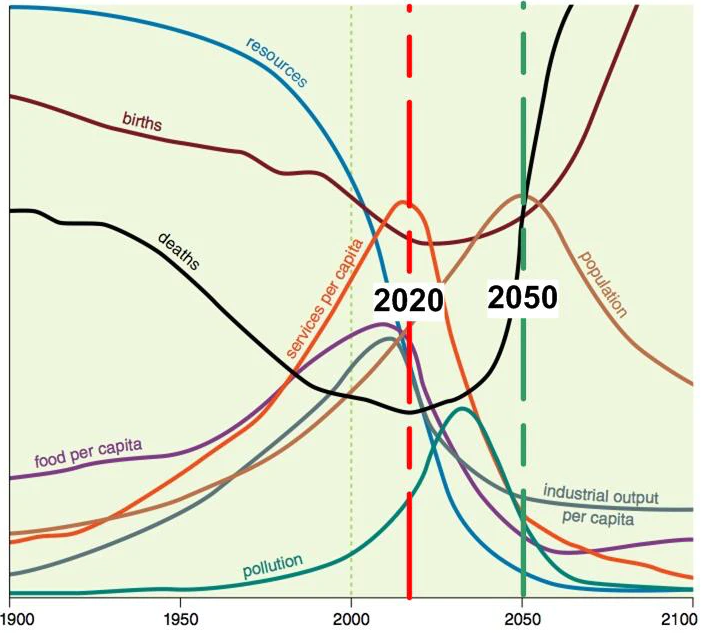
But the simple fact of the matter is that the world is well past its carrying capacity for the type of society we have. The Club of Rome predictions from 1968 have almost all tracked the real world, and we’re just past the hump: we’re into decline, but barely.

Notice that population decline happens about 30 years after the peak of food, industrial and services per capita. That’s bad and it’s part of what is going to make this so ugly. Check out the food per capita line for some real ugliness, though there’s going to be a lot less fat people.

Note that carrying capacity is not purely about population. Different global societies have different carrying capacities per capita. If we had not gone with planned obsolescence (there was a fight over near the end of the 19th century, managers vs. engineers and the engineers lost); if we did not have suburbs and exurbs but only urban, rural and wilderness; and if we had seriously started our transition from fossil fuels in the 80s instead of electing Thatcher and Reagan, our carrying cost would be much less and the world could support a much higher population. But under current circumstances, the world maximum population is probably about two billion, and once climate change runs amok it will be less.

So our population is going to reduce. It’s not “we have to reduce our population” it is “we are animals who exceeded the carrying capacity of our environment and our population IS going to drop, whether we like it or not.” That’s going to suck.

There was a window to avoid this. It is a result of our own decisions: to go with planned obsolescence, to have suburbs and massive numbers of cars, to pollute like maniacs, to destroy the forests and the swamps and the jungles, to not transition away from fossil fuels and dozens of decisions based on greed and “I won’t be here when it gets bad, so who cares?”

As for economies, high dependency rations (fewer working age people supporting people who can’t work) will be a drag. But because we have legitimately already overshot carrying capacity and because of resource and sink constraints (sinks is where we put our pollution, like CO2 and methane) reduced overall population is going to be more good than bad.

How much population will be lost is, in some sense, up to us. We left doing all the right things too late to avoid this, but the faster we transition to societies built around not exceeding planetary limits and working with and for the environment, the less people will die.

But even in a very optimistic scenario I have trouble seeing our population not winding up down two to three billion.

It is what we, as a species, chose through our decisions. That doesn’t mean you or I chose, we mostly didn’t, but at the species level, our decisions lead here.

It is what it is, and it will be what it will be.


The results of the work I do, like this article, are free, but food isn’t, so if you value my work, please DONATE or SUBSCRIBE.
Justice, Law and Norms

Last week I wrote an article on the indictment of Trump in New York. I argued that charging trump had broken an elite norm: there is no question Trump broke the law, but ex-Presidents don’t get charged with crimes and senior politicians rarely do, though as a couple commenters pointed out, there’s already been some erosion of that norm.

It’s important to understand that a norm is a cultural rule. It’s not a law, usually, it’s something you just do or don’t do because your social group requires it or forbids it. For elites, a norm is that elites don’t get charged with most crimes, especially non-violent ones, unless that crime harms other elites in large numbers. Every senior executive at a bank or brokerage broke fraud laws and the Rico statute (they conspired) in the run up to the 2008 election, for example, but who was charged? Bernie Madoff. Why? Because Madoff targeted other elites.

Likewise senior politicians regularly get away with breaking election fundraising rules and various other white collar crimes (like bribery). They don’t charge each other, because almost all of them do it. What they do is against the law, but it isn’t against elite norms.

We all know what laws are, but justice is different from law. A law can be unjust. Everything the Nazis did was legal by German law, as a friend of mine loves to point out.

Another principle of justice is that laws are applied equally. The same crimes that elites commit without being charged for are laws that are usually enforced against non-elites. This is not justice. Likewise fines that are fixed rather than relative to income or wealth or a combination of both are unjust—they hurt people with less money more than those with more money.

Bringing this back to Trump, he is being charged for crimes that while illegal do not violate the elite norm of elite impunity for crimes that are normal among elites. If elites wanted to maintain their norms, he should instead have been charged with treason or sedition, for the Jan 6th attempted insurrection, because that violates an elite norm.

Justice, norms and laws are three different thing and understanding the difference matters.


The results of the work I do, like this article, are free, but food isn’t, so if you value my work, please DONATE or SUBSCRIBE.
Open Thread

Use to discuss topics unrelated to recent posts.

Consequences Of Indicting Trump

So, a New York DA has charged Trump. There’s some posturing by DeSantis, but Trump will almost certainly go to New York and surrender. This is a watershed moment, no former President has ever been charged with a crime.

  1. This is a political act. Many President have committed crimes and have not been charged.
  2. It will lead to red state DAs indicting Democratic politicians with crimes to stop them from running or to damage them.
  3. This is a worldwide trend. Lula in Brazil and Rahul Gandhi in India are other examples.

Viewed from a wider context, there has been a catch-22. America and most nations let their elites slide on crimes that don’t  harm other elites. This has allowed a whole lot of evil acts to occur unpunished and for elites to act knowing they will never be held responsible for their actions. This goes beyond political acts, notice how somehow almost none of the people who took advantage of Jeffrey Epstein’s smorgasboard of underaged teenaged girls has been charged with a crime.

My judgment is that almost every powerful politician and every CEO of an important company has done things which are criminal acts: violations of red-letter law.

But when you change a norm like this, it becomes open season and causes political instability. Politicians may be guilty, but they will be charged not based on whether they are guilty but based on political expedience.

This is a further step towards America becoming ungovernable, and potentially a step towards a break-up of the Union, since red-state elites will be persecuted by blue state elites and vice-versa. With no norm of what laws elites are immune to, no member of the elite will feel safe. Either one side or the other must win and set a new norm, or the country must divide.

Globally, as I noted below, this is an extension of a new norm of not running against one’s opponents but simply getting rid of them politically.

This has nothing to do with my sympathies, to forestall obvious comments. I despise Trump and if he had been charged with crimes he had committed long before becoming President, this would be all null and void. But the type of crimes he committed as real-estate Mogul were the acceptable sort of crimes that real-estate moguls commit and aren’t charged for and if they had gone after him then, they would have made many other important people vulnerable.

This is the consequence of having a two-tier justice system where some crimes are only crimes when committed by little people and then weaponizing that.

What Trump should have been charged with, if elites were smart, was his actual crime against elites, where he broke a norm: trying to stage a coup. By charging him with something lesser, they have shattered a consensus norm and a great price will be paid for it.


The results of the work I do, like this article, are free, but food isn’t, so if you value my work, please DONATE or SUBSCRIBE.

Why America Will Probably Lose The New Cold War

China’s support (along with India and various other nations) makes it impossible to take out Russia with sanctions, just as Russia’s support makes it impossible to take out China with sanctions or blockade.

The fundamental issue here is the West still thinks it’s 2000 — that China isn’t the major industrial power & that Russia isn’t a fuel, mineral and food exporter. The West isn’t /needed/. For a long time you could only get things you had to have from the West.

The West is trying to use sanctions against both China and Russia, and they aren’t working. What they are doing is speeding up the end of the Western world order by forcing faster independence and bloc formation. The quick Chinese progress on semiconductors and airplanes show this backfiring.

So what’s the endgame? A new cold war in which most of Africa the middle east and S.America are aligned with China/Russia and thus a bloc which has more manufacturing AND more resources. Pure insanity. China just gives southern nations not close to it a better deal than the West does and is their major trade partner, and they will align with it.

This isn’t a moral argument, this is purely about capability and resources. In the Cold War the West always had more. In Cold War 2.0 the West will have less. (This is also why the EU has chosen the wrong side. They should have tried for independence and third pole status. Still should.)

Part of this is because of essentialist cultural bullshit. We think our culture is superior to Russia’s and China’s and that’s why we won. But standard great power analysis is that the USSR had the inferior position and was bound to lose.

Our “system” is a subset of our culture, not the other way around but what made the West dominant was not “capitalism” it was being first to scale with industrial technology and keeping that advantage for a long time. Even if it was capitalism, well everybody is capitalist now, though the culture which comes dominant out of the oncoming dark age will be the one which finds the best alternative to capitalism or which finds the next production revolution which doesn’t destroy world carrying capacity.

The West, which included the USSR, was dominant for about two centuries because of an absolute advantage in production: the industrial revolution, combined with superior tech made possible by the industrial revolution. An absolute advantage is something you can do, that your enemy can’t, that makes you absolutely superior to them. (Nukes against a non-nuke nation are another example.)

The Mongols had an absolute advantage militarily for a long time and were only really defeated when other nations figured out how to use their methods against them: the first to do so were the Egyptian Mamalukes.

Every absolute advantage system ends. Either someone else learns how to do it too, or they find a counter.

Some absolute advantage systems are geographically bounded. Roman legions fail in steppes even against horse archers without stirrups. (Crassus says “oh no!”)

Steam/petrochemical/industrial was a time bounded advantage. Someone outside the club was bound to manage it eventually. China did because we deliberately helped them out of short-sighted greed.

Now outside the club should be unpacked. Britain helped both the US and Japan industrialize. The US helped Japan and S. Korea and Taiwan. But all of those nations were brought into the club, in Japan’s case thru force.

Japan got uppity, the US crushed it and it’s now a loyal member of the club, currently doubling defense spending to get ready to fight China. The US could crush it because they were about technologically equal, but the US had more people and resources.

Britain helping the US industrialize lead to Britain losing its world-leading position because the US was a larger nation. The US then thanked them by subjugating them and most of the rest of Western Europe after World War II, adding Eastern Europe after the USSR collapsed.

America helping China industrialize is leading to the US losing its position because China (or more accurately China’s coalition) is larger in the ways that matter.

China might have been made a member of the club IF Russia and most of the non-Western world had been kept on the side of the West/US because US/EU is big. But the rest of the world/Russia was not kept in the US/EU camp.

All of this follows fairly simply from “they have more resources and about equivalent tech” and that’s what matters. Culture and system are important as determinants of ability to tech and mobilize resources. China’s culture and system are very good at that.

One corollary of this is that the “Rest of the World” (aka. non US/EU/Japan/S.Korea or China/Russia) matter. They tilt the playing field. But China gives them a better deal than the West has for a long time, if ever, including more political independence unless nearby.

When historians look back they will see the final decision point for the end of Western hegemony as the Ukraine war. Without Russia, China could be choked out by US naval power. Without China Western sanctions would have crushed Russia. This is the primary axis. But that Africa and South America are mostly going to go with them, and that the Middle Eastern powers will wind up either neutral or in the Chinese/Russia camp also matters: a lot. It gives China the decided resource advantage.

Of course, there were earlier inflection points, but from a pure geopolitical point-of-view the West needed Russia in the club far more than it did Eastern European countries. It got Europe, but Europe won’t outweigh Russia, Africa and South America.

None of this it deny that everyone has problems. For Russia and China it’s a demographic time bomb (though I’m not sure that lower population is entirely a negative, even with an older population). For everyone the joker is climate change and ecological collapse. I wouldn’t be surprised in 50 years if both China and the US have broken up.

But on ordinary dynamics, my judgment is that the West has already lost: the coalition which is forming against them will have more industrial capacity and resources and equivalent tech.

You don’t win that competition.


The results of the work I do, like this article, are free, but food isn’t, so if you value my work, please DONATE or SUBSCRIBE.

How Should CEOs And Politicians Be Punished For the Evil They Do?

Came across this tweet about the Philadelphia water spillage the other day:

So, shit happens and sometimes truly, no one is really to blame. But a lot of bad things which happen are a result of deliberate negligence or direct action. A good example is PG&E, the California power utility, which hasn’t been bothering to clear the areas around power poles and transmission poles or replace or repair old power poles. They knew this would lead to more forest fires and it did and people lost everything, including their lives, in some of those fires. PG&E had the money to do the maintenance but preferred to pay larger dividends and give more stock options to executives.

So the chemical spilled into Philadelphia’s water supply were spilled by a private company. We don’t know if negligence was the issue, but if it was, what should be the punishment?

Lately we tend to just fine companies, but that does nothing, especially as the fines are often less than the amount of money they made thru being negligent, and in any case, fines don’t remove the massive money executives already made from their actions, nor the money the owners made.

Clearly fines don’t work.

The first issue is the question of limited liability for shareholders and the use of corporations as shields for executives. There were sound reasons for limited liability for owners who really don’t control corporations, with unlimited liability people wouldn’t want to invest in companies and when primary issue of stock was a major, or the major source for creating new companies, new corporation creation would have collapsed without limited liability.

But the disadvantage of limited liability is, indeed, that corporations tend to do evil acts knowing that their owners won’t pay the full price for them, and the way corporate executives and decision-makers tend not to go to jail for actions that an individual would go to jail for (or be liable for personally in civil court) is causing huge problems.

I think we’re going to have to remove these shields, in the case of anything where a reasonable person would know that harm was likely to occur. If you make the decisions or get the benefits, you are on the hook, and you need to be on the hook for more than you made.

But there’s another question. What is the correct punishment beyond financial, because a lot of the crimes aren’t crimes where money can make the victims whole?

Perhaps with respect to polluters, for example, the executives might be made to partake of their pollution. “This is what people drank, you will drink the same.” Or “this is what people breathed for days that caused cancer, you too will breath it.”

There’s a certain eye-for-an-eye beauty to this, but I dislike doing evil to people even when they have done evil because it’s still doing evil.

I would suggest instead a simple rule. Take back all the money them made while in charge, then take enough to bankrupt them. Next, since they have shown they can’t be trusted, forbid them from any position of authority in any organization: no management or executive or board positions, no legal ability to control anything. All their possessions in the future must be controlled by an executor appointed by the government.

For truly significant harm, we might say that they are no longer allowed to work, but must subsist on whatever welfare or other provisions are provided for the indigent. Given background checks, this is often what happens to criminals: no one will hire them.

(Doing this to important people would likely lead to a significant improvement in the welfare system.)

These should probably be time gated. Ten years minimum, thirty year max, with the possibility of “parole” where they’re allowed to have a low level responsible positions, like foreman or control over their own assets while someone watches over their shoulder to see how they do.

All such rules, of course, must be done with the presumption of control. If you’re CEO or a board member, you don’t get to dodge any decision you should have known about. You don’t get to blame managers or grunts.

What sort of solution do you think would work to stop corporate malfeasance (or political)? Put it in comments.


The results of the work I do, like this article, are free, but food isn’t, so if you value my work, please DONATE or SUBSCRIBE.

Is France Near A New Republic?

This video is worth watching, though I have no idea whether the bit about dead cops is true:

The situation is simple: Macron unilaterally raised the pension age by two years from 62 to 64. This is after it was increased to 62 from 60 in 2010. He couldn’t get it past the legislature, so he used a clause which allows him to do so without legislative approval. Macron one the final round of the last election by 17%, but he had no mandate for this sort of reform. People voted for him to keep LaPen (the far right candidate) out.

This has caused an explosion of protests which is not abating.

A little more background is useful. The standard talking point is that France can’t afford the current pension system and thus MUST push back the qualification date and that this is reasonable because people have longer life spans than when the pension system was created and because the age pyramid has changed: there are proportionally fewer younger people and more older people.

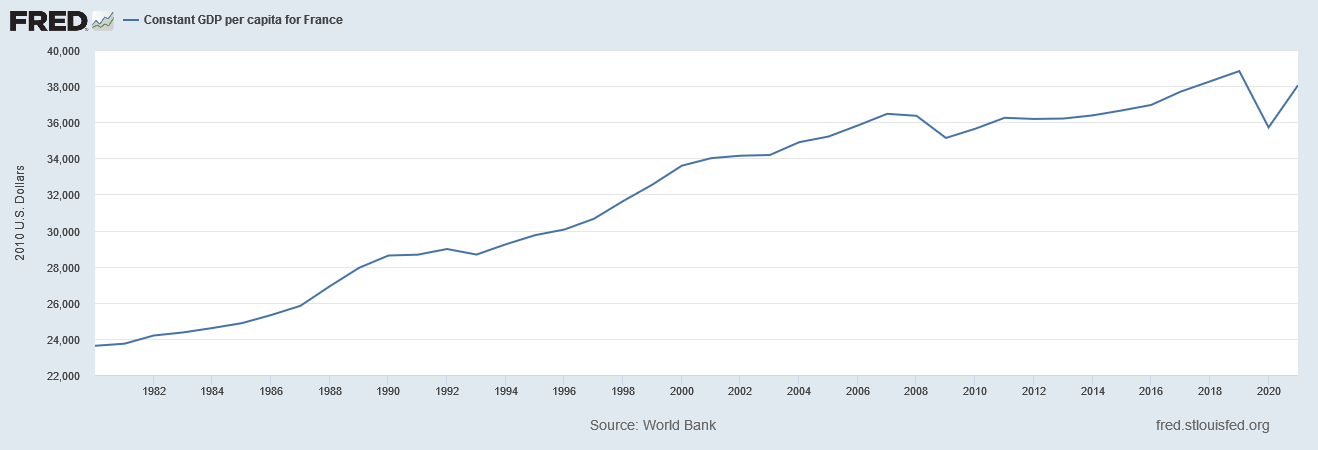
Here’s the French GDP per capita char from 1980 to 2021:

So, it rose pretty consistently till about 2008 (surprise) and since then is flat to slightly rising depending.

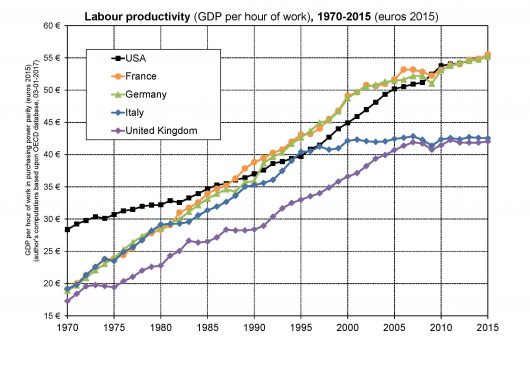
Next chart. Labor productivity.

Same basic pattern.

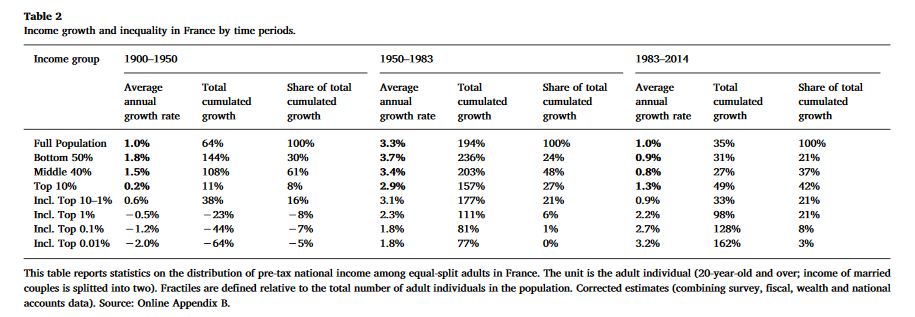
One more, inequality.

That last table, in particular, deserves a good looking at if you have time.

But for current purposes, what is important is simply this: France is richer than it used to be and more productive and more of its income and wealth is held by the rich, and if France wants to keep its retirement age at 62 it can certainly afford to do so, it just might have to tax rich people a bit more and maybe not give billions to Ukraine and so on.

Of course France can afford an early retirement age of 62 or 60. It can only not afford it if you “hold everything equal” in the sense that you assume doing so is not a priority.

So, Macron is full of shit. The government can easily afford the current French pension age and should probably even drop the age a couple years if the majority of the population want that.

Meanwhile while what Macron has done is constitutional, it clearly shows that the constitution is broken: he’s doing something the majority of the population and the majority of the legislature oppose, which in a democratic society shouldn’t be possible.

Since he’s shown that the constitution itself is broken and that majority will cannot be accommodated because doing so would require the government to tax rich people who have been doing very well over the last forty odd years, French citizens are entirely justified to get out in the streets and not just stop this bill but overturn the Republic and institute the next one.

As for Macron, he’s always been insufferably sure that he’s right about everything (I am aware of the irony of me of all people writing this) and that it’s OK to make the majority of the population suffer to keep neoliberal orthodoxy running. He’s a true believer, a genuine ideologue, his ideology is just neoliberalism and neoliberalism doesn’t work any more.

France should be a model for more countries. When your rich people screw you over, take to the streets.


The results of the work I do, like this article, are free, but food isn’t, so if you value my work, please DONATE or SUBSCRIBE.


Page 97 of 437

Powered by WordPress & Theme by Anders Norén