The horizon is not so far as we can see, but as far as we can imagine

Author: Ian Welsh Page 88 of 436

Ukraine Has Lost & A Negotiated Peace Is The Only Sane & Humane Solution

OK, I’m on the record from the start saying Ukraine would lose the war militarily. The counteroffensive has failed. NATO equipped and trained an entire army for Ukraine and it didn’t even get to the main defensive lines.

The Americans told the Ukrainians to charge entrenched, mined positions without air superiority and in the face of an enemy with more artillery than them.

That went about as you’d expect.

The Ukrainians are not taking back the territory they have lost, let alone Crimea, which was always a ludicrous fantasy.

Ukrainians are dying like flies and I am firmly on the side that says that their casualty numbers have to be higher than the Russians, because the Russians are launching a ton more artillery shells and have air superiority. Meanwhile six million refugees have moved to the EU, and I’ll bet most of them will never return to Ukraine, which was a depressed and extremely corrupt nation even before the war.

Russia has not been squeezed out by sanctions and is not going to be. China will not let it happen and most of Africa and Latin America are on their side, while India wants more trade with them. The nation hurt most by sanctions is probably Germany, which is losing much of its energy price sensitive industries (very important industries that have been world leaders for over 100 years in many cases.) Since Germany is the industrial heartland of the EU (and cemented that by using the EURO and enforced austerity to devastate other EU countries industrial base), this will hit the EU hard.

Russia, meanwhile, is churning out ammunition and weapons and buying them from North Korea and Iran, who don’t care at all about US sanctions, for obvious reasons. In the West, weapons warehouses are bare and we don’t have the capacity to restore them, nor are we ramping up production quickly.

So Russia has a larger population and army, and more weapons and equipment than the Ukrainians. They have air and artillery superiority.

The only road forward for anyone who isn’t a horrific bastard is a negotiated peace. Russia (sorry) is going to get the Russian parts of Ukraine, and Ukraine is just going to have to suck it up. If the war continues, Russia may attempt to grab the entire coastline and that would make Ukraine a land-locked country.

The longer the war goes on, the worse for Ukrainians. The war is lost and a negotiated peace will save tens of thousands of lives and make it so that Ukraine is less of a complete basket-case after the war.

There will be a guerilla war after any peace. It could be won by the Ukrainians, but I doubt it. Eastern Ukraine is flat and occupied mostly by Russian speaking sympathizers who want to be in Russia.

Sometimes you lose the war on the ground. Russia will not get everything it wanted, but they will get some of what they wanted and so will Ukraine, in the sense that they may get real security guarantees or NATO membership after the war is over.

But Ukraine has lost. Pretending it hasn’t is ridiculous and monstrous. Throwing more hastily conscripted soldiers into the meat grinder is stupid and evil.

The best possible end at this point is a negotiated peace.


This is a donor supported site, so if you value the writing, please DONATE or SUBSCRIBE.

Open Thread

Use to discuss topics unrelated to recent posts.

A Basic Buddhist Meditation Synthesis

I’ve meditated a lot. Thousands of hours. And I’ve done a lot of different types of meditation. There are hundreds of different types, and in principle one could easily come up with thousands once one understand how meditation works.

I had no teacher and was learning from books and I made a lot of mistakes. Some of them were damaging mistakes.

Like exercise, meditation is good for you, if done right, and can hurt or injure you if done wrong.

What I’m going to write about today is the basic Buddhist meditation synthesis. It consists of three parts: concentration, loving-kindness and insight. All of these styles of meditation date back to the Buddha, and in the case of case of concentration and loving kindness, pre-date him.

The Buddha is known specifically for Vipassana insight meditation, breath focused concentration (Shamatha) meditation and loving-kindness, most especially Metta but not only Metta. He did teach other types of meditation to students who needed them, along with ethical and lifestyle practices. (One meditation he had people do was go to cremation grounds and watch bodies being burned up, often for as much as six months. Not suggested for most people today.)

What Is Meditation?

At its simplest meditation is just mental exercise. It’s like lifting weights or practicing dance steps or throwing a javelin—over and over again to get better at what you’re doing.

Virtually all meditation is choosing a mental activity, doing it, noticing when you’ve stopped doing it, and going back to doing it.

If you were doing breath meditation (a form of concentration or shamatha meditation) you would pay attention to the sensations of breathing, keep your attention on your nostrils or belly when not breathing and when you notice you aren’t paying attention to your breath/belly/nostrils you would return to doing so.

It is that simple.

Meta-Attention: Of all meditation skills, this is the most important. All it means is being aware of what you’re paying attention to: to what your mind is doing. If you’ve ever started walking or driving somewhere you usually don’t go and realized that you’d spent the last few minutes heading to work or home even though that wasn’t your intention, you’ve experienced what happens when you don’t know where your attention is, or what your mind (and body) are doing. Every time you drift off in thought without realizing you have for a while, you’ve lost your awareness of what your mind is doing.

Most types of meditation, with trance states being the main exception, train meta-attention. You can’t control your mind if you don’t know what it is doing. Meta-attention is a large class, with a number of smaller classes. A good dancer or martial artist will know exactly how their body is moving, at least when practicing and in time outside of practice, but may not be as aware of thoughts or sounds or tastes or smells.

When you first start learning meta-attention it will be specific: if you do breath meditation you’ll become able to notice when you’re not paying attention to your breath. If loving-kindness, when you’re not paying attention to loving feels. If mantra meditation, when you’ve stopped saying or thinking your mantra. In time, your meta-attention will expand so that in your daily life you are more and more aware of exactly what you are doing and if it is not what you intended to do.

Without meta-attention you can’t control the mind because  you don’t know what the mind is doing. True concentration is less always doing what you intended and more noticing immediately when you stop or, as you progress, when something is about to occur that will make you stop.

Meta-attention is a necessary to make sure that your intentions are actually carried out.

Attention, Awareness And Consciousness

You have never experienced anything that is not yourself and you never will. It is literally impossible. Even if objects exist outside  yourself (an inference) everything you experience is your own consciousness, at best a representation of other objects. Your consciousness is everything you can be aware of.

The contents of your consciousness change. In dreams or certain altered states you may not be aware of your body, everything in your visual field or that you can hear can change, so much so that there may be nothing in common with any previous mental state. (This is worth contemplating, and there are types meditation intended to make that contemplation much more real.)

Your awareness is the broad field of what parts of your consciousness you are aware of. Awareness broadens and tightens. Everyone has had the experience where things were happening around them which they were not aware of.

Attention is where, within your awareness, you are focused. I might have my attention on typing this post, while being aware of the quality of light, the wall behind my monitor, the sound of my air conditioner and an itch in my armpit. While doing breath concentration my attention is on my breath, but I am likely aware of other parts of my body, without them being my focus. In fact, up until very late stages of concentration meditation, I do not want to shrink awareness too much, or drop it entirely and only be aware of my concentration object, because if I do so I will not be aware of arising sensation which might disrupt my attention before I can deal with them.

One conception of meditation is that it is nothing but learning to control attention and awareness. It’s not quite true, but it’s almost true. There are types of meditation (Mahamudra, for example) where you learn to reduce attention and attempt to have only awareness (this is very relaxing and is also improves your ability to do many things which require awareness, like fight.) The extreme of concentration meditation removes awareness outside of attention entirely: you are aware of only the object of your attention.

You have done mild version of attention and awareness control all your life, often without realizing that was what you are doing. Just as an athlete becomes much better at natural activities like throwing, running and lifting, a meditator becomes far better at normal mental activities than anyone who is untrained and eventually learns to do things no untrained person can do.

Sense Objects

Everything you have ever experienced is a sense object. You will never experience anything but a sense object. Thoughts are sense objects. Emotions are sense objects. Sounds are sense objects. Pain is a sense object and so is suffering.

In concentration meditation you learn to control attention and awareness. In emotional meditation techniques you learn to generate specific types of mental objects: emotions like love or compassion or authority or, well, almost any emotion.

In some types of insight meditation  you learn to see sense objects more clearly. For example at its most basic, every bodily sense object has three characteristics: its feel (itchy, pressure, warmth, cold, etc…), its location and its affect: pleasant, neutral or unpleasant. Pain can feel warm, be located in your toe and has a bad effect. You could also have a warm feeling in your toe but have it be pleasant.

These constituents (which are only the most gross ones) are often first noticed in concentration meditation. If you concentrate hard enough on your nose at some point you will experience your nose as a few feet away from your face. If you concentrate on pain hard enough, at some point the unpleasant part of the pain (the affect) and suddenly there’s no pain. It may even switch to feeling good.

As you proceed as a meditator you can gain some ability un-bundle sensations at will. You may also start getting access to data the brain doesn’t normally provide to consciousness or you may convince the brain to stop doing some of its pre-processing. These are advanced topics and other than mentioning them I won’t discuss them much in this article, but they are fundamental to the spiritual project of meditation, which is in large part about understanding how reality is created by the mind.

Balanced Meditation

Just as a weightlifter who does only one exercise over and over again will likely wind up injuring themselves, it is rarely a good idea to do only one type of meditation, unless you do very little meditation, say a mantra 20 minutes a day.

You always want to balance out meditation types, and one of each of concentration, positive emotion and insight is a good balance.

This is particularly true of insight meditation. People who do a lot of insight meditation (such as Vipassana) without the other two and especially without a positive emotion meditation, are the ones who drive themselves insane most often.

If I were in a teaching relationship with someone, which I’m not, this is something I wouldn’t just emphasize, it is something I would enforce. If someone would not follow my instructions in this matter, I would stop teaching them. That is how important it is.

I would rather you did NO meditation than do it incorrectly.

Basic Concentration Meditation

The most common form of Buddhist concentration meditation is on the breath. Place your attention either on your nostrils or your belly, and then watch the sensation of breathing. Between breaths, keep your attention on your belly or your nostrils.

Your intention in this type of meditation is to notice when you have stopped paying attention to your breath. This is important. Your intention is not to pay attention to your breath, but to notice when you have stopped paying attention to your breath.

When you notice your attention has moved off your breath, congratulate yourself for doing so (never be angry or upset you lost the attention object) and move your attention back to your breath.

Do as much of this as you can, until you’re doing 20 minutes a day or so.

Basic Loving-Kindness

Once you’re able to regularly do 20 minutes of concentration meditation and your attention is on your breath most of the time, you will start doing loving kindness meditation AFTER you have first done twenty minutes of concentration meditation.

Loving kindness meditation requires the ability to generate a positive feeling of love or compassion or sympathy. It must feel good.

There are multiple ways to do this, and you will have to experiment to see what works best for you. The classic Metta meditation involves first saying (mentally) towards yourself:

May I be happy. May I be well. May I be safe. May I be peaceful and at ease.

Keep saying it till you’re feeling relaxed and warm emotionally then skip down to where it says “Once you have this feeling”.

In later sessions, when you can reliably get the warm feeling , you do this for someone you love, directed at them. “May Fred be happy. May Fred be well. May Fred be safe. May Fred be peaceful and at ease.”

Then you do it for people you feel neutral towards, perhaps as a group “may everyone”, and last you do this for people you hate.

Stick with yourself or your friends at first. Keep doing it till you have a stable positive feeling. If you don’t generate one at first, don’t worry (I sure couldn’t), just keep doing it day after day until you do.

Another form is to imagine a loving experience. Perhaps imagine a puppy licking your face and wriggling and being obviously happy and loving you. Hugging and being hugged by a beloved grand-parent works for some. For others imaging someone like the Buddha or a God or a person like the Dalai Lama or some Saint who you feel would or does love you, doing so, works.

If you’re imagining a person or a God you MUST only use someone who you have no negative feelings towards. Parents, who have often been harsh to us and who we are scared of are often a bad choice (though if you had ideal parents, go for it.) For Christians and Muslims and Jews “God” is usually a bad choice because there are strong currents of punishment and fear related to most monotheistic gods.

In addition you should not choose someone you have sexual feelings toward as you want a pure feeling of love or compassion or happiness, without the admixture of lust.

Once you have the feeling, locate it in the body, and then proceed to do concentration meditation on the feeling. Pay attention to the feeling, have as your intention to notice when you are no longer paying attention to the feeling and bring your attention back to the feeling.

If the feeling goes away, generate it again, then go back to concentrating on it.

Once you can do this easily, there are more advanced techniques and there are very good, non moral reasons for wanting to eventually to feel kindness or love towards people you hate or who are bad people.

When you can do this for about twenty minutes, reliably generating the emotion and spending some time paying attention to it, move on to insight meditation.

Basic Vipassana Insight Meditation

You will do this after you have attained 20 minutes of concentration meditation and 20 minutes of loving kindness meditation which actually generates the emotion. Do not do it before. Once you can do those two types regularly you may choose to do 20 minutes of just one, then 20 minutes of insight, but better will be to all three, in order, and if you do only a 20/20 session, alternate meditation types.

In Vipassana you will notice a feeling in the body. You will put your attention on it for two to three seconds, feeling it as best you can, then you will mentally describe it, usually with one or two words “itchy, pressure, warm” or whatever. Gently release it, relaxing away from it or feeling compasson or love towards it (this is the most important step). Then you will go to another feeling and do the same thing. Do this for 20 minutes. Have as your intention, again, to notice when you are not doing it.

There are a great number of Vipassana techniques and alternatives and even more insight alternatives but master this first. Again, never do Vipassana or any other type of insight meditation without concentration and/or (but ideally both) loving-kindness meditation.

Dealing With Problems

If something seems to go wrong, if this is causing you much in the way of suffering, STOP. Consult a teacher, or take a couple weeks break, then start up again.

This style of meditation will make your mind much calmer and in time what happens to most people is that as the “chatter” of their minds calms, subconscious material comes up. That is often negative (though it also includes positive material) and certainly if you have trauma it will eventually come up.

When a strong negative emotion comes up, treat it with love if you can, and with basic Vipassana techniques. Observe it or feel compassion for it for about three seconds, name it, and move back to your meditation.

If it keeps coming up and is getting stronger, STOP. If you weren’t doing loving-kindess take a brief break, come back and do loving kindness meditation. If that doesn’t help, then stop meditating entirely for a time and you may wish to seek out a psychiatrist, in most cases one who specializes in trauma.

Do not force yourself to meditate in these circumstances, because you can re-traumatize yourself.

That’s the bad scenario: alternatively, with your concentration and loving-kindness you may be able to reduce the intensity over time. But don’t push thru if that isn’t happening.

Concluding Remarks

It’s possible to go very far just with this set of instructions and meditations, but if you actually get to the point where you’re doing an hour a day for a few months you’ve done very well and at that point you may wish to seek further instruction.

If there’s interest in this topic, I’ll write more.


This is a donor supported site, so if you value the writing, please DONATE or SUBSCRIBE
Preparing For Collapse During Collapse

As regular readers know my judgment is that we are now into civilization collapse. It’s slow right now, and it will be stop and start, but it will continue and pick up speed over time.

That means that you should be preparing for collapse to get worse, including climate change and ecological collapse.

Civilizations rise and fall, that’s normal, and ecological collapse commonly happens at the same time, but what’s unusual right now is that we have a world system which is global, and thus is collapsing all at once, and we have a global ecological collapse.

So it’s going to be bad. Very bad.

Still, there are things to be done.

The most important thing is to make and sustain social ties. The people who do best in collapses are those whom other people like and need. Join a church if you can stomach it (and there are churches which come with little theological baggage, for atheists.) Make friends with your neighbours and join groups. Be liked.

If you have family you can stand or good friends, consider communal living. An extended household will often do better than a person alone or a nuclear family, being both cheaper and having more ability to take care of itself and its members.

Get some skills: basic maintainence abilities will be worth a lot: electrical, plumbing, minor repairs, etc…

Figure out a way to grow some of your own food, or set up a relationship with local farmers, ideally one that is a trade of your abilities for their food. Back in the Great Depression one friend’s father was a lawyer, and he did the legal work for a lot of farms and they kept  him fed.

Gardens are so-so. Climate change is going to make outdoor gardening very uncertain. If you can, create something with climate control, ideally a green house and figure out a way to keep it cooled when necessary. You can do this in your house too, by replacing some walls and part of the roof with a transparent material, ideally with some form of shutters. If you have a flat roof, and it’s load bearing, you can put your green house up there.

Do something about water. Lack of water will kill you faster than anything but temperature and lack of oxygen. Some sort of storage system and ability to gather rain water is one possibility. If you’re somewhere humid, dehumidifiers of the right type can produce enough water for drinking. Get some sort of purification system, something simple.

Power is going to be an issue. Solar panels have a limited lifespan and so do batteries, but they’re better than nothing. You want to be able to provide power for a couple weeks and/or during brown outs — if power will be out hours every day due to rationing, you need to be able to handle that. Some form of non-panel solar is a good idea: research heat engines and see if you can figure out how to store energy mechanically by raising water or physical objects or some other way.

Temperature control is another obvious issue, and figuring out  how to stay cool is important. As heat rises, public power will become less reliable at exactly the times you need it, so the power equation above is important.

If there are local violent authories, whether government (police/military) or non-government (gangs) make sure they like you. Become friends with their leaders if possible. As civilization breaks down, be part of whatever replaces them in certain areas. (Like in Iraq, where various militias and mosques took over.

In general, though, understand that supply chains are going to become more and more unreliable. Get the tech you need as soon as possible, and make it tech that is durable and/or easy to maintain. Buy spare parts and take training so that you can fix your own equipment, which will also make you valuable to your neighbours.

Learn how to make certain simple medicines if you can: basic antibiotics are not hard to make and the same is true of the sulfa drugs. If you can do this, you’re golden, because you’ll be able to help other people and you will be valuable to them.

Medical systems, especially public ones will become more and more unreliable and less and less available to people who aren’t on the inside. Take care of as many medical issues as you can right now. I like to joke that it’s a good thing I got cancer now, because in 10 years I’m not sure I’d have gotten care soon enough. You can’t schedule something like cancer, but you can make sure whatever problems  you have now are dealt with.

Taper off drugs you use all the time if that’s possible. For some, like insulin, you’re out of luck (but should look into how to get an alternative supply), but for many other drugs, tapering now rather than being forced to go cold turkey is advisable IF it’s medically appropriate.

Take action as soon as possible. The more money you have, of course, the easier this will be, but if you don’t have money there are still things you can do, like joining local maker clubs, churches and organizations. If you have extra money do use some of your money to prepare: money will become less valuable as time goes by.

We’re on the downward slope now. If you want to survive, or to have a decent life, take whatever steps you can.


This is a donor supported site, so if you value the writing, please DONATE or SUBSCRIBE
Quick Takes 5: The Year Climate Change Became Undeniable

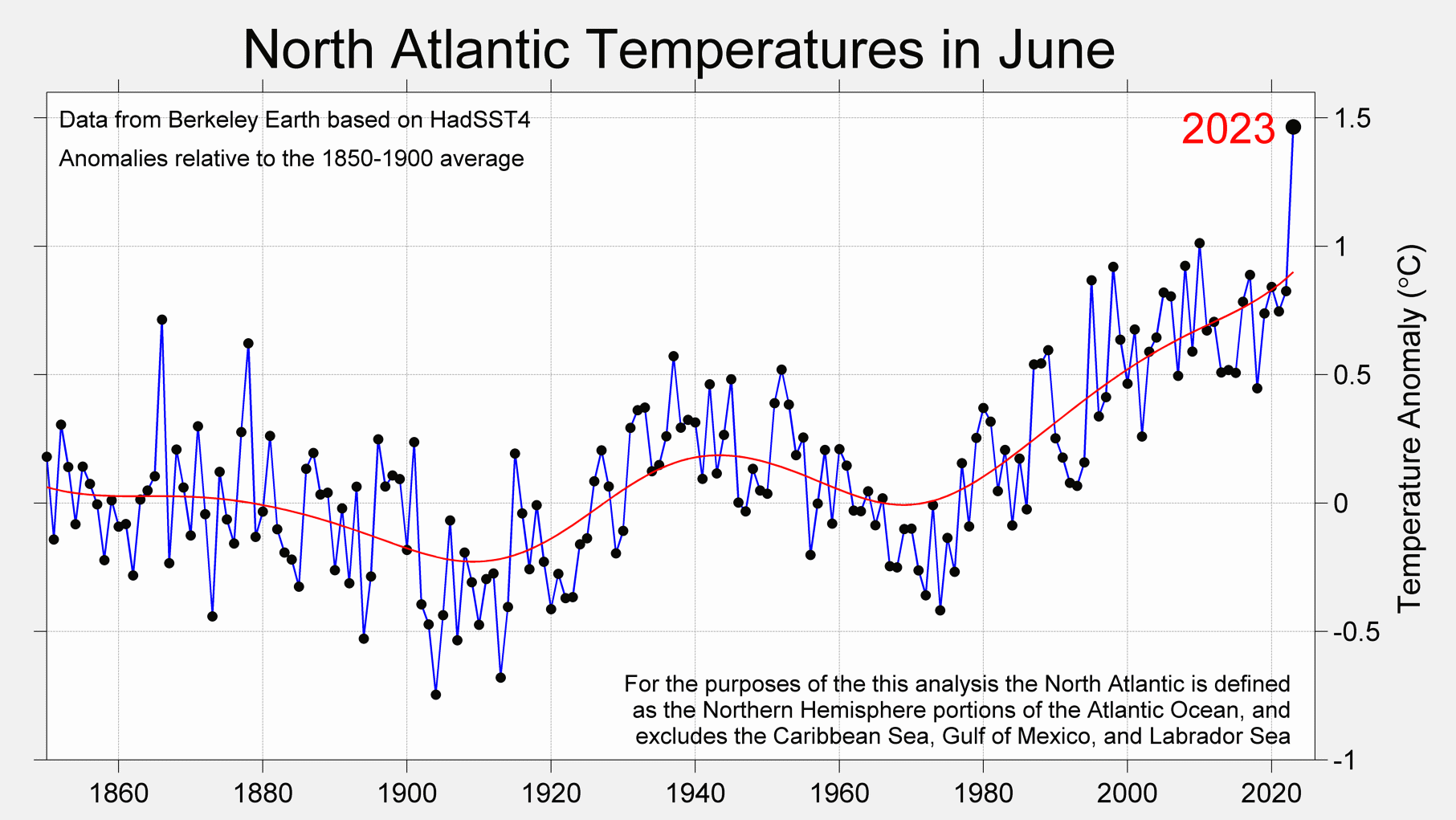
Only someone ignorant, stupid or on the payroll could deny climate change before 2023, but this is the year where to remain in denial you have to be 5-sigma stupid or on the payroll.

So, boys and girls, let’s look at some of the highlights of what will be one of the coldest years of the rest of your life.

Let’s start with Antarctic sea ice extent. Remember, this is during WINTER.

For years I’ve said that marine inundation (sea level rises) would happen before most people expect it. And I’ll be right.

Next, we have more winter fun. 35 degrees celcius in Chile.

Well, that seems… bad.

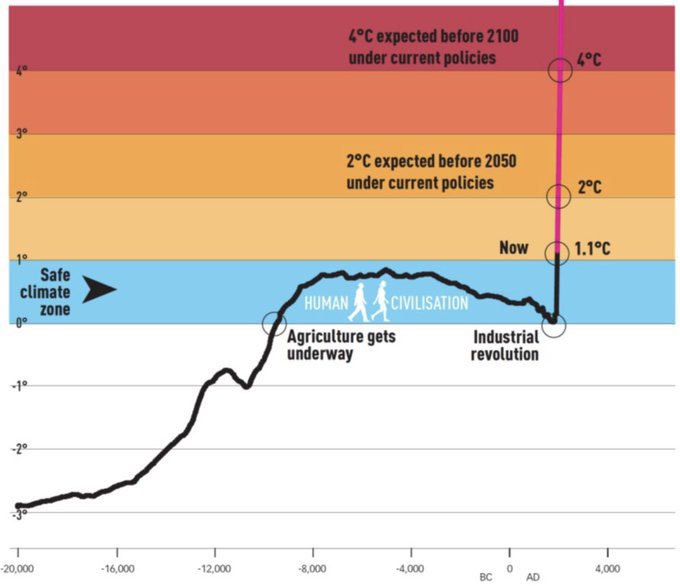
Now for the lovely long-term view:

What’s super about the aboe graph, is that I’ll lay you 4:1 it is over-optimistic. By a lot.

There’s a vast amount of delusion about how bad global warming will be. People talk about 1.5 C, or 2 C, or 3 C.

How about +10C as the equilibrium? This is from a pre-print, but it’s not unreasonable:

Equilibrium global warming for today’s GHG level is 10°C for our central estimate

Now, the guys who made the above estimate are on the gloom side and as they themselves say, blackballed, but everyone who’s been paying attention knows that essentially everything has been coming in sooner and worse than expected. Are you going to bet on the consensus forecasts made for politicians that have consistently under-estimated climate change?

Yeah.

Next we have Farmer’s Insurance leaving Florida. The time when home owners insurance won’t be available anywhere unless the government underwrites it is withing sight.

Ocean water is warming up. In the more tropical areas it’s destroying coral, but it’s damn impressive in the north, too:

Spain, July 7th.

My guess is that most of the Mediterranean area will not be inhabitable during the summer in ten to twenty years. If you don’t have air conditioning, you will die.

Then there’s the whole “jellyfish future”:

Oxygen levels in the world’s oceans have already dropped more than 2 per cent between 1960 and 2010, and they are expected to decline up to seven per cent below the 1960 level over the next century. Some patches are worse than others — the top of the northeast Pacific has lost more than 15 per cent of its oxygen. According to the Intergovernmental Panel on Climate Change’s 2019 special report on the oceans, from 1970 to 2010, the volume of “oxygen minimum zones” in the global oceans — where big fish can’t thrive but jellyfish can — increased by between three and eight per cent.

I for one welcome the ocean’s new Jellyfish overlords.

We’ll talk more about the implications of all this soon, including the implications for you personally.


This is a donor supported site, so if you value the writing, please DONATE or SUBSCRIBE
Open Thread

Use to discuss topics unrelated to recent posts.

At a Societal Level “Can’t Afford” Is Bullshit

John Maynard Keynes – “Anything we can do, we can afford.”

Money tells you how much of society’s resources you can command. Can you use that building, that land or that person?

It’s more than that, of course, but this is its most fundamental use.

But we are all familiar with the fact that often there are empty buildings, unemployed people and land which is not being used productively. We also know that often what people, land and buildings are being used to do is a bad: a net negative.

99% of Wall Street, for just one example. 85% of the US military, for a second.

We use money so much that we forget that it’s only a proxy. What matters is the actual resources: do we have enough, epople, land, buildings, oil, steel, and other resources to do something or can we get the resources we need, either by moving people and other resources away from bad stuff to good stuff, or by creating more resources.

If we have enough or can create enough or can redistribute enough resources, we can do that thing, whatever it is. The limit isn’t money, the limit is actual, real resources.

Estimates of bullshit jobs are at about 40% or so. I’d personally put it higher: jobs that either are pointless or actively harmful are the majority of what we do.

We can do plenty, any time we really, as societies, want to.

There will come a time, and that time is not so distant, where we can’t. Where real and painful decisions will have to be made, but we are still, in most of the developed world, in a surplus situation, with a lot of resources mis-allocated. Reallocate them and we can fix many of our problems and mitigate almost all the rest, while actually improving human and animal welfare massively.

“Afford” is a word for people, not a word for governments who can print money. For them, the question is “does the country have the resources and can they be mobilized?”

We can make the world and ourselves better when we want to, at least for now.


This is a donor supported site, so if you value the writing, please DONATE or SUBSCRIBE.

The Distributed Nature Of Collapse

When the western world sanctioned Russia they expected Russia to collapse. It didn’t. The first reason is that most of the non-western world didn’t cooperate with the sanctions, but the second is simple: Russia has a food and fuel and mineral surplus.

The world as it stands now is every inter-dependent. The supply networks are dizzyingly complex and a final item like a car is made up of materials and parts extracted, made and assembled in dozens of locations.

The world isn’t always this way: it was like this in the late 19th, but after WWI that changed and the era of free trade ended, collapsing in particular during the Great Depression. The world did not become as “free trade” as it was before WWI again till the early 21st century.

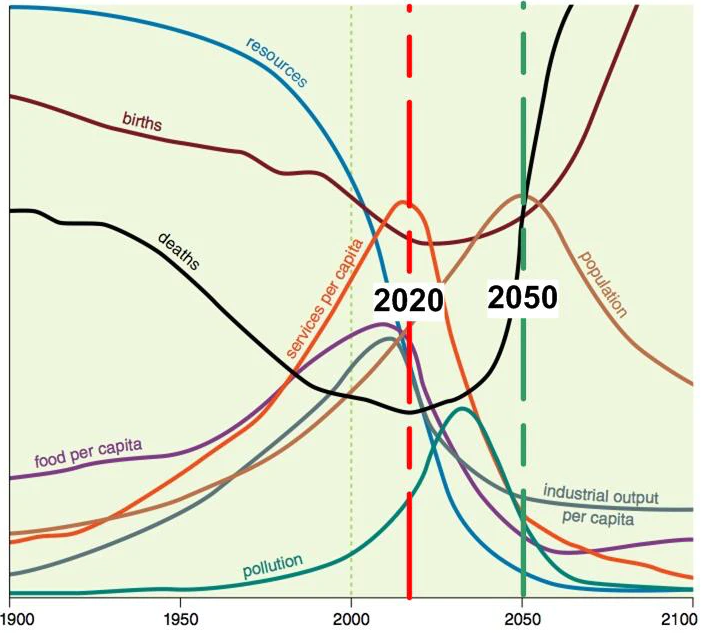
But we are in a period of collapse. The peak, I would guess, will be seen to have been 2020, though different parts of the world economy will peak at different points (peak conventional oil was 2005, fracking and shale oil is not as good.) There will be water peaks, food peaks, peaks for various minerals like copper and so on. There will be a population peak, which will occur after a lot of other peaks. One model, which has been pretty accurate in general terms, is the Limits of Growth model, which regular readers will be familiar with:

Now the thing to understand is that as resources become genuinely scarce rather than simply distributionally scarce (we have more than enough food and have for a long time but people still go hungry) countries will stop trading away what they need and will move to more restricted trade. “We have excess food, you have excess minerals, we will trade with you for this, but we are not selling food generally on the world market to just anyone.”

In periods of genuine shortages, countries stop trading indiscriminately. Food riots are one of the main causes of government collapse and elites losing their lives. Running out of heating or cooling fuel or fuel to run the distribution network (diesel is probably near peak) can lead to fast internal collapse, and so on.

So when there isn’t enough, you stop playing around. You don’t trade unless you’re getting something concrete you need. If you need something, don’t have enough of it and either can’t or would rather not trade for it and still can run your military, you send your military to go get it. (This will become harder and harder though, as modern militaries are resource hogs.)

We’ve had a world economy for a long time now: most of the world since 45, virtually all of the world since the collapse of the USSR (and even before that the USSR, which had food shortages and petroleum to sell, was in the world market.)

Increasingly we will not. Some of this is driven, right now, by competition between the West (which includes S. Korea, Japan and Taiwan) and China, but even much of that is, I suspect, shortages in drag. Soon it will just be “there isn’t enough, who is going to get it?”

Take a good hard look at where you live and what it can make and grow and dig up itself, and how well it can be defended. Because that is going to matter even more in the not-so-far future.


This is a donor supported site, so if you value the writing, please DONATE or SUBSCRIBE.

Page 88 of 436

Powered by WordPress & Theme by Anders Norén