The horizon is not so far as we can see, but as far as we can imagine

Author: Ian Welsh Page 76 of 436

Construction of Reality: Who You Feel With

This is chapter 6 of “The Construction of Reality”, one of the rewards of our 2023 fundraiser. We’ve now unlocked up to chapter 11 (There are 41 chapters in the whole book.) We are c. $1,800 from our final goal and the final reward, an article on the Middle Ages Academic crisis (overproduction and collapse.) Chapters to come include

7. The Ritual (how we create identification)

8. Interaction ritual (how daily life creates identification and personality)

9.The Ritual Masters (How rituals create different types and classes of people)

10. The Ideologues (How identity is tied into story, ideology and meaning)

11. Reign of the Ideologues (How ideology is used to create civilizations and the payoffs for ideologues)

***

We’ve touched on identification. I often say that identity is “who you feel it with.” Your tribe; your people—but that definition is not wide enough. Identity is your emotional body, which extends far beyond your physical form.

Identity is, to paraphrase Lois McMaster Bujold talking about love, “when they are cut, I bleed.”(x)

We see this, in pure form, when there are terrorist attacks. Most people are far more upset by terrorist attacks against people they identify with. Iraqis may suffer near constant bombings, but Westerners rarely hear of them, and when they do, most shrug. There may be a small pang, but most Westerners do not bleed.

But when there is a big terrorist attack in the West, in Paris or London, or New York or Manchester, many westerners become very upset.

People like us. People like them.

People we identify with.

People we identify as.

Identification is sense of self. If I identify with you, you are part of my self and while it isn’t 1:1, I treat what happens to you somewhat as if it happens to me. If something is good for you; if it makes you happy, I too am somewhat happy.

If something is bad for you; if it makes you sad or hurts you, I too am sad.

If someone is hurt while I’m watching who I don’t identify with the pain I feel, which can be measured, is much less or even non-existent compared to someone I do identify with.

Imagine for yourself someone you love being hurt vs. a stranger. If you’re very honest and have good introspection skills, you can do this exercise by degrees. Someone you love, a friend, an acquaintance, someone like you, someone not like you, someone whose culture or nation you dislike, fear or hate.

And all through it, you can feel your suffering decline.

This is why slavery requires, for most, the denial that the slave is like the master. Slaves are not equal, or not even really human. This isn’t just about race, you see this in Plato’s insistence that slaves, often fellow Greeks, were meant to be slaves, not the equal of citizens like himself.

Whomever you enslave, whoever they are, must be made something other than you; something you don’t identify with. Not “someone” but “something”. This is for your protection, so you don’t suffer when they do: this is so you can make them suffer without hurting yourself.

The same is true of war, and why in almost all wars the enemy is treated as subhuman, evil and vile. To the extent your soldiers don’t believe that, they won’t shoot. To the extent your civilians don’t believe that, they won’t support the war.

All of this is sometimes acknowledged; you may well have heard or read all this before.

But identification goes far beyond people, to objects and ideas and fictional characters.

Anything that is part of our identity is treated as part of our self.

If I am Muslim and someone destroys my holy book, the Koran, I am likely to suffer. This is not theoretical suffering, it will show up on brain scans. If I am Christian and someone desecrates an altar, same thing (especially if it’s the altar of my home church.) If I strongly identify as American and with the flag, and someone burns the “star and stripes” I will suffer. Hearing someone denigrate a person I love can make me angry or hurt, and that can be true even if the person is fictional. (If you don’t believe me, please go to a comic book forum and say bad things about a beloved super hero.)

If my house is burned down, or my possessions stolen, I will feel hurt.

If I believe strongly in, say, the right of people to have a trial, a high profile case where someone doesn’t receive a trial may make me angry or hurt or scared.

If I believe that people have souls, I may get angry that someone denies they exist. And, as anyone who has dealt with hard-core atheists knows, if I strongly believe there are no souls, I may get angry at people who insist there are.

Being upset at someone saying “your belief is wrong” is very human, but it only happens if we identify with the belief. Unless you pride yourself on your time telling, you’re unlikely to be upset if you say “I think it is three” and someone else checks their watch and says “it’s four”.

Of course you might if they imply you’re stupid for not knowing it, but unless they bring your self into it, you’ll likely shrug.

Now, imagine a baseball fan who prides themselves on knowing all the statistics is told he has some statistics wrong. Not hard to imagine that he might take that as an attack.

Identification is not all negative. If I identify with the Red Sox baseball team and they win the World Series, I’m likely be ecstatic. If I identify with Christianity, and I say a Christian prayer, it will almost certainly make me feel better, and it will be much more effective at doing so than if I am not Christian.

When the flag is raised, if I am a patriot who identifies the flag with my country, I feel good. When the anthem is sung I feel good, and I feel connected to everyone else who sings. Are we not all citizens of this glorious country?

Identity is expanded self. Anything I identify with allows me to be happy or sad or proud or loving when without that identity, I would shrug.

This goes to extremes in spiritual circles. Not only is there identity with God in theistic religions, but there is radical non-identification. In Buddhism, for example, the first great stage of accomplishment (stream entry) requires that you stop identifying as your body.

Buddhists value this because if you don’t identify with your body, when it is hurt, you suffer a lot less. It’s not yours, it’s not you, and you feel the pain, but a lot of the suffering is gone. (You may also have experienced this under the effect of some drugs, due to great tiredness or hunger and so on.)

A vast amount of our construction of reality can only be understood through the understanding of identity, and identification. Great religions, nations, philosophies, family and war, all are impossible without identification.

If we want to change reality, one of the most fundamental ways is to change who and what we identify with. Create a new identity, and you create a new reality. Destroy an old identity, and you destroy an old reality.

So, how do we come to identify with things? How do we create symbols, like flags and anthems and Gods? How does it come to be that when someone pisses on a statue of my God I get offended; and when someone says “I love Captain America” I feel warm, because I identify with him (though not as him.)

It starts with the ritual.
SUBSCRIBE OR DONATE

What Was Important In 2023

From most to least.

Climate Change Tipping Point

2023 is the year when climate change appears to have moved from linear to self-reinforcing in a big way. This was the tipping point many of us have been waiting for. Because of how movement between points of stability works, it may flip back and forth a few times, but this is the future. We had 30C weather in the middle of southern winter. Droughts. Vast forest fires. Way less ice in the arctic than their should have been, and so on.

I suspect that the point where we could stop climate change with anything short of massive geo-engineering (and I am not endorsing geo-engineering) is now past. Before, the problem was politics. Now it’s physics, chemistry and biology.

As I always note, environmental collapse is just as important, and 2023 also so a collapse of Alaska fisheries and continued degradation of coral reefs, insects, birds, and pretty much everything else.

Climate change and environmental collapse, when historians look back at this period, will be seen to outweigh everything else by a couple magnitudes, at least. Everything else is a footnote, except in in in understanding how it contributed.

Covid Continues And Long Covid Numbers Keep Moving Up

Yeah, almost no one’s paying attention, but a pandemic which is also mass disabling event and which we’ve given up even trying is one of those brute facts which matters whether you believe it does or not.

Huawei and China Handle the US/Euro Sanctions

All those chip sanctions didn’t stop Huawei in the end. They made a top end phone. China became better and better at making their own chips, and even the US forcing an end to exports of the best chip lithography machines won’t matter. China is now ahead of the US and Europe in more fields of science and engineering than it is behind in, and catching up fast in those few.

Russia Sanctions didn’t work

Notice a theme here? With the support of China, India, Iran, and the Global “South” Russia did just fine. In fact, sanctions have lead, as they did in China, to increased industrial progress and “teching-up”. Western sanctions also finally forced Russia’s oligarchs to stay at home and invest in Russia.

Russia Sanctions Did Hurt Europe / Europe’s Continued Decline

Lots of energy intensive industry had to move out of Europe over the last couple years, since replacements of Russian energy cost a lot more. Meanwhile the EU is no longer a scientific leader: China, the US, Japan and South Korea are all moving much faster. Europe’s in decline, probably terminal decline, in the sense that there’s no effort being made to do the right things to reverse it. Africa’s rebelling and kicking the French out, since they don’t need France any more as they have China.

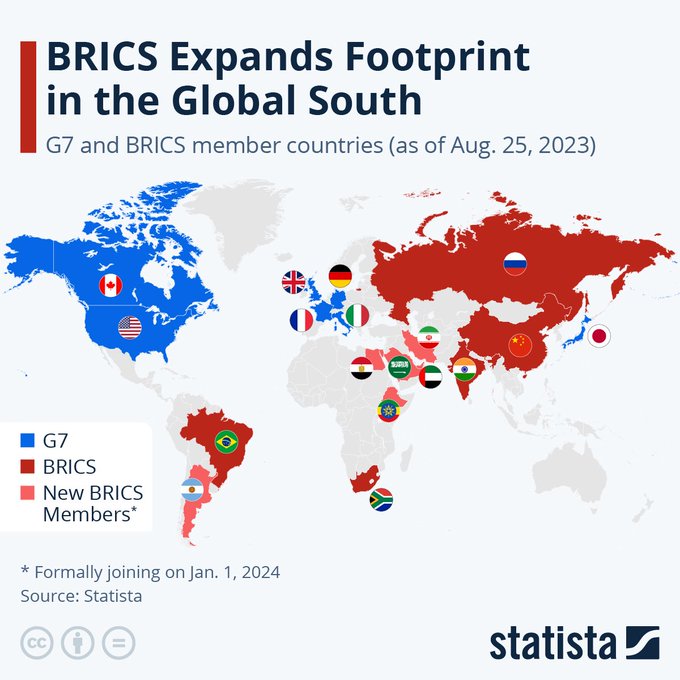
BRIC Expansion

The BRICS are now the most important trading bloc. It isn’t close, actually.

Movement Away From the US Dollar

As everyone with half a brain has expected for a long time. Slowly, then quickly. The US dollar is still number one, but a lot of deals are now being cut in other currencies, including for petroleum products. This will continue, and you can discount all the garbage about how it’s impossible. Once it was impossible that the British Pound would be replaced. This will still take some time.

This is, almost 100%, happening so soon because of US sanctions, especially freezing so much Russian money. Money that the US can and will just take away whenever it feels like makes other countries twitchy.

(This is a reader supported Blog. Your subscriptions and donations make it possible for me to continue writing, and this is my annual fundraiser, which will determine how much I write next year. Please subscribe or donate if you can.)

Ukraine Lost The War

Yes, there’s still a lot of shooting to go, but the failure of the counter-offensive and the fact that Russia has more manpower,  and that it and its allies can produce far more weapons and munitions than Ukraine and NATO mean the war is lost. It may go one for another couple years, but peace will made on Russian terms at the end. This was predictable day one (and I did) but now it should be obvious to everyone whose job or emotional integrity doesn’t require them to ignore the obvious.

The Gaza War

What’s interesting about this is that Israel isn’t winning. Oh, it’s committing genocide, but it’s not winning. What’s also interesting is that the US can’t bigfoot Yemen, because as I pointed out over a decade ago, the new generation of weapons are cheap and can easily be afforded by and made by third tier powers. A movement as fundamentally weak as the Houthis can tell America to bugger off. Missiles and drones aren’t just weapons of the rich and powerful any more.

Continued Collapse Of American Elite Consensus

The various prosecutions of Trump, all by Democrats, and the efforts to keep him off the ballot indicate America’s elite consensus is breaking down. This is low on the list because it’s just a continuation of previous trends. And no, it wasn’t actually started by Democrats: the theft of the 2000 election (and yes, it was stolen), and the attempted insurrection at the capitol were Republican.

In a way what’s happened is that the Democratic party is finally fighting back. They are no longer willing to just let Republicans do what they want. but Republicans aren’t backing down either, and so the elite is splitting. We’ll see how it plays out, but historically it’s either resolved by someone winning resoundingly and creating a solid new coalition around a shared ideology (FDR, for example) or by civil war.

***

Welcome to 2024. It’s unlikely to be a better year than 2023.

SUBSCRIBE OR DONATE

Assassination Will Not Help Israel

This is sheerest stupidity:

Nothing will change about Iran’s policy, or to how well it is carried out. Not a thing.

The problem with American leaders is that they don’t believe in anything enough to die for it. Oh, they have beliefs, the beliefs of a leech (which is unfair to leeches, which are, unlike ticks, largely beneficial to their hosts.) They really, really believe in neoliberalism, because it has made them filthy rich.

But die for it, except in the sense of “destroy the world for profit?”

No.

The leadership of Hamas, Hezbollah, even Iran to a lesser extent, have beliefs they are willing to die for, personally, not just send other people to die for.

Further, Hamas, Hezbollah and the Iranian army (especially the Revolutionary Guards) are ideological organizations. From top to bottom, they believe in more or less the same things. You could kill the top 99 leaders of those orgs, and Mr. would not be that much different.

(This is a reader supported Blog. Your subscriptions and donations make it possible for me to continue writing, and this is my annual fundraiser, which will determine how much I write next year. Please subscribe or donate if you can.)

In our society and our organizations, corporate or military or civil service, the people at the top have significantly different beliefs from the people in the middle, who have different beliefs from those at the bottom.

Further, because in our organizations there is vast infighting, because there isn’t any consensus beyond “make money” or “get power”. In organizations where, in fact, everyone isn’t pulling in more or less the same direction (if perhaps fighting a bit over “how to get there) leadership matters. The interests of employees in corps are not the same as executive interests. They don’t want the same things, or benefit from the same policies.

None of this applies significantly to Hezbollah or Hamas, to Ansar Allah (the Houthis) or (to a lesser extent) to the Revolutionary Guard. You could kill Nasrallah, the leader of Hezbollah tomorrow and it would make very little difference.

Leaders of genuine ideological organizations (we’re going to discuss this more in the future) do not have the calculus of late capitalists “leaders.” They do not think the same way. they do not feel the same way. And the organizations they run have genuine missions that the leaders and followers both believe in.

It’s been so long since we had almost any of that in our society that we don’t get how it works. Even NGOs aren’t like that: I know NGO workers and professional staff: they believe, but the people who run the NGOs don’t, actually, and don’t act in alliance with their values, morals and ethics.

Assassinating leaders of ideological orgs doesn’t matter. They just keep going.

This, plus the fact that the Israeli army is incompetent and low moral, is why Israel can’t “destroy” Hamas or Hezbollah.

As the master once wrote, “first make yourself invincible, then wait for your enemy’s moment of vulnerability.”

Israel has already lost. In truth, for those with eyes to see, in 2006 we learned they had already lost. Now it’s just about when and how much suffering.

SUBSCRIBE OR DONATE

The Presumption of Widespread Pedophilia In Elites

Is a core of right ring conspiracy theories.

But here’s the thing, while they’re clearly wrong about the details, that a significant chunk of elites are involved in statutory rape is almost certainly true.

More true is that violation of laws and strong social more is common in elite circles.

The main thing to understand is that violating social norms is a thrill. It heightens experiences. When people become powerful, the opportunity to violate norms that as someone weak they had to obey opens up and the experience can be thrilling.

If you were raised in a very Christian society, pissing on a crucifix or homosexuality or the black mass (which is essentially just an inversion of a normal mass). Pedophilia is a massive taboo in our society, and so on. Same reason some people get off on sex where there’s risk of being discovered.

When you become rich or powerful you also run into desire satiation: you can have what you couldn’t have before: the good food, gambling, legal sex, travel, lovely house, servants, automatic respect and pandering and so on. You become used to that, and soon they don’t satisfy. A normal person can eat gourmet food occasionally, you can have it every day, and soon it means little, and so on.

In general doing what even power isn’t supposed to let you do and forcing people to even what power and money aren’t supposed to let you force people to do, however, remain able to juice your emotions: the last vices of power. “What does even my society forbid to people with as much power as I have?

(This is a reader supported Blog. Your subscriptions and donations make it possible for me to continue writing, and this is my annual fundraiser, which will determine how much I write next year. Please subscribe or donate if you can.)

The only thing that remains which are able to life you past your hedonic baseline are the taboos and the illegal thrills.

Those who enable, encourage and pander to such “evil awakenings” gain a hold over the people who engage. Indeed, in many circles, to truly be trusted with power, one must have done something transgressive. If you haven’t, other members can’t trust you–they have no hold on you. The Skull and Bones society at Yale operates in this fashion: everyone has to give up blackmail material to the society.

In a properly functioning “evil elite” this blackmail is mutual. Everyone has something on each other. In a pathological one, the blackmail is gathered up and used not for in-group enforcement, but outside control. See Israel’s control over US politicians, for example. An internal or external group, controls other elite groups by having their blackmail, while they don’t have blackmail on them (or don’t dare use it.)

There are many reasons why men and women with actual integrity don’t make it to the top very often or change from good people to bad once they have power. But the hedonic adjustment to the normal perks of power, the panderers who want a hook and the elite need for everyone with power to be compromised are a big part of why.

SUBSCRIBE OR DONATE

Using Early Human Existence To Understand Historical Societies

This is chapter 5 of “The Construction of Reality”, one of the rewards of our 2023 fundraiser.

Human at Dawn

We humans adapt to the world in two ways: thru biological evolution and thru changes in culture: where culture is everything from tools and technology to language and philosophy. We are still evolving physically, and it can be seen in different human groups. Northern Europeans are more likely to be able to digest milk properly than those of African descent, for example, while whites have less melanin due to spending time in areas with less sunlight, and so on.

But cultural evolution is far faster and it is how we have done most of our adaptation since we started making stone tools.

How humans lived for most of pre-history is important, because it tells us what we are biologically adapted for: what sort of life is natural to us. Cultural adaptation often takes us away from what we were adapted for. The classic case, again, is agricultural adoption: humans became sicker, lived less long, developed serious dental problems and so on, because what they were eating is not what they were evolved for and because long terms settlements made disease more deadly. (Hunter gatherer bands move often enough, that crudely, they “didn’t shit where they eat.”)

This is a very important point and one we’ll come back to: the word progress does not mean “better life.” New technology, organization, ideology or identities may make most people demonstrably worse off and may do so for very long periods of time. Agriculture made most of the world’s population worse off for thousands of years. Yes, there were more us, and almost all of us lived worse lives than hunter-gatherers had had.

All that said, let us examine humanity at dawn.

For most of human existence we probably lived in small bands of about forty to sixty people, and interacted with other bands of similar size whom we shared ancestors or fictive kinship with. We hunted and gathered. We knew almost every person in our life.

Humans have the ability to know approximately one hundred and fifty people well (x_Dunbar’s number). This is the human span. When groups become larger than the human span we are no longer able to interact with others in the way our species was primarily adapted to do so: as individual members of our band, or of bands we have close relations to, and who probably split from our band in the past when numbers became larger than hunting and gathering could support in one location.

Within our span, we are able to:

  • Surveil others. We know what they’re up to, through direct observation or gossip with others who directly observe them.
  • Empathize and sympathize with them. Because we are physically with them much of the time, we feel their emotions almost as our own through the action of mirror neurons and bodily mimicry. We feel their pain and their joy, if not as strongly as our own, then strongly enough that their emotions matter to our own emotional well-being.
  • Apply social feedback. Since we know what they’re doing, we can apply social sanctions. If we don’t like what they’re doing, we can let them know. This may escalate to violence, but in most cases it is verbal or non-verbal approval. Since we surveil them, we will know if these social sanctions are working to improve their behaviour. Conversely, we can apply positive feedback directly, approving of them: smiling, hugging, praising and so on.

Surveillance, empathy and sympathy, social feedback. We know these people, they know us, their well-being and behaviour is in our face.

When we belong to larger groups, we can’t do these things. We use hacks, like culture and identity and ideology and organization and technology (writing and radio and Facebook & TikTok!) to scale. But none of these scale properly, they are always different from what we evolved for, and these differences generally show up as social pathologies, though there are also advantages to larger societies, even socially, as anyone who has ever lived in a village or institution knows. (I grew up in a boarding school, those who have been in the military will probably be nodding as well.)

In addition to the problems of social scaling, hunter-gatherer band societies have five other features which are important. All of these features scale badly as the number of people in a society increases, and the cultural hacks used to scale them often lead to pathologies.

We’ll circle back to these features throughout the book, so as you read each one think “how do we do this today? What has gone wrong and right?”

(This is a reader supported Blog. Your subscriptions and donations make it possible for me to continue writing, and this is my annual fundraiser, which will determine how much I write next year. Please subscribe or donate if you can.)

And here they are:

Equality, lack of surplus, reciprocity, ownership rules, and identity.

Equality. At humanity’s dawn we’re about equal. Some people may be better hunters, gatherers, talkers, dancers or singers than others, but generally speaking the differences are minor. Older people know more than younger, men are stronger than women, young people are generally healthier and fitter than older people.

And that’s about it, that’s the sum total of inequality. Any other variations are usually a result of lifestyle and geography. In colder climes hunting produces more food proportionally, and men are higher status because men are all or most of the hunters. In more lush climes gathering produces more food, women are the primary gatherers, and women have better status (though matriarchies are almost unknown, rough gender equality appears fairly common.)

Hunter gatherers who live in bands go out of their way to make sure that no one becomes unequal. Food sharing is generally enforced by social sanction, starting with mockery and humor but escalating to ostracism or violence.

Among certain tribes the hunter who made the arrow that kills an animal is considered to be the one who brought it down: but hunters share arrows and one check found that two hunters didn’t have a single arrow made by themselves in their quiver.

In Inuit bands every hunter had a group of 11 other hunters whom he shared every kill he made with, and they shared with him.

There is little material inequality in most band level societies, then (yes, there are a few exceptions). Sharing is enforced and in many societies if you want something another person has you simply admire it and they give it to you. (Then someone else may admire it and so on.) (X-Debt)

Equality here includes violence. Maybe somebody’s better at it than others, but generally one man is as good as another, and numbers are what matters. There is nothing like later societies where a few skilled, well equipped and disciplined men can defeat far larger numbers.

Lack of Surplus: Band level societies keep very little surplus. Either they have immediate return strategies in which it is not allowed to keep surplus, or they regularly use up their surplus in feasts and gifts. Surplus, and especially private surplus, is the beginning of civilization and inequality.(x-winter surplus.)

Reciprocity: Band level societies expect reciprocity: if I give you a gift, you will give me a gift, usually within one or two years. In many societies you are not allowed to give me a gift that is more impressive than the one I gave you or larger than I can reasonably be expected to pay back. Society mitigates hard against the equivalent of “overrunning your credit card” or “running up student loans.”

Ownership: The people who already live in an area have first rights to use the land. Others who have ties with them, such as kinship, fictive kinship or gift exchanges may also use the land, others who try to may be attacked. There is no concept of private ownership of the land, however, only group rights to hunt and gather. Private ownership of land is another marker of inequality and civilization.

Identity: Everyone has about the same understanding of who they are. They live the same types of lives (hunting or gathering); they spend most of their time not working doing the same activities (art, music, dance, gossip), they live in the same dwellings, eat the same food, have the same basic life experiences.

Different cultures had very different identities from each other not because they lived differently, but because they had different stories about who they were. They had different gods and most importantly, different ancestors. Identity was learned, as you grew older you would be initiated to become more and more one of your people.

It’s important to understand this: humans who weren’t part of your identity group were often considered, by default, enemies. Common humanity is not powerful for humans. Human bands are inclined to view other human bands who don’t have the same identity and, usually, also kinship (or fictive kinship) as other. People who aren’t “of us” are fair game for murder, theft and all sorts of nastiness. In this we are similar to many other animals: humans evolved to work the same ecological niches as other humans, other humans are our direct competitors.

In periods when there weren’t that many humans and when the land provided more than enough, we didn’t fight each other much: but as the land’s carrying capacity for hunting and gathering was approached violence increased.(X).

Identity told us who we should fight, who we should help and who we should ally with.

This problem, of identity, is one of the primary problems we humans have had to overcome as we lived in large groups and wanted to interact with other groups other than violently, such as for trade. Learning to expand identity also helped us be better at violence.

But identity is much more than who, it is what creates our self, the reality of who we are, and it expands far past ties with other humans. Identity, in a very real sense, is our body, expanded far beyond our mere flesh.

SUBSCRIBE OR DONATE

2023 Fundraising Update: New Chapters Unlocked

We’re at $8,700, unlocking three more chapters. The next milestone is $10,500, which unlocks the final chapters, and the full fundraising goals is $12,500, in which case there’ll be an article on the medieval university bubble and what it tells us about ours, including some commentary on the idea of elite overproduction.

I appreciate everyone who’s given so far. Times keep getting harder for most of us. This is a reader supported blog. Everyone reads for free, but the work and food and so on aren’t free. If you value my writing and you aren’t in money trouble, I’d appreciate it if you give. Could be I’m wrong, but it seems to me that this blog and my writing is right a lot more often than wrong (way more than most establishment pundits or big influencers) and I hope you consider it worth keeping around.

SUBSCRIBE OR DONATE

Merry Christmas

To those who celebrate, and to those who don’t, I hope you have the day off and enjoy it.

Open Thread

Use to discuss topics unrelated to recent posts.

Page 76 of 436

Powered by WordPress & Theme by Anders Norén