The horizon is not so far as we can see, but as far as we can imagine

Author: Ian Welsh Page 156 of 437

Making the Rich and Powerful Work for Everyone

The philosopher John Rawls suggested that the only ethical society is one which we design before we know what position we will hold in it. If you don’t know whether you’ll be born the child of janitor or a billionaire, black or white, you may view social justice differently than when you know that your parents both went to Harvard or Oxford.

Rawls’s point is just in the sense that though none of us choose our parents, very few of us are able to see the world except through our own eyes. What I am going to suggest is something different: A society works best if it treats people the same, no matter what position they hold. This is hardly a new position. The idea that everyone should be treated equally is ancient and many a war has been fought over it. But despite a fair bit of progress, we don’t really understand what equality means, how it works, and why it works.

Let’s have an example. Based on international testing, at the time of this writing, the Finnish education system is arguably the best in the world. Its students do better than those of any other nation.

What is interesting about the Finnish school system, though, is this: When they decided to change how it worked, they did not set out to try and make it the best in the world. Instead their goal was to make it so that everyone was treated the same. Their goal was not excellence, their goal was equality. Somehow, along the way, and very much to their surprise, it also became arguably the best school system in the world.

There are a number of reasons for this, the main one being a well-established fact: People who are treated as lesser don’t perform as well and are less healthy–even after you take into account other factors.

But another reason is that if you are rich or powerful, you can’t buy your child a better education. Testing results between schools are not made public and the very few private schools are not allowed to use selective admissions. In a system where your child will be treated the same as every other child, you must make sure that every child receives an excellent education, otherwise your child may not receive one.

Let’s engage in another thought experiment. In the United States, airport security is extremely intrusive. Recently, new procedures for physical examinations were put in place which include touching the genitals (I’ve personally experienced it and it definitely included genital contact, albeit with my clothing on.) Most security experts consider this to be security theatre, along with such things as taking your shoes off and the new 3D scanners. They believe that the two most important improvements in airline security were locked cockpit doors and passengers knowing that if they remain passive and allow hijacking, they could all wind up dead.

Coincidentally, the 2000s have seen an explosion in the use of private jets. The most powerful, rich, and important people no longer fly on the same airplanes as the hoi polloi and, as a result, they do not go through the same security screenings.

Do you think that if the most important people in the US had to endure the same security as ordinary Americans that it would be as intrusive as it is? How many billionaires would have to be groped before something was done?

While we’re on the subject of private jets, consider the following: A private jet still has to use a runway. If a private jet is using the same public airport you are, it takes up a take-off or landing slot. Next time you’re waiting for a take-off slot, or wondering why your flight is delayed, think on that. Less than ten people on a private jet are holding up over a hundred people on a passenger jet.

No part of society will continue to work properly if the powerful and rich have no interest in its doing so. There are three parts to this:

  1. If there is a public system, there cannot also be a private system which can be used to opt out of the public system.
  2. If there are limited resources, whether those are airplane flight slots at airports or medical care, then no one can be allowed to use either wealth or power to jump the queue, nor must they be allowed to use more resources than those without power or money.
  3. Any part of the economy where there is a monopoly or an oligopoly must either be publicly run or must be heavily regulated for quality, level of profits, and reinvestment.

(Ian-a fundamental article, originally published March 31st, 2015. As it will be unfamiliar to most current readers, re-upped.)


If you enjoyed this article, and want me to write more, please DONATE or SUBSCRIBE.
Open Thread

Use comments to this post to discuss topics unrelated to recent posts.

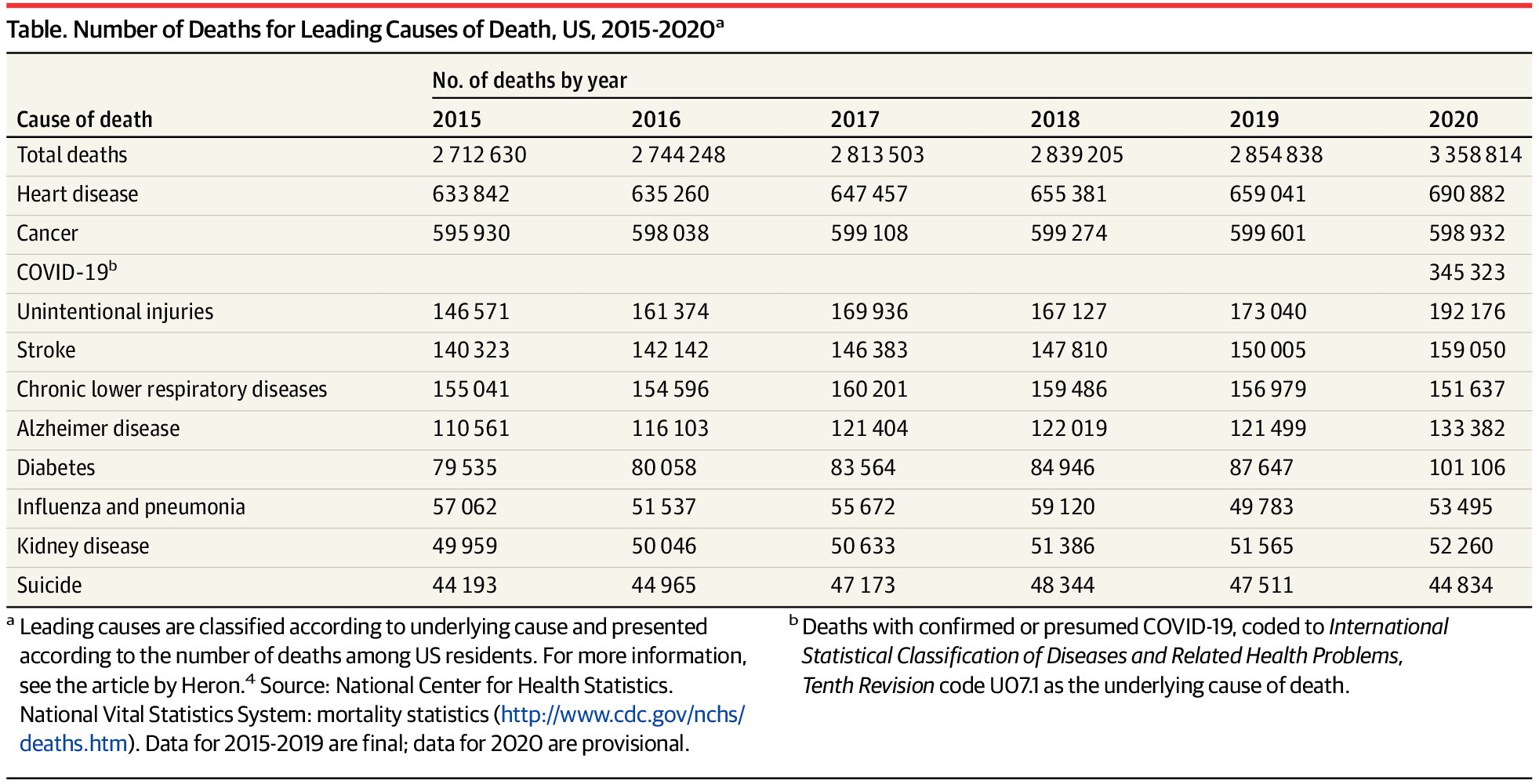
American Suicide Numbers Dropped Last Year

So, we kept being told Covid was causing increased suicides and it turned out not to be true.

I suspect this means is that American bosses are so shitty that a pandemic combined with massive economic problems is preferable to working with them in close quarters.

One of the great problems with “capitalism” is that businesses break people and aren’t stuck with having to clean up the mess they made. This is particularly noticeable, lately, at Amazon, who, in at least one case, kept an ambulance outside its warehouse because it knew enough workers would collapse and need it. Or who schedules its delivery drivers so tightly they shit in bags and piss in bottles and get UTIs.

Walmart built its business on underpaying workers and sending them to get government benefits; meaning, it wasn’t actually paying for the cost of its labor. By doing so, it wiped out businesses who did pay the cost of their labor.

Capitalism, for most of its history, has required not paying either cost of its labor practices (the human damage it does) or the cost of the resources it is permanently destroying (most recently, we are on track to kill about 50 percent of all known living species, which have both monetary and non-monetary value).

A system which throws off that much damage is obviously deranged and its “gains” are obviously unsustainable. Humanity has a limited set of resources off of which it has to live (including an ecosphere) and no, “technology” cannot replace them all. We don’t even understand the interactions of a properly functioning ecology enough to create a simple one in a biosphere; we can’t fix, or heal, what we break, any more than companies who compel employees to suicide can bring them back.

None of this is particularly necessary. Our problem is that we are STUPID. Capitalism has obvious problems that we refuse to acknowledge or deal with. We need a new way of managing our economy, one which also manages ecology and resources like, oh, THE Amazon.

This is not going to be possible if we base economic decision-making on supply and demand as we currently understand them. Nor is it going to be possible with the version of democracy or one-party states through which we have been running our society. (Nor is green fascism a solution, since fascism bottlenecks decision making.)

Money, based on debt, of which our society runs huge chunks around for almost all of our history, will also have to be completely re-thought because money has a strong tendency to reward people who abuse at scale, and always has.

None of this is impossible, though we’ve left it too late, so we’re going to eat the bitter fruits of our actions. I suggest, among other things, working to be sure that those with the most power, rather than using that power (money is power) to avoid the consequences of their actions, are forced to gorge on what they have done.

Letting bygones be bygones is a very large mistake when the bygone is multi-species genocide.

More on the rest, later.


All the content here is free, but subscriptions and donations do help, a lot.

Only Zero Covid Worked and Everyone Knows It

Vietnam has a population of 96 million and 34 Covid Deaths.

America has a population of 328 million and 550,000 Covid Deaths.


Australia has a population of 25 million, and 909 deaths.

The UK has a population of 67 million people and 127,000 deaths.


South Korea has a population of 52 million, and 1,752 deaths.

Germany has a population of 83 million, and 77,136 deaths.


Now here’s the thing, this has been known for at least six to eight months.

You shut down everything except actual essential services until cases are essentially at zero. You track and trace. You quarantine travelers. Any outbreaks afterwards, you shut down the area, HARD.

You can avoid mass lockdowns ONLY if you track and trace furiously at the start, with immediate traveler quarantine, and local quarantines as necessary, along with a mask mandate and other such policies. (See, Taiwan.) Never let Covid get out of control, and no widespread lockdown is necessary.

This works.

Taiwan, population 23 million, 10 deaths

New Zealand, population 5 million, 26 deaths.

Sweden, population 10 million, 13.5K deaths.

So, any government which had the capacity to do this and did not, after the first wave proved it worked, essentially chose to kill a huge number of people who didn’t need to die. Mass negligent homicide, at best.

It also turns out, to the surprise of no one with two brain cells, that Zero Covid produces better economic results than reopening repeatedly and allowing multiple waves.

What Zero Covid doesn’t do, however, is make the rich much, much richer while everyone else suffers. US billionaires increased their wealth 44 percent; 1.3 trillion, over the course of the pandemic until March.

That is SWEET. Forty-Four percent in about a year. Holy shit. This last year has to be one of the best times ever to the filthy rich.

Each US Covid death was worth $4,268 to America’s billionaires.

Is it any wonder that Covid was allowed to reign largely unchecked?

What a great time to be a billionaire! And it isn’t even over yet!

Edit: Article corrected to include the strategy which works with no or limited lockdowns.


All the content here is free, but subscriptions and donations do help, a lot.

Open Thread

Use the comments to discuss topics unrelated to recent posts.

Has the Era of Ordinary Americans Thinking They Are “Pre-Rich” Ended?

Nice statistic here:

Buried in the new Morning Consult/Politico poll is an eye-popping statistic: Voters by a 2-to-1 margin prefer a $3 trillion infrastructure bill that includes tax hikes on $400K+ and corporations over one that excludes those tax hikes.

For most of my life, tax-cuts were the mantra of the generation and tax-raises were automatically bad. These tax cuts went overwhelmingly to the rich, but Americans, Canadians, and Brits were all for it.

As many observed, it seemed they believed that one day they would be rich, and therefore that high taxes on rich people were bad.

Now, that seems to have changed, and I suspect it’s that Americans have finally got it through their thick heads that no, most of them will never be rich, and moreover the reason they’ll never be rich is because the people who already are, are kneeling on their necks (fortunately, just on their windpipes, not a full blood choke. Well, for most people the rich are only on their windpipes — most.)

This changes things. Certainly many politicians want to do what the rich want done, because the rich will take care of them, their families, their friends, and their mistresses and boy-toys, but there are always some who are more interested in power and winning, and if the rich don’t offer the best path to victory, they’re perfectly happy to stick a shiv in them and display the bleeding body for the masses.

Yup, that’s where we are. The Pandemic, with the rich getting massively richer while the working class died, was evicted, and generally suffered so that the wealthy and upper middle class could sip delivered lattes in their houses while tapping delicately into their computers, having Zoom meetings, and feeling sorry for themselves may well have been the straw that finally broke the back on the delusion of being “pre-rich.”

We aren’t all in this together, and we never were. It’s been class warfare for as long as humans have lived in “civilizations” (and often enough, before). Some people benefit by hurting other people. Since about 79/80, the rich have been clearly winning the class wars, driving their enemies before them, and thrilling to the lamentations of their men and women.

It’s been glorious! The modern rich are the richest rich to have ever existed, richer than in the Gilded Age. Shitting in golden toilets is nothing; these people travel the world in yachts the size of a village or on private jets, between their half dozen mansions or hotels which charge $50K a night, whose entrance you or I would never be allowed to see.

All while overseeing economies which have broken the backs of the poor and middle class and are on track to kill half the world’s species and over a billion humans.

Clarity having arrived at last, it’s time to break the rich even more than the Great Crash, Great Depression, and marginal tax rates of 94 percent did. Slap on the wealth taxes, raise the marginal tax rate on income more than 10x median to 99 percent, tax corporations, disallow share buy backs, kick foreign money out of real-estate markets, tax empty homes, create a wealth tax on anything more than 30x median, and slap an estate tax on anything over the same; your kids don’t get to rule over everyone else because you were rich. (Yes, yes, put in an exemption for actual family (small) farms and actually family (small) businesses.)

Drive the rich to the edge of extinction, into utter despair. Thrill to the lamentations of their men and women.

And don’t feel bad about it, they’ll just have to get by with, say, three or five times the median per year.

What a horror. They might only live three to five times better than most people ever do.


All the content here is free, but subscriptions and donations do help, a lot.

The Ludicrous Trans Wars

I once read that about one-third of North American tribes appear to have had roles for those born one sex who felt they were actually the other gender. Many other cultures have also had such roles.

Gender dysphoria is not new. What is new are technologies allowing us to change the body much more towards the other technology.

It is being made into a much bigger deal than it needs to be.

I’m not gender dysphoric, but if we had the ability to do full bodily changes and change back, I would certainly have lived at least a couple years a woman to expand my understanding and knowledge of human existence.

Who knows? I might have preferred it.

Not a big deal.

As the technology and social acceptance stand now, I wouldn’t do it just out of curiosity. But there’s certainly nothing wrong with gender-changing.

(I also, due to meditative experience, don’t see gender as fundamental. But it is important to being a human.)

Anyway, the trans-wars seem very misguided to me, overall. If someone wants to change their gender, let them and treat their choice with dignity. There may be some corner issues around some sports due to different skeletal structures, but that’s about it. For children, require a psychologist and a doctor to agree or something along those lines. For adults, it is really their own choice and no one else’s business, and children should be listened to, as well.

We’re walking towards a world in which half of non-human species and a billion or more humans die, while arguing about whether people know whether they want to be male or female and whether they should be allowed to make that choice.

Butt out of people’s private business that almost entirely affects only them and those close to them.


All the content here is free, but subscriptions and donations do help, a lot.

The Vast Confusion of Implicit Assumptions Like Wages and Productivity

Ran across this gem:

Paul Krugman, 1994: “Economic history offers no example of a country that experienced long-term productivity growth without a roughly equal rise in real wages.”

Now, this is one of those phrases which is a bit dubious, even on its own terms. “Long run” is doing a lot of work here.

But I’m not interested in that, it’s the embedded assumptions that matter.

Let’s tackle the word “wages” first.

When peasants were forced off the land through enclosures, and went to to work in factories, their wages increased. (Artisans who lost their jobs to factories had their wages drop, but they were a minority compared to the ex-peasants.)

These peasants went from work that they controlled, that was often only a few hours a day, with more days “off” (minus mandatory farm tasks like feeding and mucking) than modern workers, to jobs that often were 6/1/2 days a week, 12 hours a day, except Sundays, where you only worked six hours.

They lived fewer years, they were sick more often, and maimed far more often. They went from jobs with little to no supervision to closely supervised factory labor that was very de-skilled and boring.

Yes, they had more money — because they had to pay for everything (food, housing, etc.), whereas a peasant created much of their daily necessities together with other peasants and were only partially in the “money economy.”

The point is, that an increase in wages does not automatically mean an increase in wages.

After NAFTA, over a million subsistence farmers were pushed into Mexico’s slums. At the same time, the nutritional value of food in Mexico dropped due to deregulation and mergers allowing a few large companies to dominate the processing and sale of various staple grain products, and those companies decreased the quality of their offerings.

These new slum dwellers were pushed further into the money economy: they had to buy everything they needed. If you looked at the numbers, you would say, “Hey, they have more money, therefore they are better off!”

This process happened over and over again in developing countries. Peasants pushed off farms, and into slums, and it often looked like a net win. Usually, it wasn’t. Even in places where it looked like it was, like China, the results were mixed (the happiness data in China shows that those who moved to cities increased their income, but their happiness dropped). In countries that did not effectively develop, it was just a clear, net welfare drop.

This is similar to Western Europeans having lower salaries than Americans, but being healthier, taller (a good proxy for nutrition), and living longer, with higher happiness rates, fewer overweight people, and less illness.

Meanwhile, Americans pay more for worse healthcare, have to have a car, and live in larger houses with more land, farther from their jobs.

Anyway, all of this is a long way of saying wages and welfare are not the same thing.

Now, let’s talk productivity. The economic definition is the ration between output volume and input volume (labor/capital). Perfectly useful definition.

But what it doesn’t include is interesting. If I’m drawing down an aquifer to make bottled water and, in fact, causing that aquifer to be damaged so it will NEVER recover to the same capacity, ever again, but I’m not forced to book that as a negative input, am I measuring productivity correctly?

If I am polluting the air in a way that will cause climate changes that will kill a billion people and ruin tons of property, but I don’t have to book those foreseeable costs as negative input, am I measuring productivity correctly?

If my production is causing general environmental damage which shows that half the world’s species will go extinct, should that be added to the inputs side in negative terms?

If I’m using up dense energy (hydrocarbons) which took billions of years to create and which I cannot replace, should that be a net negative?

In standard accounting, wear and tear for capital equipment is counted as an expense. But the destruction of the environment, people, and entire species is not.

If I’m cold, and I light my house on fire, for a while I will be very warm. No one would think what I’ve done is wise, however — unless the other option was dying. Lighting an entire neighbourhood on fire to save one life wouldn’t be considered acceptable either.

But, in fact, by burning down the world, we are going to kill a lot more people, animals, and plants than by not burning down the world. All of this has left out more standard issues: all the asthma caused by air pollution, all the cancer caused by various chemicals in our food, water, and air, the crash in human fertility, etc, etc.

If you don’t price in externalities, to use the economic term, then you don’t know the actual productivity numbers.

So, what we’re going to find on recalculating productivity properly is that, at some fairly early point, there were no productivity increases from industrialization, and that productivity has been dropping for generations now.

Wages are very often not a good proxy for welfare. Productivity rarely includes all the negative inputs, and thus, is also inaccurate (and we’ve only touched on the issues with both).

When you have embedded assumptions, and you don’t realize what those assumptions are, or think they don’t really matter, you make terrible mistakes. If you create a decision making system (“do it if it makes a profit”) whose numbers don’t include those hidden costs, you can drive yourself very productively, and efficiently, into a hole from which you’ll never be able to dig yourself out.

It’s not that economists don’t acknowledge this. But in practice, they have acted as if it doesn’t matter.

It does. It matters now, for all the people whose lives were made worse over the last couple centuries, and it matters tomorrow, when the full bill will start to come due.


All the content here is free, but subscriptions and donations do help, a lot.

Page 156 of 437

Powered by WordPress & Theme by Anders Norén