
Use this post to discuss topics unrelated to recent posts. (So, no Covid convo, for example.)
Author: Ian Welsh Page 148 of 437
Back in 1968 the book “Limits to Growth” stormed the world. Computer models predicted that humans would run out of almost every resource, overshoot carying capacity, then crash.
It was well known and widely discussed and combined with the oil crashes, made the 70s a ferment of practical and theoretical work on alternative energy, different ways of farming and so on.
Almost all of that came to an end in the 80s, with Reagan. Carter had put solar panels on the White House, Reagan had them torn down. A decision was made to crush wages and thus the oil consumption of ordinary people, while bringing new sources online as fast as possible. Obama, with fracking, made the same decision, by the way, but even more successfully, turning the US back into a HUGE producer of oil.
But what’s important today isn’t all of that, which I’ve discussed at tedious length in the past.
Instead I want to discuss the basic argument against the “Limits To Growth”.
“We will substitute away.”
In other words, alternate energy will step up and we’ll move away from oil and coil. We’ll find substitutes for steel and nickel and rare earths and anything else in short supply.
BUT what matters is the metaphysics of the argument. When the people making this argument said it would happen, they assumed “the market” would do it.
Which, it sort of has, but too late. Much too late.
There was a strong assumption that prices were information which stored in them all known information about the past and the future, and that therefore prices would drive self-interested people to make the necessary substitutions or find new sources.
To market disciples, the market’s “free hand” was like God, all-knowing and all-powerful and weirdly benevolent. All we had to do was let the market run and it would solve all our problems.
So why didn’t that happen?
Well, to start, the market doesn’t price the future well at all. Never has, and never will. People making decisions in 1970 will mostly be dead before all this stuff matters, and the same is true of people making decisions in the 2010s. Even if they aren’t dead, is there anything in human history which makes us believe humans are good at making very long term plans, over decades to generations?
Why would you believe the market would do it based on a discipline which suggests humans are rational and know what is good for them and act rationally to get what is good for them? (If you believe all of that, you are more of a fantasist than some fanatic whipping himself while screaming for God to save him.)
Now I’m not concerned here with the hypocrites: the people who knew this was all bunk but expected to get rich off it (they were, in a real sense, very rational. A bad future they don’t see or don’t care about, “I get 50 good years and die rich when the bad times come, whatever” isn’t a reason not be rich now, if you don’t care about future people.)
But many many people really believed this bunk and the issue is that by believing that the “market” and “price signals” and *vague hand waving* would solve the problem: by saying “we have a system that solves these problems automatically by giving correct feedback” they made it impossible to solve to the extent that they were believed. (And remember, huge amounts of money were run on the markets for decades based on these ideas. People believed and put their cash on the line.)
In fact, of course, we could have taken the warning of “Limits To Growth”, “Peak Oil” and “Global Warming” and used them to make changes.
Ironically a lot of those changes would be exactly what the disciples of hand-wavy “market” crap suggested would happen automatically.
Use markets and public policy: massively subsidize alternative energy and research so that where we are with solar today is where we would have been in the 90s. Massively research alternatives to bottleneck resources. Stop over-fishing, by force if necessary. And, of course, put sharp limits on “planned obsolence” backed with death sentences for executives.
If you’d rather get more resources or if you want more than one strategy, massively fund space exploration with an eye to mining rather than defund NASA in waves (Obama, classically, did the worst cuts to NASA ever so that private industry/billionaires could make money, but NASA funding should have been increased in the 70s.)
Warnings only serve those who heed them and when you believe in metaphysical entities which don’t have the attributes they think they do (God, Markets), then you don’t act to save yourself. Markets were never, by themselves, going to miraculously do what needed being done in time. Oh sure, price feedback has eventually gotten us some decent solar, and so on, but decades later than we needed it.
Markets are human creations, like God, and to work correctly they have to be tuned for the problem at hand or, even (heresy) one has to consider that there are things that Markets or Gods can’t do, or are bad at, and find other solutions.
So here we are, and markets have not made everything good and the world’s forests are burning and we’re about to have another oil boom, as best I can tell.
Like God, mis-using markets or assigning them powers they don’t have, leads to terrible consequences, so get ready for the invisible hand to slap us silly.
(My writing helps pay my rent and buys me food. So please consider subscribing or donating if you like my writing.)
So, compared to a lot of other countries, Australia has done a pretty good job on Covid.
But they just had a Covid breakout in two major cities: Sydney and Melbourne. Those breakouts required them to then go back to shutdowns: closing and restricting businesses and movement.
Both outbreaks come from failures in the quarantine system: from hotel quarantine not working because hotels are not set up properly for quarantine due to not separately ventilating.
On July 7th I wrote that quarantine should be mandatory, with criminal penalties for violation, and…
We also do quarantine badly. Hotel quarantine is ridiculous in most hotels, because Covid is airborne and most hotels spread air between rooms.
This isn’t a difficult problem, however. Build a bunch of small huts in a field (you can even stack them), each with its own ventilation, and put people in there.
How has this been proved across the board in Australia?
The Morrison Government has stubbornly refused repeated calls to fix quarantine.
There have been 26 leaks from hotel quarantine and zero leaks from federal quarantine facilities.
It is a no-brainer. We can’t rely on hotels forever.
— Anthony Albanese (@AlboMP) July 19, 2021
I am tired of living in societies where we know how to do the right thing and simply refuse to do so because our elites are psychopathic, selfish and greedy and our population refuses to discipline or control the elites.
We KNOW what to do to stop Covid. We KNOW how to do it. We just fucking refuse.
This is goddamn pathetic. It’s just like climate change, but on a faster timeline so you can see it in weeks to months rather than decades. We may go extinct, we are certainly going to kill and impoverish billions and probably wipe out half the world’s species (which will hurt us terribly, not just them) all because while we KNOW how to do the good, non psychopathic, non criminally insane things, we REFUSE.
You discipline your elites, or most of you and your children will die or be impoverished by their actions and lack of actions.
(My writing helps pay my rent and buys me food. So please consider subscribing or donating if you like my writing.)
Has been made.
If I know that if I don’t do X, then Y will happen, and I choose not to do X, then I have chosen Y.
Our elites have chosen not to control Covid. It’s tiresome to keep going through Pandemic 101, but they haven’t tracked and traced, haven’t quarantined, haven’t enforced vaccines, haven’t opened up vaccine patents and helped every country manufacture them, haven’t kept lockdowns going long enough, have opened schools, refused to acknowledge Covid was airborne for too long, and on, and on, and on.
There is a playbook for defeating pandemics, it is well understood, and only a few countries ran it.
Covid has made the rich much richer. It kills old and poor people primarily. Selling Covid boosters every year or even twice a year for $150/pop to everyone who can afford them is a lovely new sinecure for pharma.
Because Covid has proved to be a great boon to almost everyone important, i.e., everyone who actually makes decisions or influences them, there’s no reason to end it.
And so it appears it’s going to go chronic.
Even if there are some countries who keep it under control, there will be vast numbers who don’t, and they will serve as pools for Covid to continue to evolve. This is good, of course, if you are a pharma exec with stock options, because that means new booster shots! Vaccinated populations which do not reach crowd immunity are a thing of beauty, allowing Covid to evolve against the vaccines!
Life is wonderful. Modern neoliberal capitalism is the most amazing economic system ever created — one so finely engineered by two generations of intellectuals, bureaucrats, and politicians that it turns even a plague into a massive profit event for the rich.
And, really, as anyone who isn’t rich is obviously a worthless loser who doesn’t add value to society, because money obviously accurately measures value, this is as it should be.
Too bad about grandma, or that kid getting long-covid and losing the ability to speak properly — if they were worth keeping alive and healthy, they’d be rich, because that would show their merit.
Anyway, enjoy the new world.
And remember, if you don’t overthrow your elites, they will kill you or make your life unbearable. It’s you or them, and so far, it’s you.
(My writing helps pay my rent and buys me food. So please consider subscribing or donating if you like my writing.)
Canada’s economy is substantially resource based: minerals, wood, agriculture, and, before the collapse, fish. (The Maritimes were originally colonized largely to harvest trees for masts, which Britain had run out of at home.)
Resource economies are boom and bust economies; resource prices are cyclical, and sometimes resources get replaced. Brazil had a huge rubber plantation industry at one point, before chemists figured out how to make synthetic rubber.
Resource economies tend towards corruption because the profits are so high during good times, and they tend to not develop industry for the same reason, but also because the currency rate tends to be too high to allow exports of manufactured goods during boom periods — so any industry gets destroyed during the boom.
For about a hundred years, Canada had a simple solution to these problems. We had a manufacturing sector, and during boom resource times, when the Canadian dollar’s strength made manufactured goods too expensive, we just subsidized the manufacturing and slapped on tariffs.
This was a fair deal, because when resource prices went bust and the dollar went low, manufacturing would boom and the taxes from that would be used to support people who worked in resource extraction.
Combined with some simple industrial policy along the lines of “don’t export raw logs or raw fish,” this created a nicely self-balancing economy, and it did so from about 1880 until the 1980s.
Neoliberalism and idiotic trade deals like NAFTA and the WTO put paid to that. It became very difficult to subsidize industries or to insist that processing be done in Canada; we started shipping raw logs and fish to the US, and we stopped subsidizing manufacturing during resource booms, so Canadian manufacturing got gutted.
This was, well, stupid, and a lot of blame is on Canada, Canadians, and the Canadian system, though, to be fair, most Canadians voted for parties opposed to the Free Trade Agreement (which later became NAFTA), but because of vote splitting in a third-party first past the post system, it went through anyway.
But it’s also because the US is, well, powerful. Canada’s economy is a little smaller than California’s, and Canada is a satrapy. Back in the 50s, Canada had a world-leading aviation industry and created the best fighter jet in the world: the Avro Arrow. The US government put on the pressure, and Avro (the company) was put out of business. The prototypes were sunk in a lake.
The threat was that if Canada didn’t give up its aviation industry, the US would take away auto manufacturing, and that was a much larger industry.
If the US wants Canada to do something, Canada generally does it. There have been exceptions, especially under Pierre Trudeau in the 70s, and in the early 2000s Prime Minister Chretien did refuse to invade Iraq, but they are exceptions.
Anyway, Canada’s economy is now much more fragile than it used to be, because it’s much more integrated into the world economy and much less able to adjust cyclically or insist on keeping a significant manufacturing sector.
This isn’t unique, or anything. It’s the shape of the world economy overall, where countries, especially under neoliberalism, mostly aren’t allowed to have an independent economic policy. Canada was never autarchic; we were always a trading state, but we were able to more or less run our own affairs and insist that resources mined, chopped, or fished here be at least primarily processed here.
Nations which do not make what they need are at the mercy of those who do. The US got around this by maintaining control of making, growing, and digging things without keeping them in the US, until they made the mistake of letting China industrialize.
That has lead to the rise of China/US tensions, and a realization that neoliberalism is a two-edged sword.
More on that later. In the meantime, the reason most of the world’s nations are poor and have to do what the US wants when push comes to shove, is exactly because they were not, and are not, allowed separate industrial and economic policies.
Canada, the near neighbour and satrapy, actually still has a pretty good deal, better, in fact, than is given to American peasants.
But all of that will be changing over the next couple decades.
(My writing helps pay my rent and buys me food. So please consider subscribing or donating if you like my writing.)
So, there are some protests in Cuba. I don’t know how much they amount to; I’m no Cuba expert.
Dual currency systems designate one currency for purchasing internal goods and services, and another for external goods. Their purpose is to make sure that a country doesn’t spend more money on external goods than it is earning from exports of goods and services.
When there’s way more demand for foreign goods than there are export earnings, if you allow people to just buy whatever they want in a single currency system, your single currency collapses, leading to inflation or hyper-inflation.
There’s a reason Cuba ran a dual currency system before, and while getting rid of it allowed Cubans to buy more foreign goods to start, it has also contributed (along with Covid and US sanctions) to hyperinflation:
The result of dollarization, scarcity, and devaluation: Prices have skyrocketed and inflation will likely come in at a minimum of 500 percent, and as much as 900 percent this year, according to Pavel Vidal, a former Cuban central bank economist who teaches at Colombia’s Pontificia Universidad Javeriana Cali.
Hyper-inflation destroys regimes.
Cuba is caught in a trap; they don’t have enough of anything, including food. Their primary ally, Venezuela, can no longer help (also being caught in hyper-inflation). Letting Cubans buy directly in dollars and getting rid of caps on imports must have seemed like a way out.
But shortages are shortages: Moderate inflation helps ease them, hyper-inflation simply imposes them on a different group of people -— those who can’t get foreign currency, a.k.a., US dollars.
Were I advising Cuba, I would suggest going back to the dual currency regime. Long lines and evenly-distributed shortages are tolerated much better than hyper-inflation-induced shortages because they are far more fair and predictable.
(My writing helps pay my rent and buys me food. So please consider subscribing or donating if you like my writing.)
This is what all political efforts to reduce CO2 emissions have accomplished:
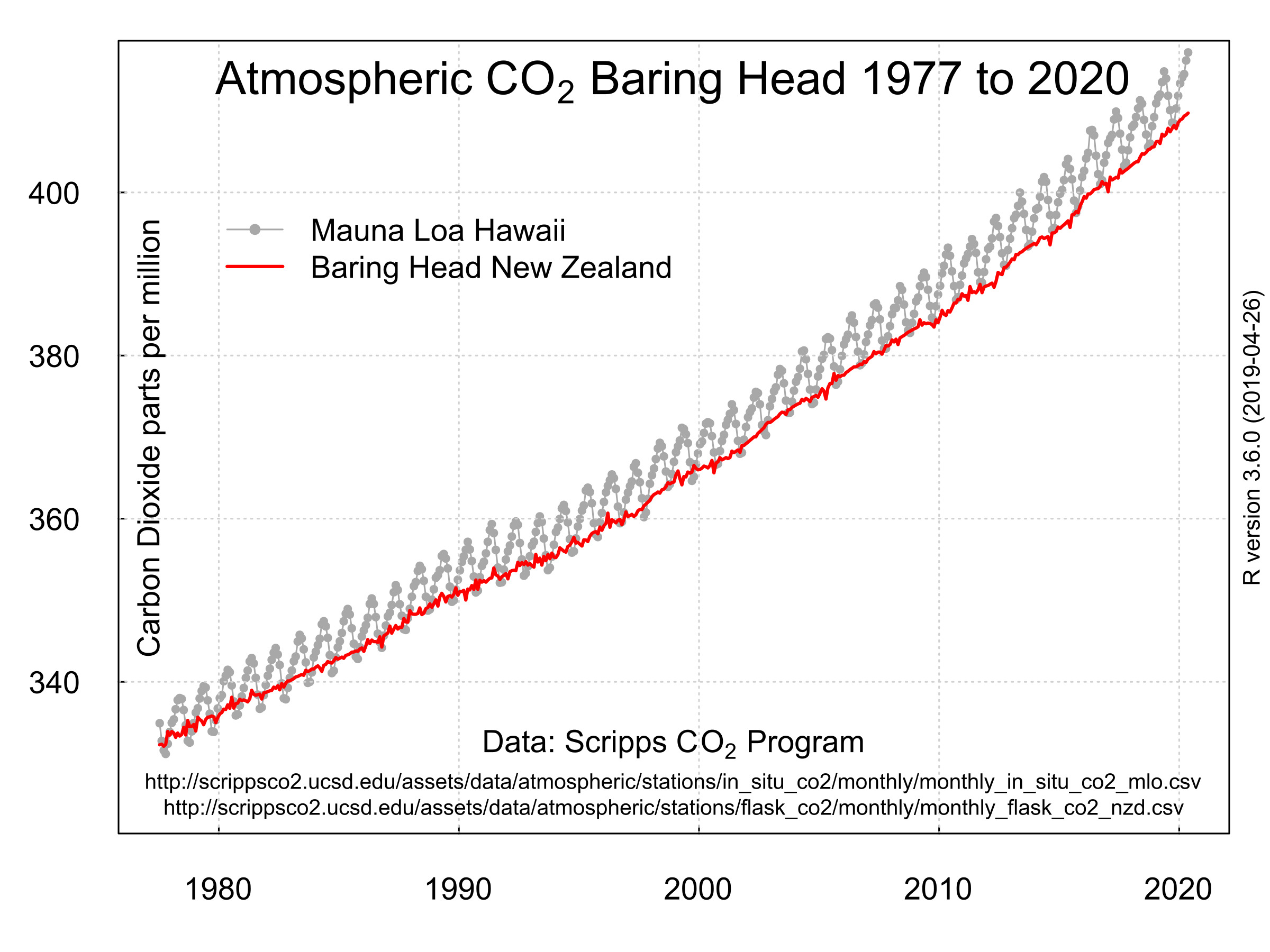
Meanwhile:
https://twitter.com/Crof/status/1413580637055852544
It is often argued that individuals are not helpless, they can join political movements intended to stop climate change.
I’m sorry, but it’s too late. The time to do that was decades ago. People did do it, and they failed. They didn’t move the needle at all.
We’re done. Climate change is happening. We have broken the old homeostasis and where the new homeostasis is, there is no way of telling. Everything we did doesn’t show up in the CO2 chart, while meanwhile we’re actually accelerating destroying one of the world’s two most important tropical rain forests, as the temperate rain forest of the Northwest burns down, changing the Pacific Northwest into a different ecosystem, one which will fix a lot less carbon. In the permafrost areas, permafrost is literally burning and exploding out of the ground, releasing methane, a far more potent greenhouse gas.
The world’s most powerful state, the US, is ruled by an oligarchy. In 2014, Princeton did a study which found that the opinion of anyone who is not part of the oligarchy (a.k.a., probably you, the reader) has no effect on what the government does. NONE.
This should hardly be a surprise to anyone who was awake during the last 40 odd years.
China is still industrializing and modernizing. More and more cars, more and more power plants, vast use of oil, gas, and coal.
The Paris climate accords, which driveling idiots gushed over, had no enforcement mechanism. None.
Politics is not going to stop climate change. Period.
Climate change is a FACT, it is past the point where it can be stopped. It is happening, now, and catastrophically. The catastrophic period has occured: Lytton, in British Columbia Canada, had Canada’s highest ever temperature, then burned 90 percent down. The fires over B.C were so fierce they were causing their own thunderstorms, complete with lightning strikes starting new fires.
YOU ARE NOT HELPLESS.
When the Titanic is going down, some people survive. When the Roman Empire is collapsing, some people survive.
I’m not saying “don’t engage politically,” at least in countries where it won’t get you dead or locked up or beaten to the point of lifelong disability.
What I am saying is: Don’t count on political action to save you from climate change.
Even if it works, the best it could and can do is slightly mitigate what is going to happen, and convince governments to prepare and maybe help people who aren’t in the top .1 percent of the population.
Your power isn’t in stopping climate change by getting government and corporations to change their behaviour — it is too late. They will change when the oligarchy decides to change, and not before, or when the oligarchy is overthrown.
BUT, you can change how you prepare. Where you live, what your housing is like, who your friends are, what your skills are, and so on. Perhaps it is time for some people to join a monastery or a mutual aide society (or church that operates as one). Perhaps it is time to migrate to a place where the bottom level aquifers aren’t polluted. Perhaps… well, whatever.
Catastrophes have started. They will continue. Whether you survive and how well will be determined, to a large extent, by you: You must prepare and adapt, and so must your friends and family. You cannot count on government or corporations, though they will give some aid. Helping you will never be a priority unless it serves the interests of the oligarchy (or CCP, or whatever).
In some countries (Vietnam, for example) the well-being of the masses is important to the elites, but in most, and certainly most developed, countries, it is not. Whether it is or not, climate change is now written into our future’s history, past the point of no return.
So don’t be fooled; don’t waste your life and energy trying to stop the Titanic from sinking after it has already been holed.
Instead, this is a self-preservation and triage situation: Decide what you can do to save yourself and some others and do that.
This isn’t an article I take any pleasure in writing. I am one of those who spent a decent chunk of their life trying to change politics to stop climate change. I, and those like me, failed (most people didn’t even try, so I don’t have any real guilt about the failure).
I wasted my life trying to stop climate change from reaching the runaway stage, but it has.
So, now, as one of those who saw this coming for decades and wrote about it repeatedly, listen to me, and do what you can to save your own life and the lives of others you care about.
(My writing helps pay my rent and buys me food. So please consider subscribing or donating if you like my writing.)