The horizon is not so far as we can see, but as far as we can imagine

Author: Ian Welsh Page 112 of 437

No The Solution To Ending Mandatory Masking Isn’t “Well YOU can still mask”

Few things make more more tired or contemptuous of someone than, when a masking mandate is removed, someone saying “well, you still have the choice to wear a mask, we’re not effecting you” or some variation.

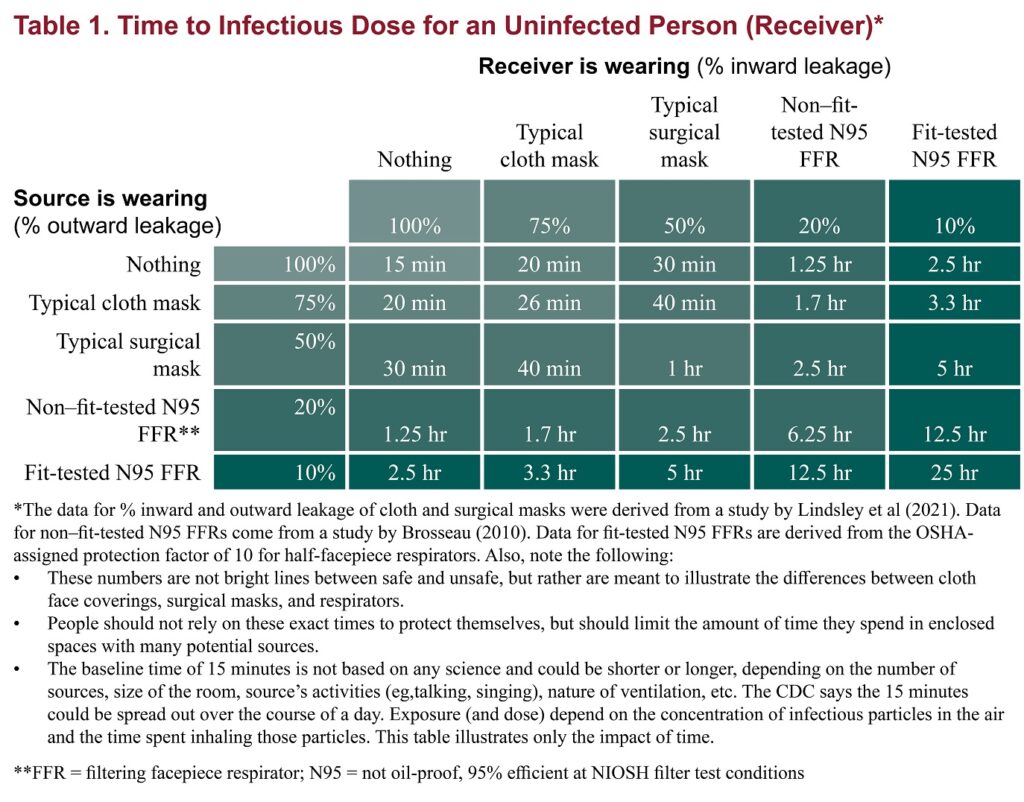
Masking is not primarily about protecting yourself. Only a respirator and a well-fitted N95 offer good protection from Covid if other people aren’t masking.


Now that chart may be making you feel safe if you go quickly in and out of businesses, but realize that there are multiple people in those buildings and that in an enclosed space the virus builds up, so even if there’s only one person who is infectious, if they’ve been there for a while, you can walk in and get a huge dose. And if you have multiple exposures in different places, the viral load can build.

Oh, and if you think anything short of a respirator is likely to protect you on a long flight where people don’t have to mask…

Masking is not primarily about protecting yourself, though it helps, it’s about protecting other people, especially since Covid can be asymptomatic and since Covid tests, especially the rapid antigen tests, often give false negatives.

It’s not, thus, just about you. It’s about the people around you.

And hysterics aside and rare conditions, no, masking may be uncomfortable but it doesn’t hurt adults or children. What hurts them is getting Covid, especially repeated exposure leading to organ damage, including brain damage, and to serious long-Covid.

Now I know that most countries have given up and just declared Covid over. Happening where I live, even as emergency departments have to be closed because of not enough nurses and doctors. It’s “over”.

But this marker is still worth placing. Masking is far more effective when it is a communal action. Some things, to work properly, we must do together.

The end result of not doing these things (which go far beyond masking) is going to be a double digit percentage of the population disabled and I doubt, combined with climate change, that our societies can handle that.

Welcome to the future. Deliberately un-handled plague, ecological collapse and climate change, combined with a cyberpunk dystopia without the cool parts of cyberpunk.

DONATE OR SUBSCRIBE

How Peace In Ukraine Has Been Made Almost Impossible

To make peace either one side has to be unable to fight any more, or both sides must want to make peace.

One problem in Ukraine is that both sides (and I don’t mean Ukraine and Russia, but Ukraine/NATO v. Russia) have put themselves into a trap where the leaders of various countries can’t afford to lose the war, because they will lose power.

Support for Ukraine is popular in Europe, but it is also true that such support has cost the Europeans a great deal, and that ordinary Europeans have seen bad economic times as a result. This is especially true in Germany and is seen as true in the UK (where more of the reason is their political leadership.) This will get worse as the war drags on thru the winter, as it seems certain to do, and Russia reduces or cuts off energy supplies as they seem almost certain to do.

Western war propaganda has been about how Ukraine is kicking Russia’s ass, and that Russia’s economy and logistics are on their last legs, while their army is weak and so riddled by refuseniks it can barely fight. Maximalist scenarios, like retaking Donetsk, Luhansk, Crimea and even breaking up Russia have been constantly stated as the war goals.

European politicians have made these statements or implicitly backed them, and if Russia is seen by their own population to win the war then there is likely to be a massive political backlash that loses them their jobs.

My read on Russia has always been that if Putin isn’t seen by Russians as winning the war (it doesn’t matter what Westerners think) then he loses power, as well, and quite possibly his life. To win Putin needs Crimea, Luhansk, a good chunk of the coast and for Ukraine to respect those borders in practice (no military incursions, no artillery or missile strikes) if not in principle.

Ukraine has virtually endless NATO material, surveillance and planning support. The West is willing to fight Russia to the last drop of Ukrainian blood, and even to encourage volunteers (many of whom I suspect are “volunteers”) and mercenaries to fight for them. Ukraine has been drafting for a long time, and still has plenty of manpower.

Russia has a 3 million man reserve. One my wonder if they can really call up all of it and what quality it is, but remember that Russia does have the world’s second largest armaments industry and that the armaments which have been doing the majority of the work aren’t fancy guided missiles (though those get the press), but simple dumb artillery with aid from the type of drones you can by on Amazon. They export food and fuel and can buy most of what they need but don’t make from China and India, where countries are scrambling to get into the market as Western companies leave.

Not only can Russia call up those 3 million, in theory it could draft many more, the question is political will and internal unity. While Western reports of resistance to the call-up seem to me to be one-sides (there are also reports of large numbers of volunteers), I would expect Russia’s political ability to call up men beyond the reserves is limited. The bill which was used to call up 300K was written to allow up to a million to be called.

So both Ukraine/NATO and Russia have a lot of ability to still poor men and weapons into Ukraine. They have incompatible peace criteria: Ukraine is not to give up any land and even take back land it already holds while Russia wants assurances from a Ukraine government it probably can’t get without toppling the government or making it clear that  Ukraine cannot defend itself.

One can legitimately point out that negotiators ask for what they never expect to get and say “neither side can seriously expect to get this?” but this isn’t a private negotiation. Putin and Zelensky and western politicians have to get a deal which their population and powerful interests will accept, and the more the rhetoric has been heated up, the harder that becomes. Putin’s real opposition is the hard right: there is no left wing or liberal opposition in his country.

Then there’s the US: the US economy is suffering, sure, but a lot of it is self-inflicted and US political elites are insulated from popular opinion. The Federal Reserve has just announced it will throw many millions more out of work to crush inflation by crushing wages of poor people rather than hurting the really rich, after all, and in any case the worst costs of the Ukraine war fall on Ukraine (whose suffering is irrelevant to them) and European countries whose weakening making them more reliable American satrapies. Humbling Germany and doing as much harm to their industry as possible is an especial bonus and very important to ensuring there is never a Europe which is independent of America.

All of this means that we’re in a trap. For there to be peace one of two conditions must prevail:

  • One side or the other must make such gains on the battlefield that the other side feels it has no choice but to give in. Russia must make it clear it can destroy Ukraine using conventional force, or Ukraine must actually push the Russians back and make clear they can and will march into all the occupied territory or even strike into Russia.
  • The costs of continuing the war must seem too high to the decision makers or those who can replace the decision makers. This doesn’t just mean Putin and Zelensky, it means NATO leaders and especially America and it means the public coming to find economic conditions intolerable and not worth it. It means China saying they will pull the plug on Russia (very unlikely unless used as pressure for a “get some of what you want deal”). If these conditions prevail on BOTH SIDES and both sides change their propaganda to “Russia gets some land and Ukraine recognizes that” then a deal is possible. Until then it is not.

Judge for yourself how likely these conditions are. World War I went on forever in part because both sides wanted something for having gone to war, and WWII happened because the Allies used their victory in WWI to punish Germany severely.

Peace requires one side to realize it absolutely can’t win and faces devastation if it continues, or it requires both sides to be willing to give up some gains they had hoped to realize. If both sides are committed to goals unacceptable to the other side, peace can’t occur until that changes.

DONATE OR SUBSCRIBE

Open Thread

Use to discuss topics unrelated to recent posts. (No Ukraine, in other words.)

Effects of the 300K Russian Mobilization

Putin has called up 300K Russian reservists. These are people who had military service, but unlike the National Guard in the US or other similar reserve forces they do not attend regular training.

I’m seeing both reports of Russian men fleeing the country and of volunteers not in the call-up reporting. Bear in mind that Russia has somewhat more than 2 million reservists, this is a little over one-seventh of the men they can call up.  The quality of these forces will be low, but they aren’t raw recruits.

Russia’s primary liability in the war is that they’ve been fight about about 1:3 odds. This will make it so they’re fight at about 5:6 or thereabouts (it’s a little unclear how many many both sides have right now.) The recent loss happened because Russia didn’t have enough money to hold lines, so Ukraine was able to punch through, and Russia also didn’t have enough mobile reserves to counter-attack. These facts are indisputable at this point.

Even low training troops can hold ground. It is a military maxim that the main difference low training (as opposed to no training makes is in the ability to move. Low training troops tend to fight well enough, but they can’t move under fire. This is why Ukraine sends its raw conscripts to die in trenches under artillery bombardment and why western “volunteers” appear to have been the spearhead of the recent counter-offensive.

So the effect of this should be to make it much harder for any Ukrainian counter-offensives to work. They are less likely to break through, and with trained troops not being used to hold ground, there will both be more men in reserve forces to stop any counter-attacks and more trained men for Russia’s own offensives.

Russia will  have to go to partial war footing to keep these men supplied, which is something Putin was trying to avoid, and there will be more death-notices to families who though their men’s time in the military was over. Russia has the world’s second largest arms industry after the US, so don’t expect that they can’t supply their forces, though there may be “last 100 mile” challenges. High end computer chips are not needed for most of what the Russian military will want (and which can be built on this time scale) and China can supply a great deal of what Russia needs even without sending arms.

The West will now need to decide whether to partially move to a war economy and whether to send even more high-end equipment to Ukraine (which will have to, in many cases, be operated by “volunteers” if it is to be fully effective. However, ramp-up times for a lot of what the West has been sending are long, and in many cases will take a year or two to go into effect, so how much can be done is unclear.

That said, one possibility is to simply play for time and do the ramp up. Keep Russian advances slow, make sure there is no negotiated settlement and try and use the Western material advantage to offset Russia’s manpower advantage. Give it a couple years and a ton of material can flood into Ukraine, more than Russia can keep up with unless China decides to fully support them.

(This is a simulation of how the NATO analysts and officers who are actually running the Ukrainian strategy are probably thinking.)

We’ll see how this plays out, but the Russians were never as bad as Western propaganda claimed and the Ukrainians never supermen. Ukraine had a 3:1 manpower advantage and was still losing ground. They had two wins: Kiev and the recent counter-offensive, but have still lost about 20% of the country. And bear in mind that most Ukrainian troops are now barely trained conscripts, they aren’t any better and maybe slightly worse than the Russian reservists.

So, the West will have to send more gear, but there’s only so much they can send and ramping up production of the fancy stuff will take longer than it takes for Russia to get these new troops to the front. That means that Russia needs to make gains during that gap and end the war before the Western production advantage can come to bear.

This winter will be key: ground will be hard, many rivers are likely to be frozen and both armies will be able to move swiftly. If Russia wants to win the war by taking enough ground to force a peace, they need to do much of it in this winter.

DONATE OR SUBSCRIBE

Machiavelli On Putin

Back in 2014 I wrote an article which started from the problems that Russia was happening at the Sochi Winter Olympics. It wasn’t running smoothly, and that was interesting and a warning of the limits of what Putin had done in Russia. The Beijing Olympics ran almost like clockwork, the 1980 Moscow Olympics worked relatively well, but not Sochi.

Russia’s got problem, big ones, and Sochi has highlighted them. Putin has failed to transition the economy from resources, and he has not kept corruption under limits: corruption is one thing, that the system can’t be made to work in high profile circumstances like Sochi, is another.

I call it “putting your fingers down.” Maybe some things in your society or organization don’t work, but wherever leadership is putting their firm attention does. Even in 1980, as the Soviet Union was rotting, the leadership could still “put its fingers down.”

Putin, at Sochi, could not.

People tend to lump China and Russia together, but they are two very different countries, with very different systems and leadership. China has had one of the world’s best performances against Covid, after some initial fumbling and Russia some of the worst.

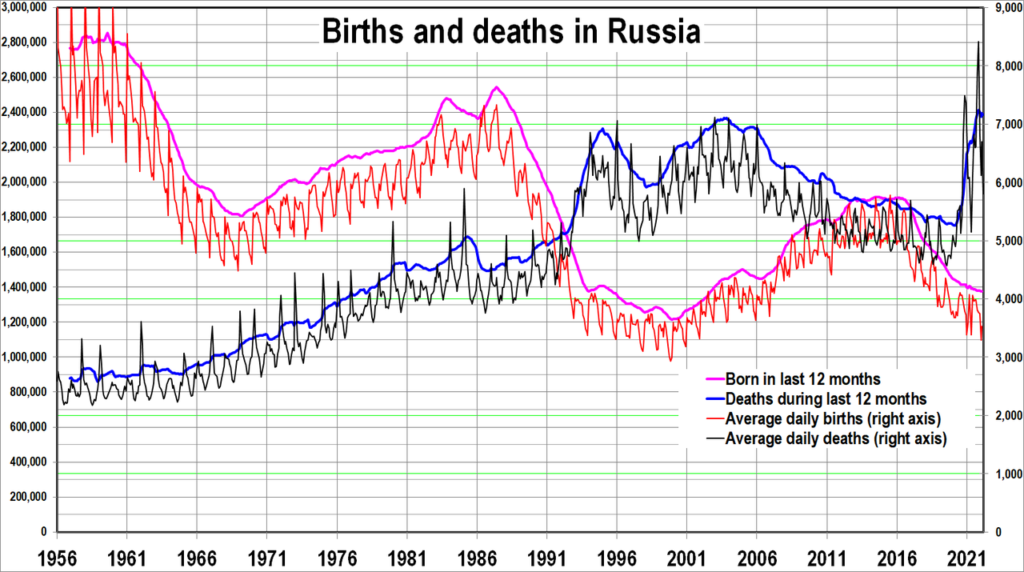
This is interesting because Russia is already in the middle of a demographic disaster: they can’t afford to lose a couple million people, they’re desperate for people.

Some nations may want less population: Russia is NOT one of them.

What enabled China to handle Covid, other than wanting to, is that they have vast administrative resources right down to the ward level and while those resources are somewhat corrupt, they are expected to produce results and Communist Party members are judged based on results. You can have some corruption IF you produce results, which includes reducing poverty.

In Russia this isn’t the case, administrative capacity is weak and riven with corruption and you don’t have to be competent at the actual running of your area.

So when Covid hit, the capacity just wasn’t available and Putin couldn’t “put his fingers down.” China had the capacity and could put its fingers down in addition.

Putin’s recovery, post-Yeltsin was based on the fundamental insight that resources were scarce or going to get scarcer and that Russia had a lot of resources. But instead of sequestering that money Norway style, Putin allowed quite a bit of corruption, probably in part because that corruption bought him a lot of cooperation from various elites. But when you don’t isolate resource money from other sectors and when you allow corruption, it rots the muscles of the rest of society.

And when it matters, you lack admin capacity and corruption is so severe it threatens non-resource core interests.

So Putin’s Russia was run on a fairly narrow basis, with a lot of corruption and no serious development of administrative capacity.

The 2nd Chechen war was fought essentially the same way that Putin tried to run the Ukraine war, except with a lot more willingness to commit mass murder. There was no general mobilization, because after Afghanistan and the first Chechen war, Russians hated mass mobilization, just as Americans had after Vietnam. Part of what made Putin popular, beyond improving the economy (vastly important) and reversing the demographic birth and death trends, was that he fought the war and won without mobilization, and the war was sold as an anti-terrorist operation.

Now Putin has had two crises, Covid and Ukraine, where his standard playbook; where what made him powerful and popular, doesn’t work.

One of Machavelli’s dictums is that most leaders don’t change with the times and challenges. Certain strategies and tactics got them into power and kept them there, and those strategies genuinely worked. Then times and challenges change and the leaders keep doing what they always did, which is no longer appropriate.

Putin has looked pretty competent for the past 20 years, but his competence was a matter of specific strategies in specific circumstances. The world has changed and the challenges have changed. He failed at dealing with Covid, and he tried to win the Ukraine war with a 1:3 force structure against a NATO trained army with strong NATO support and lots of foreign volunteers. (Or perhaps, “volunteers”. There are some reports that volunteers spearheaded the last Ukrainian counter-offensive and NATO military staffs are likely doing most of the planning.)

The strategies that worked in Chechnya, which didn’t have NATO support or a NATO trained army or massive supplies from NATO, are questionable in Ukraine, at best. The policies that created Russia’s largely resource based economy, didn’t work when Covid hit, there was not enough administrative capacity.

So, Putin’s been mostly competent for two decades. But the question now is if he can adapt; if he can change. Winter will be a key period in the Ukraine war and may decide it: the ground will be hard, many rivers are likely to be frozen and movement will be fast on both sides. Putin has about 2 1/2 months to get his army ready.

And as I’ve said before, I don’t believe Putin can political survive being seen to lose the Ukraine war by the Russian public. He may not be able to physically survive losing it. Those who will replace him are on the right, much more willing to use force than Putin, who has been (though most in the West won’t acknowledge it) rather restrained compared to Chechnya or Iraq.

Can Putin change? Can he learn? Most leaders can’t. We’ll know soon.

DONATE OR SUBSCRIBE

Open Thread

Use to discuss topics unrelated to recent comments.

Understanding and Surviving the Post-Prosperity Era

I don’t usually write about my personal life much, but today will be an exception.

The other day I had to go the hospital, to a cancer clinic (nothing to sweat, I have a type of cancer with a 98% survival rate) and the clinic I was at had only one doctor. It normally has three or four. I asked the nurse, and she told me that the others were out with Covid.

Emergency departments across Canada are having shut-downs because they don’t have enough nurses. Covid, either temporary, or nurses having quit because they can’t take the over-work any more.

Before Covid, at the same hospital I’m going to now, imaging tests for possible cancer got done in a month. After Covid, it was about 8 months, and treatment didn’t start until about 11 months. Before, 2 months.

As I say, I’ll probably live, but if I die of cancer, it will be because of, not Covid, but because of the way Covid was mishandled. For cancer, how fast you act matters. Taking an extra 9 months to start treatment isn’t a small thing: it’s a lot of dead people.

If I die, it’s a marginal (or excess) death. It doesn’t get put down as Covid, and it isn’t, but it is because of how Covid was mishandled.

And, of course, what is the government response to hospitals being slammed “we should get the private sector to do some of this stuff.” Classic neoliberalism: “make service shitty, then privatize.”

But this sort of thing is all across the spectrum. I’ve got friends on the edge, people who would have been OK ten years ago, who are now not OK. The cheap places for rent have mostly gone away; generally speaking rent at the bottom end in Greater Toronto is up about 80 to 100%, if you can find anything at all at the bottom price ranges.

More homeless people. More people paying most of their wage on rent and skimping on food and dental and medicines, because universal health care doesn’t cover dental, and Canadian drug prices are bad, just not completely “American whacked.”

As conditions get worse, people who would have made it, don’t: they get pushed off the edge, because there isn’t as much “safe” space. Homeless, sick, dead, poor.

I’m poor, have been for somewhat less than a decade now, and I’ve been poor in the past, particularly in the early 90s. (In the old days I didn’t ask readers to funds, because I didn’t need to.) I don’t use social support other than some help for cancer meds but when you’re poor, who you know includes other poor people

This period is far worse for people on the margins than the early 90s were, and they were, anecdotally and statistically, worse than the 70s.

So there are more homeless.  More dead people. People who under previous regimes would have made it, stayed housed, stayed healthy, stayed alive, aren’t.

It’s a trend, it’s been a trend for over 40 years now, but it’s an accelerating trend.

The rich are running out of money to take. In America and the UK they’ve shattered the middle and working classes, In Canada and much of the rest of the world they’re working on it. I’d guess Canada has 15 to 20 years before it reaches about where the UK is now, and where the UK is that they’re going to slide to 3rd world status. In principle it can be turned around, but in practice it’s unlikely to be. That’s why I supported Corbyn so hard, because he was the last chance they were going to get.

This trend is accelerated by climate change, and by the insistence on fighting a cold war with China and Russia. Right now the primary target is Russia, yes, but the real target in China. Breaking Russia would weaken China massively, and China is the actual threat to the current hegemonic structure, not Russia, which is not a superpower any more, just a great power (and a fairly weak great power in certain ways.)

The point here is that the way the elites are running the world, and most nations, and Canada where I live is a direct threat to my life at this point, and to many many other people. I have joked that I’m damn glad I got cancer now, because even though treatment is delayed, I’m getting it. In 10 years, I don’t know. I’m seeing stories in the UK of people who have to go private because the NHS is so overwhelmed.

To state what’s obvious private isn’t some miracle. It doesn’t create resources the society doesn’t have, it just distributes them differently: to those who can pay. In fact, generally speaking private uses more resources, because it has to make a profit.

Meanwhile the fact is that the world’s resources are actually shrinking. When climate change dries up rivers and burns up forests and increases bad weather and droughts; when aquifers go dry and glaciers and snow packs(resevoirs of water) diminish and die; when biodiversity crashes and fish stocks go away, the real resources we need to survive are being reduced, close to permanently, since recovery will take a long time even where it is possible.

With people having less resources, they can withstand less shocks, and with resources concentrated at the very top end, many people can’t take hits. More and more people are one hit away from homelessnes or death, and to top it all off Long Covid disablement is soaring and will soon be in the double digits in many Western nations.

This is, then, the culling. It’s been going on for a long time, but it’s speeding up. I wrote for a couple decades to warn other people, and now I can see my personal horizon: I can see when I’ll be on the edge. I’m already on the edge, really, as my emergency fundraiser (a first) and the delays in my cancer treatment show. I used to be able to keep other people out of poverty with help, now the aid I can give is restricted. I’m no longer much of a material resource for other (though I help with showers and food and sleep).

But this isn’t mostly about me, it’s about a lot of people being pushed towards the cliff. It’s about you and people you know. Even a lot of people in the middle class have no resiliency left: one bad bounce and off the cliff they go.

The next stage is the elites turning on each other. Having stolen all the fat and most of the muscle of the lower and middle class, they’re going to see no choice but start chewing on societies organs and to start seriously preying on each other, because there’s hardly any reserve left. In the UK, the NHS is the only major thing left worth selling. Once that’s gone, there’s nothing left to loot. All the stuff worth having will be held by other rich people.

Now, there are a few points here, and readers will have picked out some of them, but let’s state a couple clearly.

First, a lot of people, a hell of a lot of people, aren’t going to make it. If you want to not be one of them; if you want your friends and other people you care about not to be one of them, you’re going to need to do something. Probably the best thing is to organize in groups. Do what you can to help yourselves, and make it clear to the rich and powerful that  your problems are theirs: that if you get pushed off the cliff, you’re going to make it hurt them.

The second is that on the mass scale, it’s now us or our elites. They go, or we go, and they want it to be us.

Plan for this era. Climate change is now and it’s just going to get worse and our elites are going to become greater and greater predators, trying to liquidate everything they can find to keep themselves in power.

Remember that personal resilence has its limits: you need other people who care about you and have the ability to help. You need more than family, you need a community, a group and that group needs to take care of its prosperity and have a commitment to caring for its own people.

We did that thru government for a long time, but government isn’t going to hack it for a lot of people. When times like that happen, you form your own mini-governments to do what larger society won’t.

It’s sad, it’s bad, and it’s what millions of people, including myself, spent our lives fighting to avoid, but it’s here and that’s just how it is. Even if some societies turn it around and start doing the right thing, it’s unsure which ones those will be and by the time they get to it, if you aren’t caring for yourself and your chosen group, you may be dead or on the street.

And understand that everyone’s doing the wrong thing. No major society is taking this seriously. When they stop building suburbs and stop pushing cars and stop allowing planned obsolescence, you’ll know they’re serious. No government which has not done at least those three thing is serious, and since our entire economy is built around cars, real-estate expansion and throwing shit out which was designed to last only a few years, we haven’t even started.

Be well, take care of yourselves, and if you can, please organize and take care of others.

DONATE OR SUBSCRIBE
 

Lazy V.S. Uninterested & Quiet Quitting

Being lazy and being uninterested are two different things. When I was a kid I was usually reluctant to do most farm work, because it was boring, but would go for 10 miles runs or long runs, or read multiple books in a day (which many people who love farm work would hate doing.)

Most of what passes for lazy is uninterested in drag.

The old maxim: “work is what you wouldn’t do for free” is part of it, but there are four types of activities on this spectrum.

  1. “I enjoy doing it for itself and would do it even if I wasn’t getting anything from doing it.”
  2. “I enjoy it, but wouldn’t do it if I wasn’t getting anything from doing it.”
  3. “I don’t enjoy it or dislike it, but I’m willing to do it because I’m getting something from it.”
  4. “I don’t enjoy it or dislike it, and I won’t do it even if I get something from it absent coercion.”

One is your hobbies, vacations and so on. Two is work you like, which doesn’t also fall into the hobby category. Three is most people’s jobs. Four is things you do because if you don’t do it something bad will happen, usually because someone else will make it happen.

When I was a kid most (not all) farm work fell into category four, and most of the rest fell into category 3. I didn’t ever get paid for any of it, but I used to spend some holidays on an Uncle’s farm, and I liked him, and we’d do the farm work then go do something fun. I was getting something from it.

Most of my jobs have been in category 3: I did them because I needed the money. I’m not working construction or baking or being a bike courier, or painting houses or doing life-insurance back-end administration if someone doesn’t pay me.

Blogging and writing fluctuates between category 2 and 1. Some of it I’d have done (or do) even if I wasn’t getting paid , but some falls into “this pays my bills and I enjoy it, but I wouldn’t write this article if it wasn’t my job.” From about 2004-early 2009 the category 2 blogging also fell into “getting something for it” in the sense that I believed in the Netroots, and that we might get enough political power or influence to make good things happen politically. I would never have worked 70-80 hour weeks at FireDogLake just for the money (which was liveable, but only just), I did it because I believed in the mission and when it became clear just how awful Obama was and that the Netroots was falling apart, I quit, because I hadn’t been doing it mostly for the money.

I’m not entirely sure that laziness exists much. So-called “Quiet Quitting”, where workers refuse to stay late or do extra work is just enforcement of what moderns call “boundaries”, and classifying work as category 3. “I’m not doing more work than you pay me for, because I don’t enjoy it.” High wage workers understand that implicit to their high pay is doing more than is “on spec”, but doing more as a low paid worker, unless you think there’s a chance of meaningful promotions and wages is stupid.

When the people at or near the top get a 100x what the people in the middle get, and 200x what the people at the bottom get, and when most people know they’re never getting to the top and most won’t even get to the middle, and when they don’t share in profits, why should they work hard at jobs they don’t enjoy, or wouldn’t do for free?

I had a friend who, for years, had a rule that he wouldn’t do anything for money he wouldn’t do for free. It eventually broke down because if he’d kept the rule he’d have wound up homeless and then dead. His problem wasn’t super-fussiness, he wanted to do jobs that helped people and used his skills, but our society pays best for doing things that don’t help people. Since helping people is sort of an intrinsic reward (you get to feel good about yourself), we think people should do that form almost nothing, or nothing.

The weird thing is that getting people to do what they enjoy means they do more and better work, and that helping people has strong (econo speak) positive externalities. The more your society is focused on doing things that actually help others in some way, the better it is.

But our society concentrates on negative sum games (we are doing more harm than good, overall) and uses money primarily as coercion, rather than using it to allow people to do good things that they want to do, or are at least willing to do.

I don’t like farm work, but I have known many people who love it and do it for almost no money because they want to be farmers. We take advantage of that sort of impulse, in nurses and care workers and increasingly in teachers. Things that are good are done for cheap, and by less people than want to or than we need doing them, so that we can pay other people well to do things that are bad.

What you want to do absent excessive compensation or e is often a good guide for what you should be doing (not always) is often a good guide not only to what is good for you, but what is good for society and we need more of it, not less.

Many people think this means that important things that need to be done like garbage collection, janitorial labor and sewage work wouldn’t get done, but when Graeber did his research for “Bullshit Jobs” he found many people actually preferred that work because it felt useful, even when it paid less. I recently talked to a woman who works for a real-estate company which runs low-end housing. She used to make much, much more working for high end hotels, but she prefers this, because it feels like she’s helping people. “I’d rather clean someone’s shitty toilet after they’ve moved out than do any more of that bullshit.”

Incentives work, but they work best at getting people to do things which shouldn’t be done in the first place.

DONATE OR SUBSCRIBE

Page 112 of 437

Powered by WordPress & Theme by Anders Norén