
The horizon is not so far as we can see, but as far as we can imagine

Author: Ian Welsh Page 102 of 437

A Story About How Health Care Privatization Happens

So, as many readers know, I got cancer. (I’m fine. It’s treated, I won’t die of it (3% chance some years out), though I’m on hormone blockers (moderately nasty as an adult) for as much as another year.)

Anyway, I got cancer while Covid was on, so a lot of my visits were virtual, or just phone calls, unless they really required my physical presence. Three month followups: usually by phone. Faster for the doctor; faster for me, all good. But the last time I went in the waiting room was packed. I waited for hours, and the nurse apologized “the government won’t let us do followups by phone (or virtually) any more.”

Oh. Weird. Made no sense to me, but governments do stupid things all the time, and despite how I make my living I didn’t think about it much. (Doctor’s visits tend to focus my mind elsewhere.)

Ontario’s been in a deepening health care crisis for a couple decades at least. In a lot of cities, if you don’t have a family doctor, it’s essentially impossible to find one. If your current doc retires, too bad. Toronto, the largest city, is the worst. So lots of clinics sprung up, and you’d go to one of them when you got sick. They started offering virtual visits even before the pandemic.

All of this was covered by public health: you never paid for any of it. The provincial plan is called OHIP, and it’s still a sacred cow.

A spokesperson for the Deputy Premier and Minister of Health, Sylvia Jones, told CTV News Toronto, “It is against the law to charge for OHIP-covered services. If the ministry finds that a person has paid for an insured service or some component of an insured service, there is a mechanism in place for the ministry to ensure that the full amount of the payment is returned to that person. Ontarians who believe they have been charged for an insured service should contact the ministry by e-mail at protectpublichealthcare@ontario.ca or by phone (toll-free) at 1-888-662-6613.”

On Wednesday, Ontario Premier Doug Ford said he doesn’t want patients paying out of pocket for medical expenses.

“We also need to be clear, Ontarians will always access the healthcare they need with their OHIP card, never their credit card,” said Ford.

Sounds great, eh? The principle is that if it’s covered under the government plan physicians who take any money from the plan at all can’t charge: you’re either fully private or in the system. This is supposed to be true across Canada, and for a long time it almost always was. (Except in Quebec, where they use ethnic pride to allow extra lots of corruption. See “Brexit” for a recent high profile Anglo version of this.)

But about the same time I was sitting on my ass needlessly the Ford government in Ontario also changed another regulation: OHIP would no longer pay for virtual visits to clinics (or in a clinic with a telepresence doctor) if there hadn’t been a physical examination by that clinic or doctor in the last year.

THUD. People go to clinics because they don’t have a relationship with a family doctor. If they had a physical exam every year there’d be a relationship: that’s what family doctors do. Those “regular checkups”.

Have you seen the kicker?

If OHIP doesn’t cover it, then you can charge for it. Since virtual visits with doctors and clinics who haven’t phsycally examined you are not covered, they can be charged for.

Meanwhile, Galen Weston, probably the most influential and powerful Billionaire in Ontario, who owns both the most supermarkets (where he has clinics) and the biggest drug store chain (Shopper’s Drug Store, which he was allowed to buy a few years ago), had rolled out a virtual visit service. Don’t know how well it was doing, but I do know that the public health care line you call to be told what to do is now referring people to services like it.

It’s called Maple. Here’s the current pricing.
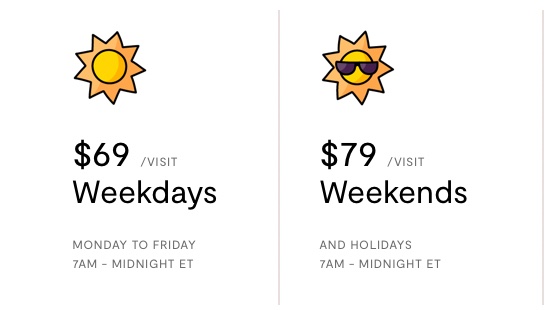
In my entire life I have literally never paid for a doctor’s visit. Not once. Not ever. Not even a virtual visit with an online clinic last year before this new regulation so I could renew some meds.

But this isn’t covered any more, so it’s legal.

And that’s one of the mechanics of stealth-privatizing healthcare.

Note that while it’s hard to get a family doctor, it’s a growing problem and most people still have them, so this is a boiling frog issue: a majority of people won’t be affected. Yet. And most people can afford $80. But this is how you do it, step by step.

And in a certain way, it’s a BIG step, because as I say, I’ve never paid. Neither have most Canadians. If I need healthcare I may have to wait sometimes (though usually not more than a couple hours), but it’s free.

This is a strike against that. You get people used to paying for some services and slowly expand which ones and pretty soon you’re paying for a lot more. Another similar step was to allow pharmacists to renew most prescriptions: but it isn’t a covered service and they can charge for it. Only $15, but I’ve never paid for a prescription in my life either. And phone renewals of prescriptions with doctors aren’t covered either, so most of them are now charging for them, though that’s been true for a while.

Step, by step. Meanwhile, under-fund the system, overwork doctors and nurses and technicians and make the quality of care worse and worse. Over decades don’t train enough doctors or nurses to start with, then use Covid to decrease supply even more and push doctors and nurses out of the public system into the private system where they don’t have to work 12 hour+ shifts over and over and aren’t expected to get Covid over and over. (In one previous visit three of the four radiation oncologists were out with Covid, another longer wait, because we refuse to ventilate, HEPA filter, use UV light and mandate N95 masks rather than cloth ones.)

I have quipped before that I’m very glad I got cancer now, because in 10 years I’m not sure I’d be able to get care. The system now is creaking, but it still more or less works if you’re really sick. But the real money in privatization is market pricing for the truly desperate, like people who have cancer.

One final point: these people make their fortunes, literally, by making you sick and making it more likely you die. That’s what they do. They are your enemies, wherever they are because anyone who is taking active steps which make it more likely for you to die, to not get healthcare you need or to become impoverished or homeless is your enemy if anyone is. We just pretend they aren’t our enemies, mortal enemies, in fact, because they operate through the system by the rules; rules they made.

More on that later.


The results of the work I do, like this article, are free, but food isn’t, so if you value my work, please DONATE or SUBSCRIBE.
The Red Queen’s Race, Neoliberalism & Why Healthcare Is Being Privatized

Back in the early 2000s I remember reading an interview with Ted Turner, who founded CNN and later sold it. He wasn’t happy with how it was being run so the reporter asked him why he didn’t buy it back.

He explained that he had only a few billion dollars, which meant he wasn’t “in the game” anymore. People mocked him for it, since to a normal person that’s more money than they could ever use, but he was right. He had sold, and now he couldn’t re-buy; prices for key assets like CNN had gone up.

This the basic issue the real players, the mega-rich and the CEOs who run the big companies face. The amount of money that was enough last year isn’t enough this year, let alone in five years. Fall behind and soon you’re out of the game. This doesn’t have to be personal money, just money you control, so if you have effective management control of a company you don’t have ownership control of, you’re in the game, though such people generally reward themselves massively, so they at least aren’t embarassed in front of their peers.

Different oligarchs are competing against each other and so are different groups: tech, finance, manufacturing, military-industrial, etc…  If one gets enough of an advantage, then they buy out the others, and even if you’re still filthy rich, you’re out of the game and nowhere near as powerful as those still in the game.

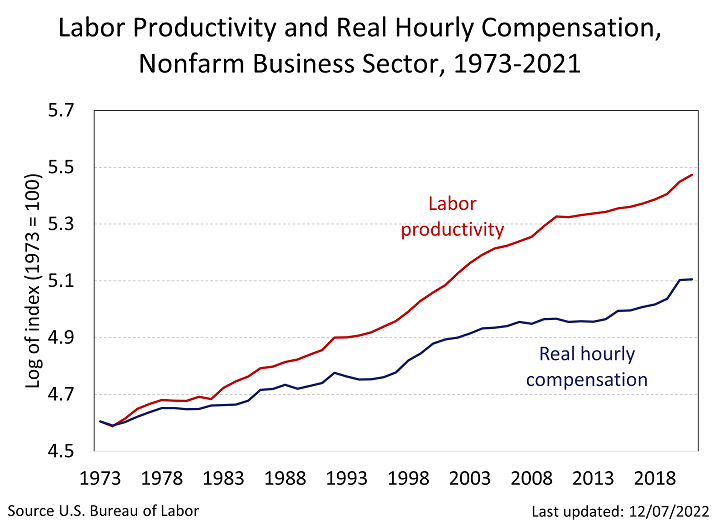
As everyone knows now, the rich have been taking more and more of pie. The most famous chart is the labor productivity vs. wages one:

Furthermore, the real players have been narrowing: there are fewer and fewer people who are really in the game. Vast waves of consolidation in almost every industry have created oligopolies and monopolies, because those sorts of businesses can squeeze customers. Some games are easier to squeeze than others: healthcare is a famous example as people will pay almost anything to live. There’s a reason Bill Gates is buying up all the farmland he can get, too, with environmental disaster onrushing, he knows that those who control food will (with enough political cover) also clean up.

But at the end of the day, everyone is taking from the same pool: any increase in wealth that doesn’t come from productivity increases has to come from someone else. The rich do take from each other, though they play by the rule that unless you’ve betrayed other elites  you get to stay wealthy, but most of what they take still has to come from the masses.

Unfortunately they’ve been squeezing the masses for 40 to 50 years, maybe a little more. So they have to keep finding new places to squeeze. This is why power has been privatized and de-regulated; why water and sewage is privatized in the UK (and sewage is in the rivers again), and so on.

But in those countries with public health systems (aka. not the US) like Canada and the UK, well, that’s a place where the full squeeze hasn’t been put on. Prices can easily be raised, by moving to the profit maximizing price (insulin at $800, like in the US, and so on), though it means a lot of people will suffer and die.

There’s one last big public heifer to be taken down and consumed, in other words. And if you don’t get in on it, well, your rivals will and they’ll be richer than you, and you stand a good chance of being forced out of the game.

So, with a few exceptions (manufacturing used to be one of them), the elite consensus is to privatize health care. It’s a big cow, sitting there waiting to be chopped up, and if you get a big enough chunk you may be able to buy out some rivals or at least stay in the game.

And in some cases it’s pretty much the last one. In the UK, it’s the only thing of worth the government owns which it hasn’t privatized. So, as everyone understands by now, you deliberately underfund and sabotage it, then call in the private sector because it isn’t working well. The same thing is happening in multiple Canadian provinces, including where I live in Ontario.

And the real players will become fewer and fewer, and if it means that you die or suffer, well, that’s a price the players are willing to pay so they can stay in the game.

As the game narrows, the players will also turn even more on each other. This has already happened with the TransAtlantic elite, who used to more or less cooperate: the US is now feasting on Europe. But then the Germans had been feeding on much of the rest of Europe already. And it’s obvious that Chinese and US elites are moving to a confrontation, and this is driven in great part by the refusal of the CCP to allow anything important in their economy to be controlled by foreigners.

Sadly, there is a real economy, and it is being fantastically mismanaged, not least by allowing the real carrying capacity of the world to collapse. Elites had such a huge pie (to change metaphors) that it usually made more sense to fight over it than to cooperate to grow it more. So we’re at the beginning stages of collapse. There will come a time when the pie starts to shrink in ways no one can deny.

The silver lining, such as it is, is that so much will have been privatized and screwed up that when we finally do get serious about change, assuming we avoid a Dark Age (not a sure thing) we will be able to do things differently, since there will be so little legacy left.

It’s not much of a silver lining, but destruction does make change possible.


The results of the work I do, like this article, are free, but food isn’t, so if you value my work, please DONATE or SUBSCRIBE.

Open Thread & Fundraising Finale

Fundraising wound up about $200 short, but I’ll probably write the final article on reasons to hope anyway, as it was so close and the past few years have been hard for so many. My very sincere thanks to everyone who gave.

Feel free to use this thread to discuss topics unrelated to recent posts.

The Death Throes Of The World Europe Made

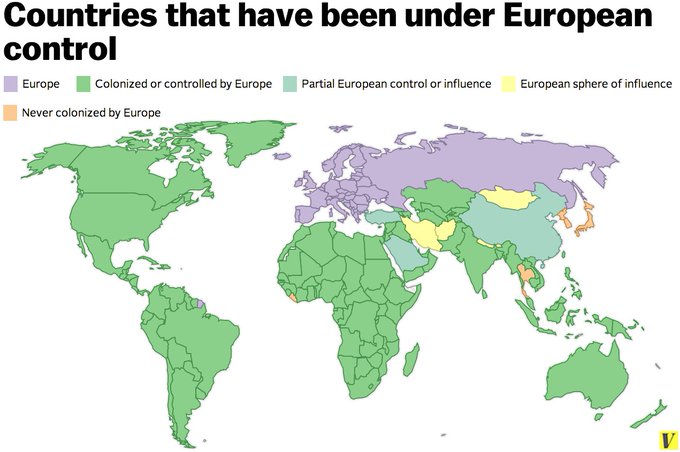
Most people don’t really get just how extensive European conquest of the world was.

The map’s a bit inaccurate over in Russia: most of Russia is “not Europe” and was conquered — most of it should be green, like North America. Likewise, Japan was conquered by the US, which is a European colony. Leaving aside their brutal war crimes, they were stupid to pick a fight with an industrialized continental power: there was never any chance of winning against the US, as Admiral Yamamoto told them.

But the point is fairly simple: Europeans made the modern world. Wiped out almost all the natives in North America; conqured all of Africa and South America, and almost all of Asia. We went around and imposed our form of capitalism. We destroyed local industry, as in India (which was at least as industrialized as England before the conquests) and forced the natives to trade with us on negative terms, the most famous example being the two Opium wars to make China allow the Opium trade, since England had almost nothing else the Chinese wanted to buy.

World War I and II were a competition between the European powers (which include the US, who had by then essentially completely wiped out the natives) and the US and USSR, the peripheral continental powers won the war, divided Europe between them, “de-colonized” and then ruled the world between them till the USSR collapsed, at which point the US got to tell almost everyone what to do and how to do it for a good twenty-plus years.

A few nations managed to sort of resist: Cuba, Venezuela, Iran and North Korea, but they were made to suffer vastly for their defiance.

The era ended, I would argue, when Russia sent troops to Syria. They defied the US directly, and fought, and the US backed down. One could argue for Georgia, but it was on Russia’s border. Syria was an assertion that the US could not overthrow any government it wanted and that it didn’t control the Middle East minus Iran.

But Russia, important as it is, is now a junior ally to China. They have the nukes, but they don’t have the economy to stand up to the West and NATO without China’s support, and they know it. The competition is not really between Russia and NATO or Russia and the Ukraine, but China and the US, even though neither side has anything more than observers on the ground.

The Russians have chosen their side: chosen not to be Europeans but to be Asians. They say this frequently, it’s a deliberate choice. If this century is to be the Asian one, Russia will be Asian. This change from looking to Europe and being essentially European is massive, and it’s what makes it possible for China to win. Losing Russia, with its vast resources and land ties to China makes it nearly impossible to use American sea-power to “choke out” China thru trade interdiction.

The coming cold war, and possible hot war (or a series of proxy wars) with China is about whether a non-European power will be allowed to remake the world Europe made. Everyone recognized that the US was Britain’s heir, ruling indirectly, but ruling nonetheless. It is about a different, non-EuroAmerican elite being powerful: people who don’t believe in exactly the same things as the trans-Atlantic rulers.

It is an existential threat to European rule, and it is being treated as such. The “yellow peril” has arrived.

In 30 years, will Mandarin be the the new English? The new lingua-Franca? The language everyone has to know and that you can, if clumsily, get by on almost everywhere?

Absent a major war, likely nuclear, or civilization collapse, I find it hard to see a scenario where China doesn’t become the most important global power. Oh, they have problems–but so does everyone.  Cries of how they can’t do it because of culture seem weak to me: China was the civilization leader for most of the last 2,000 years, the idea that Chinese culture can’t produce science, music, arts and all the other flowers of civilization is absurd and they’ve certainly been able to adopt our innovations, just as we previously adopted gunpowder and the printing press from them.

Everything ends. We Europeans had our day in the sun (though my Irish ancestors missed most of it) and now the sun sets, as it always does.

SUBSCRIBE OR DONATE TO IAN’S 2022 FUNDRAISER

China’s Trade Surplus Grows, Including With the US

There’s a lot of talk about friend-shoring and bringing industry back to the US and its allies, but the reality is quite different.

The bottom line, right now, is that if the US went to war with China, the American (and Western) economies would virtually collapse.

The US is making serious preparations for war: they are fortifying allied countries in Asia in a similar fashion to how they did Ukraine after 2014, although obviously with less of an eye to ground invasion. Japan has doubled its military budget and stated that it will no longer obey the “peace” constitution but will participate in offensive operations with America.  US bases are popping up around China wherever they are allowed.

But to fight a non-nuclear war with China, the West has to genuinely re-shore its critical industries, and it isn’t doing that beyond a few steps with regards to semiconductors. A vast swathe of basic industrial goods are made by China, and not by the West, or not in sufficient quantities.

However, to seriously repatriate industry requires reducing the cost-structure: and that means reducing housing costs, and in the US, health-care and tuition costs, so that Western industry is cost-competitive. Right now the US is grabbing a swathe of energy price sensitive industry from Europe, and especially Germany, but that doesn’t help much in an general war: they’re taking from their allies, not their enemies.

Genuine oligarchic plutocracies, which is what most of the West is, including the US, are generally very bad at industry and war, though there are exceptions (Venice, at various points. But being merchants concentrated their minds on naval power.)

The steps required for America and the West to rise to the challenge of China require Western elites to make painful choices they so far are avoiding: they simply have to give a better deal to their populations, and not concentrate on keeping wage increases under inflation increases (which is what has happened in the US.)

America’s elites can be absurdly filthy rich or they can just filthy rich and have a chance of retaining their global pre-eminence. It’s unlikely they can do both, though I suppose they could bet on ruling a post-nuclear wasteland, if they’ve gone fully insane.

SUBSCRIBE OR DONATE TO IAN’S 2022 FUNDRAISER

Fundraiser Ends Friday

Thanks to everyone who has given, I appreciate it greatly. We’re about $1,300 short of the final goal. If we hit it I’ll write an article on reasons for hope. Either way, again, I’m very grateful.

SUBSCRIBE OR DONATE TO IAN’S 2022 FUNDRAISER

Open Thread

Use to discuss topics unrelated to recent posts.

Almost Nothing

Words are always a problem, and never more so when discussing spirituality/meditation/cultivation.

There are many, many different types of meditation, designed to do very different things. There are forms of breath meditation whose primary purpose is to calm the body. When you do so, you may notice certain things about reality/yourself, but knowing “how to meditate” doesn’t mean you have achieved any level of insight or awakening; it’s just a technical skill.

But almost all of what I would consider real spirituality is about “knowing thyself.” This is primarily about observation; about noticing facts about yourself that you hadn’t before, and then noticing them over and over until something clicks and you start perceiving your existence in different ways than the norm.

When teaching “meditation” one of the main questions is how much to signpost; how much to point. If you tell people what they’re looking for, they’re more likely to see it, but the power of the insight is weaker than when it takes them by surprise.

That said, I’m going to “point” to something: almost nothing exists.

If you either calm the chatter of your mind or learn to disregard it (it doesn’t matter much which) and rest your awareness lightly over the sensations you’re feeling, what you may notice is that there isn’t a lot there. Mostly there’s a lot of nothing, with some sensations floating in space (which is also a construct, but that’s a later thing).

It’s an odd thing to notice, that you aren’t solid. You think of  yourself as solid: a body, but the actual experience isn’t that and that you believe it is is because you’re filling in what you “know” is there, stitching together a reality which doesn’t actually exist.

Try it sometime. Just be still, calm the mind or ignore the chatter, close your eyes, and see what’s actually there. (You can do this with eyes open, but it’s easier with eyes closed.)

You may be surprised.


Donate or Subscribe To My 2022 Fundraiser

Page 102 of 437

Powered by WordPress & Theme by Anders Norén