
The horizon is not so far as we can see, but as far as we can imagine

Tag: Paul Krugman

It Doesn’t Matter What Europe’s GDP Is

Well, mostly.

Krugman shared this chart, as part of an argument that it’s ridiculous for Europe to be scared of Russia:
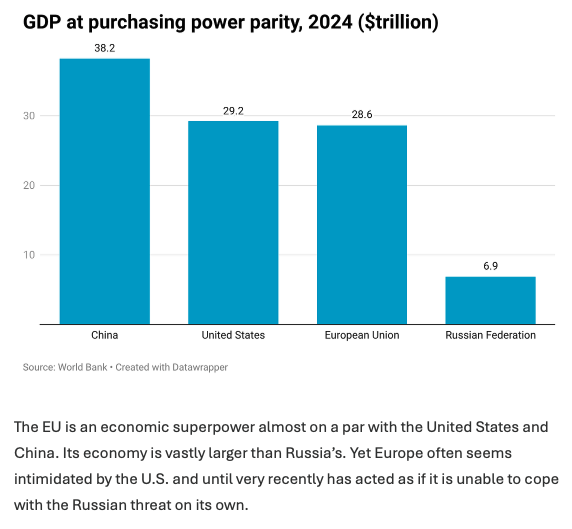
GDP indicates the value of the parts of the economy which are subject to money. (If you do something but don’t use money, it doesn’t get measured.) As such it theoretically measures how much you can mobilize using money. Back when most people lived off commons, before that was enclosed, and didn’t need to do much paid labor, you couldn’t mobilize much.

But that’s theoretical ability. It’s important, but what matters is what you do with it.

And the thing is that Russia does with it is build drones, advanced missiles, advanced jets and other weapon systems. And they build them in large amounts. Europe’s production of weapons is much smaller, and they’re less advanced than the Russian weapons. Russia also produces lots of oil and natural gas and has a huge refinery sector. They have a lot of rare minerals and resources in general. And they do still have both heavy and light industrial sectors.

Meanwhile Europe is hemorrhaging industrial jobs and its industrial energy costs are much higher than Russia’s.

So Europe may have more theoretical economic capacity, but it can’t translate that capacity into state capability where it matters. Russia is stronger than Europe.

It’s not that it necessarily has to be this way, but for Europe to match Russia it has to maintain and expand its industry, find cheap energy, and source natural resources that are scarce in Europe. It also needs a lower cost structure than it has in general terms.

These are not trivial problems. Europe is pushing on renewables, to be sure, but has some way to go and effectively has to buy those from China. It needs to get resources like oil and minerals from other countries and the closest and cheapest source of hydrocarbons, which it needs during the transition, is far more expensive than it otherwise would be. American oil and natural gas is FAR more expensive.

The other traditional source of resources was Africa: mostly ex-French colonial possessions. France never forgave their debts, had military bases all over and often forced them to sell resources at very low prices. But now that Africa doesn’t need European goods, they’re kicked the French out and raising prices and moving to do primary processing domestically.

So sources of cheap minerals are drying up.

All of this could be worked around, if Europe was a technological leader, but…
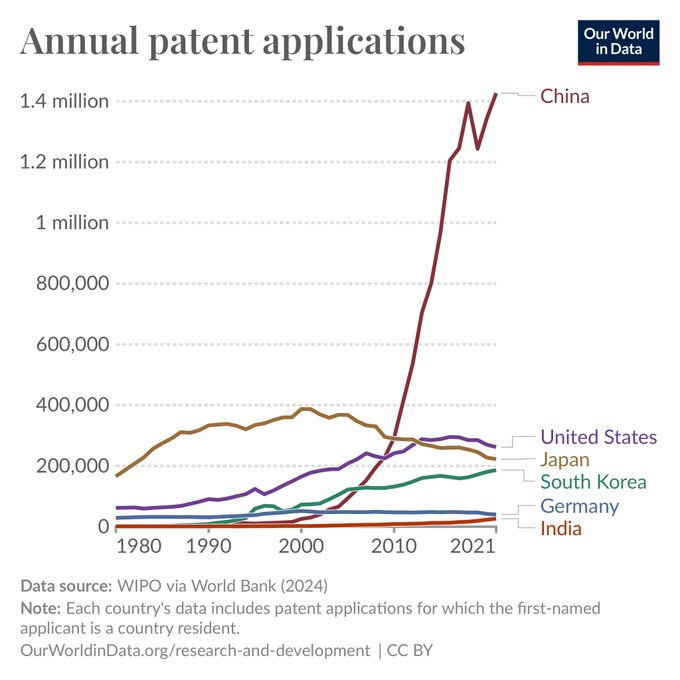
Now legacy industry matters. Machine tools. Steel. Chemicals. Stuff that Germany is good at. (Automobiles are dying, because yes, the future is EVs.) But Germany and Europe are losing those industries. And they aren’t producing the industries of the future. Everything they have is basically legacy industry, developed in the late 19th and 20th centuries. They aren’t creating, mostly, the industries of the 21st century.

GDP only matters if you can use the resources it suggests you have to produce what you need. When it comes to competing with Russia, Europe’s ability to do so is limited. Not non-existent, Germany has significantly increased artillery shell production, for instance, but not what it needs to be.

Without a colonial empire and without resource rich nations willing to trade Europe the resources it needs at reasonable prices, and without a tech lead, What does Europe have?

Very little.

And this is why Europe’s in for a long fall. There’s no easy route out and no one is even talking about doing what’s right. The center still thinks that the problem is that workers have pension and time off, the rising right are complete idiots who think the US is a good model and the left is not, in most cases, in contention. Germany’s AfD will not make Germany better off, it will continue destroying Germany. The same is true of UK’s Reform part and France’s right wing.

GDP is a stupid stat. It conceals more than it reveals. It doesn’t tell you much about the structure of a country. India, which in GDP terms is a great power just lost a minor war to Pakistan. High GDP can actually be bad, since it includes waste, billionaire income that does nothing for the country, and all the money earned in harmful industries like finance and private equity.

Europe’s high GDP isn’t meaningless, precisely, but it isn’t what matters. If it was, Ukraine would have won the war already and the EU wouldn’t constantly be on its knees groveling to America.

What matters is what an economy CAN do. And Europe’s economy can’t create what Europe needs.


Everyone reads these articles for free, but the site and Ian take money to run. If you value the writing here and can, please subscribe or donate.

Paul Krugman Against Bernie Sanders

So, Paul Krugman has a column in which he says he thinks Clinton has better policy proposals than Sanders:

As far as I can tell, every serious progressive policy expert on either health care or financial reform who has weighed in on the primary seems to lean Hillary. (emphasis mine)

Ah.  Serious.

Ok, Paul. Let’s bring up some history, Paul.

You supported Bernanke, strongly. Not just in his appointment as Federal Reserve Chairman, but during his tenure–during which he refused to do anything about the housing or financial bubbles.

Bernanke, for those who don’t know, was the man who plucked Krugman out of MIT and moved him to Princeton, where Krugman was a star. MIT had a lot of very brilliant economists, Princeton had very few.

Then, let us return to that word “serious.” For years, the word “serious” has been used to freeze out outsiders. “Serious” foreign policy experts are the most pernicious: They were virtually unanimous in their support for the Iraq war, for example.

We know how that went.

“Serious” almost always means you are part of the establishment.

Because of this, the “serious policy experts” are almost all wrong. Take Obamacare (ACA). It’s done some good, but a lot of problems have resulted in which people can’t use it because the deductibles are too high.

The serious people (like Krugman) who supported the ACA somehow didn’t predict this.

The un-serious people who opposed the ACA did predict it.

Serious.

Meanwhile, Krugman links to Paul Starr of Politico (Politico, ok), who attacks Bernie’s “Medicare for All” policy.

Starr’sattack has three prongs:

  1. Bernie’s not viable in a general election because he is a “socialist” and Americans will never vote for that because they say they don’t like the word. Might be true, but head-to-head polls show Bernie doing just fine.
  2. Medicare-for-All can’t be passed, because it would involve a large tax increase.
  3. Medicare- for-All is a bad idea because it is inefficient and pays only 80 percent of costs.

It’s a bad sign when you’re misleading your readers. Here’s what Aetna has to say about Medical Cost Ratios:

In general, the minimum percentage of premium health plans must spend on health care is 85 percent for large groups and 80 percent for small groups and individual policyholders.

So, at most, a 5 percent difference.

Starr also suggests that Medicare is less efficient. This is untrue. In fact, Medicare spends about 2 percent on administrative costs. Private health care plans spend about 17 percent.

So, Medicare is more efficient and its ratio is only slightly less than the private ratio. If the US switched to a Medicare-for-All system, it would be simple enough to go to 85 percent and would still cost less.

The international experience for single payer is that it costs about two-thirds what US healthcare costs.

Even in a non-single payer system, Medicare has kept costs down better than private insurance:

Ok. So, Medicare-for-All would cost the Americans less than private insurance + ACA has. To try and deny this is like saying the sun doesn’t rise in the morning. It’s not not just wrong, it’s not just a lie, it is delusional.

Would taxes have to be raised?

Absolutely. But since Americans pay, y’know, premiums, if the tax raises were distributed properly (a.k.a. if corporations paid their fair share), most people would have more take-home money in the end, or corporations would be paying less for insurance. There have been cases of corporations going to Canada just to avoid having to provide medical insurance.

That leads to the feasibility argument. Can Medicare-for-All be passed? Probably not. But it won’t be passed if the President doesn’t try, that I guarantee.

It can be sold, however; Medicare is popular. And it is popular with the Republican base, I might add.

Starr’s argument really comes down to obfuscation (that’s the polite word) and, “It’s not likely to pass so we shouldn’t try.”

Sanders has been a member of Congress for a long time. If he can’t get what he wants, he’ll negotiate–that’s how it works. And he’ll get more because he’s starting from a stronger position.

Meanwhile Clinton won’t even try.

As for financial reform, it is hard to even. Sander’s position is “break up the too-big-to-fail banks” and “restore Glass-Steagall.” That includes breaking up the too-big-to-fail shadow banks. The Clinton position is that shadow banks should be regulated, but not broken up or subject to Glass-Steagall. Her position is the weaker position, and arguments otherwise are obfuscation, at best. Krugman obfuscates this in his actual post, suggesting that Sanders doesn’t think shadow banks are too big to fail.

Krugman appears to have become so much a creature of the status-quo and New York elites he isn’t worth more than a casual dismissal.

I feel bad about Krugman. I remember when he was essentially the only national columnist willing to take on George W Bush.

But one can, I suppose, only expect so much from a man who spent his life at MIT, then Princeton, then writing for the New York Times. I had hoped Krugman would be an exception.

So, Paul:

Or it could be because they are, one and all, corrupt corporate lackeys. I report, you decide.

If it barks like a dog.

I was right about Iraq. I was ahead of the “serious financial experts” on the housing boom and financial crisis. I predicted correctly that the economy would never recover for most people after 2008. I said the next crisis would start in China. I said that America was ripe for a man-on-horseback many years ago (presaging Trump.)

I’m not a “serious” analyst in the way people like Krugman mean it, because I’m a nobody.

Not a member of the club.

But regarding financial reform, I say Sanders is better than Hilary. And regarding health care reform, well, judge for yourself if Sanders proposal is impossible, but it is better policy as policy.

Paul Krugman. Well, he did have one extended period of bravery when it mattered greatly. For someone who is a member of the establishment, that is remarkable. I will remember it, honor its memory, and not be too harsh on him.  Given the world he lives in, his beliefs are not surprising.

I had hoped he would prove to be more than a creature of his circumstances, that he could sustain his bravery and insight, but it was an unreasonable and unfair expectation.

Goodnight Paul. Thank you for standing up when you did.


If you enjoyed this article, and want me to write more, please DONATE or SUBSCRIBE.


Powered by WordPress & Theme by Anders Norén