The horizon is not so far as we can see, but as far as we can imagine

Category: Leadership Page 1 of 5

America’s Leaders In Waiting Have Identified Themselves

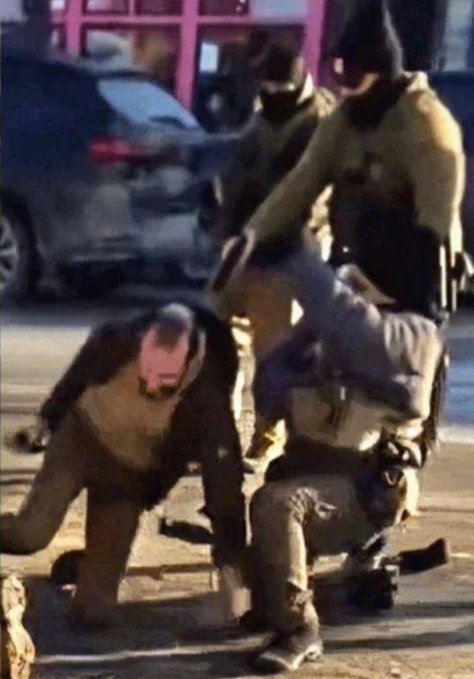
This was the situation when they fired:

Right hand holding his phone. Left hand on the ground. Zero threat to anyone. His gun, holstered, which he never went for, had been removed by an agent.

This is an execution. The Agent has not been positively identified (though there’s a possible ID floating around), and was immediately removed from Minneapolis. The ICE agents attempted to keep local police from the scene.

This is the best summary I’ve read:

an ICE agent physically assaults an annoying woman who is whistling at him to antagonize him, Pretti steps between the officer and the woman to protect her, Pretti is the restrained by 5 officers on his hands and knees, one of the officers notices he is armed and yells “gun,” an ICE officer disarms Pretti and while running away accidentally discharges the weapon, then another ICE agent reacts to the negligent discharge by shooting Pretti in the back multiple times while he is on his hands and knees.

No one has been charged, I can’t tell if there’s any investigation into the shooting: there certainly isn’t a federal one, and the local governor and mayor appear to be wimping out: going thru the motions without any attention of charging anyone.

This isn’t the first ICE execution, and who knows how many have occurred that weren’t filmed. Then there are all the people dying in detention, where they routinely keep 80 people in a cell, lights on all the time and beat people who ask for medical aid.

One of the ICE agents applauded when Pretti was killed. When Renee Good was killed the agent who shot her called her a “fucking bitch” and refused to let a doctor help her.

Police in the US are almost always bad. The job attracts authoritarians who like the idea of being able to push people around, but even the minimal safeguards were let loose on ICE and the Border Patrol—they took the job because they like being able to hurt people without even the remotest possibility they might be held accountable.

This is part of a larger pattern. The Trump administration ignores about a third of all court orders against it. Just ignores them. The rule of law has completely broken down in America at the elite and enforcer levels. It was already mostly broken, but there was a final red line: elites smarter than Trump weren’t willing to obviously ignore courts. Perhaps important people might ignore Congressional subpoenas, but Congress wouldn’t actually institute contempt against them, so the facade remained.

Now law is gone entirely. The first, second and fourth amendments are in tatters. Habeas Corpus is dead, ICE and the BP just routinely ignore it. This a common law protection, centuries old. (In the UK they’re making it illegal for jurors to not convict people if the judge disagrees, ending jury nullification.)

Civil liberties seem like “nice to have”, and so does the rule of law, but they aren’t. Without them a society can’t function. That whole “high trust” thing goes away, and no one trusts anyone else. The economy grinds to a halt and civil society collapses.

The silver lining here, the hope, is that Minnessotans have come together to resist this. Thousands of people, not just protesting, but feeding those who can’t leave their houses, helping legally, and putting their bodies on the line. There are good people left in the US, but what they need to recognize is that fixing this requires replacing almost every member of the current elite: Walz has failed, Congress has failed, business has mostly been supine to trump as have universities. Everyone who’s in a position of power, whose duty and responsibility it is to resist has either failed or not even tried.

What needs to be done is to note the ones who tried or resigned rather than engage in illegality and immorality. Go after everyone else, replace them and if they actively engaged in evil, convict them and send them to prison. Put the people who did resist back in, not just politicians but prosecutors and judges and city councillors and so on, and then fill the rest of the ranks with people who went out on the streets in Minnesota and elsewhere and put their bodies in the way of evil, or who otherwise meaningfully resisted.

These are the people who proved themselves. When the brownshirts came,  they are the ones who stood up. We now know who is actually moral, who is actually brave and who can actually be trusted when the chips down. This is the new leadership cadre, if Americans are wise.

Not saying this will be done, but these are the slivers of hope. The Brownshirts came.They were resisted. Those who actually resisted proved themselves.

Those should be your leaders. Anyone who failed should be out or in prison.


This site is only viable due to reader donations. If you value it and can, please subscribe or donate.

Western Leadership Is The Most Worthless In My Life

Which is saying something,  because worthless has been in charge of the West for generations. There are no leaders in charge of any major Western country who aren’t functionally morons.

Europe is run by utter idiots who want war with Russia, refuse to acknowledge that Ukraine is losing, are actively speeding up their loss of industry and imagine they can bully China and think America was their friend before Trump.

Trump is the stupidest president of my lifetime. No one else even comes close. Reagan with Alzheimers was better. Congress is a sewer of morons. Every major American politician, even AOC and Bernie, are functionally psychopaths. (Yes, both Bernie and AOC have repeatedly voted to send more money and weapons to Israel.)

Britain’s Starmer is the stupidest PM of my lifetimes and stunningly incompetent and evil. Yes, his job is to make rich people richer and suck off Netanyahu, but a competent pol would do that without destroying Labour as a party.

Macron has accomplished nothing for France except to make it weaker and its citizens poorer. Germany’s government is presiding over the destruction of a German industrial base that is 150 years old and one of the greatest in the world: the very foundation of Germany’s power and affluence.

Australia is acting as if America is more important to them than China with a military buildup, which is insane since Australia’s future is with China, or it has no future. Japan is antagonizing China, again, insane, without a serious plan. Either make nice or try and get nukes, there are no other paths.

Everyone is destroying free speech to symp for a genocide. Everyone is immiserating their own populations, setting up serious future political instability.

The US is all-in on AI, spending trillions it does not have, driving up energy prices, and creating a larger more concentrated bubble than the real-estate bubble which caused the 2008 crash. If AI is everything they say, it will utterly destroy the US economy by replacing 30% of workers, and if it isn’t, it’ll never pay back all the resources spent. Plus China will win the AI race anyway, since no one with sense will pay for a proprietary model when Chinese open source models are about as good and mean you can’t suddenly be hit with a massive price increase or rate restrictions.

Politicians are either ignoring climate change and doubling down on fossil fuels (which are more expensive than solar) or using climate change as an excuse to immiserate their own people.

Britain is destroying their own farmers.

Meanwhile morons are constantly whining about fertility rates when humanity is in population overshoot so severe that it is causing the second fastest great extinction in Earth’s history. Most countries would be better off with fewer people, but because they don’t know how to stabilize an economy whose population isn’t always growing leaders and their intellectual dupes are panicking.

Only China is handling this with some grace, but they’re not Western. They’re trying to increase fertility somewhat but have accepted there will be population decreases and are moving hard on robotics to care for an aging population and reduce the need for workers.

There isn’t a single major challenge that the West is facing that our leaders are not actively making worse, not better. Not a single one. It’s extraordinary. Even Nixon managed to sign Clean Air and Water Act and to pivot on China. Reagan reduced nuclear weapons. Clinton made everything worse long-term, but was able to manage the economy during his Presidency, at least, so that it felt good to ordinary people, including pushing oil prices under $20/barrel. George Bush Sr. managed the collapse of the USSR with grace. Biden had good anti-trust policy and half decent industrial policy. Trump has done nothing good of significance. Nothing. Even when he has a good idea (tariffs, reduction in H1-B Visas) he fucks it up completely because he can’t execute and has the attention span of a coked up flea.

This reminds me of the Weimar Republic or the late Roman Empire. Most things can be fixed in principle: in theory. Nothing can be fixed in practice because leadership is beyond corrupt and incompetent, high on their own wealth and convinced they are the masters of universe and that reality is what they want it to be.

Prepare, if you’re in the West. By all means feel free to keep working at the politics, but don’t count on it. Instead prepare as individuals and groups. Government isn’t going to save you, not in the West. Your leaders are the number one danger to you, more than any outsider, “terrorist” or “foreign enemy.” Treat them as such, and protect yourselves from them.

We just spent a couple thousand getting the site and email subscriptions working properly. If you value this site and can, please subscribe or donate.

Politicians V.S. Serial Killers: Introducing The Serial Killer Count

One of the themes of this blog is that, with some exceptions, the people who are most dangerous are politicians. Since rich people own politicians, indirectly, they are included.

We’ve been, as a society, obsessed with serial killers for some time. They are seen, by many, as the ultimate evil. The average serial killer is responsible for about six deaths.

The Iraq war killed about half a million people (we don’t really know, since we didn’t count, but the post-fact estimates are credible.) That means George W. Bush, as the primary driver of the Iraq War, was the equivalent of over eighty-three thousand serial killers.

If we want to spread out the blame, US and UK politician who were for the war were the equivalent of over 83,000 serial killers.

The high end estimate of active serial killers in America is 2,000 active killers.

Recently I did a bit of research into the effect of Clinton’s “Welfare Reform” bill, in which he cut access to Welfare significantly. Interestingly, it’s really impossible to tell how many people the bill killed or made homeless (which is a delayed death sentence).

We don’t count.

But I’m guessing Bill’s serial killer number is pretty high. Let’s ignore how many Americans he killed. Iraq sanctions killed somewhere between 200K to a million people, with Madeleine Albright famously saying that if 500K children had been killed, it was worth it.

Even 200K suggests a serial killer count of over 33,000.

Obama’s policies deliberately helped banks steal (foreclose) American homes (steal is the correct terminology, they used documents with fake information and signatures.)  Once again, we don’t really know how many people had their homes taken, but 750K were included in a single class action suit, so that’s the lower bound estimate. I wonder how many of those became homeless or died as a result? Again, we don’t know, but it’s bound to be a lot of people. There’s no possibility that it doesn’t massively increase Obama’s “serial killer count.”

Yesterday we discussed prosecuting those who have enabled the Gaza genocide. Of course there’s plenty of blame to go around, but assuming a death count of half a million, which is going to be a low end estimate, we’ve got a serial killer count of over 83K.

Don’t worry about serial killers. They kill hardly anyone.

Politicians, at the behest of their owners, on the other hand, now they have bloody, bloody hands.


***

If you’ve read this far, and you read a lot of this site’s articles, you might wish to Subscribe or donate. The site has over over 3,500 posts, and the site, and Ian, take money to run.

How Leadership Worked In the Early & Middle Roman Republic

When a lot of people talk about Rome, they’re thinking of the Empire and when they write about Rome, they’re writing about the decline and fall. But I’ve always been more interested in creation of new things and how they ran when they were running well. To be sure, knowing how a system eventually failed is important, but not if we don’t understand how it ran well in the first place.

The Republic actually had four different elected assemblies and voting groups (the Senate was not, strictly speaking, elected.) By the middle Republic three were still important.

Tthe Centuriata (organized by military centuries based on wealth, since wealthier citizens could afford better equipment) elected Consuls and Praetors, who had Imperium (the right to lead troops), voted on war and peace and served as a court for serious crimes. It was dominated by the richer classes.

The Tributa, was based on tribes (geographical organizations.) Because all voting took place in Rome, urban tribes had oversized power in it. It voted on legislation proposed by magistrates and the Tributa (the electorate itself) voted to select lower magistrates like Quaestors and Aediles.

Finally there was the Concilium Plebis. This body excluded Patricians and was organized by Tribes. It elected Tribunes of the People. Their powers varied over time, but at certain points they were arguably the most powerful officials in Rome. Tribunes could veto bills from other bodies and the Plebis could pass laws binding on all citizens. Tribunes were meant to be available to any Roman citizen at any time. They couldn’t even close or lock the doors of their homes.

Then, of course, there was the Senate. In the early years Senators were largely appointed by Consuls. A little later by Censors (officials responsible for running a population census and for public morals, elected every five years for a one year term.) In time it became customary for officials elected as Quaestors or Aediles to be enrolled almost automatically. As a practical matter, the Senate was controlled by powerful and rich families. At first those were mostly Patrician, but in time various powerful Plebeian families broke in.

The important leaders in the Republic were magistrates. They held court, they knew law, and in the case of officials with Imperium, they lead armies.

Except for the Tribunes, Censors and Aediles, election to office required following the Cursus Honorum.

The lowest office was Questor. You had to be 30 and the duties were administrative. You might oversee the treasury, serve as an aide to a governor or consul, or otherwise oversee financial or administrative duties.

Aediles were not part of the Cursus, but as time went by you were unlikely to be elected to senior office if you hadn’t served as an Aedile, in part because they were responsible for the games: gladiatorial contests and races. In addition they were responsible for overseeing Rome’s infrastructure: roads, temples, markets, building standards and so on.

Praetors had to be 39 years old minimum and presided over courts (were judges), governed provinces and had the right to command troops.

Finally there was the Consulship. There were two consuls at a time, they had full Imperium, presided over assemblies and acted as judges for the most important cases.

In addition, it was rare for anyone to be elected to any office higher than Qaestor without military service.

Now that we have some idea of the structure, let’s break down why it worked so well for so long.

Experience with How Government Actually Works. Because of the cursus honorum and the de-facto requirement to serve as Aedile and to have military experience, government officials actually knew how the state worked from roads and treasury to law to military affairs. They understood the nuts and bolts of government operations. Compare this to most of our politicians, who don’t know how cities are actually constructed, how the law works, how real world markets actually act and so on.

Since a state that can’t win wars risks stopping being a state, having military experience is important. Moreover it meant that civilian officials understood the military and could expect respect from the military and control it. (Until the late Republic, anyway.)

Officials were pretty much all lawyers. Yes, I know the jokes, but if your job is to create laws, knowing the law seems like a good thing, eh? And since they served as judges as well as usually acting as private lawyers (for which they could officially not accept fees) they knew how laws were actually working in the community.

Praetors serving as Governors, once Rome had provinces, meant that before they became Consul, they had also run a large principality. Again, they had experience in an executive role before being put into the supreme executive role.

Skin In the Game. Rome’s greatest military loss was probably at the battle of Cannae, when Hannibal essentially wiped out an entire Roman Army of 86,000 men. Here’s the interesting thing: one third of Senate was wiped out. Proportional losses among the most important people in Rome were far higher than among the plebs. This is the opposite of how our society now runs, where the powerful don’t serve in the military and if they do, aren’t on the front lines.

Clientage System. Everyone in Rome was part of a system of client/patron relations. Think of it as a chain. You might have a few clients, but have a patron who had many clients, and that patron might have a patron as well. Patrons had a duty to help their clients, and clients had the same duty to their patrons, including the expectation to do battle on their patrons behalf. Clients would go to court with their patrons and cheer for them. When their patrons held office, clients would assist. The patrons would help clients with business affairs, give them gifts and in general take care of them.

This means that everyone in Roman society was connected thru formal chains from almost the very bottom (slaves weren’t clients, but freed slaves automatically became clients of their ex-owner) to the very top of society. Loyalty to clients was important, because clients were a patron’s power base, including their most reliable voters. As for clients, well, powerful patronage is always useful. The powerful in Rome could not be disconnected from everyone else, or they wouldn’t be powerful.

Truly Divided Government. America’s founders tried to imitate the Roman Republic, but one of Rome’s great advantages is that the government was truly divided. The Tribunes and the Plebs truly were opposed to the Senatorial class much of the time. They truly did stop their legislation often. All thru the design of government, there were checks and balances, even at the top. There were two consuls so that neither of them could rule impeded, for example.

When necessary a dictator could be appointed, but constitutional dictatorships were specific to a problem. Usually a war or administrative issue. They were used, in effect, to solve a specific problem and once it was resolved the dictatorship was over.

Limited War Making Power. Only a few officials could lead troops: Praetors, governors (ex-Praetors, usually), Consuls and Dictators. The troops themselves were raised from the general population for specific wars and disbanded once the war was over. There were few professional soldiers, it was a citizen army. Until the late Republic it was unthinkable for Roman armies to turn on Rome and that happened because a professional army with soldiers often under arms for decades was formed. The soldiers became more loyal to their generals (who rewarded them with loot and rapine) than to Rome. But during the Early and Middle Republic the military was an appendage of society, not apart from it.

No Troops in Rome and no Police. There was no enforcer class within Rome itself. In fact to be under arms in Rome was a huge crime. A general and his troops could not be in Rome, whether armed or not, at the same time. Romans had law, but until you were convicted of a crime almost nothing could be done to you. There were effectively no prisons and no cops. In the later Republic this lead to the rise of gangs and rather a lot of violence, but it worked for a long time and kept Romans free.

A requirement for generosity. If you were rich, you were expected to give to the community. Bridges, roads, temples, libraries, monuments, theaters and so on were all built by rich Romans. In fact, election to office during the Early and Middle Republic wasn’t based on promises of “what I’ll do when elected” it was based on “this is what I’ve already done. I deserve office.” Not just giving, but military service, acting as patron, defending citizens as a lawyer and so on.

Leaders Were Held Responsible. Suing Roman officials after they left office was common. If you misused your office, any citizen could take you to court. Penalties were no joke, including banishment and even death. During office many Roman officials were above the law, sacrosanct, but offices were rarely for more than a year, and a year is not a long time.

Summarizing Remarks:

Republican Roman leadership was effective for so long because Roman leaders were forced to actually learn how government and the military worked. They were given significant power for brief periods, usually a year, and were held responsible afterwards. They were part of chains of clientage which reached from the top to the bottom of society and unable to be unaware of the condition of other Romans. They were expected to contribute their wealth to society, to help their clients and to be generous. They were trained in law and familiar with how law operated because almost all served as lawyers and magistrates. And they served in the military and could expect, as at Cannae, to suffer if the military was incompetently led.

Competence, responsibility, generosity and deep ties to the community.

Of course this system had its flaws, even very serious ones, and as all systems do it eventually broke down. But it was also remarkably successful for centuries.

And, in the context of our larger discussion of leaders being different types of people in different societies and different times, Roman leaders were very different from ours. Oh, sure, they were ambitious, leaders almost always are. And they needed to be elected. But in most ways they had little in common with our politicians and CEOs.

The question is “in what ways were they worse or better”, perhaps. If I had to pick one point, it would definitely be the Curusus Honorum. A lot of our leadership issues, both private and public, would be lessened if our leaders had been responsible for the nuts and bolts of running government and society, and actually understood how it worked.

There’s a lot to be said for the government version of “starting in the mailroom.” Do our politicans even understand how the postal system works or how roads are paved?

***

If you’ve read this far, and you read a lot of this site’s articles, you might wish to Subscribe or donate. The site has over over 3,500 posts, and the site, and Ian, take money to run.

Do The Same Sorts Of People Lead All Societies?

There often seems to be an assumption that leaders everywhere are the same: that there is no real difference between leaders in different countries or at different times.

It’s true that leaders generally share some attributes: almost all want to lead and want power. But beyond that, no.

Think a little about how leaders changed over time in America. Can you really say that the same port of people run politics or corporations today as when FDR was in charge or during the post-war period?  The people then were builders who were expanding the social safety net and increasing the middle class, not the upper. The corporate leadership was dominated by engineers, not by MBAs, and many had started at the bottom and risen to the top.

Or think about the leadership of Europe before and after it was conquered by America and the USSR and split up. These were not men who were automatically subservient to outside powers, without national pride and without ambition.

Think about China under Mao and then China today. The people who ran China under Mao, then during the Deng era, and even in Xi era, while they have some continuity, show significant changes. Over the entire history of the CCP party members are selected, not self-selecting and under Xi’s rule, they’re increasingly chosen based on technocratic accomplishments combined with belief in Party principles. To compare them to the shysters who run America, or the bloodless technocrats of Europe is insane.

In the past we’ve chosen leaders primarily based on military skill and heredity. Leaders of hunter gatherer bands (smaller groups, not all hunter-gatherers have had band formations) were often chosen not for aggressiveness but patience and lack of temper.

Leaders are different in different societies, whether different in space or time. They have different characters, different abilities and different goals. The political elites of 1933-1968 or so in America are very different from those who replaced them and that’s a relatively minor change compared to the replacement of feudal nobles by centralized court aristocrats who were then replaced by elected officials and appointed bureaucrats. Let alone the rise of the bourgeois and capitalists. Men of business think very different from aristocrats competing for court favor, let alone nobles who rule their own domains and armies and who consider even the King simply the greatest among equals. Such nobles are vastly different from Roman imperial bureaucrats or the Senatorial families and elected officials who ran the Roman Republic and were forced to come up thru the Cursus Honorum and actually learn how government works.

Of all the things we do as a society, selecting our leaders and deciding what power to give them is possibly the most important.

It’s something we’ve been very bad at for a long time now.

If you’ve read this far, and you read a lot of this site’s articles, you might wish to Subscribe or donate. The site has over over 3,500 posts, and the site, and Ian, take money to run.

The Loss Of American Leadership Competence Viewed From WWII

This is an elevated comment, from Stewart M.

By StewartM

What strikes me is our loss of leadership competency, from the extremely competent people who managed us through the depression and through WWII to the clowns of today.

I’ve been involved in Youtube exchanges where some idiot creates a video claiming how we “saved” the USSR in WWII via Lend-Lease. First, that is that factually untrue. The USSR saved itself; Lend-Lease was such a trickle in 1941-1942 that it had essentially NO effect on the Battle of Moscow in December 1941, and very little impact on the Battle of Stalingrad in the fall-winter of 1942. Stalingrad at the very least marks the point where “the USSR will survive and not lose” so Lend-Lease didn’t “save” the USSR. Lend-Lease did help the USSR, but the bulk of it (60 %) came in the last 10 months of WWII well after the USSR had turned the tide and driving back the Wehrmacht out of the USSR. The most important part of Lend-Lease help wasn’t the weapons we sent, nor the locomotives, nor the steel, nor the petrol, nor even the trucks (the most common ‘fact’ brought up). It was the food we sent–in 1942 42 % of the USSR’s arable land was occupied, and the USSR instituted a rationing program where soldiers, workers in essential industries, and children got first priority on food. If you weren’t one of those, you didn’t get much, and hunger contributed mightily to the USSR’s civilian death rate in the war. The FDR administration promised the USSR 10 % of US food production to help, but could only manage to deliver 3 %.

But my point in mentioning Lend-Lease is that such Youtubes miss the main reason why we did what we did in aiding the USSR. It wasn’t some act of friendship or mercy, we weren’t just ‘being nice’; we did it OUT OF ENLIGHTENED SELF-INTEREST. George Marshall and the US military leadership were not sure we could win WWII without Soviet help; at the very least if the USSR went down to defeat and Hitler obtained access to the USSR’s resources it would prolong both the length and sacrifice of the US and UK. The military problem the US faced was war both in Europe and the Pacific, with far-flung bases and long supply lines that “ate” up manpower and required a powerful Navy and Air arm to protect. We thus couldn’t raise an army of hundreds of divisions and supply it overseas, to do the work that the Soviets were providing the West by grinding up the Wehrmacht. Keeping the Soviets in the war was quite vital; ergo Lend-Lease.

In short, Marshall and his ilk had a clear and correct notion of what the US could do, and what it couldn’t do. The manpower restrictions on ground forces meant “no land war in Asia” which meant we wouldn’t field armies in China. Instead, we focused on a ground force manpower-minimizing “island hopping” strategy where we only took relatively few key islands and just left Japanese ground forces in elsewhere stranded and cut-off from supply. The bulk of the ground forces we did raise were going be used to defeat Hitler, whom Marshall correctly identified as the biggest threat to the US, given Germany’s technological skills and industrial base.

This kind of calculation is what we’ve lost. In WWII, we knew we were powerful, in some ways relative to the world more powerful then than now, but we knew we couldn’t do everything and that we shouldn’t even try. But after WWII, inside the US spread the notion (largely spread by conservatives and the anti-communists) that we had really ‘done it all’ and won the war without much of anyone’s help. Why did we cave to Stalin at Yalta? Why didn’t we let Patton drive the Soviets out of Eastern Europe? We had the bomb after all! (cue in Henry Stimson rhetorically patting his coat pocket). WE WERE OMNIPOTENT!

The first generation who acted on this belief, a belief definitely not shared by those who planned and executed WWII, was the “Greatest Generation” who had fought it as common soldiers when they assumed leadership—JFK through Reagan/Bush I. It led to Vietnam and to interventions everywhere, because we could and should impose our will upon the world. It was exacerbated when (as you say) financial means of scoring economies replaced measures of actual industrial capacity and output, from Clinton to today. What gets me is that the US’s leadership is more arrogant and more convinced of its supremacy despite the fact by all objective measures, whatever power the US actually has is far less relative to the rest of the world than the US during WWII during Marshall’s and FDR’s time. Yet Marshall and FDR knew we weren’t omnipotent and couldn’t ‘do it all’. And I fear nothing less than a massive comeuppance will change their attitudes.

(This blog is for understanding the present, making educated guesses at the future, and telling truths, usually unpleasant ones. There aren’t a lot of places like this left on the Web. Every year I fundraise to keep it going. If you’d like to help, and can afford to, please Subscribe or Donate.)

The Leadership Competence Crisis

By StewartM

(This is an elevated post by commenter StewartM.)

What strikes me is our loss of leadership competency, from the extremely competent people who managed us through the depression and through WWII to the clowns of today.

I’ve been involved in Youtube exchanges where some idiot creates a video claiming how we “saved” the USSR in WWII via Lend-Lease. First, that is that factually untrue. The USSR saved itself; Lend-Lease was such a trickle in 1941-1942 that it had essentially NO effect on the Battle of Moscow in December 1941, and very little impact on the Battle of Stalingrad in the fall-winter of 1942. Stalingrad at the very least marks the point where “the USSR will survive and not lose” so Lend-Lease didn’t “save” the USSR. Lend-Lease did help the USSR, but the bulk of it (60 %) came in the last 10 months of WWII well after the USSR had turned the tide and driving back the Wehrmacht out of the USSR. The most important part of Lend-Lease help wasn’t the weapons we sent, nor the locomotives, nor the steel, nor the petrol, nor even the trucks (the most common ‘fact’ brought up). It was the food we sent–in 1942 42 % of the USSR’s arable land was occupied, and the USSR instituted a rationing program where soldiers, workers in essential industries, and children got first priority on food. If you weren’t one of those, you didn’t get much, and hunger contributed mightily to the USSR’s civilian death rate in the war. The FDR administration promised the USSR 10 % of US food production to help, but could only manage to deliver 3 %.

But my point in mentioning Lend-Lease is that such Youtubes miss the main reason why we did what we did in aiding the USSR. It wasn’t some act of friendship or mercy, we weren’t just ‘being nice’; we did it OUT OF ENLIGHTENED SELF-INTEREST. George Marshall and the US military leadership were not sure we could win WWII without Soviet help; at the very least if the USSR went down to defeat and Hitler obtained access to the USSR’s resources it would prolong both the length and sacrifice of the US and UK. The military problem the US faced was war both in Europe and the Pacific, with far-flung bases and long supply lines that “ate” up manpower and required a powerful Navy and Air arm to protect. We thus couldn’t raise an army of hundreds of divisions and supply it overseas, to do the work that the Soviets were providing the West by grinding up the Wehrmacht. Keeping the Soviets in the war was quite vital; ergo Lend-Lease.


(I’m running my annual fundraiser. If you value my writing and want more of it, please consider donating. Your donations really do keep this place running.)


In short, Marshall and his ilk had a clear and correct notion of what the US could do, and what it couldn’t do. The manpower restrictions on ground forces meant “no land war in Asia” which meant we wouldn’t field armies in China. Instead, we focused on a ground force manpower-minimizing “island hopping” strategy where we only took relatively few key islands and just left Japanese ground forces in elsewhere stranded and cut-off from supply. The bulk of the ground forces we did raise were going be used to defeat Hitler, whom Marshall correctly identified as the biggest threat to the US, given Germany’s technological skills and industrial base.

This kind of calculation is what we’ve lost. In WWII, we knew we were powerful, in some ways relative to the world more powerful then than now, but we knew we couldn’t do everything and that we shouldn’t even try. But after WWII, inside the US spread the notion (largely spread by conservatives and the anti-communists) that we had really ‘done it all’ and won the war without much of anyone’s help. Why did we cave to Stalin at Yalta? Why didn’t we let Patton drive the Soviets out of Eastern Europe? We had the bomb after all! (cue in Henry Stimson rhetorically patting his coat pocket). WE WERE OMNIPOTENT!

The first generation who acted on this belief, a belief definitely not shared by those who planned and executed WWII, was the “Greatest Generation” who had fought it as common soldiers when they assumed leadership—JFK through Reagan/Bush I. It led to Vietnam and to interventions everywhere, because we could and should impose our will upon the world. It was exacerbated when (as you say) financial means of scoring economies replaced measures of actual industrial capacity and output, from Clinton to today. What gets me is that the US’s leadership is more arrogant and more convinced of its supremacy despite the fact by all objective measures, whatever power the US actually has is far less relative to the rest of the world than the US during WWII during Marshall’s and FDR’s time. Yet Marshall and FDR knew we weren’t omnipotent and couldn’t ‘do it all’. And I fear nothing less than a massive comeuppance will change their attitudes.

The Hard Problem of Leadership: Scale and Good Leaders

This Post is by Purple Library Guy, aka Rufus Polson

Ian – this is elevated from the comments on my post, “The Hard Problem of Leadership.The problems of leadership are scaling (for example, Athenian style direct democracy doesn’t scale, nor do city states), and selecting good leaders.

I have thought about this problem a lot. As a leftist, I come at it largely from noticing the two main strands of left wing thought–the relatively centralized state-oriented socialist strand, and the anarchist variety with its tendency to decentralized direct democracy. Both have fundamental problems of leadership.

But I have concluded that the distinction between the kind of leadership problem which is all about crappy leaders, and the kind of leadership problem wherein the governance doesn’t scale, are not mirror images. They are fundamentally different in kind. And what I have concluded is that the first kind of problem is insoluble: it is essential to any kind of large polity with powerful individual or small group leadership. It comes from the creation of a distinction between rulers and ruled, which results in the rulers having different interests, attitudes and culture, and information from the ruled. Almost inevitably they rule for the rulers (generally including some technocratic group that participates in rulership) rather than for the citizens. Furthermore, just because any civilization is made up mostly of the people, not the rulers, inevitably the rulers’ self-dealing and ignorance about the situation lower down are bad for the polity’s health and will pile up what Marx called “contradictions”. I could argue this at length, but for this discussion I’ll just assume it; I would like to note that individual leaders CAN occasionally resist all these factors and do good things, it’s just really bloody rare and tends to require major popular pressure to also exist. There are just mighty damn few Hugo Chaveses.

But the second kind, the problem that systems along the lines of direct democracy do not scale, is NOT insoluble. It’s a technical problem. And it’s a technical problem which has confronted hierarchical systems as well–they’ve just solved it better. This may be partly because solving this problem for direct-democratic, relatively leaderless systems is harder. It is probably also just that there has been a lot more work put into solving the problem for hierarchies. Just in the time I’ve been alive, organizations have gotten a lot better at doing hierarchy, allowing bigger transnational corporations, incredibly complex “project management” with special software assisting the processes, sophisticated communication technologies and so on. There are masses of software products for helping hierarchies organize, endless “business schools” dedicated to researching and teaching people how to effectively dominate subordinates and make large hierarchies effective, and so on and on.

But in a broad sense, many of these technologies would also be useful for creating a non-hierarchical, direct democratic organization that scaled. I have in fact figured out how to do it.

Before I describe it I’d like to talk briefly about why failing to scale is in fact a crippling problem. There are two reasons. The most important is, if you have a governance type that does not scale and you are opposed by a governance type that does scale, you lose. There’s no point in having lots of lovely little societies which then get assimilated by the Borg, or the Romans, or whoever else out-organized you. The second is that there are actually things that a large organization can do that are useful that a bunch of little ones can’t. For instance, there’s standards: Imagine you have a group of 30 anarchist towns, and they all use different railway gauges and electrical plugs and USB-like-thingies and http protocols. Besides that, there are projects that people might want to do which require mobilizing a lot of resources, like big bridges, or long railways that don’t break off at every town that decided they didn’t want to bother, or space exploration, or co-ordinated action against climate change. But really, the key problem is that decentralized small-scale organizations get eaten by large scale organizations. Anarchists know it’s true, they just can’t hack the leadership problems of centralized socialism so they pretend (centralized socialists know the anarchist critique of socialist leadership issues is true, but they want to win, dammit, so they pretend too).

So, how do you do it? How do you scale direct democracy and break the “iron law of oligarchy” and so on? Well, the fundamental problem with direct democracy as it gets larger scale is that of information/decision overload–people can’t be involved with all the decisions, there are too many. But consider that this is a problem with autocratic/oligarchic rule as well–one man at the top cannot possibly be involved in all decisions all the way to the bottom of the pyramid. There have been an amazing number of schemes dedicated to allowing the general will of rulers to be transmitted, so that all the little individual decisions follow that general will without the rulers having to pay attention to them. None have been perfect, hence the phenomenon of micromanagement and the tendency of organizations to subvert the intent of particularly annoying management decisions. But they work pretty effectively.

I have a group of ideas and principles for getting past this problem. The first is to separate the idea of any given person actually being involved in every decision from their right to be involved in that decision. In my scheme, most people aren’t involved in most decisions–but they could be if they wanted to, so if some group is making a decision that affects a lot of people and pisses them off, they can join that decision-making group and contribute to making that decision different.

The second is distributed, nested decision making and the principle that bigger groups’ decisions trump littler groups’ decisions. So, say there’s a group of people who work in a salmon hatchery on some stream. They’ve got a little decision making group for deciding how to run the salmon hatchery–but note that anyone can join it, they don’t HAVE to be working at the salmon hatchery. There is a broader group that is a decision making group about how to do things about the stream; it has sub-groups like the hatchery group, the sport fishing group, the marina association and stuff. There is a broader group than that for the whole regional watershed. OK, so, say the sport fishing group is deciding to allow some practice which is going to be a problem for the salmon spawning. The majority vote in that group is to allow that practice. But! A minority can vote to kick it upstairs; if say 30% or something think that this decision shouldn’t be made just by the sport fishing people, the proposal gets moved to the stream group–all the subgroups will now see the issue and vote on it. If the stream group think it’s too hot to handle it can get moved to the watershed group. So a vote by the stream group would overrule a vote by just the hatchery group, and a vote by the whole watershed group would overrule a vote by the stream group. Ultimately, a vote by the whole country overrules everything smaller. This turns on its head the autocratic approach in which decisions by smaller groups higher up overrule larger groups lower down.

Related to this, my approach suggests that in general, people should be expected to serve in a few decision making groups, and groups should generally have a few people randomly assigned to them by lot, like jury duty. This helps prevent little closed groups from getting insular about their decisions.

My approach requires substantial use of modern communications technology and software to help decisions get made. This allows for various factors that make even theoretically democratic organization turn oligarchic to be eliminated. Specifically, it escapes the agenda and the ability of someone to literally set the agenda, to define just what decisions get made and how they are framed. So the process at the level of a decision making group goes like this: Someone in the group identifies an issue that needs to be decided on. They submit an issue description and maybe a couple of possible decisions that could get made about it, to the group. A timer starts. There is a conversation thread about the issue, and anyone in the group can add decision options, so you end up with a few proposals of action that could be taken. When the time is up, the proposals are frozen and people can vote (also with a time limit). The vote is some kind of ranked choice setup, and the winning proposal is adopted. This avoids a problem often seen in US state-level voting on issues, where some group gets to carefully define a proposed solution, and you end up either getting their self-serving solution or you get nothing, so whatever issue isn’t dealt with at all. With this kind of software a decision making group needs no leader–anyone can initiate proposals, nobody can control an issue once it is raised. The software doesn’t currently exist, but lots of social software of equivalent or greater complexity does–it shouldn’t be that hard.

With this, it should be possible to have an organization in which small scale or specialized decisions get made at the small scale, but rarer, broader decisions to mobilize social resources on a larger scale can be made by larger groups, with no hierarchies, leadership or class structure required.


You get what you support. Please SUBSCRIBE OR DONATE

Page 1 of 5

Powered by WordPress & Theme by Anders Norén