
Why did Trump call off his big attacks? Why did the US stop attacking suddenly?
he U.S. Army has used up much of its stockpile of highly accurate long-range missiles during its five-month war with Iran, according to three people familiar with the data, raising concerns about the military’s readiness for future conflicts.The missiles are principally the Army’s surface-to-surface weapons, known as Army Tactical Missile Systems (ATACMS) and Precision Strike Missiles (PrSM). The U.S. has used “virtually all” of these weapons, according to two of the sources.
There are also claims that the US is running out of long range air to ground munitions as well.
Combined these two things mean that if America wants to keep bombing Iran, they have to actually fly over Iran and put themselves in much more danger from Iranian anti-air, and by all accounts the Iranians still have plenty left.
This problem comes from the same place virtually all US problems come from: rather than optimizing for results (production) everyone optimizes for profits. Selling fewer missiles for much more money is a better business deal, yes?
And that the US cannot significantly increase the production is due to de-industrializing: sending most of America’s key industries to China, because hey, it doesn’t matter where things are made.
China is now the US in WWII. They could, in a war, easily retool to produce literally millions of drones. They can produce a hundred warships per warship the US produces. Etc.
These are systematic issues. De-financialization is politically impossible. Without de-financialization re-industrializing is not possible, as it would require companies to make far lower profits. Chinese companies are MUCH bigger than American ones, and make less profit (not revenue, but profit) and have far lower valuations.
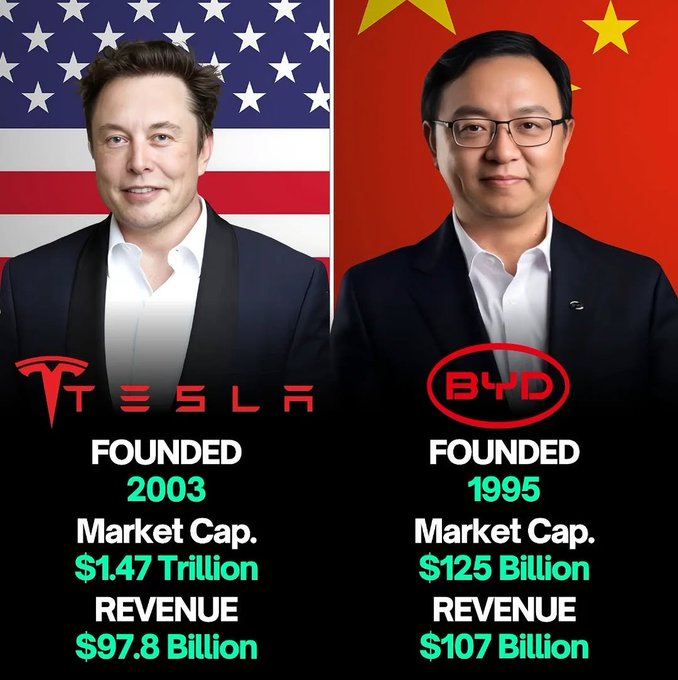
In 2025 BYD sold 2.26 million cars. Tesla sold 1.64 million. And China has many auto companies.
The mindset for scaling and the mindset for profit-maxing are very different. American elites are all looking for moats: they all want to be able to charge more for a product than it is worth because no one is competing with them on price. (This is why Chinese EVs aren’t allowed in America: they compete on price and the American car industry would cease to exist on contact.)
America lost the Iran war over fifty years as it changed from an industrial power to a financial power. Power comes from what a country can actually do. What it can buy from other countries is a minor consideration unless it has the ability to force them to sell, and that ability comes from what the country can do. Against Venezuela and Cuba, the US is still strong enough. Against a middle power which prepared for war and knows how to use geography, not so much.
In general terms, everything that is happening was predicted decades ago by objective people looking at the trends. Power comes from capability, America was systematically getting rid of that capability to optimize for the number of rich people it could generate.
Military decline, industrial decline, technological decline: all of this comes from making profits the end-goal, rather than the mean by which worthwhile goals were achieved.
“We need to make a profit do X” is very different from “we do X to make a profit.”
What I write here is for the benefit of everyone, but alas, I live in capitalism and I, and the site, take money to keep running. If you value the writing here and can, please subscribe or donate.