Ian Welsh

The horizon is not so far as we can see, but as far as we can imagine

If the American Medical Association is for something…

well, let’s just say that my reaction is the same, if not quite so virulent, as if George Bush is for something.  At best it’s “what am I missing.  In what way is what they are for evil or stupid and probably both?”

I bring this up because the AMA has endorsed the House health care plan.

The AMA primarily represents the interests of proceduralists in the medical professions.  That is, they look after doctors who get paid for doing things – heart surgery, tests, etc…

Payment by procedure is one of the biggest problems facing the US.  American doctors do more surgeries and order more tests than doctors in any other country.  You might think it’s good, but in fact the data shows it doesn’t improve health outcomes, in fact, too many procedures and tests seem to have a slight negative result.

In their letter the AMA refers to the Sustainable Growth Rate (SGR).  This is the formula by which Congress tries to restrain the growth in Medicare costs.  If they grow too fast, it leads to blanket cuts in rates for future years.  Every year the AMA has to lobby against it, to stop it from taking effect.

There seems to be a wide consensus that the SGR is a bad idea, but it’s also true that increasing rates for procedures is one of the things which is causing health care costs to explode in the US and that paying too much for procedures and too little for other types of preventative and cognitive care (for example, checking medications to be sure they don’t have negative interactions) has lead to perverse incentives.

TNR’s Cohn thinks that if it’s part of a package that tries to reduce health care costs and improve quality, he’s all for it.  But I’m dubious.  The AMA isn’t going to sign onto anything which reduces its members income.

Something else to keep an eye on.

Denying Care Till Profitability: How Insurance Companies Can Force Sick People Onto the Public Plan

One of the biggest concerns with having a public option is the possibility that the sickest people will wind up on it, while the healthiest will be in private insurance.  The House plan does what it can to make sure this doesn’t happen: companies can’t refuse to take people because of their medical history, and they can’t rescind policies because of medical history.

But that still leaves a simple way to reduce the amount of money you have to pay out as an insurer.  Deny care when you can.  Drag your feet when you can’t.  Make it hard for sick people to get the money they need.

This sort of behavior is already common amongst insurers, and it’s very hard to fight.

So what happens if there’s a public option which doesn’t engage in this type of behavior?  People sign up, on the exchanges, for private plans.  When they get sick, the insurance company starts giving them the runaround.  Pretty soon they get sick of it, and they cancel that plan and go on the public plan, which they know won’t give them the runaround.

Voila!  Mission accomplished.  Sick, expensive person, now that they cost more than they bring in, shifted from private plan to public plan!
Anyone who thinks that private insurers won’t do this systematically if they think they can get away with it hasn’t been paying attention.  And odds are pretty high they’ll think they can get away with it.

The American Choice: Break up and regulate companies or suffer another crisis

Too big to fail means to big to live. This is the mantra which many people have taken up since the financial crisis exploded last year, and 15 trillion dollars or so was spent, loaned, committed and guaranteed by the government in response to systemic failures both in and out of the financial sector (the latter stemming mainly from financial sector failure.)

Or, as Frank Borman put it, capitalism without bankruptcy is like Christianity without hell.  (Perhaps I should capitalize Capitalism, since it’s become a religion).

Letting firms and individuals take on risk is important.  Most new start-ups fail and the more ambitious they are, the more likely they are to fail.  The cycle of technological process includes periods like the end dot-com boom where the vast majority of new start-ups are crushed.  It is natural to the way that markets (not necessarily free markets) operate.

But, in order to work, capitalism requires that those who lose, lose.  Fundamentally the last 9 years didn’t happen, in economic terms.  The banks, on aggregate, made no money.  The economy, on aggregate, added no jobs (they’ve all been wiped out and by the end of this most of the gains of the 90’s will be gone too.)  When you screw up that badly, the discipline of markets requires that you lose everything.

The reason is moral hazard.  Simply put, if I know that if I gamble a trillion dollars and lose, I won’t pay the full price, but if I gamble a trillion dollars and win, I will get it all, I’ll gamble.

And if a case can be made that in letting me take my losses, you’ll destroy the entire economic system and throw the world into a great depression, well, you won’t have any choice but to bail me out, will you?

So any company which is too big to fail, is to big to be allowed to exist, because it makes moral hazard inescapable.  The only way such a system can not run moral hazard is if it is really willing to have a great depression it could otherwise avoid.

This is step on in any real financial reform: the break up of “too big to fail” companies.  If a regulator looks at a company and says “realistically we’d have to step in and keep you alive”, then the company is too big.  Period.  The Obama administration’s current proposal is to make big financial companies pay more in terms of reserve requirements and other fees in order to encourage their breakup.  This is insufficient because as with Structured Investment Vehicles (SIVs), the large financial companies just find ways to take liabilities and assets off book, or to book them at fake prices.  The record of regulators indicates they will allow them to do so.

So just break them up.

If you’re big enough to set prices, you’re too big to live, or at least to live free.

Goldman Sachs is a Problem and the Symptom of a Worse Problem

Let’s chat about Goldman Sachs profits, why they’re making so much money, and why it’s a problem rather than a case of “good for them”.

Market Manipulation Zero Hedge has made the case that Goldman could be using their program trading to move the markets in the direction they prefer, as the largest program trader in the market, twice as large as the next biggest. The case was reasonably strong, but was made stronger when the New York Stock Exchange suddenly decided to stop releasing the data on program trading which made it possible to track what Goldman was doing. Coincidence? Possibly. It is also possible that you may wish to purchase this fine bridge I have for sale, only ever driven over by a little old lady.

Government Bailout Money Through AIG Goldman received 13 billion from AIG, after receiving 5.9 billion before the bailout, which caused AIG to collapse (not that it wouldn’t have eventually).  The 13 billion is a straight government giveaway, since if AIG had been allowed to go under, GS would have received cents on the dollar, at best.

Goldman Sachs is now a bank. And that means they get money at bank rates from the Fed, which means their cost for money is as low as it is possible to be, which increases their profits.

Goldman Sachs has contacts at the highest levels of government. Glenn Greenwald laid this out best, with a stunning list of occasions in which Goldman was present for decisions or where Goldman Sachs employees (the most significant of whom was Hank Paulson) were hired for key spots in the Treasury department.  He also notes that Goldman’s executives were the top campaign donors for the year.  I’d say they’ve gotten their money’s worth.

Privatize the Profits, Socialize the Losses.  Or, as a friend put it “Golman trades high volatility”.  Which is to say, they take risks.  Big risks.  If those risks fails (as when they were AIG’s largest customer), well then, they get bailed out by the government.

Heads Goldman Sachs wins. Tails the taxpayer loses

It’s a good game, if you can be in on it.  And this is only an overview.  For example there is some speculation that Goldman may have been front running other traders (knowing what trades were coming up and putting in their orders first to take advantage of it.)

The larger issues are simpler.  Goldman was bailed out by government money and is now making lots of money.  They’ve paid back the money from TARP, but they haven’t paid back the 18 million paid to them through AIG.  They should.

Worse than that is the possibility that they are manipulating the market.  I make no claims that they are, but the evidence is that they could be.  The market is thin enough, and dominated enough by program trading that they could move the market if they chose.  It may just be coincidence that they’re having their best year ever, while normal traders who rely on normal market correlations got slaughtered:

The last few days the the market has traded “organically.”  I and many other market participants have noted that prior to the week before July 4th the market had been acting “very odd” – normal correlations between interest rate, foreign exchange the the stock markets had been on “tilt” for the previous couple of months, with the amount of “tiltage” increasing dramatically in the last three or four weeks.  In fact, many of my usual indicators that I use for daytrading had become completely useless.  Suddenly, just before the July 4the weekend, everything started correlating normally again.  I have no explanation for this “light-switch” change but it aligned almost exactly with the day the NYSE had “computer problems” and extended trading by 15 minutes. Was there a configuration change made to their networking infrastructure, one asks?

Again, this could be nothing but an odd market, and have nothing to do with Goldman Sachs.  Sometimes indicators do go haywire, and this is an unusual period.

But the perception amongst market participants and the general public is increasingly that the market is crooked and working to the benefit of insiders, especially Goldman Sachs.  Given Goldman’s clout, both financially and politically, this is not an unreasonable belief when the market is trading so thinly. But normal investors aren’t going to want to get back into the market if they believe that it is being manipulated.

The SEC, Fed and the New York State Attorney General Andrew Cuomo need to do a full investigation.  The results need to be revealed.  The US is already, in its economic policies, which preferentially bail out the rich and important, leaving ordinary people in the dust, trending towards becoming a bannana republic.  Lack of certainty about market manipulation on the flagship New York Stock Exchange is the sort of thing which will keep investors out.

And, to put it simply, the US needs foreign investors, the deep liquidity, back, and it needs them back in a big way.  There are policies which would not require them to come back, but those policies have not been followed.  If the US wants to run these huge deficits (not just government, but trade and monetary), money needs to recycle back to the US.  Yes, the balance of payments deficit is lower than in the past, and the savings rate is up, but the deficit is not down enough and the savings rate is not up enough, especially given the huge debt overhang.

Goldman is a problem, but more than that it is a symptom of the deeper malaise in the US, where the system works for connected rich insiders and doesn’t work for ordinary people.

The House Plan May Gut Employer Offered Insurance

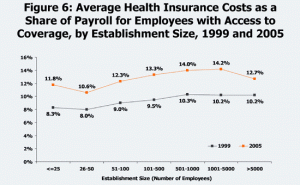
Payroll cost of insurance as a %

Payroll cost of insurance as a %

The House plan for health reform has an employer mandate for employers with a payroll of $250,000 or more(pdf).  Businesses with a payroll for $400,000 or more must either provide health insurance, or pay 8% of payroll to “subsidize” health care for their employees.

Take a look at the graph on the right hand side. It’s a little out of date (2005) but it shows payroll percentage costs of insurance.  The numbers are higher than the government numbers, because it only includes companies which do provide insurance and doesn’t average costs in of employees they don’t provide insurance for.

In other words, as of 2005, this was the cost of actually providing insurance for employees.  Since then it’s only gone up, rising faster than inflation.  You’ll notice, that for companies of all sizes, it’s more than 8%, although this doesn’t include the value of any tax deductions to the companies.

The costs do vary by size, both because smaller pools of employees tend to cost more (because variability of claims varies more the smaller the pool) and because larger firms tend to have better plans (the latter seeming to outweigh the former, to my surprise).

This will change as time goes on. The House plan will eliminate discrimination by size, which should decrease costs for smaller employers, but it will also mandate the minimum acceptable plan characteristics, which will probably raise their costs. No matter what the case, however, what’s clear is that from a pure price perspective, for most employers, dropping their health coverage and paying the 8% “subsidy” is the price effective option.  This is especially true since, while a flat 8% is automatically indexed to inflation, if health care costs continue to rise faster than inflation, and I expect they will, despite various efforts to contain them, the bottom line calculus each year will become even more favorable to dropping coverage.

The end result of this will be that more and more employers will simply drop their insurance plans and throw their employees onto the public insurance exchanges.  Assuming that the public option is cheaper and generally comparable to the private plans (not a sure thing, which I may discuss in a later post), this will mean that large numbers of people will wind up in the public plan.  Larger numbers, I think, than the current scoring expects.

Unless the public plan can reduce costs to what would be 8% or less of payroll, this means the cost of the public plan may be higher than expected, and since the private companies shedding their insurance plans won’t be making up the difference (8% being less than their own costs) that means premiums will also be higher than one might otherwise like.

Since companies won’t be (as far as I can tell) forced to return the difference in what they were paying in insurance to employees, that means employees will very likely be more out of pocket than they were before the plan.

And if that’s the case, support for the plan will collapse since at the end of the day people who used to have employer insurance will have less money in pocket than they did when the company was paying for it.

This scenario is what we would expect to play out of employers act in accordance with the incentives embodied in the plan, so I regard it as rather likely unless there are incentives I’m unaware of that would prevent it or if the tax benefits of providing private insurance are large enough to outweigh the additional costs.

This isn’t necessarily either a good or bad thing.  It could well lead to real single payor, for example.  What’s interesting is the question of whether it’s intentional or not.

Posting at Open Left From Wednesday July 15th to July 29th

Just as it says.  Pop on over, I should have up 2 posts a day (or so), on weekdays, through that period.  Posts will show here, but not until they’ve been up at Open Left for a while first.  So head over, and (hopefully) enjoy—or hate, just don’t be indifferent 😉

A Republic if you can keep it

US Constitution by KJD

US Constitution by KJD

On this Independence Day, let us not just remember those who died that America might have its freedom, but also what they died for.  The truest respect for sacrifice is not to hold a parade, to speak of gratitude or to say fond words; no, the truest respect is to value that which the dead fought for and to continue their fight.

America’s founders fought for freedom, we’re told, and there’s a lot of truth to that, though it wasn’t, then, freedom for all.  In the context of the 18th century freedom meant some of what it means today: all men equal before the law, no taxation without representation, freedom to worship as you chose, and so on, but it also meant freedom from the aristocracy, and freedom from inherited power.  “All men equal before the law” was a strike, not against slavery, but against the nobility.  No man should have more rights than another; no man should have power because of who his father was.

America is the land of opportunity, it was said.  Some still say this, and perhaps it’s still true.  But the deeper truth is dying.  Inherited wealth and inherited power are on the rise.  For centuries, indeed until somewhere between 10 and 20 years ago, America, amongst all the nations in the entire world, had the most inter-generational mobility.  To put it another way, no matter who your father was, or who your mother was, you could make it in America.  More than in any other nation, in America you had a fair shot.

Now no one would say you can’t still make it in America.  No one would say that opportunity isn’t still available in the land of the free and the home of the brave.  But the fact, the sad fact, is that amongst Western nations the US now has the most income inequality and the least inter-generational mobility (along with Britain, the nation which follows American policies most closely).   In America it now matters more who your father is, who your mother is, how much money your family has and how many connections it has, than in any other Western nation.  The old European nations are now the land of opportunity, the land where who your parents were matters least.

The reasons are simple enough.  Inheritance taxes have been weakened and progressive taxation has been slashed.  The primary education system, funded by local tax dollars, systemically favors people who live in wealthy neighbourhoods, while university tuition has grown far faster than inflation at the same time as student aid has been slashed to the bone.  The extremely rich have bought the government and use it to arrogate money to themselves, either through preferential laws—for example, Medicare Part D or the Bush tax cuts; or directly—for example, the 15 trillion spent on the financial crisis, the vast majority of which went in effect to the rich.

Power is passed from father and mother to daughter and son, with Congressional seats being passed on like some sort of inheritance and major network spots likewise going to the children of the influential.  Perhaps there are no titles, but when, for example, Luke Russert, a man with no meaningful accomplishments of his own save being the offspring of late NBC news anchor Tim Russert, is hired as a national news commentator at age 22 over others who have worked harder, who have done more, and are vastly better qualified, it’s hard to see his inheritance as all that different from a Baron passing his rights, lands and chattel to his son.

All men are created equal. But, as Orwell noted in Animal Farm, some are more equal.

For example, if you were to kidnap a man and torture him for years on end, you’d be tried in a court of law and sent to jail.  But if you were at the highest level of government in the United States and did so in violation of the law, your successor might well say that the US needs to look forward, not backwards.

Nothing strikes at the heart of the revolution, at the heart of the struggle for independence than this, that America has become not a nation of laws, but a nation of men, where some men are more equal than others.  To be sure it has always been true that the rich and powerful have been more apt to escape Justice’s blind grasp.  Yet at the same time, there can be no question that in the last eight years the greatest lawbreakers, the greatest mass murder in the country was also the highest official in the country.  And that he and his accomplices will get away with their crimes, not because we don’t all know they’re crimes, but because the idea of accountability, of equality before the law, for the highest government officials is now dead.

There are certainly those who cry out for justice.  But, let’s be frank: they don’t matter, because the people in power—in Congress and the executive branch, and quite probably on the Supreme Court (though we can’t be sure about that)—don’t believe that the laws apply to them in the same way they apply to ordinary people.

All men, in the land of the free, in the land of the brave, are no longer equal before the law.

The rallying cry of the revolution was No Taxation Without Representation, and that too is dead.  The Treasury and the Federal Reserve, between them have spent, loaned, guaranteed and issued about 15 trillion dollars.  With the exception of about 700 billion or so of that money, they didn’t get Congress’s permission for it, and when Congress asked how they were spending the money, they refused to answer.

That’s taxation without representation, and it has continued as much under the current administration as the previous one.  Moreover, faced with the greatest failure of regulation in the post-war period, most notably by the Federal Reserve, the government has proposed to give that self-same Federal Reserve even more power.  It is notable that of all the agencies which could be given more power, the Federal Reserve is the most removed from Congressional control, the most opaque, and the least democratic.

One suspects that for the executive branch all of these things aren’t bugs, they’re features.

And so, 233 years since 1776, in the land of the free and the home of the brave, aristocracy is on the rise, opportunity is taking a swan dive, taxation without representation rules the day and for the most powerful men and women, America has become a nation of men, not laws.

“A Republic, if you can keep it” – Ben Franklin

Can you?  Have you?

My wish for America, then, this Independence day, is that you keep your Republic.  Or, if perhaps you’ve lost it, that you regain it.


Cross-posted at FDL

Gay Pride

Pride

Pride

Keeping the odd hours I do, I just walked through the area where Toronto’s Gay Pride celebrations will take place.  At about 4 am the crowd was divided into celebrators still up from last night, with a few bars still open, and workers setting up the tents, portable toilets and stages for the weekends celebrations.  Lesbians, gays and straights mingled on the streets, which had been blocked off already by bored police officers, and judging from the couples holding hands or kissing, there were a lot of straights celebrating with their gay friends and neighbours.  Still, the sweetest couple I saw, caressing each other and kissing slowly and playfully, were gay, which is as it should be.

And there were a couple of drag queens too, which is also as it should be, because at Stonewall it was the queens who first started ripping up paving stones; the queens who first said “enough!”

Page 520 of 532

Powered by WordPress & Theme by Anders Norén