Ian Welsh

The horizon is not so far as we can see, but as far as we can imagine

Goldman Sachs Nominee Bob Hormats Helped Fund Sudan Genocide

Yesterday I satirically noted that what Washington really needs is another Goldman executive in a position of power.  But today I read that Bob Hormats, a Goldman vice chairman, was involved in an IPO for PetroChina, which has Sudanese holdings.  He claimed, at the time, that none of the money would be used to work in Sudan (do people not understand that money is fungible and scarce?  The claim is absurd on the face.  Even if PetroChina used none of that money for work in Sudan, it would free up other money to be used in Sudan).

However, even if you ignore how money works, it turns out Hormats lied:

  • These statements later proved to be inaccurate and misleading. Several large institutional investors, including Harvard, have since divested from PetroChina, citing human rights concerns.
  • The SEC later cited Hormats’s remarks as evidence of illegal market tampering, or “market conditioning,” in a larger case against Goldman Sachs, which the bank settled for $2 million.

I hate to be a stickler, but this is a bit more serious than just being a Goldman boy.  Lying to help fund genocide may be business as usual for some folks, but I’d like to think it still disqualifies someone to serve in the Obama administration.  Since I’m guessing the Obama administration doesn’t agree (pretty sloppy due diligence if they didn’t know) I hope the Senate does and refuses to confirm Hormats.

(And if Hormats wishes to claim “I didn’t know”, then I’m willing to take him at face.  In which case, he’s not a liar, he’s a fool with bad judgment, and still doesn’t deserve to be confirmed.)

State Revenues Took Biggest Hit On Record During First Quarter

Some devastating analysis from the Rockefeller institute (pdf) shows how bad the situation of many  states is:

State tax collections for the firstquarter of 2009 showed a drop of 11.7 percent, the sharpest decline in the 46 years for which quarterly data are available. Combining the Census Bureau’s quarterly data with its annual statistical series, which extends back to 1952, the most recent decline in state tax revenues was the worst on record.

While almost all taxes (except property taxes) are showing a big decline, income taxes are notably declining:

The personal income tax decline was particularly sharp, an unprecedented 17.5 percent in nominal terms. The inflation-adjusted decline in state personal income taxes was the greatest in the 46 years for which quarterly data are available.

But that was the first quarter!  Well, the second quarter isn’t looking better:

Early figures for April and May of 2009 show an overall decline of nearly 20 percent for total taxes, a further dramatic worsening of fiscal conditions nationwide. Preliminary figures for the state fiscal year 2009 indicate around 8 percent decline in total taxes, 13 percent in personal income taxes, and 5 percent in sales taxes.

There is one spot of good news, however:

The local tax slowdown has been less pronounced than the state tax slowdown. In the first quarter of 2009, local tax collections rose by 3.9 percent, driven by 7.4 percent growth in property taxes.

Even this, however, has a grey lining—property taxes are still based on older valuations which are no longer accurate in most municipalities.  People are paying property taxes for more than their properties are worth, and given that many are suffering from large income declines (or there wouldn’t be the huge decline in income tax), this means many are paying more than they can afford.  This is also a lagging measure, and as properties are revalued we can expect this number to start to decline.

Sales taxes are also down a wopping inflation adjusted 9.5%, also the worst on record (the previous worse being the third quarter of 91 at 6.9%.

This downturn, then, has put a massive hurt on States.  California is the worst off, followed by New York, but most are hurting.

There are some where taxes are up: Maryland, Indiana, Iowa, North and South Dakota, Arkansas , Kentucky, Alaska, Montana and Oregon.  Everyone else is down.E

The results of state cuts to services, which are happening and will continue to happen, will be devestating.   In an economic downturn government needs to increase spending to offset the fact that private spending is down.  If government does not do so, especially in a severe downturn (I think we can agree this on is) it risks making the recession or depression even worse.  This is why, next to making 40% of the federal stimulus bill tax cuts, cutting aid to the states was the stupidest part (or rather, not part) of the bill.

California, in its budget “compromise” took 4 to 5 billion from the munipalities (since their tax base is doing better than the state’s) and cut 6 billion from education.  While other states cuts will not be as brutal (and other states can raise taxes, unlike California, thanks to its completely dysfunctional proposition and majority requirements) they will still be ugly, and will both deepen and lengthen the recession.

This is your government on conservative ideology: push key spending down to states, which can’t tax or borrow the way the federal government can; insist on tax cuts over real stimulus, and then wonder why the stimulus doesn’t work.  None of this is unpredicted, at the time of the stimulus cuts economists said the state relief was one of the most important parts of any good bill.

What we got wasn’t a good bill, and the consequences will continue to pour in.  Dysfunctional states plus a dysfunctional federal government, plus conservative ideology equals devestating cuts on services people need most during a downturn, and which the economy needs most.

Obama to blogs: Help!

So, Obama had a conference call with bloggers, and urged them to help him pass his health reform bill (a bill most liberal bloggers would have preferred was single payor, something Obama ruled out day one.) I find this… fascinating.

When I was dealing with the various Democratic primary campaigns in 2007 and 8, the one which did the least outreach to bloggers and which was the most closed and insular was the Obama campaign.

When Obama became the nominee, things didn’t change. Well, except once. After the Republican convention, when Obama was behind briefly, suddenly the Obama administration wanted to talk to bloggers. A lot. The moment his numbers improved, the door went back to its prior “one inch open, shout, and maybe someone will ignore you” position.

I found that interesting then. I find it interesting now.

I also do truly hope Obama gets through a bill which includes all his criteria:

the President mentioned his criteria for reform: Does it cover all Americans; Will it drive down costs over the long-term; Will it improve quality; Are prevention and wellness included; Does it contain insurance reforms on issues like pre-existing conditions; does it provide relief to small business; and, is there a serious public option. He warned that the different bills coming from the House and Senate may not have all of those provisions, but the conference committee will be critical.

And I hope it’s not just a pep talk for the gullible troops.  I hope, more, that it’s clear he got all those things in a meaningful form rather than getting a bill through to get a bill through

And hey, last time he stopped talking to us when he didn’t need us.  I’m sure he’ll do the same thing again.  Which, oddly, leaves me hoping that he stops talking to us again soon.

At least he’s still inspiring hope in me.

Because Goldman Sachs Doesn’t Have Enough Influence In Government

I am pleased to see the the Obama administration adding a Goldman Sachs executive to the team:

Robert Hormats, a vice chairman of investment bank Goldman Sachs, has been tapped for a key U.S. State Department post, White House officials say.

Hormats was named by the Obama administration Friday to be the department’s undersecretary for economic, energy and agricultural affairs, an official announcement indicated.

The good Lord knows, the problem with government these days is that the views of high finance, Wall Street and Goldman Sachs in particular are not given enough weight.  If we had listened to them when they wanted Glass-Steagall repealed, wanted limits on leverage weakened, wanted to make sure comlex derivatives weren’t regulated and so on, well, we wouldn’t be in this pickle.

So let me just be the first to say how wonderful it is that Goldman’s, and Wall Street’s, influence continues to grow in Washington.

(More seriously, putting a Goldman man into an economic diplomacy spot indicates that keeping the credit flows moving is very important to the Obama administration.)

Americans Lives vs. Insurance Company Profits: the real battle in healthcare reform

Lying about healthcare, indeed fear-mongering about healthcare, has ramped up as insurance companies attempt to keep their profits.  Those profits are created by a system where the US spends 5% more of its economy on healthcare in exchange for the worst results of anywestern nation.  To insurance company executives, their profits, their executive salaries, and their bonuses, are not just worth lying for, but also worth killing for—or at least letting people die.

The Shona Holmes Healthcare Hitjob

Case in point: Shona Holmes is the current poster girl for the liars slandering Canadian health care in an attempt to discredit reform.  Ms. Holmes alleges she was horribly endangered by Canada’s healthcare system:

Both CNN and McConnell made a big deal out of Shona Holmes, an Ontario woman who claims she was forced by Ontario’s health system to go to the United States for life-saving surgery for a brain tumour. She claims that in 2005 delays in access to treatment at home made it necessary to go to the Mayo Clinic in Arizona and pay $97,000 for her care.

Her story sounds bad, doesn’t it?  Except, of course, it’s a lie:

On the Mayo Clinic’s website, Shona Holmes is a success story. But it’s somewhat different story than all the headlines might have implied. Holmes’ “brain tumour” was actually a Rathke’s Cleft Cyst on her pituitary gland. To quote an American source, the John Wayne Cancer Center, “Rathke’s Cleft Cysts are not true tumors or neoplasms; instead they are benign cysts.”

There’s no doubt Holmes had a problem that needed treatment, and she was given appointments with the appropriate specialists in Ontario. She chose not to wait the few months to see them. But it’s a far cry from the life-or-death picture portrayed by Holmes on the TV ads or by McConnell in his attacks.

In other words, her condition was not immediately life threatening, and it was prioritized accordingly.  But Holmes didn’t want to wait behind people who needed care more than she did, so she went the US where she could pay out of pocket to jump to the head of the line.

Healthcare Triage: US vs Canada

Here’s the deal: both the US and Canada prioritize patients, and both engage in health care rationing.  In Canada health care is prioritized by how urgently a patient requires treatment.  In America, to a much greater extent, access to medical care is prioritized by how much money the patient has.  Someone in the US who was sicker than Ms. Holmes was forced to wait longer for treatment because Holmes was rich enough to pay $97,000.

A Personal Perspective on Canadian Healthcare

I should add that I have firsthand experience with how the Canadian system prioritizes treatment.  In 1993, at the age of 25, I became very ill with ulcerative colitis.  I was hospitalized, and put on very expensive drugs.  About a week after being hospitalized, the nurse watching me called in my doctors on a Sunday because I was deteriorating so fast—pain killers were no longer having any effect (i.e., high doses of morphine were not working), I wouldn’t let anyone touch me, and I was becoming delirious.  At about midnight, they wheeled me into the operating chamber and took out my large intestine.  While they were digging around, they found out I had appendicitis, and they took that out too.  It would have burst within 2 days, and in my weakened state, it would have killed me.

Unfortunately, one of the treatments for ulcerative colitis involves immune suppressing drugs.  My immune system basically shut down, my liver almost shut down, and I spent almost another 3 months in the hospital, riddled with extremely painful and crippling infections and other problems.  At one point I was on 9 drugs; one of them was an antibiotic so expensive that only a single doctor in the hospital could approve it.  My gastroenterologist called the treatment the equivalent of “pouring gold dust into your veins.” I wasted away, my weight dropping below 90 lbs.  I often joke that I was old young: I’ve used a walker, crutches and cane.

The Universal Healthcare Bottom Line

The ultimate point of my story is simple: I got the care I needed, when I needed it, and I never paid a single red cent.

Which is good, because I couldn’t have afforded to pay.  I was young and had very little money.  The kind of care I received, even back then, would have cost hundreds of thousands of dollars in the US.

If I  had lived in the US, my parents would have faced a choice between paying for my incredibly expensive treatment, or watching me die.  They were both old, and it would have wiped out their savings entirely and thrown them into bankruptcy, and frankly, I don’t know how they could have supported themselves.  My life, at that cost, would have had too high a price.  I wonder how many Americans have had to make that calculation.

But I survived, and neither I, nor my parents, was bankrupted.  In similar circumstances I doubt all of those things would be true for an American 25-year-old trying to survive the same medical condition in America’s health care industry.

Healthcare Rationing, American-style

I have had two American friends die in the last 5 years who would have survived if they had had fully covered health care. (Note I didn’t say health insurance, that’s not what people need.  They need health care.)

One of them died of the flu.  He didn’t seek treatment because of the cost of his insurance co-payment, and he was found dead.

Another had a heart condition, but didn’t know it, because she didn’t have health care, because she couldn’t afford it.  If she’d had health care, she would probably still be alive.

Both of those people are dead because of people like Holmes, and the people behind her.  My two friends are dead because insurance company executives want to keep their obscene salaries, and force Americans to pay more for health care than they should.

So What’s the Healthcare Reform Fight Really About?

Billions of dollars are at stake in the battle for American healthcare reform.  That’s the sort of money executives, and their lobbyists, and their bought-and-paid-for politicians are willing to kill for: to let you, or your friends, or your family suffer and die. Think of your dead friends and relatives as collateral damage in the fight for health industry profits; that’s how the insurance executives see them.

The Credit Addicts Dilemma: Why the US is hemorrhaging good manufacturing jobs

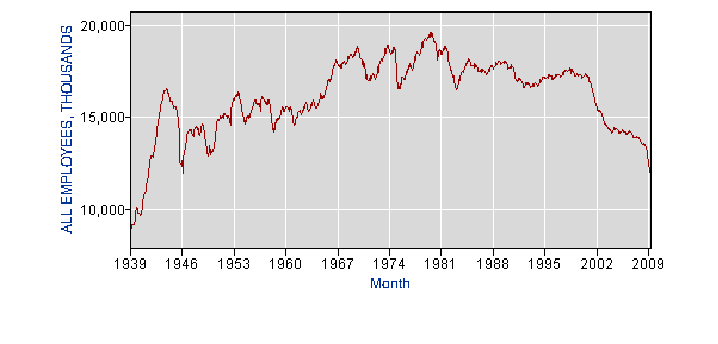
Manufacturing employment from 39

Manufacturing employment from 39

Fun graph, eh?

This is your manufacturing economy on globalization.  Bear in mind that these numbers are absolute numbers, they don’t reflect the fact that the US population has grown significantly.

According to Mike Lux:

a high level Obama administration economic adviser is quoted as saying that America’s export future resides in exporting “consulting and legal services, software, movies, and medicine.”

Whistling past the graveyard would be the kind way to characterize that statement.  Typical Summers/Geithner “brilliance” might be the less kind way of putting it.

US manufacturing was never going to stay as high as it was, relative to the size of the population, after World War II.  The majority of the world’s manufacturing capacity had just been bombed into rubble, after all.  A relative decline was always to be expected.

An absolute decline, however, is quite another matter, so let’s do a 30 second seminar on international trade and development.

No country other than a city state has ever industrialized except behind trade barriers.  None.  There are no exceptions.  Mercantalism is how states industrialize.  The trade barriers can be classic tariffs (like the US used), they can be direct subsidies, they can be through interest rate policy or  they can be through making your currency cheaper than it otherwise would be.

For good chunks of the 2000’s, the Chinese government spent about 10% of their entire GDP keeping the Yuan undervalued.  Other countries, like Japan and Korea also worked hard to keep their currencies undervalued (or the US dollar propped up, depending on how you want to look at it.)  This made their goods more competitive than they would have been otherwise and the direct result was the loss of US manufacturing jobs.  (One might also point out that this doesn’t qualify under any definition as “free” trade).

This isn’t the entire picture, just dropping the dollar won’t fix the problem, because if that happens, the US gets creamed on resource costs (read: OIL).  This means the US is in a policy bind.  Drop the dollar and get slaughtered by resource prices.  Keep the dollar high, and lose jobs.

This isn’t just a policy bind, it’s co-dependency, in the worst sense, like when a drug dealer needs a customer’s cash and the customer needs his fix.  Americans got something in exchange for this: they got cheap consumer goods, and funding for their overspending.  At some points during the 00’s the American savings rate was negative!

In exchange manufacturing and other jobs were moved directly overseas.  Off-shoring went to China, outsourcing (of legal, administrative, call center and whatnot) went to India, Canada and Ireland (because they all have large numbers of English speakers).

Breaking this policy bind is simple enough: first you have to break US dependence on oil, then you can tell the countries which are selling you drugs (which you desperately want and need, don’t blame them for your addiction to cheap credit and consumer goods) where to go.  Then you go through a very unpleasant withdrawal period, which as any ex-addict can tell you, is hell on earth.

But the status quo isn’t so hot either, is it?

Want your manufacturing jobs back?  Get off oil, then you can get off easy foreign credit and cheap consumer goods.  Then you can have them back.  And maybe once they’re back we’ll be able to buy an appliance which isn’t so lousy that it’s expected to wear out in 5 years max and be thrown to the curb.

One can dream.

Health Care Costs Part 1: The Single Payor Challenge To the Public Option

comparative-health-care-costs_html_m36226ab1

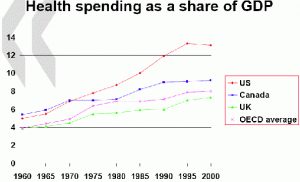
The chart at the top of this post shows what happened to per-capita costs when Canada went to single payor.  What’s interesting is that before Canada went single payor, per capita health costs in Canada were higher than in the US.  Over time, after single-payor was implemented, they they stayed even until about two-thirds of US costs, and then they started rising again.  The rate they rose at was about the same as American health care costs, but they stayed at about two-thirds of the cost.

In other words, single payor is the simplest way to get a one time savings in health care costs.  It has worked for every other country which has tried it (and yes, most European systems are variations on single payor.  They aren’t “pure” but they are still essentially single payor).

canada-hcare-vs-us-hcare

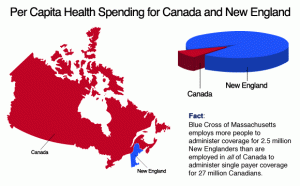
The next graphic shows the difference in administration costs.  This is one main reason why single payer is cheaper than a private system—it takes a lot less people to administer.  American hospitals have billing wings.  Canadian hospitals have a room or two of people who do all the billing.

This is the single-payer challenge to the public option.  Can it hold costs even until they are about one-third less than they would have otherwise been?  Until they are about even with the rest of the civilized world’s costs?

I’d put my money on a simple, heartfelt no.  Look hard in the mirror and try and tell yourself otherwise.

Single payer, or “Medicare for all” isn’t a long term solution to health care costs.  But it could buy the country a good ten years before costs start rising again.  That’s a lot of time.  A lot of money.  And a big challenge for any other plan to meet.

Which leads us to the question of taxes.  Every time someone starts whining about how taxes have to rise to pay for universal healthcare I want to smash my head against the nearest brick wall (since that’s softer than most of the skulls in Congress or the media).  Those per-capita costs above?  They aren’t for just “insured Americans”, they are divided across the entire population.  America is already paying more than enough money to give everyone health care, but because so much of it is being wasted, 48 million are uninisured and 62% of all bankruptcies are caused by health care problems, and 75% of those had what in the US is laughably refered to as “health care insurance”.

If proper health care reform occurs.  Health care reform which holds down costs, taxes might rise, but the overall cost should hold steady or rise only slightly.  If employers who provide insurance now are allowed to keep half the money, and required to give half of it as a raise to the employees losing the insurance benefit, and if corporations and employees are taxes, the average person will have the same amount of money as they did before universal healthcare.  And very quickly, within a few years, they will have more money in pocket than they would have without it.

Does it matter who you pay your health care money to?  The government or the insurance companies, as long as you get care?  And if the government can do it for cheaper, so you’ll have more money left over, for better care (and yes, Virginia, every country in the world with real universal health care has better overall results than the US) why wouldn’t you want that?

But no politicians comes out and says this.  “We are paying too much for health care.  You, my fellow citizens, are paying too much for bad health care.  What we are going to do is make sure that you get good health-care for less money.  Because yes, my friends, the government is better at some things than private companies, and health insurance is one of them.”

This is the bottom line—single payer—Medicare for all—is cheaper and provides better results than the current system.

Can any of the bills going through Congress say the same?  If they can, can they say it to the same extent?

That’s the single-payor challenge.  And like one of those old time boxing challenges where the boxer would take on all comers, I’m betting the public option rube is going to get his clock cleaned.

Which would be no big deal, except that it means a lot of people are going to die and suffer and go bankrupt who wouldn’t have if Congress members weren’t too beholden to insurance companies to do, for once, what is right for Americans.  I don’t know why they won’t do what’s right.  I don’t know why they won’t do what’s proven to work, rather than try and cobble together a rickety unproven plan.

But I can only assume it’s like the old question we used to ask about the Bush administration.  “Evil or stupid?”

Evil – taking health insurance company money and doing what they know is wrong because they’ve been bought.

Stupid-so ideologically blind that they think that even if every other country who’s gone single payer has had it work, it’s still a bad thing because the private sector is always better than the government, no matter how many people it kills or bankrupts.

I don’t know.  But either way, they’re failing the single payer challenge.

(Comparative Graph from OECD. *.pdf)

(New England image from health Insurance 2008)

Memory Lane on the Paulson/Goldman Stickup: What I wrote Sept 20, 2008 and why it matters today

Because sometimes, I told you so is necessary, in the hope that next time people might listen.  This is what I wrote September 20th, 2008:

This is a stickup. Paulson is trying to stampede the Congressional herd into giving him powers and money that he knows they would never give if they had time to think it through carefully. It worked with the Patriot Act. It worked with the AUMF. He’s betting it’ll work again. Create a crisis (or lie one into existence) then demand dictatorial powers and unlimited spending authority to deal with it.

Congress needs to not succumb to fear or to explicit or implicit blackmail. If the crisis was as severe as Paulson makes it out to be, virtually the end of market capitalism, he wouldn’t be quibbling over whether or not CEOs get to keep their golden parachutes.

In effect, that quibble is like you walking into your local bank and saying “I need you to loan me a million bucks. Here are the conditions I must insist are met before I let you lend me the money. First…”

Say what?

He’s given his tell, that he’s a liar, a thief and a scam artist.

Time for Congress to call his bluff, and to see that the financial crisis is dealt with on their terms, with strict oversight by people they can trust, not by a scam artist and liar like Paulson.

Of course, Congress didn’t call his bluff and Congress did fall for it.  But let’s remember our history.  The House voted against.  Nancy Pelosi indicated that she would not pass TARP unless Republicans voted for it in the same proportion as Democrats.  They weren’t going to do that, so TARP was dead.

Then Barack Obama stepped in and started twisting arms.  TARP is Obama’s baby.  If you like it, or don’t like it, remember, without Barack Obama it would have died.

This is the fundamental problem right now with Democrats.  They passed a lousy stimulus, they made TARP Democratic policy by passing it with majority Democratic votes and they are on their way to passing a lousy healthcare bill which won’t even kick in till 2013.

Bad policy leads to bad outcomes.  Bad outcomes get blamed on the incumbents (as they should).  TARP, the Stimulus, healthcare and the economy become less and less the Republican’s problem every month that passed.  Even if they screwed it up, Democrats control the House, Congress and the Presidency.  It’s up to them to fix George Bush’s mess, and if they don’t they will be judged as failures, and that judgment will be accurate and deserved.

And the outcomes are going to be bad.  The stimulus bill was both badly put together (too many tax cuts, not properly targeted) and too small.  The healthcare bill should be single payor, because single payor is proven to work and the witch’s brew that Congress has put together isn’t proven to work and they can’t afford to fail.  And TARP was, and is, a piece of crap, but the differences between Bush/Paulson financial policy and Obama/Geithner are so thin as to be largely cosmetic.

Policy has consequences.  The “compromise” position between “doing it right” and “doing it wrong” may work sometimes, but it doesn’t work when a nation is in crisis and has spent 30 years digging itself into a hole.

By the time Obama comes up for reelection, Americans won’t have better healthcare and they will have less jobs than before the recession and the stimulus.

That’s what he’ll be judged on, and all because he signed on for Paulson/Bush financial policies, and compromised his key domestic and economic policies to the point where they wouldn’t work.

Page 519 of 532

Powered by WordPress & Theme by Anders Norén