
Ian Welsh

The horizon is not so far as we can see, but as far as we can imagine

Global Warming: A localized pause and then the end of our civilization

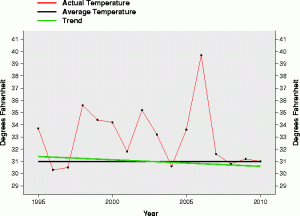
Mean continetal temp 95-10

Mean continetal temp 95-10

Let’s talk a bit more about global warming and climate change.  The majority of the American population now thinks that global warming probably doesn’t exist.  Part of that is the huge amount of money which has been spent on propaganda, but part of it is that one of the only major areas not experiencing higher temperatures is the continental USA.  If you want to be a climate change denialist, America is a great place to live.

It is also true that the speed of global warming has slowed down.  This is primarily due to two factors:

1) The sunspot cycle.  Solar radiation is currently at its lowest level in some time.  Less heat equals, well, less heat.

2) The icecap and glacial dump.  The polar icepack being dumped into the oceans has had a cooling effect.

The sunspot cycle can change pretty much any time it wants.  Probably we’ve got a decade or so at lower heat levels, but that’s not a sure thing.  As for the icecap and glacier dump: well, once the ice is gone, it’s gone.

The bottom line is that we are going to see things get worse, more slowly, in terms of temperature rises.  We will, however, keep getting crazy weather, changes to weather patterns are an early sign of climate change.

Once the mitigating factors are gone the pace of global warming will pick up again, and it will pick up fiercely.

Now, as for fixing it—there are two main problems.  The first is the will to do something.  While there may be technical solutions which would reduce the amount of carbon we are dumping into the atmosphere, there is no will to deploy them on a wide enough scale to matter.  This is as true in China as it in the US, and without China and the developing world coming on board, what the US does, assuming it does anything, will not be sufficient (and the US will not do anything, the propaganda campaign claiming there is no Global Warming has been successful.)

The second is that there will come a point where global warming becomes a self reinforcing cycle.  With no glacial caps and with the methane released from Siberia, even radical decreases in human CO2 dumping will probably not be sufficient to stop the cycle.

Add to this the severe water shortages we can expect, which will hit large parts of African, a huge swathe of China, much of India and a big chunk of the US, as aquifers are drained down to effectively zero, and you have a recipe for huge loss of life and destabilizing migratory movements.

It is also entirely possible that large parts of the tropics will become effectively uninhabitable, the combination of humidity and temperature will be so high that it will literally be lethal to be outside air conditioningfor any length of time for much of the year.

If world population is only reduced by a billion, I will be amazed.  I also expect some serious wars.  Our civilization will not go quietly into that long long night.

Climate Change: A fighting retreat

I don’t usually write about climate change, because as dire as my views are on economics, they’re even more dire on global warming.  As I understand the science it’s already too late—we’re going to get hit with runaway temperature increases over the next century, and they are going to make a good chunk of the globe essentially uninhabitable.

Huge climate change events are the sort of events which end civilizations. While it is always possible that something I can’t forsee could occur, of course, it seems to me that we’re on the glide path for disaster. With the best will in the world, and a great deal of competence, we might keep the deaths under a billion or so.

I hope we get that level of competence. Unfortunately, my guess is that by the time we do, by the time things are taken seriously, it will be so far past too late that all we can do is mitigate.

That mitigation, of course, is important, as is every little bit people can do now to mitigate. Every .1 degree centigrade the world’s temperature doesn’t rise by date X is some people who live, some people who live better, some more time to get out act together.

Sometimes our role in life isn’t even “to hold the line” it’s to engage in a fighting retreat, to buy time for others. For most of us alive today, that may be our job. It’s not glorious, it’s not fun, but it is necessary.

[Written as commentary on Sara Robinson’s excellent article on possible futures.]

Obama, Congress and Bernanke did not save the world from a Great Depression

Sorry, they simply did not. The baseline IMF forecast before the bailouts and before the stimulus bill tracks almost exactly what happened.

The bailouts were an actual net drag on the economy.  Instead of cleaning up banks balance sheets, they allowed zombie banks to continue to exist, banks which are crippled when it comes to lending.  In order to make sure these banks can pay down their bad debts, the Fed not only had to take on huge amounts of their paper at par when it was worth 20 cents at most, it has had to lend to them at concessionary rates, pay extra interest to them, and let them leverage that to make obscene profits from what lending they are doing (why did your credit card rate go up, that’s why?) and from trading on a captive market.

As best I can figure the stimulus was large enough to counteract the negative effect of the bailout.

The net, is a wash.

Furthermore, there were far, far more intelligent things which could have been done.  The crisis was, as the tired phrase goes, also an opportunity to break the power of monied interests, so that ordinary Americans could prosper again and could reclaim their government.  The stimulus was an opportunity to restructure the US economy to allow real, widespread growth in the future.

Both those opportunities were wasted, and they were wasted by Obama.  TARP would not have passed without him, and once he was in power he could have demanded that Bernanke do as he commanded (break the banks) or step down, if Bernanke wouldn’t, he could have easily impeached him.  The stimulus was his stimulus.

Obama, Congress, Bernanke, Geithner, Paulson—none of them saved anybody except the banks and the rich from apocalypse.  I understand that partisan Democrats want to pretend Dems saved the world, but they did no such thing.

(Addendum. See Rosenbert here (h/t Sean-Paul):

There are classic signs indeed that the recession in the U.S. ended last summer — output, sales, etc. But the depression is ongoing and the reason we say that is because real personal income, excluding handouts from the government, has barely budged. In fact, real organic personal income is nearly $500 billion lower now than it was at the peak 16 months ago and this has never occurred before coming out of any technical recession. It is a depression, as the chart below attests — that is the trendline for real household incomes, until the government comes in to top them off with handouts, subsidies and extended jobless benefits . . .

Real consumer spending is up $200 billion over the past 16 months and everyone believes we have a sustainable recovery even though organic income is down almost $500 billion. Think about that for a second because once the stimulus wears off, and with a 10% deficit-to-GDP ratio and concerns surfacing everywhere about sovereign credit risks, there is little out there to support future growth in consumption.)

Actual Good News

The reform of the credit agencies, which creates an office in the SEC which assigns securities to the agencies to be rated, rather than the security issuer choosing (and paying) who rates them, is an actual good reform.  The Fed audit, while it is more limited than I would have liked, if done properly, should be very interesting.  Financial reform is still far from sufficient, but some intelligent good stuff is being passed.

Cramming Down Social Security is not a partiticularly “politically difficult decision”

It has been suggested to me that cramming down social security would be a way of letting the bond markets know that the US is capable of making “difficult decisions”.

A politically difficult decision would be, say, raising taxes on the rich.  Cramming down SS is just standard soak the middle class neoliberal claptrap. It is totally unecessary. Current projections show a problem 32 years in the future. Any projection out 30+ years is essentially a guess.  Add 1% to productivity increases and the entire SS “problem” goes away.

The US may have real spending problems, but they aren’t concentrated in social security.

However those actions which would really reduce those spending problems, like single payer (save 1/3rd per capita costs on health care), or slashing the military (there is no rational justification for spending 50% of the world’s military budget), or moving back to heavy progressive taxation, or increasing the estate tax, are on the table.  The only things on the table are actions which hurt the poor and middle class.

There is no crisis with social security.  If there is a deficit crisis (due to hot money’s desire for better returns than they deserve) it is because we refuse to do the things which would actually solve the problem.  Because anything that impacts the rich or the military or pharma is off the table, apparently all that’s on the table is making ordinary Americans take it in the neck.

So, just no to cramming down Social Security: no increase in the retirement age, no decrease in benefits.  If you must make changes, just uncap the FICA tax. There, “problem” solved.

The difference between money and the productive economy

James Galbraith has a good interview with Ezra Klein on the deficit being meaningless, which you should read. A good chunk of the interview is Modern Monetary Theory, though not all.

Let’s put it more simply: the government can print money. IF you owe your debts in your own currency, and that currency is a fiat currency, then you cannot run out of money. You can have some inflation issues, you can have some problems with misallocation of resources, you can
have some issues with currency rates and so forth, but you can’t run out of money.

The key to doing this, to using the printing power, is to use it in ways which either don’t lead to massive increases in exports, or which lead to reducing dependence on exports. Likewise you need to always remember that while money as such matters less than people think, actual real productive capacity matters much more. If you’re building aircraft carriers, those people and other resources cannot be used to build other things. If you’re building yachts and $50,000/night hotel rooms, those people and resources cannot be used for other things.

Money is how you allocate resources, how an economy decides what to do. If price signals are distorted, and they are right now, you wind up spending a lot of resources on things which are not productive-which do not build up the real productive capacity of the economy, instead of the largely useless, and indeed destructive financial sector, which, at its current state of development, has gone from being a symbiote to a parasite on the economy.

Small Traders are Guppies for the Sharks (aka: banks)

It wasn’t just Goldman who made money trading every single day in the last quarter, it was four banks.

I cannot emphasize enough: this is the sign of a fixed market.  It is impossible that this could happen in a free market.  Impossible.

This means they are extracting money from the markets, aka: from everyone who isn’t a market mover.  Small traders, pension funds, trading accounts of cities, etc…  Even if those actors aren’t actually in decline, they are making less money than they should as the banks make sure that their buy orders are filled at the highest price possible, and their sell orders at the lowest level possible.  And, in fact, many of them will be in outright decline as a result of these games.

At this point, if you are not a market mover, you can only make money in the market by anticipating the moves of the market movers.  This is now about guessing what a few people will do, so you can ride the tiger.  Just don’t fall off.

Another Progressive pundit clueless on the effect of unemployment on elections

Um, dude, no, Boehner is right, and you’re wrong, when it comes to the real world (h/t Cujo)

That was odd, wasn’t it? The disconnect makes it seem as if GOP talking points are lacking in flexibility, unable to adapt to changing circumstances. When the economy was losing jobs every month, Boehner would say, “Where are the jobs?” Now that the economy has added more than 200,000 jobs in two consecutive months for the first time in four years, Boehner is still saying, “Where are the jobs?” It suggests the would-be Speaker isn’t paying attention to current events very well.

When The Economy Interferes With An Election Strategy

Ok, depending on how you count it, the economy needs to add about 140K to 150K jobs JUST to keep up with increases in the population.  About 8.4 million jobs were lost in the last recession.  At a rate of, say 250,000 jobs/month, it will take 7 years to both put everyone back to work, and to sop up population increases.

For people in the ordinary economy “where are the jobs?” is a perfectly valid question, and it is a perfectly valid election strategy, because even if the economy starts regularly producing jobs at over 300,000, when November rolls around, the vast majority of people who need a job, still won’t have one.

Here’s my prediction: as a percentage of population, employment will not recover before the next recession.  80%+ of all productivity increases will go to corporate profits, and wages will stagnate.

Boehner is right to ask “where are the jobs?”  Both as a matter of fact, because there aren’t enough jobs, and as a matter of electoral strategy.

Page 488 of 532

Powered by WordPress & Theme by Anders Norén