
Ian Welsh

The horizon is not so far as we can see, but as far as we can imagine

The Gulf Oil Spill Shows What America Has Become

Peter Daou wants to know if this is the best the US can do (h/t Digby):

A calamity is unfolding before our eyes – the greatest oil spill in history – and America’s response is little more than a big yawn.

The vast, sprawling coastal marshes of Louisiana, where the Mississippi River drains into the gulf, are among the finest natural resources to be found anywhere in the world. And they are a positively crucial resource for America. The response of the Obama administration and the general public to this latest outrage at the hands of a giant, politically connected corporation has been embarrassingly tepid. … This is the bitter reality of the American present, a period in which big business has cemented an unholy alliance with big government against the interests of ordinary Americans, who, of course, are the great majority of Americans. The great majority of Americans no longer matter. America is selling its soul for oil. – Bob Herbert

Where is the outrage? Where are the millions marching in the streets, where is the round-the-clock roadblock coverage tracking every moment of the crisis, every effort to plug the leak, every desperate attempt to mitigate the damage?

Where is the White House? Where are Republicans? Where are Democrats? Where is the left? Where is the right? Where is the “fierce urgency of now?”

Prominent oceanographers [are] accusing the government of failing to conduct an adequate scientific analysis of the damage and of allowing BP to obscure the spill’s true scope. The scientists assert that the National Oceanic and Atmospheric Administration and other agencies have been slow to investigate the magnitude of the spill and the damage it is causing in the deep ocean. – NYT

In the movies, pretend heroes like Bruce Willis and Will Smith save the planet while the whole world watches with breath and belief suspended. In real life, a global catastrophe is treated like a mere annoyance, mismanaged by a rapacious oil company, while drill-baby-drillers double down on their folly and the White House puts out defensive fact sheets about how they were on it from “day one.”

In some parts of the country, the sight of oil drifting toward the Louisiana coast, oozing into the fragile marshlands and bringing large parts of the state’s economy to a halt, has prompted calls to stop offshore drilling indefinitely, if not altogether. Here, in the middle of things, those calls are few. Here, in fact, the unfolding disaster is not even prompting a reconsideration of the 75th annual Louisiana Shrimp and Petroleum Festival. “All systems are go,” said Lee Delaune, the festival’s director, sitting in his cluttered office in a historic house known as Cypress Manor. “We will honor the two industries as we always do,” Mr. Delaune said. “More so probably in grand style, because it’s our diamond jubilee.” – NYT

Is this really the best we can do?

Yes, it pretty much is, Peter.  First, this shows the fundamental continuity between Bush and Obama.  The reaction to this is fundamentally the same as the reaction to Katrina and New Orleans: do the least possible, and sweep it under the rug as best you can.  Does anyone imagine the Bush administration’s response to this disaster would have been fundamentally different from Obama’s?  Or rather, does anyone think that Obama has treated this more seriously than Bush would have?

But Daou’s point is broader than this, he blames everyone.  The left, the right, both parties, the public.  The outrage over this doesn’t seem to be there, the demands for action are tepid.

I think this comes back to something about Americans I’ve witnessed over and over again.  Many Americans, if something doesn’t directly affect them, think it doesn’t matter enough to get worked up over.  There is this weird sense of “we’ll be fine and who cares about what’s happening to someone I don’t know?”  Americans can’t really imagine disaster, or catastrophe, unless it happens to them or someone they’re close to.  Otherwise, it’s all just “something on TV”, and fundamentally unreal to them.

So they don’t connect the dots.  They don’t get what wiping out all this sea life, destroying beaches and marshlands, is going to do to them.  (Among other things, dying wetlands means more likelihood of Katrina style disasters).  Of course some of them do care and do connect the dots, but believe that there’s nothing they can do.  After all, millions protested the Iraq war and it didn’t matter.  Americans voted in Democrats in 2006 to end the Iraq war, and it didn’t happen.  Americans called 19/1 against TARP and it passed.  Americans voted in Obama to get real change, and he decided to be Bush .

I think it’s probably a bit of both: some folks just don’t see how it affects them and don’t care about things that affect other Americans, while other folks care or understand, but feel that there’s nothing they can do about it, since government is almost entirely unresponsive to their concerns, so why waste time getting worked up?

This is America, Peter.  The best suffer from learned helplessness, the worst just don’t care unless they’re the ones being hurt.
What Left?

David Sirota nails it:

Behold, for instance, major environmental groups’ attitude toward the Gulf oil spill.

We know that before the disaster, President Obama recklessly pushed to expand offshore drilling. We also know that his Interior Department gave British Petroleum’s rig a “categorical exclusion” from environmental scrutiny and, according to the New York Times, “gave permission to BP and dozens of other oil companies to drill in the Gulf without first getting required [environmental] permits.” Worse, we know that after the spill, the same Interior Department kept issuing “categorical exclusions” for new Gulf oil operations, and Interior Secretary Ken Salazar still refuses “to rule out continued use of categorical exclusions,” as the Denver Post reported (heckuva job, Kenny!).

Undoubtedly, had this been the behavior of a Republican administration, “the left’s” big environmental organizations would be scheduling D.C. protests and calling for firings, if not criminal charges. Yet, somehow, there are no protests. Somehow, there have been almost no calls for the resignation of Salazar, who oversaw this disaster and who, before that, took $323,000 in campaign contributions from energy interests and backed more offshore drilling as a U.S. senator. Somehow, facing environmental apocalypse, there has been mostly silence from “the left.”

So true.  On virtually everything.  Principles which change depending on who is in power are not principles.

But don’t think this gets donors and readers off the hook.  I can’t tell you the number of times I have been told “we can’t run with that, our readers won’t tolerate it.  They /want/ to believe in Obama.  They need to believe in Obama.”  (Well, actually, who knows if it gets them off the hook or not. I never believed it.  I believe you can tell people the goddamn truth and still get traffic.)

That has waned somewhat, but in early 2009 the number of things I wanted to say that I couldn’t either get published or front paged was rather extraordinary.  What happens in such situations is that writers, even when not explicitly edited, start self editing.  “Everyone knows” certain things, but hardly anyone says them, which is why you get the weird sight of people saying “everyone knew”, but then you look into the person’s archives and find they never said what “everyone knew”.

Of course, everyone didn’t know, but even before Obama took office, and especially in the month after, those of us whose jobs it was to watch closely say who he was appointing, and with a few exceptions, his appointments (or lack of appointments, as when he left Bush USA’s in office, something no other President had done) told the tale.  At that point anyone whose need to believe wasn’t Hindenburg sized, knew that liberals were about to get royally screwed up by Obama.

Oh well.

Crunch Time: Two Economic Scenarios for the rest of the year

Ok, we’re in crunch time.  Bernanke is pulling a strong dollar play and trying to unwind as much of what was done in 08 and 09 as he can.  Meanwhile, across the Western world, we have a wave of Hooverism, everyone wants to cut, cut, cut spending.  And China isn’t looking as healthy as it once did, which is bad, because basically China is keeping the actual (as opposed to financial) world economy afloat.

However, the good news is the drop in oil prices.  High oil prices (and yes, $80 is high) had led to, essentially, only a few half decent months of job growth.  Oil had to be gotten under control.

This is, in essence, the same play Bernanke tried to perform in 08.  He crashed out oil prices, and took the world financial economy with it.

To understand why you need to understand the contradiction at the heart of the modern neoliberal world economy.

There is a lot of hot money in the world economy, more hot money than there are truly safe investments.  The financial bubble and collapse could be summed up as “trying to get AAA security with higher than AAA returns”.  The paper was almost all produced in an attempt to get better than Treasury bond returns while claiming to be as secure as Treasury bonds.  Obviously, the paper wasn’t, and it all crashed out.

There is still too much hot money which wants AAA security, and better than AAA returns.  They demand that governments find a way to give it to them.  One way is for the Fed to give them free money, then borrow it back from them (we’ll lend to you at zero, you lend back to us at 3%.  Free money!)  But there are limits to these sorts of games.

Why?  Well, that’s the contradiction.  Because the hot money is both scared by the prospects of high deficits (government defaults) and by the economy itself crashing out because, well, there isn’t enough stimulus.  If you’re scared of too much stimulus and you’re scared of too high deficits, well, you’re caught between the proverbial rock and a hard place.

Currently the pressure is mostly on the austerity side, with an IMF style crackdown in both Greece and Spain, with a healthcare bill in the US which “saves money” and so on.

The problem is that actual private income in the US, for example, is about 500 billion lower than it was pre-crisis.

The economy breathes fine, as long as we don’t unplug the life support.

And unplug the life support is what everyone except the Chinese seem to want to do.

The US dollar getting higher and commodities getting lower, if it doesn’t crash out the economy when added to global austerity, means that a relatively small amount of money can reorient the economy.  This is the Rubin play, and when Rubin did it for Clinton, it worked.  The thing is, back then, the internet boom was waiting to happen.  I don’t see what Obama and Bernanke will reorient the US economy towards: I don’t see the next big boom (oh, I see some things it could be, but I don’t think they want any of those things.)

The next few months will tell the tale.  Will global austerity throw the world into a second downleg of this depression?  Or will global austerity and Bernanke’s strong dollar play crush commodity prices without crushing the real economy?  And will investors freak out, caught between their twin fears of deficits (don’t want to be in bonds) and lack of stimulus (don’t want to be in stocks), and go on strike again, causing another financial contagion?

Who knows.  I’m coming down on the downside right now, mainly because I believe that when you’re given a choice of betting for or against Bernanke, you should generally bet against.  (Not directly or in the short run, though, he’s still the player with the biggest stack on the table.)

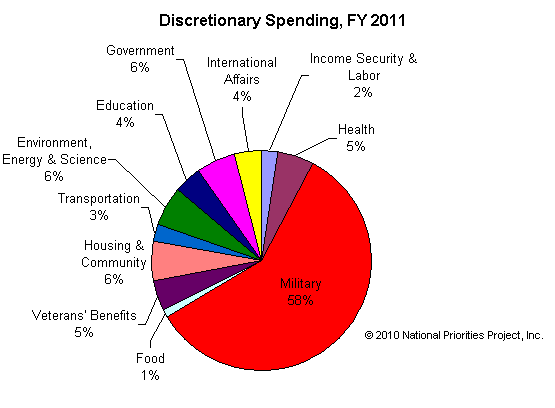
Discretionary Budget Priorities

What does the President really prioritize?  Well, the folks at the National Priorities Project have a nice little chart of the proposed discretionary budget for 2011.  Take a look for yourself…

Proposed 2011 Federal Discretionary Budget

Proposed 2011 Federal Discretionary Budget

Meanwhile, in the non-discretionary budget, Obama has sponsored a commission whose real mandate appears to be to figure out how to cut Social Security (and probably Medicare).

Priorities, priorities…  Blowing Afghanis into a find fine red mist is a priority…

No, The Feds don’t want the public to know the extent of the gusher

Seriously, Chris, I know you know better.  The Feds are not making sure independent scientists and media can’t measure the oil gusher by mistake.  Obama wants to downplay how bad this disaster is. If he didn’t, he’d allow scientists to deploy equipment underwater, which he has not allowed.  As it turns out, the flow is probably closer to 95K barrels a day, not the 5K BP and the government “estimated”.  And yes, those scare quotes are there because I don’t think they mis-estimated, I think they’re just liars.

I wonder what sort of sociopath you have to be to run BP, or the US.

Plus ca change…

Heading to America’s Future Now Conference

June 7-9th I’ll be in DC for the America’s Future Now conference, run by Campaign for America’s Future.  In exchange for letting my readers know about it, I get free registration (but not a free flight or hotel room).  Obviously registration is the least of the costs, and it’s not why I’m going.

I’m going for three reasons: first, because Campaign for America’s Future Now is about the most left wing an organization can be and still operate in the beltway.  I’m curious to see just how left that is when the hair’s down.

Second, because of the guest list.  It includes Speaker Nancy Pelosi, Rep. Alan Grayson, Arianna Huffington, Markos Moulitsas, Van Jones, Gov. Howard Dean, Rep. Donna Edwards, Rep. Jan Schakowsky, Richard Trumka, Andy Stern, Bob Herbert, Juan Cole, Digby, Deepak Bhargava, James Rucker, Drew Westen, Katrina vanden Heuvel, Robert Kuttner and Lizz Winstead.

These folks are, with a few exceptions, again, about as left wing as you can be and still expect not to be laughed at in DC (and in a couple cases, a step or two too far left.)  I want to hear, from them, where the acceptable left is in DC.  What’s the leftmost thing you can say?  What’s the leftmost thing you can expect to pass?  What do they really think of the Tea Party?  What do they really think of healthcare, the just passed primary season, and the upcoming elections? What do they really think about financial reform, immigration and so on.

Not that everything they say will real.  There’ll be plenty of pandering, but there’ll also be plenty of revealing moments.

Third, of course, is to meet friends.

If you’re considering going, you can see the agenda here, and the registration is here.  And whether you’re going or not, if you’re in DC around then and interested in meeting (I’ll be there on the 6th, leaving the 9th) drop me a line at admin-at-ianwelsh-net.

The End of the Beginning In Thailand

Or perhaps, more accurately, the beginning of the end of the beginning.  Army troops have taken control of the perimeter of the Red Shirt protesters.

The inability, or refusal, to come to an acommodation with the Red Shirts will bear bitter fruit for the future.  The bottom line is that the Red Shirts represent a prosperous rising rural class.  They elected their man,  Thaksin Shinawatra, to lead the country, only to have him removed by a military and they feel they have been shut out unfairly from power.

The army and monarchy are overplaying their hand.  They can crush the red shirts in Bangkok, but we’ll see how they do against a rural insurgency.  A rural insurgency they are begging for.

Beautiful country (I spent some time there as a teenager).  Pity it’s led by a bunch of schmucks.

The Thinker Americans Don’t Listen To

From Four Sociological Traditions:

Put briefly: Marx’s system rests on the point that labor is the source not only of economic value, but also of profit.  In a pure market system, operating under the impulsion of supply and demand, everything exchanges for its own value.  Hence arises the conundrum: where does the profit come from?  Marx answers: from labor, which is the only factor of production from which can be squeezed more than the cost of reproducing it.  This is, technically, the “exploitation of labor,” which means working laborers longer than the number of hours it takes to reproduce their own labor.  But capitalist competition impels manufacturers to introduce labor saving machinery, which in turn cuts their own throats.  For profit still comes only from the exploitation of labor, and the more that labor is replaced by machines, the smaller the basis of profit becomes.  The result, schematically, is a falling rate of profit and a series of business crises.  Across these crises, capital becomes more monopolistic as cweaker capitalists are driven out and into the ranks of the workers; simultaneously, productive capacity continually exceeds consumer demand among the displaced and increasingly unemployed workers.  (Randall Collins, pp. 54-55, 1994)

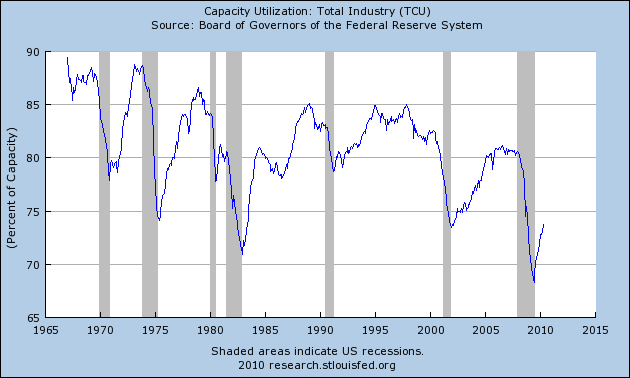
One doesn’t have to agree with the underpinnings of all of this (the labor theory of value, and the idea that there is a “lump of work” to be done) to look at it and see the workings of a first class mind, or to notice that where government stops making sure markets stay balanced, that some of what Marx predicted happens.  Consider the industry of your choice: whether banking, media, oil or pretty much anything else, and you will notice and inexorable drive towards oligopoly.  Take a look at a long term capacity utilization chart, and you will notice that decade after decade, utilization drops.  Take a look at wages and include real unemployment and real overemployment (people who want to work and can’t, as well as people who don’t want to work and have to) and see what Marx predicted happening.

Likewise, this doesn’t have to lead to a socialist revolution for it still to contain insight as applicable today as when Marx first formulated his theories.

us-capacity-utilization-to-april-2010-good

Page 487 of 532

Powered by WordPress & Theme by Anders Norén