
Ian Welsh

The horizon is not so far as we can see, but as far as we can imagine

The Enforcer Class

If you are a left-winger who wants to, in effect, overthrow a racist oligarchical system, the police are not your friends. Nor, need I point out, are corrections officers. Nor is most of the court system.

These people belong to the enforcer class. Police and corrections officers are paid not just in money but in license to brutalize. In most cases, they can get away with beating people up and even killing them. To stop a police officer from skating on murder requires riots, as a rule, and even that doesn’t usually work. The FBI has cleared themselves of every killing an FBI officer has performed for decades.

This is not incidental, this is not an accident; this is how our lords and rulers want the enforcement system to run.

Police are selected and trained and socialized to either become thugs or to cover up thuggery. Imbeciles will say things like “not all cops,” but it is virtually unheard of for the “good cops” to inform on the bad cops–they keep their mouths shut. This is wise on their part, of course, because the vast majority of police would turn on them in seconds if they were to betray the blue wall of silence.

America, per capita, imprisons more people than any other country in the world. Many of these people are non-violent drug offenders who used a drug which is less harmful than alcohol or cigarettes. Solitary confinement is widespread, prison rape and battery are widespread, and there is plenty of evidence of prison guard collusion in said rape and battery.

If you are an African American male, you are far more likely to have spent time in prison than in university.

And police lie routinely about those they arrest. How many people are in prison who didn’t commit the crime of which they are accused? How many would have been convicted if police hadn’t concealed exculpatory evidence? The answers to these questions are unknown for obvious reasons, but I would stake a great deal that it is a non-trivial number.

All of this assumes the accused even had a trial–most people in prison have never had one: They plead out. That’s absolutely not an indication of guilt, it is an indication that they couldn’t afford to fight the system. Justice is very expensive, and prosecuting attorneys advise defendants against going to trial. If people lose (which, again, doesn’t  necessarily indicate guilt), they’ll get book thrown at them.

The American “justice” system cannot operate without plea bargains. The state arrests too many people for that. Hardly anybody gets justice, people get railroaded to prison without a trial, based on the word of police who are willing to lie, and once they are felons, their lives are permanently destroyed.

The people who run this system are not your friends. They do not like you. They enjoy the authority they have, and if you “disrespect a cop,” even if you’re firmly within your rights, if they think they can get away with it, they will fuck you up, enjoy it, and firmly believe that you deserve it. Then they’ll lie about it.

Not your friends. Not your allies. The hard fist of the oligarchy, the boot stamping on your face over and over again.

If you do not understand this you are living in a fantasy land and delusional in the face of real, hard power.


If you enjoyed this article, and want me to write more, please DONATE or SUBSCRIBE.

The Honesty of Morphine Addiction

For the first time today, I had nicotine, in the form of gum. First I thought, “Wow, that’s powerful stuff.” Then I started thinking about addiction in general.

When I was in my twenties, I spent a lot of time in hospital, in considerable physical and mental pain. And by considerable, I mean “spent days screaming” and “some days no amount of painkillers was enough.” I also suffered from nausea. (Despite the major levels of actual pain, Ian’s rules of pain are that nausea is worse, and mental pain is worse than physical.)

Anyway, being that I was having such a swell time, I used rather a lot of Demerol and morphine. (Demerol is better, always choose Demerol, it provides a nice warm glow. Ahhhhh.)

I was concerned about addiction, but my doctor (a truly great man, and one of the only doctors I respect), said, “Take as much as you need, and if you get addicted, we’ll worry about it later.”

This attitude was, I suspect, composed in part by genuine empathy, in part by the nurses complaining about the screaming being “so tiresome,” and in part because, as I discovered later on reading my records, he didn’t think I was going to live, and there’s not much point in keeping a terminal patient from getting addicted to opiates. (Despite this, many asshole doctors refuse to give terminal patients adequate pain relief.)

But I surprised him, and screwed with the nurses’ betting pool on when I’d die, by living (Note: Said nurses’ pool is conjecture only. But if they’d had one, they should have let me place a bet!)

So I left the hospital, and yeah, I was addicted to morphine.

I stayed addicted for about three months, time in which I mostly slept, ate, and wished my parents would stop screaming at each other, or at least do it somewhere where I couldn’t hear them. Eating was probably the most important thing I did, since I’d left the hospital weighing 90 lbs, barely able to walk, and looking like Jesus right out of the desert.

As with the actual Jesus, good, honest “God Fearing Folk” treated me like a leper. Glassy-eyed and weaving around like a drunkard due to not having enough muscle mass to control lateral movement might have had something to do with it.

Or it could just be that good, honest, “God Fearing Folk” are mostly assholes to anyone who looks different.

Hard to say.

Or perhaps just impolite so say.

Anyhoo…addiction.

Morphine. Ah, morphine. Morphine is great stuff. You get super-relaxed, you don’t care about anything–including the fact that your back spasms every couple minutes and hits an inflamed, infected joint filled with liquid, causing you to scream. Great stuff, morphine.

But morphine, like all great mistresses, demands everything. Everything.

You can’t get shit done on morphine. And by shit, I mean “reading a book or playing a video game or having good sex.”

Morphine says, “You can have me, baby, or you can have everything else.”

So, eventually, I decided it was everything else. Breaking the addiction was unpleasant, but not that unpleasant. I tapered off till the only problem was I couldn’t sleep without taking morphine, then I stayed up about 40 hours before finally collapsing. Physical weakness was probably a big plus there.

Now, the problem with a lot of addictions is that they appear to allow you to keep everything, or most other things. Amphetamines give you more energy, let you work harder. Ecstasy makes you more sociable. Lower doses of opiates (a codeine addiction, say) let you squish through your life, and there are tons of more or less functioning alcoholics. My dad was an alcoholic, and he was extremely competent. Alcohol just made him a raging asshole to his family.

Most drugs have a cost: You get a few good years from amphetamines, years during which you look like a genius, then your brain fries and you’re never much good ever again. A lot of early Nazi success is based on “we’re all rocking amphetamines” and a lot of late Nazi failure is based on “this shit doesn’t work any more, and our brains are fried.”

But because a lot of drugs have their cost on the back-end, breaking the addiction is a lot harder. Cigarettes will kill you, but in the meantime they make you think better and they suppress your appetite. Alcohol, well, it relaxes you and makes you more social and it gets rid of that tight hot feeling in your gut from fear. SSRIs make you feel way better, but they really screw up your brain’s receptivity and uptake to serotonin, in ways from which you may never recover.

So even though morphine is really addictive, it has one great advantage over most other drugs: It’s honest. It says, “Baby, you can have me, or the world, but not both.”

In a way I was lucky, then: I got addicted to a drug that made its cost clear, upfront.  Most people aren’t so lucky and by the time they realize the cost, they’ve already paid most of it.

If you are ever addicted, may it be to an honest drug.


If you enjoyed this article, and want me to write more, please DONATE or SUBSCRIBE.
 

Canada’s Left-most Party, the NDP, Moves Ahead of the Neo-liberal Liberal Party

I am amused:

Canadian Federal Poll Results

Canadian Federal Poll Results

This is entirely the result of the decisions made by Liberal Party leader, Justin Trudeau, and by NDP leader, Thomas Mulcair. After Parliament was attacked by a mentally ill man, the Canadian Prime Minister, Harper, decided to push through a surveillance and police state bill, Bill-C51. This bill voided about half the Canadian Charter of Rights and Freedom.

Immediately after the attack, support for the bill was in heavy majority territory. So Justin Trudeau, the Liberal leader, decided to support it. Mulcair decided not to support it.

But Canadians turned out to be more sensible and principled than Trudeau thought (indeed, I was surprised, though I would have done as Mulcair did as a matter of principle); as time went by and the details of the bill came out, they turned against it.

More importantly, left-wing swing voters turned against it. And seeing that it was supported by the Liberal party, they turned against the Liberal party and towards the NDP, whose principles now appear to be driven by something other than polls.

Or, as I sarcastically noted some time ago, “I’d like to thank Justin Trudeau for single-handedly reviving the NDP’s election chances.”

Justin Trudeau is, for those who don’t know, the son of the great Pierre Trudeau, who ran the country through much of the 70s and 80s, and who is beloved by many on the left (and truly hated by many on the right, and in the West). Justin is also quite pretty, and has beautiful abs, which he showed off in a boxing match he won.

He was the heir-presumptive from the moment he was coronated by the Liberal Party (calling it an election implies there was any chance the Liberal Party wasn’t going to choose him)—the polls consistently showed the Liberal Party under him as the main opposition party to the Conservatives.

Meanwhile Mulcair kept just doing most of the right things. And one day Justin, who was always quite clearly a neo-liberal with few actual left-wing beliefs, made an error of judgment and character which left-wing swing  voters weren’t willing to overlook.

This is exactly the circumstance I was talking about in my article on ideology and political parties. Exactly:

Let me put this precisely: The job of a political party is either to get a few specific people into power, or it is to offer a clear option to the voters. If it is the second, then your job is to make sure that option remains available. In many cases, if you do so, you will get into power fairly soon—after two to three terms. In other cases, if you are a minor party, it may take decades.

If you genuinely believe in your policies, in your ideology, whatever it is, then that is fine. The public has a right to choose, you just make sure they have a real choice and not a menu that is all of the same.

Your job is to offer a clear choice. Mulcair, fairly consistently, has offered that clear choice. Perhaps he did so out of principle, perhaps he did so out of strategy, perhaps it was both, I don’t know. But it has paid off. If he had offered the same as the Liberals, those voters would not have gone to the NDP. (I happen to believe, in this case, that it is principle.)

The election is still some way off, and there is no way to be sure who will win. But this has changed a multi-year dynamic in a significant way. Last election made the federal NDP the official opposition party, but it did so on the back of the personal charisma of the previous NDP leader: Jack Layton. One election is not a pattern.  Two elections start becoming one.

If the NDP either wins the election or becomes the official opposition again, one will be able to make the case that they are one of the two main parties. At that point, strategic voting starts cutting heavily against the Liberals (a thought which brings most NDP supporters great schaenfreude). If you want the Conservatives out, you must vote NDP, not Liberal, so as to “not split the vote.”

I find that funny beyond describing.

And as for Trudeau, he was always an empty suit: A man cruising on his father’s name, “le Dauphin”, with no real accomplishments or weight of his own. Since their coup against Chretien, the Liberals have repeatedly selected as their leaders either men with little charisma (Martin, Dion), no weight (Trudeau), or neither weight nor charisma (hello Michael Ignatieff). Perhaps they should decide to believe in something other than being in power, and in doing so, deserve to be in power.


If you enjoyed this article, and want me to write more, please DONATE or SUBSCRIBE.

Congressional Surveillance Reform

I don’t have a great deal to say about the actual content of the reforms, except: “Too little, and I wonder if they’ll even obey it, but better than nothing.”

What is of more interest to me is that Democrats let Rand Paul steal the issue from them. Sure, the bill passed with mostly Democratic votes in the Senate, but Paul made it his issue, taking it away from people like Leahy.

Lots of left-wingers hate libertarians (I’m not a fan; their theory of government is childish and harmful if followed, in my opinion), but the two Pauls have led on this particular type of civil liberty issue in a way most Democrats haven’t. (And the Democrat I respect most on the issue, Russ Feingold, the only Senator to vote against the Patriot Act, is no longer in Congress.)

I wouldn’t vote for Rand Paul under most circumstances I can think of, but Feingold is standing for election again and deserves your support.


If you enjoyed this article, and want me to write more, please DONATE or SUBSCRIBE.


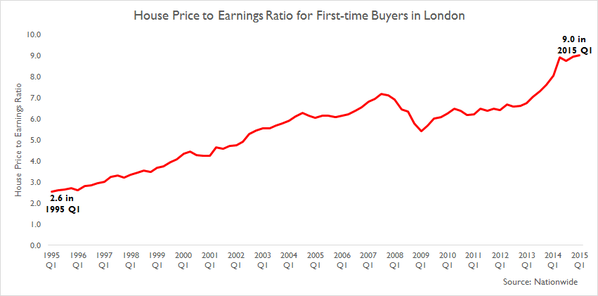
No One Who Hasn’t Sold Their Soul Can Afford a Home in London

And that’s why London is losing its soul and becoming an uninteresting place to live:

London housing price to earnings ratio

London housing price to earnings ratio

From 2.6 to 9.1.

This is a government choice. It is related to allowing the financial sector to take over London’s economy, with fake profits driving out real profits. It is related to the withdrawal from social housing. It is related to a decision to allow foreigners to buy real-estate they don’t live in most of the year. It is related to tax policy. It is related to the deliberate priming of the mortgage and housing markets by the central bank.

London is where the jobs are in England, but you can’t afford a home there if you’re an ordinary person and not attached to one of the various money hoses.

This same dynamic is playing itself out in world-cities worldwide: from Vancouver and Toronto in Canada, to New York, to Paris, to San Francisco, and so on. There are too many rich people, too many poor people, and too much pump priming from the central monetary authorities. If you live in the “rich sub-economy,” which can just mean being a retainer, you’re golden. If you don’t, you’re forced out.

There aren’t that many cities the global rich actually want to live in, play in, have vacation homes in, or retire to. There also aren’t that many financial centers in the world. Those cities that are both (like New York and London) are becoming impossible to afford the fastest, but so are all the “world cities.”

The irony of this is that huge real-estate prices drive up rents for businesses, and the interesting businesses (like book stores and one off retail outlets) are driven out of business. The artists, intellectuals, rebels, and so on that made places like New York, San Francisco, and London interesting are also driven out. The rich, being largely uninteresting and useless at anything but sucking from money-tits, make cities boring and sterile; they destroy much of what attracted them to a city in the first place.

What is left are expensive restaurants and overpriced chain fashion outlets: soulless and boring.

The rich, in numbers, are locusts, destroying what they think they value.


Fourteen Points on the World Economy as the US GDP Drops .7 Percent

So, while it generally takes two quarters for a recession to be so-called, it may be that the recession is here.

Let us recap the non-recessionary period:

  • The percentage of people employed in the US never recovered;
  • More than the total amount of growth went to the top four percent or so, with most of that going to the top one percent and most of that going to the top .1 percent;
  • The stock market had a huge bull market, even though the economy wasn’t working for anyone but the top few;
  • Outside America, the “south” of Europe never recovered in any meaningful way, and most European nations generally did badly for most of their citizens;
  • Various resource nations did well for a time, but their success was based on demand from developed nations or, more commonly, from China;
  • Chinese demand collapsed some time ago;
  • China has been printing more money than either Japan or the US; much more;
  • Japan’s “unconventional monetary policy” has been a roaring failure–if its intention was to get the Japanese economy going again;
  • The collapse in oil prices last year helped the US briefly, but because the rest of the world has rolled off a cliff and because those gains couldn’t go widespread, it was only briefly (this is as I predicted at the time);
  • Canada’s economy was hurt badly by the oil price crash, and because the mixed economy has been critically injured, there is very little else to hold up the economy;
  • Both Britain (or London…almost the same thing) and Canada have huge housing bubbles, and those bubbles, with the addition of financial games, are all that holds those economies together at this point;
  • Britain never actually recovered either, for the majority of its citizens–just a large enough minority to elect Cameron;
  • Australia has tied itself massively to resource extraction on the back of Chinese demand. There is no meaningful Australian economy whose fate is not tied to China.
  • India’s development is hollow neo-liberalism, and has seen an actual decrease in per capita calories. It is consumptive and limited to a few key areas.

Let me put this another way: The developed world is in depression. It has been in depression since 2007. It never left depression. Within that depression, there is still a business cycle: There are expansions, and recessions, and so on. Better times and worse times.

While cheap solar is a big deal, it is not yet deployed sufficiently to break the “widespread demand will crash the economy through oil price increases” problem, and this is exacerbated the by the deadlock rich elites have on most of the world’s politics and economic policies, since it is not in their interest to solve problems, but only to become more rich.  Not that solving problems is something they mind, if it makes them richer and keeps everyone else poor.

The world still has very few problems we couldn’t solve if we acted on them in a productive way (though some, like climate change and the great die-off, are beyond the point of no return for catastrophic damage), but that’s largely irrelevant while public policy remains in the hands of oligarchs. There is some reason for hope, as left-wing parties rise in Europe, but those green shoots are still nothing but green shoots.

I suggest that my readers who are able to make money do so now, you may soon find that you can’t. This is especially important if your employment is precarious.  Take care of yourselves, and take care of each other, unless you are lucky enough to live in the few rich, social democratic states left, you cannot expect much aid from your governments.


If you enjoyed this article, and want me to write more, please DONATE or SUBSCRIBE.

Trying to Move the Democratic Party Even More to the Right

Peter Wehner in the New York Times:

AMONG liberals, it’s almost universally assumed that of the two major parties, it’s the Republicans who have become more extreme over the years. That’s a self-flattering but false narrative.

This is not to say the Republican Party hasn’t become a more conservative party. It has. But in the last two decades the Democratic Party has moved substantially further to the left than the Republican Party has shifted to the right.

Wehner then goes on to argue with what amount to mostly social policies (gay rights!) and a few other cherry picked issues, to argue that Obama is substantially to Clinton’s left. (Not on immigration, executive power, non-identity-based civil liberties, assassination, and a number of other issues.) He also conflates conservatism with running surpluses (not in living memory), and so on, and ignores Obama’s help in bailing out the rich in an unprecedentedly massive way.

Or look at this beauty:

Those who insist that the Democratic Party’s march to the left carries no political risks might consider the fate of the British Labour Party earlier this month. Ed Miliband, its leader, ran hard to the left.

Miliband, of course, did no such thing. The SNP ran hard to the left, and swept Scotland. Labour ran slightly to the left of the Conservative party, and did terribly.  What Wehner is doing is “creating” facts, attempting to move the major parties rightward, and not leftward.

But I’m not particularly interested in in debunking his ridiculous column; I simply want to note that it exists. This is the creation of the circle of acceptability, which is so vastly important in determining what parties are willing to do when they take power.

Read my earlier article on the British election for a more detailed analysis of how right-wing framing works, and how it is, now, beginning to fail the neo-liberals.

(h/t Tim Armstrong.)


If you enjoyed this article, and want me to write more, please DONATE or SUBSCRIBE.


How to Be Liked or Even Loved by Blue Collar and Service Workers

Be friendly, interested, and acknowledge their existence.

You will be amazed how soon they think you’re a wonderful person.

What I find amazing is how little it takes: make eye contact, smile, ask a question or two. They’re in a near complete drought for people who treat them with even a smidgen of kindness, respect, and interest.

If you need a self-interested angle: Once you’ve established this relationship (shallow as it is), you will be astounded at what they will be willing to do for you, often without you even asking.

File this post in “absolutely obvious things most people don’t do.”


If you enjoyed this article, and want me to write more, please DONATE or SUBSCRIBE.

Page 405 of 532

Powered by WordPress & Theme by Anders Norén