Ian Welsh

The horizon is not so far as we can see, but as far as we can imagine

French Taxi Drivers Receive Concessions Through Violence

There are only two conditions under which labor receives a decent wage:

  1. It is in short supply generally (there is not enough and companies must generally compete for it).
  2. It is in short supply in a specific job category, because other people aren’t allowed to horn in (due to unions, guilds, medical degrees, law associations, taxi medallions, etc.).

I bring you now to the French Taxi riots over Uber:

“They’re beating the cars with metal bats. This is France?? I’m safer in Baghdad.”

70 vehicles were damaged, seven police officers injured and 10 arrests made on Thursday, when 30 legal complaints were filed against UberPop.

and…

France’s interior minister, in a bid to halt a day of sometimes violent protests by taxi drivers angered by Uber’s low-cost UberPop service, said Thursday that the app-based business must be shut down. He said orders would be given to seize vehicles.

This is what works. This is the only thing that has ever worked worth a damn. Unions drove higher wages in the industrial era, and unions were violent. Period. End of goddamn sentence. They went toe-to-toe against strike breakers, they fought  police when necessary, miners even once fought the army on a mountain.

You will only have a good lifestyle when you have the POWER to insist that you get a good slice of the pie.

POWER.

Thus endeth the sermon on the brutally obvious.


If you enjoyed this article, and want me to write more, please DONATE or SUBSCRIBE.

Greece and the Emperor’s New Clothes

We are all familiar with the story of the Emperor’s new clothes, yes? The emperor is sold “clothes” which are imaginary, wanders around naked, and everyone pretends he’s clothed until a child points out he’s naked?

Commenter MFI pointed out yesterday that Oliver Blanchard, the chief IMF economist, had made the following assumptions about Greece in July of last year:

1. The Greek economy would grow by three percent both this year and every other year until 2020.
2. Inflation would average between one percent and two percent a year both this year and every other year until 2020.
3. The Greek government would run a primary budget surplus of four percent a year.

As MFI points out, at best, these assumptions are delusional. Greece is in forced austerity; they aren’t going to make these targets.

Edward Harrison has been on the same beat:

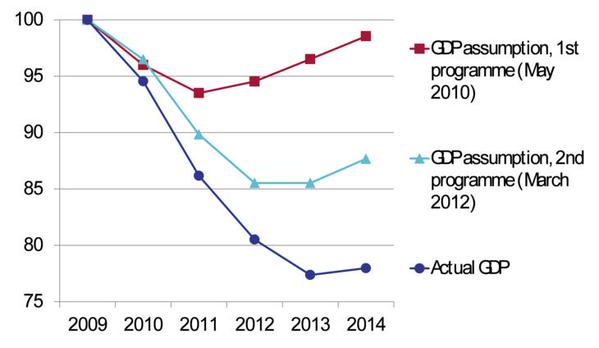
…the IMF revised down its estimate for Greece’s 2014 gross domestic product by some 22 percent in the space of 18 months.

And:

Greek GDP forecasts collated by Edward Harrison

Greek GDP forecasts collated by Edward Harrison

As Edward and MFI note, these are damning.

But they are of a piece with estimates of the effects of austerity. Austerity is a reduction in demand. Reduction in demand leads to economic activity being lower than it would be otherwise. Governments who spend less money buy less stuff, this is indisputable. Then, everybody has less money and almost certainly buys less stuff as a result, thus reducing the size of the economy.

Meanwhile, money has been given to rich people and corporations who, mostly, have not spent it and when they have spent it, they’ve spent it on luxury goods.

Austerity cannot help but reduce GDP. This is what it is designed to do.

But it is sold as a way to make economies better. You cannot, as a government or quasi-governmental agency (like a central bank or the IMF), admit that austerity will make the economy worse and many of the people in an economy to which it is applied worse off.

The question, then, is the old one. “Evil, or stupid?” Is Blanchard, for example, such an ideologue that he believes the assumptions which allow him to forecast a better economy under austerity? Are the other economists who have made similar forecasts similarly stupid? I mean, assuming moderate stupidity (normal), they might have believed it in 2008 or even 2010, but we’ve seen the effects of austerity since the financial crisis, and that’s going on seven years.

These people are either very stupid or are doing what they feel they must to keep their jobs and their membership in a very lucrative club. If they were to say, “No, these policies don’t work,” would they keep their jobs?

It’s not that we don’t know austerity doesn’t work, if by “work” you mean “improve the economy more than not being in austerity would,” we do. It’s only ever worked in theory by making very dubious assumptions, and it has never worked in practice.

So, at this point, if you believe austerity works, you’re either an extraordinarily blind ideologue, or you’re crooked, on the payroll, and know what you’re doing.

Austerity is the policy that the IMF, most central authorities, and all neo-liberal parties (which means almost all parties in power in the EU) believe in. It is a policy which works: It puts public assets up for sale which would not be otherwise, so that rich, private investors can buy them up. Combined with “unconventional monetary policy” (the two are Siamese twins), it makes sure that the rich get richer, corporations are flush with cash they do not use to hire workers, and that everyone who isn’t rich, or part of the close retainer class, loses.

You really, really don’t want to fall out of that close retainer class. They are paid very well (Lagarde receives a six hundred thousand per annum salary, entirely tax free), they are treated well, and their future job prospects are secure, as are those of their families.

The Emperor, in other words, is bloody well wearing clothes. If you want to remain the chief economist of the IMF, you had best remember that.

Austerity does what it was meant to do. I predicted its course in 2009, as did many others, and it has performed exactly as expected.

It is working: Its advocates are its beneficiaries. The people who enforce it are benefiting as well and there is a sufficient constituency, both at the elite level and the common level, to keep it going (remember, Cameron was re-elected in the UK, and Labour got many votes when its essential promise was “slightly kinder austerity”). A few countries (Germany, for example) are winning under this policy regime.

So austerity will continue. It is a successful policy which does what it is supposed to do and which has a constituency sufficient for its continuation. It must be sold by lies, to be sure, and many of those who sell those lies probably believe them, because they personally benefit from pushing austerity and people prefer to believe that they are honest and working for good.

Others, I am certain, know it is being sold with lies. Who falls into which camp? Who knows? The end affect is the same.

The Emperor has no clothes and beatings will continue until morale improves.


If you enjoyed this article, and want me to write more, please DONATE or SUBSCRIBE.

The Lesson of Greece Is that Europe Is Run by Functional Sociopaths or Psychopaths

Syriza has made an offer which includes pension cuts and VAT tax increases, and “institutions” have refused to accept it, saying that (among other things) parametric measures aren’t acceptable (though they accepted them from Spain and Ireland). They will now counter-offer.

By “among other things” they mean:

Labour laws, collective bargaining, pension reform, public sector wages, opening up closed professions, investment as well as value-added tax and corporation tax.

You do not believe, in any case, that any of these things will be good for ordinary Greeks, do you?

Total Greek Debt is about 330 billion Euros. 246 billion of that is “bailout funds,” of which over 90 percent went to private banks. As I (and many others) noted back in 2010, Greece should have defaulted then. This “problem,” such as it is, is now almost entirely the creation of attempts to bail out private lenders who should have done their due diligence, and who deserved to lose their money.

I note that the ECB is doing 1.1 trillion of “unconventional monetary policy,” about a third of which is Greek debt–mostly debt they piled up after 2010. A hundred billion of that, piled into 100 year bonds at 1 percent interest would about deal with the problem; Greece could handle the remaining debt.

A hundred billion, in today’s world, is really not that much money.

But the issue has never been Greek debt, per se, the issue has always been making it clear that no one can default and get away with it, let alone leave the Euro. Greece has been used to make an example, and when they elected a government with a mandate to negotiate an end to austerity they had to be taught an extra lesson for thinking that democracy trumped the right of debtors to run the government of those who owe them money and can’t pay it back.

(This is not remotely an exaggeration, as the terms of the deals made include the Government having to run new policies past “institutions”).

Greeks do not want to leave the Euro. They cannot devalue their currency, which is what they need to do, without leaving the Euro. They do not, apparently, even want to default and stay in the Euro.

In other words, Syriza has no bargaining position based on a popular mandate. Its mandate was “end austerity, but do it without being able to make any credible threats.”

Based on its public mandate, Syriza has no BATNA–Best Alternative to a Negotiated Agreement. In essence, they must take anything that Europe offers.

Or Syriza can turn to the public and say, “there is no deal to be had.”  But “institutions” never give them the time necessary to, say, run a referendum to get a mandate.

Greeks want to stay in the Euro, as commenter Mandos has often pointed out, because the Greek government is terribly run. They’d like to be run by the German government. The problem is, the Germans aren’t offering the government Germans get, they’re offering austerity run by the Greek government.

If Greeks want a good government, they’re going to have to create it themselves. The first stage requires giving a government a mandate allowing them to do what reason and reality both dictate must be done: seriously threaten to default and/or leave the Euro, and follow through with the threats if a good deal isn’t forthcoming.

Absent this, Syriza’s only choices are to buckle, or to do something for which they don’t have a mandate. Of course, sometimes doing the right thing goes against the wishes of the majority of the population–and these are big steps, so it is hard to blame the Greeks for being squeamish. And in hard electoral terms, if Syriza did the right thing, the economy would need to improve before the next election or they’d be out.

But, also in hard electoral terms, they may as well, because if they don’t, they’re going to lose the next election anyway. The Greeks voted them in to end austerity; they will have failed, and the Greeks will most likely try someone else.

Good luck to Greece, the Greeks, and Syriza. They’re going to need it. But luck tends to come to those who are thinking straight about the reality of their lives, and the Greeks aren’t.

As for the “institutions,” let this be your daily reminder that our leaders are functional sociopaths, at best, but act more like psychopaths. Austerity has meant immense suffering, but it is more important to them to bail out their rich donors and friends and help make them richer and more powerful, than it is to make tens to hundreds of millions of lives (far beyond Greece) less miserable.

Psychopaths.

When you’re trying to predict how European elites will operate, assume that they are sociopaths on a good day, psychopaths on any other day. The pain and suffering of those whom they do not personally know is not real to them, and they do not care how bad life is for anyone who doesn’t make their lives, personally, better.


If you enjoyed this article, and want me to write more, please DONATE or SUBSCRIBE.


Humans to Go Extinct in Three, Two—

So, a very conservative study on the rate of species going extinct has come up with the following:

Extinction Chart v06

One hundred and fourteen times faster than the normal background rate.

“If it is allowed to continue, life would take many millions of years to recover, and our species itself would likely disappear early on,” lead author Gerardo Ceballos of the Universidad Autonoma de Mexico said…

Cheerful.

This is the point where a sane species would be in a controlled panic.

Which brings us to Laudato Si. The obvious issue with Luadato Si is Pope Francis sticking to current church doctrine against birth control. It is incontrovertible that every person has a carrying load for the planet.

But Francis makes a great number of good points, starting with the fact that we are vastly wasteful. It is not that we have necessarily surpassed the Earth’s carrying capacity in theory (only in fact). Half the food in America, for example, is wasted. Suburbs are vastly wasteful. Lawns are idiocy. Most of our buildings use far more energy than they need to. Improved agricultural methods can produce up to ten times as much produce on the same amount of land, for less water. Urban indoor agriculture using LEDs is showing great promise. Centralized manufacturing, which requires concentrated power which cannot yet be provided by renewables could be decentralized even with out current tech, and within fifteen years or so we could radically decentralize it.

And so on.  There are more good ideas than one could possibly list. These ideas would allow us to support our current population on much less land and allow the environment to renew itself. We could massively reduce carbon output at the same time, stop overfishing the seas, and everyone would still be fed, have a place to live, and so on. Yes, most suburbs would be a thing of the past, but the question of “suburbs” vs. “human survival” shouldn’t be a hard one.

All of this would probably not be enough.

Yeah, sorry.

We’ve left it too late. The issue is the carbon and other hothouse gases already in the environment. They are so high that we will see release of methane from the arctic, both land and sea. This has already begun. It will continue. Even entirely stopping carbon tomorrow (which is impossible) likely wouldn’t be enough. Cutting carbon by half would definitely not be enough.

We needed to be acting back in the 1980s when climate change science first became overwhelmingly likely to be true.

We didn’t. An alien species studying our extinction, should it come to that, will only be able to conclude we did it to ourselves.

What I’m seeing is that we are on the wrong side of a self-reinforcing cycle.

We’re going to need geo-engineering. It’s messy and we’ll probably screw it up, but we don’t have much choice left.

Because there is a chance that even doing everything right, we’ll still go extinct (especially if we bork the oxygen cycle, a non-zero possibility), we need to be crashing biospheres. We’ve never made biospheres work before; we cannot create artificial environments cut off from the world which work. We need to.

That understanding will be very useful in any scenario–from cleanup of major, but not catastrophic, environmental damage, to triage on a crashing ecosystem, to saving a breeding population in a world which no longer supports humans.

A sane humanity, who self-governed in ways that made sense, and which was concerned with the welfare of their children, would have headed off most of this. A not-completely-insane humanity who had failed to take action before would now be making this the highest world priority.

We are doing neither.

Instead, our best and brightest are figuring out the best possible ways to serve ads, creating the most impressive mass-surveillance system the world has ever seen, and playing leveraged financial games which are resulting in austerity for much of the world. Destroying the human resources which we should be using to save ourselves (and so many other species, who have done nothing to “deserve” their extinction).

One can argue, and many will, that this is entirely the fault of our rulers. Maybe, maybe not, but it won’t matter when we’re all dead, and I’m not seeing widespread revolts because of mismanagement. And hey, if worse comes to worst, and enclaves are set up to save a small breeding population, remember, it’s the “leaders” who did most of the damage who will get into them.

You won’t. Your children won’t. You live or die with saving the Earth.

Probably you die.

But, then, most people probably figure they’ll die before the environmental collapse gets them. If they’re at least middle-aged, they’ll probably win that bet.

Their kids won’t. Too bad for them. Loved them enough to do everything except save their lives from a completely predictable threat.


If you enjoyed this article, and want me to write more, please DONATE or SUBSCRIBE.

The American $10 Bill

The Treasury may be changing the US $10 bill to feature a woman. Sounds good to me, but I came across these two previous $10 bills, and I have to say both of them are WAY better than the current one.

Previous 10 dollar US bills

Previous 10 dollar US bills

I like both, but I particularly like the classicism of the second.

Burn In Hell?

I am amused how many American conservative Catholics are now ignoring the official teachings of the church on the environment.

It is, I suppose, lucky for them that official teachings now define hell as “the absence of God’s love.”

But it’s good to know that they actually do believe that one can pick and choose teachings.  Given that this is the case, can we now just ignore them every time they talk about abortion or birth control?

I’ll have more on the Pope’s encyclical soon, most likely.

Push Is Coming to Shove with Greece

Greece is now close to default (and possible Grexit, though it can default without leaving the Euro):

The radical wing of Greece’s Syriza party is to table plans over coming days for an Icelandic-style default and a nationalisation of the Greek banking system, deeming it pointless to continue talks with Europe’s creditor powers.

Syriza sources say measures being drafted include capital controls and the establishment of a sovereign central bank able to stand behind a new financial system. While some form of dual currency might be possible in theory, such a structure would be incompatible with euro membership and would imply a rapid return to the drachma.

The confidential plans were circulating over the weekend and have the backing of 30 MPs from the Aristeri Platforma or ‘Left Platform’, as well as other hard-line groupings in Syriza’s spectrum. It is understood that the nationalist ANEL party in the ruling coalition is also willing to force a rupture with creditors, if need be.

“This goes well beyond the Left Platform. We are talking serious numbers,” said one Syriza MP involved in the draft.

The “creditors” believed and believe “there are no other options” but capitulation:

The creditors argue that ‘Grexit’ would be suicidal for Greece. They have been negotiating on the assumption that Syriza must be bluffing, and will ultimately capitulate. Little thought has gone into possibility that key figures in Athens may be thinking along entirely different lines.

I had been dismayed by Syriza’s apparent unwillingness to consider default and Grexit, while acknowledging that given their election campaign (premised on staying in the Euro) and Greek’s own preference for staying in the Euro, they might well be negotiating deliberately to make the case that Europe will offer an unacceptable deal. And if Europe did offer a good deal, well, excellent!

This is all coming to a head. The demands made by creditors are virtually all punitive, things like reducing pensions and decreasing pharmacy times and wages and so on. Austerity. The vast majority of Greece’s problems, other than its massive debt overhang, are not caused by ordinary citizens, they’re caused by Greece’s rich not paying their share.

But all our lords and masters can conceive of when money must be scrimped his hitting regular people harder, soaking them. They make mention of taxing Greece’s rich and ending corruption there, Syriza agrees, but they are never willing to acknowledge that that an unsustainable debt load is the real problem, let alone get serious about tracking down Greek money which has left the country.

That, of course, is the real problem. There is talk of capital controls, but most of the moveable money and assets left in 2010. It’s all gone. I’d still impose capital controls, but it has the taste of barn door slamming after the horses are gone.

Nonetheless, Greece still has its immovable capital, its land, and its people. While Greeks would have to eat quite a bit less meat and non-seasonal vegetables, if they’re willing to do that, they can certainly feed themselves. Deals can be made with Russia (whom Syriza is on good terms with) and, if necessary, Iran and Venezuela to get the oil they need.

Greece has options. They don’t need to be in the Euro for prosperity, in fact they need to be out of the Euro for it; and they definitely need to default. Now that the “institutions” have made the case for Syriza that no compromise, no deal, is possible, I hope they will do so now, then prosper (though it will take a few years.)


If you enjoyed this article, and want me to write more, please DONATE or SUBSCRIBE.

Being Effective and Liked in the Workplace

A couple weeks ago, I wrote an article about how to be liked by service employees and blue collar workers. I wasn’t writing about “in the workplace” or “as a manager,” but most commenters read it as both.

Today, let’s actually talk about being effective (and yes, liked) in the workplace. I’ve been out of a corporate environment for years now, but my last corporate gig was at a large insurance company. It wasn’t managerial, though I led the occasional team and was responsible for one large departmental reorganization. Instead, I was a senior line employee: responsible for getting stuff done that required the help of many other people, but without the authority to just make them do things. By my count, at one point, up to 16 other specialties, spread across almost a dozen different departments, could be required.

I had no authority, but I needed other people to get my job done.

Until I went off the rails in my last year or so, I was very good at this job. And I’ve held line authority positions elsewhere, including being a dispatcher and a managing editor.

So, here are Ian’s guidelines for getting folks to do what you want, at work, and having them like it. To be clear, these never worked on everyone, but they have always worked on enough people.

First, find something to admire. A couple years into that corporate gig, I was talking to a friend who was complaining about our co-workers and how she could never get them to do anything for her.

I said, “Most of the people you’re complaining about are happy to help me. It might be that I like them.” The co-worker she found a persnickity snob, I found precise, knowledgeable, and willing to share his knowledge. The boss she disliked (our mutual boss) was one of the best bosses I ever had, understanding and kind, who never failed to give me the material support I needed. And so on.

Most people go through life with very little admiration. Their families take them for granted at best, nag them at worst. Their bosses pay them attention only when something goes wrong. Their coworkers are concerned only with themselves. All of this is natural– people’s first and second concern tends to be themselves, and they are interested in others only as those people reflect them.

But it’s not hard to find something to admire or like in most people. Maybe they work hard, maybe they’re reliable, maybe they’re really precise, maybe they’re insightful. Find something and genuinely admire it. Don’t be a flatterer, your admiration and appreciation must be real. Faking it is endless work, and unless you’re really great at being fake, you’ll screw it up.

Remember, you don’t need everyone, you just need enough people.

People can tell when you actually like and admire them. And they want to keep that admiration, so they’ll be generous with their time, advice, and help. This isn’t enough by itself, but it is the essential foundation.

Next, treat them right.

I had a few rules I followed at work.

1) If I ask someone to stay late to do something for me, I don’t leave until the job is done, either. It’s my job to be there to help them if they need it. In seven years at that job, I only left work once before someone who was doing me a favor. I apologized and she forgave me, but if I had made a habit of it, she wouldn’t have stayed late for me.

2) If someone helped me, I cleared the way for them. If I asked them to do something, I ran all the interference I could; I got their bosses permission if necessary, if anyone else was needed to help, I was the one who ran them down. If they needed anything else to get it done, I got it.

3) If they were doing me a favor and something went wrong, I took the blame, even if I could have shifted it onto them, even if they made a mistake. They would never lose from helping me if I could make it so they didn’t.

4) If something went right, I made sure they got the credit, and that meant to their boss, to their face, and publicly to others. They got praise, and that praise went where it would make their lives better. Including in writing when appropriate (usually) and in terms of my nominating them for workplace prizes and whatnot.

5) In general, I acted like they were great people, and I meant it. My gratitude was not fake or bombastic, it was real. I was glad to see them, I smiled at them. I thought they were great people. (Note, I did not socialize with my co-workers, with very few exceptions.  This is not based on being their out-of-work friends.)

Did everyone like me? Hell no, some people hated my guts. But enough people liked me. I was able to get many people to do favors for me they would not do for actual management. I was able to get people to stay late, for example, who would simply not stay late for their actual bosses. (It was the sort of workplace at which the boss could not just order someone to work extra hours.)

I was also always on very good terms with my immediate boss, which has been the case in almost all my jobs, simply because I delivered.

Unfortunately, I can’t give any advice on managing up beyond the immediate boss level. As a rule, I’ve always been terrible at dealing with upper-upper-management. Perhaps because they’re used to people saying what they want to hear, and I don’t do that.  Remember, my admiration was real. But I don’t blow smoke up people’s asses: If something can’t be done, I say so. If something is illegal (I handled the compliance for the area), I say so. If there will be negative effects from a decision, I say what they are. And if more resources are needed to get something done properly and in time, I let them know.

Or, perhaps, I was just kind of a jerk.

But the jerkiness was, in most cases, predicated on protecting my people. I can’t override management, especially senior management, but I can put my body in the way, and I can say, “If you do that, it’s going to go wrong in the following ways.”

A few senior management types appreciated that, my direct managers almost always did (a couple exceptions aside), but the more senior the management was, the less I found they were interested in the real world consequences of their decisions, and the more they wanted to be told “we can do that,” even if their ideas were terrible.

So, that’s the Ian Prescription for getting shit done at work, and being liked by enough people, but pissing off the wrong people. Will you be loved? I can’t say I was. Not really my personality at the time. But when I asked for help or favors, I got them.

The same general strategy worked when I was in leadership positions, if combined with strict fairness. When I was a dispatcher, for example, I did not play favorites. The person who could do the delivery fastest got the delivery, even if it was an easy, well-paying one; I didn’t give it to my “favorites.” You only got sidelined for important deliveries if you’d proved, again and again, that you were unreliable. Most dispatchers I dealt with had favorites. I, being human, did too. But I didn’t let that affect my dispatching.

In leadership: fairness. People are treated in accordance with their demonstrated abilities and are given chances to show what they can do. Their successes are celebrated, publicly, their failures discussed in private unless an example needs to be made (which, on occasion they did; justice must be seen to be done).

All of this, in my opinion, is just an extended example of the Golden Rule: Do unto others as you would have them do unto you; combined with some common sense (no, I’m not going to let you do shoddy work).

Treat people right, and they’ll treat you right. There are some people with whom “right” treatment doesn’t work. If I’m a manager, I get rid of those people. If I’m in a position, as I was in my corporate gig where I didn’t have the power to do so, I’d sideline them to the extent that I could; nothing “mission critical” or “Ian critical” went through them if I could avoid it.

Treat people right. It isn’t hard.


If you enjoyed this article, and want me to write more, please DONATE or SUBSCRIBE.

Page 404 of 532

Powered by WordPress & Theme by Anders Norén