
Feel free to use the comments of this thread to discuss issues unrelated to recent posts.

Image by TW Collins
Let’s talk money. Everyone’s favorite subject, perhaps after sex.
Money does a lot of things, but one of the most important things it does is signal “Do this, do that, don’t do that.” It says, “We need more of this, we need less of that.”
As a result money moves people around. It compels them to do things. Or, if you prefer, “profit” does. How much you can make doing something. You have to at least break even, and the more profit you make, the more you should do of something.
This is completely vanilla economic theory. This is how capitalism is supposed to work.
Right now, we have a situation where there are things we need to do, but the price/profit/wage signals are saying, “Build super yachts. Optimize selling ads. Build more weapons. Play financial games instead of building things, because financial games make more money.”
That’s the reality. That’s what money is saying, and people are responding to it.
So we have a vast explosion–not of nurses, but of health administrators. We aren’t sinking carbon to prevent climate change, because there’s no money in it. We are creating palliative medicines rather than cures, and monetizing medicines like insulin ($300).
People are doing what money tells them to do. It’s that simple.
But, as I’ve said before, money is a social construction, and price signals are not given by God and nature: They are choices. Political choices. That isn’t to deny some physical reality behind what they signal as “worth,” but that reality has obviously been elided, when, in America, the life spans of some demographic groups are dropping while super-yachts and luxury condos are hot to trot.
All systems have to do only one thing: Whatever is required to keep the system in power.
That’s all they have to do. Whether or not human welfare is advanced, whether or not we care about animals or nature is irrelevant to the raw calculus of power and staying in power. Until it effects staying in power.
If the hoi polloi can be kept from revolting or demanding (remember demands are based on “or else,” they are not requests) well then, the powerful will not do anything that does not increase their power or money. They will only care about human welfare outside of their own group if they feel they must, or if, as happens occasionally, they see their group as being something other than the elite group.
Right now, elites don’t care about other humans enough to reshape the money and political systems (the same thing, ultimately) to prioritize human welfare, avoid a great-die-off, or stop climate change. This is clear. It is not arguable, it is a fact, based simply on their actions.
If money isn’t saying, “Do the right thing,” then money is failing. The argument of capitalism was simple: “Markets will do the right thing, if we mostly get out of the way and let them operate.”
That’s just not true. Markets only do the right thing if they are properly managed. That management may look light at times, but it actually has to be ferocious because the first thing that anyone who wins a market fight does is try to stop the market operating properly; they don’t want price signals that would take away what they’ve won.
In 2007/2008 those price signals were given. They said: “The entire banking and shadow banking system has allocated resources to the wrong things. All of their money and power needs to be taken away from them. They need to go bankrupt and that power and money needs to go to other people.”
We ignored that signal. We pretended that ignoring that signal was the right thing to do by propping up failures and incompetents–who had not only massively mis-allocated resources, but engaged in mass fraud.
It wasn’t the right thing to do. Capitalism requires both outside management and an insistence on market discipline. It is most important that market discipline is exercised on the large actors, not the small ones, because the large ones set the market terms and make most of the allocative decision. When you offer people too-cheap loans, they will take them. YOU are the one offering them; YOU are the one in the wrong.
Price signals must encourage doing the right thing. When those with market power either misbehave or mis-allocate money, they must lose their power to do so.
This is fundamental, and no society which relies on money to determine allocative decisions will prosper if it is not managed properly.
The results of the work I do, like this article, are free, but food isn’t, so if you value my work, please DONATE or SUBSCRIBE.
Real political change happens infrequently. The cycles are decades long. So, most recently, there was the crisis of the 70s which led to the rise of neoliberalism: Thatcher and Reagan. Everything that has happened since then, in the Western world and Japan, has been an unfolding of that. There are some important sideshows, but this is a neoliberal world.
Before that the Crisis of the Great Depression and WWII led to the post-war era. In the US, that runs from 1933 to 1980, essentially, but it was in crisis from about ’68 or so.
There are other such cycles, for example, in the early 1900s there was a collapse of support for Imperialism in Britain. It disappeared in a few years (I know a lot less about this). Everyone had to support it for decades, and suddenly they didn’t.
During a period where a sub-ideology reigns (all of these were capitalist periods, but they were very different forms of capitalism) it’s almost impossible to do things against the trend. The best you can do is grip on for dear life and try not to lose too much. You can, alternatively, go orthogonal: Neoliberals are basically okay with identity politics, so you can make gains there. Doesn’t mean it’s easy, but it can be done.
But the real fight is over the NEXT period, the transition. Key ideologues created neoliberal thought long before Thatcher and Reagan. When things go to hell (stagflation is the end point of the 70s) for long enough, people become willing to change ideologies.
They choose from the available ideas. Ideas with muscle and money, or which appeal to elites (if the elites aren’t being changed), have a better chance. But the key point is that if your ideas aren’t there, and being considered in the crisis period, you’ve already lost.
The conservatives were and are right: Ideas have consequences. Ideas are powerful. Next to physical facts, they are probably the most important factors in human existence (every invention is an idea first).
We are probably in a transition period. If we aren’t, we will be soon. Take this into account: Whoever wins this transition period will rule, if not the world, then a significant chunk of it. Everyone else will either be working out their ideas, resisting them, or trying to do something orthogonal to avoid them.
Finally, there are different types of ideas. Technological ideas are one subset. They aren’t as determinative as we moderns think. They determine the possibilities, but possibilities can lie fallow for a long time. Certain societies are possible with the steam engine, or the internal combustion engine. Composite bows and stirrups make other societies possible. The stirrup and composite bow were around for a long time before Genghis Khan showed what they could truly do. The Chinese invented gunpowder, the Ancient Greeks had toy steam engines.
So beware of over-determination, and also beware of the idea that histories and societies which didn’t happen–or have not happened–were therefore impossible.
Meantime, transition period, ho. Get to work, your enemies (and you have enemies) are.
The results of the work I do, like this article, are free, but food isn’t, so if you value my work, please DONATE or SUBSCRIBE.
Since it’s coming up on Labour Day weekend here in Canada, I thought I’d write a basic post on labour unions.
There’s been a vast effort, funded by huge amounts of money, to discredit unions and say they’re bad for workers.
That’s simple nonsense, but as with things like climate change denial, nonsense backed with billions of dollars is effective.
So, let’s run through the simple logic.
When we negotiate to get a job, or for a raise, in almost all cases we are negotiating with a group–the people who control a company, who are more powerful than us. They have more money (d’uh), and we need the job more than they need us. There are exceptions, of course, and it’s a lovely position to be in, but the number of exceptions is minute in a job-based economy like ours.
Corporations hire workers to do something which, combined with the effort of other workers, will make money.
The amount of money they make from a worker is “what the worker produces,” or “what the worker is paid.”
In other words, a corporation wants to make as much money as possible from your work, while paying you as little as possible, because that is their profit: That’s what they make.
You want the opposite.
This is a straight up conflict of interest. There can be a compromise which satisfies both, but really, the group hiring you wants you to make as little as possible so they can make as much as possible.
And they are more powerful than you. Also, you need the job, more than they need you. Without a job, you will be homeless and probably die; without any individual worker, they can usually just hire someone else.
So there is an imbalance of both power and consequences: Your BATNA (Best Alternative To A Negotiated Agreement) is often shit.
Now, it isn’t always shit. In a really tight economy, which most western countries haven’t had since the early 70s, you can just get another job. There are less workers than jobs. But that hasn’t been the case for a long time–except for brief periods in specific locations or jobs, for decades. Where it is the case, companies work to change that, as fast as possible because they don’t want you to have alternatives.
This stuff is important for people who are not in management (which, in the old days, included bottom-level supervisors.) It is unimportant to senior executives, who are usually the people really running the company, and who are in effect negotiating with themselves for compensation. You’ll notice that they reward themselves well.
So, people who don’t control the company, and who are easily replaceable (again, most of us, despite many people’s over-inflated sense of self-worth), need to group up in order to have power. One person, or a few, are easy to replace.
If every line worker walks off the job and then pickets to prevent any other workers (scabs) coming in, the power equation changes.
Because most of us don’t study history, we have forgotten what unions won. At the start of the industrial revolution, people worked 12 hour days, 6 1/2 days a week. The jobs were dangerous, with maiming common, and badly paid. Peasants resisted being thrown off the land because being a feudal tenant with rights to the commons was vastly better than going to a city and working in a factory job (or even most clerk jobs). You worked less, controlled your own work, were less likely to be maimed and had a ton more days off.
It took over a century to turn jobs into what they are now, with the 40 hour week, a lot less maimings, and so on.
Corporations are groups. When they negotiate against an individual they have an advantage.
Corporations almost always have more resources and power than any individual or small group with whom they are negotiating over a job. If you were richer, or more powerful than them, you probably wouldn’t be going to them for a line job.
So what corporations want is to negotiate as a group, with more money and power, against individuals.
Only a complete bloody moron would find it either smart or fair for workers to acquiesce to this. It is not in their interests. The people who control corporations (not own, control) want to make the most money possible, so do workers.
Corporate officers, notoriously ruthless, understand this. Workers should too.
As for those not in a union, and jealous: Unions raise the wages of workers around them. Plus, get in a union if you can.
Don’t be a bloody sucker. Corporations hate unions because when unions are effective, they make less money and workers make more. That is all.
And if you want to know why workers keep having shittier and shittier lives in the US, well, here’s a lovely chart for you.
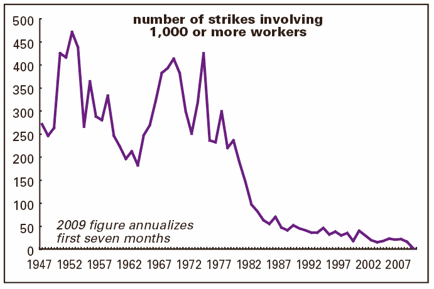
Strikes involving more than 1,000 workers
Support unions. Unless you’re a greedy, asshole boss, who thinks CEOs should earn 300x more than workers, in which case, rot in Hell.
The results of the work I do, like this article, are free, but food isn’t, so if you value my work, please DONATE or SUBSCRIBE.
by Tony Wikrent
How meritocracy became oligarchy
How Life Became an Endless, Terrible Competition
[The Atlantic, September 2019 issue]
Harvard, Princeton, Stanford, and Yale collectively enroll more students from households in the top 1 percent of the income distribution than from households in the bottom 60 percent. Legacy preferences, nepotism, and outright fraud continue to give rich applicants corrupt advantages. But the dominant causes of this skew toward wealth can be traced to meritocracy. On average, children whose parents make more than $200,000 a year score about 250 points higher on the SAT than children whose parents make $40,000 to $60,000. Only about one in 200 children from the poorest third of households achieves SAT scores at Yale’s median. Meanwhile, the top banks and law firms, along with other high-paying employers, recruit almost exclusively from a few elite colleges.
Strategic Political Economy
“Boeing’s Crashes Expose Systemic Failings”
[Der Spiegel, via Naked Capitalism 8-26-19]
Lambert Strether notes “This is brutal, a must-read.”
“It is impossible to tell the story of the 737 Max — indeed, the story of Boeing’s entire recent history — without taking a closer look at Airbus. The self-confident Americans underestimated their European competitor’s strength, not wanting to believe that Airbus’s ascent to become the world’s second-largest aircraft manufacturer was the kind of economic miracle that changed the entire game. Founded in 1970, massively subsidized by European governments and heavily promoted by an industry that was deeply invested in its success, Airbus was able to revolutionize the global passenger jet market in the course of just three decades. And then came the wonder of 1999, when Airbus received significantly more orders for its aircraft than did its American rival, despite the fact that Boeing had just merged with erstwhile competitor McDonnel Douglas a few years before….
“And this all comes at a time when the Airbus-Boeing duopoly has been developing cracks. The two may still be the world’s undisputed aerospace leaders, but companies in China, Russia and Japan are in the process of grabbing a bigger piece of the pie. Furthermore, it has become easier to build airplanes because a highly specialized global market of suppliers has developed that can deliver almost any part in the desired quality at the desired moment in time. The times when airplane construction was a calling card of unattainable technological excellence are coming to an end. Things are becoming more difficult, especially for Boeing.”
Outsourcing comes back to bite you in the ass. Every time. USA has “free traded” away the family jewels.
Use the comments on this post to discuss topics not related to recent posts.

Queen Elizabeth II
I wrote and published a piece about this briefly, and I realized I was wrong, so I took it down.
Johnson has prorogued (suspended) Parliament from about the 11th of September. It’s clearly a maneuver intended to make Brexit more likely, and shady as hell.
Under the Westminster tradition, Parliament is supreme. Not the Prime Minister.
Some years ago in Canada, Prime Minister Harper prorogued to avoid a vote of no confidence (which would have toppled the government and triggered an election). That was clearly against the unwritten rules of the Westminster tradition. When the Queen’s representative, the Governor General allowed it, she failed her duty.
I originally thought the Queen had done the same thing, and if she had, I’d want her–and the royal family–gone. They have a duty, they need to do it.
But, as Parliament will be in session for long enough to allow a vote of no-confidence (if MPs want to do one), I find this act, while clearly shady and abusive, just barely on the right side, and I can understand why the Queen let it happen.
If Parliament doesn’t want this to happen, they have plenty of time to make sure it doesn’t. If they don’t prevent it, this means they aren’t willing to topple the Conservative government. That is on them, they know the consequences.
This is back in the hands of Parliament, where it should be.
The results of the work I do, like this article, are free, but food isn’t, so if you value my work, please DONATE or SUBSCRIBE.
Days after Seoul scrapped intelligence-sharing with Japan, all branches of its military descended on a handful of disputed islets for two-day drills, raising ire in Tokyo and fueling a brewing trade conflict between the neighbors.
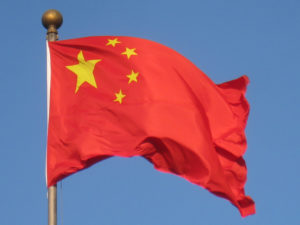 The basic truth is that the days of the Pacific being an American lake are coming to a close. China is the 800 pound gorilla. As Yang Jiechi said, “China is a big country and other countries are small countries, and that’s just a fact.”
So if the small countries don’t want to be ruled by China the way that Canada, Mexico, and most South and Central American countries are, they need to work out their differences and band together.
That is especially true for the two most powerful countries after China: Japan and South Korea.
If they can’t, well, welcome to vassalage as the Middle Kingdom rises.
The results of the work I do, like this article, are free, but food isn’t, so if you value my work, please DONATE or SUBSCRIBE.