Ian Welsh

The horizon is not so far as we can see, but as far as we can imagine

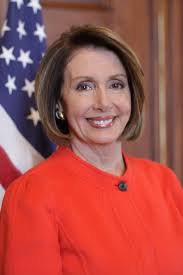
Pelosi Moves to Impeach Trump

Nancy Pelosi

This is a good thing. Trump’s done more than one thing that was illegal and impeachment-worthy.

It is interesting and amusing that what finally got her to do something was to attack Biden–someone she knows well–rather than all the crimes against people she doesn’t care about, but if that’s what it takes, so be it.

Impeachment, done properly, is about using the power of the House to control the narrative and build the case. It was not popular when it started against Nixon; it was the impeachment hearings themselves that made the case.

One hopes that Pelosi and her team will take this into account, and showcase Trump’s various misdeeds properly. One also hopes they will stop playing patty-cake with Trump officials and use Congress’s powers of inherent contempt on those who refuse to testify, or who lie.

Of course, Trump will not be convicted. But he can easily be damaged, and his ability to enact his policies can be crippled. Clinton’s impeachment attempt was followed by two Republican presidential terms.

It will be interesting to see if Pelosi has any ability to follow blood in the water.


The results of the work I do, like this article, are free, but food isn’t, so if you value my work, please DONATE or SUBSCRIBE.

UK Supreme Court Rules Prorogue Illegal

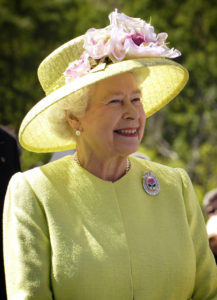
Queen Elizabeth II

News out of England continues to be important. The Supreme Court said that Johnson’s advice was “unlawful, void, and of no effect.”

Ouch.

This is a fantastically good thing. The use of proroguing to avoid oversight by Parliament is a great evil. Some years back it was used in Canada to avoid a vote of no-confidence that Prime Minister Harper knew he would lose.

I do think that the Queen, and the Queen’s representatives, need to be more willing to say, “No.” It was obvious what Johnson was doing.

As for Brexit, I want to point out something simple, that has been lost in the furor: It’s going to be settled by an election. Johnson has gotten rid of the anti-Brexit MPs. Even if he obeys the law and extends the leave period, there will then be an election. Who wins will determine what happens.

This is AS IT SHOULD BE. It is right to put this to an election. I prefer Corbyn’s position of negotiating a Brexit then putting it as a referendum, but an election fought over the issue is precisely what should happen in a democracy.

You either believe that legitimacy comes from the people, or you don’t.


The results of the work I do, like this article, are free, but food isn’t, so if you value my work, please DONATE or SUBSCRIBE.

The Democratic Ethics of Brexit

The bottom line here is that there was a referendum, and “leave” won.

All my life, I have eaten election and referendum results I hated. I have done so because of democratic legitimacy: The people, even if I or anyone else think they are wrong, are the source of legitimate rule.

There was a referendum. Leave won. Brexit should, thus, be the policy of the government.

At the same time, like any policy, the idea is to do it right, and both May’s plan and Hard Brexit will be very bad for Britain.

When people voted, they voted to Leave without really knowing what it would mean.

So we have a situation where the parties policies are:

The Tory policy is to leave no matter what, even if it’s against the law, against parliament, and will be disastrous.

Lib-Dem’s policy is “Fuck the referendum, we should just stay.”

Labour’s policy is to negotiate a deal to leave, then put it to a referendum.

I don’t think Labour’s stance (which was re-affirmed today by the membership) is the best politics. But it is the path which maintains democratic legitimacy, the primacy of parliament, and tries to make sure that, if Brexit, happens it is not disastrous.

It is, to my mind, the actual right policy in ethical terms. Both the referendum and the parliament have legitimacy, and that legitimacy should be respected.


The results of the work I do, like this article, are free, but food isn’t, so if you value my work, please DONATE or SUBSCRIBE.


Week-end Wrap – Political Economy – September 22, 2019

by Tony Wikrent
Economics Action Group, North Carolina Democratic Party Progressive Caucus

Strategic Political Economy

Matt Stoller [Pro-Market, via Naked Capitalism 9-18-19]

Director is the key founder of what is now known as the Chicago School of law and economics, which reshaped the American approach to corporate power and political economy…. Director’s life was dedicated to setting free the power of concentrated capital, eliminating the power of labor, and undoing the New Deal. His success is so profound it is hard to describe, so embedded are we today in the world and rhetoric Director shaped.

Brahmin Left vs Merchant Right: Rising Inequality and the Changing Structure of Political Conflict (Evidence from France, Britain and the US, 1948-2017) (PDF)

Thomas Piketty [via Naked Capitalism 9-15-19]

…changing political cleavages in FR-US-UK 1948-2017 documenting the shift from class-based political conflict to multiple-elite (intellectual vs business elite) and identity-based political conflict.

Main empirical finding: the rise of multiple-elite politics

  • • In the 1950s-60s, the vote for left-wing (labour-socialist-democratic) parties in France-UK-US used to be associated with lower education & lower income voters: class-based political conflict (→ redistributive policies)
  • • It has gradually become associated since 1970s-80s with higher education voters, giving rise since 1990s-2000s to a multiple-elite party system: high- education elites vote left, while high-ncome/high-wealth elites vote right. I.e. intellectual elite (Brahmin left) vs business elite (Merchant right).

Keynes Was Really a Conservative
Bruce Bartlett [via Naked Capitalism 9-16-19]

Peter Drucker, a conservative admirer of Keynes, viewed him as not merely conservative, but ultraconservative. “He had two basic motivations,” Drucker explained in a 1991 interview with Forbes. “One was to destroy the labor unions and the other was to maintain the free market. Keynes despised the American Keynesians. His whole idea was to have an impotent government that would do nothing but, through tax and spending policies, maintain the equilibrium of the free market. Keynes was the real father of neoconservatism, far more than [economist F.A.] Hayek!”

….Keynes completely understood the central role of profit in the capitalist system. This is one reason why he was so strongly opposed to deflation and why, at the end of the day, his cure for unemployment was to restore profits to employers. He also appreciated the importance of entrepreneurship: “If the animal spirits are dimmed and the spontaneous optimism falters … enterprise will fade and die.” And he knew that the general business environment was critical for growth; hence business confidence was an important economic factor. As Keynes acknowledged, “Economic prosperity is … dependent on a political and social atmosphere which is congenial to the average businessman.”

….Indeed, the whole point of The General Theory was about preserving what was good and necessary in capitalism, as well as protecting it against authoritarian attacks, by separating microeconomics, the economics of prices and the firm, from macroeconomics, the economics of the economy as a whole. In order to preserve economic freedom in the former, which Keynes thought was critical for efficiency, increased government intervention in the latter was unavoidable. While pure free marketers lament this development, the alternative, as Keynes saw it, was the complete destruction of capitalism and its replacement by some form of socialism.

We have yet to see an incisive critique of Keynes based on understanding he was a shameless oligarch with no regard for republicanism, if not outright antipathy to republicanism. Bartlett’s jab at the greatly idealized Keynes would be much more powerful if Bartlett understood the tensions and contradictions inherent between republicanism and capitalism.

Open Thread

As usual, feel free to use the comments to discuss topics unrelated to recent posts.

Should NATO Exist? Will It?

One of Trump’s constant cries is that American allies aren’t spending enough on their militaries and that the US is, thus, carrying them.

While there is a temptation to scorn this argument because it was made by Trump, it has a fair bit of truth to it, as Matt Stoller suggested today:

The American military umbrella is a bad deal for America and a good deal for our “allies.” Japan gets protected channels to Middle Eastern oil, for free. Germany gets protection from Russia, for free. They all export to us at terms unfavorable to our own industries/middle class.

The problem with this is that it is, well, true.

And that Europe “needs” America for defense against Russia is absurd:

Let us be clear, the EU’s population is 508 million. When the UK leaves, it will be 447 million.

Russia’s population is 143 million.

The EU minus Britain has a GDP of 18.1 trillion (purchasing power parity), Russia has an economy of 3.5 trillion (ppp). Germany alone has a GDP (ppp) of four trillion.

If Europe “needs” the US, it’s because it can’t be bothered to raise a proper army. That’s all. It is genuinely free-riding.
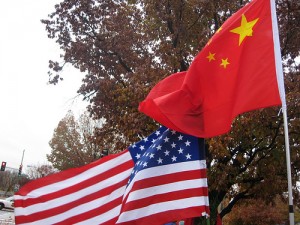
Chinese and American flags flying together

But then NATO is a large part of why Russia is a “threat”. The expansion of NATO, which Bush Sr. promised Gorbachev would not happen, is a large part of why Russia has armed up.

It’s not clear that NATO should even exist. Its purpose was to resist the Warsaw Pact and the USSR, neither of which exist. Russia has a lot of nukes, and is relatively strong militarily, but it is no USSR and has no grand alliance facing NATO. It is not a threat unless terribly mismanaged. (Which, I suppose, it has been.)

Disband NATO. Let the Europeans take care of their own defense, or lay prostate before the Russians as they choose.

Japan is a trickier proposition. What American military presence there does is simple enough: It prevents Japan from needing its own nuclear weapons. The same is true of American bases in South Korea. Leave and those two countries have to nuclearize or become Chinese satrapies (and Japan will need a much larger navy).

It’s also worth noting that the US didn’t start protecting “Japan’s oil.” The US needed foreign oil too; it is only recently, under Obama, that the US has again reached petrocarbon self-sufficiency and is able to say, “We’re protecting other people’s oil.”

WWII was won by the powers who had access to more oil. Generals and admirals at the time understood the war was, to a large extent, about oil.

America may not need foreign oil now, but it did for decades and that is why it protected maritime oil trade.

In general, however, a US withdrawal from its forward bases will be a good thing. A rebalancing of trade will also be a good thing, though it will hurt as it happens (Trump is not doing it well). Deliberately offshoring and outsourcing the US (and Britain’s) industrial base led, more or less directly, to Trump and other social ills. It created a group of people who have lost for 40 to 50 years. Their parents had better lives. They had better lives. They know it. You cannot lie to them with BS statistics and pretend otherwise.

So they are willing to vote for and support anyone who seems like they will wreck a system which doesn’t serve them. Maybe what happens will be worse, but what’s happening right now is shit.

This is not contradicted by Trump’s support from red-state elites. They are also scared, because they also know their situation is precarious and that power and wealth has flowed away from them. And they rule over Hell. It isn’t always better to reign in Hell.

So the world is changing. It was changing before Trump: The Trans-Pacific Partnership was intended to be a trade bloc AGAINST China.

Note carefully Stoller’s hostility to China. It is constant. The American elite is finally reorienting. They don’t see Russia as a primary threat. They’re moving away from caring about the Middle East as they now have enough oil of their own and see a post-oil future coming. They know the rising great/super power is China.

They want to reorient their alliances against China. The price of keeping NATO will be keeping China OUT. When Germany said they wanted to do more business with China, Stoller was angry and said it was an argument against NATO. No Huawei, no China.

The world is very likely to divide into trade blocs–probably two, maybe three.

China rises. The US moves to protect its position.

Great power politics continue, as they ever have.

There is no end to history, save an end to humans. Only fools ever thought so.


The results of the work I do, like this article, are free, but food isn’t, so if you value my work, please DONATE or SUBSCRIBE.

The Cruelty and Stupidity of Trumpian Homelessness Rhetoric

From a study by his officials:

In the report, “The State of Homelessness in America,” even shelters get some of the blame for increasing the number of people who are homeless. The argument: Some people would be able to find their own housing if they were turned away from shelters.

“While shelters play an extremely important role in bringing some people off the streets, it also brings in people who would otherwise be housed, thus increasing total homelessness,” the report states.

So tiresomely stupid. Shelters are shitholes, and unsafe, and most people hate them. Many homeless people refuse to sleep in them, and even die of exposure. They are simply too dangerous.

Or:

homelessness could be dramatically reduced by slashing restrictions on housing construction and being less tolerant of people sleeping on the streets.

In which case, more condos which poor people couldn’t afford would be built. Developers don’t want to build for poor people in “world cities,” it’s just that simple. It’s a market failure, and there are solutions; simply slashing regulations won’t do it as the current market preference is for expensive homes and apartments.

As for being less tolerant of people sleeping on the street: What? These fucktards think more than a tiny minority of the homeless want to sleep on the street? It’s a positive choice they make?

The sheer stupidity and blind ideological thinking is tiresome.

As study after study has shown there are two ways to get the homeless housed: Give them money or give them homes. For those with the most mental and physical problems, some social assistance is also needed. But if you want people housed, house them.

That requires housing which they can afford (or the government can afford) to pay for for them. That doesn’t mean luxury condos.

This isn’t rocket science. It’s been studied repeatedly. We know what works. The question, as always, is whether we care enough to bother.

I mean, rich people need more tax cuts and subsidies. You can have that or take care of poor people.

That’s the choice, and Trump is on the wrong side of it.


The results of the work I do, like this article, are free, but food isn’t, so if you value my work, please DONATE or SUBSCRIBE.


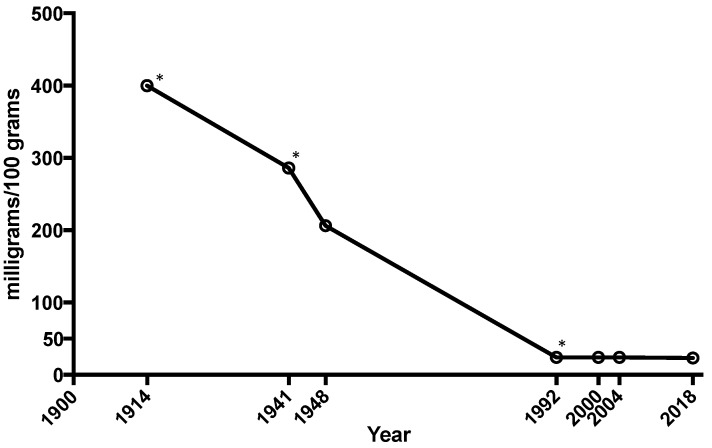
And They Made a Desert: 80 to 90% Drop in Nutrients in Food

Stumbled across this lovely chart the other day.

Nutrient Decline from Challenges in the Diagnosis of Magnesium Status

The core fact that most people, including the folks in the “best every world” Panglossian movement (like Pinker), don’t seem to understand is that even if they were right (questionable), the prosperity we have is based on burning down our own house.

“Sure is hot! Hottest it’s ever been!”

Yup. Sure is.

We have vastly reduced our supplies of various non-renewable resources. We have destroyed many species, leading to a loss of biodiversity, which may threaten food chains. In addition, every species we kill is one whose genetic code is lost to us, and we won’t even know what treasures we have lost when we genuinely become able to safely make direct genetic changes.

We have used up large amounts of sinks–places we can store pollution and excess production. We have run down aquifers so much that many of them will never recover. We have poisoned ground water. Fish stocks are down eighty to ninety percent as well, and the Great Barrier Reef is dying. It will not be saved.

And yes, we have destroyed the nutrient value of the soil (where we haven’t just let it blow away), so much so that eighty to ninety percent of some nutrients are missing. No wonder we have a vast incidence of chronic disease that our grandparents and great-grandparents didn’t: We’re effectively starving, while getting fat off of empty calories.

The Industrial Era has been the Era of Locusts. We think we’re rich, but most of what has been happening is that we’re consuming resources far faster than they can be replaced. Meanwhile, we’re poisoning ourselves and the earth; shattering ecosystems which we do not know how to repair (or even understand), and altering Earth’s climate cycle (we should be moving towards an Ice Age).

This is crazed behaviour. This is the behaviour of children who have no self-control at all. Even when we know what we are doing is destructive, we keep doing it, like some kid gorging on cake ’til s/he pukes.

The super-optimists are fools. Yes, it is possible we’ll get out of this, but it’s not possible if we keep telling ourselves that the hole we’ve dug is no big deal. “Why can’t I see the sky anymore, Papa?”


The results of the work I do, like this article, are free, but food isn’t, so if you value my work, please DONATE or SUBSCRIBE.
Page 294 of 532

Powered by WordPress & Theme by Anders Norén