Ian Welsh

The horizon is not so far as we can see, but as far as we can imagine

Corbyn’s Biggest Failure

Jeremy Corbyn

I admire Corbyn greatly, as everyone who reads this blog knows. If he had become Prime Minister, he would have made Britain a better place–a lot better–because he wanted to do virtually all the right things, and he has stuck to his principles for decades.

However, Corbyn did have one major flaw, and he made one major mistake.

Corbyn was, and is, nice in the wrong way.

If you have principles, and you get into power, it is  your duty to see those principles through. Corbyn had a mandate from Labour party members.

Labour party MPs did not agree, and the majority of them did everything they could to sabotage Corbyn, over and over again.

Corbyn had remedies: He could back mandatory re-selection (allowing party members in ridings to re-select their candidates) or he could have just kicked them out of the party.

Kicking MPs out of the party is what Boris Johnson did, and while I don’t much like Johnson, he was right to do so. He was elected leader on a platform of hard Brexit, and those who voted against him needed to go. He got rid of them.

Corbyn should have done that and implemented re-selection. Corbyn repeatedly said that his principle was that the Labour party, and the country, should be run by the grass roots. MPs who were going against the vast majority of the party needed to face the discipline of the party members.

This is also true because the MPs have a role in selecting who is allowed in the ballot for the next leader. As it stands now there may wind up being no left-wing candidate for the overwhelmingly left-wing party membership to vote for.

An ideological movement’s first job in a democracy is to control one of the two main parties. If you do so, you will eventually wind up in power. It is that simple. No party rules forever.

If Corbyn fails his movement and his principles, it will not be because he lost a couple elections. It will be because he had the chance to change the Labour party, and he really didn’t, because he blinked when it came to dealing with other MPs.

That’s failure, and that’s an actual indictment of Corbyn in a way that losing elections isn’t. He had the power to enact his principles in a way which would have greatly increased the odds of Britain becoming a better place, whether or lost he won elections, and he didn’t do so.

For that, I blame him.

(There have been a lot of articles about the British election and Corbyn over the last week. We’ll move on to other topics after this. But understanding what happened and why is important.)


Money would be rather useful, as I don’t get paid by the piece. If you want to support my writing, please DONATE or SUBSCRIBE.

Responsibility in Democracies

The primary responsibility for what government is in charge of a democracy rests with voters.

This is fundamental. Voters have choices, they make choices. One can make the claim that the choices are often all bad (although in systems where anyone can join a party and vote in primaries that is weak), but when it comes to the actual choice on the ballot, voters are in charge.

This is fundamental. This is the basis of democratic legitimacy.

It also has to be understood clearly, because there is an exact relationship between power and responsibility. If you put all, or the majority, of the responsibility onto leaders or elites, you are saying you do not have any power to make change.

In Britain’s election, the British made a choice. The forseeable consequences will be a lot more death and suffering. There was another option. They chose.

Perhaps Corbyn did not run as well as he could have, but people who say it’s primarily his fault don’t actually understand democracies.

This is the same as when Americans chose Reagan, or the British chose Thatcher. There was a clear choice, they made it. Reagan ran a racist campaign, it was known at the time (I remember it), and it was also clearly one based on a project of dismantling the regulatory and welfare state. That was the choice, Americans made it, and Americans are responsible for making it. They then ratified the decision by re-electing Reagan.

The same is true of the Brits and Thatcher, especially when they ratified the choice by re-electing her after seeing her policies. (Thatcher also bribed them by letting them buy council housing below price. In the long run that was a bad bribe to take.)

None of this is to say that leaders don’t have responsibilities, or more power than individuals or even groups. But they do not have more power than the population as a whole, in a democracy.

If they do, then it is no longer a democracy. If that’s the case one wants to make (and I can see making it), then fine. After all, Corbyn was lied about more than 75 percent of the time, for example, by the media.

But if the country is still a democracy, then the ultimate responsibility for the government rests with the people.

To claim anything else is to throw away the power and responsibility the people do have and to retreat into leader worship and powerlessness.

Which, actually, is what we’ve done, over and over again.

It’s either your country, or it isn’t.

Brits are about to get what they voted for. That is as it should be. (The same is true of my own country, where we have made bad electoral choices, over and over again. So be it. We made those choices.)

(Data-based aside: In most of the ridings I saw where Labour lost, the swing was usually the Brexit Party vote. Those people who think that strategy for Labour was as simple as “Go Remain” miss the point: One-third of Labour party voters wanted Brexit. Labour had a genuinely broken coalition because of Brexit and there was no obvious way to fix it.)


Money would be rather useful, as I don’t get paid by the piece. If you want to support my writing, please DONATE or SUBSCRIBE.


Why Labour Lost in Britain

There’s been a vast amount of foolishness in the discussion about this.
Labour lost for two main reasons:

  1. Their base was split by Brexit, and in a real way, no “positioning” could avoid this.
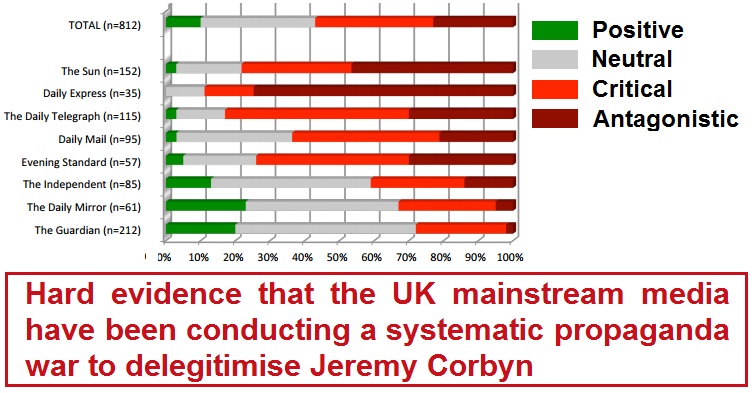
  2. There was a vast propaganda campaign against Corbyn, in particular, and Labour, in general.

What urban liberals don’t seem to understand is that there was a genuine split in traditional Labour voters over Brexit. Progressives in London were Remain; working and middle class voters in Labour’s northern strongholds were for Leave.

There was no way to split the difference, though Labour tried. Going Leave alienates London voters and gives the LibDems a chance to eat Labour’s lunch in greater London. Going Remain means losing the northern strongholds.

In 2017, Corbyn went for “We’ll respect the vote.” He did better doing that than he did this year with “The People’s Vote” (basically, a redo, based on a a negotiated deal).

But when you look at the ridings Labour lost, they include a lot of the Northern bastions. Places Labour hasn’t lost in decades. What you see is that the Brexit party (which ran in Labour-leaning ridings, but not Conservative ones) made the margin of difference, and often more than it.

By going “People’s Vote” Labour lost a big chunk of the north. It’s just that simple. BUT there was no good answer, going “Leave” would have lost a lot of other seats.

This is a problem for Labour which too many commenters simply refuse to actually admit exists. Perhaps if Corbyn had picked a position and stuck to it, Labour would have done better (but if so, that means having stuck to “respect the referendum”, which progressives screamed at him not to do), but Labour’s voters were genuinely split.

The next issue is media bias. There is simply no question that the media has been terribly biased, particularly against Corbyn, but against Labour and for Tories.

This chart gives the picture on Corbyn, but it’s worse than this, because the media lied, a lot. Over 75 percent of the time, the media has lied about Corbyn’s actual policy positions and history. So people who hate Corbyn (and they do) hate a person who exists only in a propaganda delirium. Given that Corbyn is basically a kindly, social democratic grandfather (and if you watch him interact with people, he is actually sweet and kind), this means they can mischaracterize anyone, though I do agree he should have fought back harder. Not sure it would have mattered.

Note that even the supposedly left-wing Guardian was more anti-Corbyn than pro. (Something I’ve said for a long time. When the intelligence services forced the Guardian’s editors to smash their own computers because of Wikileaks, it appears to have permanently broken them. The Guardian now knows to bow.)

As for Labour, well here you go:

People tend to overthink issues like elections. Labour lost because its base was split and it faced massive media bias. This bias is understandable, the media is owned by rich people, and Corbyn threatened the power of the rich because he was going to nationalize a bunch of stuff and increase their taxes. This isn’t complicated.

Now, one more note, so people stop self-flagellating and acting as if this inevitable and there is nothing to be done.

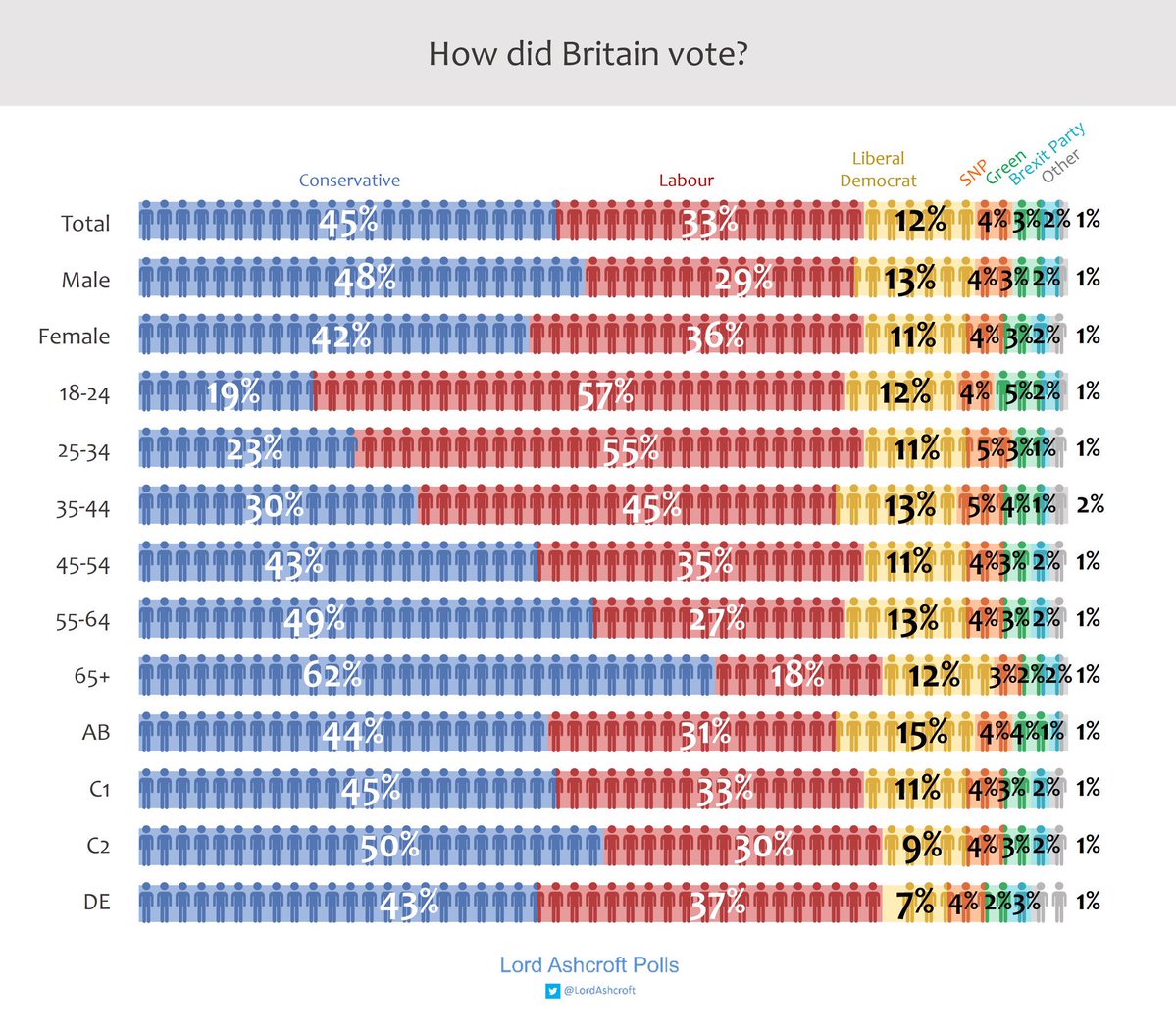
Young people voted Labour, old people voted Conservative. Only 18 percent of over 65 voters went for Labour. There is a trope that young people get more conservative as they get older, but that only happens if the system works for them. Since it doesn’t, and won’t, they will stay left-wing. This isn’t the end. But a lot of people will suffer and die because of this.

Labour got smashed in this election because their electorate was split and because of a full court propaganda campaign by the press, one which started the moment Corbyn was elected as Labour leader. Corbyn could have done some things better (in particular, I think he should have smashed those MPs who opposed him by supporting mandatory re-selection), but it’s not clear to me that some perfect Corbyn could have won this.

All of this is rather sad. In my lifetime, Corbyn has had the best policies of any major party leader in a Western country. There is no evidence that Corbyn’s policies were unpopular, they poll fine. The issue is that the election wasn’t fought on his policies, it was fought on Brexit and whether or not a man who spent his entire life fighting racism was a racist.

Fought on those grounds, Corbyn and Labour lost.

The price of this will be high. Johnson made a lot of promises, but the practical effect of his rule and his style of Brexit will be increased austerity and a continued sell-off of state services and properties. That’s what the Brits voted for, as a plurality, and they will get what they voted for.


Money would be rather useful, as I don’t get paid by the piece. If you want to support my writing, please DONATE or SUBSCRIBE.

Week-end Wrap – Political Economy – December 15, 2019

Week-end Wrap – Political Economy – December 15, 2019
by Tony Wikrent
Economics Action Group, North Carolina Democratic Party Progressive Caucus

Strategic Political Economy

The Economy of Evil

[Historicly, via Naked Capitalism 12-11-19]

Benito Mussolini became Prime Minister in October 1922. Nazis rose to power in 1933 in Germany. Mussolini convened a meeting of his cabinet and immediately decided to privatize all the public enterprises. On December 3, 1922, they passed a law where they promised to reduce the size and function of the government, reform tax laws and also reduce spending. This was followed by mass privatization. He privatized the post office, railroads, telephone companies, and even the state life insurance companies. Afterward, the two firms that had lobbied the hardest: Assicurazioni Generali (AG) and Adriatica di Sicurtà (AS), became a de-facto oligopoly. They became for-profit enterprises. The premiums increased, and poor people had their coverage removed.

In January 1923, Mussolini eliminated rent-control laws. His reasoning ought to be familiar since that is the same reasoning used in many contemporary editorials against rent control laws. He claimed rent control laws prevent landlords from building new housing. When tenants protested, he eliminated tenants’ unions. As a result, rent prices increased wildly in Rome, and many families became homeless. Some went to live in caves. Once more, these policies allowed landlords to increase their profit and holdings while they severely hurt the poor.

To remove “government waste,” Mussolini removed the federal government from remote areas in Italy. This meant that rural farmers, peasants, and workers no longer had the protection of the federal government against abuse from agribusiness. Instead, they were entirely under the mercy of big businesses.

Hitler’s economic policy was Mussolini’s policy on steroids….  In 1934, Nazis outlined their plan to revitalize the German economy. It involved reprivatization of significant industries: railways, public works project, construction, steel, and banking. On top of that, Hitler guaranteed profits for the private sector, and so, many American industrialists and bankers gleefully flocked to Germany to invest.

The Nazis had a thorough plan for deregulation. The Nazi’s economist, stated,” The first thing German business needs is peace and quiet. It must have a feeling of absolute legal security and must know that work and its return are guaranteed. The interferences In a business which occurred at first, perhaps as a result of too much zeal, have become intolerable.”

Emmanuel Macron Wants to End France’s Welfare State

[Jacobin, via Naked Capitalism 12-9-19]

….other major mobilizations have failed to bring success, most significantly past battles against pension reforms in 2003 and 2010. But the protracted resistance to neoliberalism really has had a lasting impact — explaining why France’s welfare state has proven much more resilient than those of nearly all other Western countries. To the despair of its domestic elite and of high-ranking bureaucrats in the European Union and OECD, France tops the table for government spending as a share of GDP; at nearly 55 percent, its spending level ranks ahead of all Scandinavian countries and stands about 10 percent higher than Germany and the OECD average.

Macron’s presidency, overwhelmingly supported by the French capitalist class and its European counterparts, was from the outset meant to bring that “French exception” to an end. The first year and a half following his election looked as if he would succeed. A wave of tough neoliberal reforms swept across nearly all areas of economic and social activities: the school system has been subjected to a “choice” agenda, while rail and public transport have been opened up to “competition” and sold off to the private sector.

Yves Smith, December 11, 2019 [Naked Capitalism]

The officialdom has been shaken out of its Versailles 1788-level complacency by much-derided “populist” revolts, and more recently, 1848-like revolts, including a general strike in France. It has been revealing, and not in a good way, to see people who ought to know better serve up tepid reform programs…. the coercive nature of capitalism has only gotten more intense in the neoliberal era as social safety nets have been gutted. As we pointed out in 2013:

One issue I’ve long been bothered by is the libertarian fixation on the state as the source of coercive power. The strong form version is that the state is the only party with coercive power (and please don’t try denying that a lot of libertarians say that; there are plenty of examples in comments in past posts). Libertarians widely, if not universally, depict markets and commerce as less or even non-coercive. 

What is remarkable is how we’ve blinded ourselves to the coercive element of our own system.

….Martin Wolf of the Financial Times, but an earlier this week, How to reform today’s rigged capitalism, was like Hamlet without the Prince. It followed up on an earlier article, which focused on what he saw as the causes of rising inequality: falling productivity growth, stagnating innovation, rising debt levels and finanicization, concentrated corporate power, which in turn fosters rentierism and tax evasion.

Notice what was missing? The fall in labor organization and bargaining power. The deliberate and successful attack on a muscular and effective state. It may seem hard to believe, but as recently as the 1960s, people went into public service not for the revolving door opportunities but to make a difference and in senior positions, for the prestige.

Needless to say, resetting the balance of power between workers and capital, by improving labor rights and strengthening social safety nets, is barely to be found on Wolf’s list of fixes.

Class war and economic disequilibrium

Open Thread

Use the comments on this post to discuss topics unrelated to recent posts.

TINA trauma

*** MANDOS POST ***

I have been thinking about writing another post about Britain and Brexit for some time, but every time I’ve started it, there’s been literally another new dramatic twist, so I stop. But now it seems like a corner is being turned. What the corner really is, we’ll still have time to find out. Even today, I thought I would wait until the real British election results had come in. But the exit poll gives such a wide margin for the Tories that it seems a little pointless. Even if a miracle happens, and the Tories are reduced to a minority…in what world does it make sense that the result should be so close?

Either way, I repeatedly tried to suggest, gently at first, but eventually more strongly, that Labour’s strategy has been based on a set of misconceptions driven by a certain kind of well-intentioned, passionate left-wing politics that has briefly managed to get a little bit of its day in the sun, with its perhaps now-declining control of Labour. From this viewpoint, the issues that drive the rise of right-wing politics are really just matters of economic self-interest. Questions of identity, ideology, and anything that is in the sphere of the political that cannot be traced (even through an imputed, popular subconscious) to an economic or class conflict are just distractions–un-things. One can see this painfully in the way that Corbyn and his team have handled Brexit — despite words, constantly signaling ambivalence about the issue, wanting to talk about other things, wanting to treat Brexit as though it were just another extension of a wished-for popular economic uprising.

This strategy has pleased no one. It’s now nearly a cliché to say that Brexit is the matter at hand, the only truly salient object. And Brexit is not reducible to economic matters, even through the “false consciousness” route of tracing identity conflicts to latent economic conflicts.

But this fact put Corbynite Labour on the horns of a dilemma. Full-throated rejection of Brexit, and endorsement of the emotional core of the Remain argument (the view that the Brexit referendum was a frontal attack by Nazis, more or less), yields up the economic reductionism and requires diverting attention from the emotional core of the economic left, compassion for the welfare recipient, compassion for those in need of hospital beds, and so on. Full-throated acceptance and support of Brexit, on the other hand, while superficially aligning with a traditional Labour constituency, also comes at a steep price: There is no credible way to support Brexit that does not also traduce the cultural direction of the Labour left, because the traditional Labour voters who support Brexit are not only doing so for economic reasons, but for reasons of cultural identity apart from economic need and in solidarity with people from classes with otherwise antagonistic economic interests.

Labour has failed to transcend this dilemma. Their “strategy” has been to signal that membership in the EU is something that they reluctantly accept–if they can’t get a better deal outside the EU. Implicit in this is the belief that there is a “place” for Britain outside the EU that is better than inside, but merely one different from what the Tories envisions: a post-neoliberal nirvana, freed from the (somewhat hypothetical, in the non-Eurozone-UK’s case) chains of the EU’s neoliberal bureaucracy. This is not a credible message, because it is extremely difficult to envision what that would look like in the big picture, under any kind of plausible terms of an EU departure. It pleased no one and alienated both Remain and Leave-now-ex-Labour voters.

Why is there no credible halfway position? The reason why is that, actually, the EU is a neoliberal institution. Its main bodies were formed during the the rise of the neoliberalism, and its staff are trained in neoliberal ideology. It just happens that, as a neoliberal institution, it is designed to accommodate the residual aspects of European social democracy, and, crucially, it exists in the context of an international order that is even more neoliberal. That is, any departure from the EU involves getting drop-kicked into a variety of neoliberal systems that are not designed to accommodate European social democracy– quite the opposite. The neoliberal EU, with its free movement and Excessive Deficit Procedures, is a buffer against a more neoliberal global order.

At this point, on this blog, when somebody points out that there is no solution to this problem that involves treating it as an economic conflict or a battle against neoliberal ideology or whatever, there is often a chorus in the comments section cynically needling, “There Is No Alternative, amirite?” This whole Labour situation gives me an opportunity to propound a theory about this: “TINA trauma,” an affliction that prevents much of the economic left from doing anything other than make a surprisingly conservative demand to roll back neoliberalism to a pre-neoliberal halcyon idyll, in one form or another.

When Margaret Thatcher propounded TINA, at the time she was making a normative or aspirational claim. The success of that program has traumatized the left into a kind of mental/strategic paralysis, which finds them eternally trying to prove her wrong, posthumously. Yet, decades later, the hegemonic control of the neoliberal gestalt has transformed that claim from an aspiration to a mere statement of fact. What can anyone think it means for an ideology to become “hegemonic”? It means it has successfully constrained the future to pass through its institutional bottleneck. TINA is now fact. We are all neoliberals now, and whatever comes next, if anything is there to come next, is going to bear some of the features and some of the scars of neoliberalism.

If UK Labour–and indeed the global left as a whole–is to recover from the UK Tory victory, it needs to accept that the only way out is “through,” or not at all. The left needs to get over its TINA trauma.

Britain’s Election Today

Jeremy Corbyn

(Update: polls show a likely strong Conservate majority. If correct, that’s going to cause a lot of suffering and, likely, the end of the remains of the British welfare state. So be it, this is what Brits voted for. A pity, but you can’t save people from themselves.)

So, it’s Britain’s general election. This is probably the most important British election since Thatcher was first elected. Both Johnson and Corbyn, if they win, will change the nature of Britain. Corbyn will increase human welfare massively, prepare for climate change, nationalize various natural monopolies and so on. Johnson will continue the privatization of the NHS, will drive down wages, will be cruel to anyone who needs assistance.

Johnson will Brexit in a way designed to allow Britain to drive down environmental, labour and human rights standards as well as to allow Britain to sell off large parts of what remains of its patrimony to foreign interests (primarily American.) Corbyn’s Brexit will be designed with the opposite goals: to make it possible to be better than the EU, not worse.

None of this is hyperbole, and this is not something I will be wrong about, whoever wins.

The campaign has been a complete disgrace, with the UK media, including the BBC, pushing Johnson and the Conservatives hard, and smearing Corbyn as an anti-semite, when his entire life has been devoted to causes like anti-racism. But standing up for Palestinians, as if they are human, is verboeten, because anti-semitism has come to mean “opposes Israel’s evil actions.”

Polls are all over the place, but show a Conservative lead. On the other hand, there has been a vast swell of first time voting registrations, and how they vote and if the youth vote comes out will matter.

This is a two way race (minus the SNP in Scotland). If you want a mean, cruel Britain you should vote for Johnson. If you’re not scum, you should vote for Corbyn. There are a few ridings where tactical voting may help, but do your research. In most cases it’s the Conservatives or Labour.

This election is perhaps the clearest I have seen in my entire adult life. Corbyn is, whatever his flaws, as close to a Saint as will ever have a chance of being in charge of a major country. Johnson is a serial liar and nearly completely callous.

If Corbyn does win, Labour needs to restructure the media as one of its first orders of business. If Johnson wins, well, it’ll be good for rich people and their senior lackeys. If you’re poor, sick, or handicapped, brace yourself for a lot more misery. If you’re middle class, understand your odds of staying the middle class just dropped.

Watching the election has been very instructive, because the sheer scale of the establishment’s hatred of Corbyn and willingness to lie nonstop indicates just how terrified of him they are, and thus indicates he’s actually worthy of support. They’re doing this because they know he will change the very nature of how Britain runs in ways that mean they will have less power and less wealth. He’s the first person in a position to be Prime Minister of Britain since Thatcher who actually wants to change Britain from Thatcher’s consensus (Blair didn’t, he embraced it.)

It’ll be interesting, and revealing, to see what the British voters choose. Corbyn hasn’t run a perfect campaign, and he clearly mishandled the politics of Brexit, but at the end of the day, he’s the better choice, and voters have responsibilities as well. (Plus Boris is comically awful.)

If you’re British, you know who I think you should vote for. I’ll go further, anyone who votes for Johnson and the Conservatives is a bad person. I admit no exceptions. This isn’t an election between evils, it’s an election where the choice is good or evil.

Choose.


Money would be rather useful, as I don’t get paid by the piece. If you want to support my writing, please DONATE or SUBSCRIBE.

Jews to Be a Nationality

Sigh

President Trump will sign an executive order defining Judaism as a nationality, not just a religion, thus bolstering the Education Department’s efforts to stamp out “Boycott Israel” movements on college campuses

This is, of course, the standard anti-semitic smear of the 19th and 20th centuries: That Jews cannot be loyal to their country, because they are loyal to other Jews first. This was also said, by the way, of Catholics, because of the Pope, and it’s why John F. Kennedy becoming President as a Catholic was a big deal, and why he felt he had to explicitly state that he wouldn’t take orders from the Pope.

But all those Jews, and there are many, who have been so vehement in support of Israel that they say, in effect, that any criticism of Israel is criticism of Jews and therefore anti-semitic have also brought us here.

Trump just believes them. The interests of Jews and Israel are identical, to him. Just like they are to the Anti-Defamation League.

This is, of course, a horrible thing. It will lead, in time, to many people being sure that Jews are traitors to the US, because they put another country before the US. Traitors are generally considered to deserve death.

How did we get here?

Well, Hitler genocided millions of Jews–after he liquidated the socialists and trade unionists (he knew his real enemies). That scared and horrified many Jews, as it would anyone. So a bunch of them, in a land they didn’t control, used military force to throw out the then-current occupants (if they didn’t, then their opposition to Palestinians returning and taking their homes back is odd), and set up a religious ethnostate. Because if someone genocides your people, the best response is to ethnic cleanse another group. (Yeah, it meets the definition, sorry.)

At this point, the Israelis rule a lot of Palestinians and treat them terribly, in what many consider an apartheid system. Nelson Mandela always opposed the occupation, and his grandson has straight-up said Israel is an apartheid state.

So the sort of people who oppose injustice now want to treat Israel the way South Africa was treated when it was an apartheid state. But the Israeli lobby is extremely strong in the US (please don’t waste anyone’s time denying this), in large part because of the large numbers of American Jews who support Israel, even when it’s doing evil things. (The other large group supporting Israel is the evangelicals, who want Israel to put up the Temple so that the apocalypse can happen. Nice folks.)

So Trump is giving Israeli supporters and Jews (not the same group, always) what he thinks they want.

Perhaps the real problem is nationalism: the idea that every ethnic group deserves self-determination in the form of its own state. Perhaps that’s a bad idea, actually. (Nazism comes directly out of this: “Blood and land and folk.”) Perhaps ethnic states aren’t a good thing, because we shouldn’t base how we treat people on their ethnicity. This doesn’t mean everyone has to open their border to unlimited immigration or any thing silly, but it does mean people in their country should be treated equally.

That’s all that’s being asked for these days. Treat Palestinians equally. Make them citizens with equal rights. The two-state solution is dead, anyone looking at a map knows that. So, are you going to have a massive second-class population or actually be a genuinely democratic state?

The problem is that Israel can’t remain a religious ethnostate if it does that.

Meanwhile, putting Israel first, before Jews has, in effect, lead to a situation in the US which imperils Jews. In Britain it has lead to an entire campaign run on the idea that Corbyn is anti-semitic, when he’s spent his entire life fighting racism. Why? Because Corbyn is opposed to current Israeli policy towards Palestinians.

The funny thing is that both Israel and Jewish people would be safer and better off if they simply did the right thing and gave Palestinians citizenship.

But people who have been terribly abused too often think that abusing other people is the only way to be safe.

It’s sad, and I hope for everyone’s sake–especially the Jews and Palestinians–that this era of conflating Jewish and Israeli interests and of weaponizing charges of anti-semitism against people who oppose injustice, ends soon.

We’ll all, minus some settlers, be a lot better off.

(Or, to put it another way: Don’t be evil, K?)


Money would be rather useful, as I don’t get paid by the piece. If you want to support my writing, please DONATE or SUBSCRIBE.

Page 286 of 532

Powered by WordPress & Theme by Anders Norén