Ian Welsh

The horizon is not so far as we can see, but as far as we can imagine

The Covid Live Test of Your Government

One thing Covid-19 has done is allow us to rank a lot of governments by competence. There’s a lot of governments in the running for most incompetent. The UK and the US are up there, and if Sweden’s experiment doesn’t work, they may take the crown.

Probably the most competent government in the world is Vietnam. They managed to keep deaths to zero despite being right next to China and having massive economic ties. They jumped right on top of it, tested, traced, isolated and quarantined. They made sure people isolating had food (heck, they installed rich machines which gave rice for free).

This tracks what I’ve heard from ex-pats: Vietnam is a country where things get done, and that its cities are among the most dynamic in the world. Vietnam still has the sense that there’s a task, and you don’t put profit before that task. So they are able to build infrastructure and complete goals with stunning rapidity and minimal, by our standards, waste.

Was a time, of course, when the UK was like that (in the mid to 19th century British efficiency was often commented upon). Not so long ago Japan was like this, but they’ve lost it at the top, though the rot hasn’t gone all the way through the entire society yet.

In the Anglo-Saxon world, New Zealand and Australia have performed well. Canada’s performance, while good compared to the UK and the US (not even faint praise), was delayed. I was somewhat surprised by Australia’s performance, but I guess they can still be competent when it doesn’t touch on their corrupt resource extraction industry, as was the case during the wildfires (which is, in itself, interesting information).

The keys to good performance were acting early, testing and tracing contacts, and doing isolation properly: Quarantine away from your family.

The key to fixing this is going to be widespread testing, contact tracing, and then proper quarantine, which means you have to support the people in quarantine and make it mandatory.

Tracing is slow work. It can take five days to trace one person’s contacts. That means, if you’ve let things get out of control, you need a large number of people. Oddly, in the US, millions of people now need work and hey, it can be done from home: It’s phone work.

So competence means ramping up testing as fast as possible. It means distributing masks to everyone, free of charge. It means tracing, tracking and quarantining.

Until these things are done, releasing restrictions after a drop in cases will just lead to another spike in a few weeks.

Truly competent governments got ahead of this: They didn’t need an army of tracers.

But those who didn’t, do.

Let us hope our governments can, at least, learn from their mistakes.

The alternative is a year and a half of waves of cases, isolation, and more waves. In the US, with its refusal to support individuals and small companies, that means widespread hunger. And, as the food system is impacted in many countries, along with logistics, there is likely to be famine in other areas (for example, India, which has very low margins).

Few readers thought they might want to live in Vietnam, I suspect.


The results of the work I do, like this article, are free, but food isn’t, so if you value my work, please DONATE or SUBSCRIBE.
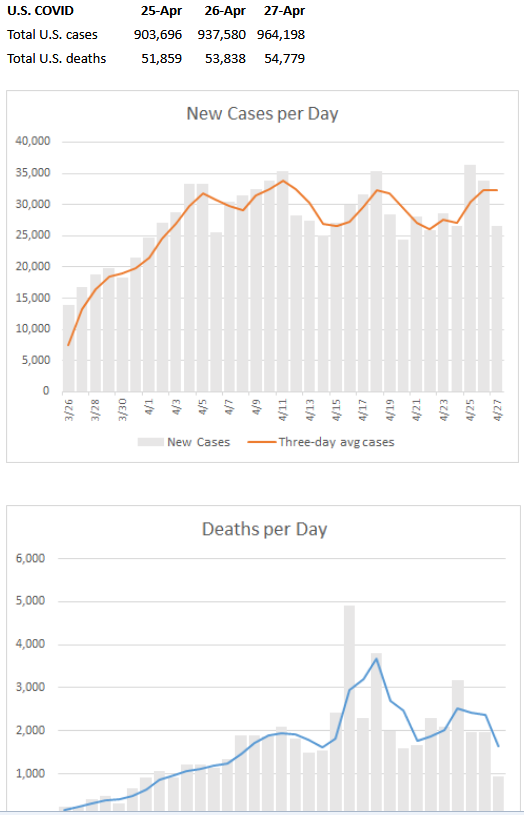
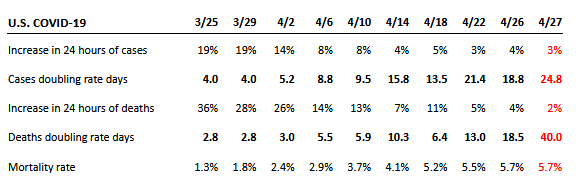


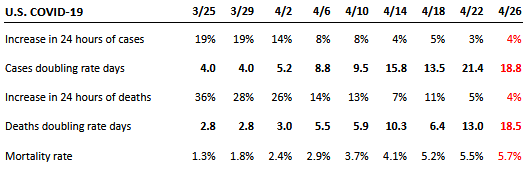
April 27th US Covid Data

Our benefactor notes a significant drop in deaths. New Jersey reported no new deaths since yesterday, which is odd.


The results of the work I do, like this article, are free, but food isn’t, so if you value my work, please DONATE or SUBSCRIBE.
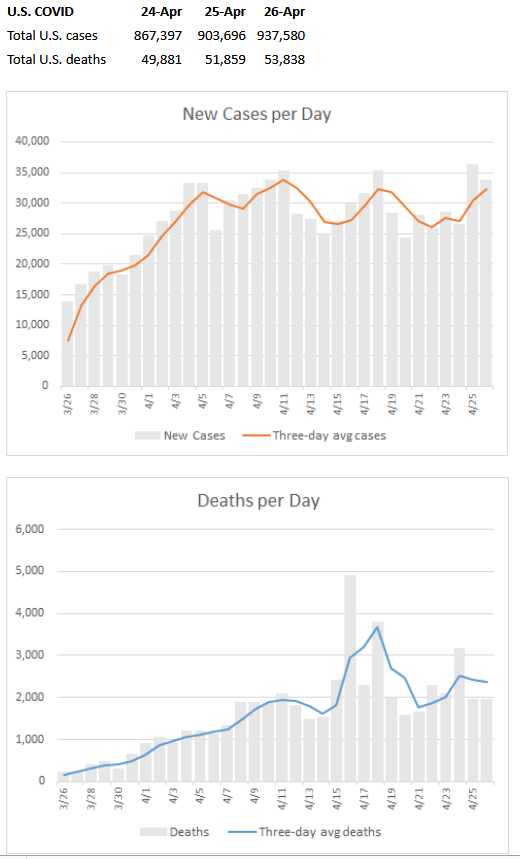
April 25th US Covid Data

Our benefactor notes that deaths will definitely 60k by the end of April.


The results of the work I do, like this article, are free, but food isn’t, so if you value my work, please DONATE or SUBSCRIBE.
Week-end Wrap – Political Economy – April 26, 2020

Week-end Wrap – Political Economy – April 26, 2020
by Tony Wikrent
Economics Action Group, North Carolina Democratic Party Progressive Caucus

Vic DiBitetto: Dear government: We need a real fucking plan, you shitbags

Shorter Twitter video:
Dear government: We need a real fucking plan, you shitbags
[via Mike Norman Economics]

Strategic Political Economy

Bill Clinton guru James Carville famously blurted “It’s the economy stupid.” Actually, it’s the economic ideology. If the American people are going to save themselves, they need to understand that their ruling elites are Malthusians of the Social Darwinian type.

McConnell Says He Favors Letting States Declare Bankruptcy
[Bloomberg, April 22, 2020]

McConnell, a Kentucky Republican, said he blocked additional state and local aid in the latest relief package, which passed the Senate Tuesday and is set for a vote Thursday in the House. “I said yesterday we’re going to push the pause button here, because I think this whole business of additional assistance for state and local governments needs to be thoroughly evaluated,” McConnell added. Later, on Fox News, McConnell said that any state or local aid must be specifically linked to the pandemic and shouldn’t be viewed as an opportunity for “revenue replacement.”

“We’re not interested in solving their pension problems for them,” McConnell said. “We’re not interested in rescuing them from bad decisions they’ve made in the past. We’re not going to let them take advantage of this pandemic to solve a lot of problems that they created for themselves with bad decisions in the past.”

Lee Saunders, president of the American Federation of State, County and Municipal Employees, said most states don’t need to restructure their debt. “Rather, they are suffering unprecedented revenue loss due to the shutdown of our economy just like so many businesses in the private sector,” Saunders said. “The money they need now is to maintain vital life-saving services provided by front-line workers in the face of the most dire public health emergency in a century.”

“We’re not interested in solving their pension problems for them.” Translation: we should avoid the costs of caring for retirees and just let them die off faster. And just in case you don’t understand yet:

The Right Wing Wants You to Die

[Vice, via Naked Capitalism 4-25-20]

Earlier this week, someone showed up at a protest in Nashville, Tennessee with a sign reading “Sacrifice the weak.”….

Other rich, advanced countries like South Korea and Germany have arrived at a solution. By using state power to do what scientists and economists say is necessary—testing the population, isolating the infected, and tracing their contacts, while financially supporting citizens who have lost income—they’ve reduced death and the spread of the virus without imposing mass suffering, offering the possibility of a return to something like normal life. The United States hasn’t seriously prepared or planned to do any of these things. Instead of organizing a response, federal leaders are engaged in piracy. The Senate’s majority leader wants states to declare bankruptcy. Trump has suggested injecting bleach into patients’ lungs….

The phrase “death cult” has been used to describe the Republican Party enough lately that it’s probably lost any real meaning, but it’s not far off as a descriptor. Ohio congressman Jim Jordan, head of the House Freedom Caucus, supports the protests and doesn’t understand why the economy shouldn’t have been opened yesterday. Pennsylvania lawmaker Mike Jones participated in a protest in Harrisburg this week, calling it “the best of America.” A protest in Michigan was organized by the vice-chair of Trump’s state campaign and the grassroots vice-chair of the state Republican Party. Government is organizing protests of itself to rally support for policies that would result in mass death.

[Sapienta, via Naked Capitalism Water Cooler 4-22-20] Interview with Chris Arnade.

“What I find particularly unsettling is the utter lack of commitment to a given place demonstrated by many with wealth in American society. By leaving Manhattan for a Long Island beach bungalow or Jersey City for a Hudson Valley home, they are denying any responsibility for acquaintances, neighbors, or friends and effectively refusing membership in a larger community–a community that serves them in good times. Compare this to the actions of people with lesser means than Arnade’s elite. Struggling local restaurants prepare meals for overworked EMTs. Young people stand in long grocery store lines to pick up food for elderly neighbors. Volunteers stitch together face masks for sleep-deprived nurses. Arnade writes about ‘front row’ and ‘back row’ America and urges us to perceive the dignity and the worth of those sitting in the back row. But what does the COVID-19 pandemic tell us about front row Americans? Do they deserve our respect?”


“The Economy of Evil” 

[Historic.ly, via Naked Capitalism Water Cooler 4-22-20]

Open Thread

Feel free to use the comments to this post to discuss topics unrelated to recent articles.

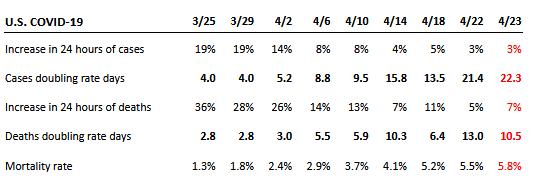
April 24th US Covid Data

There will be no Covid data post tomorrow, Sunday will cover both Saturday and Sunday.

Our benefactor writes:

New cases holding steady despite a restating downwards of NYC cases. Definitely going to make it to 60k deaths by April 30 at this rate.


The results of the work I do, like this article, are free, but food isn’t, so if you value my work, please DONATE or SUBSCRIBE.

On the Causes and Consequences of the Oil Price Crash

Image by Yuan2003

So, we had a crash of oil prices, where some futures contracts were actually negative, which means that sellers had to pay people to take oil off their hands.

Obviously, oil use has dropped during the Covid-19 crisis, and before that, prices had already decreased in an attempt by non-US producers to reduce prices low enough to crush US shale production.

Oil is a real thing: It takes up storage. Storage space is running out, and it’s not clear when demand will recover, so oil that is to be delivered now-ish is an expense–you have to pay to store it. Thus, the negative prices.

There was a bounce Wednesday, ostensibly due to Trump saying he had ordered the US Navy to blow up Iranian boats if they continued to hassle other ships. (If they do this in the Gulf, and it goes to shooting, Iran will win the initial confrontation. They have a lot of missiles.)

One could equally say this is a dead-dog bounce.

At any rate, even double digit prices are below most people’s production costs for oil, and they are above the price every major government that relies on oil needs to balance their books. This means Saudi Arabia, the four gulf oil states, Iraq, Iran, Russia, and so on. Ironically, Iran, having been under sanctions already, will be in better shape than most of the others.

It is also, obviously, low enough to make US (and Canadian) shale oil production completely uneconomical: generally that needs at least $60/barrel, and much of it needs more.

So we have countries and companies with bleeding treasuries. The US has the ability to print money, presumably it will do so to keep Shale oil around in Zombie form. Countries which cannot print money and have other countries accept it could be in trouble. This depends mostly on how long this goes on. A couple months, even three or four, uncomfortable, but no big deal.

If this crisis bubbles on for a year and a half of shutdowns, partial relaxations, then more shutdowns, we’re into some very dangerous territory. I’m not sure the House of Saud, for example, can survive that scenario (it couldn’t happen to a nicer country, etc.).

The world has been in a very long economic relationship, in which the most important commodity has been oil, and the producers sold it in dollars, so the US and the swing producers all benefited. Obama and Trump more or less broke the deal with the promotion of shale oil, and China has increasingly been insisting on buying oil in Yuan, but the relationship had stumbled on, even though it meant enabling countries that the US has been treating as enemies, like Russia.

Trump wanted to force Europeans to buy more American oil and less Russian oil: This was a major part of his economic plan, such as it was. Trump likes to find a place where he’s more powerful, and push that as hard as possible, and things like sanctions against Russia, Iran, and Venezuela were–and still are–situations in which he has unilateral power that no one else has been entirely able to get around (though China has somewhat). The EU has proven unwilling to stand up to the US in the case of sanctions.

Right now, there’s no particular reason to think this can’t continue. The US can still print infinite dollars, because foreigners will still accept them–even though the US is no longer the most important manufacturing state. So the US can bail out shale oil. Oil producers, who do not have hegemonic currencies, do not have infinite rope.

This changes only the major producers of things the US needs cease to be willing to trade in US dollars. China and the EU could (but I very much doubt will) cut the US’s throat if they ever chose to act together. Perhaps China could even do it alone. The problem, of course, is that there would be a lot of collateral damage to them. US oil is expensive, but the US can produce it. China and the EU need to import it. If they want to make such a change, they have to secure strong supply guarantee from other nations.

This is theoretically possible, but the problem is simple: Any nation that did this would then fall under (even more) US military threat. Bombs are very good at ending oil exports, and neither the US nor China is willing to go to war over this. Perhaps China could move troops and nukes into vulnerable countries, but that would trigger a new cold war, and the Chinese don’t want that–at least not yet. China is working on their own trade area, to compete with the US-led trade area (which the US is abandoning anyway, as it shits on the WTO it created), but it is not ready yet (the Belt and Road Initiative is China’s name for this trade restructuring).

The current collapse of oil prices is unexpected; while a pandemic has always been possible, knowing when it would happen was not. The pandemic has simply revealed the current production’s costs and dynamics. Saudi Arabia has been moving towards vast danger for ages because of its over-reliance on oil; this simply means the consequences may hit sooner. Oi-consuming nations have been maneuvering to reduce their dependence on imported oil in general, and unreliable oil in particular, but they were not yet ready to make any big moves. Almost everyone has been chafing under the petrodollar and under the current world payment system, which the US has abused with its constant sanctions. Despite this, no one has created a viable alternative and been willing to take the hits necessary to move off the dollar and the US/eu payment system (“EU” is in lower case deliberately).

Most oil producing nations, including the US and Canada, are generally bad actors on the international stage: with crimes ranging from moderately bad to invading oil producing nations regularly and sanctioning other ones constantly, or to being the world’s premier supporters of fundamentalist religion and terrorists.

So don’t cry too much for oil producing nations, nor even for their customers, who have enabled them greatly. But beware that the game is changing: Covid-19 has highlighted existing issues and if it continues long enough it could precipitate changes which have been desired by many, but remained unimplemented because people have been unwilling to bear the costs and risks.


The results of the work I do, like this article, are free, but food isn’t, so if you value my work, please DONATE or SUBSCRIBE.
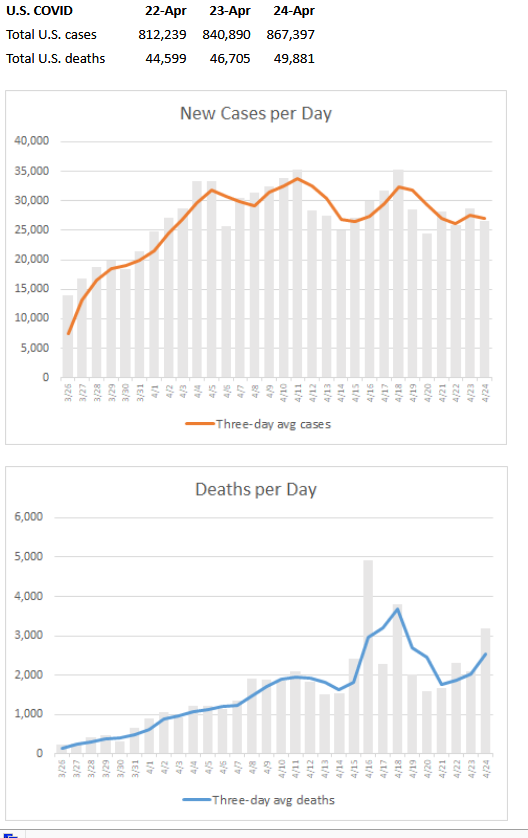
April 23rd US Covid Data

Our benefactor writes that there will likely be one million cases + 60 thousand deaths by the beginning of May.


The results of the work I do, like this article, are free, but food isn’t, so if you value my work, please DONATE or SUBSCRIBE.
Page 269 of 532

Powered by WordPress & Theme by Anders Norén