Ian Welsh

The horizon is not so far as we can see, but as far as we can imagine

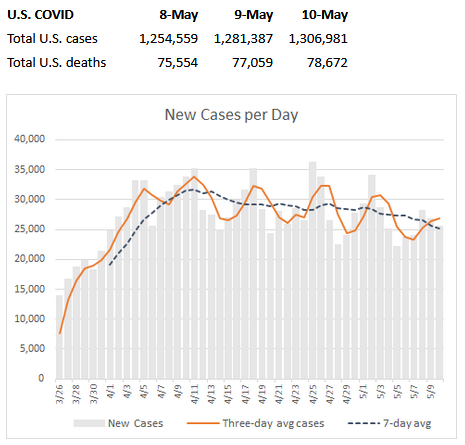
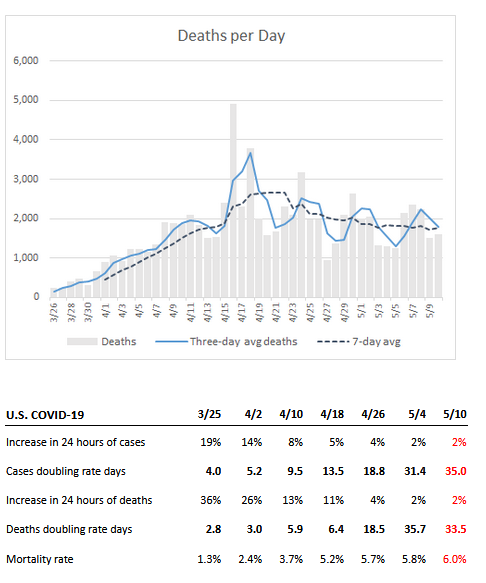
May 11th US Covid Data

Our benefactor notes:

Today is the lowest number of cases and deaths recorded since the end of March. It’s Sunday data, but still positive.


The results of the work I do, like this article, are free, but food isn’t, so if you value my work, please DONATE or SUBSCRIBE.

May 10th US Covid Data

Our benefactor writes:

The slow decline in cases and deaths continue, led mostly by NY and NJ. Weekend underreporting does not look too severe.

I’m going to discuss Covid-19 in a bit more detail next week. US policy is about to turn this into a real catastrophe.


The results of the work I do, like this article, are free, but food isn’t, so if you value my work, please DONATE or SUBSCRIBE.

Week-end Wrap – Political Economy – May 10, 2020

by Tony Wikrent

The Risks – Know Them – Avoid Them
[ErinBromage, via Mike Norman Economics 5-8-20]

We know most people get infected in their own home. A household member contracts the virus in the community and brings it into the house where sustained contact between household members leads to infection.

But where are people contracting the infection in the community? I regularly hear people worrying about grocery stores, bike rides, inconsiderate runners who are not wearing masks…. are these places of concern? Well, not really. Let me explain….

Remember the formulae: Successful Infection = Exposure to Virus x Time

….Ignoring the terrible outbreaks in nursing homes, we find that the biggest outbreaks are in prisons, religious ceremonies, and workplaces, such a meat packing facilities and call centers. Any environment that is enclosed, with poor air circulation and high density of people, spells trouble.

Some of the biggest super-spreading events are:

  • Meat packing: In meat processing plants, densely packed workers must communicate to one another amidst the deafening drum of industrial machinery and a cold-room virus-preserving environment. There are now outbreaks in 115 facilities across 23 states, 5000+ workers infected, with 20 dead. (ref)
  • Weddings, funerals, birthdays: 10% of early spreading events
  • Business networking: Face-to-face business networking like the Biogen Conference in Boston in March.

As we move back to work, or go to a restaurant, let’s look at what can happen in those environments.

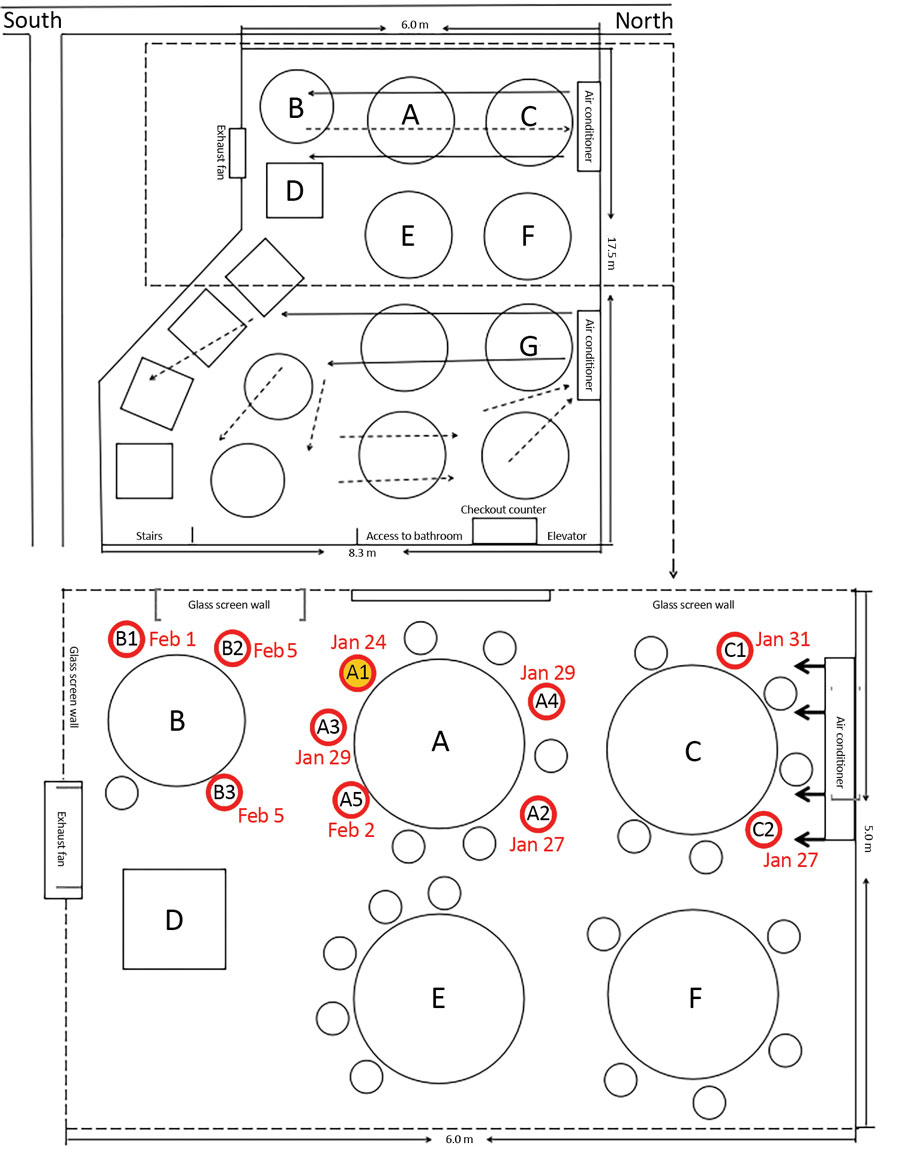
Restaurants: Some really great shoe-leather epidemiology demonstrated clearly the effect of a single asymptomatic carrier in a restaurant environment (see below). The infected person (A1) sat at a table and had dinner with 9 friends. Dinner took about 1 to 1.5 hours. During this meal, the asymptomatic carrier released low-levels of virus into the air from their breathing. Airflow (from the restaurant’s various airflow vents) was from right to left. Approximately 50% of the people at the infected person’s table became sick over the next 7 days. 75% of the people on the adjacent downwind table became infected. And even 2 of the 7 people on the upwind table were infected (believed to happen by turbulent airflow). No one at tables E or F became infected, they were out of the main airflow from the air conditioner on the right to the exhaust fan on the left of the room. (Ref)

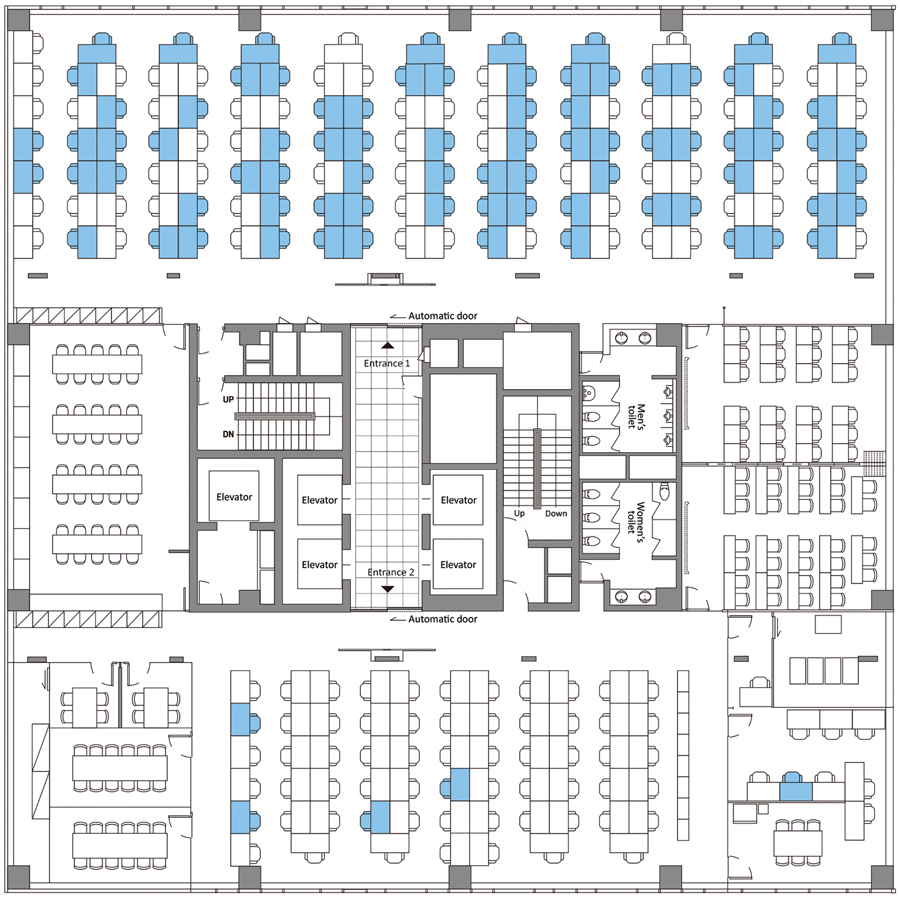
Workplaces: Another great example is the outbreak in a call center (see below). A single infected employee came to work on the 11th floor of a building. That floor had 216 employees. Over the period of a week, 94 of those people become infected (43.5%: the blue chairs). 92 of those 94 people became sick (only 2 remained asymptomatic). Notice how one side of the office is primarily infected, while there are very few people infected on the other side.


Strategic Political Economy

[The Big Picture, May 9, 2020]

May 9th US Covid Data

Our benefactor writes:

The seven-day average for new cases is about to dip below 25,000 per day. The seven-day average for deaths has been below 2,000 per day for one week. Both are relatively good news and a reflection that the vast majority of people in this country are still taking this quite seriously.


The results of the work I do, like this article, are free, but food isn’t, so if you value my work, please DONATE or SUBSCRIBE.
Open Thread

Feel free to use the comments to this post to discuss topics unrelated to recent posts.

May 8th US Covid Data

Our benefactor writes:

We inexorably climb to 80,000 deaths. The lack of broad testing just results in the mortality rate continuing to go up. The number of cases is totally under-counted.


The results of the work I do, like this article, are free, but food isn’t, so if you value my work, please DONATE or SUBSCRIBE.
How Neoliberalism Destroyed Capitalism

During the 2007/8 financial crisis, the Federal Reserve and other central banks printed trillions of dollars to support banks and big businesses. They prevented capitalism from working: While some firms that had nothing to do with the crisis should have been bailed out, those that caused the crisis by allocating money badly should have been allowed to go under.

This is supposed to be the virtue of capitalism: If people allocate resources (which we count with money) badly, they are supposed to lose the ability to allocate resources in the future. Those who allocate resources well are supposed to receive more resources. This has a lot of flaws (what makes money isn’t always what improves human welfare), but at least it’s a feedback loop.

It’s the GOOD thing about capitalism.

The Fed broke what was left of capitalism; there is very little that is good left when the allocation system doesn’t work– even under capitalism’s own terms.

It was clear that the central banks had decided that their primary purpose was to make sure that the rich stayed rich, no matter the cost to others. If they had let those firms go under, the economy would have fallen faster and recovered far better for over 90 percent of the population.

They patted themselves on the back for saving the world, and when Coronavirus hit they did the same thing.

At this point, the world economy–and especially the US economy–only works as long as you keep it hooked up to a ventilator, and it works badly.

I had been curious to see how this would be played out. As I have said many times, “there is a real economy.” There are people who make or grow things or provide actual necessary services (not your tax accountant, the people being labeled “essential workers” right now + farmers, factor workers, designers, and so on).

So, since the rich and powerful have decided that under no circumstances would they allow their class to lose money or power, no matter how badly they did their jobs, the question has been, “What are the effects of this?”

One of the effects is the complete bungling of Coronavirus in the US and the UK, the heartlands of neoliberalism. Another effect is suggested by this:

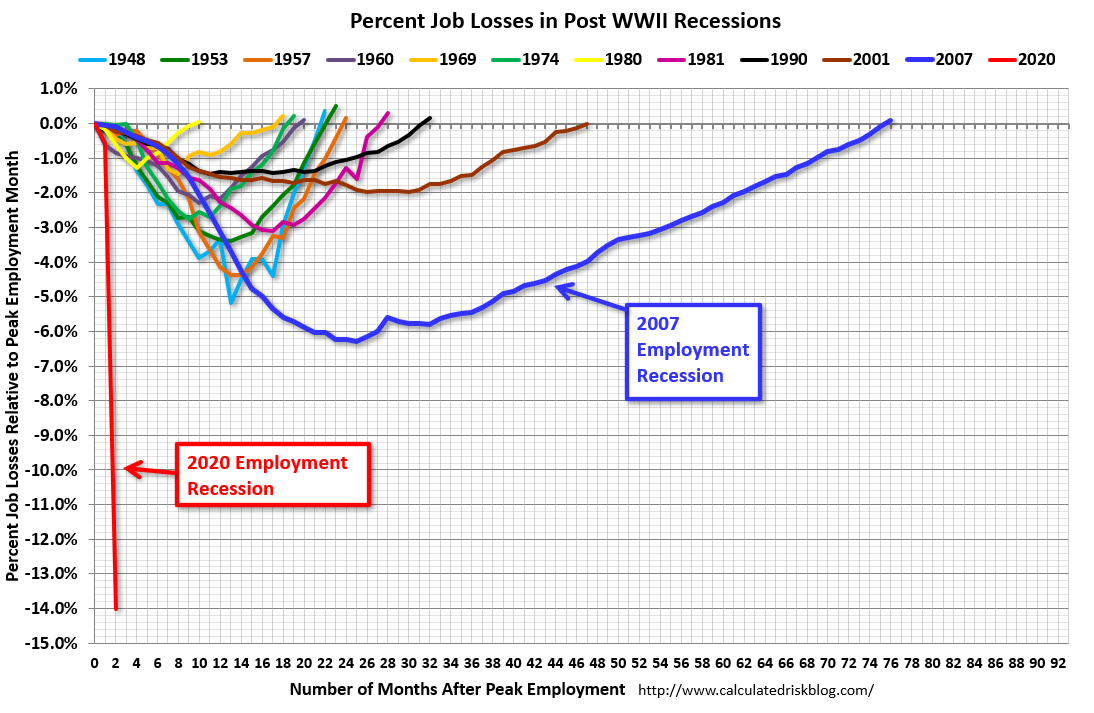
More than 40 percent of the U.S.’s 30 million small businesses could close permanently in the next six months because of the pandemic: Chamber of Commerce survey.

The stock market is doing fine, because it was bailed out. Small businesses aren’t, because they weren’t.

Covid-19 is no one’s fault, but how to deal with it is a policy decision. That policy decision reveals that the folks who run our economy will take care of the parts of the economy from which they directly benefit, and won’t help other parts of the economy.

Meanwhile, the US couldn’t make ventilators, couldn’t produce PPE, couldn’t track and trace infected people, and so on.

The effect of central bank and legislative policy is simple: There is a real economy, and the policies pursued by the elites will contract it. There’s a lot of bullshit around inflation stats, but the simple fact of the matter is that, for over 50 years, the cost of things people must actually have has risen faster than salaries. The BLS figures don’t show this, but you can’t run a middle class family with a 60s lifestyle on one middle class income today.

There is a real economy, which produces food and items people need or want. There is a financial economy, which produces financialized returns which are almost wholly disconnected from the health of the real economy. Billionaires pile up more billions as the economy gets sicker. The stock market is supported in the middle of a pandemic while actual businesses, comprising the real economy, are allowed to die.

So this is the future of neoliberal states: Elites will continue to produce “money” for themselves while damaging the real economy. At some point, a stressor will hit the economy which the actual production and logistics chains cannot handle. Elites, completely unable to do anything but manage financial numbers, will not be able to handle it, and there will be an actual economic collapse. Meanwhile, for most of the people in the US, the UK, and other neoliberal states, the long constriction of actual standards of living will continue.

If you want a good life, and you want to avoid, not disaster (like Coronavirus or huge wildfires) but absolute catastrophe, these elites and their entire supporting apparatus have to go.

If they don’t, they’re going to kill a lot of people–certainly including people you know.


The results of the work I do, like this article, are free, but food isn’t, so if you value my work, please DONATE or SUBSCRIBE.


May 7th US Covid Data

Our benefactor writes:

States must reconcile their data on Thursdays and Fridays, when we typically get our highest numbers. NY is now down to 12 percent of the total new cases. They started out at over 50 percent. The rest of the country can stop blaming NY.

At the current doubling rate, we will be at 140,000 deaths by the end of May. Positively genocidal.


The results of the work I do, like this article, are free, but food isn’t, so if you value my work, please DONATE or SUBSCRIBE.
 

Page 266 of 532

Powered by WordPress & Theme by Anders Norén