Ian Welsh

The horizon is not so far as we can see, but as far as we can imagine

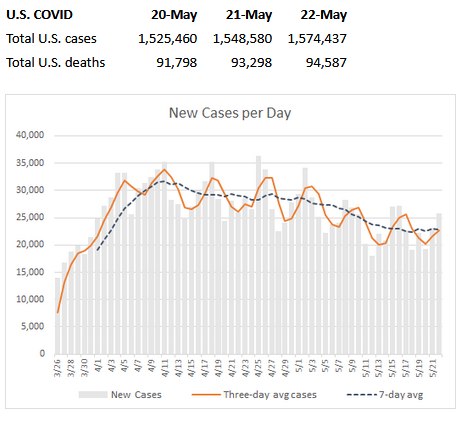
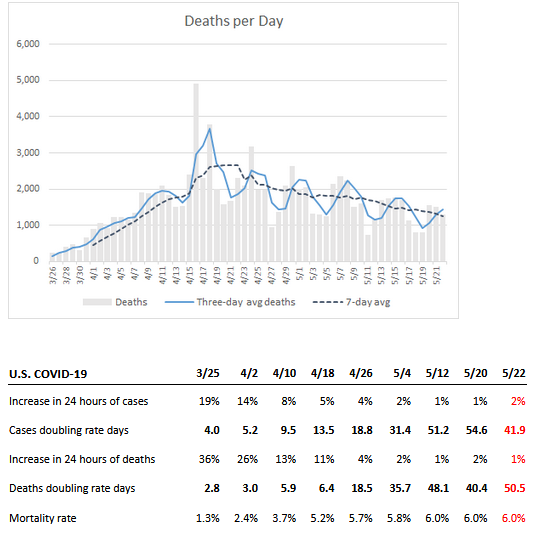
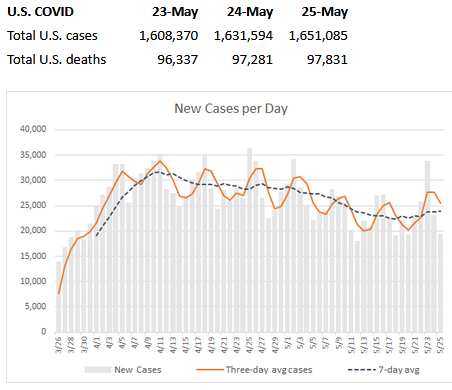
May 25th US Covid Cases

Our benefactor writes:

There’s been quite a drop in the number of deaths, likely due to the holiday weekend. Lots of big states (e.g. TX, KS, NE, KY) not reporting any deaths. They give health officials time off, too.


The results of the work I do, like this article, are free, but food isn’t, so if you value my work, please DONATE or SUBSCRIBE.

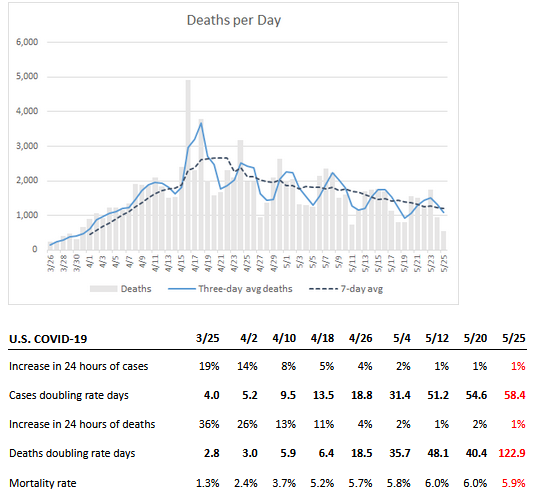
May 24th US Covid Cases

Our benefactor notes that the seven day average is still going up. We’ll see if it continues. Remember that many states are essentially allowing uncontrolled spread. States that are serious about controlling this are going to have to put in border controls.


The results of the work I do, like this article, are free, but food isn’t, so if you value my work, please DONATE or SUBSCRIBE.
 

Week-end Wrap – Political Economy – May 24, 2020

by Tony Wikrent


Strategic Political Economy

The Big Failure of Small Government
Maria Mazzucato [Project Syndicate, via Naked Capitalism 5-22-20]

Effective governance, it turns out, cannot be conjured up at will, because it requires investment in state capacity….

Decades of privatization, outsourcing, and budget cuts in the name of “efficiency” have significantly hampered many governments’ responses to the COVID-19 crisis. At the same time, successful responses by other governments have shown that investments in core public-sector capabilities make all the difference in times of emergency. The countries that have handled the crisis well are those where the state maintains a productive relationship with value creators in society, by investing in critical capacities and designing private-sector contracts to serve the public interest….

Unfortunately, for the last half-century, the prevailing political message in many countries has been that governments cannot – and therefore should not – actually govern. Politicians, business leaders, and pundits have long relied on a management creed that focuses obsessively on static measures of efficiency to justify spending cuts, privatization, and outsourcing….

Vietnam’s successful approach to COVID-19 has emerged as a striking contrast to the US and UK responses. Among other things, the Vietnamese government was able to amass low-cost testing kits very quickly, because it already had the capacity to mobilize academia, the army, the private sector, and civil society around a common mission. Rather than simply outsourcing with few questions asked, it used public research and development funding and procurement to drive innovation. The resulting public-private collaboration enabled rapid commercialization of kits, which are now being exported to Europe and beyond.

New Zealand is another success story, and not by coincidence. After initially adopting the outsourcing mantra in the 1980s, the New Zealand government changed course, embracing a “spirit of service” and an “ethic of care” across its public services, and becoming the first country in the world to adopt a wellbeing budget. Owing to this vision of public management, the government adopted a “health first, economy second” approach to the current crisis.

[Huffington Post, via Naked Capitalism 5-21

Tax evasion, to pick just one crime concentrated among the wealthy, already siphons up to 10,000 times more money out of the U.S. economy every year than bank robberies. In 2017, researchers estimated that fraud by America’s largest corporations cost Americans up to $360 billion annually between 1996 and 2004. That’s roughly two decades’ worth of street crime every single year. As the links between corporations and regulators become increasingly incestuous, the future will bring more crude-soaked coastlines, price-gouging corporate behemoths and Madoff-style Ponzi schemes. More hurdles to suing companies for poisoning their customers or letting bosses harass their employees. And more uniquely American catastrophes like the opioid crisis and the price of insulin.

An interview with Philip Mirowski [Jacobin, via Naked Capitalism 5-17-20]

Neoliberals really believe that people are inherently bad cognizers — they can’t work their way out of their problems just by thinking. Of course, that sounds like a very negative doctrine: i.e., telling us that people are incapable of understanding the nature of their problems and pursuing their own democratic ends.

But for the neoliberals, there’s an upbeat answer: the market. And they have changed the meaning of what a market is from earlier economic thought which tended to treat it as an allocation of scarce resources…. This is important, because it means that people have to be brought to understand politically that they have to, in a sense, concede that the market knows more than they do. So, they have to adjust their hopes, their fears, to what the market tells them is necessary. This point binds together a lot of sub-schools of neoliberalism….

There’s an assumption that neoliberalism arose to oppose authoritarianism — and I’m sure that’s how figures like Hayek thought about it. But as Thomas Biebricher points out, the real problem is that their theory has no imagination of how they’re going to get people in general to accept their “reforms” when, of course, they’re not going to like any of them, because they won’t understand how the market knows more than they do. This puts the neoliberals in a bind: How are they going to achieve their political objectives? So, they’re driven, essentially, to concede that authoritarianism is the only practical way they are going to triumph….

The neoliberals talk among themselves, too, and already at this stage of the crisis there are discussions of what they see as current political successes…. They see the gutting of FDA controls over drugs, the boosting of privatized telemedicine, which is something that they’ve proposed for a long time — seeking to get rid of the idea that a poor person ought to be able to see a doctor face-to-face. They also see these developments as blocking a state-run, single-payer system in the United States — they believe the crisis made it less likely than before.

They also like the idea that this is turning pharma into a “heroic” sector, after there had been a lot of political pushback against pharma and it was getting a bad rap. That’s all being undone now. They love the idea that this crisis is inadvertently causing a reengineering of higher education. They have long argued that higher education is just something that most people can’t afford to have. Now, what’s going to happen is widespread distance education, even at elementary levels. It’s promoting homeschooling, something they’ve always been in favor of. It’s boosting the privatization of elementary education, so that’s great . . . They like the idea that an inadvertent effect of the crisis is to kill the US Postal Service. These are the sorts of projects they’ve long had on the back burner. And now they see, “this is our chance.”

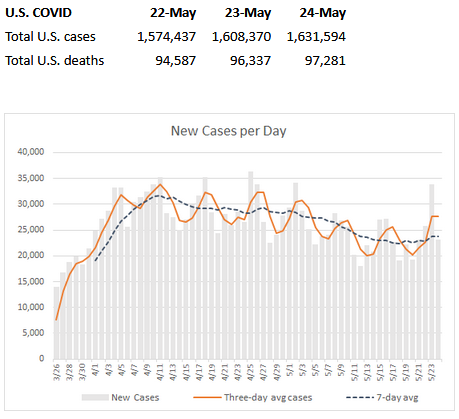
May 23rd US Covid Data

Our benefactor notes that there is “a definite increase in the number of cases, but one day is not sufficient to tell what’s going on…yet.”


The results of the work I do, like this article, are free, but food isn’t, so if you value my work, please DONATE or SUBSCRIBE.
Open Thread

Use the comments to this post to discuss topics unrelated to recent posts.

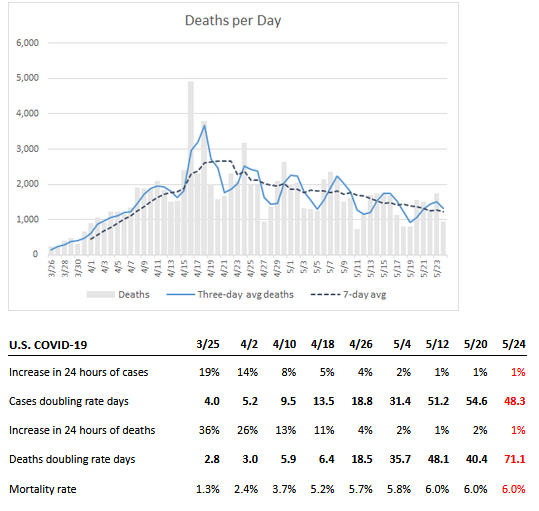
May 22nd US Covid Data

Plus ca change.


The results of the work I do, like this article, are free, but food isn’t, so if you value my work, please DONATE or SUBSCRIBE.
Herd Immunity Isn’t Happening AND this Crisis Has a Long Way to Go

So, testing has occurred in European countries to determine what percentage of the population has Covid-19 antibodies:

•Spain 5%

•Italy 5%

•Sweden 5%

•Holland 3.5%

•Denmark 1%

•Norway 1%

•Ireland 6%

You will recall that Italy has had one of the worst outbreaks in the world. To get to herd immunity (assuming it’s possible for Covid-19), you’d need about 80 percent of the population to have antibodies; that means 16X more than have them now. Given that Italy had multiple hospitals overwhelmed, this means either a long time or a hell of a lot of dead people, or both. Even if the death rate didn’t soar (it would), you’d be talking about approximately 480K deaths.

This means there are only two ways to get rid Covid-19 under control:

  • You get cases to zero or very near zero, and you have robust contact tracing and quarantine procedures if any new cases happen. This is the road Vietnam took (so far they have zero deaths, though it looks like they might wind up with one.)
  • You get a working vaccine.

That’s it.

Well, there’s a third way, you go through multiple waves so that almost everyone catches it, meaning that you get much, much larger death tolls than we’ve had already.

So, don’t expect this to go away quickly if you’re in a bungler country which didn’t crush Covid-19 into the dirt and which refused to track, trace, quarantine, and mandate masks.

And if you live in one of those countries, expect that you aren’t traveling anywhere outside those countries without a two-week quarantine (if even that is allowed by your destination country) until there is a vaccine.

There are respected scientists on both sides of the “can we get a vaccine to this” question. My sense is that if we can, it’s about a year to eighteen months out before mass issue. Hopefully, it isn’t a company in the American IP zone that produces it, or they’ll try and make a trillion + by charging everyone through the nose for it.

Meanwhile, this situation is going to keep going on and on, especially if you’re in a bungler country. Americans, you’re in a Bungler country. Brits, same.

Be well, make your plans appropriately.


The results of the work I do, like this article, are free, but food isn’t, so if you value my work, please DONATE or SUBSCRIBE.
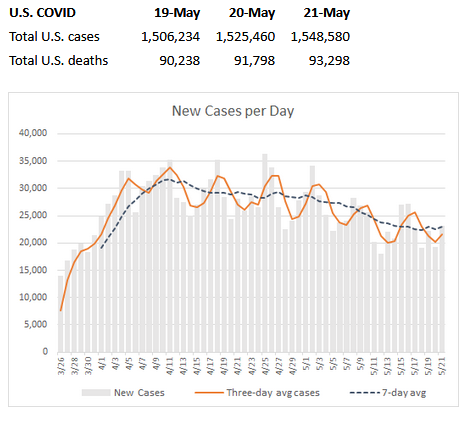
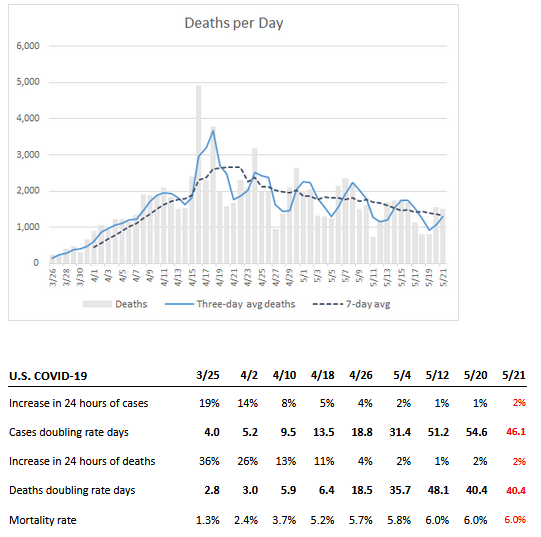
May 21st US Covid Data

Our benefactor writes:

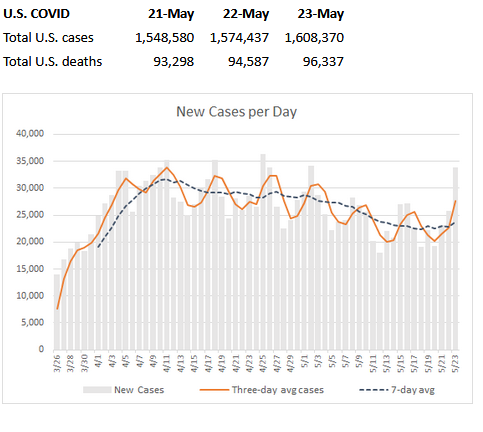
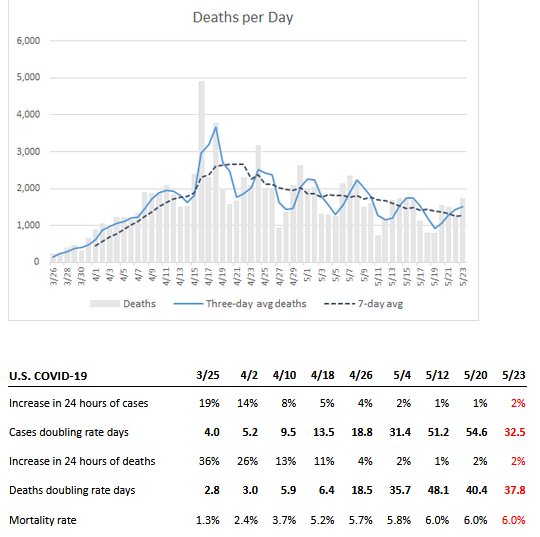
May 21. We’re living in a slow-motion Cormac McCarthy novel, a death march without the nuclear holocaust. It almost feels like the first wave was a warm-up to get used to seeing so many cases and deaths. Unless, of course, you get really sick or die, those people don’t really appreciate the lack of concern….100,000 deaths before the end of May. Hard to fathom.


The results of the work I do, like this article, are free, but food isn’t, so if you value my work, please DONATE or SUBSCRIBE.
Page 263 of 532

Powered by WordPress & Theme by Anders Norén