
Use comments to discuss topics unrelated to recent posts.
The Texas disaster is a very dramatic example of what I’ve been urging people to prepare for.
When I was a kid I lived in a number of third world nations: Malaysia, Indonesia and Bangladesh, and visited a bunch more.
In a failing state, stuff just doesn’t work well, and when there is a shove, it collapses. You can count on infrastructure or the state when things go bad.
Most of the time it’s less dramatic than the Texas disaster, BUT when you have a fragile state and infrastructure, every disaster turns into a catastrophe. Texas is the worst first world infrastructure collapse we’ve seen, but California in recent years has embarassed itself.
In fragile ecosystems, as well, events burn out of control quickly, as with the Australian, Brazilian, Californian, and various other wildfires.
Further, “once in a hundred year” weather events are becoming common. This was predicted by Stirling Newberry back in the 90s to me (he couldn’t get it published) and it’s now understood by scientists to be the case.
So if you have a neoliberal austerity state which has spent 40 years de-regulating and privatizing public infrastructure and downsizing the public service into incapability, you wind up with a situation where you can’t count on the State for water, food, or power during emergencies.
That means you have to prepare for yourself. Some off-grid energy, some food and medicine and water stores or ability to get those even in a collapse.
Collapses are sometimes brief: Texas will be back to normal soon enough, though the water damage caused by bursting pipes will lead to a lot of folks winding up homeless.
But they will become more frequent and even when there isn’t a crisis America and various other nations will move to a situation where rolling brown-outs and black-outs are common; where you can’t trust the water (already true in large parts of America) and where healthcare is more and more rationed. (One scandal in the UK is how people with learning disabilities are not being ressusitated from Covid: that sort of “triage” will continue and become wider.)
There are a lot of different decline scenarios. For many people “chronic with irregular but frequent mini-crises” is a good one to expect. The state won’t go away entirely; the cities will not collapse 98% and empty into the country a.la. the Dark Ages, but life will get shittier and more uncertain the social supports that were common and routine; the competence expected from the Great Society and which lived on because the Great Engineers of the 30s-70s did good work, will go away.
In such a situation you need to be able to handle bumps. If power goes out for a few hours or days or even two or three weeks, you need to handle it. If food is disrupted, you need to handle it. (Hardest is water.)
That’s just how it’s going to be.
These solutions don’t have to be individual or family based, they can be communal outside the State, but if you don’t have them, it takes little to destroy your life. If you’ve got the money, something like this off the grid house in the inner city is a good idea, if you don’t you should still make preparations.
Remember, these sort of events will become chronic, and in time lesser versions will just become part of everyday life. I expect, assuming I live a normal lifespan (and I’m not young any more) to see in the first world the sort of brown-outs and blackouts that were common in the third world when I was young: but exacerbated by climate and social collapse.
Get ready now, while you still can. Leave it too late, and it will be, well, too late.
Worst case scenario, if by some miracle our society pulls itself together, you’ve spent money on some preparedness you don’t use and have a home with higher resale value.
And remember, don’t build your wonderful home on a Florida flood plain; a place where the aquifers will all dry up in 20 years or the equivalent.
Be well.
All the content here is free, but subscriptions and donations do help, a lot.
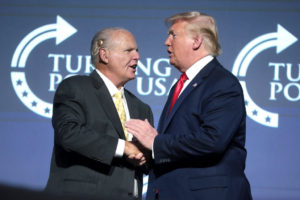 Stirling Newberry explained the concept of a death bet: you bet that the negative consequences of your actions will occur after you are dead. Classically this explains climate change: decision makers who could have stopped it will almost all be dead before it becomes significant.
Rush Limbaugh was one of the most important people in creating the modern right; driving deregulation and spreading hate and racism. It’s impossible to overstate how influential he was in the 90s, not just thru his own radio show, but because other radio hosts copied him. Radio was a BIG deal back then still, and had massive reach.
There aren’t ten people more responsible for America being what it is today than Limbaugh; there may not be five. (Robert Ailes, who ran Fox, is on the list too.)
All of these people died before they suffered from making the US a non-fuctional undeveloping nation. They were protected by their wealth and their power. Limbaugh died rich. Ailes died rich.
Meanwhile, in Texas, utilities deregulation and privatization has lead to vast suffering and death, which, yes, anyone with sense who wasn’t blinded by greed or the world’s stupidest ideology (if we give a lot of money to rich people that’ll be good for us!) knew would happen eventually.
America is divided into two tribes who hate each other. Eliminationist rhetoric is common. The media fans the flames, regularly lying and dividing people against each other.
Limbaugh. His legacy. What he worked hard for all his life. What made him rich. Hate, stupidity and the destruction of his country.
Limbaugh won. He’s dead, he never suffered the consequences of his belief.
But many of you, dear readers, will.
Men like Limbaugh at the enemies of all good people; all decent people. So are those who funded him and pushed him. So is every Texas utility executive; every member of the board, and every single politician who pushed deregulation, privatization and policies which increased climate change.
They sold your future; your lives; your children’s lives, so they could live well and be rich. This includes Pelosi and Biden, both of whom were very important in creating this world.
They’re going to die, never having faced the consequences of the evil they have done. You, on the other hand, if you’re not old and cushioned by wealth, will.
A functioning society would throw all these people in jail and take all their money and power. America? Canada? Britain?
We re-elect them and make sure they get richer and richer.
All the content here is free, but subscriptions and donations do help, a lot.
So, a lot of places are getting cold weather they aren’t used to. As a commenter noted there are some simple things you can do.
- Your pipes may not be insulated. Run your faucets (all of them, warm and cold) at a trickle. Otherwise the pipes may burst.
If you have lost power and thus heat:
- Pick a single room to live in. Put a blanket under you, not just on top. Put blankets or other cloth or plastic around the windows and the doors to keep warm air in.
- Do not use heating devices which produce a lot of carbon monoxide. Don’t run your car inside to get heat. You can use candles for heat (in a room, they make a difference, but don’t fall asleep with them on.) If you are burning wood in a fireplace, make sure the flu is open. If you haven’t used it in years, don’t assume the chimney is unblocked and don’t go to sleep with the fire on.
- a blanket fort can make a big difference. Likewise, setting up a tent inside, if you have one.
- Everyone sleeps in the same room. If comfortable doing so, sleep together to share body warmth.
- Do pee, don’t hold it because “it keeps you warm.”
- Fill your bathtub with water if there’s any concern that you might also lose water.
- If you’re concerned about frozen food, put it in an animal proof container outside.
- If you have a working stove you can heat snow for water if you must. Take only the top layer of clean snow. You can also eat snow if you can’t heat it (I did so many times as a kid). It’s not ideal and not recommended but it’s better than going without water. Obviously if you have reason to believe it’s contaminated, reconsider.
Readers are encouraged to leave other tips in comments.
The faster we get everyone immunized, throughout the world, the more likely we can stop Covid from going chronic, becoming the new flu (but more deadly, unless/until it mutates to become less fatal, which the untried models say it should.)
However, if Covid is cured, well, you can’t make money off Covid any more, can you?
Chronic Covid, mutating constantly, means more and more vaccines, and more and more and more money for vaccine makers.
Ghastly, and I know that many readers are probably, “that’s absurd”, but consider, does it have both explanatory and predictive power?
Does, “Covid makes the rich, richer so they want it to keep going” have explanatory and predictive power?
Qui Bono? Who benefits? Since the people who run our societies profit from Covid, why would they actually want it over (remember, billionaires have become vastly richer.)
I, too, dislike living in a society where this explanation has stronger predictive power than “our leaders don’t want us to die in large numbers, and become poverty-struck, just so they can get richer,” but that statement, well, look at it closely. If that was true, how would our rulers behave? Not just during Covid, but at other times?
Yeah.
I mean, I’ve been saying this sort of thing for a while, because it’s obviously true, but I’m embarrassed it took me so long to realize it applied to vaccine creators as well, especially since Pharma has a well-known bias towards medicines that are palliatives, not cures. Someone who needs your medicine again and again is much better than someone who needs it only once.
Gotta admire the pure predator instinct in our rulers. They’re the wolves, we’re the sheep and God, do they love mutton.
It’s them or us, and so far, it’s us.
All the content here is free, but subscriptions and donations do help, a lot.
by Tony Wikrent
Strategic Political Economy
“How The US Legalized Corruption”
[Indi Samarajiva, via Naked Capitalism Water Cooler 2-8-21]
“Americans have this thing called a fundraiser where you put a pile of bribes on a table, wave a wand of asparagus over it, and it just disappears. Access is still bought, but somehow because people ate food, it’s not corruption anymore. The press will literally report on the food. “In New York last weekend, $100,000 got donors a plate of grilled chicken and asparagus, a posed picture with President Trump in a palatial, 60-foot-long entryway, and a 20-minute group chat with the president. WTF is this? In any other country you wouldn’t report on the chicken, you’d report on the corruption.” (Details of a fund raiser dinner from the Washington Post).
Because this is all legal, Americans ignore how fucking insane it is. It’s just daylight bribery. This is what I mean when I say that America has legalized corruption. It’s not that your system is corrupt. Your system is corruption.
Property, Liberty, and the Rights of the Community: Lessons from Munn v. Illinois
Paul Kens [Buffalo Public Interest Law Journal, Volume 30 (2011)]
Abstract: When considering the extent to which the United States Constitution places a limit on government regulation of business, today’s historians and constitutional theorists treat the question as a matter of balancing economic liberty or property rights against government power. Moreover, modem scholars commonly maintain that this balancing formula represents the predominant tradition in constitutional history. Tracing it back to the tenants of Jacksonian democracy that emphasized distrust of government, they imply that constitutional history has developed as a straight line: always with an emphasis on individual liberty and always with a presumption that entrepreneurial liberty should be favored over governments’ power to regulate.
This paper will use the 1877 case Munn v. Illinois to demonstrate that prior to the late 1880s the paradigm for determining the constitution’s limits on government regulation of business was actually quite different. There is no doubt that the Court has always emphatically recognized the importance of property rights. Nevertheless, during the first century under the Constitution, it treated business regulation as a matter of balancing entrepreneurial liberty against the rights of the community. Furthermore, it consistently held that, because state economic regulations were an expression of popular sovereignty and rights of the community, they should be presumed to be valid.
Munn is significant because in the conventional narrative it is portrayed as a steppingstone in the straight line evolution of constitutional doctrine that emphasizes individual liberty. A closer look at the case and the events surrounding it will demonstrate, however, that the majority in Munn actually based its opinion on the traditional emphasis on rights of the community. It will further demonstrate that for more than a decade after the opinion the Supreme Court steadfastly clung to that traditional view. Even under persistent pressure to change.
Fear of the Few: John Adams and the Power Elite
Luke Mayville [Polity, Volume 47, Number 1, January 2015]
Abstract:The political thought that informed the design of the United States Constitution largely neglected the danger posed by socioeconomic elites. The writings of John Adams, I contend, are exceptional in this regard. Using Adams’s writings as a vantage point, this article exposes two important blind spots in mainstream Founding-era thought and the Constitution it informed. Whereas the likes of Hamilton and Madison insisted that majorities held the clear preponderance of power in republican America, Adams maintained that an elite of wealth, birth, and beauty retained overwhelming power even after the abolition of formal distinctions. And whereas Federalists sought security against the threat of majority tyranny, Adams’s principal fear was of aristocratic tyranny—specifically, the tendency of the elite few to undermine both popular representation and effective government.
Use the comments to discuss topics unrelated to recent posts.
One of the constant refrains which has bemused me during the pandemic is all the people saying how much kids want to go back to school.
What?
This has struck me as crazy, because I don’t seem to have childhood amnesia. I didn’t like school, and I remember that almost no kid I ever met, even those who did, preferred school to days off.
But I shrugged until I read this teacher’s account of asking her students how their time off was.
Surprise, almost all of them were happy they had had the pandemic time off.
School is, well, mostly bad. It teaches things slowly, it mostly trains obedience, and it’s a social horror show. When we say social dynamics are like high school, we never mean anything good, and there are dozens of movies about how awfully students treat each other.
And most of what is taught in school and university is quickly forgotten. I used to amuse myself by asking recent university grads what they had learned, most of them could barely remember anything. Since I was widely read, often I knew enough to ask basic questions about their discipline, and they wouldn’t know the answers.
School is no different: information which is not used or found important, is lost, and it is lost quickly once the final, externally imposed, exam, is over.
Parents want their children to go back to school because it’s a babysitting service, and since we’re not paying parents to stay home, they need someone to take care of their kids. And yes, some may be falling behind or finding distance learning hard, but a decent system could make that up well enough.
But the idea that the kids themselves miss school, except in the sense that they can’t see their friends (which is pandemic related, and if it’s not safe to see them outside of school it isn’t safe to see them in school) is laughable.
It’s fairly obvious that the way we do school is terrible. It doesn’t teach knowledge quickly; the knowledge isn’t retained well, it destroys curiosity and natural desire to learn and it mostly has the effect of making children who should be outside running around into good little slaves: people who have learned to sit down, shut up, and do what teacher (or later, boss) says, the way they want it done.
It’s a wage-slave factory and that students come out with some actual knowledge is a secondary issue (if it wasn’t, effective illiteracy statistics wouldn’t be constantly high.)
Effective traumatic conditioning makes you pretend that you enjoyed it. And that’s what school is: a way of taking the juice of life out of you and destroying your ability to make independent decisions and love learning.
We forget that, because what was done to us was horrible and all our trusted adults were onside with it. So as with horrible parents, we have to pretend they did it because they loved us.
Maybe they did, since they think being a slave is good, since most of them (us) are slaves, and we must believe that whatever we do is good.
But, at the least, let us not forget something simple. Most kids prefer not being at school to being at school. And if you have honest recollection of your childhood, you probably did too.
All the content here is free, but subscriptions and donations do help, a lot.