Ian Welsh

The horizon is not so far as we can see, but as far as we can imagine

All the Futures that Will Not Happen

I’m often amused and saddened by the techno-optimists among us and their fantasies of great futures. Or even the woke folks who think that color and gender and whatnot are the great political frontier.

Let’s run through this. Water.
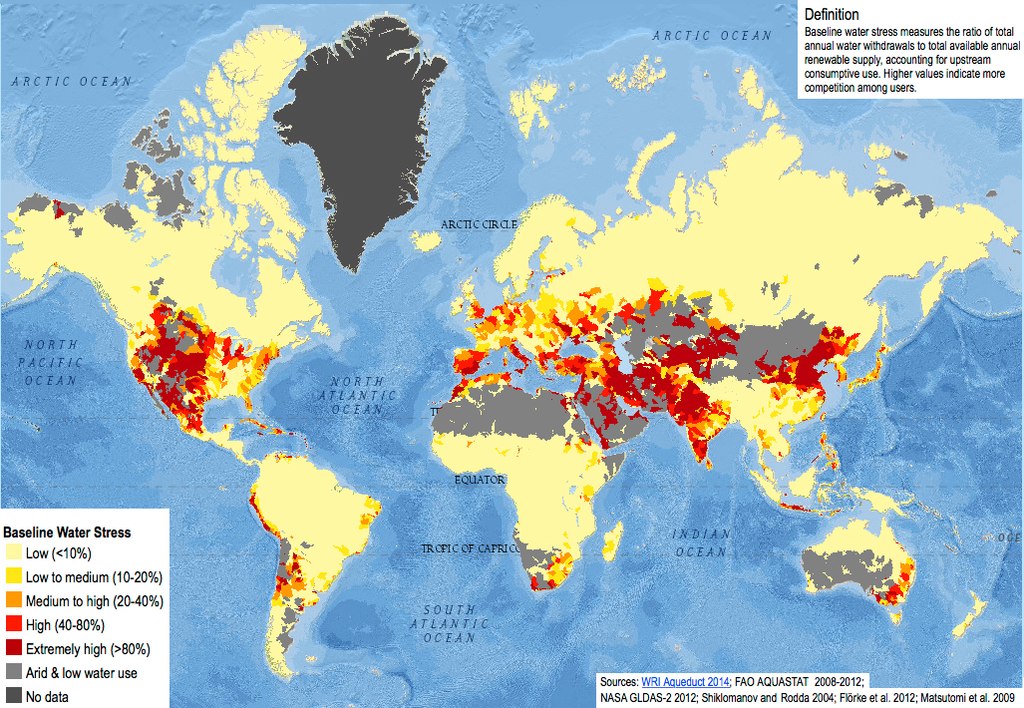
Baseline Water Stress

To put some numbers on it:

New modeling of the world’s groundwater levels finds aquifers — the soil or porous rocks that hold groundwater — in the Upper Ganges Basin area of India, southern Spain, and Italy could be depleted between 2040 and 2060.

In the US, aquifers in California’s Central Valley, Tulare Basin, and southern San Joaquin Valley, could be depleted within the 2030s. Aquifers in the southern High Plains, which supply groundwater to parts of Texas, Oklahoma, and New Mexico, could reach their limits between the 2050s and 2070s, according to the new research.

The thing to understand about this is that it doesn’t show permanent aquifer damage. If you overdraw aquifers, they lose the ability to hold as much water; that reduction is permanent.

Then there is fracking and other forms of poisoning groundwater, though how much is difficult to determine. (It’s not small.)

Meanwhile, the next thing is that important rivers tend to be driven by snowpack runoff and glaciers, but snowpack is becoming less and less and glaciers are receding. We’re talking about rivers like the GANGES and the Yangtse, not to mention all the European rivers which start in the Alps.

So we have groundwater depletion, some of it permanent. We have poisoned groundwater, and we have a reasonable expectation of reduced water in rivers, which in some cases will dry up entirely.

Let’s move on to more fun stuff: ecosystem collapse.
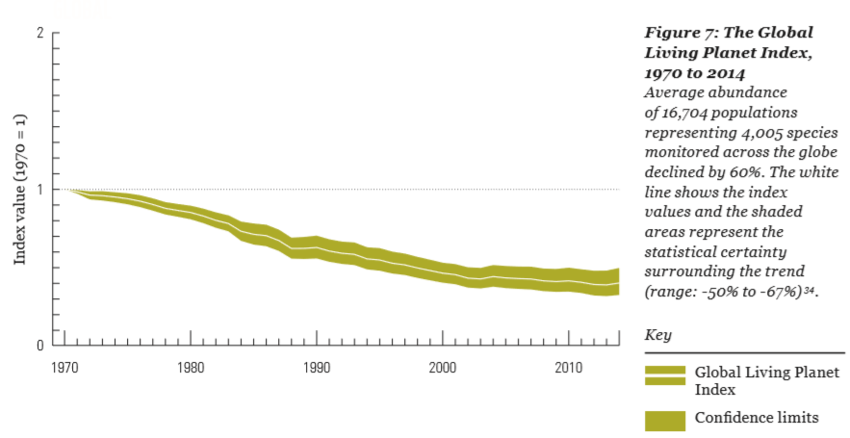
Wildlife Reduction

This number is from 1970, which was already very reduced. You can read accounts of what the Grand Banks were like originally: They could literally dip a pail into the ocean and come up with fish. We’ve massively reduced wildlife everywhere, insect populations are collapsing, and so on. Recent estimates are that the Amazon is no longer a net producer of oxygen, but now produces Carbon Dioxide.

Phytoplankton produce half the world’s oxygen. From 1950 to 2010, the population of phytoplankton dropped 40 percent. We can safely assume losses were not even, but are accelerating.

The general picture in terms of climate change is all bad:
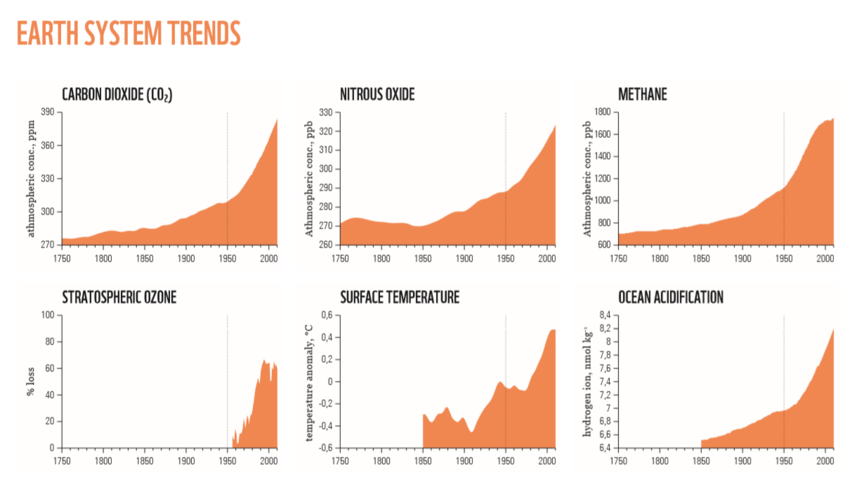
Climate Dashboard 2018

Note that first graph very carefully. There is NO sign in the actual numbers that we are doing anything of importance to stop this trend. Kyoto and Paris have achieved nothing, which is to be expected, since they were voluntary.

Let’s put this all together: massively rising temperatures; more extreme weather events; changes in climate, including rainfall patterns; massive depletion of aquifers at the same time as we can expect many rivers to lose volume or dry up; no effective political action.

One thing that India’s Covid crisis clarified for me is that India won’t be able to handle climate change, so let’s make some predictions.

India breaks up within 20 to 30 years. It dies amid great famines which kill two hundred million or more people. Bangladesh, of course, will go oven sooner, and unleash a tsunami of over 150 million refugees which India does not want, as they are mostly Muslim.

China breaks up 30 to 45 years from now and descends into warlordism. Prior to the breakup, there is a better-than-even chance of war with Russia for Siberia. Again, hundreds of millions of deaths.

The US is going to hurt worse than is obvious: Core areas will hit depletion, and many rivers will dry up. Large chunks of the Southwest will become completely uninhabitable. California’s population carrying capacity will drop massively, unless it moves to mass de-salinization (a dicey prospect).

We’ve just had ourselves a lesson in what exponential growth looks like. There is every reason to expect that at least some parts of ecosystem collapse and climate change will act that way: When break points are reached, they will accelerate, and nothing we can do will stop them. Worst case scenario is a hothouse Earth in which humanity goes extinct, but entirely plausible scenarios see the Earth losing half or more of its carrying capacity. The process will involve a lot of death, suffering, and war.

There’s a decent chance we get a marine inundation event. Rather than water rising by small amounts every year, at some point it rises very quickly, and large amounts of the coast flood permanently.

Remember that the “moderate” estimates have almost all been wrong. The “worst case” scenarios, for decades now, have been coming in correctly.

All of which is to say, whatever future you think you’re going to have, you need to run it past this lens. Does it survive this? Does society spend resources on whatever it is in the face of hundreds of millions of deaths and billions of refugees?

So, no, your future, whatever it is, unless you can instantiate it in the next two decades, probably isn’t going to happen.

The clock is ticking, we are running out of time to do whatever it is we want to do, and it is very likely that we are past the point of no return; that even if we were to go all-out to stop climate change and environmental collapse (we won’t), we could — at best — limit it to “losing half the population.”

lf you’re old enough, none of this matters, of course. But we are now at the point where, if you aren’t 60 and in poor health, or 70 and in good health, you’re probably going to get see at least the start of the really bad times.

We’ll come back to what this means in more depth later, but for now, just make your plans based on this understanding of what the future holds.


(Writers eat and pay rent, so subscriptions and donations help.)

Week-end Wrap – Political Economy – April 25, 2021

by Tony Wikrent

Strategic Political Economy

Plato, Aristophanes and Aristotle on Money-Lust, 399-380 BC
Michael Hudson, April 23, 2021 [Naked Capitalism]

Delphi’s warning that lust for monetary silver (philarguria) was the only thing that could destroy Sparta was echoed by Plato, Socrates and other philosophers accusing wealth addiction of leading to greedy and hubristic behavior that impoverished society at large. Creditors were singled out for reducing debtors to bondage and taking their land.

Near the outset of Plato’s Republic (1 at 331c-d, written c. 380 BC), Socrates (who was put to death nearly twenty years earlier, in 399) discusses the morality of repaying debts in circumstances where this would lead to anti-social consequences. Cephalus, a businessman living in the commercial Piraeus district, states the typical ethic that it is fair to pay back what one has borrowed. Socrates asks if it would be just to return weapons to a man who has become a lunatic. If a madman is intent on murder, Socrates asks, will not returning his weapon to him enable him to commit unjust acts? In view of the likely adverse social consequences, paying back such a creditor would be the wrong thing to do. It all depends on what creditors will do with their returns, and how their actions affect society. Book 8 of the Republic elaborates upon this discussion, describing how wealth leads its owners to act in ways detrimental to society.

Howard University’s removal of classics is a spiritual catastrophe

Cornel West and Jeremy Tate, April 19, 2021 [Washington Post]

Academia’s continual campaign to disregard or neglect the classics is a sign of spiritual decay, moral decline and a deep intellectual narrowness running amok in American culture. Those who commit this terrible act treat Western civilization as either irrelevant and not worthy of prioritization or as harmful and worthy only of condemnation.

Sadly, in our culture’s conception, the crimes of the West have become so central that it’s hard to keep track of the best of the West. We must be vigilant and draw the distinction between Western civilization and philosophy on the one hand, and Western crimes on the other. The crimes spring from certain philosophies and certain aspects of the civilization, not all of them.

‘Divisive’: How Corporate Media Dismiss Ideas Unpopular With Elites

[FAIR, via Naked Capitalism 4-19-2021]

The carnage of mainstream neoliberal economics

Capitalism as a Suicide Cult

[CounterPunch, via Naked Capitalism 4-24-20]

…the problems causing such widespread social misery are systemic, means that the solutions need to be so as well. To understand why, the difference between socialism and social welfare liberalism is that socialism requires a redistribution of power— from corporate executives and capitalist owners, to workers. A transfer of power, if not ownership, is what the New Deal accomplished. Conversely, welfare state liberalism subsidizes capitalism. One third of the recipients of food stamps (SNAP) who work, work at Walmart. Seventy percent work. SNAP is a subsidy of low wage employers, not its recipients.

The transfer of power of the New Deal was accomplished 1) through reforms that constrained business in its ability to rob people and crash the economy, and 2) through building public institutions that redistributed power from oligarchs and executives to workers. The Glass-Steagall Act of 1933 separated investment from commercial banking, thereby leaving investment banks to speculate with their own money. This effectively ended the financial mania that cascaded into the forced sales of bank ‘assets’ in the early years of the Great Depression. As readers know, Glass-Steagall was repealed in 1999. The result: a world-historical residential real estate bubble and the Great Recession.

“Local Economic and Political Effects of Trade Deals: Evidence from NAFTA” (PDF)Jiwon Choi, Ilyana Kuziemko, Ebonya Washington, Gavin Wright [National Bureau of Economic Research, via Naked Capitalism Water Cooler 4-22-21]

From the Abstract: “We show that counties whose 1990 employment depended on industries vulnerable to Mexican import competition via the 1994 North American Free Trade Agreement (NAFTA) suffer large employment losses (relative to the bottom quartile of counties, counties in the top quartile of NAFTA exposure see 5-8 log-point declines in employment by 2000). Despite large employment losses, we can reject even modest population declines. Trade-adjustment-aid relief rises, but covers a tiny share of the job losses we document, and Disability Insurance in fact displays a much larger response. Exposed counties (many in the upper South) begin the period more Democratic in terms of votes in House elections, but as NAFTA is debated in 1992-1994 they shift in the Republican direction and by 2000 vote majority-Republican in House elections. We show with a variety of microdata, including 1992-1994 respondent-level panel data, that opposition to free trade predicts shifts towards Republican party identification.” • Bill Clinton, good job.

Open Thread

Use comments to discuss topics unrelated to recent posts.

The Catastrophic Covid Crisis in India

I follow a fair bit of Indian media, as a lot of it is English language, and the last few days in India have unveiled a Covid situation far worse than the stats suggested. People are scrambling for oxygen in particular, with patients in hospitals dying because of its lack. There isn’t enough medicine and bodies of Covid victims are being burned in vast numbers.

At the start of the Covid crisis, I figured that India, with its vast population, inadequate health infrastructure, corruption and idiotic leadership in the form of Modi would be a fiasco. It seemed like it wasn’t so bad, and I couldn’t figure out why, but decided that since I haven’t been  there in decades there was a factor I was missing.

Turns out the main factor was probably under-counting Covid cases.

Meanwhile, where I live in Ontario, Canada, the situation is also dire, though not as bad as in India, with ICUs in the largest metropolitan center so full, they’ve had to move patients in large numbers out.

Worse, the Premier had non-ICU Covid patients moved to long-term care homes — exactly the move that New York governor Cuomo made that caused New York’s LTC disaster and which amounted to him committing mass manslaughter, for which he should go to prison.

Again, Ontario is a place where, at the start of the pandemic, I figured it would be a catastrophe because Doug Ford, the Premier, is a noted incompetent who’s also probably a sociopath or psychopath. In his youth, he was a drug dealer who allegedly enjoyed beating people  up.

But Covid seemed to be going better than I expected, until it wasn’t.

It turns out that bad leadership (Cuomo is also a psychopathic incompetent) is a good predictor for who did catastrophically bad with Covid.

In India, Modi is the fool who demonitized India, getting rid of large bills in an effort to crush corruption, but instead massively damaging the informal cash economy which most Indians live in. Any idiot knew that India, of all countries in the world, was one of the least candidates to move hard towards more e-cash, but Modi is an idiot’s idiot, enamoured both with right-wing Hindutva religious ideology and with neoliberalism, because Indian socialism didn’t work well, so the solution is obviously to do the opposite form of stupdity.

I don’t really have a moral here, except the obvious: that leadership does matter, and that one’s initial impression of competence is usually right. Modi’s incompetent. Cuomo’s incompetent. Trump was incompetent. Ford is incompetent. All of them are also malign: They don’t care about what happens to other people. Ford famously stole money from his brother’s widow, so he isn’t even in the Biden class of at least being good to his own family.

Probably, electing evil, incompetent people is a bad idea, and we should do less of it.

If I wind up dead from Covid, feel free to blame Ford, with a sidecar of blame for Canadian Prime Minister Justin Trudeau, who has refused to treat Canada as a country and take charge of Covid efforts in provinces, where the Premiers are incompetent.

As for India, the Indians have my deepest sympathies, and if you don’t care about them, remember that India has the world’s largest vaccine industry, and those vaccines will not be leaving India until Covid is under control there, which means catastrophe in India will hurt many countries, allow even more variants to be created, and kill a hell of a lot more people, far from India.

Turns out that electing an evil moron like Modi effects countries far from India, just as electing Trump, Obama, or Bush effected countries far from the US. Leaders of powerful countries, and India is powerful, matter beyond their borders.

Good luck to everyone led by shitty leaders, Indian, Canadian, and other. In the future, let us remember that mean assholes are usually also incompetent, and to stop electing them.


(All the content here is free but food and rent aren’t, so subscriptions and donations do help.)

The Ugly Reality of America’s Powerful

It’s been a while since January 6th, and on economic domestic affairs, Biden’s turned out somewhat better than I expected, but nothing’s really changed in terms of his legitimacy:

78 percent of Republicans think Biden stole the US election.

That is a broken country, folks. Fourty-five percent think the January 6th occupation was justified, which seems oddly low; I’d certainly think it was justified — if I also believed the election was stolen. In fact, I’d think it was mild, and that far more than that was justified. In a democracy, stolen elections can’t be tolerated, which is why Gore was wrong to stand down in the face of Bush’s theft in 2000.

What the US has, is a broken media system: There are two sets of facts circulating, and often more, on many issues, and people live in completely different worlds. Most Democrats don’t have any Republican friends, and vice-versa.

The weird bit is that false narratives are driven by facts with ur-truth. “Q” is wrong about the specifics, but not wrong that many American elites are pedophiles. Part of the Q myth is that rich people use a drug made from the pituitary gland of tortured children: That’s not true, but some elites do use the blood of young people (in their twenties) to help rejuvenate themselves.

Ironically, there was a great deal of election fixing, mostly by Republicans. It’s like the old joke from the Iraq war era: “We know they have WMD, we have the receipts!” Biden won despite vast Republican efforts to suppress the vote, but Democrats also suppressed the third-party vote, keeping Green candidates off the ballot wherever they could in a sickening anti-democratic display, and did a great deal during the primary that was anti-democratic against Sanders. It’s not that Democrats don’t believe in suppressing votes; they don’t believe in suppressing their votes, and in general elections, the more people vote, the more Democrats win, unless they’re pesky third-party voters.

The UR-Stories told, then, are true. US elites are evil, anti-democratic, and many are at least pedophile-adjacent (see all the pictures of famous politicians and other rich people with Jeffrey Epstein, including Clinton and Bill Gates.)

Even leaving aside the blood bit, the rich do live off the health of young people: The younger the generation, the poorer they are compared to previous generations. The US economy destroys the health of poor people for the benefit of rich people. Ordinary people, by the time they’re sixty tend to look old; rich people tend to still look young, and keep charging around well into their seventies due to avoiding hard physical labor, eating very expensive food (which is, overall, better for them) and using far superior health care, which they can afford, and the poor and middle class can’t.

The US is an oligarchy where the rich and powerful live longer and are healthier and richer because they oppress everyone else. That’s a fact. The mechanisms of how they do so are boring: Obama immunizing all the bankers and helping them steal people’s homes. Trump’s gigantic tax cut for the rich. The IRS hardly auditing rich people. Laws that make it easy to hide money offshore. Private islands where unspeakable lusts are indulged, and entirely legal use of young people’s blood to feel younger.

Most of this is done out in the open. If you were in the right circles, “everyone knew” about Epstein, but he was protected by the intelligence agencies, presumably because pictures of important people with underage girls are very, very valuable. The laws are passed in the Senate; the Treasury and the Department of Justice bail out and immunize the rich and everyone who belongs to the club is taken care of unless they steal from the club (Madoff) or egregiously embarrass the club by constantly talking up their evil like Martin Shkreli, the so-called “Pharma Bro.” Plenty of other pharma execs have jacked up prices and killed people, including for epi-pens and insulin, but those execs didn’t scream about it to the rooftops.

So conspiracy theories like “Q” are garbage, but they work because the ur-truth is that US and Western elites are, in fact, evil and engaged in hurting and killing ordinary people. It’s just that most of how they do it, Epstein aside, is boring and at scale.

So the US is broken. Republicans think the election was stolen. Back in 2000, an election was actually stolen, and voter suppression and election fixing is routine. Rich people do kill and hurt you for money, and a lot of rich people do seem to like under-aged girls, but certainly don’t need to go to some pizza joint to indulge.

There’s no need for “Q” or most other conspiracy theories (though surely, there are conspiracies). Most of the evil is done in the cold light of day.


(All the content here is free but food and rent aren’t, so subscriptions and donations do help.)

The Point People Miss About Navalny’s Imprisonment

Alexei Navalny

Alexei Navalny

So, the “opposition” leader Alexei Navalny is in prison, and is apparently very sick and perhaps near death.

Navalny is not popular in Russia, he is popular in the West. For years he’s been a gadfly for Putin, and little more.

But what got Navalny in prison, and may get him dead, is simple enough: His revelations about Putin’s family, including an alleged illegitimate daughter.

That stepped over a big bright red line. Putin was chosen as Yeltsin’s successor in large part because Yeltsin believed Putin would protect his family after Yeltsin’s death, which he did.

Putin is 68. He recently put in place a law immunizing past Presidents from any crimes they may have committed. He’s not going to be in charge forever.

The trick of being a dictator is leaving peacefully, surviving retirement, and keeping your family safe. For years, Putin has gone to great lengths to keep his family out of the spotlight, and Navalny attacked Putin’s family.

Navalny had an eye for the thing Putin cared most about — for his weakness. He was right.

But if you come for the King’s family, you’d best not fail to take out the King.

(As for Navalny, he’s not a good actor, and if anything, more violently anti-Muslim than Putin. There is no “good” side in this fight.)


(All the content here is free but food and rent aren’t, so subscriptions and donations do help.)

Why Do We Do That?

So today I stopped by the Liquor Control Board of Ontario (LCBO) and picked up a small bottle of sake.

The teller seemed unhappy, so we chatted for a bit. I told him I’d worked at the LCBO for a couple months about 25 years ago (for the Christmas season), and he opened up a bit.

“Yes, it was a better job then. It was also a better job eight years ago, or three years ago. It just gets a bit worse every year, it seems. Don’t get me wrong, it’s still better than most jobs: we have a pension, and not a lot of jobs offer one any more, but…”

The long and short of it is that every year management tries to take away a little bit of what makes working for the LCBO a pretty good job. It’s still pretty good, but if this doesn’t reverse, one day it won’t be.

This has been going on for decades; a couple generations at least, arguably three to four generations. In the US, working class male wages peaked in real terms in 1968, the year I was born, and I have white hair.

We just keep making life worse for a huge chunk of our population; this is true in Canada, in the US, and in most of Europe.

Our rich are the richest rich in his -— ah, forget it. You’ve heard me say it many times.

And I can tell you the “reasons,” but at the heart of it, I don’t fucking get it. How rich do these assholes need to be? How many private jets and vacation homes and $50k/day hotel room stays do they need? Do they really think their pleasure is worth so much more than billions of people’s suffering? Because much of what they do hits the developing world hard.

Why are they such scum? So evil?

Why do we run a society that is just making things worse for so many people (don’t waste my time with the “extreme poverty numbers,” they’re bullshit)? Why do we have more homes than homeless; waste a third of our food and have hungry people? Why are we on track to kill about half of all known life forms on Earth?

Why are we so stupid, evil, and selfish as a species? Why is our leadership made of so many people who could only, truly, improve the world by taking a long jump of a short pier?

I mean, Bill Gates fought hard to keep vaccines under patent. He’s never been a good actor, of course, but, here, he is protecting his interests by hurting people in the middle of a global pandemic, despite having more money than he could possibly need if he lived a million lifespans.

We have a pair of huge problems as humans:

  1. We’re badly led.
  2. Enough of us support terrible leadership for it to just keep happening.

Either we fix those problems, or Earth is going to continue to be Hell for much of the human race and worse than hell for non-human life.

But, emotionally, I still just don’t get these people. The Clintons’, Bushses, Obamas’, Bidens’, Bezos’, Waltons and so on. They just hurt people, hurt people, and hurt people, over and over again. There’s something deeply wrong with them, and with us as a species that these types of people wind up leading us over and over and over again.


If you enjoyed this article, and want me to write more, please DONATE or SUBSCRIBE.

Capitalism and Good Post-capitalism

Let us revisit the definition of capitalism.

Capitalism, everywhere, is defined by the removal of capital from most ordinary people and the concentration of capital in the hands of a few.

Capital, in this definition, is not money. It is the tools required to feed, house, and cloth oneself.

Medieval serfs, in most areas, had access to capital. They had the right to land to grow food, to take firewood, and so on. They built their own houses, spun their own clothes.

Depending on the time and place, they were healthy and relatively long-lived.

As I have pointed out before, early industrial workers, as a class, were worse off than the serfs and peasants they replaced. They worked longer, ate worse, died younger.

Capitalism is accompanied by enclosure virtually everywhere. The old rights are taken away and the peasants are forced off the land.

“Forced” is the operative word: In both England and China, the land to which they had rights — for centuries — was taken from them. If they won’t go peacefully, armed force is used to remove them. There are many, many stories of peasants in China resisting the government trying to take their land so they can hand it over to other owners.

Many people get “better” ownership out of the process of moving to capitalism. They get a better bundle of rights in terms of “property.” But most people lose their rights to productive capital.

You see this in virtually every developing country. Peasants are forced off the land, whether by law, crashing crop prices caused by unfettered “free” trade (which isn’t “free,” even slightly; Europe and the US massively subsidize agriculture), or by force. They flee to the cities, forming vast rings of slums. They are worse off than when they were peasants, in most cases, but there are no other options.

In most cases, this is done so that their country can concentrate on a few cash crops, plantation style, with a few owners making all the money.

Enclosure.

A citizen in a capitalist economy is distinguished by having no independent ability to feed, clothe, or house themselves. They must sell their labor on “the market” or live miserably and likely even die. (People who live on the street long-term don’t, as a rule, live long term.)

The term “wage-slave” is old, used in the 19th century to talk about what was happening then.

A person who must sell their labor to another, then do their master’s bidding, is not free. Their entire working day is spent doing what someone else tells them to do. Only a very few people, under any capitalist system, have anything close to freedom. The majority of people are slaves in their daily life, free only to sell their labor.

Because most people are undistinguishable, they take the rates offered by the market, and those rates are determined primarily by how tight the labor market is, a factor that has nothing, absolutely nothing, to do with any one individual worker.

Most workers in the world have miserable lives. Those reading this may have “good jobs.” In China, they make batteries by hand because it is cheaper than using machines. Other Chinese are now hand-pollinating crops.

That’s freedom for you.

People whose lives are lived doing what other people tell them are not only not free, but because their daily life is about obeying orders, they are not used to freedom and are conditioned to expect orders.

Being a wage-slave, taking orders is ordinary to them. It’s what they expect. They don’t know what freedom is because they have never experienced it (coming from a school system which is designed to turn people into obedient drones).

Real freedom is being your own master. It’s been a long time since that described most of the world’s population.

But capitalism, meaning wage slavery, contrary to the propaganda, has not been an unambiguous move towards freedom.

In the 19th century in North America, for example, if land was unused, you could simply go work it and after a few years it was yours.

You can’t do that now.

Capitalism is about taking the ability of the many to provide for themselves and putting it into the hands of a few. The argument is that this transfer allows for the creation of more goods and services than would be possible otherwise.

But we don’t need more — let alone the vast amount of surplus we are creating. We waste a third of the food we produce. We deliberately build “planned obsolesence” into the manufacture of goods. We are vastly overproducing past our needs, and because we distribute goods through corrupt market mechanisms, many people still don’t have enough to get by, let alone enough for a good life. We could easily provide for them if what we produced were more evenly distributed and not made to break down so we can make more.

Imagine a world with no planned obsolesence, in which everyone has a small garden (indoors gardens are easy to do now, and one pilot study found 10X yields from a basement garden with LED lights), everyone has basic maker tools, and every community has a few facilities capable of creating large appliances.

We can print buildings on 3D printers now (they could have been made well, prefab, long ago).

Freedom is the ability to make your own choices, daily, about what you do with your time and your abilities, without losing everything. It is the ability to support yourself.

Feudalism was no joy. But capitalism removed even more economic freedom than feudalism did. You don’t have to believe me, believe the people who lived at the time, who violently resisted the changes. They weren’t idiots, they weren’t fools; they knew their lives were being changed for the worse. That it worked out for some of their descendents means little: A century of technological improvement accounts for much of that.

Post-capitalism, if it is any good, will restore the ability to grow and make what they need to the people. Not like feudalism, but a craft-based, hunter-gatherer society. Work 20 hours a week to meet the essentials, spend the rest of the time as you wish and choose how and when to work those 20 hours.

More on this later.

Originally from April 17, 2016. Back to the top.


If you enjoyed this article, and want me to write more, please DONATE or SUBSCRIBE.

Page 227 of 532

Powered by WordPress & Theme by Anders Norén