Ian Welsh

The horizon is not so far as we can see, but as far as we can imagine

Week-end Wrap – Political Economy – April 24, 2022

by Tony Wikrent

Strategic Political Economy

The Godless Empire: Evil Cannot Create Anything New, Only Corrupt What Good Created

[The Reading Junkie, via Mike Norman Economics 4-18-2022]

Analysts in Washington study a culture and find its most primal, barbaric roots, and create a cartoonish caricature of it. With that caricature as a false god, that whole society is turned into a death cult, the perfect, self-destructing weapon against Washington’s rivals. The suicidal nature of Washington’s pawns is deliberate. After Russia is destroyed, there would be no use for a Ukraine anymore, so it is actually better for Ukraine to be destroyed in the process too…. The West loves “blood harvests” and projects that idea onto other cultures like Iraq, Libya, and Ukraine, but it originated on our own shores. Look at modern movies and shows like 300 and Vikings. Why do our filmmakers dream so much of mass killings, rapes, and blood gods? Why do they love depicting barbarians raping and massacring weak and pathetic Christians? It’s weird.

TW: This is why it is a tragedy that contemporary scholars of civic republicanism such as Pettit sand Rawls are misleading people by defining civic republicanism as “freedom from domination.” What makes civic republicanism a superior philosophy of political economy and governance is its insistence on promoting the human capacity to “do good,” by striving toward perfection.

Samuel Scolnicov, “An Image of Perfection: The Good and the Rational in Plato’s Material Universe” (Revue de Philosophie Ancienne, Vol. 10, No. 1, 1992)

Matt J. Rossano, Seeking Perfection: A Dialogue About the Mind, the Soul, and What it Means to be Human (Routledge, 2015)

This idea is, of course, reflected in the Preamble of the USA Constitution (“a more perfect union”) , but the philosophical importance of its inclusion is today all but forgotten. 

[Twitter, via Naked Capitalism Water Cooler 4-20-2022]

.

The Taliban Were Afghanistan’s Real Modernizers 

[Palladium, via Naked Capitalism 4-22-2022]

Carter Malkasian’s The American War in Afghanistan: A History is the first history to adequately capture this story. Malkasian deployed as a civilian officer in Kunar and Helmand provinces in the aughts, and then returned to Afghanistan as an advisor to General Joseph Dunford in 2013, and stayed at Dunford’s side through his tenure on the Joint Chiefs of Staff. Malkasian speaks Pashto fluently, traveled widely across Afghanistan conducting interviews, and participated in the Trump era negotiations with the Taliban.

Malkasian’s account of American error builds on these personal experiences. His catalog of American mistakes and miscalculations is long….

Most accounts of the conflict are one-sided portrayals of the American experience in Afghanistan. Malkasian’s fluency in Pashto allows The American War in Afghanistan to escape the limitations of the genre. Entire chapters are built on Afghan sources that other histories of the war ignore. From their perspective, the U.S. war in Afghanistan was not really American at all. Over the last two decades, it was Afghans, not Americans, who have done the majority of the killing, bleeding, and dying. The war in Afghanistan was first and foremost a civil war. Any account of the Taliban’s victory must start with what each side of this civil war was fighting for.

Mexico nationalises lithium in populist president’s push to extend state control 

[FT, via Naked Capitalism 4-212-2022]

[India Inside Out, via Naked Capitalism 4-23-2022] Rohan Venkat.

[FT, via Naked Capitalism 4-22-2022]
Open Thread

Use comments to discuss topics unrelated to recent posts.

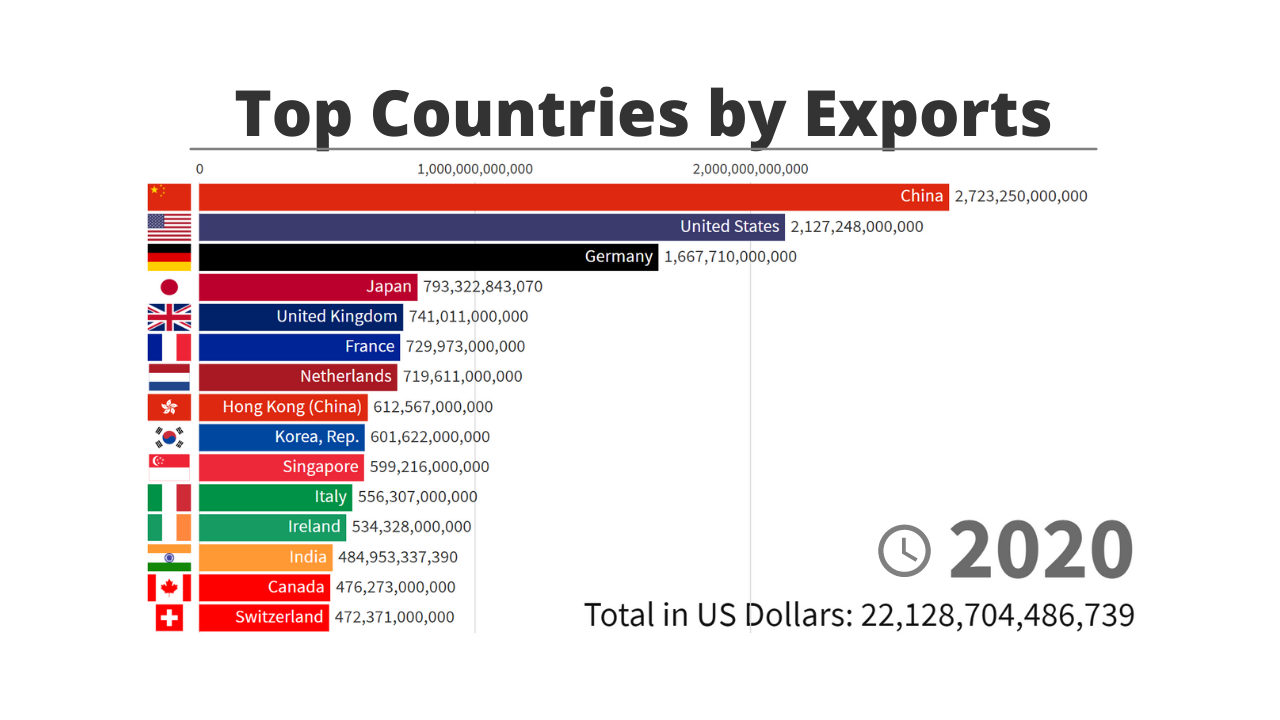
How Big Is The Chinese Economy Compared to The West?

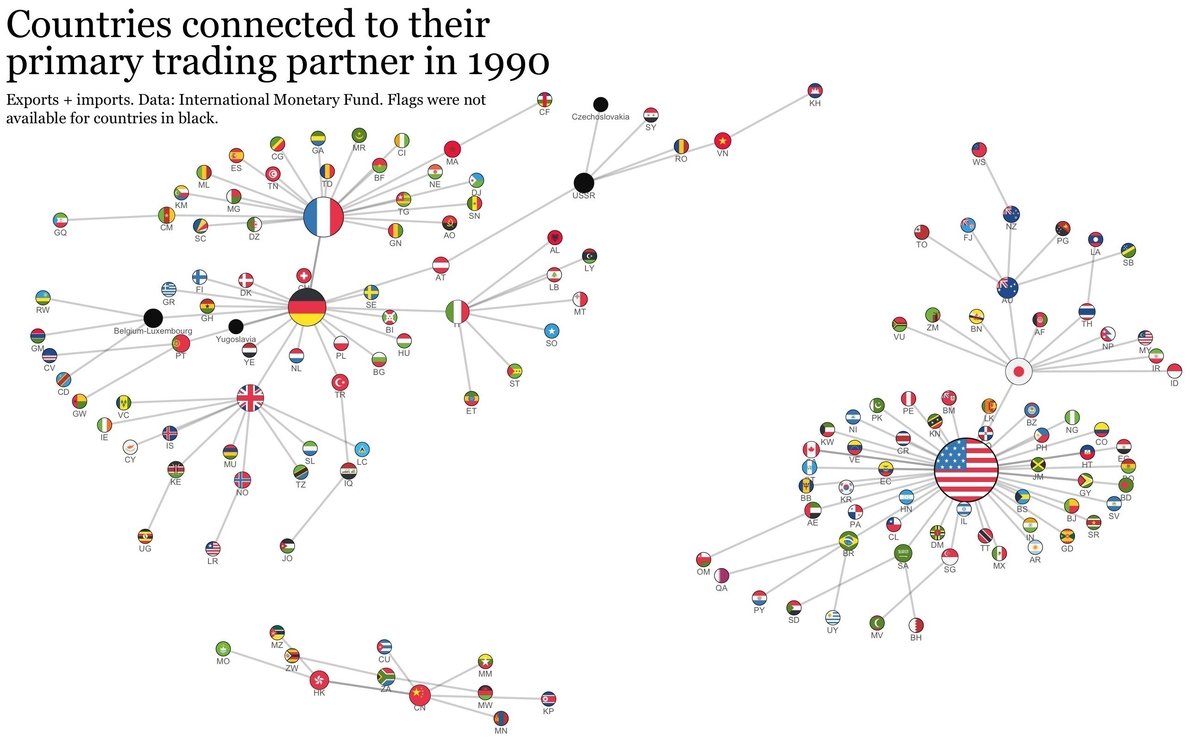
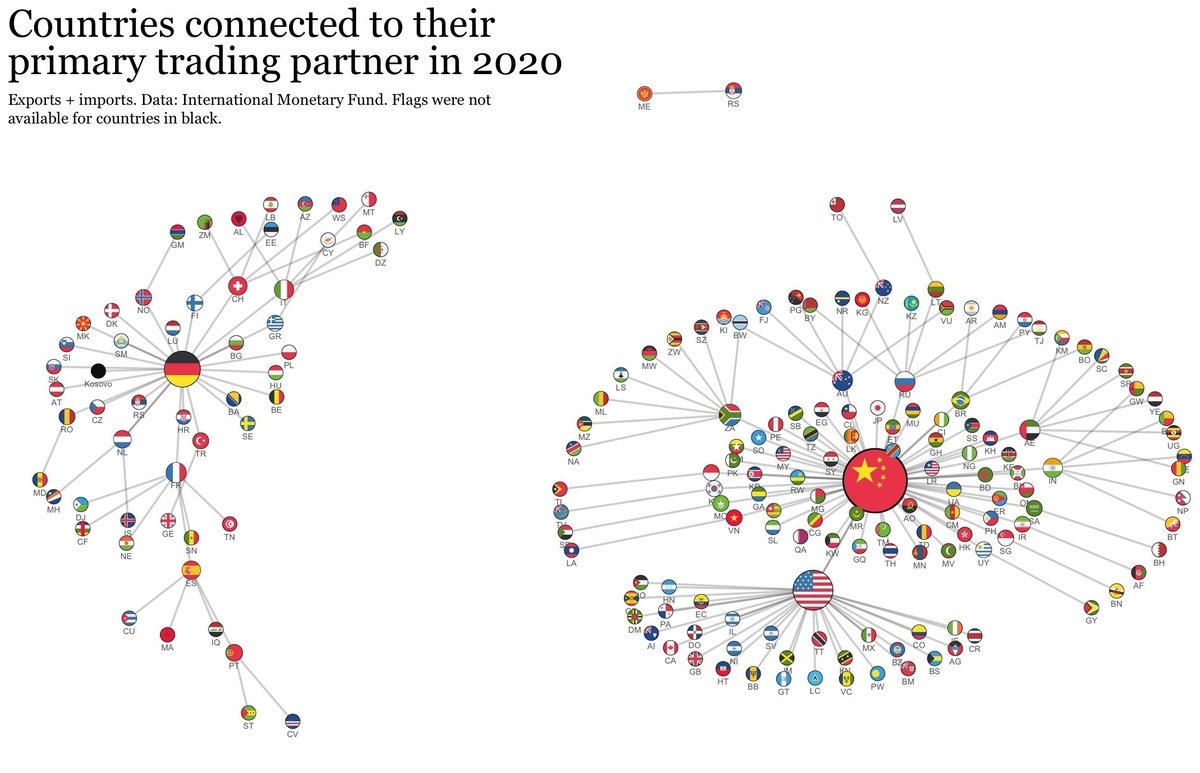
I recently came across these charts, of the biggest trade partner of each country, from 1990 and 2020.

To simplify: China is now more dominant in trade than the US at the height of its recent power. (Also of interest is the change in the UK and Japan’s position, though the collapse of Japan is overstated: it’s not , but it’s still a big trade power.

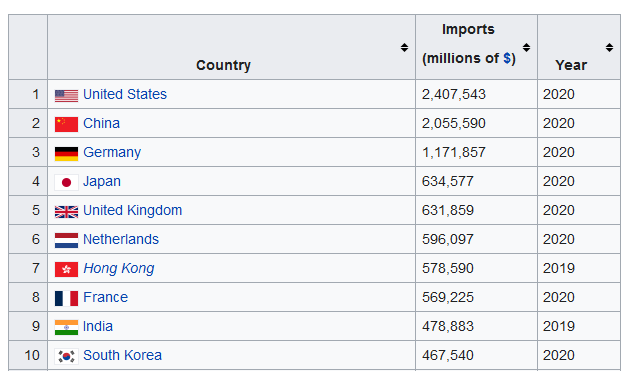
Let’s put the 2020 chart in numbers, bearing in mind that doing it in US dollars will overstate the relative size of the US.

For imports (from Wikipedia):

So, China is the primary trade partner of far more countries than the US. It exports more than the US, and imports less. These numbers understate the situation, though, since they are “goods and services.”

French Economist Jacques Sapir recently did an economic comparison by adjusting GDP numbers (not trade) as follows. First, change them for purchasing power parity (PPP), which is to say you can buy more with the same amount of money in China or Russia than in the US or Germany. Then adjust for the service sector being overvalued, so you’re left with manufacturing and the primary sector (digging things up and refining them) as the primary drivers.

Do this and Russia’s economy is 5% to 6% of the world economy, and much larger than Germany’s. China is about 30%, and the EU + US are about 30%.

Now I don’t entirely endorse this, there are some useful things in “services” like parts of the tech industry (much is worthless though, serving ads better does not increase a country’s actual economic strength. It might sap it.)

But it puts the situation in better perspective than using raw GDP.

Really there are three primary drivers of actual economic power: manufacuturing, resources and technology. Everything else either exists to service those 3 areas, or is nice and maybe even important to social stability (law, entertainment) but not primary.

China is the world’s primary manufacturing power. Russia is a powerhouse for resource exctraction. Russia is a leader in some types of military technology and not far behind in many others, and China is rapidly closing on the West in terms of tech and is even ahead in many areas (5G, for example, or hi speed trains, civilian use of drones, and so on.)

China also has something the US doesn’t have: a belief in technology. Robots and drones are common, technology is viewed as good, not bad and a threat. The Chinese believe in the future in a way that the west hasn’t since the 50s.

On top of all of this China is the world’s largest developer of nations: if you want ports, roads, train stations, hospitals, schools, smart cities or anything else, China will build them for you. They’ll finance them, and some exceptions aside they offer good loan rates because usually they’re more interested in good trade relations and getting your food/oil/minerals than they are about making a profit off building the infrastructure. In addition, Chinese construction companies building overseas infrastructure means those industries don’t have to downsize: they build China, now there isn’t enough work, so they’re off in Africa and South America.

To summarize then: China is:

  1. the number 1 trade partner of more nations than anyone else, and more than the US had in 1990.
  2. the world’s largest manufacturing nation
  3. Technologically near even with the West, and in some places ahead.
  4. The nation that helps the most other nations develop.
  5. When you adjust for PPP and service sector crap, a larger economy than the US. With Russia, a larger economy than the US and the EU combined.

And this is the nation we want to enter into a Cold War with? We shipped them so much of our industry that they now have more than we do, and after doing that we decide it’s time to pick a fight?

One thing is true of post-industrialization great politics: industry, access to resources and tech are what determine power. Since there is no longer a situation where the West has technology that is vastly ahead of everyone else’s, it really comes down to industry + resources.

And with Russia locked in and South America and Africa tending to prefer it, China is ahead or secure in both of those those categories.

If we wanted to keep our supremacy, we had to not ship China our industry and our tech so we could make some of our elites even richer. The Chinese accurately sized up our elite’s weaknesses and exploited them to the hilt. They thought they were “international” elites and it didn’t matter where the manufacturing was done, or who had the technology. The Chinese, however, were a national elite, and they knew it did.

I’m not sure this was exactly a bad thing. The West, in the unipolar moment (and heck, before) vastly misused its power, over and over again. Maybe a two-polar world will be better, if it isn’t, at least all power won’t be centralized in America with a few satrapies getting a voice and maybe that will be better for many countries and billions of people.

DONATE OR SUBSCRIBE


The Petrochemical Age In Context

If you want to do super big picture macrohistory, humans have really had three eras:

1) Hunting/gathering

2) Agriculture

3) Industrial.

To over-summarize, hunter-gatherers, with some exceptions in nutritionally dense areas were generally egalitarian. They had high childhood mortality and a fair bit of violence, but they lived longer lives than any time period before the Industrial era, and were health. In some cases we still haven’t caught up (for example, the width of hips of their women was wider than ours, and that correlates to health and easier childbith.)

Agriculture started out OK-ish for about 2,000 years, but the nature of agriculture creates private surpluses and allows for large elites. It’s easy to appropriate food and service from farmers, because they can’t move away and they can’t hide their take well (crops are harvested at known times, and about how much land produces is also known.) For the vast majority of the population, living in an agricultural civilization sucked. Yes, there were more of us, but we were sicker, died younger and more likely to have a nasty overlord. Violence decreased (though these figures are controversial), but that’s because the lords and masters don’t want other people killing.

Humans in this period were essentially domesticated, and there’s some reason to believe the process weeded out most people who naturally rebel against control. This is little different from how wolves became dogs, and just as degrading.

We know the industrial era, because we live in it, but I want to invite you take the long view: imagine it’s a 1,000 years from now. Or 5,000.

What the industrial age looks like when you zoom out is “the petrochemical age”. We figured out how to harness coal, gas and oil, added in a few other sources of energy, and became clever at hooking machines up to our power sources.

The problem is that in a period of less than 300 years we’ve burned up so many petrochems that we’re overheating the planet thru the mechanism of climate changes gases, and our population is well over the planet’s carrying capacity, leading to a crush in ecosystem diversity and the absolute number of animals, plants and insects.

Since ecosystems + climate are what make the planet habitable for humans, from the long point of view, all the industrial/petrochem era looks like is a massive orgy: a predator species which has overshot the world’s carrying capacity.

If we can’t transition to a technological way of supporting ourselves which doesn’t destroy the world’s carrying capacity, then all this period will be looked back on as is a blip: a brief period of species-wide stupidity, where we exploited technologies and powers we were too foolish and stupid to control the consequences of.

Progress isn’t automatic, and it isn’t one way. When you look at charts of health characteristics in the western world from the stone age, on, one culture stands out: Greek City States. They live longer than anyone else, they are healthier on multiple metrics, and their civilization is destroyed by the Romans, who don’t have nearly as good lives.

The same thing can happen to us. We are not sustainably transitioning to a new way of living. Even when we do some right things like electrification, we don’t build items to endure. We’re dumping valuable minerals into phones and cars and consumer goods we’ll throw out in 5 years or so, and we don’t have the resources to waste. We’ve done nothing to stop climate change. We’re over-fishing. Over 90% of the insects in multiple areas (perhaps world wide) are gone, as anyone over 50 or so can tell you. The birds are gone, too. The big animals. The wild areas. The coral reefs are dying. The Amazon is dying and now a net-emitter of carbon, not a sink.

In theory we could probably still fix this. The technology either exists or is with in sprint to do so, but it’s about more than technology: we’d have to change how we live. Give up our consumption based society; get rid of planned obsolesence and use the same items for decades. Ditch exurbs and suburbs almost entirely, and re-wild or make it so that people who want land have to live by the rule that their presence must increase biodiversity.

The changes are radical, and there is no sign of anyone in power taking them seriously. Instead we build more and more crap, pollute more and more, spew more and more gases into the atmosphere, and salivate over drilling for gas and oil in the arctic, even as we run down or pollute our aquifers.

Our technology was a test: we were given (or gave ourselves) great power, and our task was to use it to benefit ourselves in a way which was beneficial, or at least not catastrophic, for the rest of life on Earth (our ecosystem) and to not destroy a climate which is the only one human civilization has ever known.

We failed in this task, and so the Petrochemical Age is likely to just look like a blip. Perhaps a new technological civilization will arise from our ashes: but if it is to survive and prosper it will  have to do what we didn’t and give at least as much back to nature as it takes out (and rather more, to fix the damage.)

As for us, it seems unlikely most of our civilization will make it. Doubtless hi-tech enclaves will continue to exist, but ecosystem collapse, water shortages and climate change make it unlikely our civilization as a whole will survive another century. It may not even make it 50 years.

And looked at from afar, it’ll be a 4 century mistake, in which some people lived very well, but the near permanent ability of Earth to support life was damaged, making every future human poorer in a very real sense.

DONATE OR SUBSCRIBE


Standing With the Good Samaritan Against So Many “Christians”

I was brought up Christian—baptized Anglican and enrolled in Roman Catholic Sunday School. That was my mother’s bargain: dad could chose the baptism, but mum got to choose the Sunday school. Smart woman.

I can’t say I’m Christian anymore, though I still have a ton of respect for Jesus from those early days. Like most schools for beginners, my Roman Catholic Sunday School concentrated on the basics. The basics I received were:

  • God is Love
  • Jesus wants you to take care of those less fortunate than you
  • Love Thy Neighbour as Thyself.
  • Do Unto Others As You Would Others Do Unto You
  • Better to be a Good Samaritan than a Pharisee (i.e., better to not believe and do good deeds, than to believe and not do good deeds)

Now, I’m no theologian, and unlike with some other disciplines I know I haven’t read enough to have a really informed position. But I do know a few things, a few simple things. I know that when Jesus talked about judgment, he said this:

35For I was hungry and you gave me something to eat, I was thirsty and you gave me something to drink, I was a stranger and you invited me in,

36I needed clothes and you clothed me, I was sick and you looked after me, I was in prison and you came to visit me.’

37″Then the righteous will answer him, ‘Lord, when did we see you hungry and feed you, or thirsty and give you something to drink?

38When did we see you a stranger and invite you in, or needing clothes and clothe you?

39When did we see you sick or in prison and go to visit you?’

40″The King will reply, ‘I tell you the truth, whatever you did for one of the least of these brothers of mine, you did for me.’

Whenever I read these words I think that Jesus is a man I could love and respect. And whenever I read these words I am saddened by how few of his followers today are worthy of the word “Christian.”

Marx once said “I am not a Marxist”. I wonder if today, Jesus would say “I am not Christian”.

Oh, certainly there are many good Christians, like the priest who taught me so many years ago, or the priest who regularly visited me when I was in hospital even though I wasn’t one of his flock. Many, many Christians feed the hungry and visit the prisoners and the sick.

But so many seem to suffer from the sickness descended from Calvin, this diseased thinking that to be Christian all you have to do is believe in Christ, that belief and not works matter more. Once “saved”, once “reborn”, well, after that you can do whatever you want: be a Pharisee and still call yourself a Christian.

I stand with the Good Samaritan. I’ll take my chance with God, and Jesus, for that matter, with all my doubts, but at least understanding that it’s my deeds in life that mattered and that what I did to help the least of Jesus’s brothers is what I’ll be judged on, not whether or not I “believed” the correct piece of doctrine about who Jesus was, or what the after life is like, or whether being gay is bad.

Because I’m not a Christian. But I hope I’m a good Samaritan.

And if Jesus is God’s son, I hope he’ll recognize me as such when that time comes when I have to account for the life I lived.

Originally published in 2008, at FDL.

DONATE OR SUBSCRIBE

Week-end Wrap – Political Economy – April 17, 2022

by Tony Wikrent

Strategic Political Economy

“The policy of the USA has always been to prevent Germany and Russia from cooperating more closely” 

[Swiss Standpoint, via Naked Capitalism 4-12-2022]

We forget that Crimea was independent, even before Ukraine became independent. In January 1991, while the Soviet Union still existed, Crimea held a referendum to be managed from Moscow and not from Kiev. It thus became an Autonomous Soviet Socialist Republic. Ukraine did not get its own independence referendum until six months later in August 1991. At that point, Crimea did not consider itself a part of Ukraine. But Ukraine did not accept this. Between 1991 and 2014, it was a constant struggle between the two entities. Crimea had its own constitution with its own authorities. In 1995, encouraged by the Budapest Memorandum, Ukraine overthrew the Crimean government with special forces and abrogated its constitution. But this is never mentioned, as it would shed a completely different light on the current development.

Liberalism, conservatism and the lack of discussion of civic republicanism

Why the Past 10 Years of American Life Have Been Uniquely Stupid It’s not just a phase.

[The Atlantic, via The Big Picture 4-16-2022]

The story of Babel is the best metaphor I have found for what happened to America in the 2010s, and for the fractured country we now inhabit. Something went terribly wrong, very suddenly. We are disoriented, unable to speak the same language or recognize the same truth. We are cut off from one another and from the past….

Second, the dart guns of social media give more power and voice to the political extremes while reducing the power and voice of the moderate majority. The “Hidden Tribes” study, by the pro-democracy group More in Common, surveyed 8,000 Americans in 2017 and 2018 and identified seven groups that shared beliefs and behaviors. The one furthest to the right, known as the “devoted conservatives,” comprised 6 percent of the U.S. population. The group furthest to the left, the “progressive activists,” comprised 8 percent of the population. The progressive activists were by far the most prolific group on social media: 70 percent had shared political content over the previous year. The devoted conservatives followed, at 56 percent.

These two extreme groups are similar in surprising ways. They are the whitest and richest of the seven groups, which suggests that America is being torn apart by a battle between two subsets of the elite who are not representative of the broader society….

It was just this kind of twitchy and explosive spread of anger that James Madison had tried to protect us from as he was drafting the U.S. Constitution. The Framers of the Constitution were excellent social psychologists. They knew that democracy had an Achilles’ heel because it depended on the collective judgment of the people, and democratic communities are subject to “the turbulency and weakness of unruly passions.” The key to designing a sustainable republic, therefore, was to build in mechanisms to slow things down, cool passions, require compromise, and give leaders some insulation from the mania of the moment while still holding them accountable to the people periodically, on Election Day.

Russia / Ukraine

The Economics of the Russian Victory
Sergey Glazyev, March 18, 2022 [StalkerZone

Open Thread

Use to discuss topics unrelated to recent posts.

Official Inflation vs. Real Inflation (Rent Edition)

So, rent increases:

In the 50 largest U.S. metro areas, median rent rose an astounding 19.3 percent from December 2020 to December 2021, according to a Realtor.com analysis of properties with two or fewer bedrooms. And nowhere was the jump bigger than in the Miami metro area, where the median rent exploded to $2,850, 49.8 percent higher than the previous year.

Other cities across Florida — Tampa, Orlando and Jacksonville — and the Sun Belt destinations of San Diego, Las Vegas, Austin, Texas, and Memphis, Tennessee, all saw spikes of more than 25 percent during that time period.

Bozeman, Montana (not in that top 50):

According to the rental site Zumper, the average two-bedroom apartment in Bozeman surged from $1,300-a-month in February of 2020 to $2,175 in February of 2022. 

BOOM.

The fact is that official inflation numbers (and even those are jumping) are underreported and have been for decades. The nonsense of hedonic adjustments, things like taking prices from places like CostCo which poor people can’t reach and how the basket is determined, among other things, have made inflation appear much less than it actually has been. In no way have wages for most people, especially in the bottom 50 percent, kept up.

Homes and apartments are being snapped up en-masse by private equity and other large private investors who are raising rents massively and holding vast numbers of properties off the market to keep prices up. Places like Bozeman get hit hard, as workers who can now work remote got there, and with their “big city” money drive up prices — which are still low to them, but which locals can’t afford, and so on.

Prices rising faster than wages is one of the simple stories of the last 50 years that rarely gets told, because official stats make it seem like it didn’t happen.

But people feel it, and it has political consequences. As people feel poorer and poorer, and perceive their future will be poorer still, they are willing to turn to people like Trump and LePen, or vote for policies like Brexit. They know they are in a trap, and they will do anything to get out, like a wolf who will chew of it’s own leg to escape a leg trap.

Wise governments and ruling classes don’t make their populations desperate, because desperate populations are the seeding ground for tyrants, men-on-horseback, fascism, and revolutions of all kinds.

DONATE OR SUBSCRIBE

Page 190 of 532

Powered by WordPress & Theme by Anders Norén