
Ian Welsh

The horizon is not so far as we can see, but as far as we can imagine

Week-end Wrap – Political Economy – October 30, 2022

by Tony Wikrent


Mike Davis, California’s ‘prophet of doom’, on activism in a dying world: ‘Despair is useless’ 

[Guardian, via Naked Capitalism 10-27-2022]

You’ve been organizing for social change your whole life. How do you deal with a future that feels so bleak?

For someone my age who was in the civil rights movement, and in other struggles of the 1960s, I’ve seen miracles happen. I’ve seen ordinary people do the most heroic things. When you’ve had the privilege of knowing so many great fighters and resisters, you can’t lay down the sword, even if things seem objectively hopeless.

I’ve always been influenced by the poems Brecht wrote in the late 30s, during the second world war, after everything had been incinerated, all the dreams and values of an entire generation destroyed, and Brecht said, well, it’s a new dark ages … how do people resist in the dark ages?

What keeps us going, ultimately, is our love for each other, and our refusal to bow our heads, to accept the verdict, however all-powerful it seems. It’s what ordinary people have to do. You have to love each other. You have to defend each other. You have to fight.


Global power shift

[Twitter, via Naked Capitalism 10-24-2022]

George Yeo, Singapore Cabinet member for 21 years (!):

https://twitter.com/RnaudBertrand/status/1584132178543144960?ref_src=twsrc%5Etfw%7Ctwcamp%5Etweetembed%7Ctwterm%5E1584132183152697344%7Ctwgr%5Ed792b5d9fbc76e9aef0e0abd1432404fa823215d%7Ctwcon%5Es2_&ref_url=https%3A%2F%2Fwww.nakedcapitalism.com%2F2022%2F10%2Flinks-10-24-2022.html

.

Slouching Towards Reverse Colonialism

Yves Smith, , October 27, 2022 [Naked Capitalism]

…it’s not so hard to see how we got here: our feckless leaders, after decades of believing their own PR about Russia, had convinced themselves that the shock and awe sanctions of late February would prostrate Russia, leading to the rapid ouster of Putin and Zelensky and Victoria Nuland toasting each other in Moscow….

The US and EU, having only mediocre hacks in charge, could not admit error and try to find a sanctions Plan B, which could have attempted face saving by being more surgical (“Oh, we really want to pound those evil Rooskies, but these vulnerable populations are suffering too much, so here’s how we are refining the program.”) No, the answer to failed and self-harming sanctions has been even more failed and self-harming sanctions. And the media has evidently done a great job of covering for the sanctions disaster. Even with the start of some public pushback in America, the noise has been about shoveling ever-more taxpayer dollars into the Ukraine money pit and the risk of nuclear war, and not the sanctions debacle….


How the U.K. Became One of the Poorest Countries in Western Europe 

Derek Thompson [The Atlantic, via Naked Capitalism 10-26-2022]

Britain chose finance over industry, austerity over investment, and a closed economy over openness to the world.


UK’s first Anglo-Asian leader grips a poison chalice 

[Asia Times, via Naked Capitalism 10-26-2022]

But if Sunak, 42, is a poster boy for overcoming racial barriers, he is also representative of the UK’s other social bugbear: classism.

As one of the UK’s 250 wealthiest people, the Oxford graduate and ex-Goldman Sachs banker is certainly a member of the elite, raising allegations that he is out of touch with the lives of the average Nigel and Ella.


A Former Goldman Sachs/Hedge Fund Guy Is the New U.K. Prime Minister

Pam Martens and Russ Martens, October 25, 2022 [Wall Street on Parade]
Open Thread

Use to discuss topics unrelated to recent posts.

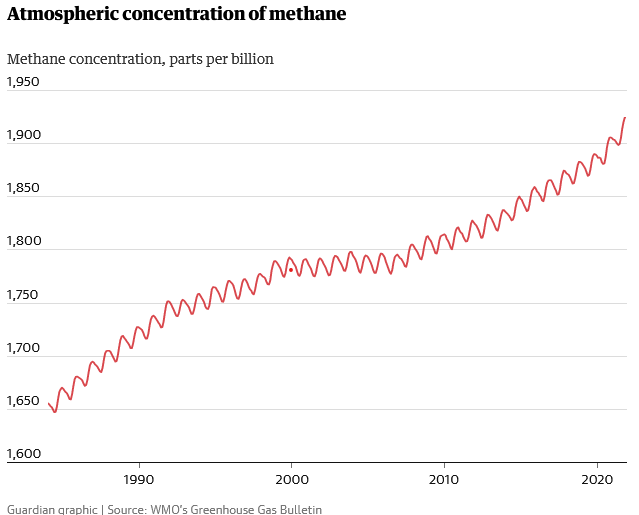
Climate change is getting worse, faster. It’s accelerating. What is required to change that?

Who would have expected? All three are accelerating, with Methane the worst.

Now my first reaction was that this was a reaction to Covid restrictions ending, but if you look at the chart it’s clear that isn’t the case, as the amount of increase is more than Pre-Covid.

Related:

This is why I laughed when people heralded Kyoto or Paris or any other climate agreements. The treaties have no teeth and are generally dead on arrival. And it’s small countries that tend to do the most, which isn’t what is needed.

To put it simply, there is no way we’re going to stop at a 2 degrees change, and those who say otherwise are guilty, at best, of wishful thinking. Yes, it’s “theoretically” possible, but there is a real world and in the real world it will not happen absent revolution, peaceful or otherwise, because it requires actions our rulers will not take. (Look at Germany, in energy crisis, still refusing to turn nuclear reactors back on.)

Nor will anything other than radical change work. In the beginning of the pandemic, when most of the major industrial countries were in lockdown, concentrations kept going up. The very structure of our society requires these emissions and thus we will have to change the structure, simply doing “less” the same way won’t do the job, though it may happen, albeit not voluntarily.

We must move to a full electrical economy. We are going to have to design and build better, safer nuclear reactors and we are going to have become the sort of societies which can run nuclear safely. To fix the ecosystem collapse (related but not identical) we’re going to have to change how we do agriculture almost entirely, remove almost all toxins from our products and go to a combination of very high density cities (no more sprawl) and people who live outside of those high density areas will have to be ecological stewards: their existence must make ecodiversity increase, not decrease or they simply can’t be allowed.

We will also have to outlaw planned obsolesence and make it a criminal offense for anyone, including officers of corporations and perhaps even shareholders to create a product which does not have the smallest possible footprint or which is not designed to be easily repaired and upgraded. No more non-biodegradable products which are not designed for long lives. As much as possible will have to be made bio-degradable and again, not doing so will be a crime, with criminal sentences in prison.

None of this is impossible, and oddly, it will create a world which is in certain ways, much more pleasant to live in and which gives people much more agency.

But it won’t happen under the current system or with the current elites. Capitalism as we know it has to go, and every ruling elite in every major country must be replaced.

DONATE OR SUBSCRIBE


The Inflationary Consequences of Friendzoning and Decoupling

During the rise of China and the “One World/Free Trade” period, one good thing which can be said for offshoring is that it helped reduce inflation.

It, indeed, drove much of the inflation reduction, with most of the rest of the inflation reduction being concerted efforts to keep wages low, with a strong assist from the Bureau of Labor Statistics to use methods like hedonics to pretend that inflation was lower than it actually was.

The new mantra is “friendzoning” — not so much bringing industry back to the US but moving it to friendly countries. Vietnam and Bangladesh are mentioned often, and Mexico will benefit as well. But friendzoning has limits, these countries don’t have the capacity to quickly take on all the production done for the US and Europe, nor do they really have the technological ability in the medium run.

This means that the determination to have a new cold war, and possibly a hot war with China will drive inflation higher for years to come.

The solution would be to, more than friendzone, re-shore: bring production back to core nations. But that would require reducing the cost structure: and I don’t mean wages so much as I do predatory finance and driving rent and housing prices down massively — about two-thirds at a minimum, along with no longer health-care predation. Do those things and wages don’t have to rise nearly as much, and the US (and Europe to a lesser extent) become much more competitive.

But to re-shore, you have to, in effect, give ordinary people a decent deal and not treat them as assets to shorn, but rather as productive assets to be cared for. (Note you don’t have to do this out of the goodness of your heart, our elites don’t have any of that.)

For the time being, this seems unlikely, so don’t expect inflation to go away. All the Federal Reserve can really do to stop it is push the economy into the dirt, but that’s not going to be a long term solution unless it stabilizes at “you’re a third world nation”, which, actually, probably won’t solve it either.

DONATE OR SUBSCRIBE

Week-end Wrap – Political Economy – October 23, 2022

By Tony Wikrent

What is happening in the West Bank right now: a full breakdown 

[Mondoweiss, via Naked Capitalism 10-19-2022]

The past few weeks have witnessed a noticeable intensification of Israel’s crackdown on Palestinians in the West Bank, targeting both ordinary civilians in their homes and villages, and armed resistance fighters and groups.

Simultaneously, armed settlers have been terrorizing Palestinian communities across the West Bank, often in the presence and protection of the Israeli military.

The current repression, and the resistance to it, are part of a larger, months-long campaign to quell growing Palestinian resistance, particularly armed resistance, which has seen a resurgence in areas of the West Bank.


Global power shift

Biden’s Tech-War Goes Nuclear 

Mike Whitney [Eurasia Review, via Naked Capitalism 10-19-2022]

“Lots of people don’t know what happened yesterday. To put it simply, Biden has forced all Americans working in China to pick between quitting their jobs and losing American citizenship. Every American executive and engineer working in China’s semiconductor manufacturing industry resigned yesterday, paralyzing Chinese manufacturing overnight. One round of sanctions from Biden did more damage than all four years of performative sanctioning under Trump. Although American semiconductor exporters had to apply for licenses during the Trump years, licenses were approved within a month.

With the new Biden sanctions, all American suppliers of IP blocks, components, and services departed overnight – thus cutting off all service [to China]. Long story short, every advanced node semiconductor company is currently facing comprehensive supply cut-off, resignations from all American staff, and immediate operations paralysis. This is what annihilation looks like: China’s semiconductor manufacturing industry was reduced to zero overnight. Complete collapse. No chance of survival.” — Posted at Jordan Schneider’s Twitter account @jordanschnyc from a translated thread at @lidangzzz


US Chip Sanctions ‘Kneecap’ China’s Tech Industry

[Wired, via The Big Picture 10-19-2022]


Strategic Political Economy

New Jersey Sues Five Oil Companies, Alleging Decades of ‘Concealment’ and ‘Public Deception’ on Climate Change 

[DeSmogBlog, via Naked Capitalism 10-19-2022]


Supreme Court orders the DOJ to explain why it let Chevron prosecute me

Steven Donzinger [via Naked Capitalism 10-19-2022]

The carnage of mainstream neoliberal economics

Open Thread

Use to discuss topics unrelated to recent posts.

The Adderall Shortage Is Just the First Major Shortage

People who have read me for a while know that for years I’ve been warning of prescription drug shortages or even stoppages. Well, now we have one that’s large enough to have made headlines:

A national shortage of Adderall has left patients who rely on the pills for attention-deficit/hyperactivity disorder scrambling to find alternative treatments and uncertain whether they will be able to refill their medication.

The Food and Drug Administration announced the shortage last week, saying that one of the largest producers is experiencing “intermittent manufacturing delays” and that other makers cannot keep up with demand.

Some patients say the announcement was a belated acknowledgment of a reality they have faced for months — pharmacies unable to fill their orders and anxiety about whether they will run out of a medication needed to manage their daily lives.

Experts say it is often difficult for patients to access Adderall, a stimulant that is tightly regulated as a controlled substance because of high potential for abuse. Medication management generally requires monthly doctor visits. There have been other shortages in recent years.

“This one is more sustained,” said Timothy Wilens,

Now, it may be possible to move to generics, and a lot of the reason for this is how regulated amphetamines are as part of the war on some drugs. Back in the 60s it was possible to buy pure amphetamines over the counter just as at one time one could buy cocaine, morphine and codeine OTC.

That said, supply lines are under pressure and those pressures, though they will fluctuate, are going to get worse over the next years and decades.

Going off Adderall can be nasty, but there are other drugs where it’s downright hell, including SSRIs and Benzos. I know one guy whose careful titration of Xanax took a year, and when another friend’s was without for two days because of a prescription problem his body started just moving and speaking on its own. (GABA is what allows you to not do things, and benzos crush your bodies natural production.)

Then, of course, there are drugs people need because without them they will die or become seriously ill.

As we go forward, all of these things will be subject to the possibility of supply shocks and shortages. I would say, indeed, that more drug and medicine shortages and supply shocks are inevitable.

It’s hard to say what to do about this, because you can’t build up a supply of your own: doctors can’t let you have a 6 months buffer, say, of benzos (which if you take them every day, is about what I’d guess you’d need to have enough to safely take yourself off them with small reductions over time.)

But be aware of this issue and see if you can figure out a way to protect yourself. And remember, even without shortages, there will be future “insulin situations” — where those who have a drug people must have jack the price up so high many people can’t afford it.

Plan ahead if you can, and be well.

Update: Someone who wants to remain anonymous offers the following suggestions:

Avoiding Added Emotional Suffering (Buddha’s Second Arrow)

When I say in this post to imagine something stop and imagine it, or you won’t get the necessary effect.

First, imagine falling. You catch yourself on your hands, you’re not seriously injured, but your hands are abraded and you’ve wrenched a muscle in you back.

Next. Imagine that you fell unavoidably: there was a small bit of ice, but you were walking carefully and there’s nothing you could have done.

Third: imagine that you were careless. There was an obvious piece of ice, you weren’t paying attention, and you knew there could be ice. Feel this.

Fourth: imagine that you feel on a walkway that someone should have cleared (it’s usually the law in places with a lot of snow and ice.) You were careful, but still fell. Feel this.

Fifth: imagine you feel because someone deliberately tripped you. Feel this.

…

If you’re a normal person and you took the time to actually feel, these felt different. Either number three (carelessness) or number five (someone tripping you), feels worst: you’re angry at yourself or someone else.

But even with the first one: it just happened and no one is responsible, you may be upset: it’s not just the pain you’re feeling, but your upset.

This anger, upset, hatred, sadness, etc… is what Buddha called the second arrow.

There is pain and nauseau and itching and so on. They feel bad. But unless you’ve got drugs or advanced meditative skills, they just happen, and there’s not much you can do about them.

Everything else is added by your emotional reaction. That’s the low-hanging fruit. That’s the stuff that’s (relatively) easier to control or choose.

Different people have different ways of doing this, but the first concept is simple enough “adding a negative emotion doesn’t help the situation, and it makes me feel worse.”

As someone who spent a lot of time beating themselves up for mistakes or not living up to my ideal self, I eventually realized that not only did it make me feel bad, it didn’t drive long term changes in behaviour. It had no benefit.

As for getting angry at other people, my experience, as someone who spent years and years not just angry, but enraged (long term readers will know I speak the truth), is that it didn’t help the situation, and it made me miserable (and eventually had negative health effects.)

As Mark Twain said, “Anger is an acid that can do more harm to the vessel in which it is stored than to anything on which it is poured.”

This doesn’t mean you have to forgive them, though sometimes that brings relief. It doesn’t mean you can’t take the person who didn’t clear the sidewalk to task, even to the police or court. You don’t need to be angry or to hate to act.

Which leads to a point I’ve made before: a lot of our emotions happen because we believe we ought to feel them. We ought to be sad, or angry or hate or love or be sympathetic. (Forcing yourself to feel positive emotions rarely works well, though learning to bring love or happiness or relaxation up is useful.)

If you think you should have an emotion, you probably will and if you don’t, you’ll feel bad because you aren’t being the person you think you should be. So kill the idea that you must feel certain emotions in certain circumstances.

You do this, in my experience, by carefully examining the question “does this emotion help and is it worth it?” Examine it now, and examine it next time you get upset.

If the answer to either question is “no”, stop believing you should have the emotion.

This is as true for simple things like dropping a plate on the floor. It’s done, and being upset makes the situation worse. Sometimes a display of remorse is necessary socially, but in my experience a rueful laugh and apology works fine with anyone who isn’t an asshole.

The second arrow is the low lying fruit. And remember, people who deliberately fuck with you usually want an emotional reaction from  you. They like it when you get angry or upset.

So don’t. If you need to hit them or otherwise retaliate to make a point, do. But don’t bother with the anger or upset: you’re just giving them what they want. They love your anger, especially if you don’t do anything: your powerless rage makes them feel strong and in control.

Give your enemies nothing but hell. Never let them see you sweat. And as for the internal censor who think you should be upset and miserable, dump that guy.

And when you forget or fail, that’s when you forgive–yourself. Just try and remember next time.

DONATE OR SUBSCRIBE

Page 171 of 532

Powered by WordPress & Theme by Anders Norén