
Ian Welsh

The horizon is not so far as we can see, but as far as we can imagine

Losing the Power of the Printing Press

If you look up whether governments can “just print more money,” what you’ll find at most sites is the answer, “No, because it only increases the amount of money, not the amount of economic activity.”

This is not true, and it’s not true in a number of ways.

If there is under-utilization of capacity, you can print. Here’s US capacity:
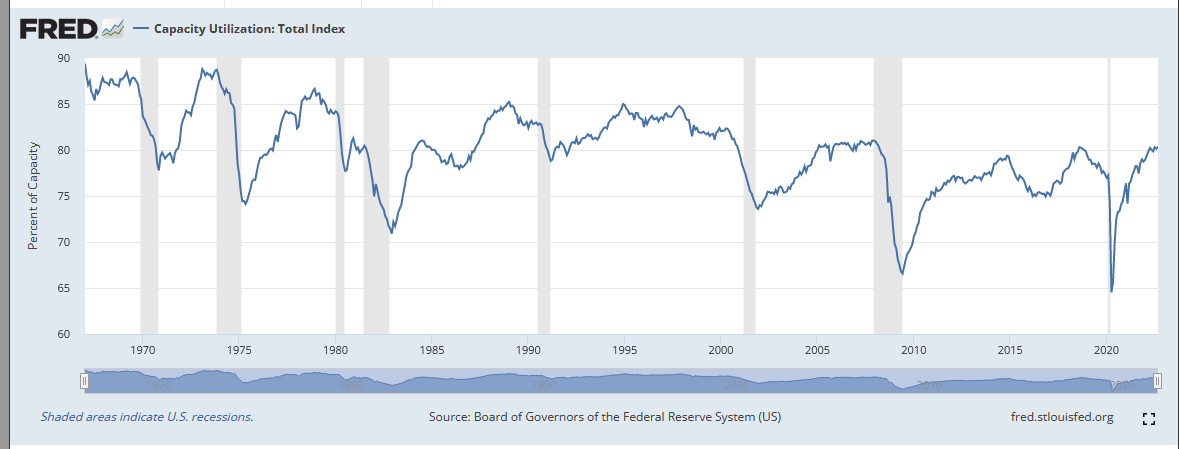
The US has been running substantially under capacity for a long time.

But, you say, there was a lot of money printing (private and public, most money is created by banks, brokerages, and so on), and capacity utilization didn’t go up. In fact, it went down.

Well, yes, because the money went to other countries like China, where it increased capacity vastly, or it went into assets (the housing bubble, stock bubbles, and so on), or it bought private jets and yachts and so on.

Which is to say, it’s not just about money creation; it’s about who gets the money. Since virtually all the money creation of the past 40+ years has gone to rich people, capacity has been created for what they want. And because it was cheaper and more profitable to build capacity overseas, that’s where the money created went.

In addition, there’s the fact that the US dollar is used to buy oil and is the general medium of exchange in most foreign trade. It’s also the “gold” currency, in that during crises it tends to go up, so people want to hold a store of it against bad times.

All of these factors are contingent. If oil was not sold primarily in dollars, or trade settled in dollars, for example, there’d be a lot less demand for dollars. If the trade regime didn’t allow for vast imports and exports, but the world was more autarchic, then building new industry overseas wouldn’t make any sense, and so on.

This is to say, nothing is eternal. The dollar’s position is a historical artifact, based on specific circumstances which did not, and will not, always exist.

Remember, there was a time when the center of the world economy was Britain (chart from Mike Todd).
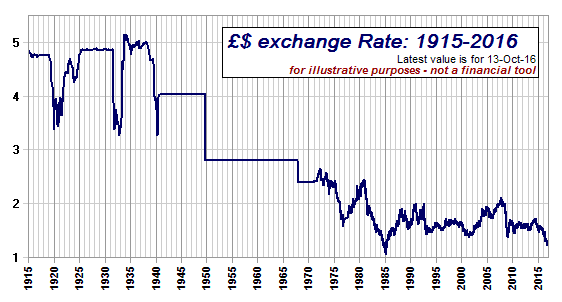
What you see in that chart (and it’s going to keep getting worse) is the switch from London to New York; from the pound to the dollar, because the pound wasn’t the primary international currency any more AND (and this is important) the UK kept de-industrializing so there was less and less relative demand for its products, though the City of London retained an important financial role, which kept the pound higher than the economic situation of Britain would otherwise have allowed.

Developing countries, as a rule, cannot run the printing the press because people only want enough of their currency to buy whatever goods and services they produce. In addition, because most Third World countries have vast import requirements (more so as time has gone on), and their agricultural bases have been destroyed, printing money causes inflation very fast. It’s not just an internal matter, more money chasing goods, it’s that people try and use the new money to buy goods produced externally, and their exchange rate collapses.

When the US prints money, a lot of it goes into other countries reserves and the reserves of people and companies. It pools, as it were, uselessly, and to the extent that it is “more money chasing the same goods,” its effect is spread over most of the world and not just internally.

Once this was true of the British pound.

The original conception of comparative advantage was based on the assumption (true at the time) that money mostly pooled inside countries and could not be used to create production in other countries. If Britain produced less widgets because French widgets were cheaper, the money freed up in Britain would go to produce something in which they had a comparative advantage, say woolens, instead of fleeing overseas. (See Ricardo’s Caveat for the long form of why comparative advantage doesn’t work with free capital flows.)

Now, you can also print money if you give it to the useless classes, i.e., the rich. In that case, it drives bubbles (see the SPX chart above or art prices) or creates niche markets, like yachts and private jets. It doesn’t drive general inflation, it only drives inflation for what useless people want.

Unfortunately, that inflation does eventually cause various crises, but for a time, it seems “free” — you make the rich much richer without causing widespread inflation.

What matters, then, is who you give the money to, and what they spend it on. Volcker crushed wages because, in addition to wanting to make useless people richer, he didn’t want ordinary people to have more money because they would spend it on things which lead to buying more oil, and given oil prices at the time, that would lead to more inflation. He needed to smash oil prices, and he did so by smashing wages to smash oil demand.

If you print money and give it to ordinary people, and it just leads to them buying more stuff from overseas, it won’t move that capacity utilization number you see in the chart at the top very much.

But this isn’t to say that printing money doesn’t “work.” It does work. It always does something. Someone benefits. If you print a bunch of money, and make sure it goes to ordinary people in your country, and that your country increases utilization and/or increases how much it produces, then it can produce a general wave of prosperity. After all, when wages rise higher than the cost of goods and services, that’s prosperity, but companies don’t like that unless they’re still making more money because they’re selling more overall.

(That last sentence, by the way, is the secret of the post-war good era. Meditate upon it.)

You lose the power of the printing press when no one wants your currency because you can’t produce enough, or increase production, AND it isn’t necessary for other things (like international trade).

This goes in stages. Britain, outside of the EU and with less and less industry, and with less reason to send money to the City of London, is in danger of losing the power of the printing press in the way Third World countries do. “There’s no reason to buy any more of this than however much you need to buy their goods.”

At that point, you need to figure out how to re-industrialize and under a free trade order like the neoliberal one, that’s hard. Every time you try, money floods out of your country instead of increasing activity inside of it.

As for the US, it’s in an extraordinarily privileged position, but as China and the BRICS move to conduct more and more trade without dollars, and as trust in the US to run the international monetary system drops and drops due to repeated sanctions and thefts of reserves, that privilege will decline, and the US will find more and more that if it wants goods from another country, it will need to provide not dollars (though they may still be exchanged), but actual goods and services itself.
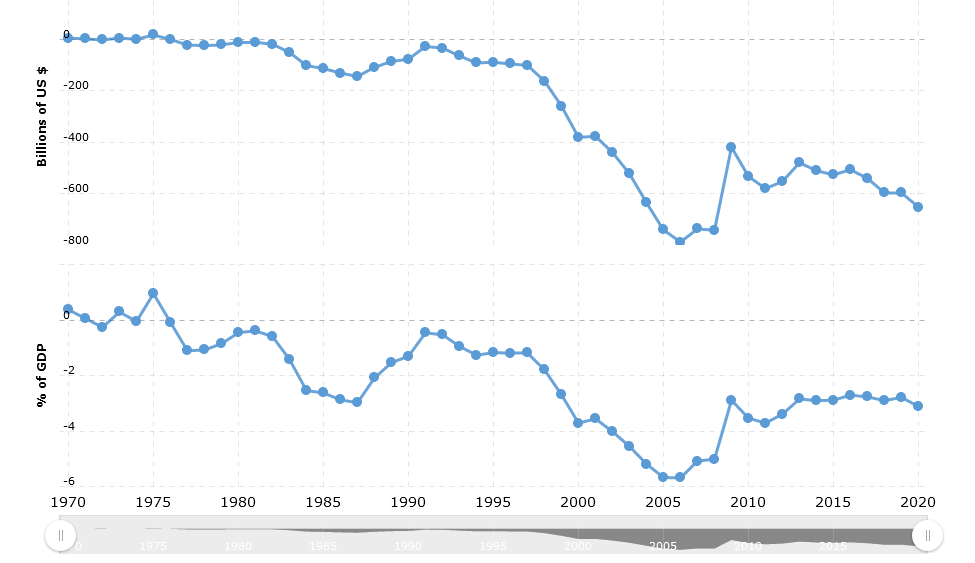
If you can’t pay with goods and services, you pay by selling your patrimony — companies, land, resources, etc.

The power of the printing press is great, but it can be used for ill and good. It can create real economic growth and widespread prosperity under the right conditions, conditions which are partially under a country’s control. But if you become too weak or poor, you can lose even the theoretical ability to create those conditions. There is essentially nothing most African countries can do to restore enough sovereignty to allow them to use the printing press for good, and if you’re a relatively rich country which does still have the freedom of the printing press, there is always the temptation to use it foolishly or venally, as the US mostly has in recent generations.

Money is a social creation. So is how we run the economy. It can be made to work for everyone, for a few people, or as a machine of impoverishment. The choice, on aggregate, is ours.
DONATE OR SUBSCRIBE

The Great Favor the West Is Doing China by Banning Equipment Needed to Make Chips

We really are run by fools.

“If you shut out [China] with export control, [they’ll] strive toward tech sovereignty… [Then] they’ll be able to do it all by themselves and the market [for European suppliers] will be gone.”

The great problem in the neoliberal era is that the usual road for tech and industrial catch-up, protectionist tariffs is mostly closed. (This is how Britain, the US, and almost everyone created their industrial base and caught up in tech.)

Despite what a lot of people seem to think, China isn’t a command economy. It’s a capitalist one, albeit with a large state company sector. Letting markets in is explicitly how Deng created the Chinese economic miracle.

So China buys a lot from other countries. It is a trading state, and that makes it more difficult to catch up in some techs.

Now, if this was done to, say, Bangladesh, or probably even India, those countries would be screwed — they don’t have the industrial and knowledge base. But China has these things; sure, it wasn’t cost-effective to do all the research necessary to learn how to make this equipment when they could just buy it, and after all, they need to buy some things from their customers.

But if they can’t buy it, they can learn how to make it themselves. Sure, it’ll cost them two or three years. It’ll hurt. But they’ll get over it, and then they can make it for themselves.

The knock-on effect is fun, though: Once China can make this equipment, they can sell it to other countries, which means those countries (Brazil, Iran, India, etc.) don’t need to get it from the West, and sanctions become much less effective because there’s another option on the table.

So by sanctioning China, the West will soon lose its ability to sanction not just China but pretty much the rest of the world.

Fun!

This is also true of the sanctions on aircraft equipment, by the way. China, which has a rather advanced space industry, will learn how to make its own civilian aircraft, and then, instead of everyone having to get aircraft from Europe (Airbus) or the US (Boeing, though Boeing is losing the ability make aircraft), they’ll be able to get it from China (and possibly Russia as well).

Now sanctions like these have their place: You do them just before you’re about to declare war. But if we aren’t going to do that (and there are certainly factions in Washington who do want a war with China soon), then it’s just foolishness.

Let’s hope it’s just foolishness.

DONATE OR SUBSCRIBE

Election Discussion Open Thread

I don’t cover US elections real time any more, but for those who want to talk about it, this is the place.

Week-end Wrap – Political Economy – November 6, 2022

by Tony Wikrent


The Pandemic

The Worst Pediatric-Care Crisis in Decades 

[The Atlantic, via Naked Capitalism 11-2-2022]

[Twitter, via Naked Capitalism 11-2-2022]

[Twitter, via Naked Capitalism 11-1-2022]

[Twitter, via Naked Capitalism 11-1-2022]

.

How Republicans Claimed COVID as a Winning Campaign Issue 

[New Yorker, via Naked Capitalism 11-1-2022]

The backlash against pandemic restrictions has become a more potent talking point than the public-health crisis itself.

[TW: For me — because I believe we need to revive civic republicanism and especially its principle of civic virtue — the public hostility to adopting individual measures to protect the public health, is very demoralizing. ]

Open Thread

Use to discuss topics unrelated to recent posts.

Growth Through Real Estate Bubbles v.s. Sustainable High Income Growth (China)

All right. Let’s talk some basic development stuff, primarily in the neoliberal era.

Because industrial policy was disallowed with a few marginal exceptions due to the “rule based order” enforced by a variety of trade agreements and organizations, the traditional route of protecting domestic industries and growing behind tariffs became very difficult to do.

Various countries used different dodges. Russia, to get out of the Yeltsin era collapse, went whole hog into resources: advanced nations had to have oil and natural gas and minerals, and bribed key financial regions like London’s city with huge influxes of resource-money.

China did something different. They opened up partially and let foreign companies in, but they used bureaucracy to keep them under control (as had Japan, in part) and offered foreign elites huge labor arbitrage profits. They bribed the West’s elites with personal wealth, in effect. In exchange they insisted on, generally very strictly, in real technology transfer. Meanwhile, they created a protectionist bubble thru monetary policy, keeping the exchange rate in their favor.

But the other thing they did is what Turkey tried. They created a self-reinforcing property bubble. Municipalities and states built tons of new homes, people flooded in from the countryside to get the new factory jobs and the service and government and construction jobs which supported industry. Prices went up, municipal and state budgets went way up and a virtuous cycle was created, for a time.

Turkey did the same thing, but the problem is Turkey didn’t have an expanding industrial base, and that’s why Turkey imploded sooner.

All bubbles, including property bubbles are time limited. The more of a real economy you have, the longer they can run, but eventually inflation in property becomes too high, and most citizens can’t afford the housing. Meanwhile, inflationary increases in living costs make workers too pricey, and the industrial base begins to suffer.

You can start from three positions.

  1. Like the US or UK or much of the EU you can start with an industrial base and cannibalize it, or..
  2. Like Turkey you can start with a poor but big country and cannibalize an increasing part of your population, plus what little industry and agriculture you have (India is similar, but much larger and managed to get some industrialization out of this strategy), or..
  3. Like China you can build your industrial base at the same time.

Whatever you do, this strategy eventually runs into the roadblock of a cost structure which becomes too high to allow actual productive industries.

At that point, you have to tame the housing market and other out of control costs (medical, food, whatever). If  you don’t, you’re pushed back from 3 to 1, or if you did 2, the artificial prosperity begins to collapse. (India’s calories per capita have spent decades decreasing and someone who spent time there in the 80s, I can tell you Indians weren’t overfed to start with.)

So China’s now in a position where rather than bubbles, especially the housing bubble, being synergistic with industry and improvements in technology, they’re starting to strangle growth.

The route out (minus mercantalist imperialism, which is long run a loser too) requires you to stop relying on property bubbles, and start strangling your cost structure. The “free” money from asset bubbles has to go away, and you have to create a consumer society: not one like we have now, but one like we had in the post-war liberal era. Housing costs have to be kept at a level where people can buy or rent homes fairly easily: 30% of wages for rent or so, and at most about 5 years wages to buy a small home or condo.

Since the free profits of bubbles and speculation have to go away, companies have to make real money by providing real services and not just count on “real estate always goes up” or (America) “people have to have health care, so we’ll increase prices thru the roof.”

This is the task that China now has. It’s a hard task, akin to getting of hard drugs like heroin or SSRIs or Xanax. It hurts, because the financial pipes are reliant on what amounts to free or easy money.

During this transition, headline GDP and so on will suffer, there is no way around it minus looting expeditions, especially since simply running the printing press (something we’ll talk about in another article) defeats the point, which is making companies earn their money by providing goods and services for small markups at scale. (The post war liberal era worked on 3-4% markups for most mass goods.)

This is where China is. Where America and most of the West is similar: except it’s after destroying much of the industrial base and real consumer economy that doesn’t rely on massive price gouging on items people must have. There is no way to bring the good jobs back for most of the population in the US or UK or Canada or Australia without crushing the cost structure, strangling property speculation and prices and in the US tackling the medical and drug cartels.

China’s making the attempt. A lot of what they’re doing is clumsy and crude (but then, so was the one child law, but it worked even if it caused future problems.) So far the UK and Canada and the US and most of the West are not even trying, which is why you hear more about friend-shoring (aka to cheap places that are Western allies) rather than re-shoring, which can only be done for the goods that are either very high margin or which elites have realized are too militarily strategic to do in other countries.

This is why, as far as I’m concerned, the smart money is still on China, and if it wasn’t for climate change and ecological collapse, I’d consider it a done deal even if it took a couple more decades and a lot of screaming and shooting.

As it is, we’ll see. But China’s at least trying to do the right thing.

DONATE OR SUBSCRIBE

None of This Had to Be: The Two Paths

There are broadly two views of the situation we humans are in.

The first is that what is happening is just a result of human nature. It is who we are. We are stupid, short-sighted, and profoundly cruel to each other and to other living beings. Our history is one of war, rape, and torture. In Tudor times, we would cut open a person’s belly and burn their intestines while they were still alive. Crowds would gather, and turn the occasion into a celebration.

Environmental destruction is old, too. Mesopotamia was not a desert once, but we made it into one.

There are those who look to the time before agriculture made possible the rise of kings and nobles and see it as better (and there is some truth to that), but there was violence then, too. The kings domesticated us, turned us into sheep, and except when they turn us on each other, there is less violence now. But, then a shepherd doesn’t want his animals to fight each other; they exist to be shorn, and die to feed the shepherd.

Humans are, in this view, too stupid, mean, and short-sighted to be considered more than animals. No smarter than bacteria in a petri dish, who expand until we choke to death on our own waste.

It may be that this view is correct.

There is a second view, however, which says that humans might be able to learn wisdom, foresight, and kindness — that we might be able to make that scale in both space and time. That we might be able to avoid the generational cycles of rise and fall; that we might learn to shape ourselves into a race which isn’t stunningly cruel, stupid, and foolish.

This isn’t a utopian view. It doesn’t pretend that the demons of human nature don’t exist. It says that we may be able to control them; that we may learn not to let predators and parasites run our societies, and that we might understand that what happens to the least of us, and to the least of the animals and plants, matters most, because whatever we do those without power is what we will do, in the end, to ourselves.

In prisons, rapists get raped, and those who do so become rapists. Those who laugh and consider it part of the punishment are rapists by proxy; their approval makes them monsters. When we say “this person deserves it,” we indict ourselves.

The penalty for abuse of power, in this view, is only to be permitted no power. To abuse the abusers is to become abusers, and those who are abused, themselves abuse later.

We live in cycles of abuse and powerlessness, and have given away our responsibilities to the worst among us. No serial killer is as evil as a President, or the CEO of a major bank or oil company. They have not killed nearly as many people, after all, nor hurt as many. But a serial killer’s killing, their cruelty, is that of a sheep against other sheep, and the sheep cry out that only the shepherd is allowed to kill and indulge in cruelty.

We are faced, today, with our the power we have created through technology, science, and our own domestication. We have become instruments of a few people — the cruelest and worst of us. But they rule because we have been made tame, and we have learned to see the world they way they do: that their power is legitimate and that we must acquiesce. They could enforce none of it if we did not acquiesce, and if they did not have their sheepdogs.

In this second view, we took the wrong path a long time ago, and followed it to self-destruction, misery, and powerlessness. We let the first kings and the first warrior castes rise, and we let the scribes become their servants, who turned into our modern scientists and engineers, forever crying out that what is done with their creations is not their fault.

When we take the wrong path, we must first recognize that we have done so, and that where we are is not where we want to be. We must understand how we came to walk that path, why it seemed reasonable.

Then we must change and find new ways of navigating.

In human society, this means a new culture. A new way of interacting with each other and with the animals and plants with whom we share the world.

Because we have gone so far down the path of (forgive the word) “evil,” almost everything will have to change.

Is that possible?

The second view claims that it is — that human nature possesses a range of possibilities, and that range emphasizes choice, and as we have choices, we can choose.

Is the second view true? Is the first? Are we evil because of an invariant human nature we will never be able to shape into something wiser, kinder, and longer-sighted?

The answer is, for now, unknown.

I choose to work for the second view, that what we have now is not the only possible expression of human nature at a global level, and that we can change, that we can be better.

It’s not the easy path because if it’s true, we’re going to have to have to give up almost everything we believe and are; everything we have shaped ourselves into over the millennia. Simply shrugging, living one’s life, and dying is easier.

And, perhaps, it is better. False hope is a sickness, not a blessing.

So I’ll not condemn those who shrug and say, “This is just who we are. Cruel, stupid, and short-sighted. The masses are nothing but sheep, the sheepdogs are the masters’ self-congratulatory tools who make serial killers look like children.”

We’re here now, just past the peak of our civilization (a cursed word, for almost all have been worse than the savages they scorn). This is the time we, you, must decide which of the two views you hold, and if you will work for the second path.

Is there a way to the good, or are we doomed to evil, for evil it is?

DONATE OR SUBSCRIBE

The Rules Based International Order is the Minority

I’ve said this for a while, but now we have empirical proof that most of the world likes Russia and China more than the US (h/t Johnstone):

“Among the 1.2bn people who inhabit the world’s liberal democracies, three-quarters (75%) now hold a negative view of China, and 87% a negative view of Russia,” the report reads. “However, for the 6.3bn people who live in the rest of the world, the picture is reversed. In these societies, 70% feel positively towards China, and 66% positively towards Russia.”

However, across a vast span of countries stretching from continental Eurasia to the north and west of Africa, we find the opposite – societies that have moved closer to China and Russia over the course of the last decade. As a result, China and Russia are now narrowly ahead of the United States in their popularity among developing countries.

While the war in Ukraine has accentuated this divide, it has been a decade in the making. As a result, the world is torn between two opposing clusters: a maritime alliance of democracies, led by the United States; and a Eurasian bloc of illiberal or autocratic states, centred upon Russia and China.

Now, what they’re saying without quite saying it is that the Ukraine war correlated with even better public opinion towards Russia and China.

I find the next chunk predictable:

However, what matters may not be so much the presence of democratic institutions, but
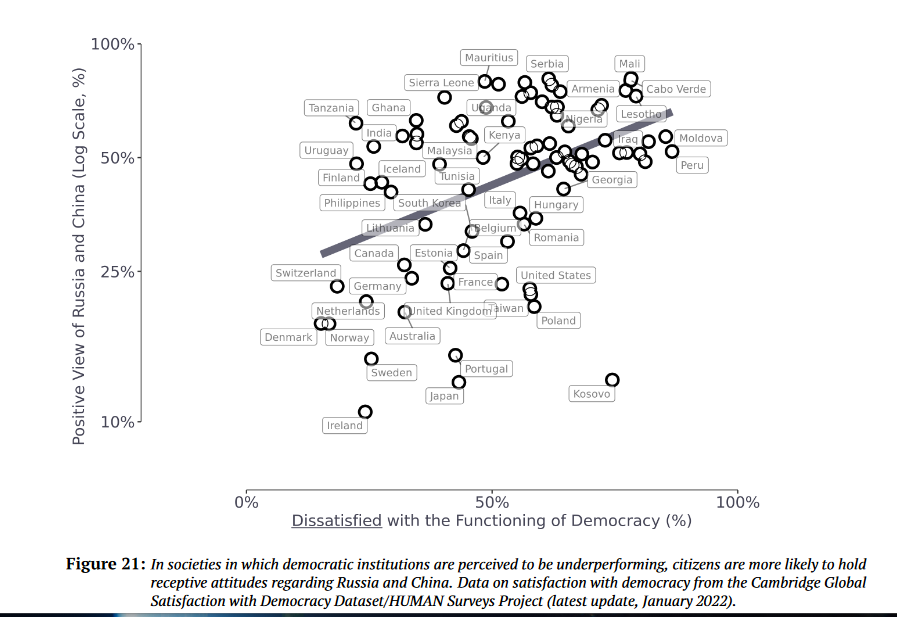
rather, whether they are valued and appreciated by citizens. If so, attitudes towardscountries such as Russia or the United States might take into account their potential to assist – or damage – the health of their democracy. For a closer look at Figure 20 reveals anumber of electoral democracies, such as Indonesia, India or Nigeria, in which the public remains sympathetic to Russian or Chinese influence, in spite of a difference in political regime. Thus it is not simply whether democratic institutions exist that countsbut rather, the degree to which they are seen as functional and legitimate.

This seems reasonable, at first glance. Here’s the chart:

Eyeball those nations above and below the 50% mark.

What does the grouping below 50% all have in common? What does the grouping above 50% have in common?

Whether or not they could be considered part of the Westerns sphere. Those above the line are generally not those who have done well under US hegemony and who are not Western allies.

So, yeah, this looks to me to be a case of “correlation is not causation”. I would gently suggest that what creates the legitimacy of “democratic institutions” is whether they have delivered for people and that those countries under 50% tend to be those who have been inside the Western (US/EU/close allies bubble.)

So, yes, it is actually about the new cold war.

Now remember, China now does most of the world’s development. It isn’t even close. They build the new ports, airports, hospitals, roads, bridges and even cities. Further, they do it cheaper than the West does it.

So, if you’re a developing nation who isn’t inside the “blessed bubble”, even as bad as that bubble has become under neoliberalism, China looks good and America looks… well, not so good, especially since the US has been the primary driver of trade and finance rules which have been very bad for the third world.

This has been going on for a long time, but since the collapse the USSR there hasn’t been another option. China offers one, and Russia is thumbing its nose at a global order that has gone out of its way to screw over the countries which are above that 50% line.

So, I wouldn’t say it’s exactly about “democratic legitimacy” — that legitimacy is a dependent variable and it is associated with America, NATO and to a lesser extent the EU. When a global regime doesn’t deliver it is discredited, and in fact even in countries under the 50% mark, most have been losing trust in “democratic legitimacy” as well. Americans and British will know well of what I speak.

The end result is that most of the world now slightly favors China and Russia and the important part is that trend is likely to continue. There will be a cold war, and most of the world wants to remain neutral or slightly favors China/Russia. On election Lula in Brazil said they would keep trading with both sides and not be drawn into the cold war, but Brazil is one of the founding members of the BRICS (Brazil, Russia, India, China, South Africa) the most important economic bloc that doesn’t include the US. Brazil will remain “neutral” but 31% of Brazil’s exports now go to China and 11% to the US. If the US is stupid enough to push, and military might isn’t determinative, Brazil would be foolish not to go with China.

Power follows industrial capacity and popularity follows treatment. With a few notable exceptions, if you’re a third world country, China treats you better than the US has in ages. As for Russia, well, they may screw with nearby countries, but otherwise they don’t get involved much (remember Syria invited them in, and is a long time ally.) Indians, in particular, remember that Russia was a friend for generations when the US and Europe were not. As for Africa, China has been developing good relations thru trade and development for decades now.

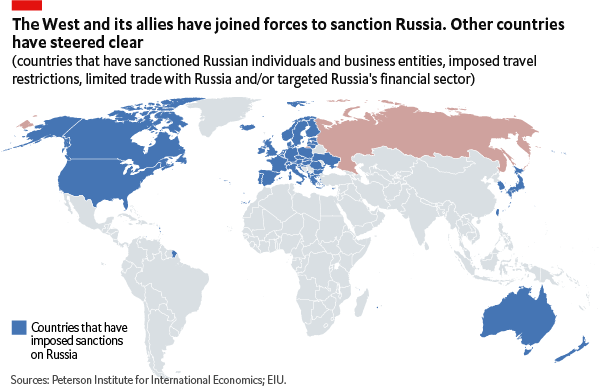
In this cold war, the West is going to be the one isolated, as the above (older) map from the Economist suggests. Yes, they are “neutral” for now, but if forced to choose, don’t assume they’ll choose the current order.

The “rules based international order” is rather small and how it has been run has damaged democratic legitimacy far more than “China” or “Russia”.

DONATE OR SUBSCRIBE

Page 170 of 532

Powered by WordPress & Theme by Anders Norén