
Ian Welsh

The horizon is not so far as we can see, but as far as we can imagine

Denial Of Reality

One of the defining features of our civilization is that we deny what we don’t want to believe is true if it’s inconvenient to us.

Covid has been the most recent example, with the World Health Organization (WHO) taking two years to admit that it was an airborne virus, insisting it spread thru droplets. I daresay that refusal to admit reality cost a couple million people their lives.

Back in the 2000’s a number of us warned about the housing/sub-prime bubble for years. (A correspondent said he found 42 people who publicly predicted the crash.) It was obvious just from looking at charts, it was classic bubble formation.
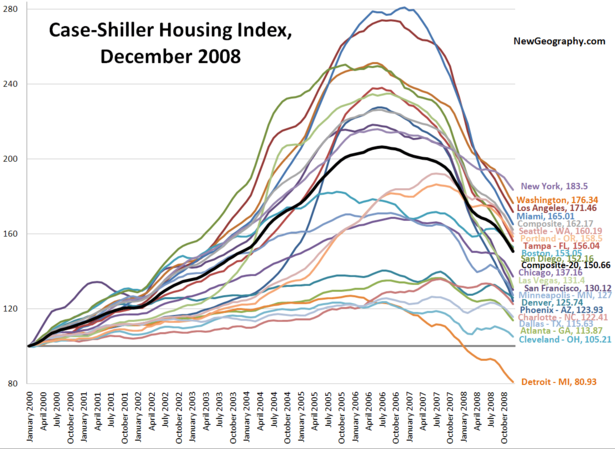
I made two predictions about the market. The first was for late 2005. I based that on the supposition that the Federal Reserve, looking at the chart, would act. It was the last moment to do so. But the Federal Reserve believed there was no bubble, because markets are efficient, so they did nothing.

Reality denial.

It was one of my first lessons in “our elites are incompetent” (also venal and evil).

I then predicted October of 2007 about a year in advance and got that one right. A friend of mine who knows far more about economics thought it would be later, because the Fed would hold it off till after the election to help Bush. I disagreed, he thought they were still competent.

So, denial of reality and incompetence.

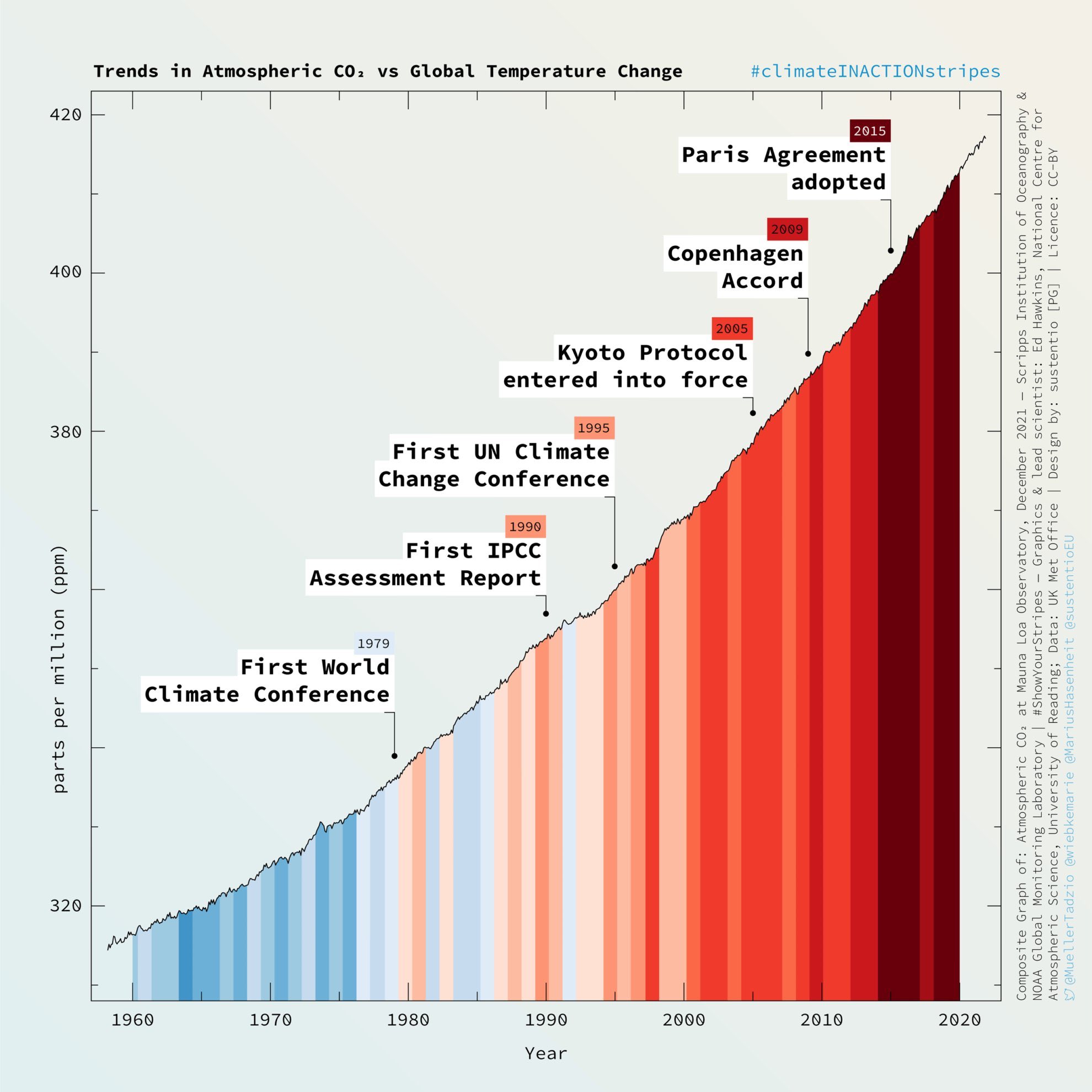
The grand-daddy of reality denial in the modern era is, of course, climate change. We’ve known about it for a long time, one friend has traced elite knowledge back to the 50s, and I can assure you that by the 70s and 80s knowledge was widespread and there was real alarm.

We did…. nothing, while pretending we were.
Recently WHO has said there is no longer a Covid emergency. I actually have some sympathy for what they’re saying: we’ve decided to just let it continue, and there’s evidence there are less deaths, and since no one is treating it as an emergency I suppose the emergency is over.

But we refuse to deal with the fact that it’s causing Long Covid and that repeated infections do damage to the brain, cardiovascular system and immune system, often non-symptomatic to start and that excess deaths are still highly elevated in most countries.

We’ve basically decided to ignore a mass crippling event. We can’t even be bothered to put filters in classrooms and other public areas, and hospitals are stopping mandating masks and most don’t have air filtration. (If you we won’t even put air filtration in hospitals and schools we clearly don’t give a fuck.)

And, of course, new variants emerge and there’s no reason to assume none of them will have an increase in lethality. The most recent “Arcturus” variant, while not more lethal appears far more infectious than previous variants, which were already in the running for the most virulent diseases in history.

We sort of acknowledge it exists, with a massive denialist cohort, the sort who keep insisting it’s just as bad as the flu, and then we do, effectively, nothing, after an initial, completely incompetent series of measures in the first year and a half, which because of their incompetence, discredited intervention. (Remember that 2 years of WHO claiming that Covid wasn’t airborne.)

There are plenty of other examples. I remember writing back in 2009 that if things continued as they were Americans would lose their abortion rights. I was pilloried for it. Similarly when Obama got rid of Dean at the DNC I said it was the end of the 50 state policy, and again I was savagely attacked for it, including both pushback from the White House and by commenters at FDL and Daily Kos.

Then there was all the pretense that Afghanistan could be won, or the 72% of Americans who thought that Iraq had WMD. (Well they did have some chemical weapons, but that’s not what anyone meant.)

That China is the largest economy in the world in the ways that matter is another thing most people are still in denial about, along with the fact that America is losing its tech lead.

I suppose you could say “well Ian, we admit reality and then do nothing” but actions are what count, and based on actions we’re in complete denial about our major problems, and when denial is still even remotely possible, we continue with it. I can’t count the number of people I run into who are still climate-change denialists, even as we have wildfires and every week leads to some decades old temperature record being broken.

This era is right up there with the last decades of the Western Roman Empire for stupidity and incompetence. The difference is that the scale is global and the problems are bigger than barbarian invasions.


My ability to write these articles depends on donors and subscribers so if you value this writing, please DONATE or SUBSCRIBE.
Week-end Wrap – Political Economy – May 7, 2023

by Tony Wikrent

The ‘Free Market’ is a Fever Dream and Adam Smith Wasn’t in It [YouTube]

[Rhodes Center Podcast, via YouTube, Mar 31, 2023]

Mark Blyth interviews “Jacob Soll… professor of philosophy, history, and accounting at the University of Southern California, and in his book “Free Market: The History of an Idea,” he begins way back in ancient Rome, stops in 17th-century France with Louis XIV’s minister Jean-Baptiste Colbert, and, on the way to the present, barely mentions Adam Smith at all.”

…. [1:16] French Minister Colbert reviled today as a so-called mercantilist who becomes the critical builder of markets and whose state-led form of development has had a far bigger impact on how the world actually works….

… [8:58] Smith says guilds are the worst thing in the world — except that’s where capitalism comes from it comes from… if you go to Florence and see the Duomo or the Palazzo Vecchio it’s covered with all the signs of the guilds who pay for the government and they’re very aware that they’re paying for government… this is where Machiavelli comes in… remarkably visionary, Machiavelli… says, look all these Merchants are necessary but the state has to be richer than any single Merchant otherwise we have an oligarchy or a dictatorship. And of course that’s what had happened under the Medici….

[10:03] …so where you really make… a controversial contribution though is to really invert the relationship that we commonly have in our heads between France and the UK, and between the figures of Colbert and Smith. So let’s go right into this…

[11:38] [The supremacy of Smith is] an Anglo-Saxon fantasy, yes, to put it politely…. Colbert is a former businessman, but he’s working for a monarchy he’s got to raise funds so he tries to reorganize the government. But he doesn’t believe in wealth hoarding; he doesn’t believe that gold is just the simple road to riches; …he believes he believes that manufacturing will create extensive expanding wealth, and so will imperial Seaborne trade….

[17:03] …that myth does not exist in the mid-18th century; it doesn’t even really exist under Smith. The Americans, people like [Alexander] Hamilton are reading Jacques Necker … Hamilton says he wants to be the new Colbert when he’s building the American state. He doesn’t talk about Smith; in fact please read his Report on Manufactures — it is a direct response to The Wealth of Nations. He basically knocks down every one of Smith’s theories: the idea that agriculture will make you rich; the idea that open markets can work for developing nations like early America. He knocks it all down, and America has the highest rate of tariffs for the whole of the 19th century…. no one’s heard of Henry Clay; no one has any idea this guy Henry Clay continues Hamilton’s policies, calling it the American System, which is a system of tariffs and small subsidies for infant industry, which is how America gets on its feet. America is not a free market nation in the 19th century….

[18:40] England has this very special trick up its sleeve (France has some of this trick too), it’s called the global Empire. It’s an Empire run on coercion and gun boats, it’s not that friendly, it’s based on pillaging. We calculate that over 140 years Britain extracted around 44 trillion dollars from India alone. That’s just the colony of India….

[19:06] The free marketeers who say they are against Empire Still are for maintaining the Empire  against uprisings. Theoretically they’re against it, just like Smith is theoretically against slavery. But is he really against slavery? Are these guys really against Empire? Not when push comes to shove… This guy is essentially a huckster… the 18th century equivalent of somebody who’s in the ideas industry, as Dan Dresner wrote about a few years ago. He makes his living getting grants from giant oligarchical landowners who basically allow him to do the things that he wants to do, and he writes very flattering books that never implicate them in anything….

Smith’s a hedger. You have to think of Smith as a professor who’s on the make with some big donors. He works for the donors. He actually lives in the donor’s house, the Earl of Baklao [TW — name incorrect, but I can’t find correct name] who’s really one of the richest most powerful men in all of Britain. These people run the parliament. They’re trying to cleanse their lands of peasants and crafters so that they can put lambs or sheep and these high return cattle. So they’re… land owning oligarchical agricultural entrepreneurs and if you read Smith that is what the system that he is talking about. Do businessmen exist? Yes. Does manufacturing exist? Sure, but they can never produce wealth on their own according to [Smith]— all wealth comes from agricultural labor and all industry is dependent on agricultural production. Which we know is just not true; that’s not how it works.

There is a huge and long tradition of people desperately arguing that agriculture will not create enough wealth, it will not create stable wealth or growth, that you need for a modern commercial society. All these other authors who you’ve never heard of, but are in my book, are calling for this. Most notably Alexander Hamilton. And so Hamilton’s the heir of a long tradition of market thinkers who don’t believe that agriculture is the path to wealth.

Smith is what we might call a medieval economist or a sort of neo-feudalist. This is not the father of capitalist thinking… [In the] Anglo-Saxon world we live in a bubble, I think. that came from the British Empire and then from American hegemony, and the fact is we’ve written a story that supports a certain narrative of how we got rich which just isn’t the story at all. It just happens to back up lots of people’s interests or certain interests.…

[27:21] But how did America actually get rich? There’s a huge reaction first of all to FDR— that’s so much of what people are angry about economically: FDR creating Social Security; FDR bringing the state more into the economy….  the narratives of the 20th century get written after the war and that’s where a lot of this economic stuff comes from, especially in America, with the Austrian School and others. So there’s definitely the material interest in telling a particular story because it protects … the wealth and property rights of those who are telling the story….

[29:31] I don’t know really good examples of wealth creation without government involvement at some point…. [TW: see my series on How America Was Built; some of the subsequently posted articles are listed at the end of HAWB 1954-1976: The three major developments in aerodynamics].

Open Thread

Use to discuss topics unrelated to recent posts.

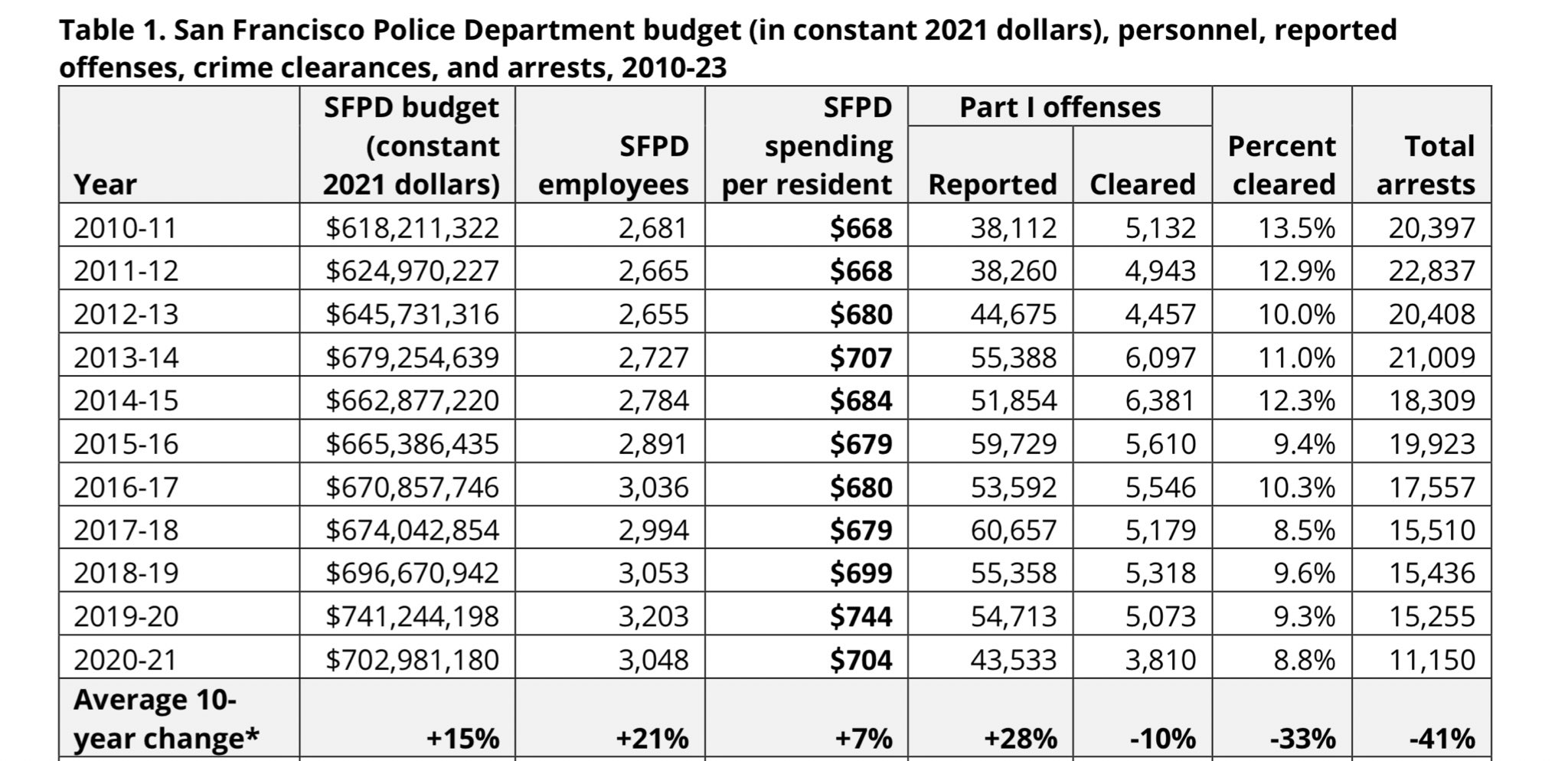
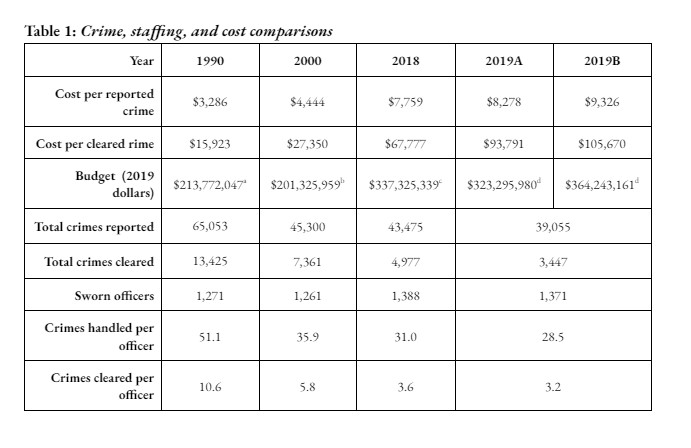
Are Police In San Francisco Too Lazy To Work, Too Scared, Or Just Incompetent

Stumbled across this interesting rabbit hole on twitter.

Brian Kirschner did the math in constant 2019 numbers:

And, on traffic citations:

So, this interesting. There’s been a general collapse in clearance rates across the country, but when you look at them in detail you tend to see that police have basically stopped trying to clear crimes against blacks, and concentrate on crimes against whites.

But SFPD looks like more than that, it looks like refusal to work.

It’s an interesting situation. Part of it, I’m quite sure, is the way that police are trained to be scared. David Grossman (I’ve read his book “On Combat”) is famous for insisting that training must create instinctive killers who react without conscious thought. Police training is full of exercises which make cops scared of the public.

Indeed…

…officers are afraid of being injured or killed because their jobs are dangerous, but data show that being a police officer is relatively safe. Law enforcement doesn’t crack the top-15 list of most dangerous jobs in America, according to the Bureau of Labor Statistics.

…“A lot of research shows that what people think is dangerous and what they believe poses the greatest risk of harm is determined by your membership in various social groups,” Arsiniega says. This is a phenomenon called “social amplification.” Police may believe they are at a great risk of civilian assault, even when empirical data say otherwise…

…

Mixing systemic racism and socially amplified fear of assault becomes deadly because police are armed, and they have “legal justification to kill people and be legally excused if they’re protecting their lives or lives of a third party,” Arsiniega says.

However, in more than 90 percent of cases in which an officer kills a civilian – about 1,000 each year in America – officers claim to be protecting themselves, not a third party.

Neither do the majority of injuries to on-duty officers come from civilians.

For her dissertation at the University of California at Berkeley, Arsiniega studied police officer injury data from all causes in Savannah, Georgia, between 2010 and 2018. Only 11 percent of all officer injuries were the result of civilian assaults.

She also studied assaults on Atlanta Police Department officers from 2015 to 2018 using reports written by officers themselves. Despite having a violent crime rate roughly 2.5-times the national average, not a single officer was shot or stabbed in the years of her sample. The most serious injuries caused by civilians were broken bones in the hand and cuts and scrapes on officers’ hands and knees while arresting suspects.

Cops are basically immune to prosecution for violent crimes against civilians. There are exceptions, but they’re exceptions. They aren’t actually doing a particularly dangerous job: being a logger or a fisherman is way more dangerous, but they think they are, and they have an ethos of “us versus them.”

But their training emphasizes that is “better to be judged by twelve, than carried by six”. They are more concerned about their safety than the safety of others, they don’t “protect and serve” civilians, they protect and serve themselves.

This feeling of being a beleaguered group, under great danger, probably contributes to refusal to work. They show up, but they don’t take anything they perceive as risks.

There is also a sense that they aren’t appreciated, a “we risk our lives and you look down on us and don’t treat us like heroes” and that also, I’m sure contributes to a sense that they don’t owe it to the public to do their jobs. After all, money isn’t worth their lives.

But basically, being a cop is close to being a sinecure at this point. They are mostly immune to prosecution, they are paid very well for municipal workers, and police budgets in most cities keep rising and are often the largest part of the city budget. It’s a union job in the worst sense of the word: a job where there is no real accountability to actually do the job, and it is cushioned by the high respect that most white Americans have in the police.

Sixty-nine percent of Americans trust local police and law enforcement to promote justice and equal treatment for people of all races (up from 56%), and 52% feel the same about police unions (up from 40%).

Since clearance rates have been declining for decades and since the response to that has been to increase budgets, there really is no reason for police to do their jobs. In fact, not doing their jobs is probably the strategy that works best: it’s easier, they get to say crime is out of control and claim that more money is needed.

If not doing your job leads to more money not less, why do your job, especially when you’ve been trained to think it’s a dangerous job, when being a policeman isn’t even as dangerous as being a farmer, logger, or fisherman.


My ability to write these articles depends on donors and subscribers so if you value this writing, please DONATE or SUBSCRIBE

Violent Determinants Of Social Hierarchy

There are four primary determinants of social hierarchy. They are productive ability, social ties, ideology and violent ability. All are affected by geography.

None of these operate in isolation. Productive ability directly affects violent ability.  Ideology determines what people will and won’t do but over time tends to move towards what a Marxist would call material determinants, though that time can be a LONG time: it took about two thousand years for the early kings to rise after the introduction of agriculture, so the power of ideology, though not the only factor slowing adoption, shouldn’t be understated. Two thousand years shows a lot of resistance.

To the extent hunter-gatherers tended towards egalitarianism, and there are certainly exceptions, generally based on high surplus, it was based on the fact that one guy with simple wood and stone weapons isn’t much better at violence than any other guy, especially in a society where all men who aren’t shamans are hunters. Oh, the best might be able to take two men at once, maybe even three in exceptional cases, but if a group of other males attacks he’s done. Likewise, though ambushes can change the formula, conflicts between men and groups of men are extremely risky unless one side outnumbers the other.

This changes a lot with early bronze weapons and armor, and it changes even more with organized bodies of men trained to fight together. Professional warrior or soldier classes whip peasants. So when agriculture makes every man not a hunter, but allows for division of labor, the “every man is about as good as another” changes, especially in organized groups.

He who is able to transfer the loyalties of a group of warrior or soldiers to himself can rule. Alternately men good at violence can transfer their loyalty to each other, creating a ruling warrior caste.

Let’s take the case of ancient Greece. The Homeric age emphasizes individual combat, but nobles can train much more for it and have better gear. They rule, but the society is still remarkably flat overall. In the classical period, the primary military arms are the phalanx and the galley. The Phalanx is simple and doesn’t require a lot of training, but it does require fit men with gear acting in groups with high solidarity. If everyone doesn’t push together, in unity, they lose.

Athens citizenship was almost exactly “men who fought in the Phalanx” and “men who rowed the galleys.” The galleys were for poorer men, and the state provided the galleys, but galley rowers had to be highly trained and work in precise unity. Slave rowers could not compete with free men, and highly trained crews of citizens could and did, as with the Athenian navy against the Persians, dominate.

So, while those who rowed were usually of the lowest class of Athenian citizens, they were citizens.

What was also important is that for the phalanx, men provided their own weapons and armor and the state, which was the citizens, provided the ships.

Rome started off similar: legions were full of citizens who served for relatively short periods, and who provided their own arms and armor. As with most of the Greek cities, they returned to their farms or other lives after the wars. They were not professionals: they did not make their living as soldiers, but they were able to beat professionals. Sparta may have been the best for a long period, but they didn’t win every battle, their dominance on land was real, but not determinative. Rome in the early and middle Republican period defeated armies made up of professionals regularly.

The fall of the Republic comes when the army is professionalized: this is now how people make their living, they are provided their weapons and armor, and they are loyal primarily to their generals, because their chance of real wealth is from looting and that depends on the general, including whether and how much he lets them loot.

Crassus, near the end of the Republic, simply raises his own legions without the help of the state.

Rome comes to depend on professionals, not citizens, and those professionals are not loyal to the citizenry, and as such the Roman Republic comes to an end when one of the great generals, Augustus,  defeats all his opponents. The Republic never returns, because the conditions for Republican rule are gone.

As we can see, then, if amateurs can’t defeat professionals and if armies are not raised from the citizenry by the citizenry, Republican or Democratic rule cannot continue.

The great Democracy of the last six centuries or so was Switzerland. Similar to the Greek city states, they relied on pikemen, raised from the general population by the general population and able to defeat professional militaries, including knights who had trained since childhood. Even when operating as mercenaries (as city state citizens sometimes did) they retained their loyalty to Switzerland.

But the heart of it is that they could defeat troops raised in non-free states.

But notice in all these cases: men had the franchise, because they were the ones who could and did fight. Women in Athens were treated particularly badly, indeed they were treated worse than most slaves who didn’t work in mines. Switzerland was one of the last western nations to enfranchise their women.

Let’s talk about that enfranchisement. The main feature of 20th century warfare from the WWI thru Korea was that it was mass conscription warfare. The armies were huge. This meant that women, during war, had to take over jobs done by men who were fighting.

Women thus, while mostly not fighting (WWII Russian women are a rare exception), were absolutely integral to military success. They made much of the weapons and kept society running.

When did women get the vote in the US? 1919.

The US draft ended after Vietnam, and the army was professionalized. Not coincidentally, egalitarian distribution of goods has since then spent over 40 years collapsing. This was due, in part, to the constraints on war in a nuclear armed world. Before nuclear weapons, great powers could win wars against each other and the benefits of doing so were huge as were the costs of losing. (Austria stopped existing, Germany lost a huge amount of its land and became a US Satrapy, as did Japan.)

Going all out, enlisting as many men as possible and increasing war production thru the roof all made sense.

But in Vietnam, the US never went all out, because North Vietnam was a Russian ally. They wanted to win without really winning: without conquering North Vietnam.

You don’t need a mass conscript army for a war where you’re not seriously trying to win and where, indeed, seriously trying to win may provoke a nuclear war. (This also applies to the Ukraine war to some extent.)

It is notable that democracy rises with cheap gunpowder weapons. Mass egalitarian societies, in economic terms, result from WWII, and the policies supporting them come to an end about the time that mass drafts are done away with and armies are “professionalized”, aka, become internal mercenaries.

Worse for the future may be the rise of robotic armies. If you don’t need men for soldiers, if you don’t need mass numbers of women to step in and make the robots, well, perhaps the time of egalitarian societies is done.

Or, perhaps not. Because as important as who fights is who makes the weapons. The great disaster of the war of 1812 is that decentalized American armaments production could not compete with centralized armaments factories. It was the end of the yeoman farmer ideal: the idea that decentralized armies raised from the yeomanry could defeat professional militaries.

But if drones and robots which are effective combatants and effective assassins or area denial weapons can be created by ordinary people easily, and the powers that be are unable to deny people the means of doing so, then robotics may prove to be positive in spreading power among the population.

This is one of the hopes of the future, and you should understand clearly that those who want to restrict your access to the determinants of power do not have your best interests at heart.

We’ll talk about that at a later date: it gets to the heart of much of the culture war around guns, a contentious topic and with good reason, given just how many children are being served up on its altar.

But that is for later, for now: who is good at violence matters and it determines who gets the good life and who doesn’t; who rules and who serves.


My ability to write these articles depends on donors and subscribers so if you value this writing, please DONATE or SUBSCRIBE.

The Disastrous Rise of STEM

STEM includes the natural sciences, math, engineering, and technology-related fields. It’s all the rage, and at the same time universities are shutting down or reducing humanities and social science faculties and offerings.

In one sense this is a simple result of market forces: university is ludicrously expensive, especially in the US (but tuition has risen massively in many other countries) and the “degree premium” has declined. Once just having a bachelor’s degree was enough to get you a good job, now it’s enough to let you apply, competing against a ludicrous number of other candidates, for a wage that often won’t allow you to afford a house or children.

But STEM jobs are in demand, although this may be changing. The current downturn has seen a large numbers of coders laid off and Chat-AIs threaten a lot of programming jobs, though I suspect less than it seems, so far.

I bow to none in my admiration for science, but our society suffers from a simple problem: we’re doing mostly the wrong things with our technology. For all the increases in renewable energy, the climate change and ecological collapse charts  show no change in trajectory. We’re in ecological overshoot, and we’re accelerating it.

This is not a technological problem. We’ve known what to do for a long time, and we haven’t used the technology we have to fix it.

To put it more simply, more technologists just pours fuel on the fire.

A fairly strong case can be made that our problems have been made worse by technology, but more to the point, the solution to our problems is not technological. Our problems require social and ethical change: they are problems related to the social sciences and humanities. We have to do the right things, not the wrong ones.

I’m not sure that the social sciences and humanities have a solution, but they are at least oriented in the right direction, with the exception of Economics and perhaps political science.

Now there are larger problems with academia. For the current topic, let’s just say that they’ve become disconnected from society, and mostly aren’t working on solutions, because of an overemphasis on sterile “research”, publishing findings for other specialists which don’t get to the general population or influence elites for the better.

But a start to solving those problems is to not worship funneling more programmers to figure out how to serve ads better and create superior echo chambers and walled gardens.

A lack of programmers isn’t holding us back. A lack of good ideas becoming influential is.


My ability to write these articles depends on donors and subscribers so if you value this writing, please DONATE or SUBSCRIBE.

Week-end Wrap – Political Economy – April 30, 2023

by Tony Wikrent


Strategic Political Economy

America Fails the Civilization Test

[The Atlantic, via The Big Picture 4-23-2023]

The true test of a civilization may be the answer to a basic question: Can it keep its children alive?

For most of recorded history, the answer everywhere was plainly no. Roughly half of all people—tens of billions of us—died before finishing puberty until about the 1700s, when breakthroughs in medicine and hygiene led to tremendous advances in longevity. In Central Europe, for example, the mortality rate for children fell from roughly 50 percent in 1750 to 0.3 percent in 2020. You will not find more unambiguous evidence of human progress.

How’s the U.S. doing on the civilization test? When graded on a curve against its peer nations, it is failing. The U.S. mortality rate is much higher, at almost every age, than that of most of Europe, Japan, and Australia….

According to data collected by Burn-Murdoch, a typical American baby is about 1.8 times more likely to die in her first year than the average infant from a group of similarly rich countries….

GRAPH: U.S. annual mortality rate as a multiple of similarly rich countries

By the time an American turns 18, the U.S. death ratio surges to 2.8. By 29, the U.S. death ratio rockets to its peak of 4.22, meaning that the typical American is more than four times more likely to die than the average resident in our basket of high-income nations. In direct country-to-country comparisons, the ratio is even higher. The average American my age, in his mid-to-late 30s, is roughly six times more likely to die in the next year than his counterpart in Switzerland.

The False Choice Between Neoliberalism and Interventionism 

Yuen Yuen Ang [Project Syndicate, via Naked Capitalism 4-25-2023]

To some commentators, the recent passage of the CHIPS and Science Act and the Inflation Reduction Act, US President Joe Biden’s two signature industrial policies, marks the end of neoliberalism and the re-emergence of interventionism as the dominant paradigm.

But this is a false dichotomy. Governments are not limited to a binary choice between laissez-faire and top-down planning. A third option, long-neglected by policymakers and economists, is for governments to direct bottom-up processes of improvisation and creativity, akin to the role of an orchestra conductor. One can find plenty of examples of this in China and the US….

In defiance of Western prescriptions, Japan and the four “Asian tigers” – Hong Kong, Singapore, South Korea, and Taiwan – opted for massive government intervention. By crafting long-term plans, investing in public infrastructure, and selecting and promoting potentially successful industries with favorable policies, all of them achieved extraordinary economic growth between the 1960s and the 1990s. Proponents of the model underlying the “East Asian Miracle” criticized the Washington Consensus for ignoring the indispensable role of governments in late-developing economies.

[TW: Actually, it’s not a false choice—There Is No Choice. Either we jettison neoliberalism and its pagan worship of markets, or we continue to fail the Civilization Test. ]

Open Thread

Use to discuss topics unrelated to recent posts.

Page 153 of 532

Powered by WordPress & Theme by Anders Norén