
Use to discuss topics unrelated to recent posts.
…my strength is as the strength of ten, because my heart is pure
-Tennyson
Greer blamed some of this on Tolkien, a frequent sparring target, and with some reason.
But this is as an old idea, and I place the most modern wellspring firmly in the mythos of World War II.
The Germans were Nazis, and the Nazis implemented the Holocaust. The Holocaust was Evil, not just evil. At first they seemed unbeatable, but the forces of good did eventually win.
Every western war of my lifetime has had its propaganda wellspring firmly in World War II, as the constant Hitler and Munich analogies suggest. “We must stop him now” (whoever he is), “or he will keep going, just like Hitler did.”
Saddam wasn’t going to conquer much beyond tiny and completely artificial oil-states. He tried with Iran and failed. Putin isn’t going to conquer Europe. China has some territorial disputes but it isn’t going to go on a Japan style rampage and conquer multiple neighbours.
But every time I deal with Ukraine supporters they fail to account for fundamental realities. Russia has more resources and the backing on China. It has air superiority and artillery superiority, and it is producing more artillery shells than the West, whose shelves are bare and and who has not ramped up war production significantly.
WWII wasn’t won because we were the good guys. It was won because more of the world’s resources wound up on the other side and Hitler made huge mistakes, over and over again. One example is that Germany was winning the Battle of Britain with its initial strategy of attacking airfields and factories: it was killing RAF planes and pilots faster than they could be replaced. Then Hitler freaked out after the British raid on Berlin and ordered the Luftwaffe to attack population centers, which allowed the RAF to recover.
If the initial strategy had been stuck to, the RAF would have been defeated, and the Royal Navy, without air support, would have been unable to stop the German from crossing the Channel and conquering Britain. Imagine trying to do DDay without holding Britain?
Germany lost because more resources were on the other side, and because Hitler screwed up multiple times, not because they were evil, though they were that.
And while the Allies were less evil, Dresden and the Tokyo firebombing and so on show that we were not “good”.
Ukraine cannot make up for material short-fallings and bad strategy by being the “good guys” (we’ll leave aside whether they are the good guys.)
America, having given its industrial base to China will not defeat China in the game of Great Powers because America is the good guy either (and Americans aren’t, though for some reason they think they are.)
There are some advantages to genuinely being the good guys, even military advantages, but they aren’t large enough to determine most wars, especially since it’s very rare that either side is good, the best we usually see is “less evil.”
It doesn’t matter if Ukraine is the “good” side. What matters is who has the best strategy, tactics and resources. And in a war of attrition, well, that ain’t Ukraine.
I would love to live in a world where the good always vanquishes the evil, but that ain’t our world and it never has been.
Donors and subscribers make it possible for me to write, so if you value my writing, please DONATE or SUBSCRIBE
Back in the 2000’s I belonged to the Netroots movement. Our mantra was “more, better democrats.” We ran primaries, fundraised and put pressure on politicians, on top of all the normal blogging stuff, much of which we were the first mass practitioners of.
We failed. Obama was our loss moment, as he bypassed us and was able to get our readers without having to appease us.
But Obama was something more important. The financial crisis of 2007-9 was a moment which would have allowed for radical change. An FDR figure could have changed the nature of America in their response to it, breaking up banks and other monopolies and letting a vast swathe of the rich go bankrupt and charging them with crimes, thus breaking their power for generations to come.
Obama didn’t do that. He didn’t even seriously consider it, instead he supported the Federal Reserve and Treasury in saving them and enriching them.
I considered it then, and now, a political tipping point. The financial crisis was the last real political chance to change the direction of society, globally (since an American response would have cascaded throughout the world, as it did), enough to perhaps stave off climate change and ecological collapse, since politically dealing with those required breaking the power of the wealthy.
The most important political tipping point was actually the neoliberal empowerment moment: 79’s election of Thatcher and 80’s election of Reagan. Clinton and Blair ascending to the top of the Democrats and Labor were the second political points, since each of them institutionalized the changes made by their Republican/Conservative predecessors. Thatcher understood well, noting that her victory was sealed by Blair.
For both climate change and ecological collapse to be stopped, for the physical tipping points to be avoided, we had to make a radical change in how we ran our societies. Continuing on more or less as we had before meant disaster. To be sure, the changes necessary were truly radical (though less so the sooner they were begun), but nonetheless they required political victory and destruction of the power of vested interests.
So while others were saying “we still have time”, I was looking at the politics and the realities of power and saying the opposite, “it’s too late, we missed the window”, because there was no political possibility.
The physical tipping point for climate change was reached this year or last year, I’m reasonably sure. The ecological collapse tipping point may have been somewhat earlier. The civilization collapse point has also probably passed, and I put that around 2020.
All along the road off-turns were offered. People laugh at Dennis Kucinich, but he wanted to do the right things and ran in the Democratic primaries multiple times. The fact that he was considered laughable even though his policy prescriptions were correct is exactly the problem.
While Corbyn came too late to turn the tide, his election and success, if it had been the precursor of serious political realignment, as was Thatcher, could have saved hundreds of millions of lives and made the process much less painful. Indeed his defeat is one reason (though only one) that I consider 2020 the turning point for civilization collapse. It was definitely the turning point for UK collapse.
Modern propaganda is mighty indeed, and Corbyn lacked the necessary ruthlessness to defeat entrenched interests, if it was even possible. Unlike Obama, however, he at least wished to do the right things.
And that’s the main point: whoever runs society must want to do the right thing. Physically we had plenty of time, if you look at it from back in the 70s, which is when I first became concerned as a child.
Politically, though, we did not have lots of time. Changes in ruling sub-ideologies and opportunities to break the power of elites are not that common, and we failed to do so at each possible political tipping point.
And so, here we are.
Donors and subscribers make it possible for me to write, so if you value my writing, please DONATE or SUBSCRIBE
So, this map tells you about half of what you need to know about the war in Ukraine this year:
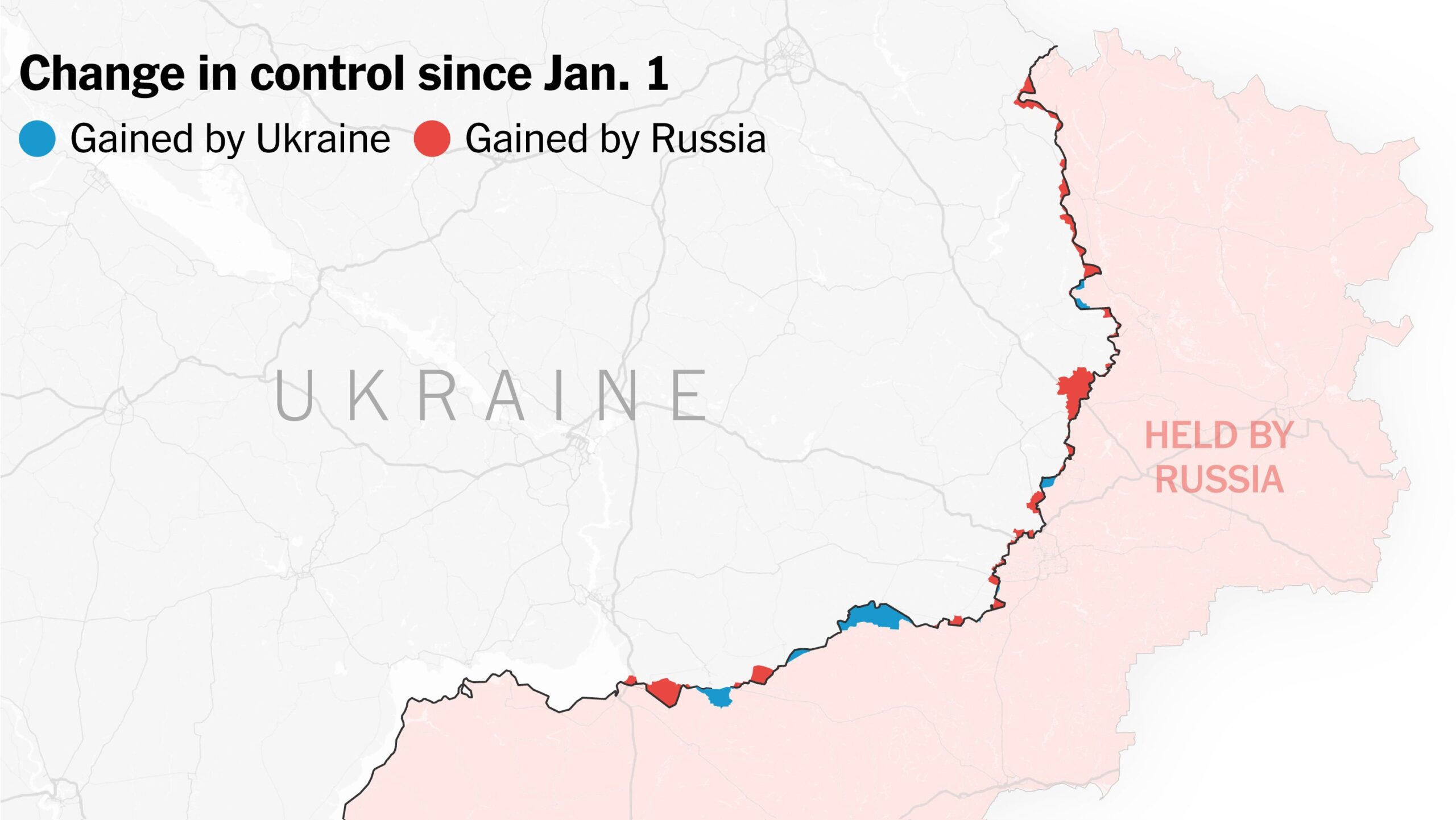
For this, some hundreds of thousand of soldiers and civilians have been killed, wounded, raped, tortured or made into refugees.
From fairly early I’ve been saying that Ukraine should be settled by peace negotiations.
This is why.
This is WWI bullshit. Ukraine is gaining nothing, and Russia is gaining little (they’ve significantly improved their alliances and their ability to produce war goods.)
Ukraine is under extreme stress. Western countries are becoming less willing and able to support it, they’ve engaged in multiple waves of conscription and are at the point of trying to force men who fled Ukraine to come back, sign up, and go into the trenches.
There’s a fairly strong argument that France never recovered from the manpower losses of the Napoleonic war and WWI.
Now, as for the future, these sorts of wars end when one side can’t keep it up any more, and when it can’t the war ends fast or large gains are made. The country most likely to not be able to keep it up is Ukraine, it has far fewer men and resources than Russia, and those allies providing armaments are losing the will or ability to keep doing so, while Russia’s allies (who provide mostly parts, other than Iran and North Korea, who could care less about sanctions) find Russia’s needs easily supportable.
It’s hard to say “when” this will happen, but it could even occur during the next Russian offensive, it’s more than possible.
What have they gained by continuing to fight? Nothing but a lot of dead people they can’t replace and a pile of destruction.
As for the West, we are clearly “fighting to the last Ukrainian” and that’s despicable.
End the war. Ukraine is very unlikely to get better terms later than sooner.
Donors and subscribers make it possible for me to write, so if you value my writing, please DONATE or SUBSCRIBE
Most of the world’s trade is done in dollars, even for trade that never goes to the US.
Most of the world’s money transfers at some point go thru the western banking system, and quite often an American bank, even if both parties are not in America. This is how the US justified its’ anti-FIFA case: the bribes, though at never point involving any Americans or going to America, at some point went thru a US bank on their way to their target.
Everyone needs (or needed) dollars, and everyone needed the Western banking system. There was no real alternative, and to a large extent there still isn’t.
But that has been changing. Russia (SFPS) and China (CIPS) built their own interbank messaging and transfer systems to replace the West’s SWIFT. They have started to connect them together. Since the Ukraine war in particular, China and Russia have been encouraging countries to settle trade in local currencies, and oil has been sold in rubles and yuan (previously, with a few rare exceptions it was always in dollars.
This is called dollar privilege. It has disadvantages, but because everyone needs dollars and because a ton of world debt is denominated in dollars and because the interbank transfer system is controlled by the West (SWIFT is actually located in Europe), America has been able to command far more of the world’s resources than it otherwise would have been able to. Of course this is backed up by US and allied military power, and it was possible to create it because after WWII the US was both the greatest military power and the largest industrial power.
Still, while it was definitely abused during the cold war period, and more than once, it was after the collapse of the USSR that America really went wild with sanctions.
But the most important thing about dollar privilege is not the ability to sanction, it’s the ability to settle all debts in dollars, which everyone needs.
What happens when everyone doesn’t need them? What happens when the US actually has to pay, somehow, for what it consumes?
Though losing dollar privilege is second order, downstream from losing industrial and military dominance, and has been moved forward by the abuse (and failure) of the sanctions system, it will still be a massive blow to America. Put simply (and with some exceptions), America will have to live on what it can actually make and grown and what it can trade for with what it makes and grows. Well, and what it can steal with its still strong military.
This will be a massive blow.
It will also be an opportunity of sorts. Dollar privilege let the US command more of the world’s resources than otherwise, but it also made the dollar worth far more than it should have been, and thus increased costs in America. In principle (though hard to do in practice) the US dollar collapse caused by the end of dollar privilege would make American goods and services much cheaper overseas and improve the US terms of trade, allowing more manufacturing in the US.
In principle. In practice, the collapse in ability to command resources is likely to lead to economic collapse, and only a very savvy leadership class will be able to navigate the issue, at least in a timely manner. In the longer run, America is still a continental power and if it doesn’t split up, the country has significant advantages which may allow it to survive and even be moderately prosperous.
But when you see moves by the BRICS to create their own multinational interbanking system, and moves away from the US dollar, understand that what you’re seeing are attempts to end US hegemony; attempts which will have shattering effects on the US economy.
Donors and subscribers make it possible for me to write, so if you value my writing, please DONATE or SUBSCRIBE
by Tony Wikrent
80 Years Ago Denmark Miraculously Saved 8,000 Jews From Nazi Murder
Harvey Wasserman, September 25, 2023 [downwithtyranny.com]
Strategic Political Economy
VACCINE SPECIALIST PETER HOTEZ: SCIENTISTS ARE ‘UNDER ATTACK FOR SOMEONE ELSE’S POLITICAL GAIN’
Julian Nowogrodzki, September 21, 2023 [Natue, via Overnight Science News: Politically motivated bullies want to ‘tear down the fabric of science’, DailyKos 9-23-2023]
The Deadly Rise of Anti-Science: A Scientist’s Warning, Peter Hotez, Johns Hopkins Univ. Press (2023)….
You prefer to say ‘anti-science aggression’ rather than ‘misinformation’. Why?
Misinformation makes it sound like it’s random junk that appears out of nowhere on the Internet. It’s not: it’s an organized, well-financed, politically motivated campaign that’s meant to tear down the fabric of science. And we have to frame it in that way.
Anti-science rhetoric is not new. What’s changed?
Now, it’s fully embraced by a major political party in the United States, and by authoritarian regimes in other countries such as Hungary and, previously, Brazil. It’s sanctioned by elected leaders in the US Congress. It’s reached a new level of organization and aggression — it’s starting to resemble the 1930s, when Joseph Stalin’s regime in the Soviet Union portrayed scientists as enemies of the state.
How did you see this play out during the COVID-19 pandemic?
Some 200,000 Americans died because of anti-science aggression…. When I went into the more conservative, rural areas of east Texas, essentially everyone I talked to had lost a loved one because they refused a COVID-19 vaccine. In the intensive-care unit, you saw some people deny COVID-19 existed, yet in their dying words feel remorse and advise their friends: ‘Don’t do what I did, get your COVID-19 immunization.’ These are good people. [Anti-science campaigners] took advantage of that….
…I’ve been leading this dual life, having to combat aggression against science and scientists. It’s hit me hard because now I’m a major target of far-right extremists. It’s odd to have [former White House strategist] Steve Bannon call you a criminal on social media. Those [statements] act as dog whistles, and then it’s followed by a wave of threats online and by e-mail, and even physical stalking.
Right now, you’re seeing individual scientists getting picked off by anti-science bullies on the Internet, or getting subpoenaed to testify at show-trial-like hearings. It’s terrible to watch my virology colleagues get paraded on [television network] CSpan as though they’ve done something wrong, when all they did was what I do — science for humanitarian purposes.
And I see the aggression getting worse as we head for the 2024 election.
So how can this be stopped?
This is the hardest question to answer. People in the health sector don’t know what to do; scientific societies discuss it in bland, defeatist language and talk about meeting with social-media companies. But no one seems to be willing to say, as I do, that this is political. As scientists, we are trained to have neutrality, we’re not supposed to talk about Republicans and Democrats or liberals and conservatives. But what do we do when the attacks are partisan?
We’re not seeing vigorous pushback or response, and neutrality favours the tormentor or the aggressor. We’re not hearing from the leadership of scientific societies, from university presidents, to defend science. I think they don’t want to offend donors coming from that political side, or state legislatures or the federal government. But they need to speak out in a forthright way.
[TW: Below is not exactly the other side of the argument, because the dangers Taibbi warns against are all too real:]
Anthony Fauci Was America’s Warmup Dictator
Matt Taibbi, September 30, 2023
He institutionalized the purposeful lie, suppressed critics, mastered emergency politics, even sold himself as a sex symbol. Anthony Fauci gave the next monster a playbook
Use to discuss topics unrelated to recent posts.
The army, or a part of it at the war college, has perked up and noticed some of the lessons of the Ukraine war, and that it’s a war that the US military could not fight. They’ve missed a lot of things, or felt they couldn’t/shouldn’t write about them, but they’ve figured some stuff out and written about them in a new report, “A Call to Action: Lessons from Ukraine for the Future Force” by Lieutenant Colonel Katie Crombe, and Professor John A. Nagle.
The entire thing is worth reading, but I’m going to pull out three of the main points. The first is that a volunteer US military can’t fight a real war.
The Russia-Ukraine War is exposing significant vulnerabilities in the Army’s strategic personnel depth and ability to withstand and replace casualties.11 Army theater medical planners may anticipate a sustained rate of roughly 3,600 casualties per day, ranging from those killed in action to those wounded in action or suffering disease or other non-battle injuries. With a 25 percent predicted replacement rate, the personnel system will require 800 new personnel each day. For context, the United States sustained about 50,000 casualties in two decades of fighting in Iraq and Afghanistan. In large-scale combat operations, the United States could experience that same number of casualties in two weeks. (emphasis mine)
Huh. Yeah, that seems bad. And it comes just as the US military is having trouble with volunteer recruitment, though even if wasn’t volunteer recruitment couldn’t keep up with the meat grinder of a real war.
The US Army is facing a dire combination of a recruiting shortfall and a shrinking Individual Ready Reserve. This recruiting shortfall, nearly 50 percent in the combat arms career management fields, is a longitudinal problem. Every infantry and armor soldier we do not recruit today is a strategic mobilization asset we will not have in 2031. The Individual Ready Reserve, which stood at 700,000 in 1973 and 450,000 in 1994, now stands at 76,000. These numbers cannot fill the existing gaps in the active force, let alone any casualty replacement or expansion during a large-scale combat operation. The implication is that the 1970s concept of an all-volunteer force has outlived its shelf life and does not align with the current operating environment. The technological revolution described below suggests this force has reached obsolescence. Large-scale combat operations troop requirements may well require a reconceptualization of the 1970s and 1980s volunteer force and a move toward partial conscription. (emphasis mine).
If the US expects to fight Russia, China, or even Iran, they’re going to face a real war.
The US has spent 20 years fighting with air, artillery and surveillance supremacy, with clear communications. American veterans who went to Ukraine were unprepared for a war where the other side has, if not supremacy, air and artillery superiority, and the Ukraine war has been a meatgrinder. Plus, the current command methods the army use don’t work in an environment like the Ukraine:
Twenty years of counterinsurgency and counterterrorism operationsin the Middle East, largely enabled by air, signals, and electromagnetic dominance, generated chains of command reliant on perfect, uncontested communication lines and an extraordinary and accurate common operating picture of the battlefield broadcast in real time to co-located staff in large Joint Operations Centers. The Russia-Ukraine War makes it clear that the electromagnetic signature emitted from the command posts of the past 20 years cannot survive against the pace and precision of an adversary who possesses sensor-based technologies, electronic warfare, and unmanned aerial systems or has access to satellite imagery; this includes nearly every state or nonstate actor the United States might find itself fighting in the near future
Back in 2012 I wrote an article titled “Drones are not weapons of the powerful.” I posited that they’re cheap, easy to make and everyone would eventually get them. We’re pretty much there, in terms of large group actors (the step after that is individuals, leading to an era where even a single person or small group can launch significant attacks.).
The authors of the article agree:
These systems, coupled with emerging artificial intelligence platforms, dramatically accelerate the pace of modern war. Tools and tactics that were viewed as niche capabilities in previous conflicts are becoming primary weapons systems that require education and training to understand, exploit, and counter. Nonstate actors and less capable nation-states can now acquire and capitalize on technologies that bring David’s powers closer to Goliath’s.
There are issues the authors don’t deal with, the main one is “designed in California, built in China.” The US’s weapon building capacity is massively degraded. As one example, the Chinese can build 3 ships per one the US builds, and the ships are probably better.
Since WWII, in every war the US has fought, they’ve had air superiority or supremacy and more advanced weapons than the enemy. They’ve also had more “stuff”. But the WWII “arsenal of democracy” is dead, it doesn’t exist any more.
Another issue is that the US military has outsourced too much of its capabilities. The corporate mantra of “outsource everything except your core competency” doesn’t work in a real war. All support functions should be run by the military and soldiers. (I may write an article on that in the future.) Contractors are too expensive and unwilling to really risk their necks, and outsourcing maintainance to non-army technicians is a disaster.
The US retains one huge advantage, however, its continental position makes it hard to attack the mainland. But this is also a disadvantage if the US loses air and naval supremacy. America’s enemies can only be reached by air and sea, after all.
Anyway, one takeaway is that conscription is likely to come back. I assume they’ll first make a huge push to recruit immigrants, undocumented or not, but that isn’t going to be enough. Get ready and remember, Empires rarely fade, they go down in huge conflagarations. The British Empire’s end involved two world wars.
Donors and subscribers make it possible for me to write, so if you value my writing, please DONATE or SUBSCRIBE