
One of the failures of imagination I see most often is the inability to understand that things were, actually, different in the past and that they are different in other places.
I live in Canada. In the West. Our leaders are all functionally psychopaths. They’re all corrupt and they all lie like they breathe. They have zero interest in anything but making their donors happy, and have spent over 50 years destroying the egalitarian society built by FDR and his successors, in order to give more money to the rich.
Many people think this is universal behaviour. It isn’t.
Different places and times are different.
Someone like Trump could not have become president even 30 years ago. Impossible.
These days the children of elites don’t fight in wars. In WWI and WWII they did, even FDRs sons went to war and the carnage in the British ruling class in WWI was epic because they personally lead the charges right into machine guns.
Different times are different.
Right into the early 90s it was possible to walk into almost every government and private building in Canada. No security guard would stop you. Not just walk into, take the elevator to pretty much any floor. You might have trouble getting to a few people, because they had secretarial or receptionist gates, but you could definitely get right up to that receptionist and if you insisted you could walk right past her.
Oh, and you could go into almost every building and use the bathroom.
I remember when there were no food banks because they weren’t needed.
For decades inequality decreased, not increased. This was a choice and the political elites were mostly onside with it. Even a lot of business elites were (though definitely not all.) When John Kenneth Galbraith investigated why corporate leaders in the 60s didn’t earn more he came to the conclusion it was cultural: they didn’t believe in paying more and anyone who tried was shut down hard by that consensus.
Even small things can be very different. We go on and on about female breasts and attractiveness, but traditional Japanese society did not find breasts sexy, and bound them tight: they associated them with child raising. They even didn’t like bright white smiles, this was considered “showing your bones” and disgusting, so women often blackened their teeth.
Anthropological studies show that in hunter-gatherer bands leadership is often chosen from people who are slow to anger and not aggressive. When testosterone was studied carefully, it turned out that high-normal testosterone isn’t actually about violence, it’s about status behaviour. Put a male with high T in a society that favors hugging and being empathetic and that doesn’t like aggressiveness and suddenly they’re the big huggers and empathizers.
Chinese leadership is not the same was Western leadership. They have different goals, incentives and values. They don’t act or think like us. This is also true of Russian leadership.
All of these things are contingent: they change over time based on circumstances. People have biology, but they also have vast amounts of conditioning based on what their society is like which forms their personalities. Leaders are chosen and promoted in different ways, emphasizing different morals and personalities at different times. Western leaders right now are mostly soulless psychopaths, but that hasn’t always been the case and even when it was, the morally neutral virtues they valued were different. (Courage, for example. Think what you want of 19th century British elites. They were scum. They were not cowards and intensely shamed cowards and people who didn’t do their duty.)
Humans are always humans, but the details change with the society and the time. If you over-generalize from your own time and experience you will make serious mistakes when you try and understand outside your time and society. This often becomes clear to people as they get older: I can assure you that the culture and the type of person was quite different back in the 70s and even 80s from now. I remember people who grew up in the Great Depression and they were not like Boomers, let alone like Zoomers. Nor would they have put up with someone like Trump.
Time change. People change. Different places are different and produce different types of people.
This shouldn’t need saying, but it is evident that it does.
What I write here is for the benefit of everyone, but alas, I live in capitalism and I, and the site, take money to keep running. If you value the writing here and can, please subscribe or donate.
Jan Wiklund
Ha-Joon Chang tells (23 things they don’t tell you about capitalism) that in the mid 1800s the Brits never thought German would industrialize, they were too lazy and disorganized. The same about Japanese in about 1900.
People change. But why?
We know more or less why the Western elites only care about themselves today, but had wider aims 70 years ago. At that time western capitalism was industrial, it needed both workers and customers, so it had to nurture these classes of people. Today it is rentierist and doesn’t need to.
That’s all.
All intensely capitalist, or simply flourishing, economies seem to degenerate into rentierism. Too much money simply clogs in too few accounts. It seems universal, see George Modelski, Bas van Bavel, Charles Kindleberger. Possibly China will also. It seems that when all seems to go well, people won’t care about tomorrow and build in guards against rentierism.
It has to be fought against when it is on the upturn. We managed to do that in the late 1700s, about 1850, in the late 1800s and in the 1930s. But the last time we failed. Probably we were too cocksure the good times would never end.
Purple Library Guy
Related but not quite the same, I’ve noticed that people tend to imagine other times and places as being more like now than they actually were. So for an example that I know a little bit about, lots of people seem to think that feudalism in Europe was basically capitalism with some peasants underneath it and some nobles stuck on top. It wasn’t. Adam Smith’s book got popular because it was explaining a new thing that was a major rupture with how people were used to stuff working. The whole idea of people being employed for wages was alien, as mostly was the idea of groups of people making things together in one place using division of labour, as with Smith’s famous pin factory. Under feudalism, a shop was a place where a craftsman sold the things that he and his apprentices made there. Maybe in a big city it could be a place where a traveling merchant’s extended family sold the things he imported on his trading journeys, and that was one of the things that eventually led to capitalism, but it was a tiny piece of the economy. Cities were like 10% of the population anyway, and everyone else barely touched money at all–they were mostly self-sufficient, or they worked for a noble in return for living for free at the manor house plus maybe a few coins they could spend at the fair now and then. Taxes weren’t mostly in money, they were in stuff that peasants produced–grain, chickens, flax, whatever.
But most people don’t have a conception of how any system different from the one they’re actually in could work. It’s a failure of imagination caused by a lack of knowledge, and it’s a political problem because it makes people unable to conceive of change.
I remember reading a science fiction book called “Beggars in Spain” by Nancy Kress. It was VERY popular at the time, nominated for the Hugo and Nebula, originally published as a novella which did win both prizes. And it was dealing with political/economic issues. And basically the author was grappling with her belief that neoliberal, even Libertarian economics was The Truth, while her heart told her there was a major problem here. And OK, it introduced this subgroup of people who were all both exceptionally intelligent and didn’t have to sleep, with zero bad side effects, and how they basically became techbro billionaires and generated tons of value but ordinary people, who weren’t generating tons of people, were being left behind. And my conclusion was, her problem was that she just knew nothing about any political philosophy or economic ideas outside what was influential in the United States right then.
This was emphasized for me when one of these ubermensch types was mentioned as having studied Renaissance Italy and derived Libertarian lessons from that because, in this telling, Renaissance Italy was distinguished from the pre-Renaissance by its abandonment of statism and its unleashing of entrepreneurial merchants to basically do laissez-faire. It was a throwaway example made to show how awesome and smart these people were. Except it was bullshit. I’ve dabbled in learning about Renaissance Italy, and it was statist as hell. Florence was full of craft guilds dictating tons of rules about how goods had to be produced and sold; a loaf of bread was legally required to be a certain size and weight to stop anyone from being cheated. The greatest trading city in the world, Venice, which sent its merchant fleets around the Mediterranean . . . those merchant fleets were built in the government owned shipyards, and were owned by the government; merchants basically bought space in them. Key Venetian industries were controlled by the government so it could jealously guard Venetian trade secrets (“intellectual property”); glassblowers, for instance, were not allowed to leave the city. But the author didn’t know this stuff and accepted the vague narrative you hear that assumes that because their understanding of capitalism is that it relies on laissez-faire, and because Renaissance Italy was sort of a pre-cradle of capitalism and, like, dynamic and stuff, that must mean Renaissance Italy was all laissez-faire and anti-statist. And the audience didn’t know any better, so they ate it up.
So a big audience thought this book was awesome because, like the author, they were ignorant of any political or economic ideas except the rather bankrupt ones of the 90s USA, and one aspect of that was they were willing to impose narratives on the past that had nothing to do with the actual past but just reflected their narrow assumptions.
(incidentally, the core conceit of this book is a parable about how there’s no point giving money to beggars in Spain or whatever impoverished place, because there are far more beggars than you can give to, and that means nobody can do anything about poverty implicitly including government, so you should instead be a Libertarian and build capitalist abundance or something. Of course the real takeaway is that individualized anti-social approaches cannot end poverty, what you need is comprehensive government programs to both provide welfare and create jobs, improve wages, and reduce expenses. But the author didn’t know enough to be able to conceive of that.)
And the thing about all this is that the author’s heart was in the right place mostly. She was kind of trying to fight against the narrative she thought was the only one in town. I think she would have been a lot happier if she had known more; she would have had more weapons for that fight and the book would have been a lot less intellectually weak. Her lack of knowledge, including about how things can be different and have been different, is what sabotaged her politics.
cc
Thanks Ian, good reminder that we often forget that things were not always as they are now.
This also reminds me of a recent comment here from Feral Finster:
“There was a time when black people were thought to be inept at…basketball, which at that time was believed to be a sport to which Jews were uniquely and innately suited.”
and a possible parallel from watching the movie “Marty Supreme”:
Apparently there was a time in the 1940s and 1950s, when many top American players were Jewish, and the Japanese, let alone Chinese, were not imagined as competitive in ping pong (apparently invented in Victorian England.)
Perhaps it could be useful to compile a “There was a time when …” series:
There was a time when “Japanese society did not find breasts sexy, and bound them tight”
There was a time when Japanese society “didn’t like bright white smiles, this was considered “showing your bones” and disgusting, so women often blackened their teeth.”
“There was a time when black people were thought to be inept at…basketball, which at that time was believed to be a sport to which Jews were uniquely and innately suited.”
There was a time in the 1940s and 1950s, when many top American players were Jewish, and Japanese, let alone Chinese, were not considered competitive in ping pong.
Re “it was possible to walk into almost every government and private building in Canada”, 2001/09/11 of course made that much worse. But Wahhabi-terrorism started when the US covertly fostered and metastasized it starting in the late 1970’s in order to use the Wahhabi extremism to overthrow the secular progressive government in Afghanistan. Women were doctors, lawyers, etc. That was in order to use Wahhabi extremists to, in the words of US NSA Zbigniew Brzezinski, “induce” a brutal war in order to inflict on “the USSR its Vietnam war,” at the expense of thoroughly destroying the country and society of the people of Afghanistan for decades.
(And in an attempt to repeat that, since long before the US-sponsored 2014 Maidan regime change in Kiev, the US also fostered neo-Nazi extremism and nationalism in the Ukraine to again use a neighbouring country that had good ties with Russia as a weapon against Russia, to try to weaken Russia yet again. Canada has actively been involved in this, including letting the Maidan insurrectionists use the Canadian embassy in Kiev in 2014, and continuing to send billions of Canadian taxpayer money to fuel the collective West’s proxy war against Russia.)
So a lot of the negative changes that we’ve seen can probably be traced back to the creation of the CIA in 1948, and their endless covert machinations, including shaping the world’s leadership – ex. Operation Gladio in Europe/Italy, countless assassinations and attempted assassinations around the world, countless regime changes, even including apparently in Australia. And including shaping the West’s own leadership, ex. no JFK, yes to the CIA-supportive, foreign-intervention-supportive Reagan, Bush, Obama, Biden, Trump, etc.
A lot of what the world has become today, including the “mostly soulless psychopaths” running the West, can probably be traced back to this massive out-of-control rogue apparatus that has its fingers in so much of the world.
David on an Island
“Our leaders are all functionally psychopaths. They’re all corrupt and they all lie like they breathe. They have zero interest in anything but making their donors happy, and have spent over 50 years destroying the egalitarian society built by FDR and his successors, in order to give more money to the rich.”
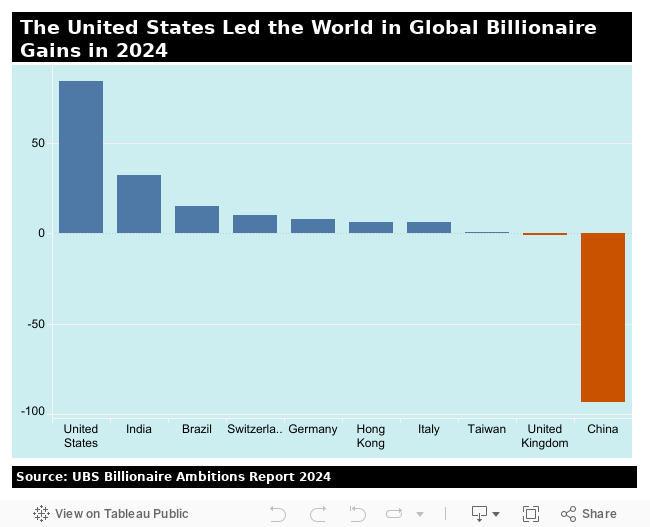
This is the most apt description of how the American government has operated continuously since January 21, 1981 that I have ever read. The American tax system and the deregulation of financial markets have steadily increased number of billionaires in the United States from just over 60 in 1992 to over 900 today, yet a billionaire has exactly zero social utility other than as a source of political graft.
spud
this is the man who set this off, he was devastating to civil society.
Before Bill Clinton’s presidency, there were approximately 200 billionaires in America. After his presidency, the number of billionaires increased significantly, reaching over 600 by 2021.
Wikipedia White House Historical Association
Billionaires in America: A Comparison
Before Bill Clinton’s Presidency
Approximately 200 billionaires existed in America.
After Bill Clinton’s Presidency
The number of billionaires increased significantly, reaching over 600 billionaires by 2021.
This growth reflects substantial changes in wealth accumulation and economic conditions during and after Clinton’s time in office.
White House Historical Association Wikipedia
Bill Clinton’s presidency coincided with policies that contributed to the growth of wealth concentration, including financial deregulation and free-trade agreements like NAFTA. By 2025, the number of billionaires in U.S. politics, especially in Donald Trump’s administration, had surged, with eight billionaires serving in key roles.
The New Republic nowthenmagazine.com
The rise of billionaires in American politics can be traced back to policies implemented during Bill Clinton’s presidency, which fostered wealth concentration. Key factors include:
Financial Deregulation: Clinton’s administration supported deregulation of financial markets, which contributed to the growth of wealth among the richest Americans.
Free-Trade Agreements: The North American Free Trade Agreement (NAFTA) and similar policies facilitated capital flows and increased corporate profits, benefiting wealthy individuals.
Surge in Billionaires Post-Clinton
By 2025, the political landscape saw a significant increase in the number of billionaires involved in governance, particularly during Donald Trump’s presidency. The following table highlights the billionaire presence in Trump’s administration:
Position Name Net Worth (2025)
Special Government Employee Elon Musk $431 billion
Commerce Secretary Howard Lutnick $3 billion
Education Secretary Linda McMahon $3 billion
Deputy Defense Secretary Stephen Feinberg $5 billion
Ambassador-at-Large Steve Witkoff $2 billion
Small Business Administration Admin Kelly Loeffler $1 billion
The influx of billionaires into politics has raised concerns about the influence of wealth on democracy. President Joe Biden warned of an emerging oligarchy that threatens basic rights and freedoms, highlighting the potential risks associated with such concentration of power and wealth in governance.
The New Republic
———–
a rules for thee not for me society we have today, is not long lasting. the tyrants have been trying to smash every printing press since its exception, only to have the truth spread far and wide in less time, then the time before.
the tyrants not only help the spreading of the information, they super charge it by ruining ever more lives, daily.
example,
Police appreciation nights have seen lower attendance in some communities due to a mix of factors including public sentiment shifts, event scheduling conflicts, and evolving priorities around law enforcement visibility.
nleomf.org
Factors contributing to lower attendance at police appreciation nights include negative public sentiment towards law enforcement, budget constraints affecting community participation, and a lack of awareness or promotion of the events.
Thomson Reuters concernsofpolicesurvivors.org
Community sentiments play a crucial role in shaping police appreciation night events, as positive relationships between law enforcement and residents can lead to higher participation and support for these events. Conversely, negative sentiments may result in lower engagement and a lack of enthusiasm for honoring police efforts.
projectchildsafe.org nleomf.org
—–
every life they ruin, that life has friends and family, many who no longer are fooled. now we see that in politics, from top to bottom.
no amount of propaganda and smashing printing press’s will reverse this spread of knowledge.
Nat Wilson Turner
I’ve run against this hard when talking about music history. Some shit was just different in different times and places. For example the 19402-1960s Black Gospel scene was a hotbed of outrageous sexual behavior including what we’d now call pedophilia — Billy Preston as a semi-out gay man described his arrival on the Gospel circuit (small groups traveled from church to church looking for gigs to fill the dead spots between Sunday and Wednesday services) as “they turned me out, man. After one tour I was a grown ass f****t and I’d done it all.” Aretha Franklin ended up having 2 kids by the time she was 15 after just a couple of years on the tour. She was touring with her father, but I never believed the rumors that he was the father and neither did her biographer David Ritz — there’s plenty of evidence that various players on the tour got to young ‘Retha when dad’s back was turned. As Muddy Waters (a bluesman and certainly never part of the Gospel Circuit) said, “I always thought starting ’em young was alright. The kids always came out healthy and a teenage girl hardly ever die in childbirth.”
For me, I just note that’s how it was for those folks in that time and place and I am certainly in no position to judge the people who not only survived but thrived and made incredible art in the murderous apartheid society my white ancestors formed and that I still benefit from.
But try explaining that shit to a bunch of judgemental millennials, zoomers and alphas who barely even think sex is ok.
I think that last part is because it’s obvious to everyone that we don’t need to replace the human population 1:1, we need to cut way the fuck back.
/rant
mago
Commonsensical thread with insightful comments. Been thinking about cc’s observations of the CIA’ murderous influence along with Mossad and other post ww2 alphabet agencies.
NWT’s comment on sexuality and music history opened some doors. I knew nothing about those aspects of the early gospel scene, nor was i aware of the millenial’s and zoomer’s sexual phobias and ignorance.
I do know a little bit about food history and trends from a lifetime of practice and study. I’ll limit my comments to some recurring fads in the past few decades. Having been on the (alternative) scene since my early twenties I’ve watched it come and go and come back again.
There was the post hippie scene with frutarians versus the brown rice crowd along with the food gurus espousing their philosophies and delusions. During that 70’s food renaissance there was resurrection of earlier food trends such as food combing. It was difficult to pick and choose among the contradictory views, but one thing was clear to those raised on wonder bread and TV dinners: that processed refined shit sucked.
Moving into the 80’s corporate interests subverted the natural foods movement and put a natural veneer on processed foods, which still pertains. It’s even worse now with organic processed foods the main sellers at Whole Foods and Vitamin Cottage and other lesser chains.
I’ll skip the production and distribution aspects and move on to dietary fads such as the Atkins diet in the 80’s that was discredited and returned disguised as Paleo, which is such a crock of shit that I don’t know where to begin, but I’ve learned to stay silent in the company of true believers. Then there’s the Eat Right For Your Type crowd. It goes on and on. For example there’s the current thing about seed oils being toxic. Forget that humans have used seed oils since forever. No. Now we must use avocado oil, and I won’t even touch on how toxic and ugly the avocado world is on all levels: economic, political and environmental. But, yeah, groove on your avocado toast millennials while you cis out.
Ok, vale, basta. I could go on and on, but will leave it with the obvious statement that change is the only constant.
mago
Lest I forget, there was something I wanted to post on the open thread but forgot, yet it’s pertinent here as well talking about the winds of change.
Recently, rustling and rattling in my wood stove awoke me in the wee hours. I thought it was another fucking mouse (they invade from time to time), but I’m like turn over and snore some more and leave it for the morning.
Around dawn the next morning the wood stove rattling arose again. Ok. How did a mouse get in there?
I opened the stove door and out flew a bird that flew to the skylight and bounced against the glass. I mounted a stool, reached up and grabbed it in my hand and then released it out the door.
What I’m leading up to in the change department is that nine years ago in my dwelling place every spring bluebirds would fly down the chimney, and I had a ritual of tracking them and catching them by hand (sparing you the details) then releasing them. The last release count some 9 summers ago was a record 19.
There are no more bluebirds flying down chimneys around here no more.
Changes.
Come tomorrow will I be older/ come tomorrow maybe a soldier/will time make men more wise. . . Courtesy of Jeff Beck.
bruce wilder
The past is another country.
TM
The country I was born into no longer exists, having fought a ruthless civil war. For some reason, many people in the new constituent countries celebrate war criminals and hail this period of self-immolation as some kind of heroic epic. Shadow play and echoes of conflicts in the past that do nothing to address the problems of the present.
My parents were very young when they had me, and they were of a generation that caught the tail end of the good (and bad) things in socialist Yugoslavia. Just normal working class kids from a small town who had access to excellent education, arts, sports coaching and facilities. They produced a lot of very bright, hard working and socially conscious people then gave them zero opportunities to find work. So many talented people left even before the war, and my father worked in various countries and various jobs to try to support us. In contrast, I was mostly raised in the UK, within an apathetic education system, without much access to anything (my parents’ assumptions that the UK would work similar to back home and I’d be inundated with free activities…) apart from a local library where I read voraciously. I didn’t even go to university, I was so disillusioned; straight into work. But there was so much opportunity here, and my fluent English and computer literacy got me further than I deserve in the 20 years since.
I think about that a lot now that my wife and I are both financially stable, home-owning first generation immigrants. My parents thought that my life would be better in this foreign place, and sacrificed a lot to get here and stay here. They were right, in the end, even if the mechanisms they imagined were very different. My children will have a totally alien experience to me; I hope I’ll have the wisdom and knowledge to guide them to their own happiness.
For decades I would go back home and see burned out buildings, bullet holes and grenade-blown facades, and nothing seemed to be built except for mosques and bars. Why? Because they tried to wipe us out, so fuck em. But even that changes now. New money comes in, the self-identity of the country changes. Young people still leave to find work, but now tourists flood in and some places become sustainable. It will never go back to what it was, but something new is born, the new generations have their own context.
Hiero
my mother grew up during great depression and voted for ding dong donny twice, would have a third time had she lived long enough, she was ride or die and it was awful to experience – abortion was one helluva potent wedge
spamned
*Citizens United* would like a word~
Jorge
About Japanese women and blackened teeth: this started out as a court tradition because there was an Emperor with terrible teeth.