The horizon is not so far as we can see, but as far as we can imagine

Category: Latin and South America

Brazil’s Economic Tumble

No surprise, but…

Brazil’s economy has fallen further into its worst ever recession, contracting by 3.6 percent in 2016…

…Brazil’s economy is now eight percent smaller than it was in December 2014.

Recently, there was a legislative coup in Brazil, but that was a symptom, not a cause, as are Venezuela’s problems, the electoral reversal in Argentina, and so on.

All that is required to understand what is happening is this chart of commodity prices.
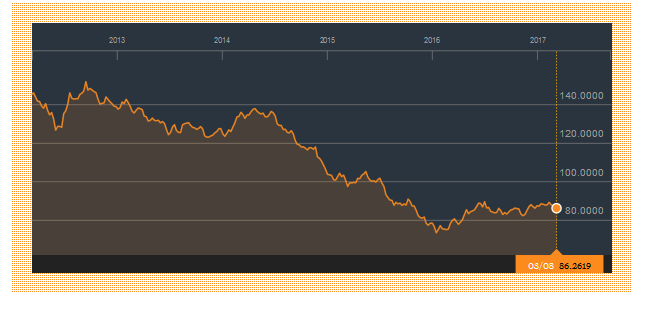
 Bloomberg 5 years commodity index March 8 2017


Bloomberg 5 years commodity index March 8 2017

We have a very foolish economy. The developed world has been in austerity since 2008, China does not have a rich enough middle class to take up demand. Without demand for goods and services in the developed world, commodity prices have crashed.

Our lords and masters don’t want growth they can’t capture, and they value low wages and debt-slavery more than they do a thriving economy. As a result, the economies which prospered by supplying commodities to China and other manufacturers have stumbled and crashed out. This simple fact is behind many headlines which seem unrelated to it, including virtually every change of government in South America.

A globalized economy is moronic. It makes countries dependent on policies over which they have no control. There is virtually nothing that Brazil’s government can do about this (though engaging in austerity of their own is stupid); nor was there a damn thing Venezuela could do about it (though, yes, the Bolivarian economy was mismanaged, something I said as far back as 2004).

This is by design. Our elites don’t want national elites to be able to make policy. As a result, there are only two nations which approach full sovereignty in the world: the United States and China. Only they are powerful enough and rich enough to make unilateral moves without suffering vast consequences (and maybe not even them). The EU could almost be sovereign, if it wasn’t run by ideological morons, but it isn’t, and Russia has enough resources and military power to have some sovereignty, and that’s basically it.

And so, the Brazilians will suffer what they must, because however large and rich they think they are, they are still a non-sovereign state in the ways that matter in our world.


The results of the work I do, like this article, are free, but food isn’t, so if you value my work, please DONATE or SUBSCRIBE.
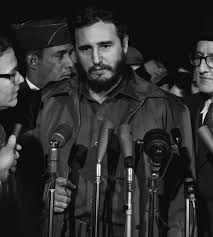

Castro’s Legacy

Castro has died at age 90.

Despite the squeals, the bottom line for Castro is that he improved the lives for the vast majority of Cubans. Even after Soviet aid was cut off, Cuba under Castro was able to recover. Cuba, like all nations, suppresses some political dissent, but it has a far smaller percentage of people imprisoned than the US, and those prisoners are treated far better than US prisoners. Human welfare statistics are high, including lifespan, infant mortality, education, and so on.

One can qualify Cuba’s success, but it is, overall, a success–especially when compared to most Latin and South American countries.

As for Castro himself, he outlived pretty much all his enemies and many of their children, and died in bed. Can’t ask for much more than that as a revolutionary leader.


If you enjoyed this article, and want me to write more, please DONATE or SUBSCRIBE.

The Brazilian Dilma Rousseff Coup

Dilma Roussef

Dilma Roussef

Rousseff has been impeached and removed, supposedly for corruption, though there’s little evidence she personally benefited from corruption, while many of those who impeached her are very corrupt. Brazil was a “miracle economy” for much of the past decade and a half while the “left” ran things, but much of that was due to forces beyond local control, like the price of oil and the strength of the world and Chinese economies.

The new President’s “plan” is as follows:

President Michel Temer said on Wednesday that fixing Brazil’s economy would not be easy, but his priority was to pass a spending cap this year, attract foreign investment, reduce unemployment, and begin pension system reform.

A.K.A., neoliberal austerity. Unions will be crushed, pensions will be cut, spending will be cut, and outsiders will be allowed to buy up Brazilian companies and resources for relatively cheap, so long as Brazilian elites get a cut.

Rousseff wasn’t the greatest prize, having run neoliberal-light policies in many areas, but she wasn’t personally corrupt and she engaged in far less austerity than Temer will.

Parties of the left are being crushed in much of South America for the simple reason that they ran the countries during the resource boom of the 2000s and have not been able to manage the drop in resource prices, first from oil, then generally as China stopped buying so many resources. I’ve discussed the perils of basing a left-wing government on resources before.

(See also Mandos on the coup.)


If you enjoyed this article, and want me to write more, please DONATE or SUBSCRIBE.

What the Melian Dialogue tells us about the End of Empire (Venezuelan security threat edition)

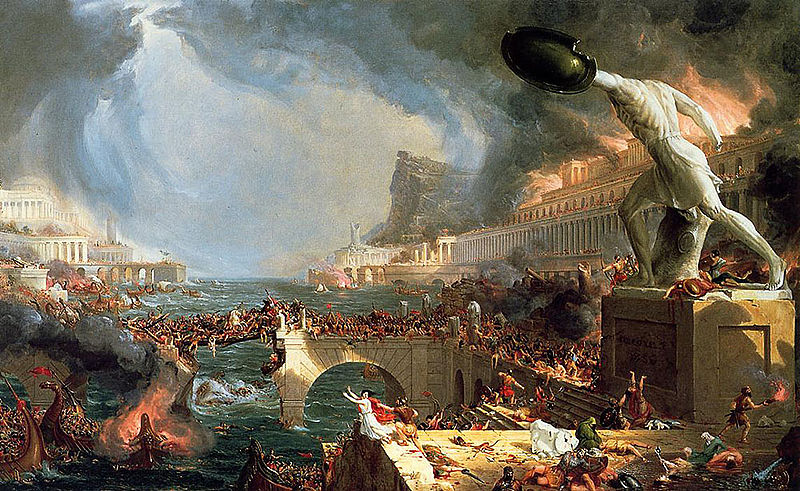
The Course of Empire by Thomas Cole

The Course of Empire by Thomas Cole

I’ll just point out that in no way can Venezuela be considered a security threat to the United States.  And the “human rights violations”, while some are real are far less than routinely committed by many US allies, including Saudi Arabia, while Venezuela is more democratic, again, than many countries the US has not imposed sanctions on.

This sort of bullying is exactly the sort of thing which will lead to the end of American hegemony.  Though less severe, one is reminded of the Melian dialogue.  The Athenians argue that the powerful do as they will and the weak as they must, and that the Melians should surrender.  If they do not, the Athenians will slaughter the men and sell the women and children into slavery.

The Melian reply in part, is thus:

But do you not recognise another danger? For, once more, since you drive us from the plea of justice and press upon us your doctrine of expediency, we must show you what is for our interest, and, if it be for yours also, may hope to convince you: Will you not be making enemies of all who are now neutrals? When they see how you are treating us they will expect you some day to turn against them; and if so, are you not strengthening the enemies whom you already have, and bringing upon you others who, if they could help, would never dream of being your enemies at all?


(I am fundraising to determine how much I’ll write this year.  If you value my writing, and want more of it, please consider donating.)


The irony of the Melian dialogue is that both sides are right: the Melians are destroyed, and would have been better off if they submitted.  But the destruction of Melos is indeed one of the contributing factors to the eventual fall of Athens, because while Sparta may be nastier internally, they are also less dangerous to other city-states than Athens is.

The analogy is not perfect, because even with all of Venezuela’s problems, much of the population is better off resisting the US than it would be conceding (the poor and the darker colored citizens have benefited immensely under the Bolivaran revolution).

But America, and the West’s continued insistence that nations will kneel or suffer is very similar and is already damaging American power.

Page 3 of 3

Powered by WordPress & Theme by Anders Norén