The horizon is not so far as we can see, but as far as we can imagine

Category: History Page 4 of 5

Rising and Falling

** MANDOS POST **

In several recent threads on this blog, we discussed (i.e., argued passionately about) the current goings on in Europe (Brexit, Greece, Italy, etc.) as signs of the impending decay and demise of the European project. I used to share this view to some extent, because I too am sometimes in the grip of a moral fallacy that haunts left-wing discourse: that things that are good, work, and things that aren’t good, don’t work. I actually think that in the bigger picture, this is true, but only in the largest temporal and spatial frames. In the medium term, lots of things that are good, are not stable enough in context to work (as in, be sustained for more than a short period of time), and lots of things that are not good, are nevertheless stable enough to last decades and even centuries.

Predicting whether, when, and how some particular set of events will cause large institutions to rise or fall cannot be done lightly or easily, and such predictions, when done in the moment, are more likely wrong than right. You should expect unexpected things to occur; there are too many variables. Some people are better at it than others, but you should take even the best track records with a grain of salt. Even two to three years ago, I would have predicted that the build-up of “bad karma” in the European system would have caused the EU to break apart by now. Even a few months ago, the rise of Euroskeptic populists in some countries suggested to me that the situation is increasingly desperate for European unity. However, over that time, and somewhat unexpectedly to me I must admit, it appears that some sort of inflection point has been reached.

The EU, as it stands now, was designed by a set of people that had different attitudes and goals over time. Therefore, it is a mixed bag, when it comes to good, not good, works, doesn’t work. A good chunk of its institutions were designed at around the peak of the neoliberal revolt against state management of the economy. In the EU, this took its expression in an approach to the economy that militated against state attempts to protect or bolster industrial employment in both public and private sectors. Because Europe does not suffer so much from the “moralized” version of libertarianism from which the US suffers (essentially, that your bank account is a virtual extension of your physical body), there is a stronger commercial regulatory apparatus developed even in the neoliberal era than what other developed “capitalist” countries tend to have. The neoliberal bits, especially the most recent ones like the Eurozone, have increasingly showed themselves to be not good and not working.

But this cannot be taken out of the context of the whole. It’s increasingly clear to me that Europe is still not that far off from the overall intended trajectory of the two generations of designers of European convergence. It is absolutely true that those who built the system had, for a number of different reasons, a deep suspicion of the public and popular sovereignty, even while they were also against outright dictatorship. I generally consider this to be overall not good and probably won’t work in the long run. (But I must note that the designers of the EU also recognized that they might need to legitimize popular sovereignty at a European level and built in provisions for systems to implement it.) However, they believed both in the necessity of European unity (in the modern world, a disunited Europe is structurally, deeply vulnerable), and the difficulty in getting a multilingual, multicultural subcontinent of fallen empires to accept the necessity of unification, so they constructed a system of what are effectively one-way traps to ensure that the cost of departure is always greater than the cost of endurance, even when the system in some matters doesn’t work. The goal is therefore for this endurance to eventually result in a crisis whose only positive-sum resolution is the Europeanization of authority.

With Italy’s effective capitulation to the Commission, and yes, with Greece’s previous compliance, and yes again, with a Brexit that is already providing the necessary object lessons, it appears that the crisis-and-trap strategy is still operating, or rather, it cannot be said to have failed at this point in time. That is, it remains that case that the strategy of making a series of systems that don’t work is working.

Considering that this game of deliberate historical manipulation has real human costs and indeed a known death toll in itself, one may well choose to designate it as not good. But, the evidence is that it still works.

So what would the decline of the European project actually look like?  Well, there are, of course, phenomena that are hard to predict directly, like, sudden environmental cataclysms. If I were forced to make a prediction, however, the political coming-apart would probably have to look like one of the following options:

  1. A situation comes to pass where it is immediately more materially beneficial to leave than to stay (this has not yet happened).
  2. One or more countries decide to leave a major institution/treaty despite the costs, and they do economically better in the relatively short run after departure. (Brexit under the Tories is not likely to be an example of this.)
  3. A consensus develops in several countries that long-term economic suffering is more desirable than staying in the EU, even if that suffering is greater than what they might have experienced inside the EU, and they sustain this consensus even after feeling that suffering.

All of this may lead you to consider projects like the European unification, designed explicitly around creating consequences that override popular will, to be not good. I have given you at least three possibilities for it to not work. So I would say, as before, that it is a mixed bag.

Political theodicy is dead. Long live political theodicy.

What 9/11 Did to America and the World

I wasn’t going to write much more about 9/11, but then Obama wrote that no act of terror could ever change America.

I don’t know if that’s true. If it is, it means America was already a terrible, terrible place.

The funny thing about 9/11 is that it worked. Bin Laden had a plan, his plan was to draw Americans in and show they could be beaten.

He thought they’d be beaten in Afghanistan. They weren’t–they were beaten in Iraq. When the US left Iraq it had to pay the various militias off to avoid attack.

That’s losing.

Meanwhile there are al-Qaeda affiliates over much of Asia and Africa. Al-Qaeda central may be weaker, but al-Qaeda the idea is far far stronger than it was before 9/11.

Saddam was a secular Muslim. He was one of bin Laden’s enemies, and the US destroyed him.

Meanwhile, at home, the US destroyed its own freedoms. It tortured people.

The US also instigated a worldwide assassination program, killing whoever it wanted, wherever it wanted, on the authority of the President.

The US has always been pretty shitty when dealing with others: supporting coups versus democratic governments, sponsoring death squads, looking the other way when its pet governments and terrorists raped, tortured, and murdered. (Pinochet had dogs trained to rape women; he was very approved of by Washington.)

Bill Clinton, of course, had killed about half a million Iraq children with his sanctions, and Madeleine Albright, a truly evil woman who is burning in Hell today if there is one (I doubt it) stated she thought it was “worth it.”

But after 9/11, the US went even further. Torture, from the top, by its own soldiers, as opposed to merely winked at. Widespread assassination. The gutting of habeas corpus. Probably a million more dead Iraqis. Later, under Obama, the destruction of Libya, another war crime. (He should hang, as Nazis hung, along with Blair, Cameron and Bush. Most Nazis were hung not for the Holocaust but for attacking a country which had not attacked them.)

American crimes, of course, are endless. All empires’ crimes are endless, and so are all colonial states’ crimes. This is true of both America and Canada, as they moved West, and it is true today of Israel.

Still, something important changed after 9/11. Lines were crossed.

Americans who are okay with all the crimes should be aghast as well, not that lines were crossed (they have no lines) but that they were crossed so incompetently. The US got its ass kicked by a bunch of rag tag militias. The myth of US military supremacy lay shattered. The US can still bomb anyone into dust, but everyone now knows that its military can do nothing but destroy.

Bin Laden was the first great man of the 21st century. Great is not a synonym for good. From a position of infinite weakness, he made his enemy use its own strength to accomplish his goals.

The US proved itself not just evil (don’t even, there are too many dead), but stunningly incompetent and crippled by corruption.

And today, Democrats are rehabilitating George Bush, the war criminal, to attack Trump.

Trump may yet do far worse than Bush, but until he’s started a major war, he hasn’t, and even if he does, Bush was–and is–evil and should be in a war crimes dock, along with most other major American politicians of the time, almost all of whom voted to give Bush the vast powers he used exactly as any fool could have predicted he would.

9/11 either changed the US, or revealed the US. Either way, the US after 9/11 was ghastly and evil.

And in 2004, knowing all the evil Bush had done, Americans re-elected him, thus showing that enough of them approved of what he had done. Cavil all you want about vote suppression and so on, it is not as if there was a huge tide of Americans who said “not in my name.”

This is still George Bush’s America, and his America is bin Laden’s America. Bin Laden was right about the US. He knew exactly what the US was, knew how to push its buttons and America did what bin Laden wanted to.

Bin Laden was a profoundly evil man, and he recognized the US’s profound evil and used that evil to his benefit.

Understand clearly, there were choices: Iraq did not have to be invaded; Afghanistan did not have to be occupied (a punitive expedition would have been sufficient); the Patriot Act did not have to be passed; torture in Guantanamo did not have to occur; routine drone assassination was not necessary.

All of these were affirmative choices, and virtually all of them were reconfirmed in 2004, then in 2008, because Obama continued almost everything Bush did, and even ramped some of it up, like drone assassination and deportations.

Bin Laden won because he was right that the US was evil, or perhaps, that with a push, it was willing to be even more evil.

Hell of a thing.


The results of the work I do, like this article, are free, but food isn’t, so if you value my work, please DONATE or SUBSCRIBE.

Nazis Are Not Socialists

Th above idea, because they were called National Socialists, tends not to die.

The Nazis reduced wages and shattered unions. Being a socialist got you sent to a camp.

Under the Nazis, corporate profits and the percentage of national income going to high income people increased.

And the Nazis also privatized a great deal, in fact their privatization regime was very similiar to how neoliberals have run the economy.

Nazis were right-wingers, who believed in poor workers and rich capitalists and that the state should mostly be involved in military and police. They were not socialists, by any definition of the word socialist of which I am aware.


The results of the work I do, like this article, are free, but food isn’t, so if you value my work, please DONATE or SUBSCRIBE.

Syria and the Cult of the Tough Decision

(POST BY MANDOS!!!)

The chances were always high that regardless of who was elected, Trump or Clinton, there would be some kind of American attack in Syria.  However, the chances were always higher with Trump than Clinton. Yes, you read that right: It was always a lot more likely that Trump would attack Syria than Clinton would. The reason for this is that Clinton took a more hawkish position on Syria before the election. Trump took a right-populist position of focusing on domestic politics and telegraphed a Russia-friendlier course. This more or less convinced me that he was going to attack Syria at some point. Likely, Clinton would have too — but with Trump it was basically inevitable.

Running a complex industrial and military power requires a highly technical bureaucracy. That bureaucracy therefore has an ultimate veto on what is possible to accomplish that is necessarily beyond democracy. That bureaucracy has made it clear that it won’t implement policies by people it doesn’t consider to be “serious.”  The hallmark of seriousness is the ability to make the Tough Decision.

(DID I MENTION THAT THIS WAS A POST BY MANDOS? BEFORE YOU COMMENT…)

The complaint by the technocratic class against what it denigrates as “populism” is — among other things — that populism is ultimately the rejection of the Tough Decision. Left-wing populism holds that there are a lot of win-win situations where the benefits to (most) stakeholders far outweigh the costs of participation. Right-wing populism does not believe in win-win propositions, but rather that in a win-lose situation it is effortless to identify who should be on the losing side of the equation and to practically shove the loss onto them. Either way, left- and right-wing populism deny the centrality of the Tough Decision in leadership.

Clinton ran as the anti-populist candidate, presenting herself as the one who would preserve an already-great America through her ability to make Tough Decisions that distributed costs in a way that her supporters wouldn’t always like. Trump ran as a right-wing populist, explicitly riding on the feeling that there were designated “winners” who weren’t winning and designated “losers” who weren’t losing, and proposing solutions whereby this state of affairs could be effortlessly corrected. Insofar as he has attempted to make good on this aspect of this program in a public way, the system has acted against him, because all of the other entities, and that includes the House “Freedom” Caucus, believes in the Tough Decision.

Foreign policy is always the domain in which the right-wing populist can most easily exercise the Tough Decision and win back some loyalty from the managerial class. That is because, in the short run, breaking a promise on a foreign policy or military point is often the one that is lowest-cost to his principal support base. By attacking Syria, Trump proves that he can make a Tough Decision and that he can be “brought to reason” by the policy elite. Clinton would not have had to do this so soon, at least, and would thus have had the confidence of the policy elite that she would “push the button” but would merely be holding off until a strategically more optimal moment. The policy elite seems to have been afraid that Trump would never push the button. That concern has been proven unjust.

The cult of the Tough Decision is killing the world. It is not merely a fetish of a generation of technocrats but deeply engrained into the psychological structure of our society. It stems from a couple of inoffensive common-sense pillars:

  1. There Ain’t No Such Thing as a Free Lunch
  2. You Can’t Have Your Cake and Eat It Too

Both of these are narrowly true. Every “free” lunch requires at least some effort to go and obtain it. (1) is merely a recognition that all things have an up-front energy cost. (2) is merely a recognition that once you’ve made a choice, the world changes such that the very same choice is not available a second time in its exact original form. In present-day psychology, we exaggerate these to mean that not merely is there an up-front cost to everything, but it is highly likely that most up-front costs outweigh the benefits — and that there are no win-win situations, because the up-front cost of most choices must result in a major stakeholder losing out.

This exaggeration of common-sense wisdom has come in its most exaggerated form of the fetishization of abstract intellectual exercises from economics and game theory. These exercises are concentrated in the political and managerial elite, but they are constantly reflected in popular discourse and media culture. It is propagated by often very well-intentioned people who would like to make the world better.

Its results are particularly damaging to left-wing populism, because left-wing populism is founded on the existence of low-cost, self-replenishing free lunches — repeated win-win situations. (As opposed to, as I said, right-wing populism, which rejects either the low-cost or the self-replenishing part.) The existence of these free lunches probably sounds like an absurdity even to readers here. Admittedly, they seem to be vanishing quickly, but they are not all gone. Single-payer universal health care in a developed country is one of these free lunches, where the principal payers of the monopsony cost (medical services providers of various sorts, including large organizations) can afford the cost without true suffering.

In a twist of fate, Trump was one of the popular purveyors of the Cult of the Tough Decision in his reality show career. Reality TV, of the “voting off the island” genre, is all about making someone cry in public as a designated loser, and then self-back-patting that it was a responsible or necessary or realistic choice. It is a genre that is emblematic of our era. So it should surprise no one that Trump returns to the ontology of public action that worked out so well for him.

The Basic Psychological Structure of Our Society Does Not Work

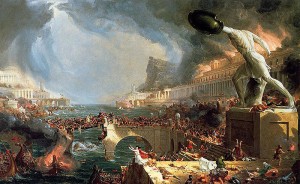
The Course of Empire by Thomas Cole

The Course of Empire by Thomas Cole

Here’s the thing. Our society only works after generational crises which don’t destroy it. After the Napoleonic Wars, the survivors made Europe more or less work. They got a good long run out of it–a surprisingly long one–but it began going south starting around 1870, and it blew up with WWII.

It went south in ways that are recognizable, by the way. For example, the British Empire pushed laissez-faire trade policies which made the rich richer, but gutted the British manufacturing base over time, moving much of it, ironically, to America.

The system went into crisis from 1914 to 1945, and the Americans took it over and ran it basically well up until the early 70s, about 25 years. Then it went into decline. It’s hard to tell exactly when the end-game crisis start(ed) until we can look back, but if we aren’t in it right now, we’re close.

1945 to 2008 is 63 years. If you count up through to today, it’s 71 years. If the crisis isn’t seen to have started for another ten years, it will be 81.

But the core point here is that it’s very hard to create people who can run a system.

A common refrain is that prosperity destroys character. But that’s not quite right: The people who created the good post-war economy were the FDR types, mostly. People who were adults in the 20s and 30s, who saw what went wrong.

People have a hard time learning from other people’s experiences. They have to see it themselves. So, in the early 70s there is an attempt to get rid of the short-sale uptick rule (you can only short a stock on an uptick of the stock) and it dies in the face of massive backlash. A couple decades later, those people are dead, and even more wholesale revisions to the rules are put in place to prevent another Depression. Finally, Clinton kills Glass-Steagall, the main spar, wholesale, something entirely unthinkable in 1960 when the population had lived through and remembered the reasons Glass-Steagall existed in the first place.

But the rot goes deeper than just, “It’s hard to learn what you didn’t experience.” It goes to the core of how we raise ourselves and our children.

School, as we do it, is a terrible way to raise people. What it actually teaches us is to, “Do what you’re told, when you’re told. Wait to be told how to do things, don’t figure out things for yourself, and give the approved answer, not one you came up  with  yourself.”

It trains drones. It trains people who are meant to spend their adult lives under supervision, doing what they are told, when they are told, and giving their bosses the answers their bosses want.

Those people make fine wage slaves, yes, but they don’t make good citizens. They have been failed to be taught how to think for themselves. Even worse, they have been taught that if a thought of their own should come up, they should keep it to themselves.

Meanwhile, school interactions with peers are terrible. When we call something “high school” we mean horrible peer pressure bullshit. A few people remember high school fondly, but most people remember it as one of the worst times of their lives.

Wage slavery, and I use the term slavery very deliberately, is a terrible system if you want a democracy or a Republic. Mass production consumer societies, in which we choose from menus rather than creating anything ourselves, are terrible for democracies or Republics.

The ways we school people, the jobs most people work at, and the methods through which we distribute goods to people (through money gained by sitting down, shutting up, and doing what you are told) are antithetical to free, egalitarian societies. Only a crisis which forces people to think for themselves and where they have to be trusted for a while can briefly create people suited to political freedom.

But we can’t have world wars and depressions all the time, for what I assume are obvious reasons. So we stagger along, brief good periods sliding into shit periods, regularly.

Of course there is more to it than this, such as cycles of destruction of capital and labor and so on, but much of that is manageable–in theory. It isn’t manageable in practice, not because it couldn’t be done, but because our society–we, ourselves–don’t create the people who can do it.

Freedom, democracy, equality: these things are not compatible with how we order our economic affairs, how we raise our children, or how we condition our adults.

We will not reverse course, this cycle; that doesn’t happen and it won’t. It’s too late. But there is always another cycle. If we don’t want the next cycle to be as disastrous as this one, we must figure out a better way to run our economy, to educate our children, and to live as adults. A way suited to people fit to be free.

This doesn’t mean “work or starve” as many libertarian morons would think; it means allowing real choices to be made, which requires an absence of existential fear while still including consequences. It means teaching children to to be something other than “good workers.” It means jobs that aren’t “you’re a kneepad for the boss or you lose everything.” It means a power structure that does not concentrate wealth and power in the hands of a few and create a gate around access to the good life, which fosters outside of it a subservience born of the desperate knowledge that the good life comes from good jobs, which are in scarce supply.

All of this is do-able. In some sense, most of it isn’t even all that complicated. But that doesn’t mean any of it is easy, and it is hardest because we have been trained to exist in a poverty of imagination, an inability to imagine worlds that are much better than the one in which we live.

We have the technology. What we don’t have is the people. We aren’t the people who can run a good society (this is obvious, as we haven’t).

But as people, we can re-create ourselves and our descendants. Biology is only half destiny, the rest is in our hands.

So far, we’ve been acting like bacteria in a petri dish, rushing to destroy our environment through unchecked, stupid growth.

Let us hope we can prove ourselves wiser than that. Or, instead of us instructing ourselves, Nature will instruct, and her lessons will be harsh.


The results of the work I do, like this article, are free, but food isn’t, so if you value my work, please DONATE or SUBSCRIBE.

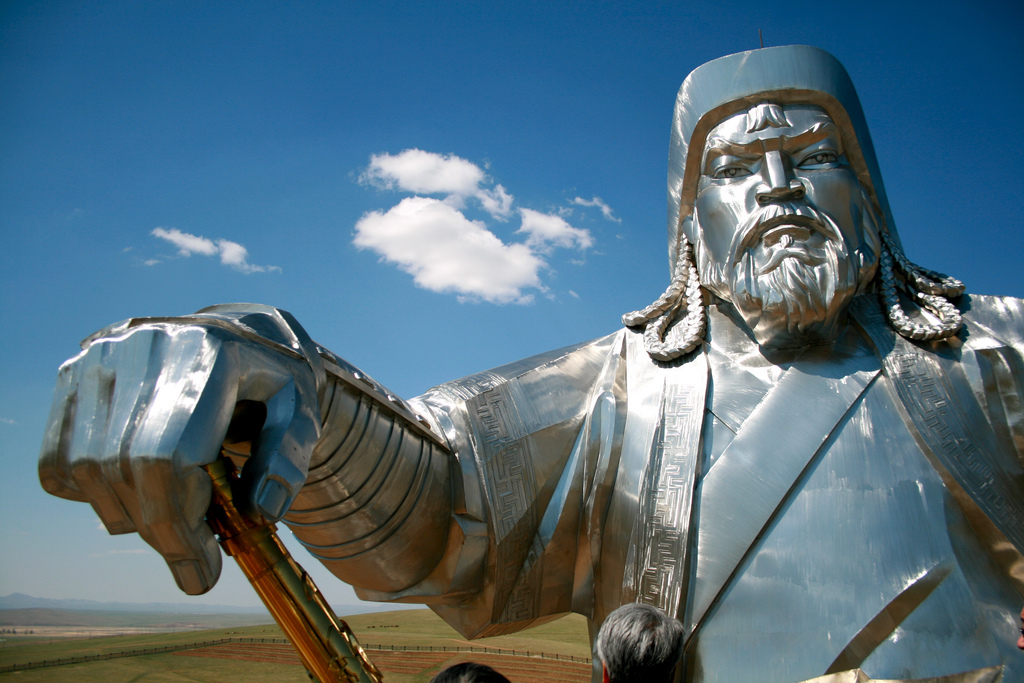
Genghis Khan, Photo by Francois Phillipe

The Genius of Genghis Khan

So, he comes out of nowhere, and he and his heirs create the largest land empire in history.

It was not inevitable; horse nomads didn’t always win, they usually lost. At one point Temujin (his name, Genghis Khan is a title) chose not to attack the Chinese capital because he just didn’t have the forces.

Temujin was exceptional in many ways, and his life, especially his early life, reads like an adventure novel: He was exiled from his original tribe when his father died, killed his own older brother (ostensibly for hoarding food when the family was hungry), was captured by his enemies and escaped, rescued his kidnapped wife and refused to disavow the child she bore that may not have been his, and rather more. It’s worth reading.

Genghis Khan turned the Mongols into probably the most dominant military in history. They basically didn’t lose battles or wars during his life, and they weren’t defeated straight up until the Mamluks in Egypt, long after his death. The Mamluks did it by copying the Mongols, but it wouldn’t have worked against Temujin’s Mongols (I’ll explain why below).

The Nazis developed blitzkrieg, in part, by examining Mongol campaigns and strategy. The Mongols, in an era with no communication faster than a messenger, were able to coordinate multiple armies advancing hundreds of miles apart, so that they would meet at an agreed place on the same day. Temujin and his generals coordinated armies in a way contemporaries couldn’t. They were also startlingly fast: Mongol armies performed marches in the Russian winter which moved faster than WWII panzer armies over the same terrain.

The Mongols treated war and mass hunts the same: They couldn’t give a damn about glory or honor; they were there to defeat the enemy with the least losses possible, so they would regularly feint, withdraw before attacks while punishing them with bow fire, and so on. They gutted Eastern Europe’s chivalry just this way, and those who think that Europe could have stood up against the Mongols if they hadn’t withdrawn due the Great Khan’s death are simply fooling themselves. They defeated far more unified and dangerous opponents over as bad or worse terrain multiple times; the only terrain that ever stopped the Mongols was the Ocean (although it took them some time to conquer southern China due to terrain.)

Genghis Khan was ruthless. Because the Mongols were few in number, he would either recruit enemies into his ranks, or slaughter them outright. In cities that resisted, all men of fighting age would be rounded up, taken to the next city assault and forced to attack the walls. This is pitiless, to be sure, but the Mongols could not afford to leave populations capable and willing to rise up behind their lines.

When attacking a city, the Mongols generally offered quite generous terms–if the city didn’t resist. If it did, they would often destroy the city entirely. Part of this is because, especially at the beginning, they had almost no siege capability. Sieges took years the Mongols couldn’t afford, so they made surrender very tempting and the cost of resistance terrible.

Resistance in Afghanistan basically ended the Hellenic culture there. (But then, the Afghans killed Temujin’s emissaries when he asked for peaceful trade. Whoops.)

Khan was particularly good at espionage. He protected merchants, made friends with them, and used them as spies. When the Mongols invaded they would know their enemy’s weaknesses, including any vassals who were willing to rebel, any conquered and resentful minorities, and so on, and they used that information, often inspiring uprisings at the same time as their attacks.

All of this is very nice, and important, but the greatest aids to Temujin’s success were two things most people don’t concentrate on amidst all the slaughter, glory and rapine.

Genghis Khan was absolutely brilliant at sizing people up, and he was brilliant at inspiring loyalty.

Khan regularly took people who had been his enemies and made them his most important generals and administrators. None of them betrayed him.

One of the main causes of the Mongols’ later defeats is that after Khan and those who he had directly picked to administer and lead died, the genius was gone. The last truly great general, for example, was Subotai, who (as best I recall) never lost a battle (Subotai lead the attack on Europe).

Khan had genius subordinates, as competent as him or moreso at warfare and far better than him at administrating non-nomads. And they were loyal.

Khan certainly favored his family, but he didn’t do so to the extent of freezing out the truly talented. Competence and success were rewarded, in anyone, including, in notable occasions, in women. Relatedly, Khan, quite unusually for the time, enforced religious equality in his empire.

Once a population was conquered, they were taxed lightly, and the rule of law was enforced. One may quip the Mongols made a desert and called it peace, as with Augustus, but the Pax Mongolica was very real, and allowed travel from Europe all the way to China. The line is that, on Mongol patrolled routes, a virgin with a pot of gold was completely safe–including from the Mongols. You certainly couldn’t say the same virtually anywhere in Europe at the time (probably anywhere, but perhaps there were some small areas which were exceptions).

I bring all this up because Khan, of course, also killed millions and wiped entire cities from the map. The Mongols broke the flower of Muslim civilization, ending their Golden Age. (Anecdote: Upon conquering,  I believe, Baghdad, the Mongols, who had a taboo on spilling royal blood, locked the Caliph in his treasury with his gold to starve, commenting that he should have spent it on armies and defenses. They were not without a rough sense of humor.)

The historians I have read on the period often note that Mongol atrocities weren’t worse than most of the people they fought. Instead, the Mongols were just far more successful (but that doesn’t change the sheer scale of them).

So, why do I bring all this up?

Because Genghis Khan is far removed from our time. We have very few real emotional feelings about him (unless you’re Mongol, and some Chinese are still angry).

Genghis Khan was a great man. I don’t think there’s any reasonable definition of great that doesn’t conflate great with good, a criteria which he does not meet. He was extraordinarily competent, one of the most competent figures we know of in history. He was honorable, keeping his deals. He loved his wife greatly, there is no question of it; the romance and love of Borte and Temujin is one of the great historical romances. He was religiously tolerant in an age of violent religious bigotry.

He also killed millions. Effectively destroyed civilizations. He was evil by any useful definition of evil. He was a great man, an evil man, an honorable man, a man who inspired great dedication and loyalty. He committed fratricide, something his own mother never forgave him for.

Bad man. Competent man. Honorable man. Great leader. Great general (though not the best Mongol general; note that Genghis Khan could secure the loyalty of men who were more competent than him).

I’m going to return to this theme at least one more time. In the meantime, Genghis Khan, great man, world’s greatest conqueror (you can quibble about Alexander, but I give it to Temujin), evil, genocidal bastard. Romantic.

All at the same time.

In the meantime, reading up on the Mongols and Khan is fascinating, can teach you a great deal due to distance, and can be disturbing as well.


If you enjoyed this article, and want me to write more, please DONATE or SUBSCRIBE.

Do Great Men and Women Change the World?

Most of us, when we were young, were taught history as a series of events, with the names of important men and women attached. In effect, we were taught the “Great Man” theory of history, that history is the result of the actions of great individuals.

Do the great matter? Do they make a difference?

Sometimes, I think.

In some cases, a person we call great fills a role someone else would have filled, and does it no better than anyone else would have. Sometimes they fill a role someone else would have filled and perform it so well it makes a huge difference.  And sometimes they wrench history about, in a role someone else would not have filled.

Let us start with a man who filled a role someone else would have, but did it brilliantly, and it mattered.

Napoleon.

The Revolution almost inevitably ended with a dictator. I don’t think, given the sort of revolution France had, that could have been avoided.

That it was Napoleon, one of the greatest generals in history, mattered. He didn’t have to be a great general to get the job, he had to be in the right place at the right time. A competent general could have gotten the job.

Napoleon almost never lost a battle. Other French generals lost often. That mattered. Napoleon, wherever he went, changed everything: from ending the Holy Roman Empire, to shattering various other bonds of feudalism, Napoleon changed Europe far, far beyond France. A man who lost even a few more battles than Napoleon did, wouldn’t have.

Let us take two modern great men who, I think, changed little. Start with Mark Zuckerberg, CEO of Facebook. Someone was going to win the “social friends” space. For a while it looked like it would be MySpace, and there were contenders before Facebook. Indeed, Facebook is not dominant in every country in this space.

All Zuckerberg did was win a space someone would have won. The details are different, sure, but not enough to really matter to anyone. Having won it he has done nothing particularly different anyone else would have done in that space.

Though still worshipped as a genius, I think Bill Gates is in the same category. MS DOS (in which I was an expert) was little different from any other OS that IBM could have chosen at the time. Windows (like the Macintosh) is just Xerox Park tech, which if Gates had not been around, would have been stolen/co-opted by someone else (aka. Jobs).

Gates was very good at creating a near-monopoly for a couple decades, but other businessmen in the same situation might well have done the same thing.   Perhaps they wouldn’t have, and he made a difference. If so, that difference was negative, it seems to me.

If something is inevitable, someone will do it. The specific individual Who does it only matters if they are extraordinary. If they are just very good at what they do, well, someone else very good could have stepped up and the difference would have been minor.

I suspect this applies to a lot of earlier “Lords of Industry.” Ford, for example.

In the “inevitable” but it mattered who it was category I’d slot, say, Genghis Khan. He wasn’t the only one trying to unify the Mongols, but his degree of success rested on his own particular genius, which, oddly, was mainly that he was an extraordinary judge of ability and character in other men and women. Temujin’s generals and administrators were extraordinary, and he made loyal followers out of people he had been enemies with. Similar to Shaka (but much more succesfully since he didn’t have to face 19th century weapons), he was also able to turn his society into an extraordinarily efficient war machine.

So who came out of nowhere and changed the world? Who forged a position which wouldn’t have existed otherwise, then did something extraordinary with it?

I find it hard to think of anyone. In the intellectual sphere, Socrates, Plato and Aristotle, for example, came out of a specific time and place where philosophers and teachers were very highly valued because they taught people how to argue.  (Read Plato’s dialogues and tell me, for all his sneering at “sophists” he is not an amazing debater.)

Perhaps one can make a case for Newton, but Leibniz created calculus almost at the same time. Were the rest of his discoveries made much sooner than they otherwise would have been?

Or perhaps the great religious figures? Buddha, Christ, Confucius. Does a Buddha have to happen? Certainly the circumstances are there for one in the newly urbanized cities of northern India with their loss of faith in the old Vedic religion. Indeed, modern Hinduism really comes out of that period as well, for all they claim the Vedas they have little in common with that religion.

Someone would have done what Buddha did, but I think a strong argument exists that how well he did it, and how he did it matters.

So, what do my readers think? Who would you nominate as coming out of nowhere and changing the world? Who is the great one who did not fill a slot someone would have filled?


If you enjoyed this article, and want me to write more, please DONATE or SUBSCRIBE.

Did the Industrial Revolution Require Land Clearances, Slavery, Genocide, and Empire?

The Leninist argument is that imperialism, industrialization, and capitalism were intertwined. It did not make sense to discuss capitalism or industrialization without discussing Empire, and all its crimes. It is also the common argument that land clearances, in which commons rights were taken away from peasants and serfs, often by law and force, were required to create the industrial workforce.

This is because the early industrial workforce was a terrible place to work and live–and the phenomenon is not temporary, by most measures. It was true for between a hundred and a hundred and fifty years. Maybe longer. You worked longer (six and a half days a week, 12 hours a day was common in certain periods), you lived in urban filth, ate less, were sick more, grew to lower height if born into this, and died younger.

So, clearance was bad for the people who were cleared. I trust I don’t have to explain why European Imperialism was bad for most everyone else. Granted, European Imperialism predates the Industrial Revolution (but not the commercial, wind, and water revolutions), but it goes into overdrive during the Industrial period, and the gains of previous periods are definitely used to support the Industrial Revolution.

There are two questions to answer with regards to the clearance issue. First, whether or not clearances were necessary for the agricultural revolution to occur. With no agricultural revolution, there’s not enough food for expanding city populations.


(I am fundraising to determine how much I’ll write this year. If you value my writing, and want more of it, please consider donating.)


The orthodox answer to this question is, “No.” But recently, a scholar, Robert C. Allan, went through the agricultural records and compared enclosed field to non-enclosed field production. Common fields were usually somewhat less productive than enclosed fields, but their gains increased almost as fast as enclosed fields did, and were even higher for certain crops (for instance, as with nitrogen fixers, like clover).

In other words, no, the agricultural revolution was not predicated on field enclosure–it just would have happened slightly slower in a non-field-enclosure scenario.

The second question concerns wages for workers, and is trickier. Allan argues that the Industrial Revolution happened in England for a simple reason: The coal was right there and could easily be shipped to factories. Shipping coal was hellishly expensive, and early steam engines were massively inefficient. Industrialization didn’t start in, say, Paris, because it lacked the resources. In Paris, it was cheaper to use more labor rather than to use coal.

Field enclosures made labor cheap in England. Without them, there are a lot less desperate workers, and a lot less desperate workers means higher wages and better treatment of workers (no one’s leaving the peasant village to go work 78 hour work weeks). Higher wages could make steam-driven factories unprofitable. No profit = no revolution.

This is an empirical question, and I don’t see the data to indicate the answer one way or the other. The theoretical point of view is this: Land clearances forced the cost of labor down. The higher wages are, the more you want to use capital (like equipment), not workers. In such a case, again, the Industrial Revolution happens, but it happens closer to Newcastle to keep the cost of coal down, and it is slow to gain traction due to profitability concerns. Once stabilized, however, the incentives for increasing machine efficiency of the machines faster could quite possibly have accelerated the Industrial Revolution faster than how it actually played out. Hard to say, but the argument is sound.

Now, for Empire.

With a very few exceptions, the main one being the USSR, every country which has industrialized, including Britain and the US, has done so with mercantalist policies, that is, behind trade barriers of some sort or another. They become free traders when their industry is well-established, not before.

Mercantalism does not require imperialism, but imperialism can augment mercantilism. When the British invaded India, India had more factories than England. Soon, they didn’t. India was a vast market for British manufacturing and provided raw materials.

The South in the US provided much of the cotton, through slave labor, as did Egypt and various other places which were conquered or absorbed through imperialism. (While the US South was, no, not under British control during this period, the Native Americans were cleared from it by European imperialism and disease and the slaves were brought over on European ships.)

Imperialism provides two things: Markets and cheap supplies for the factories. Even the Chinese opium/tea trade is related. Tea reduces appetites and enables people to work longer, and the British, even with the agricultural revolution, are somewhat underfed. Minus six half-day weeks, of course, they would not need so much food, but they do. (Ever done hard, manual labor all day? I have. I ate A LOT.)

There is clearly a benefit from Imperialism for industrialization under capitalism.

Could industrialization have happened without forcing open these barriers to British exports and without cheaper commodities like cotton, acquired through slave labor, plantations (which require shoving small farmers off the land), and so on?

What would have happened if we didn’t conquer, pillage, and enslave so many people? What would have happened if we didn’t deliberately retard their economic development? If we didn’t kill so many of them?

Perhaps they would have been more prosperous. Granted, many tribal societies have little use for money, but as the Hudson’s Bay experience shows, if you provide goods they really want, they’ll go out of their way to get what you want in return. And India, despite vast numbers of peasants, had vast mercantile cities and trade long before the British, Portuguese, and so on, arrived.

The commodities wouldn’t be so cheap, and Britain may not have gained so near a monopoly in early industrial manufacturing, but other societies would have also been richer–which means more purchasing power. Richer people can pay more.

The British still would have had that huge advantage: Coal near the manufacturing areas and near the coast. It’s an island. You can get what you manufacture to the sea easily, and you can use coal because the coal is near the sea too (everything is near the sea in England, from the Continental point of view).

This scenario suggests that England would have still industrialized first, and the Industrial Revolution still happens in Britain. Is it’s pace slower? Faster? I suspect slower at first, faster later. But it is more humane, and it leads to a better world.

If China and India had industrialized at a faster, more organic pace than they did; if they had been dragged along closer behind, standards of living would have risen faster. But standard of living is negatively correlated to the number of children.

A world in which all (or at least most) boats rise together, with England in the lead, but not excessively so, is one with a lot less of a population problem and a lot less of a poverty problem.

It may just be that being complete bastards to virtually everyone was not required for industrialization. It may be that we would have lived in a vastly better world.

It may not, of course, but I think the argument for “Being Assholes Wasn’t Actually Necessary” is pretty strong.

And I think it’s fairly important, because it’s at the heart of the whole “Is other people’s suffering required for some people to live the good life?” question.

(This is part 3 of a semi-series.  Read part one on “The Death of Capitalism” part 2 on “What Capitalism is and part 4 on  “How The Rational Irrationality of Capitalism Is Destroying the World”.)


If you enjoyed this article, and want me to write more, please DONATE or SUBSCRIBE.

Page 4 of 5

Powered by WordPress & Theme by Anders Norén