Makes sense, however, Prime Minister May’s Conservative party is up 17 percent over Corbyn’s Labour and she must expect to increase her seat count. In addition, there’s a good chance Corbyn is out, if he doesn’t get a lot more seats than expected. He doesn’t have to win, but he does need to beat expectations. Expectations are low, at least.
Corbyn being out is good for May because standard centrist-Labour leader X will not undo most of what a Conservative government does even if it wins, whereas Corbyn will undo everything and then kick it into reverse.
I, of course, will be hoping Corbyn does well, but it doesn’t look good. Even if he does better than expected, Scotland appears to be a write-off.
This is an awkward election overall, as May is positioning it as a referendum on Brexit, but Labour doesn’t oppose Brexit, the SNP is Scottish and the Lib-Dems (who do oppose Brexit) are violently distrusted by anyone with sense after they helped the Conservatives push through some of the worst retrogressive policies in generations.
Should be fun. This is one I actually care about a bit, so I’ll be hoping the polls are off and that Corbyn gets some wind.
(Given how absolutely cruel the Conservatives are, I will judge Britons who vote Conservative harshly–not that there’s any reason for any such Briton to care…nonetheless.)
The results of the work I do, like this article, are free, but food isn’t, so if you value my work, please DONATE or SUBSCRIBE.
I hope you’re shocked by that number. It means that newspapers were lying about Corbyn’s views almost 90 percent of the time.
Cases like this are common, though rarely this extreme. When people talk about how the Fourth Estate is essential to the functioning of democracy, I laugh. A media which lies 89 percent of the time is worse than no media at all.
72 percent of Americans didn’t wind up thinking Iraq was behind 9/11 in the run up to the Iraq war because the media called out the Bush administration’s misleading statements, but because they amplified them.
The media has its own agenda. If it agrees with a politician, it will amplify his voice; if not, it will attack savagely. You can see this with Trump, in highlight. The media savaged Trump for his Muslim ban, but they cheered on his missile attack on a Syrian airbase.
Someone like Corbyn is far more of a threat to the powers that be than Trump could ever be. Corbyn wants to re-nationalize vast chunks of the British economy. Trains are a good example, and before you get on your privatization high-horse, the facts are simple: Privatized trains cost more, have higher debts, still require government subsidies and have worse service. They are more expensive and worse on all significant metrics.
Much like privatized medicine, which, by the way, has been proceeding under the Tories per the usual plan: De-fund public healthcare and invite in “private partners” to help. Richard Branson, for example, who bought and fucked up British trains, is involved in health care in the UK.
Horrors! He is against using nuclear weapons and has said he would never do so.
This man is a serious goddamn threat to how things are done. My God! He wants to build huge amounts of council housing, so that ordinary people don’t have to pay usurious prices and service mortgages.
What would the UK economy be without peons servicing overpriced mortgages?
A UK economy with a lot less fat bankers, anyway.
So, if it is necessary to lie about Corbyn 89 percent of the time, well, that’s what the media will do. They are owned by a very few people, and they do what they’re told. Heck, at this point, most of them even believe in it.
As for Trump, I disagree with a great deal of his platform, but notice that he is being rewarded when he sticks to the Washington consensus (massively favorable media coverage for going after Assad) and gets negative coverage when he acts against it.
You may think that the Washington consensus is better than Trump on some things, and worse on others, and still notice what is happening and judge it to be a negative that the media and deep state (who are together on this) are working so hard to stop a President doing what he was elected to do.
The media campaign against Corbyn has worked. I judge this not by the poll numbers, though they are bad, but by the fact that “casual left-wingers” think he’s a dud. Whenever I interrogate them, their reasons are weak, even wrong. But for a normal consumer of news who isn’t digging, who assumes that the news is essentially correct, the impression is terrible. It’s one fuck up after another.
For example, a little while ago Corbyn released his taxes and the coverage was that he had cheated.
He hadn’t. Some outlets corrected those stories (which no one sees) and most didn’t, and the damage was done.
Lie. Lie. Lie.
And so a man whose policies would cost billionaires massively, who would fund health care, and give wheelchairs back to cripples, is unpopular in the face of someone as monumentally as incompetent and vile as May.
Break them up. Shatter them into a thousand pieces. Enforce ownership rules. Make many of them into cooperatives. And drive their owners into the ocean, wailing in terror. It is what they have earned.
And it will be nearly impossible to have a good society so long as they retain their power.
The results of the work I do, like this article, are free, but food isn’t, so if you value my work, please DONATE or SUBSCRIBE.
Article 50, which starts a two-year negotiating period, has been triggered. In principle, this is irrevocable, in practice, perhaps not so, but it’s hard to see May changing her mind.
The EU negotiators primary goal will be to make sure that Britain is worse off after leaving than before. It’s not that this has to be the case, but the EU doesn’t want other nations leaving, and, as when Greece tried to resist European austerity, an example will be made.
May suggested, in her letter, that security cooperation: criminal and defense, might be on the block if a deal can not be made on other concerns. EU negotiators sneered that they would not trade security for anything else. Obviously, however, it should be on the block, that’s what negotiations are about.
One should point out that the UK, despite all the doom and gloom, is still the world’s fifth largest economy, even if a lot of that is bullshit (inflated by money flows through the city that most Brits never touch and the government hardly taxes.) It is not Greece.
Nonetheless, May’s position is weaker than Brussels’s. As I have noted before, what May really needs is for LaPen to win in France. If both France and the UK are leaving the EU, Brussels will have to buckle; between them they are too large to bully.
I am not a fan of how the EU has developed, but leaving the EU with May in charge of negotiations, with her emphasis on immigration, leaving the European Court of Justice, and intending to take advantage of the withdrawal to gut labor and environmental laws is certainly not the way to do it.
Bottom line, ordinary Britons will get it in the neck on this, not because it has to be that way, but because both May and Brussels want it that way. I do hope that among the EU’s vindictiveness are specific measures intended to hurt the elites who wanted Brexit, and not just vindictiveness aimed at the weakest in society as has largely been the case in Greece.
There is some talk of Scotland and Ireland leaving, but we shall see. Both May and Corbyn have said they don’t support another referendum. As for Ireland, the primary issue will be free border movement, I suspect. It will be difficult to give Northern Ireland what it wants, and still “take control of immigration,” which is the one thing May will be giving to populist concerns.
A sorry show all around, and those Labour MPs screaming about Corbyn should be ashamed of themselves; it being their constant attacks, combined with the media’s straight up lies, which have weakened Labour at this turn.
The results of the work I do, like this article, are free, but food isn’t, so if you value my work, please DONATE or SUBSCRIBE.
I have a theory about why Jeremy Corbyn seems so unpopular in the UK, despite the fact that he represents a lot of policy positions that are in themselves popular. My theory is that, deep down, in their collective subconscious (if not their actual consciousness), the British public doesn’t think that Corbyn will send fighter jets to bomb people in foreign countries on under-substantiated suspicions.
Oh, to be sure, there are lots of other problems faced by Corbyn worth discussing, like an extremely disloyal caucus (although disloyalty is probably not the right word as it presumes that they had once been loyal, and they’d made it clear from the beginning how little they thought of him). But the antiwar thing is basically a deep psychological show-stopper in terms of the electability of leader in any medium-to-major military power. People may not precisely articulate this discomfort with a leader who doesn’t seem like he’d attack small countries on a small suspicion when world politics suggests that said lethal use of military force is a diplomatic, strategic thing to do.
Now there are actually other things you can do to satisfy this urge. For example, Theresa May already proved her willingness to harm innocents with a pathologically, maniacally, cruel immigration policy, for which she was responsible. That policy has made her credible, governmental. You know that May will send fighter jets to foreign countries when the media requires it.
Now, you may ask, why is being bombing-credible, or at least cruelty-capable so important for the election of a leader? The reason why is that the leader is supposed to Protect Our Children. (I’m using “our” figuratively here, since I’m not British.) You’d do anything for your child, right? If you’re an upstanding, caring parent, that is. So consider the very slim chance that someone in a foreign country may concoct a successful global takeover plot when you’re dead and your children are old people. Surely avoidance of such demands a low threshold for long-distance war. After all, it’s either your children or theirs, right?
But Corbyn is perceived as a repudiation of Blair. And there’s nothing that defined Tony Blair more as a politician, nothing that placed him more in history than his willingness to go to war on thin evidence. Corbyn and his core support base are visibly angry at that. And that is, at a ground, atavistic level, killing Corbyn’s candidacy. (As I said, among other things.) Blair may be unpopular now, but most people are willing to issue negative judgements after the fact, having voted for the man before the fact. Blair already Protected Our Children, was believed to be credible on this front, and won elections.
You may protest: There are lots of other things that threaten people’s children, like lack of health care, unemployment, impending global enviropocalypse, and other very real but rather imperceptible problems like those. My experience of watching how the European refugee crisis unfolded, particularly in anglophone media and public opinion watching from outside, is that people perceive threats very differently, and react more viscerally to a low-probability threat from other individual humans than they do from higher-probability things like their own potential poverty or workplace safety and suchlike. An incident of lawlessness in Cologne, perpetrated by a tiny fraction of the refugees and not only them, overshadowed in Western media all of the other things that humans, including refugees, face. Because we have to Protect Our Children.
To be sure, lest someone object, a lot of this attitude descends and is transmitted by certain sorts of elite opinion-makers like newspaper columnists and so on. Yes, that is so. But they are working with a public that is highly primed for this visceral syllogism.
Does my theory about Corbyn’s unpopularity demand that this situation remain so forever? No: I don’t counsel despair. My theory is about explaining what has happened so far. People always have the possibility to choose otherwise. Maybe even in time for the next British elections. You never know.
…The chances are we’ve gone too far,
You took my time and you took my money,
Now I fear you’ve left me standing,
In a world that’s so demanding…
— New Order, “True Faith”
In this post, I discuss the options for the UK in its relationship to the EU after the Brexit vote, particularly in light of the fact that Theresa May’s government has decided that freedom of labour movement is to be sacrificed on the altar of the hostility towards immigration–which is held to have driven much of the support for Leave. It is also increasingly clear that the EU will take a harsh view of British attempts to separate trade access to the EU from the access of EU citizens to British work opportunities. I argue that, overall, this position is justified and mostly reflects an EU leadership representing the interests of their citizens in the face of a United Kingdom that, for whatever reason, believes that it can take what it believes to be the beneficial parts of its relationship with continential Europe and leave behind what it mostly (and wrongly) considers to be the costly parts. I make this argument despite a dislike of and disagreement with some of the governing attitudes in continental Europe: The historic demands of conservative, Eurosceptic UK politicians would have exacerbated what is bad about the EU and attenuated what is good about it.
The Taxonomy of Brexits
In practice, the European Union is actually a constellation (or maybe nebula) of treaty-defined entities. An EU member is a country that participates in a certain subset of them, but not necessarily all of them (there is of course a more formal definition, but I am talking about the institutional mechanics)–the UK is one of the exemplars of this choice. Conversely, there are countries that participate in some of the EU institutions, but are not members–the best exemplar of this is Norway, which participates in the single market, the unified visa area under Schengen, in the scientific bodies, and pays a significant charge in lieu of membership dues.
We are now months after the Brexit referendum returned a clear Leave result (52-48 is not a small margin, and immediate do-overs after buyer’s remorse is a democratically terrible idea), and the United Kingdom faces a choice in how to implement the referendum. The taxonomy of choices resolves to two major taxa of future possibilities: “hard” or “soft” Brexit. Under a “hard” Brexit, the UK effectively reverts unilaterally to a mostly exterior relationship with the countries of the European Union without (much) special status or access to EU-related institutions. The UK becomes like a nearby Canada, in other words. There’s no question that the border will remain open for Brits to visit the EU, but they will likely do so under the same visa waiver terms under which Canadians and Australians live, which generally excludes labour competition with EU citizens and permanent residents, outside of designated priority professions. Goods and services will have to be negotiated by treaty separately, but they will have to be agreed-upon by the entire EU, meaning that everything, absolutely everything, would be on the table, and more favorable terms than the current access to the single market would not be on offer.
Under “soft” Brexit, the UK becomes, in practice, mostly like Norway. That is, it would retain access to the single market, have to pay dues, and remain a participant in many of the institutions–but will emerge from the direct, if often only superficial, supervision of the European Commission. Much less, in terms of the UK’s real capabilities, would change, but some aspects of internal policy and regulation become officially independent of EU authority, and much influence in EU institutions would, of course, be lost.
The division between these two types of Brexits turns out to revolve around one issue: The separability of the Four Freedoms of the European Single Market. These are: freedom of movement of (1) goods; (2) labour; (3) capital, and; (4) services. These freedoms, presently well-entrenched in the EU treaty framework, are supposed to guide convergence towards a fully-implemented, single market (meaning: It’s not fully implemented). If, as a Leave supporter, your problem with the EU lies elsewhere, for instance, in its economic regulatory framework, then you would still be willing to accept the Four Freedoms, and soft Brexit is an option that other EU partners would accept in overall good faith, especially since the departure of Britain from the rest of the EU’s convergence framework would enable other agenda items, that the UK has deliberately hindered, to go forward with minimal overall disruption.
Economic Freedom as Compromise
If, however, your problem with the EU is with the implementation of the Four Freedoms, then, Houston, you have a real problem as a Brexiteer. Because every country in the EU has some significant sectors vulnerable or sensitive to one or more of the Four Freedoms. The Four Freedoms establishes a relatively simple guiding framework for compromise among these issues. I hope that it is not too difficult to see that allowing countries to withdraw in spirit and practice from one or more of these freedoms, while retaining full privileges on the rest, is a recipe for disaster for the entire Single Market project, because some countries would become “free riders” to the detriment of the other countries, which would in turn cause the disadvantaged countries to withdraw from other freedoms, in a downward spiral that would dismantle European economic unity.
The Four Freedoms and the regulatory framework that accompanies them makes the Single Market a far superior trading arrangement to treaties like NAFTA, and, yes, TTIP. The common regulatory framework, needless to say, impedes (however, does not prevent) the degree of race-to-the-bottom behaviour that you see in NAFTA-like deals, by creating a regulatory and arbitration system that is, yes, considerably more accountable to the public than the infamous investor-state dispute settlement (ISDS) that is a common practice in bilateral treaties. European, particularly British critics, decry the European Commission and its institutions as being very distant from popular sovereignty, and the criticism is true, to some extent; but that the road to accountability is long does not mean that there is no road at all, in contrast to international arbitration tribunals, which are sensitive to very little.
But more importantly, the free movement of labour is essential if you decide you want to have free trade at all. It is increasingly clear that trade deals like NAFTA, alleged to lift poor countries out of poverty by exporting low-skilled economic activity to these countries, actually have deleterious effects on developing countries. Mexico has experienced a great labour dislocation from exposure to competition from sectors that were domestically important but more productive and heavily subsidized in the US. Free movement of labour at least slightly ameliorates this by permitting workers in sectors negatively affected by this dislocation to find work in countries that directly benefited from it (overall). Because NAFTA does not lift border controls on the free movement of labour, Mexican workers who go where the work has gone (to the US) cannot send back remittances that reflect the higher US value of their labour, because they live under a wage-suppressive environment of immigration control. Needless to say, US workers do not benefit from the immigration controls as much as they are told.
What UK Eurosceptics are demanding, when they demand immigration controls for EU labour while retaining access to freedom of goods, capital, and services, is that UK business be able to profit from access to new markets in Bulgaria and Romania, countries that cannot yet compete in productivity with the UK, and yet fail to offer Bulgarian and Romanian workers the ability to improve their lot and their skills in higher-wage, higher-productivity environments with UK domestic labour protection, such as exist. It should not be hard to see why this is toxic.
European Unity and Freedom of Movement
The choice that Theresa May seems to be making is for a hard Brexit, particularly as signaled by some public pronouncements suggesting that existing EU-citizen workers in the UK would not be fully protected and grandfathered into the post-Brexit arrangement–that is, they are being designated as bargaining chips. The only condition under which it makes sense to use their status as a bargaining chip is to make an attempt for the UK to have privileged access to the EU without accepting any reciprocal obligations. (Whether it is actually possible to use them as bargaining chips this way is another matter.)
For the choice to be something in the middle between a hard and a soft Brexit, the EU would have to allow cherry-picking among the four freedoms, and therefore its own demise as a political project. I have described some of the reasons for this above. The EU is not going to passively accept its own demise at the hands of right-wing British Eurosceptics, some of whom have made no secret of their desire not only for Britain to leave the EU, but for the EU project itself to fail.
The mistake of British Eurosceptics, at least those who care about maintaining a privileged economic relationship with the European Union, is to fail to understand many continental politicians and bureaucrats, and significant portions of the continental public really “mean it” when it comes to European convergence. While the spectre of WW2 hangs in the air, somewhat faded due to the inevitable passing of those who survived it, continental Europe has still had regular reminders that it, the originator of colonialism, is in the modern world now itself susceptible to divide-and-conquer politics steered by greater, exterior powers. Critics of the EU say that the democratic legitimacy of its institutions is undermined by the non-existence of a European “demos,” but policy-makers are well aware of that. That is the whole point of the convergence process. The EU, in fact, has programmes to encourage social relationships between citizens of member states, precisely out of a desire to ensure that a European demos emerges in a future generation, and, yes, the United States of Europe can thereby be finally constructed.
Freedom of labour movement is a element of the unification of peoples explicitly envisaged by the construction of the European Union. In addition to its role in helping the Single Market to be mutually beneficial, the workplace is a key element of social integration and the building of trust between peoples at an individual level. Among younger British people, the policy has already shown signs of working–one of the complaints of younger Brits about Brexit is precisely that they were the generation that had both the most developed European identity and the highest intention of taking advantage of freedom of labour movement, of educational movement, and other related European freedoms.
National and Personal Factors
I would be remiss if I stayed only at the “high” institutional levels when discussing the dilemma into which the EU must now force the UK. There is certainly a personal dimension that cannot be ignored. British Eurosceptic politicians and media, both UKIP and Tory, have attacked what most continental Europhiles, both official and otherwise, see as the emotional core of the EU project, and did so consistently and constantly, so much so that EU immigration is seen as a prime driver of the Leave vote. Indeed, so much so that Theresa May feels compelled to choose it over Single Market access. Anyone who believes that such a consistent attack on a core belief and life work of many European politicians and bureaucrats would have no effect on how the negotiation proceeds is fooling themselves. Greece’s and Syriza’s offense during the 2015 negotiations was to attempt to step off script and make it politically impossible for German politicians to sell the band-aid to their own public; this is nowhere near as offensive as a direct political attack on free labour movement. If the UK gets off this with less visible damage than Greece, it is only because the UK is, for various reasons, economically much stronger than Greece–and not a member of the Eurozone.
Furthermore, it evidently became a bad habit in UK politics to blame domestic policy failures on the EU. The UK was never a member of the Eurozone, and there is nothing about the EU that prevents the UK from running a more social-democratic economy than it has. It was always within the power of the UK to handle its own housing crisis, its economic inequality issues, its infrastructure issues, and so on. What flaws the EU has (and it definitely has flaws!) cannot be blamed for very many of the problems now viewed as causing the political alienation that has led to the Brexit vote. Now, yes, it is a common sport across the EU for national politicians to blame Brussels officials for preventing them from doing things, and this is often true: The Commission has known democratic legitimacy issues, even if it is better legitimized than ISDS arbitration tribunals. Eurocrats are used to serving as the “distant scapegoat” function. The problem is that UK politicians did not, apparently, know when to pull back, or they knew it and chose to go over the cliff anyway, because an internal Tory party battle was more important than keeping the European project together. EU negotiators are human; they are not going to simply accept that they were the cruel masters from whom the British people needed freeing.
Therein lies a major, unavoidable issue. There are parties, particularly in countries like France and the Netherlands, that would likewise wish to scapegoat Brussels for whatever goes wrong and sell an EU breakup as a panacea. Former (?) colonialist countries like France have populations that share the imperial nostalgia issues that right-wing British Eurosceptics do. It would be actually irresponsible if EU negotiators simply attempted to go for the narrow-sense, economically most mutually beneficial deal with the UK possible. It must be seen that the EU was not the author of British woes, but at worst neutral. This is quite a different situation from Greece and the Eurozone, where, in material terms, the structure of the Eurozone acted as a real straitjacket on Greek well-being and Greek fiscal democracy.
Brexit, Boiled Hard
If there’s anything underhanded about the EU position on these matters, the blame goes principally to the people who set up the EU treaties well before this point. The article 50 exit procedure is deliberately designed to disadvantage the exiter by turning the tables: Exit is turned into exclusion, and exclusion happens automatically after the (too-short) deadline. No negotiation is possible until the country in question puts on the article 50 dunce cap and sits in the corner of shame. The architects of European convergence have always been especially careful to ensure that convergence is a one-way procedure wherein departure is so costly as to be better to be avoided at all. This was done, to put it in Ianwelshian terms, because they thought it was the right thing. Otherwise, European convergence would not be externally credible, and its lack of external credibility would be a further invitation for foreign powers to play wedge games.
One may argue that a hard Brexit also damages Europe as it disrupts the flows that currently exist, and this is always costly. European leaders have made it crystal clear that the project is more important to them than the short-term cash flows. Just as the British say that they can find substitute buyers and sellers, so can the rest-of-EU–with, in some ways, greater efficiency, because manufacturing still significantly exists on the continent. And everyone, even German industry, knows that the destabilization caused by separation of the four freedoms of the Single Market would, in the medium term, be more costly than putting up tariffs against the UK, to be negotiated down in a later and less UK-favorable process than full UK membership.
In this instance, I do explicitly take a strongly EU-sympathetic position on this. The aftermath of the Leave campaign has shown that anti-immigrant hysteria, nationalist nativism, and colonial/imperial nostalgia had a major impact on the shape of this, not a major desire for either libertarian economics or left-wing fiscal expansion. These are real dangers and ought not to be rewarded by political victories. Even under a hard Brexit, it still remains fully within the power of UK politicians to ensure that ordinary people are at least exposed to only minimal immediate suffering, and if they are not willing to use their means to protect their people, we know, once-and-for-all, that the woes and alienation of the people of the UK were never because of Europe.
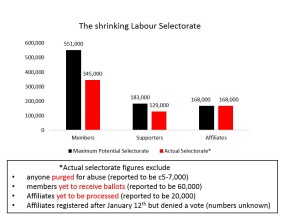
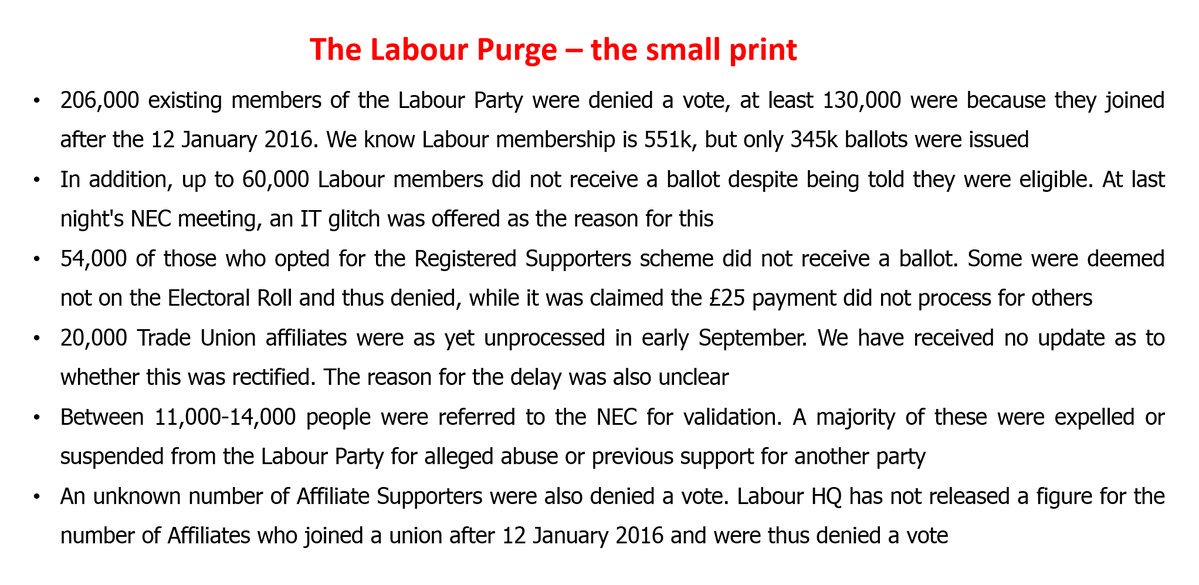
This is a fairly remarkable set of numbers. Even if we take them to be on the high side, a concerted effort appears to have been made to deny people votes, and almost always, from the anecdotes of those purged, they were Corbyn supporters. What is amazing is that even with so many people denied a vote, Corbyn crushed Smith.
The National Executive Committee (NEC) is the body which has the power to execute the purges.
I will suggest, strongly, that with a new roster on the NEC, Corbyn’s allies should re-instate virtually all the purged members, and that they should then purge those who were behind the purges.
There have been calls from neo-liberal Labourite leaders, like Kinnock, for ex-members of Labour’s Shadow Cabinet who participated in the abortive coup to ask to be reinstated and for Corbyn to let them back. Beyond a small number, I do hope Corbyn does not. These are not honest actors who can be trusted to stay loyal to Corbyn, and having lost two elections in a row, even despite the massive purge, they have little mandate.
We will now see if there is a split–many Tories and Labour MPs feel there should be a neo-liberal party dedicated to remaining in the EU.
This is a good day and a good result. Let us see what an actual left-wing Labour party is able to do going forward. For the first time in years, one of the two major parties in a Westminister democracy is actually left-wing, not “center-left” Blairist and neo-liberal.
If you enjoyed this article, and want me to write more, please DONATE or SUBSCRIBE.
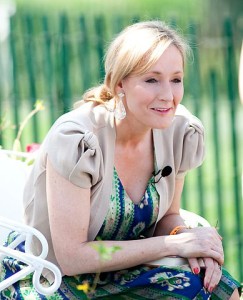
So, the author of the Harry Potter books has come out hard against Jeremy Corbyn, and for Blairism. She has defended the Blairite legacy, and she has some good points: There were more nurses and teaching assistants, for example.
One could note that Blairism, as with all neo-liberalism before the crash of 07/8, was unsustainable. It was based on bubbles. Though it is true that Blairites did distribute more money than Conservatives have past the bubble: Insane austerity was not yet the guiding principle of the day.
Unsustainable means “helped cause the crash.” It’s true that Blairites would be less cruel than Conservatives, and it is also true that almost every MP who opposed Corbyn also abstained from voting against Welfare cuts, for example.
I don’t want to get too down on Rowling. As very rich people go, she’s a pretty good one. She doesn’t dodge taxes, she supports social welfare spending, and so on. “High” UK taxes are why she’s no longer quite a billionaire. (Quite; you needn’t worry she’ll be on the rolls again.)
But I think to understand Rowling’s love of Blairism one should understanding three things. First, she got welfare and doesn’t seem, again, to have noticed that the Blairites she loves are now anti-welfare.
Here are the other two things which might be important to understand Rowling’s love of neoLiberalism:
1)
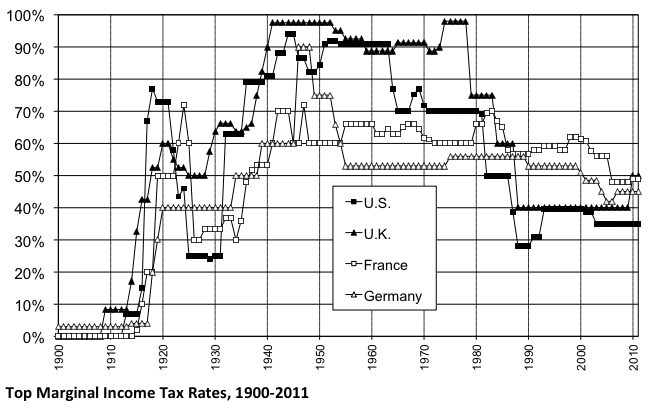
Top Tax Rates
Whatever else is true of Corbyn, if he becomes Prime Minister, he will raise taxes on the rich.
2)
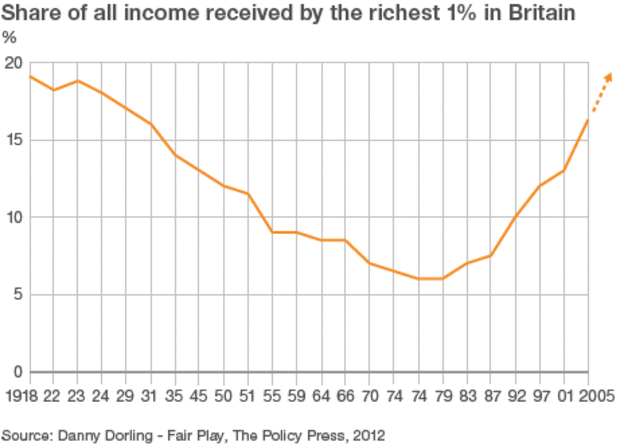
UK one percent share of income to 2005
Blairism is kinder-gentler Thatcherism. It is neoliberalism, and rich people have done very well under neoliberalism. Though this chart doesn’t show it, the top .1 percent do even better, the top .01 percent even better, and so on.
I don’t doubt Rowling’s good will, or her concern for those who have less money than she does. She’s put up by paying taxes she could have dodged. But that doesn’t alter the fact that neoliberalism has been very good to her, and she’d have been a ton less rich if the policies Corbyn favors, as epitomized by tax rates after WWII, plus far less generous copyright protection, had been in force.
Blairite neoliberalism, like Clintonianism, is the policy regime that lets rich and upper class people feel good about themselves. They get most of the benefits of neoliberalism without having to watch a boot stomping a face over and over again, as under Cameron.
That doesn’t alter the fact that neoliberalism is a cruel, unsustainable policy regime based on exporting British manufacturing, favoring “the City” and the financial industry over all others, and on pushing income and ownership of assets towards a small number of people. Nor did that change under Blairite Labour.
Rowling, of course, also thinks that Corbyn can’t win. Maybe he can, maybe he can’t. It’s certainly true that Labour infighting has seen the polls move heavily against Labour. It’s not clear, however, that this is Corbyn’s fault, or that it will be true come election time, or that a Blairite leader could win election either. Labour has been losing, and its collapse in Scotland did not happen while Corbyn was leader, nor probably would have, as it was driven in part by anger at austerity policies which Labour refused to oppose.
All this, however, is neither there nor that. The bottom line is that being a Blairite, Clintonian, or other third-way type, allows the rich and well-off to have their wealth and their tax cuts, and feel good about themselves. Rowling may be 100 percent motivated by the milk of human kindness, but she is still supporting a regime that has done very, very well for her against the possibility of a change which would damage her financial position significantly.
If you enjoyed this article, and want me to write more, please DONATE or SUBSCRIBE.

 Article 50, which starts a two-year negotiating period, has been triggered. In principle, this is irrevocable, in practice, perhaps not so, but it’s hard to see May changing her mind.