
The horizon is not so far as we can see, but as far as we can imagine

Author: Ian Welsh Page 144 of 437

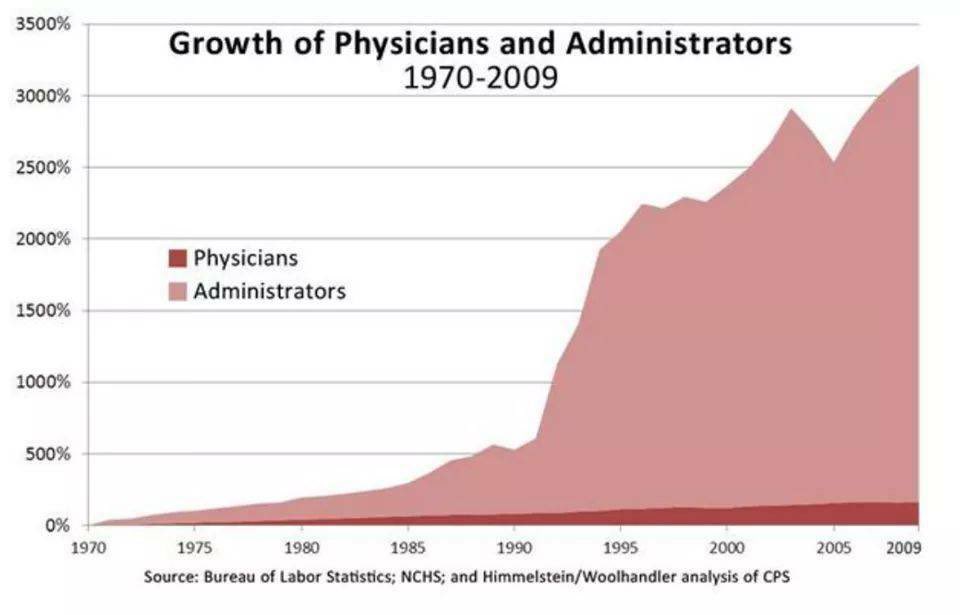
The Simplest Explanation for Western Decline

Is just…this:

Similar numbers can be found in most fields.

This is related to the computer productivity paradox: Computers and the telecom revolution have not noticeably increased productivity.

The reason is simple enough — they weren’t used to create productivity, they were used to create control, to allow managers to micromanage employees without actually being in the presence of the employee all the time.

No society can stay healthy with this sort of admin bloat; admin are support, meant to help the people who actually do the job. If your tooth-to-tail ratio is higher than 2:1 or 3:1, something’s probably wrong.

In my personal life, at my last megacorp job I saw multiple waves of computer “improvements.” Every single one of them increased control and reduced the workload employees could handle. I know this for a fact because I measured it, in part because it was my job, in part because management refused to admit that their shiny new programs were actually slowing productivity, and, until I forced them to admit it, they wouldn’t  hire more people.

Furthermore, each wave of “upgrade” de-skilled the job further, making the employees do what the computer said, and removing their discretion. All of this was intended to raise the bottom, but what it mostly did was lower the top; the most productive, most highly-skilled employees suffered the greatest productivity losses, were the most unhappy, and tended to leave, because the job had become semi-automated, and no longer involved actually doing the job.

As a general rule, no one should run something like a hospital who is not still involved in hands-on client care — probably a nurse or doctor. No one should run a university who is not either still teaching or an active student. This principle can be applied more generally, in that no one can properly manage anything they still don’t do. This is often recognized in the business literature, but, understandably, CEOs and executives almost never want to actually perform the real work of the business, nor will they excuse themselves from interfering with those who do and, thus, actually understand what is needed.

At most, upper management can set general goals. They should never be in charge of deciding how to achieve them. This is the opposite of how we run things, but it wasn’t always entirely so: Auto and plane companies used to be run by engineers, insurance companies by underwriters and actuaries, hospitals by nurses and doctors, and universities by Senates of Professors.

One issue is that front line workers often really want to do front line work: Professors don’t want to administer, they want to teach or do research, doctors want to treat patients, etc.

But if you give administrators power over you, you never get it back. University Senates hired administrators, and a few decades later discovered the administrators were running the show, were able to order profs around, and were the highest paid people in the university (outside of the football coach), while doing no actual teaching or research, and understanding little to nothing.

It is also important to understand that while it’s certainly better if you have done the front-line job at some point, that you lose that knowledge quickly. Ten years out, and you’re clueless — you’re just another administrator. Managers and executives have to keep their hands in, or they wind up clueless.

Bottom line: We can’t afford to let anything important be run by people who aren’t actually practitioners. They don’t know what they’re doing, and they spend most of their time building bureaucratic empires that do nothing but act as modern courtiers. In the best case, they do no harm other than sucking up resources, but in most cases they try to justify their existence by trying to tell the front lines how to do their jobs and make things worse.

If we want to fix our society we have to get rid of this admin bloat, along with the cluelessness it represents.

But what usually happens, instead, is some form of societal collapse, which strips out administrators in a more brutal and effective fashion.

That’s what where we’re headed.


(My writing helps pay my rent and buys me food. So please consider subscribing or donating if you like my writing.)
The Biden Presidency So Far

So, Biden’s approval ratings have dropped a lot.

This is because he left Afghanistan and the military, intelligence, and foreign affairs (the blob) establishments don’t want to. The withdrawal has actually gone well, with hardly any casualties, and while there are some exceptions, overall the Taliban is letting people leave who want to leave, which is in their interest, anyway, something clueless fools seem unable to fathom.

So Biden’s been hit non-stop with bogus media about this withdrawal, which is one of the only good things he did. The US war in Afghanistan was a matter of murder-robots and murder squads making night-time hits. Civilian casualties were sky high, the “army” they created was full of pedophilia (look it up, and be ready to feel sick), and the government was corrupt as hell.

Ironically, Biden has been mostly a bad President in other ways, for which he has not been attacked en masse by the media. Covid has been handled badly. His promise to support breaking Covid mRNA patents is a dead letter because he hasn’t made it a priority when dealing with holdouts like Germany. (He could easily have traded that with Germany in exchange for dropping US opposition to the Russian pipeline to Europe Nordstream, but gave them that for nothing.)

The CDC’s advice and rule-making has continued to be haphazard at best, and Biden has been a cheerleader for sending children back to school, which is going to be an absolute disaster. It’s safe to say that Biden’s handling of Covid has been as lackluster as Trump’s, but it’s actually going to kill more people overall due to Delta and him being around for longer.

Conveniently, as with Trump, no real effort is being made to accurately count Covid deaths, and the real death toll will be determined post-facto through population studies.

Economically, he has gotten little through the Senate and been unwilling to use his executive power for much. As would be expected from the man who made sure students couldn’t discharge loans in bankruptcy, he has relieved hardly any student debt. He’s constantly authorizing new oil and gas drilling, so it’s hard to take him seriously on climate change, despite some lovely rhetoric.

The economy was bouncing back from Covid (thus my prediction of a boom a few months ago, which was right for a brief period — but not as long as I expected), but last months’ numbers were anemic. The end of moratorium restrictions, the draw-down of support payments and the surge of Covid which is going to get worse, not better, means the US economy is about to take a new hit. People who have no choice will work where they must, but people who do have a choice, won’t, and those are the people with money to spend.

Overall, Biden’s done one good big thing, for which he has been slammed, and otherwise been a status-quo-don’t-do-much-fiddling sort of guy. There’s still hope some good things will happen, as with the move to break up Facebook (though the judge is clearly hostile), but overall, Biden’s about what he seemed likely to be.

A pity. As with Obama, he came into office in the middle of a crisis, and could have used that crisis to be a good President — even without control of the Senate. He’d rather not be, though, and that’s understandable. Biden’s one of the most important architects of the neoliberal world we live in, and while he’s a better man than Obama (no great feat), to expect him to dismantle key spars of it was always too much.

The real election was the primary, and Obama, Clyburn, and Warren made sure Biden won that, and the one politician who would have sincerely tried to change things, Sanders, did not become President.

The consequences for that will reverberate through the next 40 years or so. Along with the all-out push to defeat Corbyn, no matter what it took, Sanders was the last chance to mitigate climate change and inequality.

As for Biden, he seems likely to go down as a caretaker president at best.


(My writing helps pay my rent and buys me food. So please consider subscribing or donating if you like my writing.)

It’s Not Your Money

You also didn’t earn most of it.

It seems like every time I discuss taxation, some libertarian will waltz in and say: “It’s my money, and I don’t see why the government should be able to take it.”

So let’s run through why, no, it isn’t your money. We’ll start with two numbers. In 2005, the income per capita for the US was $43,740. The income per capita for Bangladesh was $470.

Now, I want you to ask yourself the following question: Are Bangladeshis genetically inferior to Americans? Since not too many of my readers think white sheets look great at a lynching, I’ll assume everyone answered no.

Right then, being American is worth $43,270 more than being Bangladeshi, and it’s not due to Americans being superior human beings. If it isn’t because Americans are superior, then what is it?

The answer is that if it isn’t individual, it must be social. On the individual — but still social — level, Americans are, in fact, smarter than Bangladeshis because, as children, they are far less likely to suffer from malnutrition. However not suffering from malnutrition when you’re a baby, toddler, or young child has nothing to do with you, and everything to do with the society you live in and your family — two things over which you have zero influence (perhaps you chose your mother, I didn’t!).

Bangladeshis won’t, on average, get as good an education. They won’t get as much education either, since every child is needed to help earn a living as soon as possible. For most Bangladeshis, there’s no room for the extended childhood and adolescence to which westerners have grown accustomed, which often stretches into the late twenties or even early thirties, amongst those seeking PhDs or becoming doctors or lawyers.

When a Bangladeshi grows up, the jobs available aren’t as good. If he or she starts a business, it will earn much less money than the equivalent American business. If he or she speculates in land and is very successful, the speculation will generate much less wealth than it would in the US.

I could go on and on. I trust the point is obvious: The vast majority of money that an American earns is due to being born an American. Certainly the qualities that make the US a good place to live and a good place to make money are things that were created by Americans, but mostly they were created by Americans long dead or they are created by all Americans working together and are not located in the individual.

The same is true of the really rich. Forbes keeps track of the world’s billionaires and almost half of them are in the US. This is because US society, and the US government in particular, is set up to create billionaires. Your odds of being a billionaire take a massive jump if you’re born in the US. Your odds of being a billionaire if you’re born in Bangladesh? Essentially zero. Now, one could point out that billionaires are still so rare that the odds are always essentially zero; how many billionaires are in your circle of friends? Nonetheless, in 2005, the US had 371. Coming in second, Germany had 55.

Bangladesh, you won’t be surprised to hear, had zero.

If you’re a billionaire in the US, you’re a billionaire in large part because you live in the US.

So, if you’re American, a large chunk of the reason you make a lot of money (relative to the rest of the world) is that you are American. The main cause of your relative wealth is not that you work hard or that you’re innately smarter than members of other nations (though you may be because you weren’t starved as a child). It’s because you were afforded opportunities that most people never had and those opportunities existed due to the pure accident of your birth or because you or your family chose to come to the US. The same is true of most first world nations.

Immigrants understand this very well. There’s a reason why Mexicans, for example, are willing to risk death to cross the border. Their average income is $7,310, compared to the US average income of $43,740. They won’t make up all the difference just by crossing the border, but they’ll make up enough that it’s more than worth it. They haven’t personally changed, they don’t suddenly work harder now that they’re across the border. They don’t suddenly become smarter or stronger. They just change where they live and suddenly the opportunities open to them are so much better, their income goes up.

So let’s bring this back to our typical libertarian with his whine that he earned his money and the government shouldn’t be allowed to take it away. He didn’t earn most of it. Most of it is because, in global terms, he was born on third and thinks he hit a triple. This doesn’t mean he hasn’t had to work for it, but it does mean that most of the value of his work has nothing to do with him (and Ayn Rand aside, it’s almost always a him).

Now, in a democratic society, a government is the vehicle through which the population, as a whole, chooses to organize collective action. Government, imperfect as it is, is the closest approximation to the “will of society” that we’ve got.

Because the majority of the money any American earns is a function of being American, and not the result of their own individual virtues, the government has the moral right to tax. And because those who are rich get more from being American than those who are poor, it also has the moral right to take more money from them.

More importantly than the moral right, government has the pragmatic duty to do so. The roads and bridges that government builds and maintains, the schools that it funds, the police and courts that keep the peace, the investment in R&D that produced the internet, the sewage systems that make real estate speculation possible, and on and on, are a huge chunk of what makes being American worth so much more than being a Bangladeshi. Failure to reinvest in both human and inanimate infrastructure is like killing the golden goose, and the US, for decades now, has not been properly maintaining its infrastructure, let alone building it up.

And money itself is something that government provides for its people. It’s not your money, it’s the US’s money and it’s a damn good thing too. If you don’t believe me, try issuing your own money and see how many people accept it. Some will, because when an individual issues money, it’s an IOU (which is essentially what money is). I’ve written a few in my life. In every case, the person I gave it to was less happy to receive it than he would have been to get some nice crisp dollars. And I rested my IOUs on dollars, that is, I promised to repay in my country’s currency. Barring the use of accepted currencies, you’d have to issue an IOU saying: “I will repay you with a bundle of rice.” Or gold or a service. This raises the question of enforcement (one thing even libertarians admit the government should do): What if I suddenly refuse to meet the conditions of the IOU? Even an IOU is based on the sanction of the government. If it isn’t, it’s worth only as much as the good will of the person issuing it or the strong arm of the person holding it.

So, no, it isn’t your money, and it’s a good thing it isn’t. And while you may have worked your butt off for it, you also didn’t earn most of it. The value you impute to yourself (“I’m worth my $80K salary”) is mostly a function of where you live, where you were born, and of who your parents are.

Originally published Feb 9, 2008.  Republished 2010, April 15, 2015 and Sept 7, 2021.

Let’s kick this to the top another time for a new generation of readers. This one of foundational and IMPORTANT.


If you enjoyed this article, and want me to write more, please DONATE or SUBSCRIBE.

As Employers Cut Their Own Throats: How They Could Save Themselves

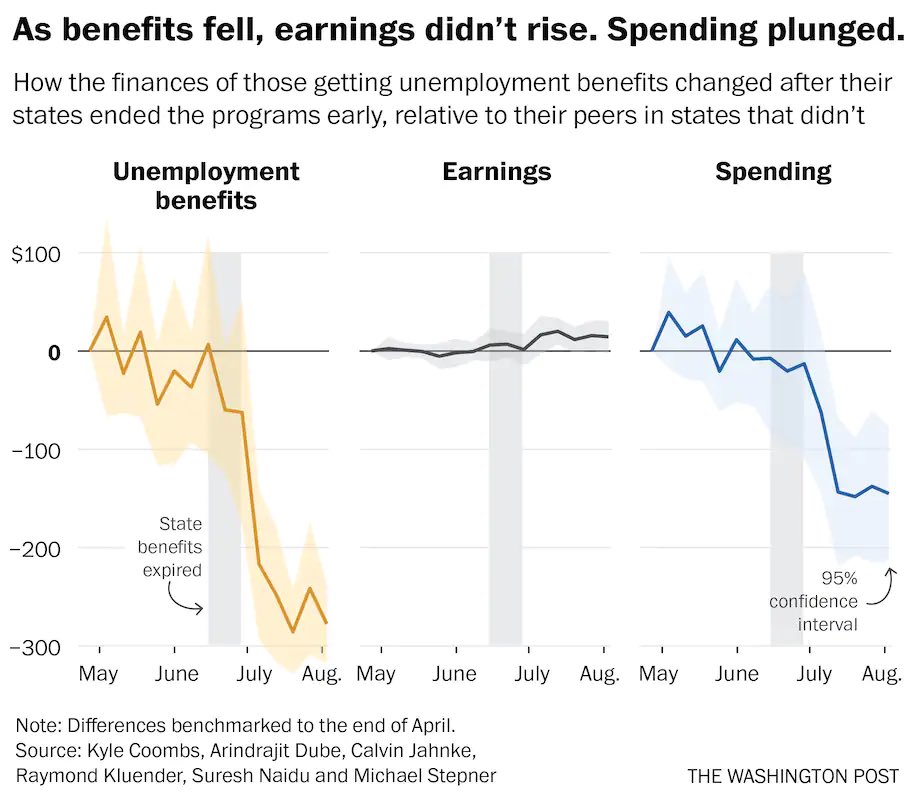
From the Washington Post:

You will remember that employers squealed they were having trouble finding workers, so Republican states ended extra EI benefits.

The end result? No more workers, but businesses were harmed by reduced spending.

Whoops?

One of the many fundamental “errors” in neoliberal thinking is that you want workers and recipients of government aid to not have a lot of money. After all, they’re a cost.

But every business’s employee is a bunch of other businesses’ customer, and every aid recipient is also a customer. Smart businessmen, or ones who have learned from experience (a.k.a., those who remembered the Great Depression) know this, and want high wages. It’s not a competitive disadvantage if everyone has high wages. Likewise, generous government benefits are good for business.

So smart businessmen want a high minimum wage without exceptions, and generous benefits.

One of the few real insights of modern economics is “marginal” thinking. For decision making, it doesn’t matter what the average cost of something is; what matters is the cost of the next unit — the next widget you make or the next employee. This means that supply matters a lot. For a job for which 100 people are applying, every open position puts employers in the cat seat.

If there are three, a lot less so. If there is one job-seeker per three open slots, well, you’re going to have to raise wages, both to compete and to increase the pool. I recently read an article where a homecare business was complaining that there was one person per ten open positions, but they also noted they paid a couple dollars less an hour than retail and menial labor jobs.

Anyway, even if the Covid death toll seems large, it’s the effect on marginal workers that matters. Add to that that many workers who kept their jobs are not going back to offices and the geography of jobs has also changed. People who run businesses in fancy, high-priced suburbs without any real transit, can’t expect nearly as many cheap workers, because they can’t afford to live in that suburb and traveling to it is hard. You create enclaves that price out blue collar and service workers, you need to go to them, and not vice-versa.

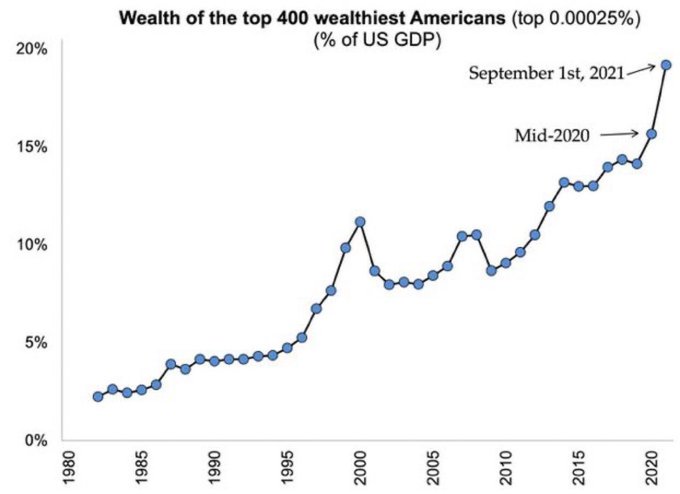
In the larger picture, an ongoing pandemic that just keeps killing and killing, and is killing the poor and minorities in much higher numbers, is naturally going to lead to a tighter job market. While the rich have gotten a lot richer because of Covid, the long-term affect is going to be higher wages.

There will be attempts to avoid this, as with making homelessness illegal, mass-evicting people, then throwing them in prison and using prison labor, but even that has its limits, when there are just less people.

This is a lesson Europe learned during the Black Plague (the people who survived were treated much better than those who lived before), but Europe didn’t fuck up the Black plague deliberately because it was making rich people richer.

Our wealthy are fundamentally stupid in fairly awe-inspiring ways, because they’ve spent the last 40 years destroying the very environment they will need — social, economic, and physical — for their own future prosperity, and indeed, survival. They think their money will protect them from the wasteland they’re creating, but that’s a bad bet.

Oh, I guess the older ones weren’t stupid, but if you’re filthy rich and not at least 60, I wouldn’t be fucking up Covid, destroying the social fabric of the West by encouraging right-wing authoritarianism, destroying democratic legitimacy, and crashing biodiversity while screwing up the climate.

Might come back to bite you on the ass. If you actually care about your kids (obviously you hate everyone else’s kids), you might find all this foolish, too, if you weren’t someone whose only talent is making money by hurting other people.

Anyway, one of the few silver linings coming out of this will be increased wages, unless the rich and their politicians can move hugely to forced labor. Understand that forced labor is the play: That’s why they’re cutting benefits, to force people back to work. It just didn’t work. That’s why they’re criminalizing homelessness, and there will be more policies along this line.

You’re a unit of production, expected to work for poverty wages, and they want to keep it that way even during a plague, even if they have to force poor people to keep working and send your kids back to schools w/out masks or proper ventilation.

This is who the rich are. Who we are, as a group, is people who accept this or even support it.

Meanwhile, employers of low-wage workers should be asking governments to increase the minimum wage significantly ($24/hour in the US, minimum, with automatic increases based on cost of living), not to help workers, but to help themselves. They could ask for transition subsidies for a couple years, and most of them would be fine, and making more money.

But we’ve trained our employers to be idiots, concentrating only the bottom line and not the top line.


(My writing helps pay my rent and buys me food. So please consider subscribing or donating if you like my writing.)

Open Thread

Use this thread to discuss topics unrelated to recent posts.

Texas’s Effective Anti-Abortion Law

No abortions after six weeks, any private citizen can sue anyone who “aids and abets” a private abortion, and while there is a medical exception, no exception for rape or incest.

I remember a friend who drove his friend to get an abortion, she didn’t have a car. He’d certainly be sued under this law.

Most women don’t know they’ve pregnant at six weeks, so this is an obvious attempt to make almost all abortions illegal.

An ordinary American, from Texas or elsewhere, may now be able to seek up to $10,000 (£7,200) in damages in a civil court against abortion providers and doctors – and possibly anyone at all involved in the process. That means people like clinic staff, family members, or clergy who encourage or support the procedure could, in theory, be sued.

Turning over enforcement of the Heartbeat Act to private citizens instead of government officials likely means that – in the absence of Supreme Court intervention – the law cannot be challenged until a private citizen seeks damages.

The Supremes have refused to intervene, telling us what we all know: Roe vs. Wade is a dead letter.

I asked my father about abortion once. He was a life-long conservative, though of the old school, and he was personally anti-abortion. But he wanted abortion to be legal. That seemed…odd.

He said, “Ian, I remember when abortion was illegal. All it meant was that women with money still got abortions, and that those who didn’t have money either couldn’t get one, or had to get a dangerous one. You see one women bleed out from an illegal abortion, and your views change.”

My father was one of the world’s biggest assholes, but he was a fair man in most ways.

I get why some people are anti-abortion; I understand the moral argument. But I’m not willing to tell someone else she has to spend nine months gestating a baby; there is a moral argument there, too, and I consider it more important.

In particular, when women can be raped and forced to bear the baby (this is the Texas law), then they are not free.

Texas recently had a huge power outage and the power providers who failed made huge windfall profits. It’s trying to get through an extreme election-fixing bill. It’s generally a regressive state with awful laws.

I would not do business there, and if I lived there and did not follow its politics, I would leave if I could. If I were in charge of a corporation I would not put any offices or factories there. (But then, this is true of much of the South, and not just the South.)

I can already hear people screeching, “Stay and fight!” but remember, people who fight when they’re on the ground and surrounded by guys with steel-toed boots get hurt bad or killed.

The main argument is just that this is the thin edge: What’s coming to Texas now will be coming to you very soon. Roe vs. Wade is doomed; Republican Trumpists are taking over the party apparatus to ensure the next coup attempt succeeds, and Democrats are doing nothing to stop any of this.

Leaving Texas probably isn’t enough.

The best case scenario is probably the US splitting up peacefully. That will be unfortunate for those left-behind, but it beats the entire country falling, or a civil war.

In the meantime, take this stuff seriously: It is the future, and not just in the US.


(My writing helps pay my rent and buys me food. So please consider subscribing or donating if you like my writing.)


Three Simple Policy Heuristics

A number of people (and most of those who run our societies) don’t understand the policy default: “Be kind.”

There is a widespread belief that life is shit, “hard choices” have to be made, and those hard choices usually involve someone else suffering and dying.

Life may well be lousy, but most “hard choices” don’t have to be made, and those hard choices are one of the main reasons why life is lousy for so many people.

The most important thing to understand is this: Harm ripples, kindness ripples. People you hurt go on to hurt other people. People who are treated with kindness become better people, or more prosperous people, and go on to help others. Yes, there are exceptions (we’ll deal with those people), but they are exceptions.

First: Do no harm.

Again, people who are abused, go on to abuse others. Rapists were often raped before they raped others. People who have no money can’t buy other people’s goods. People who are crippled physically, mentally, emotionally, or socially cannot contribute fully to society and tend not to make those around them happier or more prosperous. Rather the reverse.

While it is necessary to imprison some people for committing crimes (though far fewer than most societies imprison), it is not necessary to make having been convicted an economic death sentence. People who can’t get living wage jobs (or any job at all) when they get out of prison gravitate back to crime.

We don’t want people raped in jails, because many become rapists themselves and virtually all are damaged by it. When they get out of jail, we have to deal with that damage. We don’t want them stuck in solitary confinement for long periods of time because brain scans show this inflicts traumatic brain damage, and, yeah, we wind up having to deal with those people when they get out.

If someone runs out of money, we don’t want them to lose their primary residence. Even if you are soulless, you shouldn’t want a society that creates homeless people; it takes far more money to support someone on the street than it does to pay for almost anyone’s mortgage or rent. We don’t want people who are sick to be denied health care because they become pools for disease. We’re treating these people eventually anyway (when they turn 65 or become so poor they qualify for Medicaid), which is far more expensive than dealing with their illnesses when they first present themselves.

We don’t want to destroy other countries (Iraq, Afghanistan, Syria, Libya, etc.) because their people become refugees with whom we must then contend; this produces scads of angry people, some of who may wind up killing us, and it further ruins their economies, rendering them unable to buy our goods (except our weapons).

Damage to others who live on the same planet as you can comes back to haunt you. Damage to others in your own society will come back to haunt you.

So, first, do no harm. Yes, there are exceptions, but they are radically rare. Almost every bit of harm we do to others through government policy is a bad idea. The only common class of exception is covered in rule three.

Second: Be kind.

As the harm you do others comes back to you (insofar as you are “society”), so the good you do comes back to you. I almost don’t know what to say about this, as it is so brutally obvious. Happy people are better to be around. Prosperous people are better to be around. Healthy people are better to be around.

Only when goods are legitimately scarce is there reason not to help make other people better off, and, in those cases, it is only applicable to the scarce goods, and only until you can make the goods no longer scarce. Short on food? Ration and plant more crops.

But in today’s society, all the significant shortages of the goods which matter most are artificial; we have more than enough food to feed everyone. The US has five empty homes for every homeless person. Europe has two empty homes for every homeless person. Clothing is cheap as hell. Access to the internet is vastly overpriced. Our main sink is just carbon: We need to spew less of that, and we can do that. Our second main limitation is the destruction we are imposing on biodiversity, but we could produce our food with far less impact on the environment if we wanted to, and, even in the short term, we’d be better off for it.

People need stuff: food, housing, safety, education. None of these things should be in shortage anywhere in the world, including safety. They are in shortage because we choose to act greedy, violent, and selfish when we do not need to.

Third: Remove the ability or reason for people to do harm.

Humanity is not a race of saints. It does not need to be. Most people are neither good nor bad, they are weak. They do what the social and physical environment disposes them to do, with the social environment being far more important in the modern era.

Still, some people are bad. The hard core is probably around five percent of the population. And many other people are damaged, because our society has damaged them. They take that damage out on others.

The most dangerous class of malefactors are incentivized to do evil. Think bankers, corporate CEOs, billionaires (almost all of whom do evil as routine). These people do evil because they profit greatly from it, BUT (and most of you will not believe this) what makes a profit in the modern world is overwhelmingly a social choice. The government chooses who can create money, what counts as profit, who is taxed how much, who is subsidized how much, what is property, how much it costs to ship by rail vs. road, etc., etc.

There are independent technological and environmental variables, but they are overwhelmed by social variables. Change the variables and you change the incentives.

The policy is simple: Take away incentives for people to do evil. Take away their ability to do evil (a.k.a., their excessive access to money.)

Those who continue to do evil, lock them up. Do it completely humanely, no rape, no violence, no solitary confinement. But make it so they can’t do evil. While they are in prison, try to rehabilitate them. Norway has half the recidivism rate of the US for a reason: Rehabilitation does work for some people.

When they get out, bring them back into society. Make sure they have housing, food, clothing, and so on. If they do evil again, lock them up again.

None of this is complicated, in principle. This is simple. This is straightforward. It is work, mind you, we must stay on top of incentives and ability, and not allow anyone to become so rich or so powerful that they are able to buy the rule-makers or be above the law.

None of this should be controversial, though it is. None of this is new, these strands of thought go back to Confucius, Ancient Greece, and beyond. They are only controversial because it is in the interest of many for these ideas to be painted as such. And many people, having done evil, develop a taste for it.

Running a society well is hard, in the details it is complicated, but in principle, it is simple. Do the right thing. Make it so that people do well by doing the right thing. Make it so people who do things that are harmful to others stop doing them.

When you want a good society to live in, inculcate these principles. Until then, know that you will only live in a good society briefly and by chance.

Originally Published September 3, 2015. Back to the top for a new generation of readers.


If you enjoyed this article, and want me to write more, please DONATE or SUBSCRIBE.

Living in Reality: Afghanistan Issue

Two weeks ago, I noted that the Taliban were competent and not corrupt.

Because of this, the Taliban leadership and even its lower ranks is made up of competent people who are true believers…

…The Taliban, like Hezbollah, does not tolerate people who are serial fuck-ups. In this they are the exact opposite of America’s elites, who not only tolerate serial fuck-ups, but promote them.

The Taliban will rule Afghanistan effectively, in line with their beliefs and goals.

This week,

“I’m happy about the improved security situation,” said Qadiri, 40. He doesn’t worry about crime the way he did a few weeks ago. He said corruption, along with the gov’t, appeared to vanish overnight.

Both of these things: improved security AND no corruption should not be a surprise. If you are surprised, your mental model of the world was badly flawed. The US-backed government was massively corrupt and the Taliban are competent true believers.

As Stoller notes, the next problem will be the economy.

Without the US flying in pallets of cash, Afghanistan will have some real problems. If the US insists on sanctions and doesn’t provide aid, Afghanistan will more or less automatically go into the China/Russia/Iran/Pakistan/Turkey axis. (Oh, they don’t like Iran, but they’ll live with them.)

The Taliban, as I have noted, run on an ideology I absolutely loathe. But I try to live in the real world, and I acknowledge the strengths and virtues of my enemies.


(My writing helps pay my rent and buys me food. So please consider subscribing or donating if you like my writing.)


Page 144 of 437

Powered by WordPress & Theme by Anders Norén