

The Goddess Libertas
Are you free if you need a job? For most people lack of a job means homelessness (indeed many homeless have jobs, that’s how far things have sunk) and you’ll go hungry, and almost certainly wind up dead sooner than otherwise.
This was well understood by the people who created capitalism. The central requirement of capitalism was enclosure (getting rid of common land which people could use for crops and animals.)
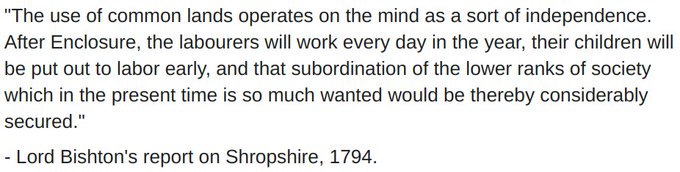
The fact is that peasants worked a lot less than workers. They had more holidays. They had to do some work for their lord, to be sure, but that was far less than the 12 hour days typical of industrialization, or even the eight hour days we now work. And, mostly, they controlled their own time.
The condition of having a job is that you do what your told. It was called wage slavery by Americans being forced off farms by low profits (because of railroad monopolies) for a reason: they had controlled their own time before. To be sure they had to work, even work hard, but they weren’t taking orders from a boss.
The fact that one can, sometimes, choose one’s master (for that’s what a boss is) doesn’t change the fact that they’re a master. In good capitalist times, in my experience before 90 or so, the worst boss behaviour was mitigated by plentiful jobs and easy choice: but today people put out hundreds of applications to get a job. Once you’ve got one, you can’t risk it by telling your master to bugger off if they order you to do things you find distasteful.
Bottom line, modern life is do what you’re told in school for twelve to twenty years, then spend your adult life doing what your told by bosses, then when you’re too old to work maybe you’ll be allowed a few years of declining health without a master. Quite likely you won’t even get that.
This is the modern form of slavery, where we pretend that most people have a choice. Oh a few escape, I have (at the price of poverty), and some others do, but the structure of the economy is that most people, the vast majority, must spend most of their life as wage slaves, doing what their masters tell them to. There is no way around this, it’s what giving control of the means of production (what you need to feed yourself, have shelter and goods) in the hands of a tiny minority of people.
It’s been a while since I discussed fundamental of how societies operate and what to change to make them better. We’re going to come back to freedom, a lot, as part of a series. We’ll also do a series on the fundamentals of societies: what is used to make them stick together, what determines how we run them, and how those are used against us or could be used by us to make a better world for 99% of humanity.
For now it is important simply to understand the chains that bind us, and not to fall for the lie that we are free or that our current civilization is the best that is possible.
Everyone reads these articles for free, but the site and Ian take money to run. If you value the writing here and can, please subscribe or donate.
spud
i view capitalism as theft. theft of just about everything that matters, as well as your life. i vowed to free myself of the theft of my life, and became self employed, and have been for about 43 years now. its been a wild ride, feast or famine as they say. but i was more than willing to go without at times, and never ever to live beyond my means.
humans evolved through cooperation. capitalism killed cooperation, and the reason why we got socialism, enough people understood that cooperation is how we evolved.
ayn rand even proved we cooperate, when she applied for social security and medicare:)
so capitalism response to cooperation is, fascism. and you can see that failing right now before your very eyes. it might take years of brutality, or as lenin said, sometimes it can seem like things never change, then all of a sudden in a few weeks, everything changes, or something like that, but failing it is.
https://www.youtube.com/watch?v=REB64DhO58I
How Human Cooperation Made Us the Dominant Species | 1/26/2026 | Part 147
Humans didn’t become the dominant species because we were the strongest or fastest—we succeeded because we learned how to work together. 🌍🤝
In this video, you’ll discover how cooperation shaped human survival, from early hunter-gatherer groups to the rise of complex societies and civilizations. Learn how sharing food, protecting one another, building trust, and collaborating beyond family ties gave humans a powerful evolutionary advantage.
If you’ve ever wondered why teamwork is so deeply wired into human nature, this video breaks it down in a simple, engaging, and science-backed way. You’ll walk away with a clearer understanding of how cooperation influenced culture, innovation, and the world we live in today.
If you enjoyed this video, don’t forget to like 👍, share it with curious minds, and subscribe for more fascinating insights into human history and evolution. Drop your thoughts in the comments—how do you think cooperation shapes our future?
Feral Finster
I am hardly a libertarian, but what we live under is crony capitalism.
Keep in mind that when Lord Bishton wrote his report, corporations were almost non-existent, requiring an Act of Parliament to establish and they typically were established for a limited period of time.
spud
Feral Finster:
it matters not what its called and how it operates, its capitalism. as long as rich parasites control capitalism, its capitalism.
if the capitalists do not want to be called parasites, they will work hard to do away with the ability, for any up and coming parasites, or rich parasites buying into capitalism.
but they can’t nor won’t, that’s why people who understand how humans evolved, created socialism, which can make capitalism work for all.
Like & Subscribe
… humans evolved through cooperation. capitalism killed cooperation, and the reason why we got socialism, enough people understood that cooperation is how we evolved.</i.
Pre-civilization societies survived and persisted via cooperation. The few uncivilized societies today do the same. Civilization killed cooperation and replaced it with coercion and compulsion. Socialism and communism are still rudimentarily coercion and compulsion. Lenin and the Bolsheviks deployed a massive amount of bloody, murderous coercion and compulsion to bring about the Soviet Union and they continued to deploy that iron fist to maintain that authoritative power until the very end. Communist China did the same and still does even though, or especially since, it has deployed a capitalist economy to juice its insatiable appetite for prodigious growth.
mago
Yep. No shit. Late stage capitalism is a cancerous disease eating its host, but as long as the parasites can make bank they will until they can’t anymore. The rest of us can eat shit and die. Other than that it’s a wonderful and glorious world on the Good Ship Lollipop, which some lurkers around here seem to enjoy, not to get too enigmatic about it.
spud
Like & Subscribe:
socialism and communism is capitalism, free of rich parasites.
today, russia, china, iran and others, are full of cooperators leaving the parasitical western capitalism not into the dust, but ground into the dust.
smith was dead set against the rich being involved in capitalism. smith was basically a socialist.
Adam Smith’s Concept of Rent-Seeking
Adam Smith’s concept of rent-seeking involves acquiring economic rent by manipulating public policy or economic conditions instead of engaging in productive activities. This practice is not about creating new wealth but rather about extracting value from existing resources or systems.
Economic Implications
Rent-seeking can have several negative effects on the economy, including:
Reduced Economic Efficiency: Resources may be misallocated, leading to inefficiencies.
Stifled Competition: It can create barriers for new entrants in the market.
Decreased Wealth Creation: Focus shifts from productive activities to gaining advantages through manipulation.
Increased Income Inequality: Wealth becomes concentrated among those who successfully engage in rent-seeking.
Potential for Corruption: It can foster cronyism and undermine public trust in institutions.
Comparison with Profit-Seeking
Aspect Rent-Seeking Profit-Seeking
Definition Extracting value without productivity Creating wealth through transactions
Economic Impact Inefficiencies and inequality Economic growth and innovation
Method Manipulation of policies Engaging in mutually beneficial activities
Conclusion
Adam Smith’s insights into rent-seeking highlight the importance of productive economic activities over manipulative practices. Understanding this concept is crucial for recognizing how certain behaviors can hinder overall economic health and competition.
Rent-seeking negatively affects competition by stifling it, leading to reduced economic efficiency and misallocation of resources. This behavior often results in monopolies or oligopolies, where wealth is concentrated among a few, diminishing opportunities for new entrants and innovation in various industries.
Wikipedia marlboro.emerson.edu
———
of course smith admitted capitalism cannot work without socialism,
Adam Smith emphasized the importance of labor in creating wealth, arguing that the interests of workers are crucial for a flourishing society. He believed that a well-governed society benefits when the majority, particularly laborers, improve their circumstances.
Columbia University thedailyeconomy.org
Adam Smith’s Views on Workers
Importance of Labor
Adam Smith highlighted that labor is fundamental to the creation of wealth in society. He argued that the interests of workers are essential for a thriving community. According to Smith, a well-governed society flourishes when the majority, especially laborers, see improvements in their living conditions.
Workers’ Rights and Interests
Smith recognized that the interests of workers often conflict with those of employers. He noted that while workers strive for higher wages, employers aim to minimize costs. This dynamic creates a natural tension in the labor market, which Smith believed should be acknowledged and addressed.
Societal Benefits of Labor
Smith posited that when the circumstances of workers improve, the entire society benefits. He emphasized that a society cannot be truly flourishing if the majority of its members, particularly laborers, do not share in its wealth. This perspective underscores the moral and economic importance of supporting workers’ rights and interests.
In summary, Adam Smith’s philosophy places significant value on the role of workers in economic prosperity. He advocated for a society where the well-being of laborers is prioritized, as their success directly contributes to the overall health of the economy.
Columbia University adamsmithworks.org
——————-
here is the real bloody fist, that has killed untold millions, perhaps billions for the enrichment of a few parasites.
https://evonomics.com/free-market-genocide-the-real-history-of-trade/
Capitalism
Free Market Genocides: The Real History of Trade
One reason this hushed-up history matters is that even today economic “rationality” and plunder often remain partners in crime.
September 10, 2022
By Jag Bhalla
What role should greed play in how we run the world? Should it rule us and shape all that we do?
I’d argue that we live under “greedocracy” disguised as a form of liberalism. Gussied-up as the only rational way, greed has become the guilt-free guiding star of global elites. But the grand narrative usually used to justify this world-shaping greed-is-good creed vigorously ignores salient history, and disingenuously suppresses data on greed’s present-day harms. This essay will walk you through why the “liberal world order’s” free markets are not really remotely in the business of maximizing flourishing—to rightly judge their track record requires reckoning with the greedocracy’s glossed-over genocides and hushed-up holocausts.
Consider how “rational optimist” Steven Pinker paints the history of trade in his billionaire-beloved good-news-bearing bible, The Better Angels of Our Nature (its “the most inspiring book I’ve ever read” gushed Bill Gates, the prominent predatory philanthropist). In it Pinker preaches thinking “like an economist” using “the theory of gentle commerce from classical liberalism,” under which trade becomes “more appealing than … war.” Rationally-enlightened leaders reasoned that your “trading partner suddenly becomes more valuable to you alive than dead.”
Compare that glorified life-affirming tradeoff to the views of a frontline practitioner of that so-called gentle commerce: “There can be no trade without war,” declared Jan Pieterzoon Coen of the Dutch East India Company. That’s a quote from Amitav Ghosh’s The Nutmeg’s Curse (an eloquently alarming book about gigantic ideological gaps in climate crisis discourse). Unlike Pinker’s, Coen’s words weren’t abstract theorizing, and he concretely came to the opposite conclusion on the value of trading “partner” lives. He ordered a monopoly-securing massacre of the Banda Islanders. This involved 50 vessels, and 2,000 men (including 80 Japanese ronin, masterless samurai mercenaries) who displaced, “killed, captured, or enslaved” 90% of the 15,000 indigenous “trading partners.” This “almost total annihilation of the population of the Banda Islands [was] clearly a genocidal act” (concluded a 2012 paper in the Journal of Genocide Studies). The cursed spice of Ghosh’s title was so valuable that a handful of nutmegs “could buy a house or ship.” which sadly meant Coen’s gentle-commerce genocide made greedy profits even at the cost of 5,000 slaves per year (“labor” didn’t last long under gentle-commerce conditions).
Pinker isn’t wrong in reporting Enlightenment views. Economist Albert Hirschman, in The Passions and the Interests, an influential book on the long process of alchemizing the once-deadly vice of avarice into plainly-rational “self-interest” during the rise of early capitalism, confirms there was “much talk… about the douceur of commerce.” Douceur translates to “sweetness, softness, calm, and gentleness… the antonym of violence.” Hirschman and Pinker cite a long list of Enlightenment luminaries, for instance, Kant in 1795 wrote that “The spirit of commerce … can not exist side-by-side with war.” Pinker concurs, “commercial powers …tended to favor trade over conquest.”
But this majestic myth-making of modernity—the Enlightenment as a triumph of rationality and humanism—must not be allowed to mask that the Age of Reason ran parallel to and often justified the vast violent plunder of imperial economics (now often euphemistically called “free trade”). One reason this hushed-up history matters is that even today economic “rationality” and plunder often remain partners in crime. For all of Pinker’s elegant-stats-wielding elite-soothing sermons that “in fact a free market puts a premium on empathy,” there was little empathy, empirically evident, for the likes of the Banda Islanders. Or for many millions more lives ended or blighted by “gentle commerce” and “free trade,” which as we’ll see could materialize at your border in the form of a genocidal corporate army bent on “premium-empathy”-ing your way of life into your own blood-soaked dust.
Consider what classical-liberalism’s gentle-commerce blessings brought to the basic business of staving off starvation. As presented in Pinker’s brand of rigorous rationality, which seems to require boiling history’s byzantine complexities down to whatever sort of weak grasp can be gained by glancing at “the numbers.” Dispositive data should preferably be plotted on a now rhetorically powerful sexy chart or failing that, one should squeeze hyper-complex histories into spreadsheet-like tables with columns for nifty swift numerical comparisons. For instance, the Deadliest Disasters of All Time table on page 195 of Pinker’s Better Angels of Our Nature.
This lethal league table of tribulations has just two entries explicitly called “Famines.” At number two “Mao Zedong (mostly government-caused famine)” with 40,000,000 deaths, and at number 12 “British India (mostly preventable famine)” at 17,000,000 deaths. Pinker also provides figures adjusted for relative population growth, which makes the adjusted British-in-India famine number 35,000,000. That’s deadlier than World War I (15,000,000) and many-times more murderous than the Nazi holocaust (6,000,000). Pinker blames Mao’s “harebrained schemes” which he feels illustrate how “utopian leadership selects for monumental narcissism and ruthlessness.” But nowhere does Pinker note that, as I’ll show, those Brits-in-India famines were policy-driven and explicitly justified by liberal free market doctrine. These “enlightened” imperial policies were implemented by impeccably elegant elites selected for at least industrial-scale ruthlessness, if not also monumental statue-seeking narcissism. Surely such colossal crimes should weigh against “gentle commerce” in history’s moral scale?
Plus ‘Pinkering’ (rationally optimistic number-narrowed thinking) too easily hides how imperial “free market” policies contributed to the series of revolutions that culminated in Mao, triggered by those paragon gentle-commerce programs known as the Opium Wars (1839-1860). Britain’s noble narco-capitalist armed forces wrecked China’s multi-millenia old social fabric, which centrally featured famine prevention infrastructure. This vast opulence-enabling opium operation was run by the most successful narcotics gang in history (these Brit nobles were O.G. drug kingpins). These sorts of intricately entangled causal interconnections are easily lost in neatly labeled “numbers” (under a risible ruse of rigor).
Historian Mike Davis reports Brit-ruled Indian famine deaths at 12 to 29 million, in his book Late Victorian Holocausts. He explicitly blames the “imposition of free-trade,” noting that these millions were killed “in the golden age of Liberal Capitalism.” The first public reports in February 1878 by journalist Robert Knight declared British officials were guilty of “multitudenous murder.”
Get Evonomics in your inbox
Applying Pinker’s scaling factor To Davis’s figures, we get the equivalent to 24 to 58 million 20th-century-scaled deaths (four to ten times the size of the Nazi holocaust). During all this the decorously dining Downton-Abbey set exported grain to world markets as millions starved. Market “efficiency,” then as now, means allocating resources to whomever pays most. But fear not, noble Brits acted quickly to protect what mattered most to them— their beloved free market. They imposed the “Anti-Charitable Contributions Act of 1877, outlawing private relief that might interfere with the “market-fixing of grain prices.” The only aid permitted was at horrifyingly harsh hard labor camps, such as in Madras, which offered fewer daily calories than Buchenwald. As Davis writes, while “Asia was starving the United States was harvesting the greatest wheat crop in world history… and in California’s Central valley worthless surplus wheat was burned”—malicious market morality in action. To understand the frame of mind of this enchanted circle of imperial overlords, consider that in 1874, those exemplary classical liberals at The Economist wrote that it was unwise to encourage “indolent Indians” to believe that “it is the duty of the Government to keep them alive.” Lord Salisbury, secretary of state for India, felt it was a mistake to spend “money to save a lot of black fellows.”
Many Brits weren’t nearly as callous as the glamorous imperial ghouls of their governing elite. As Shashi Tharoor notes in his book Inglorious Empire, a piece in The Times of London lamented that “the Viceroy had interposed to repress the impulses of charity.” And relief fund of “£820,000 was raised from millions of small contributions by individuals, schools, churches, and regiments throughout the British world.” Viceroy Lord Lytton, whose main qualification for governing India was that he was Queen Victoria’s favorite poet, called the fund a “complete nuisance.” Tharoor concludes that “the facts of British culpability even at the height of their ‘civilizing mission’ … are overwhelming” but often still glossed over.
Why, one wonders, aren’t these famines rightly called Imperial Holocausts? British Holocausts? Free Market Holocausts? Liberal Holocausts? Corporate Holocausts? Capitalist Holocausts?
Readers repelled by linking that term to much-lauded much-laundered liberalism, should recall that ‘holocaust’ means any mass destruction. It derives from the Greek for a wholly burnt sacrificial offering (hence many Jews use the term Shoah —catastrophe — which lacks godly links).
In his history of the global food system, Animal, Vegetable, Junk, Mark Bittman notes that free-market loving classical liberals lorded it over a 3,000% increase in the Indian famine rate—from less than one famine per century to one every three years. Explicitly invoking the name of rational free market efficiency, Brits violently disrupted ancient practices of storing local food reserves which had for centuries enabled Indian elites to discharge duties to feed their poor in times of famine. And ruthlessly increased British taxation had eviscerated the peasantries purchasing power (Tharoor calls this “the culmination of two centuries of colonial cruelty”).
Of course, these stupendous century-spanning imperial sins had contemporary critics. For instance, Thomas Paine of American revolution-launching pamphlet fame, wrote that “the naked and untutored Indian, is less Savage than…King of Britain.” His incendiary ink-fire inflamed the colonial settlers against the “crowned ruffians” of royalty that ruthlessly ruled such that “every spot of the old world is overrun with oppression.” Paine skewered the supposed divine right of kings, by calling William the Conqueror “a French bastard landing with an armed banditti …[to] establish himself king against the consent of the natives.” Lets skip the ire-raising ironies of Paine promoting a genocidal invasion without securing the consent of American natives, to focus on his divine debunking of royal rights: he concludes that William the Conqueror was “in plain terms a very paltry rascally original—[whose claim to kingship] certainly hath no divinity in it.”
Paine was disgusted by the “horrid cruelties exercised by Britain in the East Indies — How thousands perished by artificial famine.” His moral reflex here is laudable, but his numbers are a thousand times too small, and he got the guilty party slightly wrong: as Horace Walpole, son of a British Prime Minister wrote “We have murdered, deposed, plundered, usurped—nay, what think you of the famine in Bengal, in which three millions perished, being caused by a monopoly of the provisions by the servants of the East India Company”). Don’t forget Boston’s totemic tea-tossing was of East India Company shipments. Sadly, Paine’s deep political desire that such decorous dastardliness should “never, never be forgotten” has failed to hold up. Did your schools teach this history? That the private army of a corporation (twice the size of the king’s) killed millions to enforce “free trade” and “gentle commerce”?
Readers tempted to shake their heads at all this monumental moral ignorance and nakedly nasty nonchalance, while feeling assured that our Pinker-reading elite would never allow anything like any of the above to happen today should consider the global Covid immunization situation. Our greed-is-rational elite are again putting profits above saving lives by not lifting vaccine patent restrictions (Pinker’s pal Gates has played a leading far from philanthropic role in this). Millions of avoidable mostly-distant-dark-skinned deaths are again being offered for sacrifice on the altar of the almighty liberal god of greed. This horrific fiasco has been dubbed “vaccine apartheid” by many Global South advocates, including World Health Organization Director-General Tedros Adhanom Ghebreyesus, because of how deeply under-protected non-white poor nations remain.
To be fair, we should note that those jolly jodhpur-clad classy Brits weren’t quite being racist in today’s sense. They were equally elegantly evil on an industrially deadly scale to their Irish neighbors. Davis writes “India like Ireland before it had become a Utilitarian laboratory where millions of lives were wagered against dogmatic faith in omnipotent markets.” Regarding the Irish famine, that cherished champion of classical liberalism John Stuart Mill wrote that “The Irish are indolent, unenterprising,” he feared “it may require a hundred thousand armed men to make the Irish people submit to the common destiny of working in order to live” (a position lately lampooned as: Let them eat liberty). Don’t forget Mill was for decades employed by the looting-Lords of the East India Company before entering Parliament as a Liberal. In case you haven’t kept track of the Irish Famine details, a million perished, two million fled, and Ireland’s population took 170 years to recover (achieved pre-famine levels only in 2021).
And, lest we forget, European elites also starved their own poor in the internal colonization process of enclosing the commons. Public lands used for collective benefit (enabling a “Golden Age” for European peasants) were privatized. This was part of the vast organized political effort to create and naturalize economic liberalism and emerging capitalism. As economic anthropologist Karl Polanyi writes in The Great Transformation “the people of the countryside were pauperized” in “a revolution of the rich against the poor.” From 1500 to 1700 real wages fell 70%, starvation became common, and life expectancy fell from 43 to the low 30s (hitting 25 in the urban squalor of Blake’s “dark Satanic Mills,” he didn’t but could just as well have meant John Stuart). Polanyi provides extensive evidence that “There is nothing natural about laissez-faire free markets.”
Here we must re-examine a view dear to many Pinker-parroting pious liberals and greedocrats alike, who feel certain that their own unbridled greed is just inalienably at the very heart of human nature. Polanyi debunks this as an anthropologically and historically ignorant self-serving projection. Many cultures have been studied that are not organized around unbridled individual greed (and there is no evidence of any of them having extraterrestrial origins). In sharp contrast to Enlightened European liberalism, Polanyi says ”as a rule, the individual in primitive society is not threatened with starvation unless the community as a whole is.” He cites three examples, South Africa’s Bantu people (for whom “destitution is impossible: whosoever needs assistance receives it unquestioningly”), Canada’s Kwakitul tribe (“No Kwakitul ever ran the slightest risk of going hungry”) and pre Brit-blighted India. “Under almost every and any type of social organization up to about the beginning of 16th century Europe” a principle for freedom from starvation prevailed. Sadly the logic of “smashing up social structures in order to extract labor” under threat of starvation became standard “civilized” liberal market practice (as violently imposed in Ireland and India and many places beyond).
Importantly, Polanyi notes that this destruction of the material fabric of a peasantry’s way of life, to force them into capitalist labor, was first done to “white populations by white men” before being exported globally to the benighted barbarians of distant dusky-maiden-laden lootable lands. The idea that letting the poor starve is just human nature took vast industrial-scale evil-evangelizing efforts to make the “creed of liberalism” feel like it was human nature itself. As Paine noted in his other smash-hit, The Rights of Man: “a great portion of mankind, in what are called civilized countries, are in a state of poverty and wretchedness, far below the condition of an Indian.” Classical liberal market-oriented “civilization” historically went hand-in-hand with making mass starvation amid plenty seem morally acceptable or like an unavoidable necessity. 1830s Britain saw “an almost miraculous increase in production accompanied by a near starvation of the masses.” Polayni calls Britain’s 1834 Poor Law Reform a “scientific cruelty” under which the prior “right to live was abolished” for the sake of the labor market. The threat of starvation was a “psychological torture coolly advocated and smoothly put into practice… as a means of oiling the wheels of the labor mills.”
Here, the concept of “conscience management” can illuminate. That’s just one of many important ideas in historian Priya Satia’s 2020 book Time’s Monster (on the role of historians in building the “ethical scripts” and elite-soothing grand narratives that enabled empire’s evil). Conscience management explains how “for the most part, empire was not the work of villains, but of people who believed they acted conscientiously.” Some (especially elites) were in it for “loot and adventure” but millions “sincerely believed they were in the business of spreading liberty.” Under that exquisitely engineered oxymoron ‘liberal imperialism’ the vast violence of colonialism was justified to bring the blessings of civilization to the savage races—they’ll thank us later. She rightly rejects today’s moral-balance-sheet-minded defenders of British occupation benefits as akin to saying “Hitler was horrible to Jews but, on the other hand, he built the autobahn.”
Speaking of Hitler, many post WWII intellectuals and artists, of many stripes, have cast the Nazi holocaust as a “chasm in history,” as exemplified by Adorno’s declaration that “to write poetry after Auschwitz was barbaric.” But this serene studious sophistication sails on an ocean of ill-informed ink, premised on ignoring the prior gentlemanly genocides noted above. To cast Nazi atrocities as history-remaking exceptions requires an act of mindbogglingly-monumental collective amnesia, of industriously suppressing the centuries-long carnage of liberal imperialism. Not to mention the role of liberal civilization’s own artists and intellectuals in creating the “ethical scripts” of empire. As Ghosh points out, Alfred Lord Tennyson, his era’s leading lyric poet, in 1849 wrote that nature’s “red in tooth and claw” battles would ensure the victory of a “crowning race” of European conquerors. That was a decade before Darwin’s The Descent of Man declared that “the civilized races of man will almost certainly exterminate… the savage races.” Darwin was a liberal and abolitionist, but these sorts of race-ranking, death-to-the-lesser-losers ideas were in Ghosh’s view “mere common sense [for] a great number of liberal progressive Westerners.” Such license to kill en-mass for profit goes back to another rational Enlightenment hero, Francis Bacon, who in An Advertisement Touching on Holy War, concludes it is both lawful and godly “for any nation that is policed and civil [to].. cut from the face of the Earth” those who are not.
The point here isn’t to judgmentally impose our moral norms retrospectively, rather it is to consider the magnificent ambient amnesia necessary for the educated today to feel that Nazi atrocities were unthinkable exceptions for civilized art-loving European elites, rather than a centuries-long pattern that was coming home to roost. A pattern long celebrated in “civilized” literature and the arts, for instance Rudyard Kipling’s 1899 hymn to empire, exhorting imperialists to “send forth the best ye breed” to take up the “White Man’s burden” and “serve your captive’s need.” Captives lyrically painted as “your new-caught sullen people, half devil, half child.” He was awarded one of his “civilization’s” highest honors, the Nobel Prize in literature, in 1907 for the “virility” of such ideas. And don’t forget that shortly before the allied intelligentsia exerted itself to express an inability to grasp Hitler’s “history-rupturing” horrors, that lion of liberalism, Winston Churchill in 1943 enacted policies that starved another 3 million Indians.
All this matters because as Satia rightly fears, “the historical sensibility that enabled imperialism is still intact.” I’d add that that sensibility’s most dangerous disguise now goes under cover of the grand narrative of neoliberal globalization’s free-market growth supposedly lifting the poor out of poverty. This is Pinker-approved, let-the-market-decide, free market economic doctrine—whereby elite greed is alchemized into awesomely being what’s best for everyone, and especially the poor. Meanwhile, in reality, this form of greed-excusing economics systematically underweights the preferences, rights, and even lives of the planet’s poor.
Consider what lurks in savvy-sounding jargon like economic rationality and “efficiency.” As a leaked memo signed by the sadly-still-influential former Treasury Secretary Larry Summers revealed: “the economic logic behind dumping a load of toxic waste in the lowest wage country is impeccable.” Since “measurements of the costs of health impairing pollution depends on the foregone earnings … a given amount of health impairing pollution should be done in the country with the lowest cost, which will be the country with the lowest wages.”
This sort of “rational” economics is riddled with systematic anti-poor biases. A view seconded by the spiciest Federal Reserve footnote ever, in 2021 long-time Fed economist Jeremy Rudd wrote of his “deeper concern that the primary role of mainstream economics… is to provide an apologetics for a criminally oppressive, unsustainable, and unjust social order.” He noted that did “not necessarily reflect the views of the Board of Governors or the staff of the Federal Reserve System.”
Scandalously few economists actually address poverty in their work (research from the International Monetary Fund found only 1.4% of papers in the top 10 economics journals focused on poverty). Unless this kind of impeccable economic rationality and “efficiency” is explicitly countered, it structurally adds to the burdens of the poor—Summers-style standard economic ‘logic’ sees the loss of earnings of one American as equivalent to the lost earnings of 265 Barundians (using the ratio of national gross domestic product per capita as a proxy for typical earnings in each economy). However rational and “efficient” that looks in your Pinker-approved think-like-an-economist [liberal-loot-orama] calculus, it is clearly contrary to basic morality and to any semblance of resource justice.
The most seductive and super-poisonous flavor of this greed-washing is preached under liberal-beloved “win-win” rubric whereby elite-fattening market-greed is sold as lifting millions out of poverty. As Phillipe Alston, ex- UN Special Rapporteur on Poverty has written, this rhetoric has really been used to redefine “the public good as helping the rich get richer.” Far from being one of the “greatest human achievements” this “win win” narrative has been a “convenient alibi” for guilt-free greed.
Why exactly should every gain for the poor require gains for the rich? I find it appalling that many greedy growth fans feel they are simply deferring to the objective facts while their data-driven Pinkering gospels hide how markets actually allocate the vast bulk of the global economy’s gains and resources to precisely the opposite of poverty-alleviation. Only 5% of global GDP growth gets to the poorest 60% of people (95% adds to the comforts of the unpoor, and even within that it’s heavily top-skewed to the Top 1-10%). Do those numbers pass a basic ethical sniff test? Should we celebrate a trickle-down pace so slow that it means 8 generations of sweatshop toil till your descendants rise above a disgustingly low poverty line? While for each of those generations the bulk of the planet’s resources are win-win-ed away into rich wallets?
By the way many misunderstand what that disgustingly low official poverty line means. It is a P.P.P $1.90 a day, which means it is adjusted for purchasing power parity. So as best as can be estimated, like living on ~$700 a year in the US now—one nineteenth the official US poverty line. And surely countless sins lurk in data built on the idea that making 10 cents more, for a total of $2 per day ($730 per year) warrants being classified as having “escaped” extreme poverty.
The data-driven discourse here is dominated by a diabolically bad framing of the main moral issue. Contrary to the Pinker-preached plutocrat-pampering perspective, the key question isn’t “Are things better now than before,” but rather “Is this the best we can do?” Indeed, are we even making a minimally decent effort to minimize suffering? As economic anthropologist Jason Hickel has pointed out, viewed from that angle, global poverty has never been worse. The world is richer now than ever, but we still don’t prioritize use of enough resources to end poverty. Only a small fraction of the world’s wealth would be needed to end “extreme poverty” (Hickel calculates 3.9% of global GDP, and Max Rosner of Our World in Data, in 2013 figure estimated $160 billion from a $70 trillion pie, or under 3%). Yet we let global markets “decide” to spend more each year on ice cream and face cream than that ($90 & $100 billion). How can it make ethical sense that markets “decide” to use 80% of arable land to fatten cattle while 150,000,000 kids are stunted by malnutrition and 1,900,000,000 humans (25% of everyone alive today) are more food insecure than rich-nation pets? The deep data-dazzled dumbness here is due to how GDP mixes luxuries and survival basics in the same monetary bucket, then “rationally” and “efficiently” sends resources to whoever pays most, thereby “objectively” prioritizing the whims of the wealthy. Whatever your political or moral leanings, if they don’t help you condemn and counter this, they may need an upgrade. They are in no coherent sense humane or enlightened.
Get Evonomics in your inbox
The Pinker-preached faith that markets are in the business of maximizing flourishing often operates as fancy conscience management camouflage. As currently practiced, markets don’t distribute flourishing (or much of anything else) in an ethically sound way. Surely, the right thing to do is to always prevent avoidable suffering, before further enhancing rich lifestyles. By what logic can we square squandering resources on rich toys when so many obvious gains in basic suffering reduction are within relatively easy reach? While this isn’t quite as simple as redirecting financial resources from ice cream and face cream to poverty alleviation, it’s also not that much more difficult. Why are toys and trinkets for the world’s wealthy more important than food to prevent those 150,000,000 kids from being stunted? Surely much less flourishing arises from the incremental last 1% of billionaire bauble buying than would for example by educating the world’s hundreds of millions of kids who aren’t presently schooled. A 1% wealth tax on the $13 trillion of the world’s 3,000 billionaires (meaning they might have to make do with a smaller second superyacht) versus the vastly improved flourishing of 250,000,000 kids. Why is that a hard trade off if you really are interested in maximizing flourishing? By ignoring such noxious nightmares of distributional sins, neoliberalism operates like a nerdier form of imperialism (with extra-advanced emperor’s new-clothes tailoring courtesy of Pinkering pundits, in our era’s version of Kipling’s conscientious conquerors—“The Bright Man’s Burden”—cognitive supremacy (assessed by flimsy tests like SAT scores) grants divine rights to hugely disproportionate share of global resources, and control of how horribly slowly the not-so-bright looser-layers can gain.
To present a key puzzle pictorially, for the benefit of the the Pinker-reading data-driven rational optimist do-gooders: if globalization is really all about lifting billions out of poverty, why has the gap between the rich and poor nations basically never not been growing? In the deluge of dazzling data visualizations daily paraded, like that on the left below, why hasn’t the data plotted on the right gotten any attention? The chart shows GDP per capita, with the upper line for rich nations accelerating away from the lower line for poor nations. It is almost as if there was a plot against sharing the world’s resources more equitably.
These lines document not a triumph, but a decades-long disgusting record of misallocation of resources that should be unacceptable and morally shocking. As Olivier De Schutter, the UN Special Rapporteur on extreme poverty and human rights has written: “Growth alone, without far more robust redistribution of wealth, would fail to effectively tackle poverty.” Indeed based on historic trends “it would take 200 years to eradicate poverty under a $5 a day line and would require a 173-fold increase in global GDP.” The current global economy is already busting biosphere boundaries—to ignore this and presume that the global economy can grow 170 times larger is plain science denial. There are remarkably twisted ironies in Pinkering rationalists choosing to ignore the basic facts of ecology and earth sciences.
If you are sincere in your concern for the world’s poor and haven’t encountered these facts before, you might consider finding alternative sources of information. Your education and media has failed you. It is not hard to refute the rational-optimist plutocrat-pampering narrative (but that has been too much effort for far too many journalists and pundits who prefer to sell you self-flattering soothing conscience-management fairy tales).
In the Global South phrases like the “liberal world order” and “free trade” evoke these evident evils. Irish diplomat Conor Cruise O’Brien discovered that people in ex-colonies were often “sickened” by the word liberalism, as Pankaj Mishra notes in a London Review of Books essay On Liberalism and Colonialism. They saw it as an “ingratiating moral mask which a toughly acquisitive society wears before the world it robs.” Mishra notes that such contradictions “haunted the rhetoric of liberalism from the beginning.” He quotes the Samuel Johnson quip, “How is it that we hear the loudest yelps for liberty among the drivers of the negroes?”
Two-hearted two-faced tensions have lurked in the term “liberal” from its beginnings. As historian Alexander Zevin excavates in his book Liberalism at Large: The World According to the Economist, thinkers like John Locke didn’t called themselves liberals. The first people to do so were Spanish activists focused on civil liberties in the aftermath of Napoleonic havoc. Later a uniquely British stream was added which centering economic liberties (typically deemed more important than minor details like democracy). That’s the laissez faire, “free market,” and “free trade” finance-focused ideology that The Economist magazine was founded in 1843 explicitly to promote, as it still does today (for a fast summary check out Zevin on a podcast called The Refined Sociopathy of The Economist). That British greed-driven component (aka greedocracy) has been central to both classical and neo-liberalism. But so far from universal are the norms of classical liberals that Mishra reports, Japanese and Chinese translators of Adam Smith and John Stuart Mill had difficulty finding words for phrases like ‘legitimate self-interest’ that avoided the taint of morally reprehensible selfishness and dereliction of duty. Even the most liberal forms of Indian thought were “impregnated with the ideas of sharing, generosity, and compassion… dramatized by tropes from the Indian classics” as Christopher Bayly wrote in Recovering Liberties: Indian Thought in the Age of Liberalism and Empire. The late nineteenth century Bengali thinker Bal Gangadhar Tilak saw liberalism as a ‘system of duties’ in which “ethical conduct, not rational self-interest, came first.”
Contrast that with Hannah Arendt’s assessment in The Origins of Totalitarianism: the European imperative to ‘imperialize’ meant ‘to organize the nation for the looting of foreign territories and the permanent degradation of alien peoples” (extremely enlightening on lack on liberal enlightenment). As grand mufti Muhammad Abduh declared, “we Egyptians believed once in English liberalism and English sympathy; but we believe no longer for facts are stronger than words. Your liberalness we see plain is only for yourselves and your sympathy is that of the wolf for the lamb which he designs to eat.”
Western psychologists have finally cottoned onto the gross anthropological and empirical errors of presuming that experiments on undergrads on an Anglosphere college campus can shed light on human nature. They’ve coined the acronym W.E.I.R.D. for western, European, industrialized, rich, and democratic. Any economics or politics that casts gentle-commerce greed as just human nature is making a historically and anthropologically ignorant W.E.I.R.D.o sampling error (as Polanyi previously noted).
However glorious the glowing rhetoric of gentle-commerce growth gets, it is best understood as designed to protect and fatten the privileged. As American diplomat George Kennan put it in 1948, we have “50% of the world’s wealth, but only 6.3% of its population… Our task … is to maintain this position of disparity.” Today the proportions differ and the ideology now engorges a grotesquely self-satisfied global elite, but neoliberalism enacts the continuation of Kennan’s greed-uber-alles priority. Beware what’s behind the decorous designs of the two-hearted and two-faced beast of liberalism.
Let’s help free market fans and rational optimists avoid (even unwittingly) behaving as badly as those elegant imperial moral monsters of (classical or neo)liberalism. Especially those avuncular avatars of avarice who have usurped the term “rational” to mean something utterly self-serving—their almighty and savage market god of greed isn’t alleviating poverty at anything like a morally acceptable pace. Until the justice-hampering biases baked into free markets are countered by more equitable and just values, economics must not be our main guide on major moral issues (like global poverty, or the climate crisis).
We must be ever vigilant against our own time’s monsters, like those elegant conscience-clearing doctrines that equate all progress with greedocrats graciously gobbling up more of the globe’s resources (strictly for the sake of the poor, of course). If you wish to see the good parts of liberalism’s gifts rescued, you’d better grasp and make amends for its ghastly track record. And best to pay much less heed to those accomplished plutocrat-pampering pundits that our corporate-courtier press loves to parade.
Having been enlightened by all this, what role should greed play in how we run the world?
Footnote:
The author apologizes for ignorantly using of a historic term that is today considered offensive in an earlier version of this piece.
Donating = Changing Economics. And Changing the World.
Evonomics is free, it’s a labor of love, and it’s an expense. We spend hundreds of hours and lots of dollars each month creating, curating, and promoting content that drives the next evolution of economics. If you’re like us — if you think there’s a key leverage point here for making the world a better place — please consider donating. We’ll use your donation to deliver even more game-changing content, and to spread the word about that content to influential thinkers far and wide.
mago
Jesús spud. Think I’ll just point a. pistol to my temple, pull the trigger and die. It’s easier than following all that.
JSR
I’ve thought for a while now that underneath the premise of capitalism was the idea that no one will do anything for anyone unless you incentivize them (almost always money/profits). There is no room for just doing/helping others out of sheer decency in that. And this appeals to baser/negative qualities in humans. Selfishness, greed, extreme individuality . Unless you can figure out how to put a cap on those (Ian and others have written about much higher tax rates in the past, while the economy was better than it typically is). Obviously America has never really bothered with such trivialities as it is “winner(s)” take all, while until recently 99% of Americans were asleep to any dangers of allowing a handful of people to rig everything and have unlimited amounts of money and influence and a majority thought they themselves would be rich by tomorrow. I feel for Americans (sometimes) while to paraphrase George Carlin, “There’s a lot of dumb mother$#@&’s running around.”
Like & Subscribe
socialism and communism is capitalism, free of rich parasites.
Spud, stop. Socialism and communism have their hierarchies and classes as well. They have ruling elites and a ruling class. The ruling elites of any of these systems, be it capitalism or socialism or communism, certainly cooperate with one another, but for everyone else there is coercion and compulsion. China, as much as any capitalist country, compels, nay coerces, its population to work itself to death. I was watching a video yesterday about the Chinese in Zambia and they never take a day off. One guy, a construction manager building apartment complexes to accommodate more and more Chinese was there 20 months and in that 20 months only had one day off — the Chinese New Year. The Chinese indicated Zambians are not good workers — that they enjoy life too much and do not work hard enough. This does not bode well considering the 21st century is the Chinese century. You cutting and pasting propaganda on the internet all the live long day is not work. You can be sure your soon-to-be Chinese masters will put an end to that in short order and show you what real work really is. It will be 24/7 for a pittance — 24/7 for permission to breathe and always with a smile on your face and never, ever a complaint.
Jan Wiklund
“Freedom” is a myth. We are always dependent on other people, from ouyr parents and our local communities onward. The quest for “freedom” from dependence is disruptive and give os people like Musk or Thiel who apparently have been very successful in that respect.
That said, it must be admitted that the dependence should be mutual, not one person’s onesided dependence of another. For that reason producer’s cooperatives are better than the standard capitalist organization. Incidentially, the also seem to be more profitable, productive, and healthy, see for example https://chrisdillow.substack.com/p/for-worker-democracy
Bill H
I’ve always questioned the “wage slave” idea with respect to capitalism. I worked for wages most of my life, mostly in steel processing plants, and usually as an electrician, and I never felt the least bit enslaved. I worked hard, yes, but took pride in my work and enjoyed it. I was able to look at infrastructure (bridges, for instance and buildings) and feel a sense of accomplishment that I played a role in giving them birth. I later owned my own business in the same industry, and felt far more enslaved by my customers than I had ever felt by my employers.
Mel
@JSR: “I’ve thought for a while now that underneath the premise of capitalism was the idea that no one will do anything for anyone unless you incentivize them (almost always money/profits). There is no room for just doing/helping others out of sheer decency in that.”
That is the present doctrine.
I heard a podcast from Freakonomics which reviewed Adam Smith’s _On the Logic of Moral Sciences_. In this Smith described human beings’ original motivations, the ones before economics, the ones that made us capable of forming societies in the first place.
The podcast’s commentary and quotations made Smith’s description sound very sensible and very sympathetic. I’ll have to read the entire thing. Thank you, for once, Freakonomics.
It ain’t what Milton Friedman and the Chicagoans made out of _The Wealth of Nations_.
StewartM
Spud
Consider how “rational optimist” Steven Pinker paints the history of trade in his billionaire-beloved good-news-bearing bible, The Better Angels of Our Nature (its “the most inspiring book I’ve ever read” gushed Bill Gates, the prominent predatory philanthropist).
Calling Pinker “rational” is akin to calling Ayn Rand “rational”. It’s an abuse of the term.
But this majestic myth-making of modernity—the Enlightenment as a triumph of rationality and humanism—must not be allowed to mask that the Age of Reason ran parallel to and often justified the vast violent plunder of imperial economics (now often euphemistically called “free trade”). One reason this hushed-up history matters is that even today economic “rationality” and plunder often remain partners in crime.
Yes, but that’s true of any ideology. The same Enlightenment also led us to things like the study of anthropology, which taught us to understand and appreciate the perspectives of other cultures. It’s why Bill Maher is so wrongheaded when he posits an opposition of the “rational” West (which still ain’t very rational) to the “religious” Islamic world (which used to be more ‘rational’ than the West). An anthropological and historical understanding of both makes you realize all this and more. As few as 50 years ago, the Islamic world wanted to be more like us, and in ways still does, that is, until they veil fell from their eyes and realized that the West is just preachifying looters.
And the scales also falling from the eyes of Asians too.
StewartM
Bottom line, modern life is do what you’re told in school for twelve to twenty years, then spend your adult life doing what your told by bosses, then when you’re too old to work maybe you’ll be allowed a few years of declining health without a master. Quite likely you won’t even get that.
Exactly!
In the 1960s, with cheap or free university, college students were at a time more “free” and thus more politically active. But that’s been taken away by $$$$ college (by design), crappy job markets, and purely vocational college education. One of the things that you (via Jane Jacobs) taught me was how, starting in the 1930s, a college education became less about education and more about accreditation. Now the goal of college seems to be to create a nice resume and minimally prepare you for a career without having ever taught you anything to question the current socio-economic system.
(And yes, this applies to supposedly ‘liberal left’ graduates as much as it does the righties. The “liberal/left” might hone in on a topic or two, but they rarely actually question the system itself; the “righties” are what they’ve always been, cheerleaders for it).
I have never really felt free in my life; now, as a more fortunate retired person, I feel a bit more (but not completely) free. All my youth I was under the control of powerful adults, then after you escape them it’s your workplace that restricts you. Bob Black has said the American workplace is probably less free than a moderately de-Stalinized Soviet republic, and he’s probably right. I noted that working at a corporation was not too far removed from descriptions I had read of the USSR, complete with competing organizations and their ‘tails.’*
*(A rising leader has a ‘tail’ of supporters and hangers-on who aspire to follow that leader upwards in their career paths; however, there’s always a risk is that if the the head of the organization falls, then the members of the ‘tail’ might suffer too, so one’s allegiance to the head should guarded. I have seen this in my job; the work alliances of a leader who is axed or who falls will result in some of the closest supporters were re-assigned to backwater jobs and such. The winning leader will move to move *HIS* (or her) supporters/allies into the more conspicuous jobs.
Mind you, in my job, we’re talking about replacing/moving/re-assigning scientists and engineers, not just managers. You’d think that there would be more technical criteria used on this, but that’s strictly up to the personality of the leader—some seemed not to care that they were moving a recognized expert from a position and putting in a green (but loyal) replacement.
This also happens within military organizations; witness the Civil War. Before watching this video hosting Sean Chick, I had never noticed the “Henry Halleck Fan Club” in Union Civil War generals:
https://www.youtube.com/watch?v=fjdxwJalgXQ&list=PLDR7QyNPoGNwAhSCZNnJU_yCKpOt88LLB
People who succeeded either were Halleck favorites or became buddies with Halleck later (Grant and Sherman later). People who Halleck never liked tended to have limited exposure in the sun, so to speak, and could be ousted after a single bad moment (Rosecrans, for example))
But now, even as a ‘lucky’ retiree, I am still waiting on SS and my pension and having to live entirely off my retirement savings. So I don’t consider myself secure, and I doubt I’m now employable again to boot.
Purple Library Guy
On motivation, I’d like to suggest this discussion about research on “The surprising truth about what motivates us”:
https://www.youtube.com/watch?v=u6XAPnuFjJc
It concludes that except for rote tasks, money is a terrible motivator–it actually leads to bad performance. Rather, as long as people are being paid enough to be stable, there are three things that lead to good performance:
Autonomy
Mastery
Purpose
Autonomy is obvious. Mastery–people are motivated by the chance to get good at things. Purpose–people are motivated by the desire to make a difference in some way.
This suggests that best results don’t come from schemes that relentlessly focus on profit.
Mark+Oglesby
To this article: GOD DAMMED RIGHT!
spud
mago:
the article is a must read for anyone who is not a elite, and to see the history of what free trade capitalism did to the rest of the world, even including the depressed powerless people of the homeland of the controlling free trade capitalist western countries.
its full of facts that refute many lies. its done in a way of sarcasm, laced with hatred for what the free traders have done to their countries.
it a open window that tells you what will happen to the falling western free trade empires, our standard of living will all but collapse, we will be treated very poorly, perhaps broken up. and the rest of the world will get their revenge.
we see this in africa right now in mali, the africans will not tolerate a so called humanitarian response to the capitalist mercenary armies. they are going to slaughter them to the last man. the capitalists will call the africans criminals like Stalin and Moa, who were the inevitable results of a criminal form of capitalism.
spud
StewartM:
the author was being sarcastic.
spud
Mel:
yep, the chicago school left out everything smith said that they did not agree with, and only included what smith said that they agreed with, and published a fantasy.
spud
Bill H:
most likely you were in a union shop, which is socialism, courtesy of the new deal/fair deal/Gatt modest socialism.
i knew a fellow once, he was so thick headed, he thought ford was a wonderful place to work, and was treated fairly by the company. i told him it was the union contract, in a state that was not a right to work state.
he was clearly bewildered.
Roslyn Ross
It is about more than capitalism. I lived in Malawi for five and a half years until 2015 and had previously lived in Angola for more than four years, South Africa and Zambia so knew Africa. But I experienced something in Malawi which I found horrifying. We lived in a complex which had a servant quarters just down the road. I suppose 20 families.
Anyway, they had planted up around their homes the most wonderful vegetable gardens. It was very impressive. Then we heard that the real estate managers of our complex and the servant quarters had come in and torn out all the gardens saying they had no right to plant there. I was astonished, horrified and could think of no sane or valid reason why they would do that or even care. But they did.
Was it about keeping people in their place? Whatever it was about it was evil. These were people who were generally well paid compared to many but who still had a family to feed.
Roslyn Ross
To add to my comment about the real estate management destroying the vegetable gardens the servants for the complex had created, the point needs to be made, THIS WAS NOT EUROPEANS, this was done by locals, Malawians, punishing servants for turning vacant land around their homes into vegetable gardens.
spud
Like & Subscribe:
every country, every system will get corrupted and fall. china will be no different. its not propaganda i posted. its fact.
china is not my master, i predicted quite clearly and quickly what would happen to america with what bill clinton and others did to us. i flat out called it treason. i got the boot from my local democratic party in the 1990’s just for that opinion i made in public at a meeting of the party.
the chinese will over reach, its a matter of history. but you have to look at a country like russia, who really never dumped socialism, and it saved itself from the towering intellectual mental midgets of the one two punch of gorby and yeltsin.
people inside and outside of government had a stake under communism, and never let go completely of the economy, 75% of it stayed in the governments hand, dumped most of the oligarchs, and today has expanded to about 80% of the economy.
that actually shows the power of cooperation and collectivism, vs. a free market ayn rand fantasy.
my sister was made to train in a chinese worker on her machine. after the training, the factory was closed down, and everything shipped off to china.
i know others that this happened to. so your real beef is not with the chinese, but the elites that did this to us.
without free trade capitalism, china would have still risen, but at a much slower pace, and maybe would have been reformed further to attain their goal.
really, your beef is with the free trade capitalists. and their corrupt feverish believers in government.
StewartM
Like & Subscribe:
China, as much as any capitalist country, compels, nay coerces, its population to work itself to death. I was watching a video yesterday about the Chinese in Zambia and they never take a day off. One guy, a construction manager building apartment complexes to accommodate more and more Chinese was there 20 months and in that 20 months only had one day off — the Chinese New Year.
To add to that, let me give you a Klaize video on mental health in China (and Asia):
https://www.youtube.com/watch?v=zdT1TUCDsQs
Schizophrenia and other mental illnesses are thought to have both genetic and developmental components, and to develop them you both need the genes and the “triggers”. Two of the biggest developmental “triggers” are drug/alcohol abuse (not necessarily addiction; “partying”) and stress.
Chinese people from their school years onward have gobs of the latter. Their work is described as the “996” pattern — 9 am to 9 pm, 6 days a week. And it’s killing both their physical health and their mental health.
The anarchist Bob Black has famously described this too, in his “Abolition of Work”:
https://theanarchistlibrary.org/library/bob-black-the-abolition-of-work
“The ludic life is totally incompatible with existing reality. So much the worse for “reality,” the gravity hole that sucks the vitality from the little in life that still distinguishes it from mere survival. Curiously—or maybe not—all the old ideologies are conservative because they believe in work. Some of them, like Marxism and most brands of anarchism, believe in work all the more fiercely because they believe in so little else.
Liberals say we should end employment discrimination. I say we should end employment. Conservatives support right-to-work laws. Following Karl Marx’s wayward son-in-law Paul Lafargue I support the right to be lazy. Leftists favor full employment. Like the surrealists—except that I’m not kidding—I favor full unemployment. Trotskyists agitate for permanent revolution. I agitate for permanent revelry. But if all the ideologues (as they do) advocate work—and not only because they plan to make other people do theirs—they are strangely reluctant to say so. They will carry on endlessly about wages, hours, working conditions, exploitation, productivity, profitability. They’ll gladly talk about anything but work itself. These experts who offer to do our thinking for us rarely share their conclusions about work, for all its saliency in the lives of all of us. Among themselves they quibble over the details. Unions and management agree that we ought to sell the time of our lives in exchange for survival, although they haggle over the price. Marxists think we should be bossed by bureaucrats. Libertarians think we should be bossed by businessmen. Feminists don’t care which form bossing takes so long as the bosses are women. Clearly these ideology-mongers have serious differences over how to divvy up the spoils of power. Just as clearly, none of them have any objection to power as such and all of them want to keep us working.”
mago
I’d be happy to never work another day in my life, although I’ll work until the day I die, but I’ll be happy along the way because what I’m doing is a work of love. And if I contradict myself, so be it. To quote Whitman or someone, I contain multitudes.
Mark Level
Thanks to everyone here who takes down LAS’s idiotic racism and love for TPTB (as long as it’s Whitey it seems to me) and the status quo.
I will comment on the next page on things I heard on NPR when I went out for groceries very early in the mornning, but I want to share an actually Good Piers Morgan “Uncensored” link– https://www.youtube.com/watch?v=rTZj-Z49xVY
He has 2 excellent guests on, the rightly famous analyst Prof. Jiang and an Australian gent, Steven Keen, who both get it. Then there is a horribly smug asshole who is taking a view that the Venn Diagram to LAS’ words, “former Trump advisor Stephen Moore,” smug, lying “We’re extraordinary, every migrant in the world wants to come to USA, we’re “the good guys”!! Straw-manning like a champ, if LAS were smarter he could get a paying niche in the Pundit class.
Roslyn Ross, I have to tip my hat to you, though your share depresses me. That’s the thing about hierarchy and why I go by Mark Level, am anti-authoritarian. When leadership can literally take food out of families’ mouths, they need to do what the Miners who were Wobblies used to do in states like Colorado c. the 1870s. I thought better of African-connected societies than that, but you learn something new every day. Kill those motherfuckers or drive them out, it’s basically kill or be killed (slowly) at that point.
spud
Mark Level:
yep the africans are doing what Stalin and Moa had to do. the Syrians now wished they had done, same i think with Iran and Russia now have figured it out.
its free market capitalism(not smiths free market), or sovereignty, but you cannot have both.