
The horizon is not so far as we can see, but as far as we can imagine

Category: Creating Reality Page 1 of 7

Character and Destiny

From 2012 to 2014 this blog’s project was a large number of pieces on ideology, and quite a few have been about character: how it is created by experience, and how specific types of character (like sociopathy) are selected for amongst our leadership classes. I want to reprint some of these, because they’re fundamental and at least half my readership has never read them.

We’ll star with “Matters of Character”.

Let’s parse this out:

1) Character (personality), determines how people act.

2) While part of character is clearly genetic, much of it forms out of our experiences. Different experiences create different types of character. As a simple thought exercise, you would be a very different person if you had been born five hundred years ago in, say, Central Africa, than you are today.

3) As children, our primary experience is of school. We are a very schooled society, with the upper classes starting school at age 5 or so, and continuing into their mid twenties. Twenty years of schooling is not uncommon. Fifteen to sixteen is completely normal.

4) This schooling takes place when we are forming much of our character, when we are most susceptible to having our character changed.

5) In addition to this, we are influenced by media of various kinds (including books), our parents, and our peer group.

6) Different time periods form different characters, as do different nations, because people born in those times and places have different experiences. The more synchronized events are, as Newberry has noted, the stronger this is. In a mass media society, with relatively fast technological and social change, it makes sense to speak of generations. The character of people born 20 or 30 years apart in modern societies will be different, and within cohorts similar experiences will tend to create somewhat similar patterns of character.

7) Society is nothing except people and their creations and interactions over time. Walk around an old neighbourhood one day, and look at the buildings, the road, the trees and think about all the people who made everything you see, and all the people behind those people. Read the laws, and know that people made those, and enforce those.

8 ) Because society is just people, past and present, the nature of society is formed by our character.

9) If we want a different society, we must deal with matters of character.

10) Because we should be leery of engaging in eugenics, for reasons which should be obvious, changing society involves changing character through changing our lived experiences.

11) Everyone’s character matters, but some people’s character matters more than others. The more power someone has, whether that power comes from political position, charisma, force, or money, the more their character matters.

12) Leaders inform the character of people. People tend to act up, or down, to their leadership.

13) Money is permission. The more money you have, the more you get to decide what other people do. This can be directly through hiring them, or indirectly by buying the products of other people’s time. As the market society has spread to more and more of our lives, what we do is what gets paid for.

14) Who we give money to, and be clear that what banks, government and financial institutions do is decide who gets money, and what they get to spend it on, determines much of the lived experience of adults, and indeed of children outside school, and with the rise of for-profit schooling, inside school.

15) Money positions are of three main types. Elected (taxes); officers (CEOs and so on who control a lot of money that isn’t theirs); actually rich (the money is their own).

16) In all three cases who gets that money is a social choice. Billionaires are a social choice, created by government policy including tax policy, and the entire structure of how profits are booked. Multi-millionaire CEOs are a social choice, created by tax and other laws as well as social norms. And politicians are a social choice, especially in a democracy, but even in autocracies, though in such societies few people’s active and passive consent is needed.

17) If we select for positions of power, whether monetary, political, or charismatic, people whose character is such that they do not insist on good outcomes for the majority of people, then those outcomes will occur only by chance, if the happenstance of technology and environment aligns in what amounts to random fashion. Having not been planned, having not been understood, any such prosperity and freedom will not last.

18) If society is just us, and is a matter of our character combined with environment and technology, then we must consciously choose what we want our character to be. If we look at how we raise children and see that it is not creating the sort of people required for a happy, free, healthy, and prosperous society, then we need to change how we rear children. This is a social decision, not an individual one: we can choose a different type of learning (not necessarily schooling), we can choose a different type of media, we can choose to encourage different types of parenting (parenting styles have changed massively over the last 100 years, more than once).

19) We can also change how we select our leaders, both political and economic, to whom we give money, and for what purpose. We already do: Who makes money is a social choice, embedded in our tax code, laws (like “IP”), and monetary system. We can make other choices and create a system where people make money because they do good, not because they do evil (see “bankers”).

20) We can change our adult experience of the world, and when we change how goods and services are distributed (note that I did not use the word “money”), we will change our experience of the world, and in so doing we will change our character.

21) We can do so even if our current character is flawed. The politicians who ended Jim Crow were themselves mostly racists. They were racists who knew that racism was wrong. It is possible to look at one’s own character and know that it is simply a product of experience: to say “I am racist and sexist but I still know that is wrong.” It is possible to be involved in corruption (Kennedy Sr., the first SEC chairman) and decide to help clean it up, to end it. It is possible to have all the accoutrements of privilege (FDR) and turn around and change society mostly for the better.

We are all products of our time and place. We are all products of our parents and our experiences; millions of small events which shaped our character, for good, for ill, for kicks.

All of us (except maybe a few enlightened sages).

The full realization of how shaped we are is one of the watersheds of any voyage worth having. If you cannot look at yourself, and see how shaped you were, then you are trapped by those experiences, an even more limited and finite being than you need to be.

Once, however, you see the shaping, feel it, know it, and acknowledge it, then you are not free, but you have the potential to be more free, to change what you are and who you are, both individually, and as a group.

Character matters. It is destiny. Change your character, change your destiny. Change the character of nations; change their destiny.

Change the character of humanity; change our destiny.

What I write here is for the benefit of everyone, but alas, I live in capitalism and I, and the site, take money to keep running. If you value the writing here and can, please subscribe or donate.

The Haters Guide To Post-Modernism

To be read while listening to the Beastie Boys, Sabotage, at full tilt. Speakers, not earbuds you nit-wit.

In the beginning, circa 1989-93ish, post-modernism was out of step with mainstream academia. Derrida was a curiosity. Baudrillard was simply too dense to understand. (Confession: Baudrillard’s book, “The Gulf War Did Not Take Place,” is actually damned profound and prescient once you get past the kind of syntax that would make Yoda blush.) And Foucault, poor Michel (already dead by the time I attended university) was still dismissed as a fad—although of all the post-moderns Foucault’s work has aged the best and is worthy of respect. His discourses on the body, knowledge and the aggrandizement of power over all three by public institutions presaged neoliberalism. Credit where credit is due.

Sed tamen aberro . . .

Regardless, to the overworked and underpaid graduate students the post-moderns had the frisson of transgression. And nothing attracts the mediocre like a charlatan wrapped in the mantle of authenticity.

Eventually, those grad students became instructors, adjuncts and associate professors all over the country. Chipping away at the old ways by introducing Lyotard’s “incredulity towards meta-narratives” and Roland Barthes declaration that “the author was dead” both invalidating authorial intent and empowering the reader’s (usually baseless) interpretation, Derrida’s rejection of common sense and objective interpretations (known as ‘Deconstruction’) was the perfect mortar for the worst possible innovation.

It was probably Foucault, as his education included a substantial grounding in the history of science, who connected the dots leading from Heisenberg’s Uncertainty Principle, aka the observer effect, and grafted the concept onto his own thinking on the fluid and relative nature between institutions and power.

Then, in 1975 he took LSD. The experience changed everything according to Foucault. He completely revamped his work on human sexuality and its was here that sex took on the aspect of a social construct, to be negotiated. Sex was no longer an issue of pleasure, but of truth. (And thus our sexual identity politics were born.) Foucault’s popular discourse took on a life of its own, especially after his premature death in 1984.

The post-moderns soon expropriated wholesale the ‘observer effect.’ Unfortunately they abandoned rigorous analysis at the same time and like the good mediocre minds they were, adopted a pose I call, “la pose de Sarte.”*

With a highly dubious interpretation of science in one hand and quasi-erotic mojo in another students flocked to their lectures in droves. The ladies showed up for you. The men showed up for the ladies. And everyone ate up the half-baked but dangerously sexy contrarian theories on race, gender, and the negotiation of sexual identity.

Sometime between 2002 and 2014 when I returned to academia the entire coterie of post-moderns had infected all the humanities. And the observer effect acted like leprosy rotting the academy from every which way at once.

But the classes were full. Administrators took note. Professors got grants.

“Whoa, this grift is working?” They thought.

“Nicely done, Waldo.”

Now they’re wearing Zegna shoes and hand-woven black woolen Irish turtlenecks. Undergrad coeds hop in and out of their beds like Mae West on meth.

Soon they get published in peer reviewed journals by overworked and underpaid peers who just don’t give two fucks because university administrators have proliferated while tenured jobs have declined in nominal and real terms.

Big time college sports gobble up what is left of the academic budget, so universities start hiring half-assed adjunct professors and pay them slave wages.

And still, the post-moderns strike le pose, claiming their bullshit truth is equally as true as 2+2=4, when in actuality said theory is the the square root of wildebeest horns multiplied by baboon asses, divided by the Pyramid of Giza plus the Sphinx.

Making any sense yet?

It should not. It should boggle the mind, as not one iota of the post-moderns nonsense theorizing is scientifically provable or falsifiable. It’s bunkum. A weak attempt to prove there is no such thing as objective reality to anyone but the observer.

While working on my second masters I signed up for a seminar on the history of human sexuality. This was 2015 and we deconstructed the biological focus of traditional theories of sexuality. Now there was a masterclass of freeway rubbernecking idiocy. After that nonesense, we discussed Foucault, Jameson and finally Deluze, who more than any other post-modern flagrantly conflated science and mathematics to justify nothingness and subjectivity’s role on the observer’s effect, especially on sexual identity.

Give you one guess what conclusion we arrived at: sex is a social construct.

To be fair, gender is a social construct. The Thai’s have three genders, masculine, feminine and khathoey, or ‘Lady Boy.’ Kathoey are fully integrated and accepted into mainstream Thai, Cambodian and Laotian society. But sex, sex is not a construct.

I can prove the objective reality of sex’s falsifiability as a social construct.

Question: can you have an orgasm? Answer: yes. Then you are male or female.

Answer: no. Well, I respect your commitment, snip-snip, but you are neither male nor female.

Why would the professor care about any of this? He has tenure and his agenda. Besides, he’s getting laid more than Hank Moody in Californication.

Meanwhile the students grow stupider yet simultaneously more arrogant as they adopt le pose.

A vicious cycles ensues and we now find ourselves in the present moment, slaves to time’s relentless arrow.

But as the close neared its end it was time to put up or shut up. Yes, I know how to be a good suck up of a student and get high marks!

So, I wrote my research paper on the Alexandrian Greek poet Constantine Cavafy and his catamite. I got an ‘A’ but the course, well, to be generous, it was a shit show of moral degeneracy and complete intellectual absurdity.

I’d have been better off in Amsterdam’s Red Light District. At least I’d have had more fun.

————————

*Sarte: French existentialist philosopher of high regard and mortal enemy of Foucault.

What Is Post-Modern Thought?

Until I went back to graduate school 12 years ago, I really had little exposure to post-modern thought. Let’s just say after getting my master’s I’m very familiar with it now. It just wasn’t taught in the 90s when I got my bachelors. But now? I got a rude awakening.

Post-modern thought is not a complete philosophy like say the Enlightenment or the Renaissance, or even Aristotle’s great efforts at systematizing human experience. Nor is it an ideology. What the totality of post-modern thought represents, both its Continental version and its Anglo-American offshoot, is a highly adaptable toolset to critique the modern world, to learn to understand it in very uncomfortable but real ways: a toolset that alters a persons perception away from preconceived notions they are often born and indoctrinated into at an early age, that will inevitably challenge their view of the world and the processes that dominate their lives. But it is not an ideology like capitalism—backed up by the fantasy of Chicago School economics, or socialism or Communism. It is incomplete, not a totality of ideas for living and creating government like the Enlightenment philosophers imagined.

That said, the collection of post-modern thought is a highly worthwhile corpus of texts to read, which soon becomes a very useful toolset to engage in modern and ancient texts, modern media, nationalism and government. At least, that’s been my experience. Yes, I know I kind of repeated myself. Sue me.

Perhaps an example will be efficacious. Let’s go with Foucault’s discussion of the nation owning a person’s biology. An excellent example from my own life is my father had stem cells harvested to rebuild the cartilage in his knee several years ago for a procedure in Mexico. He had the stem cells harvested in the US and they prohibited the export of them to Mexico. So he had to start all over. I can think of many other examples, such as female body autonomy in the United States. I would never have conceived of my own nation owning my biology, but when I consider that corporations can now patent DNA Foucault’s ideas first ring true and second increased my analytical rigor towards just how much power “they” have and how little choice I truly have. Not to mention how my choices are only growing less and less as we go full fascist and I grow older.

Why do I bring this up? I have no idea. It’s 2:11 AM central time and I can’t sleep. My unsleeping brain got stuck on Foucault so I decided to write this up. Maybe I should read some Foucault next time. That guarantees sleep.

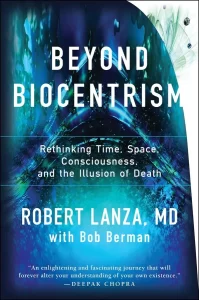
Is Consciousness Reality’s Organizing Principle? (Beyond Biocentrism, by Lanza and Berman)

Quantum mechanics is seriously weird. The majority of us have a model of the world based primarily on Newtonian physics. We believe in cause and effect. The universe is a giant machine following laws, and if there wasn’t a single conscious being in it, those laws would still be the same.

But in quantum mechanics particles like photons don’t exist as particles until observed. If a photon is given the choice of two paths, it takes both as a wave, but if measured and observed to see which path it took, it then takes only one.

The key point here is observed. If a measurement is in the past, the photon doesn’t choose which particle path it took until observed. (It may decohere, it doesn’t choose which way to decohere. Or that’s Lanza and Berman’s argument.)

Schrodinger’s cat is an attempt to scale this up to macro, and to show how absurd it is. “The cat is both alive and dead.” (It doesn’t really work, because the cat is conscious and observes.)

Lanza has written a series of books on Biocentrism, each more extreme than the last. Beyond Biocentrism is the third in the series.

Biocentrism takes the quantum physics at its face and tries to extend the consequences. It argues that nothing really exists except in potentiality (a range of possibilities) until it is observed by something that is conscious. This doesn’t have to mean a human, presumably any conscious being will do the job. Lanza discusses bird and fish and bats and dogs, all of whom observe the world differently than them, but I’d point out that evidence is coming in that at least some plants (almost certainly trees) are conscious. Perhaps single celled entities are, and we keep finding those in places like Mars and the subsurface oceans of moons and so on.

Lanza notes that the conditions for life, especially Earth life, are very specific. From atomic constants to the moon impacting the Earth in just the right way and winding up not orbiting the equator, nor destroying the Earth, the odds against a garden world like ours are astronomical. Even the odds of a universe existing which allowed for life in theory are astronomical.

Biocentrism resolves this by putting consciousness first. Concrete reality is formed by consciousness, so physical laws must confirm to what is required for life, since it is biological life which gives rise to consciousness. The odds go from astronomical, to “they had to support life, so they did.”

Lanza’s interpretations of the consequences of quantum mechanics or even of quantum mechanics itself aren’t always orthodox. For example, there’s a delayed choice experiment called the quantum eraser, in which finding out something in the future seems to change the past.

While delayed-choice experiments might seem to allow measurements made in the present to alter events that occurred in the past, this conclusion requires assuming a non-standard view of quantum mechanics. If a photon in flight is instead interpreted as being in a so-called “superposition of states“—that is, if it is allowed the potentiality of manifesting as a particle or wave, but during its time in flight is neither—then there is no causation paradox. This notion of superposition reflects the standard interpretation of quantum mechanics.

Lanza interprets this as “no the change actually occurs in the past and there is a causation “paradox”, though in biocentrism it’s not a paradox, since consciousness is primary.

I don’t claim to know who’s right about this. Hopefully an experiment will be devised which resolves the issues. But Lanza brings it up in part to rescue free choice.

As you may be aware, experiments show that by the time we become consciously aware of making a decision, the decision has already been made. Biologists can tell that we’ll do something before we believe we’ve made the decision. Since neural activity is fundamentally quantum, Lanza attempts to rescue free will by suggesting that the decision is indeed made when we believe we did, it’s just that it changes the past thru the act of observation.

Without something like this, we are, in fact, biological machines and free will is an illusion. Blaming or taking credit for anything you have ever done, or anything you are, is ludicrous. You are just a cause and effect machine and your idea that you’re in control of any of it is an illusion. (Why that illusion should exist is an interesting question.)

I don’t consider myself qualified to judge Lanza and Berman’s work on Biocentrism. It might be substantially right and it might not be. But I do think he makes a good case that the science (which he describes at great length, including having appendices with the math) doesn’t allow us to cling to Newtonian or even Einsteinian views of the universe or our place in it. Something weird is going on when consciousness is required to cause packet collapse. Indeed, he even includes one experiment where the effect was scaled up to macro, though still a very small macro.

The world is strange. Far stranger than the still reigning consensus “folk” models suggest, and while biocentrism may not be correct in all its details, it’s worth reading and considering, because it takes quantum mechanics weird results seriously and tries to reason from them, rather than around them in an attempt to preserve as much of the older systems as possible.

At the same time, we must always be wary. After all, post-Newton very few people outside of some religions would have argued against a clockwork universe, and it turned out that informed opinion was, well, wrong. (Which doesn’t mean God made the universe in 7 days or any such nonsense.)

Still, this is the cutting edge, and we know at the very least that it puts a few nails in the clockwork universe’s coffin and at least a couple into the relativistic universe. To ignore it, and to pretend that consciousness isn’t much more important than we thought it was is head in sand style thinking. And Lanza isn’t some quack. His interpretation may be unorthodox, but he understand the science.

I think this, or one of the other Biocentrism books is very worth reading. Even if you wind up not buying the whole package, you’ll be forced to rethink what you “know.”

***

If you’ve read this far, and you read a lot of this site’s articles, you might wish to Subscribe or donate. The site has over over 3,500 posts, and the site, and Ian, take money to run.

Hell Is What Humans Deserve

I don’t know how to explain this to readers, but I’m going to try.

If you want to live in a good world or good society, certain types of behaviour have to be off the table and the response to them has to be harsh and overwhelming.

Understand the next statement: Anyone who will take what they want from someone else just because they are stronger is a threat to you.

The moment you say “none of my business” when someone abuses their power, you have created the conditions for Hell.

This is why certain behaviours have to be opposed. Genocide. Rape. Torture. Elites making the price of medicine a thousand times the cost.

Now, in the Middle East, Israel wants Greater Israel. They haven’t been shy about it. All of their neighbours and even some of their non-neighbours are in danger if Israel expands and grows more powerful. All of them are in danger if Israel eliminates the near enemies: Syria, Hezbollah and the Palestinians because they will then be able to turn their full power and attention (and that of America) on new enemies with lebensraum.

This is so obvious I shouldn’t have to state it.

And Israel is a threat to America, too. They control your politics (no, don’t even) and make your rulers do things that are evil and against American interests, and certainly against the interests of the vast majority of actual Americans. Yeah, they aren’t genociding you, but as millions are homeless you’re spending billions on helping Israel commit genocide.

Israeli cops teach American cops how to brutalize Americans the way they brutalize Palestinians. Everything American elites are willing to do Palestinians they are willing to do to you if they ever decide it’s in their best interest. If you think they have the least fellow feeling for you you are so stupid I’m surprised you can keep breathing.

Hell is hell because evil is tolerated or even admired and suckers who do good are despised. Heaven is heaven because evil is not tolerated and people who do good are admired and emulated.

Update: Israel is now 20 miles from the northern border to Lebanon in Syria. But Syria falling is no big deal, honest.

SUBSCRIBE OR DONATE

Why Assisted Suicide Bills Will Proliferate & Deaths Will Increase

Nothing saves money on people who are old, disabled and unable to work like just killing them.

Covid killed mostly old people. That saved the government money in the long run, although in the short run it was expensive, except for Sweden where they just euthanized their old people with Covid instead of treating them. (Gave them opiods even when they had enough oxygen and drugs.)

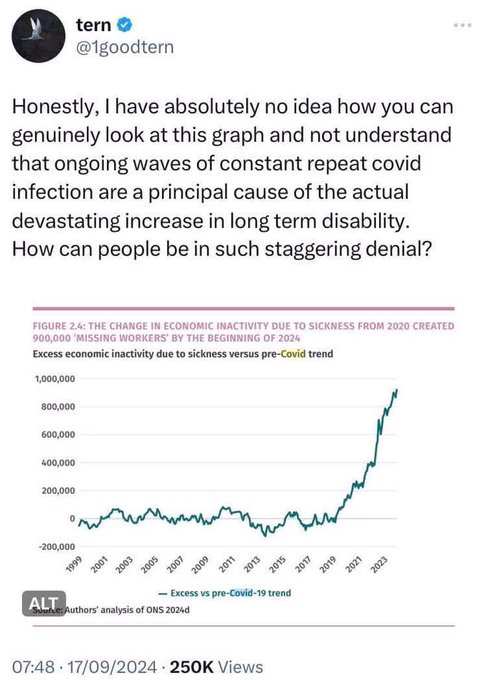
Since Covid, however, there’s been an unfortunate increase in people who can’t work because they’re chronically ill.

This isn’t hard to understand. Britain is massively importing young people who can work, or older people who have lots of money, but at the same time the number of people who are liabilities, financially speaking, is exploding. If you have a liability the easiest way to get rid of it is to… get rid of it.

Canada’s in the same boat, and these bills will spread.

Assisted suicide isn’t automatically a bad thing, mind you. If people were properly supported and cared for I’d support it. People who are in a ton of pain and won’t get better ought to have the option.

But when the government is whining about benefits and cutting them, as in Britain, one doesn’t expect this is being done from a humanitarian impulse. And the medical and social workers, in hospitals and palliative care centers that are overstretched and don’t have enough nurses or doctors or beds, well, convincing someone who’s taking up time or a bed to just die already will have to be pretty tempting, sometimes even with somewhat good motives: to free up resources for people who can be cared for.

But, of course, what will often happen is that chronically ill people or homeless types who could live for quite a long time and with proper care could be fairly happy will wind up dead because in Britain and Canada we don’t help them enough: to get enough housing, food, help and pain meds (given the way we’re so scared of opiates.)

Wikipedia lists some known cases of abuse of the law:

  • In 2017, a mother of a young woman with cerebral palsy was told by a doctor that not applying for MAID was “selfish”. Her daughter was in the room when the conversation took place and described the experience as traumatic.[71]
  • In 2018, Roger Foley was being treated for cerebellar ataxia at an Ontario hospital. Foley alleged that his only options were to be forcibly discharged from the hospital and then treated by an organization that had previously failed to provide him adequate care or apply for MAID. Foley hired a lawyer for a charter challenge.[72]
  • In 2019, Alan Nichols successfully applied for MAID while being hospitalized for suicide ideation. The reason given on his application was hearing loss.[1]
  • In September 2021, Rosina Kamis, a 41-year-old Malaysian woman, applied for MAID citing fibromyalgia as the reason. However, in conversations and recordings shared with friends, she mentioned financial hardship and social isolation as additional factors influencing her decision.[73]
  • In February 2022, an anonymous Torontonian suffering from extreme chemical sensitivity syndrome with the pseudonym Sophia had a medically assisted death after failing to find affordable housing that was free from tobacco smoke and other chemicals.[74] This case was addressed by her health care provider in testimony provided to the Special Joint Committee on MAID, and was referenced in their final report.[75]

One can safely assume there are many, many more. The fact is that even doctors and social workers think some lives are worth more than others. No one who’s spent time in the medical system believes otherwise.

The West is in decline. Our elites are wedded to austerity as a “solution”. They often, probably usually, feel that people who are non-productive are useless eaters and a burden on the state.

That combination is going to lead to a truly vast expansion of measures intended to get people off benefit rolls.

In a way assisted suicide, or euthanasia, is the most honest of those policies and maybe even the most merciful. There’s nothing honest about deliberate policies which make people homeless, leading to most of their deaths, after all. Politicians know that winding up on the street long term is essentially a death sentence, they know that policies like mass immigration without increasing the housing supply to match will cause homelessness, so they know their policies cause homelessness and death but they can pretend it’s an unintended side effect.

Just killing people is at least not hypocritical.

***

Close to the end of the annual fundraiser, which has been weaker than normal despite increased traffic. Given how much I write about the economy, I understand, but if you can afford it and value my writing, I’d appreciate it if you subscribe or donate.

All We Have Is Each Other

Of all that I have learned, the most important lesson was how much a human can suffer. When I was twenty five I wound up in the hospital for three months. I spent days screaming, in so much pain that morphine couldn’t handle it. For about a month I couldn’t move enough to even pull myself up in bed without crippling agony. Later my  body decided that every foreign substance was an enemy, and when I was given IV antibiotics, every four hours, I’d spend the next twenty minutes dry heaving, since I couldn’t eat or drink and had nothing to bring up.

It turned out I was one of those people who get psychotic episodes from high doses of steroids. One episode was so bad, prior to hospitalization, that I promised myself I’d commit suicide if it didn’t end in twelve hours.

Strangely, as much physical pain as I experienced, the bad psychotic episodes were worse.

After I got out, I had about a period of about a year where I’d wake up every morning with the muscles in my lower back extraordinarily tight, and the least movement would make them seize up: both painful and crippling. I once ate breakfast at a restaurant standing up because I knew if I sat down I wouldn’t be able to get back up. Another time fire fighters had to break down my door and take me to the hospital: I couldn’t get out of bed.

It took me years to recover, and the recovery was never complete. I never regained the easy athleticism of my teens and early twenties: I had been a serious runner and a gymnast, and I loved both and I never got that back.

This isn’t primarily “woe me.” It was terrible, but others have had it worse, though I certainly had my bouts of self-pity.

What I learned was that the human capacity to suffer is damn near endless. It’s way beyond anything which could be considered “useful for survival” since at a certain point it becomes crippling.

I also learned, not only from my own experiences, but from watching others, that it has nothing to do with “deserve.” The worst people in the world often have really good lives. Kissinger is a good example, but there are many, many others.

The human body and mind are capable of experiencing Hell for very long periods. The same, I am sure, is true of animal bodies and there’s evidence coming in this is probably true of many plants, including trees.

This isn’t to deny that life can be good or even great. I’ve experienced some of that end of experience as well: both physically when a young athlete and in the past ten years as a result of meditation and cultivation.

And I’ve been in love and that was marvelous.

But, bottom line, life can be Hell and most of us will experience it at some point in our lives. No one deserves the worst suffering: I wouldn’t inflict on Hitler the worst of what I’ve gone thru, and suffering appears to make people worse, not better, somewhat more often than it ennobles them. Suffering can lead good places, but it isn’t necessary, and the worst suffering is largely pointless.

In all of this all we have is each other. We can decide to be predators, to prey on those who are suffering or weak and to not give a damn. We can rape and torture and steal from the weak. We can hoard resources so that those who need them most don’t have them, and enjoy the luxuries and pleasures of wealth.

Or we can decide to be kind and to look after each other. At least when I was sick and in hospital I had free health care and doctors and nurses and orderlies who were trying to help. (Had one who was trying to hurt, too, but he was a minority of one.)

There is so much suffering in the world, and so much hoarded wealth and deliberate cruelty. So many humans, especially powerful humans, making the suffering worse or hoarding and accumulating wealth which could help others.

And beyond alleviating suffering, we could help each other be happy and joyous.

No one is going to help us but us. The route out of Hell, the route to making Earth less hellish, not just for us but for the others who are also here, is simple kindness at scale. Only we can make life worth living: not just alleviate suffering but make it fun and great for each other.

Alone we are weak, together we are immensely strong. We can decide to use that strength in service to each other, to make the world so much less a Hell and so much more a Heaven.

And really, that’s my only wish for us.


My writing happens because readers donate or subscribe. If you value that writing, and you can afford to, please support it.

Construction of Reality Preview: The Ritual Masters

Continuing from Interaction Ritual

Rituals can fail. The Christmas party where everyone is awkward and not enjoying themselves. The sermon and hymns that are just so plain boring so that you can hardly wait to leave. The concert where no one is dancing. (x-Collins)

Putting on a successful ritual is a skill. Being good at it takes practice in moving the participants’ attention where it should be, in encouraging emotional focus and in physical entrainment. The surroundings should be suitable, the central symbol should be framed, costumes may be needed, and on and on.

We have a lot of standardized rituals: the wake for the dead, the marriage and the trial, among others. Watch a trial, the judge dressed in formal robes, and depending on the country, perhaps wearing a white wig. Always deferred to, always addressed as “Your Honor” or “Your Lordship”. The accused sits in a specified place, witnesses in another and so on.

This is high ritual.

The person who is the center of a ritual, who conducts a ritual, if it succeeds, gains stature and energy. Look at the way rock stars are treated for a concrete example. Money, fame, glory, and all the sex they want.

There is a certain divinity associated with big enough, successful enough rituals. Whatever the symbol, the person who conducts the ritual will also become a symbol and will take on some of the power and mystery of the rite.

Who performs rites and what their role in the rite is, thus, is central to how society is organized and to our personal perception of reality. By associating ourselves with various parts of the rites, we then create who we are: how others see us, and how we see ourselves.

Rites allow us to change stories.

Consider the God King. Ubiquitous in later ancient Mesopotamia and in ancient Egypt.

Think of our early religion and ideology. There is a God or Gods, who created all. There are ancestors we are descended from, and those ancestors created our way of doing things: our civilization.

The Divine created everything, and everything good comes from the divine. Our greatest respect is reserved for the divine, with lesser but still great respect granted to our ancestors. To the divine and to our ancestors we owe everything. No human is important in comparison (x-Flannery/Marcus).

This is a story which mitigates hard against inequality and against anyone becoming too powerful. Someone may be a good hunter, but the good things do not come from them, but from God. And however good a hunter they are, they are nothing compared to the ancestor who created hunting.

This question, where do the good things come from, is essential to the structure of every society.

If the good things come from you, then you should be treated with reverence, and since they come from you, they are essentially yours.

Consider the ritual of the Aranda in the previous chapter, where older men dressed as revered ancestors.

Imagine, now, dressing as a God. Playing that role in a successful ritual. The attention is on you, you are associated with the God, and it is from the God that all the good things come.

It takes many steps to get from egalitarian hunter-gatherers to God Kings, but this is the social logic by which it happens: rituals which associate you with a God, and a story that it is from Gods that all the good things come.

Lest you smile condescendingly and think we are beyond all this, I invite you to consider the concept of the “job creator”. A job creator is someone who hires people. In our society, for almost everyone, all good things come from jobs. A job creator is thus the person from whom all good things come. It would be wrong to tax such a person highly, or to burden them with legislation, because they are the source of the good. Not coincidentally, our taxation of the rich and on corporations it at multi-generational lows.

This wasn’t always the story, in the post-war liberal period the consumer was where all good things came from, and businessmen were just meeting public demand. And the consumer was able to spend because the government had fixed an economy private industry had trashed during the Great Depression. All hail the consumer, and the government which makes sure the economy works. And all hail top marginal tax rates of eighty to ninety percent.

Stories matter, and so does your ritual position. Rituals put you in a place in the story, and the story, if it is widely accepted, then works for you.

Note that the story has an element of truth, even if that truth is socially constructed. All good things do come from a God King: the Pharoah owned everything. God Kings had wealth and power and could give good things to people. Billionaires and big corporations really do decide, directly and indirectly thru the small companies which would not exist without them, who gets many of the good jobs.

These are self-reinforcing stories.

It is not hard to extend this analysis to today’s press, with their fawning coverage of CEOs and executives; of the stock market and so on. The beautiful people bow to the powerful people in powerfully choreographed images, and we too see them as powerful.

Certainly there is more to it, wealth and military prowess and so on, but all of those rest on people believing they should obey your orders and that you should have way more stuff than anyone else. During the Great Depression Americans decided that the rich, whom they blamed for destroying the economy, didn’t deserve so much stuff, and they instituted punitive taxes.

In the Great Depression it was clear that “the good stuff” didn’t come from the rich and corporations, because they’d been substantially in charge, and buggered it up. And who helped? Government.

So, when Reagan moved to decisively end the post-War liberal era, he said “The most terrifying words in the English language are: ‘I’m from the government and I’m here to help.'”

Reagan had a story about where the good things came from, and how to get them. And that leads us to our next topic: the storytellers and the ideologues.


You get what you support. If you like my writing, please SUBSCRIBE OR DONATE

Page 1 of 7

Powered by WordPress & Theme by Anders Norén