The horizon is not so far as we can see, but as far as we can imagine

Category: Trade Page 1 of 15

Shockwaves From The Second Iranian American War

Some of the issues from the Iranian war are obvious: everyone’s talking about oil and natural gas, for example. Many have mentioned fertilizer. But I think it’s worth going into in a bit more depth.

First is that in addition to gasoline, oil is used to make bunker fuel (98% of freighters and tankers), jet fuel, and diesel (heavy machinery, large trucks.) The prices for all three are rising faster than gasoline prices and there will be a worldwide shortage. Production of semiconductors, phones and so on will shut down some time after that, depending on how the small reserves available are shared out. Taiwan is particularly vulnerable and production can be expected shut down in a couple weeks.

The chart below is from six days ago:

Don’t take the above chart too seriously, I’ve heard different numbers from different sources, and the type of oil in reserve matters a LOT.

This will, of course, hit the AI Bros hard. They have significant stockpiles of some of what they need, but not everything. Worried about that data center coming to where you live? If you’re lucky, Iran has just saved you from an AI driven spike in your energy prices, but not an oil shortage spike!

Airlines are already reducing flights. Expect prices for travel to spike significantly. If you don’t already have tickets for a trip get them now. Even so, it wouldn’t surprise me if many already booked flights are cancelled without recourse, citing forece majeur. Diesel and bunker oil shortages will mean supply line disruptions, and primary processing disruptions. Fertilizer shortages are already changing planting decisions, farmers in Australia are planning on planting much less wheat, for example.

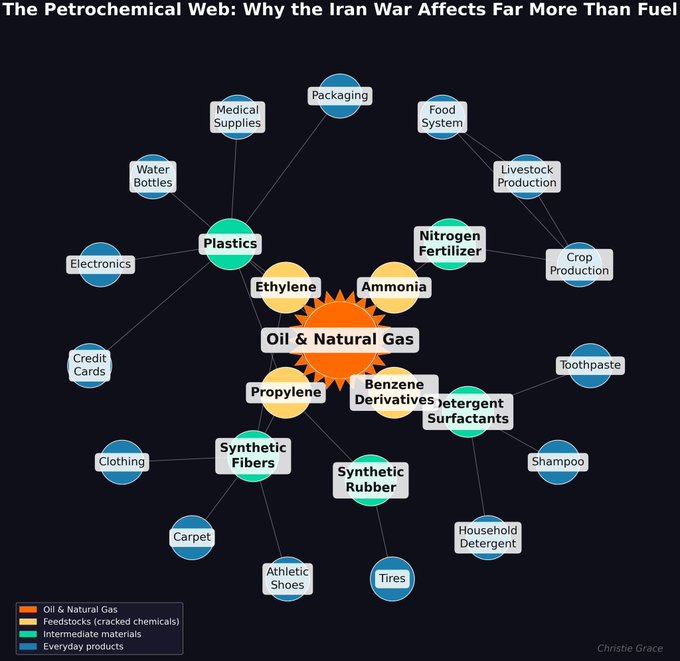
Oil goes into a lot of things. Here are a couple of graphics showing some of them:

And,

To oversimplify, pretty much everything has some oil in it. For example I’m stocking up on NSAIDs and Tylenol 2s (legal in Canada.) I saw one person saying they went out and bought about a year’s supply of pretty much everything which can be stored. One side benefit may be that insane levels of plastic packaging might, at least, be reduced.

China’s bunkering up. No refined oil products are being allowed for export. Fortunately for China, they, unlike apparently almost every other nation in the world, are not run by retards, so they have massive petroleum reserves and they bought about 50% of the world’s grain production for the last four years and stored much of it. But this goes far beyond petrochem: they produce, for example, almost all of the world’s tungsten, and no more exports of that.

Stockpiles in the the West are essentially at zero, right now, and yes, most advanced weapons cannot be made without Tungsten.

There’s been a crash in silver prices recently. You may have read about it. But here’s the thing, there’s an actual physical shortage of it because it’s used in essentially all electronics, including semiconductors and even more importantly, solar panels. Everyone’s going to want solar panels now.

China, not being fools, are no longer allowing export of silver because they know it’s the physical shortage that matters, not the paper price on paper exchanges where delivery isn’t expected to happen.

I spent years railing that just-in-time logistics was sheer fucking insanity and should be outlawed. In addition every country who isn’t a net producer should have at least year’s stockpile of fuel and even net producers should have three years of food stored (because things like droughts and fertilizer shortages happen.) Medication and key medical goods should also be stockpiled. A lot of people are going to suffer and die when key drugs hit shortage and many cancer drugs, for example, are produced in India and on top of the factories not being able to operate without energy, many drugs use petrochemical derivatives directly.

This war should never have happened. Even if it ended now there would be serious shortages for about four to five months, and it would be three to four years before full production could be resumed, if it can be. (Shutting down oil and gas well production often damages the underlying fields.)

Oh, and which major nations will suffer the least? Russia and China. It is to laugh.

I know this is the second article on this subject in a few days, but the impacts of the war are important for you to understand.

Everyone reads these article for free, but the site and Ian take money to run. If you value the writing here and can, please subscribe or donate.

How Dependent Is Canada On The US?

This “issue” has flaired up again as Trump attacks Canada again.

The short answer is that in the short term Canada is moderately dependent on the US and the long term it is hardly dependent on America at all.

Right now we (Canada) have a lot of trade with the US. We buy mostly finished goods, and pay fees to American tech and copyright holders. The US buys oil (which it cannot easily substitute away from in the short term). The US buys cars from us (#2, but deceptive, since they’re made by US companies in Canada), a small amount of machinery like nuclear power equipment, and a grab bag of other industrial goods. We also sell Potash (about 80% of what the US needs) and aluminum to the US, for which there is no easy substitute: these things are in global shortage, and the best alternative for potash is Russia and despite various bullshit about American/Russian alliances, Russia doesn’t trust the US at all and would not be a reliable trade partner. Without potash American farmers are screwed, since it’s used for fertilizer. America can’t significantly improve domestic potash production, there isn’t enough in America.

There’s substantially nothing we buy from the US that we can’t get from China for less or Europe for a bit more. And what the US sells Canada is high value add goods, not resources. We’re a valuable customer.

And, at the brass tacks level, if all trade stopped tomorrow, Canada could feed itself and would have plenty of energy. Our houses would stay hot in the winter and cool in the summer, our trucks would have gasoline and diesel, our trains would run and our planes would fly.

Canadian dependence on America is about 80 to 90% a legacy issue. We currently do a lot of trade with America, but we don’t have to. We can sell manufactured goods to Europe, and resources to China and buy from China and Europe and various other nations. Nothing we get from the US is a “must have with no feasible replacement.”

So the game is very much along the lines of the old joke about saying nice things to a barking dog while you find a rock. Not that we will ever fight the US unless they invade, but we just need time to disentangle our economies and move to reliable trade partners.

America could hurt us a lot if they cut of trade, but it wouldn’t be a mortal blow and we would recover. We’d prefer to do it slow, but if we have to do it on an emergency basis it can be done.

Canada doesn’t need the US. It just needs some time to change trade partners, and that’s what Carney is doing, because as he has said, it no longer makes sense to do business with the US.

We’ll talk a bit more about trade with the US from a global perspective soon, but basically the US has a legacy trade position: no one needs to buy from it any more unless they’re stupid (Europe refusing to buy Russian gas). Selling to it is still necessary for many nations, but that will become less true over time.

America’s prosperity and power are both legacies, they have no solid foundation to stand on any more. Ironically Canada is in a better position in the middle to long term than America simply because it only has 40 million people and is a continent sized country with a continent’s worth or resources. The only significant danger is an American invasion.

This site is only viable due to reader donations. If you value it and can, please subscribe or donate.

Just How High Can Silver Really Go?

~by Sean Paul Kelley

Everyone is talking about gold topping $5k an ounce. The yellow metal is captivating and big moves by it tend to suck all the oxygen out of the media space regarding other metals. In 2025 gold rose a whopping 64% against all comers, i.e the dollar, the S&P 500, oil, Bitcoin and on and on.

Gold’s meteoric rise last year is a fucking piker compared to what silver did. Silver was the best performing asset of 2025 rising an astonishing 147%. Yeah you read that right. 147% from January 1, 2025 to December 31, 2025. This raises some important questions, such as why did silver, after decades of disappointing performance, blow past every asset this planet has to offer and consequently how high can it go? Does silver have a ceiling?

So, questions asked, let’s now examine the known and/or knowable variables affecting silver prices at present.

First, what’s silver’s all time inflation adjusted high? This depends on who you ask and how you measure inflation. By our current CPI measurement silver’s all time, inflation adjusted high was roughly $150 an ounce. This was in February 1980 when the Hunt Brother’s tried to corner the silver market. Now, as most of you know, Ian and I both distrust current inflation measures, like the CPI, because it overweights consumer goods with stable or falling prices, using accounting legerdemain like hedonic pricing which equates increasing computer chip power and/or efficiency as disinflationary. At the same time the CPI underweights prices of goods that are rising, like food and other non-durables.

Seriously, I defy anyone to tell me food prices are stable or falling: you can’t do it. The CPI does this primarily to avoid COLA adjustments on entitlements, cheating retirees.

Other measures of inflation, indices, weighting using purchasing power parity or other yardsticks, delivers an all time silver high closer to $190. So, I’m going to channel King Solomon and split the baby in half and call the all time high at $170. But however you measure inflation it’s clear silver isn’t even close to its 1980 Hunt Brother’s high.

Second, price moves in gold and silver are not coupled and have not been for at least 150 years. They don’t correlate. Gold is considered a safe-haven against fiat currency hyper-inflation or economic collapse. Silver, on the other hand, is essential to modern electronic manufacturing. So gold had a nice run last year, but silver was number one by a very, very wide margin, outperforming gold, the way Shohei Ohtani outclasses everyone else on a baseball diamond. Even as silver and gold have been decoupled since the late 19th century evidence is mounting that last year’s silver move might have been the opening act of their long awaited re-coupling.

Perhaps a précis on how and why they decoupled and what a re-coupling would look like is in order.

The first question is to ask, “how long were gold and silver coupled?” Well, from ancient times—yes, fucking Greeks and Romans ancient times—until the 19th century silver and gold traded at a 15:1 ratio.

Don’t believe me?

Consider then how the 1792 US Coinage Act established a 15:1 ratio between the two in our newly constituted republic. That said, during the next century—the 19th—a handful of rare developments coalesced to break the two thousand year old linkage between the two royal metals, thereby widening the ratio nearly exponentially.

First, the gold standard for measuring currency values between nations was established. It soon became the, well, gold standard for all international trade.

Second, the conventional wisdom prophesied the end of America’s silver boom—never mind that the aggregate value of silver mined in Arizona and Nevada had a notional dollar value greater than the California, Yukon, Deadwood, Montana and Alaska gold rushes combined. Gold’s price during the 19th century, due in large part by its merciless acquisition by European banks, blew out the ratio, decoupling the two metals for a century and a half. The ratio between the newly decoupled metals had widened from 15:1 to 50:1 by the turn of the 20th century. By the turn of the 21st the gap was nearly 100:1, in large part due to US government manipulation of silver prices. The US government sheltered a rentiers market in silver bullion for decades. Wholesalers got silver at spot prices. They then charged retail buyers high premiums and pocketed the sizable difference. This cozy arrangement, due to silver’s recent price moves is breaking down, and fast. Good I say.

That said, I argue, based on a reasonable man’s assumption, that the spread, now roughly 50:1, will continue narrowing and sometime in the next few years complete a reversion to its 2,000 year historical mean. That puts a potential price of an ounce of silver at $320 an ounce and might even overshoot a little bit, as reversions are wont to do at times. Overcorrections are a real thing. Hitting the Hunt Brother’s high of $170 an ounce is just a mental milestone, nothing more. The silver bugs are getting their revenge and how.

Now, my assumption is based on a single premise, a reversion to the mean/norm. Not a bad premise to base an assumption on, but not enough for intellectual coherence and honesty. So, let’s explore another variable: silver’s supply versus demand forecast.

What is the global supply versus demand picture like? In short, extremely unbalanced. The numbers are staggering. Aggregate global demand per year is 1.3 billion ounces. Annual global mining supply maxes out at roughly 850 million ounces. Let’s be generous and toss in recycling raising global supply to 1 billion ounces of silver a year available for industrial purposes.

The maths paints a grim supply picture: a whopping 23% gap between supply and demand. Because silver is the single most important industrial metal—it is in every electronic we own— demand is not going down any time soon. A single tomahawk missile requires 500 ounces of .999 grade silver. Yes, 500 ounces. See where I’m headed with this demand equation?

Why is it in everything? It’s the goldilocks of metals. Silver might not be as conductive as some but it’s less resistant than most. It doesn’t overheat like some and burn through plastic coating, but its best left exposed and uninsulated. It’s place in the bell curve of the electrical performance of all metals is right before the big bulge grows. Most of the time we want things good and fast. In reality, however, we must choose between good or fast, but silver? Well, silver gives you good and fast together. Goldilocks!
One big variable exists concerning global silver supply that has no easy short or even medium term fix. It’s physically impossible for global mining companies to ramp up mining production enough to even begin closing a 23% gap between supply and demand in any time frame less than 2-3 years. And this assumes no economic growth leading to increased global demand. That is some wicked nasty inelastic demand for silver and it has zero supply side answers, except very high prices that lead to retail silver owners cashing out. Central banks would have to print precisely three metric shit-tons of fiat currency to induce silver bugs to sell. I know some of them—they make rabid dogs seem like puppies—and they are adamant: no selling until the ratio reverts to 15:1. Until they get their ring there will be no huggy or kissy.

Another fundamental we ought mention are draconian export controls on bullion instituted by the Chinese central government. Note: China is the world’s leading consumer of industrial silver. It also has an extremely long and complex history using silver as its monetary base. Much, much less so with gold. If you want a book recommendation on the subject just ask.

Then there is our southern neighbor, Mexico, our number one supplier of silver to this day, is considering retaliatory tariffs on silver for United States because of Trumpian fuckery. Much fuckery there and I applaud Mexico’s president for sticking to her guns.

Consider as well dollar weakness and potential QE. Both point directly towards higher silver prices. Add to all this a wildcard fundamental hiding in plain sight: the magic price point that compels the addition of physical silver to the portfolios of Central, Commercial and Investment Banks around the globe. It’s a simple equation: storage costs fall as prices rise. At $40 an ounce there is no reason to hold silver in a vault. At $170? We’re getting close. At $300? Bingo! You’re goddamned right there is a reason. Such a development would spike demand by an order of magnitude as it would reinforce the powerful upward trend already in place. This is the dynamic that could at long last force the reversion of the gold to silver ratio back towards 15:1. Gold’s present price of $5000 an ounce implies a target of $333 per ounce of silver. In my opinion, and this is not investment advice, this is where we are heading. Right now. It may take 18-24 months, but it’s going to happen.

These are just some of the fundamentals. I can’t cover them all. If you think I missed an important one, add it in the comments, please.

Let’s talk about some technicals followed by sentiment.

Late in 2025 silver achieved a triple top breakout. Triple top breakouts are very rare in any asset. But when they occur they are an extremely bullish signal, conveying that there is no predictable upper limit to the assets potential advance. This is silver today. Silver hit $50 in October, backed down to the low $40s, made another run in November to try and overcome $50 and didn’t make it. But then in late November and all of December during the Santa Claus Rally silver blew through $50 and ended the year at $72.05. Market observers I respect, all unsure but all equally intuitive, explained the triple top breakout as the result of a handful of factors coalescing in the short term, such as Chinese export control tightening, high retail demand, Mexico threatening tariffs on silver, and a short squeeze on the Comex. This confluence makes sense to me.

The underlying technicals that lead to triple top breakouts are usually either a short squeeze or a gamma squeeze. In late 2025 silver underwent a short squeeze. But in early 2026 led by a bank frenzy to cover what were in essence some very large naked shorts in the SLV and PSLV ETFs, coupled by a bizarre change in margin requirements—from a straight percentage to one based on the notional value of the contracts (I mean, WTF?)—backfired spectacularly, leading to the rarest of rare technical developments, one I’ve only seen once in my life as an investor—the mythical unicorn, the gamma squeeze.

In short, a gamma squeeze “is a rapid [asset] price surge from [futures] trading, where heavy retail (read: investment banks, spk) call buying forces market makers to buy shares to hedge risk, creating a feedback loop that pushes the price even higher.” A gamma squeeze can be viewed as one powerful force intent on creating and sustaining an upwardly positive feedback loop “[where the] cycle escalates because as the [asset] price rises, market makers must buy more [futures or the hard asset] to cover their increasing delta risk, driving prices up further and attracting more call buying, often in low-float, i.e. low-volume [assets].” Silver is now, for all intents and purposes, in a virtuous rising feedback loop, leading to higher prices which force more buying to cover expected demand thus leading to higher prices. When it comes to shorting a gamma squeeze FAFO. You will lose your ass.

These developments all serve to reinforce my call late last year that silver is not on a cyclical bull run. It is engaged in a secular bull stampede.

Cyclical trends last between 3-5 years, represent basic price discovery and a market composed of two healthy opposing forces: supply and demand. Cyclical bull or bear runs tend to predict the business cycle as well, serving as a leading economic indicator.

Secular trends, however, are a different animal altogether. Like Earl Campbell, that human rhinoceros, running over middle linebackers like they were children, a secular bull or bear is powerful, based on large scale structural economic rearrangements, demographic realignments, and/or crushing but ‘unforeseeable’ externalities—like the Arab Oil Embargo of the 1970s or losing wars like Vietnam, Iraq, and Afghanistan——that leave robust long-term consequences, like inflation, busted supply chains, broken armies, revanchist politicians, rising internal violence and other variables, in their wake. Secular bulls or bears last decades, some as long as 40 years.

Now a word on sentiment. Sentiment is a fickle bitch, much like the muse. Nothing can bankrupt an investor with more rapidity and totality than a sudden turn in sentiment. Two forces, ultimately rule investing: fear and greed. Beware the latter and respect the former, said my mentor at Morgan Stanley.

Right now silver is flying under the radar. Everyone is talking about gold. It’s gold, why the hell not? Gold makes people febrile. I’ve literally seen it with my own eyes. I’ve felt my forehead warm up and my fingers get a sudden subtle itch when I’ve held certain gold coins in my life. I had a Julius Caesar gold aureus in the palm of my hand once. Wow! So I get why silver remains the red headed step-child of the metals market. And the lack of commentary on silver reinforces my conviction of silver’s inevitable rise to $250-$300. As I used to say when I worked on Wall Street, “buy the rumor, sell the news.”

It worked every time. And right now silver is hardly a whisper much less a rumor.

So, realistically at what price would I begin selling my silver?

$275-$300 an ounce.

I’m patient.

And certain.

How To Drive Domestic Production and Reindustrialization

There’s a lot of confusion over this topic, so let’s break down some of the factors.

The principle is that you need someone to buy whatever it is you want to produce. That means it has to be priced reasonably, and that you either have to have foreign or domestic consumers.

It’s often noted that before the British conquest of India, India had more textile factories than Britain. Britain destroyed them. Why? Because they wanted them to buy textiles made in Britain. Before that, the most important government action to create industry in Britain is that they forbid the export of wool to the Low Countries. Why? Because Flemish weavers were way better than British ones. But it doesn’t matter how good your weavers are if they don’t have wool. So the Brits kept the wool at home and pretty soon they had a textile industry. When cotton and mechanized looms came along they wound up selling the world. After all, there wasn’t any competition from India!

Imperialism, trade policy and technological advances for the Industrial Revolution win.

So if you’re a country which wants domestic production you need customers. Demand. It can be domestic or international. Now in traditional industrialization you need foreign customers usually, because your country is poor before industrializing. Almost everyone did it this way except Russia. America was a partial exception, having strong domestic markets and legacy tech inherited from British North America, but only a partial one: they sold a lot to Britain and Europe in the early years.

You also need the technology, and you get a lot of that from overseas unless you were Britain. This is true of pretty much everyone, including the US (which got huge investments from Britain), Japan (Britain first time, US for reindustrialization after WWII), South Korea (US), Taiwan (US), and China (US). Germany might be considered a partial exception in the 19th century, their industrialization story is startling and impressive (See “Cities and Civilization” by Peter Hall.)

But let’s say you’ve already industrialized once, and then partially re-industrialized. You have the remnants of a skilled workforce and you have good universities and technical institutes and a literate workforce. (Pushing it here, half of Americans are essentially illiterate.)

You’ve also got a fairly rich population and decent domestic demand, in global terms. In other words, there’s domestic demand sufficient to support more production than you’re doing. (How do you know? Well, all those imports indicate demand, don’t they?)

The problem is that foreign production is cheaper and quite likely better. (Remember those Flemish weavers.)

Now the first way to do it takes its cue from the Brits and wool. If you produce a lot of resources suitable for production, why are you selling them in the raw state?

There’s a few stages of this. If you’ve got oil, say, you could refine it in country before sending it overseas. In Canada it used to be illegal to ship raw fish overseas, but after NAFTA it got sent to the US to be stuck in tins or smoked or whatever. You shouldn’t be sending raw logs. You should refine bauxite into aluminum yourself. Copper into wires. Etc…

This only works if the current producers can’t just buy from someone else, but there are certainly still cases where this is true. (We’re about to experience very severe copper shortages, silver is already in shortage, and China has been using its control over rare earths like this.)

Tariffs come in when you want to make domestic production cheaper than overseas. If you’re just starting in an industry, it’s going to be. You can use tariffs (the US strategy during the 19th cnetury), you can force your currency lower than its market value (this is what China did) or you can use subsidies. Tariffs are under international agreement, essentially illegal, but Trump has made that a dead letter, so they’re possible again.

Tariffs are only useful, however, if you’re actually going to be increasing production. They do nothing if you aren’t. (Trump, pay attention.)

Now let’s talk about demand. If you need more demand for goods you need to increase the amount of money people can spend on whatever it is. There’s a number of ways to do that.

First is tax policy: tax poor and middle class people less and rich people more. Give them money, taken from the rich. Poor and middle class people spend most of their money on goods and services. Rich people, given more money, drive up asset prices. Note that this means income taxes. Get rid of general VAT taxes, you don’t want to tax consumption or in anything you want more demand create an exemption. You can also remove taxes on whatever it is you want people to buy.

Change other types of taxes to discourage short term trading, buying in secondary markets and future markets and encourage people with more money than they need to invest in production. High capital gains taxes on short term investments, for example. Tax rich people’s income highly, and send that to poor people or use it directly for investment thru the government. Tax corporation highly so they are encouraged to retain earnings and invest them. Get rid of stock buybacks, just make them illegal, like they were for much of the 20th century.

Second are any policies which drive up wages for the bottom 80% of the population generally.

Third are subsidies. Subsidize the cost of buying or manufacturing whatever it is. Europe, China and the US have all used this with electric vehicles.

Fourth are general market policies: you need competitive markets with few barriers to entry. You must make oligopolies and monopolies illegal and easy to break up or you must tightly regulate prices in monopolies. In general you don’t want any business to have pricing power, because if you give regular people money and business just jack up prices, demand doesn’t increase.

Fifth is breaking supply side bottlenecks. After the oil crises central bankers spent a lot of time deliberately putting downward pressure on wages because wage increases led to using more oil, all marginal oil increases had to come from OPEC and that meant inflation. So instead they pumped up asset prices like houses and stocks. If there’s something needed for production, you need to find a way to get enough for reasonable prices. Copper, coal, oil, silicon, rate earths, uranium… whatever. This may mean domestic production, it may mean trade deals, though domestic is better if feasible.

Sixth is that you have to reduce cost structures. Real estate, rent, interest rates, medical prices, and so on.These are costs: they make production more expensive and they soak up demand from regular people. If landlords can increase prices freely then, again, they’ll just take up any extra money that regular people get which would otherwise go to buying all those new products.

Seventh is making currency levels dependent on trade and not on financial flows. You want your currency low if you’re importing more than exporting, and high if you’re exporting more than importing BUT if you export a lot of resources, you need to find a way to reduce currency rates below what they’d normally be if you want manufacturing to increase. Doing all this means taming financial markets and making the central bank do what is necessary, which it often doesn’t want to, since it’s usually run by ex-bankers and traders.

Eighth is managing trade deals. It’s a lot easier to get a big enough market if you make a deal with another county or countries. “You produce X and we won’t. We’ll produce Y and you won’t, thus X and Y both have much larger markets. And we freeze other countries out of our market for these goods.” General free trade is usually stupid, managed free trade like this is smart.

Ninth is making your banks lend to producers at reasonable rates rather than lending to people whose actions will drive up asset prices instead.

This is a high level overview. Each point could support it’s own article, heck, it’s own book and I haven’t even hit all the high points.

But the point is that there’s a lot involved. Real policy is when a government tries to do something from all angles, not just one. You don’t just put on subsidies and hope for the best. You don’t just slap on tariffs and think “surely someone will start producing”. You have to actually use as many levers as possible to make it possible to produce: demand, supply, credit, market structure, smashing barriers to entry, avoiding pricing power and so on.

That doesn’t mean it can’t be done, that’s means you have to make it your main priority, the way it was for China for decades or for Japan for decades or for South Korea for decades. It doesn’t happen by accident, or if you only half-ass it. In fact half-assing it is likely to produce no noticeable results at all.

If Western countries want to reindustrialize, they can. But only if they decide they’ll do whatever it takes. Decline is baked in, resurgence takes effort.


This site is only viable due to reader donations. If you value it and can, please subscribe or donate.


Canadian LapDog Breaks For Exit After Trump Declares Dog Is On The Menu

Canada has cut a trade deal with China. This is what I have been suggesting for ages, and it’s finally happening. (Not, of course, because Carney reads me, but because it’s the obvious play and of all Western leaders he’s been the most resistant to Trump’s threats and blackmail.) Canada cuts a deal:

Chinese leader Xi Jinping and Canadian PM Mark Carney have announced lower tariffs, signalling a reset in their countries’ relationship after a key meeting in Beijing.

China is expected to lower levies on Canadian canola oil from 85% to 15% by 1 March, while Ottawa has agreed to tax Chinese electric vehicles at the most-favoured-nation rate, 6.1%, Carney told reporters…

In the deal struck on Friday, Canada will allow only 49,000 Chinese electric vehicles into the Canadian market at the 6.1% tariff rate.

The cap is in response to Canadian automakers’ fears of an influx of affordable Chinese EVs.

As well as relief for canola producers, there will also be reduced tariffs on Canadian lobsters, crabs, and peas.

I would expect that if the Chinese are willing to manufacture in Canada we’ll give on other things. The limit on autos is to get China to manufacture here. US manufacturers of automobiles are no longer reliable and Stellantis has started to pull out of Canada, there are no major “Canadian” manufacturers, so US manufacturers they must be replaced. The 100% tariff on EVs was to please the US (Trump can’t be pleased), and to protect Canadian jobs. Since those jobs are now at risk and almost certain to be lost, well…

The BBC says this move is in reaction to Trump’s on and off again tariffs, but that’s only half true. I keep noticing this in much of the media, they talk about tariffs and not about the annexation threats and both are a factor. You can’t have your primary trade partner be a nation which wants to invade you or break you up with covert actions and color revolutions. Then, of course, there’s Trump’s comments that the US doesn’t need anything from Canada. OK then, if you don’t need it, guess we’ll have to sell it to someone else, and since that has to go two ways, guess we’ll phase out buying American cars and buy Chinese instead.

This will break the ice for many nations. As I have argued for ages, even before Trump came to office, everyone needs to cut a deal with China because it’s the rising power. It’s already the most powerful nation in the world in many ways, and it will be in all ways that matter in less than ten years. Perhaps five.

But it’s also that you can make a deal with the Chinese. They keep their deals unless you cross very clear red lines like supporting Taiwanese independence. Even before Trump the US did not keep its deals. As a Canadian I’m aware that America just ignored trade rulings against it in favor of Canada even twenty years ago. America is simply untrustworthy, they don’t really believe they have to obey even rules they themselves have agreed to. Trump is “ignore inconvenient rules on steroids” but pretending he hasn’t just ramped up an already existing American characteristic would be delusional.

It’s also worth noting that this is, in the words of commenter Carborundum, “seismic”. Canada has been extremely hostile to China ever since Justin Trudeau was elected, including arresting the Huawei heiress for America, slapping on those 100% tariffs and multiple other incidents. We did this in order to keep America happy, calculating that we needed America more than China. (I never agreed, but I was in the minority). Under Justin Trudeau we were America’s second most faithful lapdog (no one can ever beat the UK when it comes to lick-spittle toadying.)

So this is, if not a 180 degree turn at least a 100 degree turn. Carney said all the usual bullshit about human rights and Hong Kong, but they were pro-forma. They won’t get in the way of a deal, and I suspect that public scoldings and statements along those lines will become much less frequent. The issues will be given a nod when some journalist asks about them and little more.

Canada was the first of America’s lapdogs to make a break for the exit after Trump decided dog was on the menu. We’ll see who goes next. Because when Carney said that this was preparation for the new world order (down, conspiracy types) he was right: the old world order is all but dead, and everyone has to re-orient away from the setting sun of America towards the rising sun, China.

This site is only viable due to reader donations. If you value it and can, please subscribe or donate.

Trade Is Not The Primary Driver of Currency Rates

The misunderstandings packed into this little bit of writing are stupendous:

Over the past few years, China has been in deflation, while the US has been in inflation. Yet despite this stark divergence, the CNH has still depreciated more than 10% against the US dollar. This combination — falling relative prices in China and a weaker currency — has made Chinese goods and services extraordinarily cheap in global terms. A vivid example: a night at the Four Seasons Beijing costs roughly $250, compared with more than $1,160 in New York

First, a 10% drop does not make a hotel room cost one quarter as much in Beijing as in New York. That’s ridiculous on the face. Almost everything costs less in China than in America. America has an economy optimized to drive prices high to extract maximum profit. China has economy with actual competitive markets: if you raise prices someone else will come in underneath you. Almost all of America is operating in or as if it is in an oligopoly. There is little actual price competition because even when there are competitors they figure that competing on price is stupid: it hurts both of them. Why not both raise prices to usurious heights? Win/Win.

This doesn’t happen in China because it has competitive markets and it has competitive markets in large part because China will throw executives in prison or execute them if they engage in this sort of price collusion, whereas in the US, though ostensibly illegal based on the laws on the book, such collusion has been made legal by decades of court decisions and prosecutorial decisions. (Prosecutors mostly don’t, and when they do courts almost always refuse to convict.)

China also has lots and lots of firms and genuine low barriers to entry. If you try to collude, someone from outside your industry will enter and undercut you, and often this will be someone with deep enough pockets that you can’t win a price war with them.

Second, currency values outside of hyperinflation are driven primarily by demand for currency. That isn’t primarily about trade, it’s about investors and financial carry trade. China unquestionably has a more dynamic and larger economy than any Western nation, but it isn’t financialized: Chinese companies don’t produce the sort of returns that American companies have over the last 50 years. This is deliberate policy: if they did, then China’s economy would suck for ordinary people, like Western economies suck for ordinary people because prices would be much higher. (See that Hilton room, though it cascades thru the entire economy, with rent and food at the low end much cheaper in China too.)

It is also pretty hard to invest in China as a foreigner, while the US is set up for foreign investors. Even if you want “China exposure” it’s hard to get.

So the Yuan isn’t in massive demand, because there aren’t bullshit over-sized returns like the AI bubble. The central bank doesn’t run its policies based on “the stock market must always go up.” America has spent 50 years burning down its real economy to produce outsize “profits” due to asset pumping. China keeps asset prices under control, and when a bubble does occur, as it did in real-estate, they deliberately deflate it, bearing the cost.

None of this is particularly unique, by the way. It’s basically the way the US economy was mostly run from the 30s thru the mid 70s or so. The policy details, the ways things are done are different, but American policies were meant to encourage real economic growth and if you look at a stock market graph you’ll see it traded sideways. No 50 year bull market. Asset bubbles were discouraged. You can’t have a good economy with high real-estate prices, just can’t be done and the stock market is a secondary market, not a primary one. Emphasizing it is sheerest insanity.

There is very little that China has done which is genuinely unique, despite jingoistic assertions otherwise. The playbook they have run is the same one almost every successful industrializing nation after Britain used, and very similar to the Japanese model. What is different are two things. First, the scale, when 1.4 billion people industrialize and modernize, it shakes the world. Second, a genuine desire to help the poor, which is extremely rare during industrialization, though not unheard of. (The Gilded Age did not care about the poor. Britain’s industrialization period was driven by hurting the poor as much, or more, than they could bear. They were far better off as peasants than in factories.)

Anyway, countries can be real rich (lots of genuine productive capacity with low prices and dynamic markets) or they can be fake-rich, with financialized markets that squeeze the last penny out of consumers and immiserate workers, leading to non-competitive markets and oligarchy. China is rich. America is fake-rich.


This site is only viable due to reader donations. If you value it and can, please subscribe or donate.

Yes, Canadians Did—Did Think America Was A Friend & Yes, Trump Is Good For Canada

These numbers are astounding:

36 per cent of Canadians currently view the United States as a friend, compared to 60 per cent at the end of 2020 and 89 per cent in 2013, and that 27 per cent of Canadians presently view the U.S. as an enemy, a number that stood at 11 per cent in 2020 and as low as one per cent in 2013.

Notice that 1% figure regarding the US as an enemy in 2013, and 60% viewing it as a friend as late as 2020. When I say I was a lone voice screaming that we couldn’t trust America, I’m not exaggerating by much.

My position was half “America has never been trustworthy to anyone, and it ignores NAFTA rulings and destroyed our aviation industry” and half “countries have interests not friends.”

The moment it wasn’t in America’s perceived interest to be friends, it wouldn’t be, and empires are always implicitly enemies of their vassals, seeing them as useful tools, not friends.

But I want to emphasize how grateful I am to to Trump. If he had played along, given the appearance of friendship while slowly screwing Canada over, the way most recent administrations have, Canada would have gone along with it. If the past 45 years have taught us anything, it should be that people will tolerate a slowly eroding situation for ages, the metaphorical frogs in the slowly heating pot. (Frogs aren’t actually that stupid, not being humans.)

Canada spent the 90s and 00’s making nice with China, then reversed on a dime under US pressure, arresting the daughter of Huawei’s CEO for America and slapping 100% tariffs on Chinese EVs.

Then came Trump with his talk of annexation and his lies about Fentanyl (the same lies being used against Venezuela, you’ll note. Trump is not very imaginative. One lie for all seasons.) The truth is that Canada is exactly the sort of trade partner that America should want: yes we have a surplus, but it’s because we sell oil and minerals to the US. In the far more important manufactured goods area, we’re net importers.

If we were to cut the US off from Canadian crude, multiple refineries would be shuttered and there wouldn’t be enough gasoline. (Ironically, Venezuela is the other big supplier of the sort of heavy crude these refineries are set up to use.) You don’t want it? You don’t have to buy it, it isn’t competing with US crude.

But lately Trump may have gone too far for even Canadian politicians, though to be fair, Canada has been far more resistant to tariff blackmail than almost any other country except China. Japan and the EU buckled far more easily.

Two important events: first Stellantis said it was going to move a factory to the US from Canada. Reshoring industry and all that. Canada and America’s auto industries have been integrated since World War II under the Auto Pact. This is why Canadian politicians were ready to hit China with that 100% EV tariff, they were protecting Canadian jobs since Chinese cars are half the price of American made ones.

Then, in response to Ontario Premier Rob Ford’s ad quoting Reagan as against tariffs, Trump slapped on another 10% tariff on Canadian goods, and stopped all trade talks.

Thank God for Trump. Canadian politicians want to capitulate, if they can get surrender terms that don’t amount to “you won’t be re-elected” and he keeps not letting them.

So word is that the Feds are considering ending the 100% tariff. Presumably the idea is to try for the same sort of deal Mexico got: assembly plants in Canada for Chinese EVs.

If we can’t have American car manufacturing jobs, why not Chinese? Bonus, happy consumers/voters when they can get better cars for half the price.

Trump just keeps giving, just not to anyone who voted for him who isn’t worth 7 figures. Canada should have been pivoting to China hard years ago, and now, thanks to Trump it may well happen.

I just hope that after Trump gets on his knees and begs Xi to let him off the China trade war hook, that he doesn’t let us off the hook and give Canadian pols a way to avoid the pivot.

All praise Trump. He’s a genocidal monster, has the attention span of a dementia patient and betrays anyone stupid enough to trust him who can’t afford to bribe him, but he may just save Canada yet.

We’re near the end of our fundraiser, and now about $1,500 out from our fundraising target. If you read regularly and value the site and have the money to spare, please consider subscribing or donating. Over 10k people read this site every day, and it’s free, but it and Ian do take money to run. Huge thanks to all who have given so far, a number which is now slightly over 100 people.

Palestine’s Last Hope

We’re about 3 weeks into our annual fundraiser. Our goal is $12,500 (same as last year). So far we’ve raised $9,010 from 79 people out of a readership of about 10,000. 

If you read this blog, you’re usually ahead of everyone else. You know, years in advance, much of what’s going to happen. The intelligence from this blog is better than what people pay $10,000/year for. Without donations and subscriptions, this blog isn’t viable. If you want to keep it, and you can afford to, please give. If you’re considering a large donation, consider making it matching. (ianatfdl-at-gmail-dot-com).

It is now over 20 years ago that I first wrote that Israel would either become a single, secular state, or it would ethnically cleanse or genocide the Palestinian. There were no other solution sets: the land is not actually large enough, nor does it have enough water to divide it into two states and in any case, it was obvious Israelis would never go for that.

Even at the time I figured genocide and ethnic cleansing was more likely, there’s a point where the depravity of a people becomes so pronounced (as it was for colonial North Americans) that no other solution is likely, given the means.

I don’t know how many of you have read bin Laden’s writings. (I don’t endorse him, but he was a smart man.) His fundamental point was that America must be defeated before various local evils, because America was propping them all up.

As retired IDF general Yitzak Brick said:

“All of our missiles, the ammunition, the precision-guided bombs, all the airplanes and bombs, it’s all from the U.S. The minute they turn off the tap, you can’t keep fighting. You have no capability. … Everyone understands that we can’t fight this war without the United States. Period.”

The only way the Palestinians don’t get genocided and ethnically cleansed out of Palestine (the ceasefire/peace will be temporary, and has been violated multiple times by Israel even as they ramp up attacks on the West Bank), is if Israel can’t. And the only way Israel can’t is its economy collapses and takes the country with it, possibly with its neighbours opportunistically jumping in.

Fortunately Trump, with his escalating trade war, is working on it.

First we have the rare-earth export controls from China. Most weapons need rare earths, the West is ten to twenty years from being able to produce enough (always bet the under on China, and over on the West), and China’s controls include any use of rare-earths for weapons. If Trump doesn’t make peace with China, on their terms, the weapon flow to Israel will slow to a trickle. (It will be even worse for Ukraine.)

But there’s far more that China could do. A cursory search shows that it controls the majority of production of the following:

  • Graphite. US is 100 import dependent. China controls 90% of the processing. Used in batteries, EVs, lubricants and steelmaking.
  • Gallium. China does 98% of this. and the US is 100% import reliant. A lot seems to come in from 3rd parties, but China could shut that down. Used for semiconductors, LEDs, solar panels and radar.
  • Solar panels and wafers are about 80% China manufactured. 95% for polysilicon wafers.
  • Lithium ion battery cells and packs. China has about 80% of the manufacturing, and these things go in everything, including almost all consumer electronics.
  • Refined graphite anodes. China produces 90% and you need them for Lithium-ionC batteries.
  • Consumer drones. (Important for agriculture and the parts often used for military drones.) China controls about 80% of production. More, I’d guess.
  • About 80% of generic drugs are produced in China.
  • Legacy semiconductors (28nm+). As Europe is finding out, since China will no longer let Nexperia import them, and auto assembly is having to shut down as a result, China controls a lot of the manufacture of these items. Taiwan, etc… have moved on, but these are used in consumer electronics and autos in vast quantities and mostly supplied by China.
  • High Capacity transformers and inverters. (Can’t transmit electricity without them, and China has at least 70% of the manufacturing, probably more.)

Imagine if China put export controls on all of this?

The US economy would collapse. Nothing of significance can be manufactured in the US or Europe without Chinese components. It’s that simple. China would take a big hit, but they can tank it if they have to.

And, almost overnight, Israel would be without its suppliers. Plus, of course, they are reliant on US subsidies, and America wouldn’t be able to afford them. Europe wouldn’t be able to make up the difference, even assuming they didn’t get hit hard too.

Now I don’t necessarily expect this, it’s not a prediction, but it’s the only route I see left for any sort of relief for Palestinians.  And if it does happen, I doubt Israel would survive.

It’s also worth running thru to understand just how precarious a position the West has put itself in with regard to China. More on that later.

Page 1 of 15

Powered by WordPress & Theme by Anders Norén